REVIEW 3 major objections 4 minor 1 cited by
Detuning the Floquet anomalous chiral spin liquid
T0 review · 3 major / 4 minor · reviewed 2026-08-03 · deepseek-v4-flash
Pith's one-line read This paper argues that the low-frequency 'Swap' chiral spin liquid and the high-frequency chiral spin liquid are distinct phases, separated by a resonance-dominated window in which the driven system likely heats, so no continuous interpolat
desk verdict A solid Floquet many-body study with a clean analytic core; the no-transition claim outruns the numerics, but the construction and diagnostics are worth a serious referee. read the letter →
The pith
A machine-rendered reading of the paper's core claim, the machinery that carries it, and where it could break.
The reading
What carries the argument
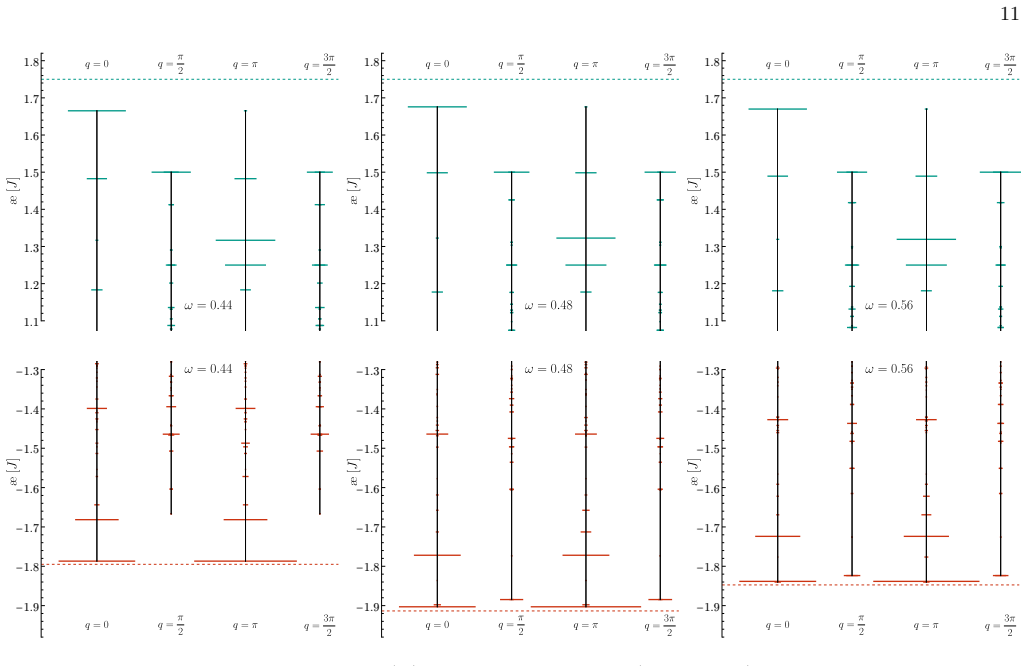
The central object is the four-step piecewise-constant XXZ drive that at tuned frequencies realizes a swap circuit on the square lattice; the Floquet unitary then factorizes into local swap gates in the bulk, while edges acquire nontrivial micromotion. The diagnostic that carries the detuning analysis is the average-energy spectrum, defined as æ_n = (1/T)∫₀ᵀ ⟨φ_n(t)|H(t)|φ_n(t)⟩ dt, together with the geometric Berry phase Φ_n = T(E_n − æ_n) mod 2π; these unfold the folded quasi-energy spectrum and expose resonances. The empirical bandwidth scaling W(δω) ≃ w_{p,q} L_geo N δω determines the crossover frequencies δω_fold and δω×, and the interpolating path J_ω(ω) links the low-frequency Swap po
What would settle it
Run exact time evolution from the anomalous ground state at a detuning inside the intermediate window and measure a local observable such as the edge spin current or energy density over many periods; if the observable shows no secular drift and the average-energy spectrum stays smooth on larger clusters, the claimed heating barrier and the absence of a continuous connection would be falsified.
Extended reading notes
Core claim
The central claim is that the anomalous CSL realized by low-frequency Swap drives and the dynamical CSL realized at high frequency belong to different phases, with no direct continuous transition along the interpolation the authors construct. Evidence comes from the average-energy spectrum and geometric Berry phases, which behave smoothly for small detuning, then become increasingly erratic in an intermediate frequency interval as the density of Floquet resonances proliferates, an effect interpreted as heating toward infinite temperature. At small detuning, edge modes remain visible in the dynamical structure factor and the anomalous winding number obtained from the Streda flux response stay
Load-bearing premise
The conclusion rests on treating the dense spectral resonances seen on a 16-site cluster as a thermodynamic-limit heating region and on the chosen interpolation path being representative; if a different path or a larger-system calculation connects the phases smoothly, the conclusion fails.
Editorial extensions
If this is right
- If the two phases are indeed disconnected, any adiabatic attempt to go from the anomalous to the ordinary CSL by raising frequency must pass through a resonance/heating region, not a conventional phase transition.
- Small detuning preserves the anomalous phase's fingerprints: chiral edge modes persist in the edge dynamical structure factor and the anomalous winding number from the Streda response remains quantized, so the phase is stable to weak frequency errors.
- The narrow intermediate folding regime provides a candidate prethermal anomalous CSL, meaning an experiment could observe anomalous edge transport for long but finite times before heating.
- On a cylinder, the stable detuning window shrinks as 1/N^{3/2} (versus 1/N on a torus), so in the thermodynamic limit the phase around the swap point is protected only in a prethermal sense.
- The high-frequency effective Hamiltonian reduces to the same chiral Heisenberg form as a sinusoidal drive, so the high-frequency part of the phase diagram is protocol-independent.
Reading between the lines
- Editorial inference: the no-transition conclusion is established only for the single interpolation path chosen by the authors; a different detuning protocol (for example, a different static coupling or a two-tone drive) could in principle thread between the phases while avoiding the chaotic window.
- Editorial inference: the heating interpretation could be tested directly by time-evolving local observables (energy density or edge spin current) over many periods; the intermediate regime would be genuinely prethermal if those observables stay close to their initial values for exponentially long times.
- Editorial inference: if resonance proliferation is generic in interacting Floquet systems, then interacting anomalous topological phases are fundamentally harder to connect to their high-frequency counterparts than non-interacting ones, where edge states can persist across the frequency domain.
- Editorial inference: the average-energy unfolding method could serve more broadly as a resonance detector for driven many-body systems whenever quasi-energy spectra fold.
Editorial analysis
A structured set of objections, weighed in public.
Referee Report
Summary. The paper constructs a family of four-step square-wave Floquet drives on the square lattice that, at tuned low frequencies, realize 'Swap' models with an anomalous chiral spin liquid (CSL) phase: the bulk one-period evolution is trivial while chiral edge modes persist. The authors study the fate of this phase upon detuning the frequency, using exact diagonalization (ED) on 4x4 tori, cylinders, and a 2x8 ribbon. They develop a first-order-in-detuning expansion of the Floquet Hamiltonian (Appendix B), obtain the average-energy spectrum and geometric Berry phases, extract edge modes spectroscopically, and compute the anomalous winding number via a Streda-like response. At high frequency they reproduce, for the square drive, the effective static chiral Hamiltonian previously derived for sinusoidal drives, confirming the dynamical CSL. Interpolating between the low- and high-frequency regimes along a single one-parameter path, they observe three regimes (unfolded finite-size, folded prethermal-like, and resonance-dominated) and conclude that the anomalous CSL is not continuously connected to the high-frequency CSL, with a possibly heating intermediate interval.
Significance. If the central claim is correct, this is an important result: it contrasts with non-interacting anomalous Floquet systems where chiral edge modes persist across frequencies, and it gives concrete evidence that in interacting many-body Floquet systems the low-frequency anomalous phase and the high-frequency effective static CSL are separated by a heating-like chaotic region. The paper's methodological strengths are substantial: the first-order detuning expansion of Appendix B is internally clean and verified against ED (Fig. 6); the single-spin-flip benchmark reproduces the known W_A=+1 anomalous winding number of Ref. [28] (Fig. 14); and the high-frequency square-drive spectrum matches the static chiral Hamiltonian (Fig. 21). These anchors make the paper a solid platform for studying frequency-driven transitions in interacting spin systems. However, as detailed below, the load-bearing claim of 'no continuous connection' rests on a single interpolation path and on finite-size spectral criteria, so the result is currently suggestive rather than established.
major comments (3)
- [Section IV B, Eq. (46)] The central no-transition conclusion is established only along the single ad hoc interpolation curve J_omega(omega) given by Eq. (46), which smoothly connects lambda_omega~2 at high frequency to J_omega=0 at omega=J/2. A different deformation through the (omega, J_omega, Delta) parameter space, e.g. keeping lambda_omega~2 for all omega while varying Delta, could plausibly avoid the chaotic interval while maintaining a finite quasi-energy gap. Moreover, in the S_z=0 sector the paper itself shows W_A=0 both at the Swap point (particle-hole symmetry) and in the high-frequency static limit (Section III D), so no quantized invariant is available to preclude a continuous path. The data therefore support 'no direct transition along this path', not 'no continuous connection' in general. Please either scan a multi-parameter family, identify a symmetry-breaking or topological obstruction, or consi
- [Section III B, Eq. (15)] Equation (15), W(delta omega) ~ w_{p,q} L_geo N delta omega, is measured on a single 16-site cluster and used to extrapolate the thermodynamic fate of the three regimes: delta_omega_fold ~ 1/N on a torus and ~ 1/N^{3/2} on a cylinder (Eq. (16) and following text). No finite-size scaling across multiple cluster sizes is presented, so the existence and even the scaling of the 'prethermal' intermediate regime ii) and the resonance-dominated regime iii) are not established beyond N=16. Since these regimes are the basis for the statement that the two CSLs are separated by a heating region, this extrapolation is load-bearing. The authors' own caveat that 'it is not clear whether regime ii) will survive in that limit' is appropriate but should be reflected in the abstract's stronger claim.
- [Sections III B and IV B] The identification of the intermediate/interpolated frequency interval as 'heating' and 'infinite temperature' is inferred solely from the proliferation of spectral resonances and erratic Berry-phase/spectral behavior. No time-evolved local observable (e.g., energy absorption rate, entanglement entropy growth, or imbalance decay) is computed anywhere in the paper. The phrasing 'system may heat up' is appropriately hedged, but the conclusion that 'the two phases are believed to be separated by a region where the system absorbs energy' (Section V) overstates what the ED spectra alone can show. A direct calculation of a heating diagnostic on the same small clusters would greatly strengthen the claim; absent that, the heating interpretation remains a plausible conjecture.
minor comments (4)
- [Section III D] Two numerical slopes appear to contain typographical errors: 'W_A = 13' for N_p=2 and 'W_A = 88' for N_p=3. Please check whether these are intended values or formatting artifacts; the dashed lines in Fig. 14 suggest non-integer slopes, so the text should be clarified.
- [Sections I and IV] The symbol 'AE' (average energy) is used throughout but is not defined in a glossary. Consider defining it at first use in Section III B and consistently referring to it as 'average-energy spectrum' to avoid confusion with the quasi-energy E.
- [Appendix D, Eq. (D3)] In Eq. (D3), the product of determinants reads D_a(omega)D_c(omega)D_b(omega, phi)D_d(omega, phi), but the order in Eq. (2) is d,c,b,a. The notation is clear enough, but a short sentence explaining that the determinants commute would help the reader.
- [General] The paper would benefit from a table summarizing the three frequency regimes, their estimated boundaries (delta_omega_fold, delta_omega_x), and the diagnostics used to identify them. This would make the central frequency-interpolation argument easier to follow across Figs. 5-9 and 16.
Circularity Check
No significant circularity: the no-transition claim is an interpretation of exact-diagonalization spectra along an explicitly constructed drive family, not an output of the cited inputs.
full rationale
The derivation chain is self-contained: the Floquet unitary is built from the XXZ bond Hamiltonians, the detuning expansion (Eq. 12) is computed analytically and checked against exact spectra, the average-energy spectrum (Eqs. 17-19) is defined directly from the micromotion, and the high-frequency effective Hamiltonian (Eqs. 35-41) follows from a Magnus expansion. The bandwidth scaling of Eq. (15) is an empirical fit to 4x4 data, but it is used as a diagnostic to define the three frequency regimes rather than being relabeled as an independent prediction. The high-frequency CSL identification relies on prior work, including self-cited iPEPS and Floquet studies, but those serve as external benchmarks and are not the source of the paper's main conclusion. The interpolation path Eq. (46) is explicitly a hand-chosen cosine ramp satisfying the stated boundary conditions; the 'no direct transition' claim is an interpretation of the spectra along that one path, with the authors explicitly hedging ('Our data suggest...', 'It is not clear whether regime ii) will survive in that limit...'). A different path in parameter space might connect the two phases, but that would be an underdetermination/robustness limitation, not a circular reduction by construction. No fitted parameter is renamed as a prediction, no uniqueness theorem is imported from the authors' prior work, and no ansatz is smuggled in via citation to justify the central conclusion.
Assumptions & free parameters
free parameters (3)
- J_ω(ω) interpolation amplitude =
Eq. (46): J_ω/J = (-1/4 + πJ/32ω) (1 + cos(πJ/2ω)) / 2
- λ_ω (dimensionless Heisenberg coefficient in H_eff) =
λ_ω = 2 + O(1/ω)
- Regime boundaries and bandwidth prefactor =
δω_fold ≃ 0.05J, δω_× ≃ 0.075J on 4×4 systems; w_{p,q} in Eq. (15)
assumptions (6)
- standard math High-frequency (Magnus) expansion for a 4-step drive, Eqs. (34)-(40), from Goldman-Dalibard (Ref. [30])
- domain assumption The average-energy spectrum Eq. (17) and geometric Berry phases Eq. (24) provide a meaningful spectral ordering/unfolding of Floquet states
- domain assumption The static chiral antiferromagnetic Heisenberg model hosts a CSL for λ ≈ 2
- ad hoc to paper Empirical bandwidth scaling W(δω) ≃ w_{p,q} L_geo N δω (Eq. 15) extrapolates beyond N=16
- domain assumption Density of quasi-energy resonances is a proxy for heating
- domain assumption Particle-hole symmetry forces W_A = 0 in the S^z = 0 sector
Cite this review
Pith. "Pith review of Detuning the Floquet anomalous chiral spin liquid." pith.science (2026). https://pith.science/paper/3RWADXKQ
@misc{pith2026251223418,
  author       = {Pith},
  title        = {Pith review of: Detuning the Floquet anomalous chiral spin liquid},
  year         = {2026},
  howpublished = {\url{https://pith.science/paper/3RWADXKQ}},
  note         = {Machine review of arXiv:2512.23418}
}
read the original abstract
At high-frequency a periodically-driven quantum spin-1/2 system can emulate a chiral spin liquid (CSL) described by an effective static local chiral Hamiltonian. In contrast, at low-frequency these settings realize "Swap" models exhibiting {\it anomalous} CSL phases, in which one-way spin transport occurs at the edge although the bulk time-evolution operator over one period is trivial. In this work we explicitly construct a family of Floquet quantum spin-1/2 models on the square lattice implementing Swap models to investigate the stability of the anomalous CSL under frequency detuning and the transition to the high-frequency regime. We used the average-energy spectrum on finite-size torus and cylinders to unfold the Floquet quasi-energy spectrum over the whole frequency range and obtain the geometrical Berry phases. This enabled us to identify three regimes upon increasing detuning: i) a finite-size regime (with no folding of the Floquet spectrum), ii) an intermediate (narrow) regime with folding and very few resonances and iii) a regime with an increased density of resonances suggesting heating. At small detuning, edge modes are revealed by spectroscopic tools and from the Streda response of the system giving access to the anomalous winding number. The analysis of all the data suggests that the anomalous CSL is not continuously connected to the high-frequency CSL. We also discuss the possible occurrence of a long-lived prethermal anomalous CSL.
Figures


Figures from the paper (16 more)




Forward citations
Cited by 1 Pith paper
-
Stroboscopic stability of a Floquet chiral spin liquid beyond the folding frequency
On a 16-site spin-lattice torus, a periodically driven chiral spin liquid stays stable down to a drive frequency about half the folding scale, with exponentially suppressed heating.
Reference graph
Works this paper leans on
-
[28]
D. J. Moore, Floquet theory and the non-adiabatic Berry phase, Journal of Physics A: Mathematical and General 23, L665 (1990)
1990
-
[1]
Note that|ϕ n(t)⟩are also, up to a phase irrelevant in Eq
Average-energy spectrum The average-energies are defined as æn = 1 T Z T 0 ⟨ϕn(t)|H(t)|ϕ n(t)⟩dt .(B1) Here|ϕ n(t)⟩are the micromotion Floquet eigenstates given byU(t,0)|ϕ n⟩. Note that|ϕ n(t)⟩are also, up to a phase irrelevant in Eq. (B1), the eigenstates of the uni- tary evolution operatorU(t+T, t). In the general case of an arbitrary drive Hamiltonian,...
-
[2]
(8) and (9))
Expansion near a swap point Floquet Hamiltonian –We now turn to the problem of computing the Floquet Hamiltonian in the vicinityω= ωs +δωof a Swap model characterized by a pair (ω s,∆ s) (see Eqs. (8) and (9)). Up to the first order inδω, each termU ∆ α=a,...,d( π 2ω ) of Eq. (2) takes the form Uα =U s α e iπδω 2ω2s Hα =U s α 1−δω iπ 2ω2s Hα ,(B6) where w...
-
[3]
Static” sites are represented as (solid or shaded) black dots and “active
Floquet Hamiltonian on the torus Let us consider a system with no boundary (either in- finite or a finite cluster on a torus). In this case, using the identityU s F =1, equation (B8) takes the form UF =1−iδω π 2ω2s Ha +H d +U s a †HbU s a +U s d HcU s d † +O(δω 2) =e iπδω 2ω2s H s abcd +O(δω 2).(B11) FIG. 17. Range √ 5 interactions generated under unitary...
-
[4]
compressed
Floquet and average-energy spectra in the presence of a boundary On a cylinder,U s F no longer reduces to1but is given by (see Section III A) : U s F =T A,left −2a ⊗1 bulk ⊗T B,right 2a (B15) which now involves, as shown if figure 18, the translations by two lattice spacings of half the sites of each boundaries (belonging to opposite sublattices). Eigenst...
-
[5]
Karch, P
J. Karch, P. Olbrich, M. Schmalzbauer, C. Zoth, C. Brin- steiner, M. Fehrenbacher, U. Wurstbauer, M. M. Glazov, S. A. Tarasenko, E. L. Ivchenko, D. Weiss, J. Eroms, R. Yakimova, S. Lara-Avila, S. Kubatkin, and S. D. Ganichev, Dynamic Hall effect driven by circularly po- larized light in a graphene layer, Phys. Rev. Lett.105, 227402 (2010)
2010
-
[6]
Kitagawa, E
T. Kitagawa, E. Berg, M. Rudner, and E. Demler, Topo- logical characterization of periodically driven quantum systems, Phys. Rev. B82, 235114 (2010)
2010
-
[7]
M. S. Rudner, N. H. Lindner, E. Berg, and M. Levin, Anomalous edge states and the bulk-edge correspondence for periodically driven two-dimensional systems, Phys. Rev. X3, 031005 (2013)
2013
Show all 34 references
-
[8]
G. Chen, K. R. A. Hazzard, A. M. Rey, and M. Her- mele, Synthetic-gauge-field stabilization of the chiral- spin-liquid phase, Phys. Rev. A93, 061601 (2016)
2016
-
[9]
I. C. Fulga, M. Maksymenko, M. T. Rieder, N. H. Lind- ner, and E. Berg, Topology and localization of a peri- odically driven kitaev model, Phys. Rev. B99, 235408 (2019)
2019
-
[10]
B.-Y. Sun, N. Goldman, M. Aidelsburger, and M. Bukov, Engineering and probing non-abelian chiral spin liquids using periodically driven ultracold atoms, PRX Quantum 4, 020329 (2023)
2023
-
[11]
Kalinowski, N
M. Kalinowski, N. Maskara, and M. D. Lukin, Non- abelian Floquet spin liquids in a digital Rydberg sim- ulator, Phys. Rev. X13, 031008 (2023)
2023
-
[12]
H. C. Po, L. Fidkowski, T. Morimoto, A. C. Potter, and A. Vishwanath, Chiral Floquet phases of many-body lo- calized bosons, Phys. Rev. X6, 041070 (2016)
2016
-
[13]
Zhang and M
C. Zhang and M. Levin, Classification of interacting Flo- quet phases withu(1) symmetry in two dimensions, Phys. Rev. B103, 064302 (2021)
2021
-
[14]
Khemani, R
V. Khemani, R. Moessner, and S. L. Sondhi, A brief history of time crystals (2019), arXiv:1910.10745 [cond- mat.str-el]
2019 arXiv
-
[15]
D. A. Abanin, W. De Roeck, and F. m. c. Huveneers, Exponentially slow heating in periodically driven many- body systems, Phys. Rev. Lett.115, 256803 (2015)
2015
-
[16]
D. J. Luitz, R. Moessner, S. L. Sondhi, and V. Khemani, Prethermalization without temperature, Phys. Rev. X 10, 021046 (2020)
2020
-
[17]
P. M. Schindler and M. Bukov, Counterdiabatic driving for periodically driven systems, Phys. Rev. Lett.133, 123402 (2024)
2024
-
[18]
Mambrini and D
M. Mambrini and D. Poilblanc, Quantum state prepara- tion of topological chiral spin liquids via Floquet engi- neering, SciPost Phys.17, 011 (2024)
2024
-
[19]
Poilblanc, M
D. Poilblanc, M. Mambrini, and N. Goldman, Floquet dynamical chiral spin liquid at finite frequency, Phys. Rev. B110, 224408 (2024). 24
2024
-
[20]
P. W. Anderson, Resonating valence bonds: A new kind of insulator?, Materials Research Bulletin8, 153 (1973)
1973
-
[21]
Poilblanc, N
D. Poilblanc, N. Schuch, D. P´ erez-Garc ´ ıa, and J. I. Cirac, Topological and entanglement properties of resonating valence bond wave functions, Phys. Rev. B86, 014404 (2012)
2012
-
[22]
Poilblanc, Investigation of the chiral antiferromagnetic Heisenberg model using projected entangled pair states, Phys
D. Poilblanc, Investigation of the chiral antiferromagnetic Heisenberg model using projected entangled pair states, Phys. Rev. B96, 121118 (2017)
2017
-
[23]
J.-Y. Chen, L. Vanderstraeten, S. Capponi, and D. Poil- blanc, Non-abelian chiral spin liquid in a quantum anti- ferromagnet revealed by an iPEPS study, Phys. Rev. B 98, 184409 (2018)
2018
-
[24]
Chen, J.-W
J.-Y. Chen, J.-W. Li, P. Nataf, S. Capponi, M. Mambrini, K. Totsuka, H.-H. Tu, A. Weichselbaum, J. von Delft, and D. Poilblanc, Abelian su(n) 1 chiral spin liquids on the square lattice, Phys. Rev. B104, 235104 (2021)
2021
-
[25]
Hasik, M
J. Hasik, M. Van Damme, D. Poilblanc, and L. Vander- straeten, Simulating chiral spin liquids with projected entangled-pair states, Phys. Rev. Lett.129, 177201 (2022)
2022
-
[26]
P. M. Schindler and M. Bukov, Geometric Floquet the- ory, Phys. Rev. X15, 031037 (2025)
2025
-
[27]
Aharonov and J
Y. Aharonov and J. Anandan, Phase change during a cyclic quantum evolution, Phys. Rev. Lett.58, 1593 (1987)
1987
-
[29]
Moore, The calculation of nonadiabatic Berry phases, Physics Reports210, 1 (1991)
D. Moore, The calculation of nonadiabatic Berry phases, Physics Reports210, 1 (1991)
1991
-
[30]
Goldman, J
N. Goldman, J. Beugnon, and F. Gerbier, Detecting chi- ral edge states in the hofstadter optical lattice, Phys. Rev. Lett.108, 255303 (2012)
2012
-
[31]
Binanti, N
F. Binanti, N. Goldman, and C. Repellin, Spectroscopy of edge and bulk collective modes in fractional chern in- sulators, Phys. Rev. Res.6, L012054 (2024)
2024
-
[32]
L. P. Gavensky, G. Usaj, and N. Goldman, The Streda formula for Floquet systems: Topological invariants and quantized anomalies from Cesaro summation (2025), arXiv:2408.13576 [cond-mat.mes-hall]
2025 arXiv
-
[33]
Poilblanc, J
D. Poilblanc, J. I. Cirac, and N. Schuch, Chiral topo- logical spin liquids with projected entangled pair states, Phys. Rev. B91, 224431 (2015)
2015
-
[34]
Goldman and J
N. Goldman and J. Dalibard, Periodically driven quan- tum systems: Effective hamiltonians and engineered gauge fields, Phys. Rev. X4, 031027 (2014)
2014
Reviewed August 3, 2026 · model on record in the stance chip above.
Discussion (0). Continue with ORCID to comment.