REVIEW 4 major objections 6 minor 37 references
A data-driven pseudo-resolvent built directly from time series recovers the Koopman spectrum with proved Hausdorff convergence and residual-based error bounds.
Reviewed by Pith at T0; open to challenge. T0 means a machine referee read the full paper against a public rubric. the ladder, T0–T4 →
T0 review · deepseek-v4-flash
2026-08-04 06:27 UTC pith:A7A3HJJK
load-bearing objection Competent but largely derivative repackaging of known spectral approximation results, with a useful diagnostic wrapper and an unverified stability assumption at the load-bearing point. the 4 major comments →
Resolvent-Based Singular-Value Diagnostics for Data-Driven Koopman Finite Sections
The pith
A machine-rendered reading of the paper's core claim, the machinery that carries it, and where it could break.
Core claim
The paper's central claim is that the finite-section resolvent R_N(z) = (zI - K_N)^{-1} of the standard data-driven Koopman approximation can be formed directly from the raw data matrices via the Sherman-Morrison-Woodbury identity, without ever assembling K_N. The reciprocal of its norm, 1/∥R_N(z)∥, is the smallest singular value of the shifted finite-section operator and functions as a spectral indicator. The paper proves that if the finite-section resolvents are eventually uniformly bounded on the true resolvent set (Assumption 4.2), then for an isolated eigenvalue the set of approximate eigenvalues inside an isolating contour converges to the true eigenvalue in the Kuratowski/Hausdorff se
What carries the argument
The central object is the data-driven pseudo-resolvent matrix obtained by applying the Sherman-Morrison-Woodbury identity to (zI - Ψ_X^† Ψ_Y)^{-1}: R_N(z) = (1/z)I + (1/z^2) Ψ_X^† (I - (1/z) Ψ_Y Ψ_X^†)^{-1} Ψ_Y. This expression is mathematically equal to the resolvent of the finite-section Koopman operator K_N but is computed directly from the data, and its norm's reciprocal is the key spectral diagnostic. The identity carries the argument by connecting the raw data matrices to the resolvent, which then feeds the convergence theory and the error bounds.
Load-bearing premise
The load-bearing premise is Assumption 4.2: for every z in the true resolvent set, the finite-section resolvents are eventually defined and uniformly bounded; the paper assumes this rather than deriving it from data or dictionary properties, and it also relies on the empirical Gram matrices converging in the large-data limit before the finite-section operators are meaningful.
What would settle it
Take a system with a known purely continuous spectrum (for example, a chaotic map) and a fixed dictionary, compute R_N(z) on a fine grid of z, and compare the inverse-norm sublevel sets with the known spectral support; persistent spurious sublevel sets or failure of the norm to diverge at genuine spectral locations as N grows would indicate that Assumption 4.2 fails for that dictionary. Alternatively, for a linear oscillator with known eigenvalues, compute the ratio |λ - \bar{λ}_N|/η_N for increasing N; if that ratio grows without bound, the asserted N-independent error bound is violated.
If this is right
- The reciprocal of the smallest shifted singular value of the finite-section operator identifies spectral candidates: probes where it is small are near the true spectrum.
- Under the stable-convergence assumption, the finite-section spectra converge locally to the Koopman spectrum in Hausdorff distance, so spectral pollution disappears and true eigenvalues are not missed.
- For an isolated eigenvalue with preserved multiplicity, the arithmetic mean of the approximate eigenvalues obeys a residual-controlled bound, giving an a posteriori error estimate.
- Because the generator pseudo-resolvent is built directly from data, one avoids the matrix logarithm, preventing spurious dissipation in conservative systems.
- The leading right and left singular vectors provide a minimum-residual pseudomode and the corresponding optimal forcing direction, enabling mode separation.
Where Pith is reading between the lines
- The stability assumption is stated without data-dependent sufficient conditions; verifying it for a specific dictionary would require numerically checking that ∥R_N(z)∥ stays bounded as N grows on a grid of z in the resolvent set.
- The residual-based and resolvent-based diagnostics are reciprocal views of the same pseudospectral object; combining both could yield a method that both certifies individual eigenvalues and separates nearby modes.
- The residual-bound theorem suggests a practical dictionary-selection rule: increase N until the ratio of eigenvalue error to the residual quantity stays below a chosen threshold, though the constant C must be estimated.
- Extending the construction to stochastic systems via an Itô-calculus version of the cross matrix would provide a data-driven resolvent for stochastic differential equations, where spectral pollution is equally problematic.
Editorial analysis
A structured set of objections, weighed in public.
Referee Report
Summary. The paper proposes a data-driven spectral diagnostic for Koopman operators based on the resolvent of EDMD finite sections. It constructs a matrix approximation R_N(z) via the Sherman-Morrison-Woodbury identity, establishes in Eq. (5) that this object is exactly (zI-K_N)^{-1}, and then develops convergence theory for the approximate spectrum. Under Assumption 4.2 (stable convergence) it proves local Hausdorff/Kuratowski convergence near isolated eigenvalues; under Assumption 4.5 it claims preservation of algebraic multiplicities. Theorem 5.4 gives an error bound |λ-\bar{λ}_N| ≤ C η_N with η_N = ||(K-K_N)P_N^λ||. Numerical experiments on a pendulum, the Lorenz system, and a noisy two-oscillator example illustrate threshold-based spectral detection, pseudospectral contours, and mode separation. The convergence theorems are conditional on stability assumptions and largely follow standard operator-approximation results from Chatelin and Mills; the numerical evidence is suggestive but does not verify the preconditions of the theory.
Significance. If the conditional theorems were fully justified, the paper would provide a clean resolvent-based framework for spectral detection and error certification in EDMD finite sections, complementing residual-based methods such as ResDMD. The SMW construction is computationally standard, and Eq. (5) shows that no genuinely new operator is introduced beyond the resolvent of K_N; the substantive content is the set of convergence and error theorems, which import known results from the spectral approximation literature. The paper is explicit about Assumption 4.2 as an external hypothesis, and the linear-oscillator experiment makes a serious attempt to test the error bound using a known flow map. However, the advertised data-driven guarantees are not established: the key stability assumptions are neither verified nor supplied with concrete sufficient conditions, and the finite-data/finite-dictionary limit is conflated. With substantive revision, the conditional results could become a useful contribution.
major comments (4)
- [§4, Assumption 4.5 and Corollary 4.9] The justification of Assumption 4.5 is logically invalid. Corollary 4.9 proves only dim(P_N^λ F) ≥ m_λ, while Assumption 4.5 requires equality. Strong convergence of Riesz projections does not prevent extra eigenvalues of K_N inside Γ_λ: a rank-two projection can converge strongly to a rank-one projection, so the lower bound does not imply dimension equality. The upper-semicontinuity part of Theorem 4.10 only excludes eigenvalues of K_N outside B(λ,ε); it does not exclude additional eigenvalues that remain inside arbitrarily small neighborhoods of λ. Consequently, the multiplicity-preservation conclusion of Theorem 4.10 and the definition of \bar{λ}_N in Theorem 5.4 are not established. An argument excluding spurious eigenvalues accumulating at λ is required.
- [§4, Assumption 4.2 and Abstract] The entire convergence theory rests on Assumption 4.2, which is precisely a condition that rules out spectral pollution. The abstract promises that 'contractive, measure-preserving, and compact settings provide concrete sufficient conditions,' but no theorem in the full text supplies such conditions. The text itself notes, after Definition 4.1, that strong convergence of K_N to K and SLLN for the Gram matrices do not imply resolvent convergence, yet it never verifies Assumption 4.2 for the EDMD dictionaries used in the paper. Without a data-dependent criterion or a more restricted claim, the main convergence theorem is conditional on an unverified input that essentially assumes away the phenomenon the method claims to solve.
- [§4 Definition 4.1 and §6 experiments] The theory is formulated for the infinite-data limit K_N = lim_{M→∞} Ψ_X^† Ψ_Y, but all numerical experiments use finite M, and no bound connects the finite-M empirical resolvent to this idealized K_N. The SLLN statement is too vague for deterministic or non-i.i.d. trajectories, especially with unbounded dictionaries, and in §6.2 the numerical study sets ndata = 30N, so M and N grow together. The theorems take a fixed K_N and let N→∞; a joint limit or a finite-M perturbation bound is needed before the numerical evidence can support the convergence claims.
- [§5, Theorem 5.4] The error bound is not a practical a posteriori estimate in a data-driven setting because η_N = ||(K-K_N)P_N^λ|| requires exact knowledge of the true Koopman operator K. The only numerical verification (§6.2) is possible because the linear oscillator flow map is known in closed form; in the nonlinear examples no η_N is computed. The Conclusion's claim that the method offers 'a quantifiable measure of reliability that is often missing' is therefore not supported. Please clarify that Theorem 5.4 is an operator-theoretic convergence-rate statement, not a data-computable certificate, or provide a computable surrogate with rigorous control.
minor comments (6)
- [Title/Abstract] The arXiv title emphasizes singular-value diagnostics, whereas the full text is titled 'Data-Driven Spectral Analysis through Pseudo-Resolvent Koopman Operator...' and the two abstracts use different terminology and promises. Please harmonize title and abstract with the content actually presented.
- [Remark 3.2] The notation R_N(z) is used for both the discrete Koopman resolvent and the generator resolvent. This is a source of confusion; consider distinguishing them, e.g., R_N^K(z) and R_N^A(z).
- [Definition 4.14 and Remark 4.15] The remark that resolvent stability 'prevents the formation of spurious eigenvalues in the vicinity of U' is too strong. If spurious eigenvalues lie inside U, then for z near U but outside U the distance condition in Definition 4.14 can fail, making the implication vacuous. Rephrase to describe what the condition actually prevents.
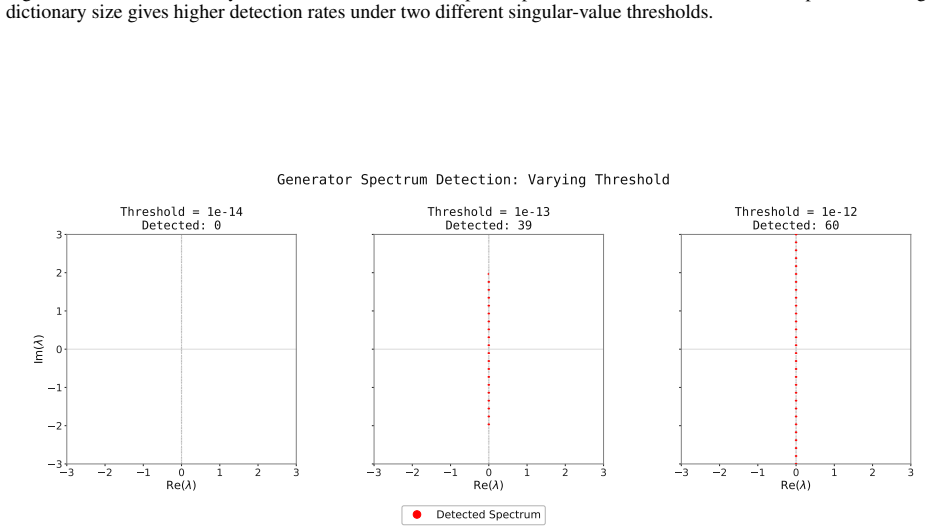
- [§6.1 / Figure captions] Detection thresholds are reported inconsistently: the text states thresholds 2.5e-14 and 3.5e-14, while Figure 1 captions list 9.2e-14, 1.6e-13, and 1.9e-13. Please align the text and figures.
- [Lemma 5.3] The symbol M is used both for the invariant subspace and for the data size M elsewhere in the paper. Use a different letter, e.g., V or E, for the subspace.
- [Theorem 5.4 proof] The proof is only a citation to [4, Theorem 6.15]. Since this is the main error-bound result, please state the relevant theorem or include a short proof, and verify that the hypotheses of [4] match Assumptions 4.2 and 4.5 exactly.
Circularity Check
No significant circularity in the main derivation; the resolvent construction is explicitly equivalent to the standard EDMD resolvent, and the convergence theorems rely on external stable-convergence hypotheses. One secondary multiplicity-preservation clause reduces to its own assumption.
specific steps
-
self definitional
[Theorem 4.10 (second clause) and Assumption 4.5, Section 4]
"Assumption 4.5: Assume dim P_N^λ F = dim P^λ F = mλ < ∞ for all large N. ... Moreover, if Assumption 4.5 holds, we have σ(K_N)∩Δ consists of exactly m eigenvalues."
By the Riesz decomposition invoked in the proof, the number of eigenvalues of K_N inside the isolating contour Δ equals dim P_N^λ F. Therefore Assumption 4.5 and the theorem's second conclusion assert the same fact: exactly mλ eigenvalues (counting algebraic multiplicity) inside Δ. The 'multiplicity preservation' half of Theorem 4.10 is thus a restatement of its hypothesis, not a derived prediction. The paper's attempted justification of Assumption 4.5 by Corollary 4.9 is also insufficient because Corollary 4.9 only gives dim P_N^λ F ≥ mλ, which does not imply the required equality. This is a secondary overclaim; the Kuratowski/Hausdorff convergence half is genuinely derived from Assumption 4.2.
full rationale
I find no circularity in the paper's central derivation chain. The pseudo-resolvent R_N(z) is explicitly identified in Eq. (5) with the ordinary resolvent (zI - K_N)^{-1} of the EDMD/Galerkin matrix, so the SMW formula is an algebraic shortcut rather than a source of new information; no prediction is hidden in the identity. The main convergence results (Theorem 4.10 first part, Theorem 4.16) are conditional on Assumption 4.2, an external stable-convergence hypothesis from Chatelin [4] and Mills [25], and are not derived from the conclusions they assert. The self-citations [36,37] and coauthor citation [29] are background or experimental-tool citations, not load-bearing for the spectral theory. The Section 6.2 constant C=0.04 is fitted to the same data as the plotted ratio; it is an a posteriori illustration of the theorem's bound, not an independent prediction, so it does not constitute a fitted-input-called-prediction circularity. The serious weakness is missing support rather than circularity: the abstract promises 'concrete sufficient conditions' for contractive/measure-preserving/compact settings, but no such theorem appears; Section 4 asserts SLLN convergence of Gram matrices without a finite-M bound; and the conclusion admits that 'development of principled guidelines for dictionary selection that ensure the stable convergence assumption is satisfied' is open. These gaps mean Assumption 4.2 is unverified for the reported experiments, but an unverified external hypothesis is not a circular step. Overall score 2 reflects the one secondary multiplicity-preservation clause that reduces to its own assumption, while the central claim retains independent conditional content.
Axiom & Free-Parameter Ledger
free parameters (4)
- Error-bound constant C =
0.04
- Lorenz nonlinear coupling scaling s =
0.1
- Detection threshold ε =
10^{-14} to 10^{-12} (swept)
- RFF kernel length-scale ℓ =
1.5
axioms (7)
- standard math Sherman-Morrison-Woodbury identity (Eq. 3)
- domain assumption Strong law of large numbers for empirical Gram/cross matrices
- domain assumption EDMD matrices converge strongly to K (Korda & Mezić [20, Theorem 3])
- ad hoc to paper Assumption 4.2: stable convergence, ||R_N(z)|| ≤ M_z for z∈ρ(K)
- ad hoc to paper Assumption 4.5: dim P_N^λ = dim P^λ = m_λ
- standard math Spectral mapping theorem for C0 semigroups
- standard math Arzelà-Ascoli and Riesz projection toolkit
read the original abstract
Finite-dimensional Koopman eigenvalues do not characterize resolvent growth, particularly for nonnormal compressions. We study the singular-value structure of empirical Koopman finite sections in the inner product induced by the data. Resolvent Dynamic Mode Decomposition (Resolvent DMD) removes unresolved Gram directions and then forms the Koopman or generator compression in a Gram-orthonormal basis. At a prescribed spectral parameter, the reciprocal of the smallest shifted singular value is the resolvent norm on the retained observable space. The associated right and left singular vectors give a minimum-residual pseudomode and the corresponding optimal forcing direction. For deterministic unregularized data, the squared ResDMD residual admits an orthogonal decomposition into a projected shifted residual and an invariance defect. The finite-section singular value is therefore a lower bound for the minimum ResDMD residual on the same space. We then identify stability assumptions that connect the finite sections with the underlying Koopman operator. Pointwise stability gives one-sided inclusion of inverse-resolvent sublevel sets. Stability on a punctured isolating neighborhood obtains local Hausdorff convergence near an isolated eigenvalue, while multiplicity stability preserves the algebraic count. Contractive, measure-preserving, and compact settings provide concrete sufficient conditions. The numerical examples examine coordinate dependence, finite-data residuals, contour calculations, and pseudomode separation for a noisy two-frequency signal.
Figures




Reference graph
Works this paper leans on
-
[1]
Geodesic flows on closed riemannian manifolds with negative curvature
DV Ansov. Geodesic flows on closed riemannian manifolds with negative curvature. InProc. Steklov Inst. Math., volume 90, pages 1–235, 1969
1969
-
[2]
American Mathematical Soc., 1927
George David Birkhoff.Dynamical systems, volume 9. American Mathematical Soc., 1927
1927
-
[3]
Applied koopmanism.Chaos: An Interdisciplinary Journal of Nonlinear Science, 22(4), 2012
Marko Budiši´c, Ryan Mohr, and Igor Mezi ´c. Applied koopmanism.Chaos: An Interdisciplinary Journal of Nonlinear Science, 22(4), 2012
2012
-
[4]
Chaitin-Chatelin.Spectral Approximation of Linear Operators
F. Chaitin-Chatelin.Spectral Approximation of Linear Operators. Computer science and applied mathematics. Academic Press, 1983
1983
-
[5]
Rigorous data-driven computation of spectral properties of koopman operators for dynamical systems.Communications on Pure and Applied Mathematics, 77(1):221–283, 2024
Matthew J Colbrook and Alex Townsend. Rigorous data-driven computation of spectral properties of koopman operators for dynamical systems.Communications on Pure and Applied Mathematics, 77(1):221–283, 2024
2024
-
[6]
Springer, 2019
John B Conway.A course in functional analysis. Springer, 2019
2019
-
[7]
Higher order extended dynamic mode decomposition based on the structured total least squares.SIAM Journal on Scientific Computing, 45(2):A985–A1011, 2023
Weiyang Ding and Jie Li. Higher order extended dynamic mode decomposition based on the structured total least squares.SIAM Journal on Scientific Computing, 45(2):A985–A1011, 2023
2023
-
[8]
Engel, S
K.J. Engel, S. Brendle, R. Nagel, M. Campiti, T. Hahn, G. Metafune, G. Nickel, D. Pallara, C. Perazzoli, A. Rhandi, et al.One-Parameter Semigroups for Linear Evolution Equations. Graduate Texts in Mathematics. Springer New York, 1999
1999
-
[9]
Consistent spectral approximation of koopman operators using resolvent compactification.Nonlinearity, 37(7):075021, 2024
Dimitrios Giannakis and Claire Valva. Consistent spectral approximation of koopman operators using resolvent compactification.Nonlinearity, 37(7):075021, 2024
2024
-
[10]
A lemma in the theory of structural stability of differential equations.Proceedings of the American Mathematical Society, 11(4):610–620, 1960
Philip Hartman. A lemma in the theory of structural stability of differential equations.Proceedings of the American Mathematical Society, 11(4):610–620, 1960
1960
-
[11]
SIAM, 2002
Philip Hartman.Ordinary differential equations. SIAM, 2002
2002
-
[12]
Data-driven resolvent analysis.Journal of Fluid Mechanics, 918:A10, 2021
Benjamin Herrmann, Peter J Baddoo, Richard Semaan, Steven L Brunton, and Beverley J McKeon. Data-driven resolvent analysis.Journal of Fluid Mechanics, 918:A10, 2021
2021
-
[13]
Koopman operators with intrinsic observables in rigged reproducing kernel hilbert spaces.Nonlinearity, 38(11):115022, 2025
Isao Ishikawa, Yuka Hashimoto, Masahiro Ikeda, and Yoshinobu Kawahara. Koopman operators with intrinsic observables in rigged reproducing kernel hilbert spaces.Nonlinearity, 38(11):115022, 2025
2025
-
[14]
Kato.Perturbation Theory for Linear Operators
T. Kato.Perturbation Theory for Linear Operators. Classics in Mathematics. Springer Berlin Heidelberg, 1995
1995
-
[15]
Number 54
Anatole Katok, AB Katok, and Boris Hasselblatt.Introduction to the modern theory of dynamical systems. Number 54. Cambridge university press, 1995
1995
-
[16]
Stefan Klus, Péter Koltai, and Christof Schütte. On the numerical approximation of the perron-frobenius and koopman operator.arXiv preprint arXiv:1512.05997, 2015
Pith/arXiv arXiv 2015
-
[17]
Data- driven approximation of the koopman generator: Model reduction, system identification, and control.Physica D: Nonlinear Phenomena, 406:132416, 2020
Stefan Klus, Feliks Nüske, Sebastian Peitz, Jan-Hendrik Niemann, Cecilia Clementi, and Christof Schütte. Data- driven approximation of the koopman generator: Model reduction, system identification, and control.Physica D: Nonlinear Phenomena, 406:132416, 2020
2020
-
[18]
Hamiltonian systems and transformation in Hilbert space.Proceedings of the National Academy of Sciences, 17(5):315, 1931
Bernard O Koopman. Hamiltonian systems and transformation in Hilbert space.Proceedings of the National Academy of Sciences, 17(5):315, 1931
1931
-
[19]
Koopman and John von Neumann
Bernard O. Koopman and John von Neumann. Dynamical systems of continuous spectra.Proceedings of the National Academy of Sciences, 18(3):255–263, 1932
1932
-
[20]
On convergence of extended dynamic mode decomposition to the koopman operator
Milan Korda and Igor Mezi´c. On convergence of extended dynamic mode decomposition to the koopman operator. Journal of Nonlinear Science, 28:687–710, 2018
2018
-
[21]
Kernel methods for the approximation of the eigenfunctions of the koopman operator.Physica D: Nonlinear Phenomena, 476:134662, June 2025
Jonghyeon Lee, Boumediene Hamzi, Boya Hou, Houman Owhadi, Gabriele Santin, and Umesh Vaidya. Kernel methods for the approximation of the eigenfunctions of the koopman operator.Physica D: Nonlinear Phenomena, 476:134662, June 2025
2025
-
[22]
Deep learning for universal linear embeddings of nonlinear dynamics.Nature communications, 9(1):4950, 2018
Bethany Lusch, J Nathan Kutz, and Steven L Brunton. Deep learning for universal linear embeddings of nonlinear dynamics.Nature communications, 9(1):4950, 2018
2018
-
[23]
Spectral properties of dynamical systems, model reduction and decompositions.Nonlinear Dynamics, 41:309–325, 2005
Igor Mezi´c. Spectral properties of dynamical systems, model reduction and decompositions.Nonlinear Dynamics, 41:309–325, 2005
2005
-
[24]
Koopman operator, geometry, and learning.arXiv: Dynamical Systems, 2020
Igor Mezi ´c. Koopman operator, geometry, and learning.arXiv: Dynamical Systems, 2020
2020
-
[25]
Mills, Jr
Wendell H. Mills, Jr. The resolvent stability condition for spectra convergence with application to the finite element approximation of noncompact operators.SIAM J. Numer. Anal., 16(4):695–703, August 1979. 18
1979
-
[26]
Pazy.Semigroups of Linear Operators and Applications to Partial Differential Equations
A. Pazy.Semigroups of Linear Operators and Applications to Partial Differential Equations. Applied Mathematical Sciences. Springer New York, 2012
2012
-
[27]
Sur le problème des trois corps et les équations de la dynamique.Acta mathematica, 13(1):A3– A270, 1890
Henri Poincaré. Sur le problème des trois corps et les équations de la dynamique.Acta mathematica, 13(1):A3– A270, 1890
-
[28]
Random features for large-scale kernel machines.Advances in neural information processing systems, 20, 2007
Ali Rahimi and Benjamin Recht. Random features for large-scale kernel machines.Advances in neural information processing systems, 20, 2007
2007
-
[29]
Enhancing spectral analysis in nonlinear dynamics with pseudoeigen- functions from continuous spectra.Scientific Reports, 14(1):19276, 2024
Itsushi Sakata and Yoshinobu Kawahara. Enhancing spectral analysis in nonlinear dynamics with pseudoeigen- functions from continuous spectra.Scientific Reports, 14(1):19276, 2024
2024
-
[30]
Differentiable dynamical systems.Bulletin of the American mathematical Society, 73(6):747–817, 1967
Stephen Smale. Differentiable dynamical systems.Bulletin of the American mathematical Society, 73(6):747–817, 1967
1967
-
[31]
Chapman and Hall/CRC, 2024
Steven H Strogatz.Nonlinear dynamics and chaos: with applications to physics, biology, chemistry, and engineering. Chapman and Hall/CRC, 2024
2024
-
[32]
Koopman resolvent: A laplace-domain analysis of nonlinear autonomous dynamical systems.SIAM Journal on Applied Dynamical Systems, 20(4):2013–2036, 2021
Yoshihiko Susuki, Alexandre Mauroy, and Igor Mezic. Koopman resolvent: A laplace-domain analysis of nonlinear autonomous dynamical systems.SIAM Journal on Applied Dynamical Systems, 20(4):2013–2036, 2021
2013
-
[33]
PhD thesis, Princeton University, 2013
Jonathan H Tu.Dynamic mode decomposition: Theory and applications. PhD thesis, Princeton University, 2013
2013
-
[34]
Williams, Ioannis G
Matthew O. Williams, Ioannis G. Kevrekidis, and Clarence W. Rowley. A data–driven approximation of the koopman operator: Extending dynamic mode decomposition.Journal of Nonlinear Science, 25(6):1307–1346, June 2015
2015
-
[35]
Woodbury and Princeton University
M.A. Woodbury and Princeton University. Department of Statistics.Inverting Modified Matrices. Memorandum Report / Statistical Research Group, Princeton. Department of Statistics, Princeton University, 1950
1950
-
[36]
A data-driven framework for koopman semigroup estimation in stochastic dynamical systems, 2025
Yuanchao Xu, Isao Ishikawa, Yuka Hashimoto, and Zhongwei Shen. A data-driven framework for koopman semigroup estimation in stochastic dynamical systems, 2025
2025
-
[37]
Generative modeling through koopman spectral analysis: An operator-theoretic perspective, 2026
Yuanchao Xu, Fengyi Li, Masahiro Fujisawa, Xiaoyuan Cheng, Youssef Marzouk, and Isao Ishikawa. Generative modeling through koopman spectral analysis: An operator-theoretic perspective, 2026. 19
2026
discussion (0)
Sign in with ORCID, Apple, or X to comment. Anyone can read and Pith papers without signing in.