REVIEW 4 major objections 6 minor 2 cited by
MemBuilder: Reinforcing LLMs for Long-Term Memory Construction via Attributed Dense Rewards
T0 review · 4 major / 6 minor · reviewed 2026-08-03 · deepseek-v4-flash
Pith's one-line read A 4-billion-parameter model trained with dense session-level rewards and contribution-aware gradient weighting surpasses closed-source baselines in constructing long-term dialogue memory.
desk verdict The central gradient-weighting mechanism in Eq. (12) is mathematically inert for positive advantages, and the LoCoMo alpha sweep leaks test data; the dense-reward idea is still worth a look, but the paper needs substantial fixes. read the letter →
The pith
A machine-rendered reading of the paper's core claim, the machinery that carries it, and where it could break.
The reading
What carries the argument
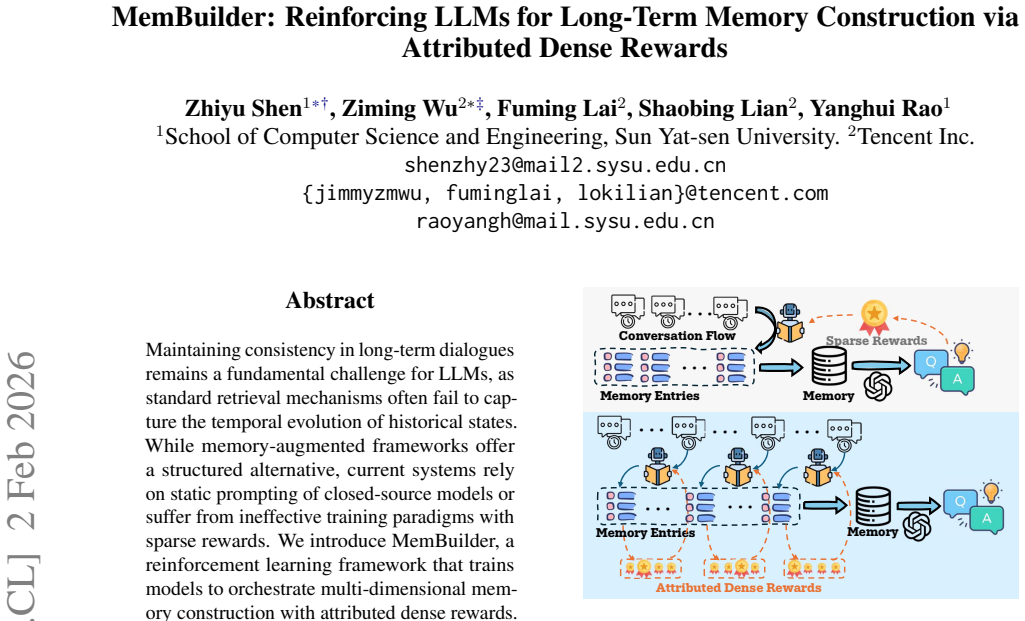
The engine is the ADRPO objective, which extends GRPO with dense session-level rewards and contribution-aware gradient weights. For each memory type, the importance-ratio term in the policy-gradient loss is multiplied by w(m), set to alpha for the component most often retrieved during downstream QA and 1 otherwise, concentrating credit on the memory type that actually helped. The dense reward itself comes from synthetic session-level QA pairs: an expert model generates questions about the current session and its connections to retrieved history, and the average accuracy of answers read from the candidate memory bank is the reward.
What would settle it
Trace a single positive-advantage token from the dominant memory type with importance ratio in [0.8, 1.2]: under Eq. (12) the min with clip(rho, 0.8, 1.2) makes w(m)=4 irrelevant. A corrected implementation that multiplies the clipped term or the advantage itself would settle whether the alpha=4 gain comes from attribution weighting; if no gain remains, the contribution-aware mechanism is not the cause.
Extended reading notes
Core claim
MemBuilder's central claim is that a lightweight model can learn to orchestrate a four-part memory bank (Core, Episodic, Semantic, Procedural) through reinforcement learning if the reward is dense and attributed. ADRPO gives a reward after every session by having a capable model answer synthetic session-level questions using the candidate memory bank; each rollout is scored by average QA accuracy, gated by format validity and a length penalty. During evaluation, retrieval counts identify the dominant memory component, and the gradient update for that component is amplified by a factor alpha. Trained only on LongMemEval, the 4B model reaches 84.23% on LoCoMo, 85.75% on LongMemEval, and 93.14%
Load-bearing premise
The main premise is that synthetic session-level QA questions faithfully measure downstream memory quality, and that the contribution-aware weighting actually amplifies learning for the component that deserves credit; the objective as written makes the amplification inert for a range of positive-advantage tokens, so the attribution result rests on this implementation detail.
Editorial extensions
If this is right
- Open-weight 4B models can replace closed-source memory-construction APIs, with the paper reporting higher benchmark scores than Claude 4.5 Sonnet under the same answer model.
- SFT is a required cold start: RL alone underperforms SFT alone, so the two stages contribute different capabilities.
- Reward density is a first-order factor: as the fraction of sessions receiving task rewards drops, performance degrades and eventually falls below the SFT baseline.
- The trained memory generalizes across answer models and out-of-distribution benchmarks, suggesting memory quality, not answer capability, is the bottleneck.
- The action design (UPDATE and MERGE preserving old references) supports temporal reasoning through explicit versioning, which appears as large gains on MultiHop and Temporal questions.
Reading between the lines
- If reproduced, the method suggests memory construction is a trainable capability rather than a prompt-engineering service; agent deployments could keep memory construction local and call a larger model only for final answers.
- The dense synthetic-QA reward is a generic recipe for long-horizon agentic tasks with terminal-only feedback, not just dialogue memory.
- A caveat the paper itself notes: evaluation fixes the answer model to a closed-source system and uses synthetic QA pairs that can contain noise, so the reported numbers measure memory construction quality under those conditions, not the whole pipeline.
- The contribution-aware mechanism as written in Eq. (12) may not produce the amplification it claims: w(m)>1 affects only the unclipped ratio, and the min with the clipped term cancels it for positive advantages inside the clip band, so the alpha=4 ablation (Section 4.3.1) does not by itself demonstrate attribution credit.
Editorial analysis
A structured set of objections, weighed in public.
Referee Report
Summary. The paper proposes MemBuilder, a reinforcement-learning framework that trains a 4B-parameter model (Qwen3-4B) to construct multi-dimensional long-term memories (Core, Episodic, Semantic, Procedural). The method has two main components: (1) dense session-level rewards obtained from synthetic question-answer pairs, and (2) contribution-aware gradient weighting that supposedly scales policy updates according to each memory type's downstream retrieval contribution. The authors define the ADRPO objective by extending GRPO with these components. Experiments on LongMemEval, LoCoMo, and PerLTQA report that the trained 4B model achieves 84.23% on LoCoMo, outperforming Claude 4.5 Sonnet used as a memory-construction baseline, and generalizes to out-of-distribution benchmarks.
Significance. If the reported results are reliable, the paper would make a meaningful practical contribution: showing that an open-weight 4B model can replace expensive closed-source memory-construction APIs. The paper is also strong on reproducibility infrastructure: it releases code, provides a detailed cost breakdown, includes concrete case studies of learned memory operations, and gives full prompt templates. The dense synthetic-reward idea is a sensible approach to the sparse-reward problem in long-horizon memory construction. However, the central technical mechanism of contribution-aware weighting is, as written, not implemented by the stated objective, and the headline evaluation protocol is compromised by hyperparameter selection on the test benchmark.
major comments (4)
- [§3.4.3, Eq. (12)] Equation (12) cannot implement the claimed amplification of gradient updates for dominant memory types. For a positive advantage A_i>0, the clipped term clip(ρ,1−ε,1+ε)A_i is always ≤ the unclipped term w(m)ρ A_i when w(m)>1 and ρ is inside the clip range; when ρ>1+ε the min selects the clipped term as well. Thus w(m)>1 has no effect on positive-advantage tokens; it only amplifies penalties for negative advantages. The ablation in Figure 4 (α=4 vs α=1) therefore cannot be attributed to the stated mechanism. The authors should either replace the min with the correct operator that amplifies positive advantages (e.g., a max or a different weighting), or clearly describe and derive the actual objective used in the released code, then rerun the ablation.
- [§4.3.1 and Figure 4] The contribution-weighting coefficient α is selected using LoCoMo accuracy, and the same LoCoMo set is then used for the headline result in Table 1 (84.23%). Appendix E.1 states only that the ablation uses a reduced training set of 10 dialogues sampled from the RL training dialogues; it does not state that the LoCoMo evaluation used for α selection is disjoint from the final LoCoMo test set. Since the final LoCoMo number is a test-set-selected result, the claim that MemBuilder outperforms Claude 4.5 Sonnet on LoCoMo is not a clean held-out comparison. The authors must either select α on a LongMemEval validation split and report the corresponding LoCoMo test result, or report all α settings transparently and avoid presenting the selected α as evidence of generalization.
- [Appendix A.2] The training/evaluation split for LongMemEval is not specified rigorously. The paper says 500 questions are used for evaluation and that 50 dialogues are sampled for SFT and another 50 for RL, all from LongMemEval, but it never states whether these 100 training dialogues overlap with the 500 evaluation questions. If any overlap exists, the LongMemEval result of 85.75% is partially in-distribution and cannot be used as evidence of memory-construction quality. The authors should explicitly state how the 50+50 training dialogues are disjoint from the 500 evaluation questions, or provide an evaluation subset that is provably held out.
- [§4.2 and Appendix D.3] There is a numerical inconsistency. Section 4.2 and Appendix D.3 state that using Qwen3-4B as the answer model achieves 82.00% on LoCoMo, but Table 2 reports 81.12% for 'Qwen3-4B Ours'. This discrepancy must be corrected and the correct number used consistently, since it is the basis for the direct comparison to Memory-R1 (62.74%).
minor comments (6)
- [Table 1] The row labels '+ SFT', '+ RL', '+ SFT + RL' are ambiguous. Clarify that '+ RL' means RL applied to the base model without SFT, and '+ SFT + RL' means the full ADRPO pipeline.
- [Appendix A.1] The description of LongMemEval says '500 independent questions, each with its own dialogue context'. This makes the overlap question in Appendix A.2 particularly acute; please define the relation between a 'dialogue' and a 'question' in LongMemEval.
- [Figure 4] The figure is captioned 'Training curves with different gradient weighting coefficients on LoCoMo', but the axes are not described in the text. Specify whether the y-axis is final accuracy after training or per-epoch accuracy, and include the LoCoMo test accuracy for each α.
- [Appendix G] Appendix G references 'Section 5.3.2', but the paper has no Section 5.3.2; the reference should point to the appropriate section (possibly §4.4.2).
- [§3.4.1] Typo: 'retrieved memoey' should be 'retrieved memory'.
- [§4.2] The comparison to Memory-R1 is not apples-to-apples because Memory-R1 uses a different base and answer model. The authors note this, but the sentence 'significantly outperforming Memory-R1' should be tempered to reflect the different evaluation setup.
Circularity Check
No meaningful circularity: the central claim is an empirical benchmark comparison, with only minor evaluation-protocol caveats and one unverified stated mechanism.
-
other
[Section 4.3.1 and Appendix E.1 (Figures 4-5; α selection on LoCoMo)]
"We conduct this ablation on a reduced training set for efficiency. ... the optimal value at α= 4. ... To efficiently explore the effect of contribution-aware gradient weighting, we conduct this ablation on a reduced training set consisting of 10 dialogues sampled from the 50 RL training dialogues."
Not a derivation-level circularity: α is selected using LoCoMo accuracy and the reported LoCoMo number uses α=4, so the headline comparison is a test-set-selected result rather than a held-out OOD claim. However, this is an evaluation-protocol weakness, not a self-defined prediction or fitted-input-called-prediction. The main SOTA claim remains an empirical benchmark comparison against external baselines, so it is not circular in the derivation sense.
-
other
[Section 3.4.3 Eq. (12), Section 3.4.2 Eqs. (9)-(10)]
"w(m) ρ(m)i,k Ai, clip(ρ(m)i,k ,1−ϵ,1+ϵ)Ai ... ∂J/∂θ = ... + sign(Ai)·w(m)·... [Eq. 13] ... The dominant contributing type is: d = arg max...; w(m) = α if m=d, 1 otherwise"
The stated mechanism is partly inconsistent with the given equations: since α multiplies only the unclipped term and the loss takes a min with the clipped term, α>1 does not amplify updates for positive advantages when the importance ratio is within or above [1−ε,1+ε]; it only amplifies penalties for negative advantages. This undermines the ablation's stated interpretation but is an internal mechanism flaw, not a circular derivation: the benchmark numbers are not defined in terms of α.
full rationale
No step in the paper derives its benchmark results from its own training signals by construction. The reward is an external API judge (GPT-4.1-mini) grading synthetic QA, the memory construction is evaluated on standard benchmarks (LoCoMo, LongMemEval, PerLTQA) with fixed answer models, and the comparison is against external prompting/RAG baselines. The SFT trajectories, synthetic QA, and RL rewards are training-time inputs, not the eval labels. There is no self-citation chain that imports a uniqueness or ansatz conclusion; the related-work citations contextualize the method but do not carry the load of the empirical claim. The two notable weaknesses are protocol-level, not circularity-level: (1) α is chosen on LoCoMo itself and the 84.23% headline uses that chosen α, making the OOD/generalization claim partly test-set-selected; and (2) the overlap status of the 50/50 LongMemEval training dialogues with the 500-question LongMemEval eval set is not disclosed. These are correctness/evaluation-validity concerns, not instances where a prediction reduces by definition to an input, and they do not warrant a circularity score above 2. The Eq. 12/13 mismatch is a stated-mechanism inconsistency rather than a circular reduction. Overall: no significant circularity; score 1.
Assumptions & free parameters
free parameters (6)
- contribution weight alpha =
4
- length penalty coefficient lambda =
0.8
- core length penalty thresholds theta_min, theta_max =
150, 400
- non-core length penalty parameters delta, gamma_l, gamma_u =
delta=200, gamma_l=0.5, gamma_u=1.3 (gamma_min/gamma_max unspecified)
- number of synthetic questions J per session =
5
- dominant-type tie-break =
unspecified
assumptions (6)
- standard math PPO/GRPO clipping in Eq. (12) preserves a trust region and is a valid policy optimization objective.
- domain assumption Synthetic QA pairs generated by Claude 4.5 Opus cover the information needed for downstream benchmarks.
- domain assumption LLM judge correctness labels are reliable proxies for ground truth.
- ad hoc to paper Retrieval frequency h^(m) measures the downstream contribution of memory type m.
- domain assumption Training on LongMemEval transfers to LoCoMo and PerLTQA.
- ad hoc to paper The w(m) scaling in the unclipped term amplifies gradient updates for dominant memory types.
Cite this review
Pith. "Pith review of MemBuilder: Reinforcing LLMs for Long-Term Memory Construction via Attributed Dense Rewards." pith.science (2026). https://pith.science/paper/RTQGP7BP
@misc{pith2026260105488,
  author       = {Pith},
  title        = {Pith review of: MemBuilder: Reinforcing LLMs for Long-Term Memory Construction via Attributed Dense Rewards},
  year         = {2026},
  howpublished = {\url{https://pith.science/paper/RTQGP7BP}},
  note         = {Machine review of arXiv:2601.05488}
}
read the original abstract
Maintaining consistency in long-term dialogues remains a fundamental challenge for LLMs, as standard retrieval mechanisms often fail to capture the temporal evolution of historical states. While memory-augmented frameworks offer a structured alternative, current systems rely on static prompting of closed-source models or suffer from ineffective training paradigms with sparse rewards. We introduce MemBuilder, a reinforcement learning framework that trains models to orchestrate multi-dimensional memory construction with attributed dense rewards. MemBuilder addresses two key challenges: (1) Sparse Trajectory-Level Rewards: we employ synthetic session-level question generation to provide dense intermediate rewards across extended trajectories; and (2) Multi-Dimensional Memory Attribution: we introduce contribution-aware gradient weighting that scales policy updates based on each component's downstream impact. Experimental results show that MemBuilder enables a 4B-parameter model to outperform state-of-the-art closed-source baselines, exhibiting strong generalization across long-term dialogue benchmarks.
Figures


Figures from the paper (11 more)


Forward citations
Cited by 2 Pith papers
-
AttriMem: Attribution-Guided Process Feedback for Agent Memory Construction
Token-level attribution of the final answer to memory tokens provides process rewards that improve RL-trained memory construction for LLM agents.
-
AttriMem: Attribution-Guided Process Feedback for Agent Memory Construction
Token-level attribution of the final answer to memory contents, used as RL process rewards, improves memory-construction policies for long-horizon dialogue QA.
Reference graph
Works this paper leans on
-
[1]
Examine all messages thoroughly to extract EVERY detail about the user's preferences, personal information, and vital facts
-
[2]
Look deep into the messages to identify user behaviors, preferences, personal details
-
[3]
Be proactive - extract more information than just what's explicitly stated
-
[4]
}]} 15 RL Model.Adds the new method as a versioned entry, preserving the original: {
Slow pour over 3 minutes. | Context: Pour- over method, refined morning routine."}]} 15 RL Model.Adds the new method as a versioned entry, preserving the original: {"operations": [{"action": "ADD", "memory": " Pour-over coffee method (v2, current) | Steps: 1. Grind 18g beans to medium-fine. 2. Heat water to 92C. 3. Bloom for 30 seconds. 4. Slow pour in ci...
-
[5]
operation
Decide on ONE operation: APPEND: Add new information to existing block (if <90% full); REPLACE: Update specific outdated or incorrect information; REWRITE: Reorganize and consolidate the entire block (if >90% full or major updates needed) Return JSON with ONE of these operations: {"operation": "APPEND", "content": "Additional text to append"} OR {"operati...
-
[7]
The core memory can be as detailed as possible - capture context and nuance
-
[9]
One Event Per Timestamp: Each memory = ONE specific event at ONE point in time; Multiple events in one message → create SE PARATE memories
-
[10]
YYYY-MM-DD
Timestamp Format (Use ABSOLUTE time only): Use ONLY absolute dates: "YYYY-MM-DD", "YYYY-MM", or "YYYY"; "yesterday" → calculate and use YYYY-MM-DD; "last week" / "last month" → calculate and use YYYY-MM; "this past weekend" → calculate and use YYYY-MM-DD; No time mentioned → use conversation timestamp; Unclear → use YYYY-MM or YYYY (do NOT guess specific ...
Show all 14 references
-
[11]
last month
Preserve Original Time Expression in Details (REQUIRED): ALWAYS start Details with time context; User says "last month" → Details starts with "Last month from conversation date of {{conversation_timestamp}} (calculated as YYYY-MM), ..."; User says "yesterday" → Details starts ...
2024
-
[12]
Not answerable
If the GOLD answer is "Not answerable" (meaning the information truly doesn't exist in the conversation history): The generated answer should be CORRECT if it clearly indicates unavailability; Accept equivalent expressions: "Not answerable", "There is no information", "There i...
-
[13]
7 May 2023
If the GOLD answer is a SPECIFIC answer (e.g., "7 May 2023", "John", "Paris"): The generated answer saying "Not answerable " should be counted as WRONG; This means the system failed to retrieve information that actually exists in the conversation history; Even if phrased as "n...
2023
-
[14]
Not answerable
CRITICAL RULE for "Not answerable" responses: When the generated answer indicates "Not answerable" or similar (cannot find , no information, etc.), the ONLY way it can be CORRECT is if the GOLD answer is ALSO "Not answerable"; If the gold answer contains ANY specific informati...
-
[2024]
Evaluating very long-term conversational memory of LLM agents. InProceedings of the 62nd Annual Meeting of the Association for Com- putational Linguistics (Volume 1: Long Papers), ACL 2024, Bangkok, Thailand, August 11-16, 2024, pages 13851–13870. Association for Computational...
2024 arXiv
-
[2025]
operation
Mem- α: Learning memory construction via reinforcement learning.CoRR, abs/2509.25911. Di Wu, Hongwei Wang, Wenhao Yu, Yuwei Zhang, Kai-Wei Chang, and Dong Yu. 2025. Longmemeval: Benchmarking chat assistants on long-term interac- tive memory. InThe Thirteenth International Con-...
2025 arXiv
Reviewed August 3, 2026 · model on record in the stance chip above.
Discussion (0). Sign in to comment.