REVIEW 4 major objections 5 minor 2 cited by
In the FLAMINGO hydrodynamical simulations, the three-point intrinsic-alignment signal of galaxies and haloes is described by tree-level effective field theory on scales above roughly 26 Mpc, and a two-parameter reduced version performs alm
Reviewed by Pith at T0; open to challenge. T0 means a machine referee read the full paper against a public rubric. the ladder, T0–T4 →
T0 review · deepseek-v4-flash
2026-08-03 08:08 UTC pith:OWIQ2JDQ
load-bearing objection Genuinely new 3-pt aperture-mass IA measurements from a large hydro simulation; the EFT claims look credible on large scales, but the jackknife covariance and post-hoc scale cut need scrutiny before the quantitative results harden. the 4 major comments →
Three-point intrinsic alignments of galaxies and haloes in the FLAMINGO simulations
The pith
A machine-rendered reading of the paper's core claim, the machinery that carries it, and where it could break.
Core claim
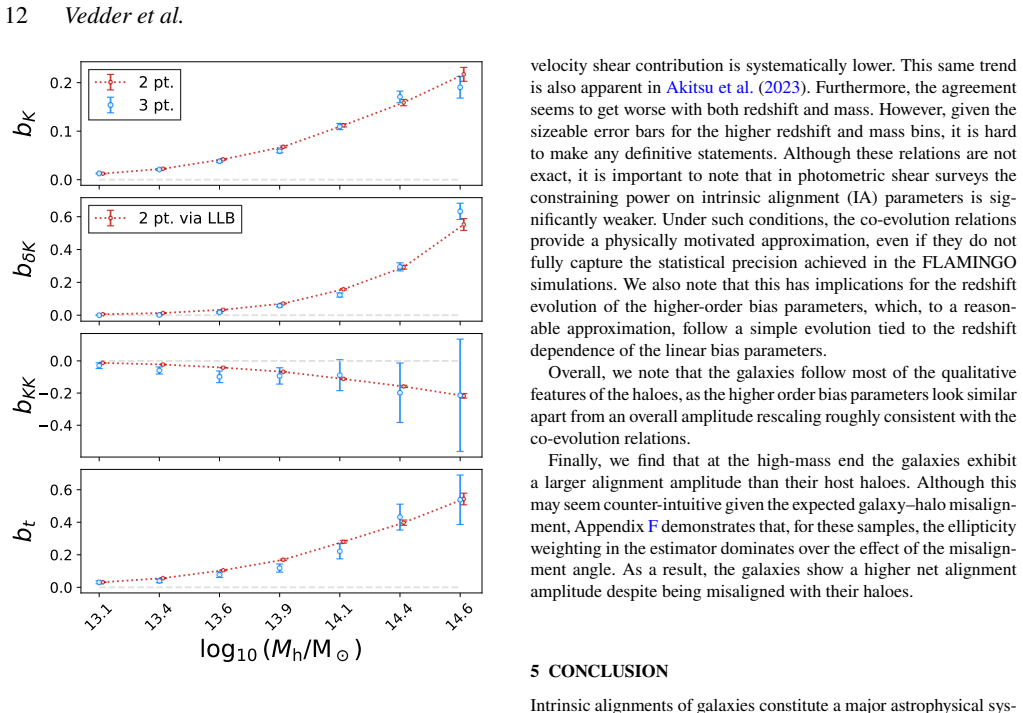
The central claim is that the tree-level EFT of intrinsic alignments — the leading perturbative order in the shape field — accurately predicts the third-order aperture-mass statistics ⟨NNM_ap⟩, ⟨NM^2_ap⟩, and ⟨M^3_ap⟩ for both galaxies and haloes in FLAMINGO once triangles with any side below about 26 Mpc are excluded. Fitted to ⟨NNM_ap⟩, the full EFT gives b_K = 0.0317 ± 0.0009 (A_IA = 3.86 ± 0.12) for the main galaxy sample, with all four higher-order bias parameters deviating from zero at several sigma, and the same parameters predict the other two statistics consistently. The paper further claims that the linear-Lagrangian co-evolution relations b_KK = -b_K and b_t = (5/2)b_K are approxi
What carries the argument
The central object is the third-order aperture-mass statistic ⟨NNM_ap⟩(R1,R2,R3), an E/B-mode decomposed integral of the three-point correlation function, together with the tree-level EFT expansion of the shape tensor g_ij = b_K K_ij + b_δK δK_ij + b_KK TF(K^2)_ij + b_t t_ij. The key mechanism is the linear Lagrangian bias ansatz (co-evolution relations), which fixes the tidal-torquing and velocity-shear coefficients in terms of the linear alignment bias b_K and linear galaxy bias b_1, reducing the model to two free parameters. Aperture-mass filters are what isolate the connected part of the 3PCF and separate E from B modes, and the multipole decomposition makes the 3PCF estimators computati
Load-bearing premise
The load-bearing premise is that stochastic (shot-noise-like) intrinsic-alignment terms contribute nothing to the configuration-space aperture-mass statistics, so the tree-level EFT with only the deterministic operators fully describes the signal on the fitted scales; if stochastic terms are non-negligible, all fitted bias parameters — including the claim of consistency with two-point statistics — shift.
What would settle it
Repeat the ⟨NNM_ap⟩ fit on scales Ri ≥ 26 Mpc with a covariance matrix estimated from multiple independent simulation volumes (or an analytic covariance) instead of the jackknife+SVD prescription; if b_K then moves away from the two-point value by more than the joint uncertainty, the tree-level EFT or the zero-stochastic assumption fails. A complementary check is to measure the B-mode statistic ⟨NNM×⟩ with a non-averaging estimator: the paper predicts it should vanish under angular averaging, so any robust nonzero detection would signal missing physics or binning artifacts.
If this is right
- If the tree-level EFT is correct on these scales, third-order IA statistics can be joined to two-point analyses within one framework, breaking degeneracies that limit parameter constraints.
- The same EFT parameters fitted to ⟨NNM_ap⟩ also predict ⟨NM^2_ap⟩ and ⟨M^3_ap⟩, so a single set of bias parameters describes all three third-order observables.
- When the co-evolution relations hold, photometric shear surveys can fix b_KK and b_t without fitting them, needing at most one extra parameter beyond the linear model — or none if the galaxy bias is known.
- Omitting the velocity-shear operator (as standard TATT implementations do) biases the linear amplitude at third order, so EFT-no-VS and NLA are not safe alternatives on these scales.
- The stringent scale cut Ri ≥ 26 Mpc required for chi2_red ≈ 1 limits the reach of the tree-level model in surveys, motivating hybrid or small-scale extensions.
Where Pith is reading between the lines
- If the linear Lagrangian ansatz holds for lower-mass, more disc-dominated galaxies — for which the paper explicitly cautions — the third-order IA prediction would become essentially parameter-free once b_K and b_1 are measured from two-point data; this could be tested directly in FLAMINGO by lowering the stellar-particle cut.
- The near-degeneracy of equilateral triangles suggests that real survey analyses should include a wide range of aperture radii and triangle shapes; restricting to equal-scale apertures would make the four-parameter EFT unconstrained.
- Since the aperture-mass construction averages the parity-odd B-mode to zero by symmetry, a configuration-space estimator that avoids the angular average might expose parity-violating IA information not captured by ⟨NNM×⟩.
- The mass and redshift dependence of the co-evolution relations implies that higher-order IA parameters can be approximately evolved with redshift using the linear bias parameters, simplifying tomographic survey forecasts.
Editorial analysis
A structured set of objections, weighed in public.
Referee Report
Summary. The paper measures the three-point correlation function and third-order aperture-mass statistics of intrinsic alignments for galaxies and haloes with M_halo > 10^13 Msun in the (2.8 Gpc)^3 FLAMINGO hydrodynamical simulation. The tree-level EFT of IA is fitted to ⟨NNMap⟩ on scales R_i ≥ 26–30 Mpc, yielding b_K = 0.0317 ± 0.0009 (A_IA = 3.86 ± 0.12) for the main galaxy sample. The fitted parameters are then used to predict ⟨NM^2ap⟩ and ⟨M^3ap⟩, and the linear alignment amplitude is compared with a two-point measurement. The paper also compares the full four-parameter EFT with three alternatives: EFT without the velocity-shear term, NLA, and a reduced EFT imposing linear Lagrangian bias co-evolution relations (EFT-LLB). It finds that EFT-LLB performs nearly as well as the full EFT, while EFT-no VS and NLA bias b_K, and it examines the mass and redshift dependence of the higher-order bias parameters.
Significance. If the conclusions hold, this is an important step: a large hydrodynamical simulation is used to demonstrate that tree-level EFT of IA describes third-order aperture statistics on large scales, and that a two-parameter model based on linear Lagrangian bias recovers the linear alignment amplitude. The analysis has genuine strengths: the projection integrals connecting bispectra and aperture statistics are derived explicitly; the predictions for ⟨NM^2ap⟩ and ⟨M^3ap⟩ are not fitted; the co-evolution relations are tested over mass, redshift, and inertia-tensor definitions; and the model comparison is performed on the same data vector. The main reservations are statistical — the covariance estimation and the post-hoc scale cut — rather than conceptual, and they are addressable with additional validation.
major comments (4)
- [§3.3, Eqs. (43)–(45)] The covariance is a single-volume jackknife (3×4^3 subvolumes) regularized by SVD with the threshold λ^2 > sqrt(N_jk/2). The reduced chi-squared, quoted parameter errors, and S/N all depend on how many singular modes survive this cutoff. With N_jk = 192, the threshold on the variance-normalized eigenvalues is about 9.8, which is very restrictive and is not justified in the text. Please report the number of retained modes, show the stability of the best-fit parameters and χ²_red to variations of the threshold and of the number of jackknife patches, and discuss whether a Hartlap-type correction or an independent covariance estimate is needed. As written, the claims χ²_red ≈ 1 and b_K = 0.0317 ± 0.0009 are not yet robust to the covariance treatment.
- [§4.2, Fig. 7] The scale cut R_i ≥ 26 Mpc (elsewhere 30 Mpc) is selected after inspecting the same χ²_red and parameter-stability curves that are then used to claim agreement with the EFT. This is a post-hoc selection on the data and can bias the goodness-of-fit and the quoted parameter errors. Moreover, the text is internally inconsistent: Sec. 4.2 says fits use R_i ≥ 30 Mpc, while Figs. 6–8 and the conclusion use 26 Mpc. Specify the fiducial cut, justify it with a pre-defined criterion (e.g., a threshold chosen before fitting, or validation on a subset of triangles), and show the sensitivity of the headline b_K and of the EFT-LLB / EFT-no VS / NLA comparison to this choice. As it stands, the central claim of EFT validity on R_i ≥ 26 Mpc is not fully supported.
- [§3.2.1, Eq. (32)] The EFT treatment ignores stochastic operators because 'these do not contribute in configuration space.' For strictly local stochastic terms in the connected 3PCF at separated arguments this is correct, but the statement is asserted rather than demonstrated for the projected aperture statistic with line-of-sight integration. If stochastic or disconnected residuals survive the random subtraction or the finite aperture integration, all four fitted parameters, including b_K, would be biased. I do not regard this as the main weakness of the paper, but the assumption should be justified with a short argument or a numerical test (e.g., adding a stochastic amplitude to the model or comparing random-subtracted estimators).
- [§4.2, Fig. 8] The consistency of the EFT predictions with ⟨NM^2ap⟩ and ⟨M^3ap⟩ is assessed visually from equilateral slices. Because these predictions are an advertised independent check of the model, please provide a quantitative goodness-of-fit for the predicted statistics, including the same scale cut and SVD covariance. In particular, clarify whether the null ⟨M^3ap⟩ for galaxies in equilateral configurations is statistically consistent with the full-triangle detection, since this is used to motivate the use of non-equilateral triangles.
minor comments (5)
- [§4.2] The fiducial b_K = 0.0317 ± 0.0009 is quoted without specifying which scale cut it corresponds to; given the 26/30 Mpc inconsistency, please state the exact cut used for each quoted result.
- [§3.3, Eq. (47)] The definition 'S/N = null otherwise' should be made precise; presumably S/N = 0 when χ² < N_dof + 1. Also clarify the relation between the threshold and the asymptotic expression √(χ² − N_dof).
- [Eq. (14)] The notation 3AM_j = {⟨NNM⟩, ⟨NMM⟩, ⟨NMM*⟩, ...} is not defined cleanly. Define explicitly which aperture statistics correspond to which index j and which kernels are used.
- [§3.1.2] The statement that aperture masses 'select only the connected part' is later qualified by finite integration limits and E/B leakage. Consider stating this qualification earlier to avoid confusion.
- [Fig. 1] The y-axis label of the upper panel appears garbled ('0 0.0 2.5 ...'). Please check the typesetting and label the density units clearly.
Circularity Check
No significant circularity: EFT parameters are fitted to one third-order statistic and checked against independent statistics and two-point amplitudes; model kernels are explicit and externally validated.
full rationale
The central derivation is not circular. The four EFT parameters are fitted only to the NNM_ap statistic (Sec. 4.2: 'We fit the EFT model to the NNM_ap statistic'), and the agreement with NM^2_ap and M^3_ap is explicitly an out-of-sample prediction: 'We emphasize that these predictions are not fitted to the bottom two panels; instead, we use the fitted parameters and assume zero stochastic noise.' The bK consistency check compares the 3-pt best fit with a separately fitted 2-pt amplitude (Appendix C), not an input used to construct the 3-pt model. The EFT-LLB model fixes bKK and bt through the LLB co-evolution relations (Eqs. 35-37) using independent two-point bK and b1, and the paper tests those relations against the 3-pt fitted values rather than imposing them. The model kernels are cited from Bakx et al. (2025a,b); although those authors overlap with the present paper, the kernels are explicit parameter-free operator expressions whose parameters are fitted to the new FLAMINGO data here, and the earlier works provide external DMO validation, so the citation is not a definitional reduction. The neglect of stochastic terms ('these do not contribute in configuration space') and the Ri >= 26 Mpc scale cut are modeling/robustness assumptions, not inputs that force the reported agreement. The main validation risks identified in the text -- jackknife/SVD covariance and post-hoc scale-cut choice -- concern error estimation and model selection, not circularity. No step in the derivation reduces a predicted quantity to a fitted input by construction.
Axiom & Free-Parameter Ledger
free parameters (6)
- bK =
0.0317 ± 0.0009 (galaxies, Mh>1e13, z=0); A_IA=3.86±0.12
- bδK =
0.0241 ± 0.0018
- bKK =
-0.0566 ± 0.0148
- bt =
0.0668 ± 0.0065
- b1 (linear galaxy bias) =
varies with mass/redshift; ≈1.25–3.60 in Fig. 11
- Rmin scale cut =
26–30 Mpc (hand-chosen)
axioms (6)
- domain assumption Tree-level EFT expansion: g_ij = bK K_ij + bδK δ K_ij + bKK TF(K^2)_ij + bt t_ij (Eq. 32), truncated at second order.
- domain assumption Stochastic IA contributions vanish in configuration space.
- domain assumption Linear Lagrangian bias ansatz / co-evolution relations (Eqs. 35–37).
- domain assumption Linear matter power spectrum from CAMB and tree-level kernels describe scales ≥26 Mpc.
- domain assumption Jackknife covariance with SVD mode truncation reliably estimates the data covariance.
- domain assumption Projected simple inertia-tensor shapes with a 20 Mpc line-of-sight window adequately represent the intrinsic alignment signal.
read the original abstract
Third-order statistics provide information beyond two-point measures, but extracting this information requires accurate and consistent modelling. We measure and detect the three-point correlation function and third-order aperture mass statistics of intrinsic alignments (IA) for galaxies and for haloes with $M_{\rm halo} > 10^{13}\,{\rm M}_\odot$ in the $(2.8\,\mathrm{Gpc})^3$ simulation volume of the FLAMINGO hydrodynamical simulation suite. We model the third-order aperture mass statistics and show that on large scales both the galaxy and halo samples are well described by the tree-level effective field theory (EFT) of IA across the three dark matter density-shape combinations and a wide range of triangle configurations, with the alignment amplitude consistent with that inferred from two-point statistics. We compare the full EFT to several other models: a version neglecting the velocity-shear term, the non-linear alignment model, and a reduced EFT assuming co-evolution relations that follow from the assumption that alignment is linear in Lagrangian space. The first two models yield biased constraints on the alignment amplitude, but the reduced EFT performs remarkably well, achieving a low reduced chi-squared and minimal bias. We examine the redshift and mass dependence of the higher-order bias parameters, finding that the linear Lagrangian bias assumption is approximately satisfied across the explored halo mass and redshift ranges for both galaxies and haloes. These co-evolution relations can be valuable for photometric shear surveys, where limited constraining power on IA parameters favours models with fewer free parameters.
Figures



Forward citations
Cited by 2 Pith papers
-
Assembly bias and the redshift evolution of intrinsic alignments for LRGs
FLAMINGO simulation analysis shows IA amplitude for LRGs depends on halo assembly history and exhibits redshift evolution beyond mass effects, yielding an empirical mass-redshift model.
-
Cosmological constraining power of the redshifts, heights, and angular clustering of weak gravitational lensing peaks
In an idealized Euclid-like simulation forecast, the combined redshift distribution, height distribution, and angular clustering of weak-lensing peaks constrain cosmology better than shear two-point correlation functi...
Reference graph
Works this paper leans on
-
[1]
Akitsu K., Li Y., Okumura T., 2023, J. Cosmology Astropart. Phys., 2023, 068 Bakx T., Kurita T., Chisari N. E., Vlah Z., Schmidt F., 2023, J. Cosmology Astropart. Phys., 2023, 005 Bakx T., Kurita T., Eggemeier A., Chisari N. E., Vlah Z., 2025a, arXiv e- prints, p. arXiv:2504.10009 Bakx T., Kurita T., Eggemeier A., Chisari N. E., Vlah Z., 2025b, arXiv e-pr...
arXiv 2023
-
[2]
Without loss of generality, we placek1 in the𝑥𝑧-plane with𝑘 1,𝑥 >0, which fixes MNRAS000, 1–19 (2026) 16Vedder et al. 10 2 10 1 bK 1.75 1.50 1.25 1.00 0.75 0.50 0.25 0.00 bKK LLB 10 2 10 1 bK 0.0 0.2 0.4 0.6 0.8 1.0 1.2bt 10 2 10 1 bK 0.0 0.2 0.4 0.6 0.8 1.0 1.2b K Inertia tensor Simple Reduced Simple iterative Reduced iterative Mass bins [1013, 1013.5] M...
2026
-
[3]
Note that here we explicitly used that the shape is located atr(3)
(B5) Here, we introduced𝑟(2) ∥ =𝑟 (3) ∥ +Δ(23) and𝑊 Π(Δ)is a top hat filter with widthΠ. Note that here we explicitly used that the shape is located atr(3). Putting all of this together, and inserting in the bispectrum as the inverse Fourier Transform of the term in brackets, we obtain: ⟨𝑁𝑁𝑀 ap⟩= 3Ö 𝑖=1 "∫ d2r(𝑖) ⊥ d3k(𝑖) (2𝜋) 3 # ∫ dΔ(13) dΔ(23) ×𝑈𝑅𝑖(r(𝑖...
2026
-
[4]
Using these, we fit a simple galaxy bias or alignment model on scales above 40 Mpc
(C4) ×𝑤 gg(𝑟⊥). Using these, we fit a simple galaxy bias or alignment model on scales above 40 Mpc. Even though it is likely possible to push to- wards smaller scales, we stress that we are being conservative as our goal is to simply obtain an unbiased measurement of the linear bias parameters. For our largest sample, the𝑏𝐾 fits are shown in Figure C1. AP...
2002
discussion (0)
Sign in with ORCID, Apple, or X to comment. Anyone can read and Pith papers without signing in.