REVIEW 3 major objections 1 cited by
Vision-language robot planners fail on long tasks because they rebuild geometry from pixels and forget action history; RoboStream fixes both with persistent 3D object tokens and a causal memory graph, without training.
Reviewed by Pith at T0; open to challenge. T0 means a machine referee read the full paper against a public rubric. the ladder, T0–T4 →
T0 review · grok-4.5
2026-07-14 21:58 UTC pith:JMOT4K54
load-bearing objection Training-free VLM planner that binds visual patches to 3D Gaussians and logs action-triggered state transitions; large, ablated gains on long-horizon RLBench and real Franka, with one real confound in the memory ablation. the 3 major comments →
RoboStream: Weaving Spatio-Temporal Reasoning with Memory in Vision-Language Models for Robotics
The pith
A machine-rendered reading of the paper's core claim, the machinery that carries it, and where it could break.
Core claim
The dominant failure of VLM-based robot planners on long-horizon work is the lack of two representations: identity-persistent geometric anchors that stop the model from re-inferring 3D geometry from pixels at every step, and an explicit causal log of how actions and occlusions rewrite object states. Injecting Spatio-Temporal Fusion Tokens and a Causal Spatio-Temporal Graph into an otherwise unchanged VLM recovers object permanence under occlusion and prevents cascading precondition violations, producing large gains on both simulated multi-step benchmarks and real Franka block tasks with no fine-tuning.
What carries the argument
Spatio-Temporal Fusion Tokens (STF-Tokens) compress each object's filtered visual patches together with its 3D centroid and Gaussian shape into a single identity-stable reference; the Causal Spatio-Temporal Graph (CSTG) stores those tokens across a sliding window plus action-triggered events, so the planner can query last-known pose and causal history even when an object is fully hidden.
Load-bearing premise
The system assumes open-vocabulary segmentation and language parsing will keep assigning the same object the same identity mask across many steps even under stacking, full occlusion, and color-similar distractors.
What would settle it
Run the same long-horizon hide-and-restore block tasks while deliberately corrupting or swapping segmentation masks and object IDs mid-episode; if success collapses while the causal graph still receives those broken identities, the claim that the memory structures themselves are doing the decisive work is falsified.
If this is right
- Long multi-step stacking, covering, and restoration tasks become reliable once geometric identity and causal history are supplied, even for 8B-scale models.
- Zero-shot transfer across robot embodiments improves because geometry is expressed in metric 3D rather than image-specific features.
- Model scale helps more once the memory structures exist; without them, larger VLMs still fail on occlusion and multi-step consistency.
- Reactive planners that rebuild the scene from pixels each step remain limited on any task that requires object permanence or reverse-order restoration.
- Structured memory can be injected without fine-tuning and still close much of the gap previously expected only from end-to-end action models.
Where Pith is reading between the lines
- The same token-plus-graph pattern could be internalized inside continuous vision-language-action controllers so causal memory guides low-level motion, not only high-level plans.
- Because parsing and detection already dominate real-world failures, further gains may come more from identity-stable open-vocabulary tracking than from larger planners.
- If the causal graph is the main driver of long-horizon gains, lighter discrete geometric state machines might deliver similar reliability at lower latency.
- Contact-rich or deformable tasks would test whether Gaussian shape slots are enough or need richer physical attributes.
Editorial analysis
A structured set of objections, weighed in public.
Referee Report
Summary. RoboStream is a training-free planning framework that injects two structured representations into a VLM loop for long-horizon robotic manipulation: Spatio-Temporal Fusion Tokens (STF-Tokens), which bind per-object visual patches to 3D centroids and Gaussian shape parameters (Eqs. 1, 5; §3.3), and a Causal Spatio-Temporal Graph (CSTG) that maintains sliding-window object identities and action-triggered event logs (Eqs. 2, 6; §3.4). Semantic action directives from the VLM are then deterministically grounded to 6-DoF poses via stored geometry (Eqs. 3–4). Evaluated zero-shot across SIMPLER, eight long-horizon RLBench tasks, 6-DoF SpatialBench, Open6DOR V2, and 21 real Franka tasks, the method reports 90.5% average success on long-horizon RLBench (RoboStream-235B) and 44.4% on hard real block-building, versus 11.1% for SoFar and VoxPoser, with ablations (Table 5; Appendix Table 8) attributing large gains to CSTG and secondary gains to STF-Tokens.
Significance. If the results hold under tighter controls, the paper makes a clear empirical case that persistent geometric anchoring and structured cross-step memory—not model scale alone—are decisive for long-horizon VLM planners. Strengths include: (i) a fully training-free design that transfers across embodiments (Google Robot, WidowX, Franka) without fine-tuning; (ii) multi-benchmark coverage spanning short-horizon spatial grounding, long-horizon occlusion/restoration, and real hardware; (iii) scale sweeps (8B/32B/235B) and component ablations that cleanly show CSTG is necessary for multi-step consistency; and (iv) an honest real-world failure breakdown (Appendix C.2). These are concrete, falsifiable contributions to embodied VLM planning and would be of interest to the robotics and VLM communities.
major comments (3)
- Table 5 / Appendix Table 8 and §4.6: the claim that “causal memory” is the critical missing component rests on the w/o-CSTG collapse (90.5% → 14.5% at 235B). The ablated condition removes both the causal event structure and essentially all multi-step history/scaffolding from the prompt (Sec. 3.4–3.5). There is no control that retains a non-causal history of comparable length (e.g., raw prior action captions, a flat object list without event sources, or an unstructured sliding window). Without that control, the 76-point drop confounds causal structure with simply giving the VLM more context for chain-of-thought verification. The same pattern appears at 8B/32B. Either add such a control or soften the abstract/title/§5 language from “causal memory” to “structured persistent memory,” and state the isolation limit explicitly.
- §3.2–3.3 and Appendix C.2: identity-preserving object parsing is a load-bearing assumption. Descriptors and SAM3 masks are conditioned on M_<t, yet 20.7% of real-world failures are already Object Parsing & Detection errors under color-similar distractors and stacking occlusion. The paper does not quantify identity-switch or re-ID rates over long horizons, nor does it report sensitivity to the free parameters I_th (patch IoU filter) and sliding-window length K. Because STF-Tokens and CSTG nodes inherit these identities, a short quantitative study of re-ID stability (and of K / I_th) is needed to support the claim of “persistent object grounding” under occlusion.
- §4.2 / Tables 6–7 and §4.4 / Table 2: success rates are reported without uncertainty. Real-world tasks use only three trials each (so 44.4% is 4/9), and RLBench uses 25 episodes per task with no confidence intervals or binomial error bars. The headline comparisons (e.g., 44.4% vs 11.1%; 90.5% vs 28.0%) are directionally convincing but not statistically characterized. Please report intervals (or at least raw counts consistently) and, where feasible, increase real-world trial counts for the hard settings that drive the abstract claim.
Circularity Check
No circularity: empirical training-free system evaluated on external benchmarks; success rates are measured outcomes, not quantities forced by construction from fitted inputs or self-defined premises.
full rationale
RoboStream is a training-free engineering framework (STF-Tokens + CSTG + off-the-shelf VLM) whose central claims are empirical success rates on held-out RLBench long-horizon tasks, SIMPLER, SpatialBench, Open6DOR V2, and real-world Franka block tasks, compared against external baselines (SoFar, VoxPoser, RT-2-X, etc.). There is no derivation in which a quantity is defined from data and then re-presented as a prediction of that same quantity; no uniqueness theorem imported from the authors; no ansatz smuggled via self-citation; and no renaming of a known closed-form result. Equations (1)–(6) construct tokens and a graph from RGB-D observations and then condition a VLM; the reported percentages are execution success rates, not algebraic identities of the inputs. Ablation Table 5 / Appendix Table 8 remove modules and re-measure success—they do not redefine the metric in terms of the modules. Using the same VLM family for object parsing and planning is standard multi-use of a backbone and does not force the benchmark numbers. Experimental confounds about whether the CSTG ablation cleanly isolates causal structure (vs. prompt length) are correctness/design concerns, not circularity. Score 0 is therefore the correct finding.
Axiom & Free-Parameter Ledger
free parameters (3)
- IoU threshold Ith for visual-patch filtering
- Sliding-window length K for CSTG memory
- Choice of VLM backbone scale (8B/32B/235B) and SAM3
axioms (3)
- domain assumption Open-vocabulary segmentation (SAM3) plus VLM parsing yields identity-consistent masks across long horizons under occlusion and distractors.
- domain assumption A frozen VLM can perform reliable chain-of-thought precondition checking when given structured STF-Tokens and CSTG text without any fine-tuning.
- ad hoc to paper Gaussian shape parameters plus median centroid are a sufficient 3D geometric summary for 6-DoF placement.
invented entities (2)
-
Spatio-Temporal Fusion Tokens (STF-Tokens)
no independent evidence
-
Causal Spatio-Temporal Graph (CSTG)
no independent evidence
read the original abstract
Enabling reliable long-horizon robotic manipulation is a crucial step toward open-world embodied intelligence. However, VLM-based planners treat each step as an isolated observation-to-action mapping, forcing them to reinfer scene geometry from raw pixels at every decision point while remaining unaware of how prior actions have reshaped the environment. Despite strong short-horizon performance, these systems lack the spatio-temporal reasoning required for persistent geometric anchoring and memory of action-triggered state transitions. Without persistent state tracking, perceptual errors accumulate across the execution horizon, temporarily occluded objects are catastrophically forgotten, and these compounding failures lead to precondition violations that cascade through subsequent steps. In contrast, humans maintain a persistent mental model that continuously tracks spatial relations and action consequences across interactions rather than reconstructing them at each instant. Inspired by this human capacity for causal spatio-temporal reasoning with persistent memory, we propose RoboStream, a training-free framework that achieves geometric anchoring through Spatio-Temporal Fusion Tokens (STF-Tokens), which bind visual evidence to 3D geometric attributes for persistent object grounding, and maintains causal continuity via a Causal Spatio-Temporal Graph (CSTG) that records action-triggered state transitions across steps. This design enables the planner to trace causal chains and preserve object permanence under occlusion without additional training or fine-tuning. RoboStream achieves 90.5% on long-horizon RLBench and 44.4% on challenging real-world block-building tasks, where both SoFar and VoxPoser score 11.1%, demonstrating that spatio-temporal reasoning and causal memory are critical missing components for reliable long-horizon manipulation.
Figures




Forward citations
Cited by 1 Pith paper
-
One Hand Watches The Other: Dynamic Multi-Agent Cooperation for Sample-Efficient Bimanual Manipulation in Dynamic Environments
DynaMAC extends multi-stream robot policies to dynamic and bimanual manipulation by masking kinematically linked reference frames and using the opposite arm as a dynamic frame, giving zero-shot transfer from static demos.
Reference graph
Works this paper leans on
-
[1]
In: Proceedings of the IEEE/CVF international conference on computer vision
Armeni, I., He, Z.Y., Gwak, J., Zamir, A.R., Fischer, M., Malik, J., Savarese, S.: 3d scene graph: A structure for unified semantics, 3d space, and camera. In: Proceedings of the IEEE/CVF international conference on computer vision. pp. 5664–5673 (2019)
2019
-
[2]
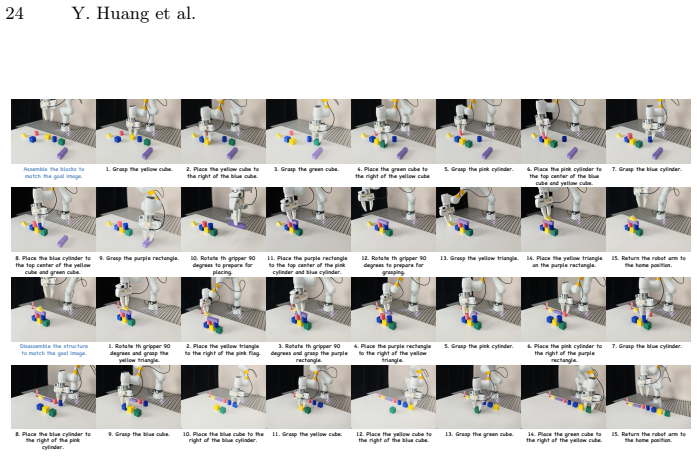
arXiv preprint arXiv:2403.01823 (2024)
Belkhale, S., Ding, T., Xiao, T., Sermanet, P., Vuong, Q., Tompson, J., Chebotar, Y., Dwibedi, D., Sadigh, D.: Rt-h: Action hierarchies using language. arXiv preprint arXiv:2403.01823 (2024)
Pith/arXiv arXiv 2024
-
[3]
arXiv preprint arXiv:2212.06817 (2022)
Brohan, A., Brown, N., Carbajal, J., Chebotar, Y., Dabis, J., Finn, C., Gopalakr- ishnan, K., Hausman, K., Herzog, A., Hsu, J., et al.: Rt-1: Robotics transformer for real-world control at scale. arXiv preprint arXiv:2212.06817 (2022)
Pith/arXiv arXiv 2022
-
[4]
In: Conference on robot learning
Brohan, A., Chebotar, Y., Finn, C., Hausman, K., Herzog, A., Ho, D., Ibarz, J., Irpan, A., Jang, E., Julian, R., et al.: Do as i can, not as i say: Grounding language in robotic affordances. In: Conference on robot learning. pp. 287–318. PMLR (2023)
2023
-
[5]
In: 2025 IEEE International Conference on Robotics and Automation (ICRA)
Cai, W., Ponomarenko, I., Yuan, J., Li, X., Yang, W., Dong, H., Zhao, B.: Spa- tialbot: Precise spatial understanding with vision language models. In: 2025 IEEE International Conference on Robotics and Automation (ICRA). pp. 9490–9498. IEEE (2025)
2025
-
[6]
arXiv preprint arXiv:2511.16719 (2025)
Carion, N., Gustafson, L., Hu, Y.T., Debnath, S., Hu, R., Suris, D., Ryali, C., Alwala, K.V., Khedr, H., Huang, A., et al.: Sam 3: Segment anything with concepts. arXiv preprint arXiv:2511.16719 (2025)
Pith/arXiv arXiv 2025
-
[7]
arXiv preprint arXiv:2507.15493 (2025)
Cheang, C., Chen, S., Cui, Z., Hu, Y., Huang, L., Kong, T., Li, H., Li, Y., Liu, Y., Ma, X., et al.: Gr-3 technical report. arXiv preprint arXiv:2507.15493 (2025)
Pith/arXiv arXiv 2025
-
[8]
Chen, B., Xu, Z., Kirmani, S., Ichter, B., Sadigh, D., Guibas, L., Xia, F.: Spatialvlm: Endowingvision-languagemodelswithspatialreasoningcapabilities.In:Proceedings of the IEEE/CVF Conference on Computer Vision and Pattern Recognition. pp. 14455–14465 (2024)
2024
-
[9]
arXiv preprint arXiv:2512.04069 (2025)
Chen, S., Uy, M.A., Song, C.H., Ladhak, F., Murali, A., Qu, Q., Birchfield, S., Blukis, V., Tremblay, J.: Spacetools: Tool-augmented spatial reasoning via double interactive rl. arXiv preprint arXiv:2512.04069 (2025)
Pith/arXiv arXiv 2025
-
[10]
Advances in Neural Information Processing Systems37, 135062–135093 (2024)
Cheng, A.C., Yin, H., Fu, Y., Guo, Q., Yang, R., Kautz, J., Wang, X., Liu, S.: Spatialrgpt: Grounded spatial reasoning in vision-language models. Advances in Neural Information Processing Systems37, 135062–135093 (2024)
2024
-
[11]
In: Proceedings of the IEEE/CVF International Conference on Computer Vision
Daxberger, E., Wenzel, N., Griffiths, D., Gang, H., Lazarow, J., Kohavi, G., Kang, K., Eichner, M., Yang, Y., Dehghan, A., et al.: Mm-spatial: Exploring 3d spatial understanding in multimodal llms. In: Proceedings of the IEEE/CVF International Conference on Computer Vision. pp. 7395–7408 (2025)
2025
-
[12]
In: 2024 IEEE/RSJ International Conference on Intelligent Robots and Systems (IROS)
Ding, Y., Geng, H., Xu, C., Fang, X., Zhang, J., Wei, S., Dai, Q., Zhang, Z., Wang, H.: Open6dor: Benchmarking open-instruction 6-dof object rearrangement and a vlm-based approach. In: 2024 IEEE/RSJ International Conference on Intelligent Robots and Systems (IROS). pp. 7359–7366. IEEE (2024)
2024
-
[13]
arXiv preprint arXiv:2010.11929 (2020)
Dosovitskiy,A.,Beyer,L.,Kolesnikov,A.,Weissenborn,D.,Zhai,X.,Unterthiner,T., Dehghani, M., Minderer, M., Heigold, G., Gelly, S., et al.: An image is worth 16x16 words: Transformers for image recognition at scale. arXiv preprint arXiv:2010.11929 (2020)
Pith/arXiv arXiv 2010
-
[14]
In: International Conference on Machine Learning
Driess, D., Xia, F., Sajjadi, M.S., Lynch, C., Chowdhery, A., Ichter, B., Wahid, A., Tompson, J., Vuong, Q., Yu, T., et al.: Palm-e: An embodied multimodal language model. In: International Conference on Machine Learning. pp. 8469–8488. PMLR (2023) 16 Y. Huang et al
2023
-
[15]
arXiv preprint arXiv:2303.07280 (2023)
Du, Y., Konyushkova, K., Denil, M., Raju, A., Landon, J., Hill, F., de Fre- itas, N., Cabi, S.: Vision-language models as success detectors. arXiv preprint arXiv:2303.07280 (2023)
Pith/arXiv arXiv 2023
-
[16]
Robotics: Science and Systems XX (2024)
Fang, K., Liu, F., Abbeel, P., Levine, S.: Moka: Open-world robotic manipulation through mark-based visual prompting. Robotics: Science and Systems XX (2024)
2024
-
[17]
arXiv preprint arXiv:2512.02013 (2025)
Gu, C., Liu, J., Chen, H., Huang, R., Wuwu, Q., Liu, Z., Li, X., Li, Y., Zhang, R., Jia, P., et al.: Manualvla: A unified vla model for chain-of-thought manual generation and robotic manipulation. arXiv preprint arXiv:2512.02013 (2025)
arXiv 2025
-
[18]
In: The Thirty-ninth Annual Conference on Neural Information Processing Systems Datasets and Benchmarks Track
Han, S., Qiu, B., Liao, Y., Huang, S., Gao, C., YAN, S., Liu, S.: Robocerebra: A large-scale benchmark for long-horizon robotic manipulation evaluation. In: The Thirty-ninth Annual Conference on Neural Information Processing Systems Datasets and Benchmarks Track
-
[19]
arXiv preprint arXiv:2510.07181 (2025)
Han, Y., Chi, C., Zhou, E., Rong, S., An, J., Wang, P., Wang, Z., Sheng, L., Zhang, S.: Tiger: Tool-integrated geometric reasoning in vision-language models for robotics. arXiv preprint arXiv:2510.07181 (2025)
arXiv 2025
-
[20]
In: First Workshop on Vision-Language Models for Navigation and Manipulation at ICRA 2024
Hu, Y., Lin, F., Zhang, T., Yi, L., Gao, Y.: Look before you leap: Unveiling the power of gpt-4v in robotic vision-language planning. In: First Workshop on Vision-Language Models for Navigation and Manipulation at ICRA 2024
2024
-
[21]
In: 2024 IEEE/RSJ International Conference on Intelligent Robots and Systems (IROS)
Huang, H., Lin, F., Hu, Y., Wang, S., Gao, Y.: Copa: General robotic manipulation through spatial constraints of parts with foundation models. In: 2024 IEEE/RSJ International Conference on Intelligent Robots and Systems (IROS). pp. 9488–9495. IEEE (2024)
2024
-
[22]
In: Conference on Robot Learning
Huang, S., Chang, H., Liu, Y., Zhu, Y., Dong, H., Boularias, A., Gao, P., Li, H.: A3vlm: Actionable articulation-aware vision language model. In: Conference on Robot Learning. pp. 1675–1690. PMLR (2025)
2025
-
[23]
In: International conference on machine learning
Huang, W., Abbeel, P., Pathak, D., Mordatch, I.: Language models as zero-shot planners: Extracting actionable knowledge for embodied agents. In: International conference on machine learning. pp. 9118–9147. PMLR (2022)
2022
-
[24]
In: Conference on Robot Learning
Huang, W., Wang, C., Li, Y., Zhang, R., Fei-Fei, L.: Rekep: Spatio-temporal reasoning of relational keypoint constraints for robotic manipulation. In: Conference on Robot Learning. pp. 4573–4602. PMLR (2025)
2025
-
[25]
In: Conference on Robot Learning
Huang, W., Wang, C., Zhang, R., Li, Y., Wu, J., Fei-Fei, L.: Voxposer: Composable 3d value maps for robotic manipulation with language models. In: Conference on Robot Learning. pp. 540–562. PMLR (2023)
2023
-
[26]
Advances in Neural Information Processing Systems36, 59636–59661 (2023)
Huang, W., Xia, F., Shah, D., Driess, D., Zeng, A., Lu, Y., Florence, P., Mordatch, I., Levine, S., Hausman, K., et al.: Grounded decoding: Guiding text generation with grounded models for embodied agents. Advances in Neural Information Processing Systems36, 59636–59661 (2023)
2023
-
[27]
In: Conference on Robot Learning
Huang, W., Xia, F., Xiao, T., Chan, H., Liang, J., Florence, P., Zeng, A., Tompson, J., Mordatch, I., Chebotar, Y., et al.: Inner monologue: Embodied reasoning through planning with language models. In: Conference on Robot Learning. pp. 1769–1782. PMLR (2023)
2023
-
[28]
arXiv preprint arXiv:2410.21276 (2024)
Hurst, A., Lerer, A., Goucher, A.P., Perelman, A., Ramesh, A., Clark, A., Ostrow, A., Welihinda, A., Hayes, A., Radford, A., et al.: Gpt-4o system card. arXiv preprint arXiv:2410.21276 (2024)
Pith/arXiv arXiv 2024
-
[29]
IEEE Robotics and Automation Letters5(2), 3019–3026 (2020)
James, S., Ma, Z., Arrojo, D.R., Davison, A.J.: Rlbench: The robot learning benchmark & learning environment. IEEE Robotics and Automation Letters5(2), 3019–3026 (2020)
2020
-
[30]
In: International Conference on Machine Learning
Jiang, Y., Gupta, A., Zhang, Z., Wang, G., Dou, Y., Chen, Y., Fei-Fei, L., Anand- kumar, A., Zhu, Y., Fan, L.: Vima: Robot manipulation with multimodal prompts. In: International Conference on Machine Learning. pp. 14975–15022. PMLR (2023) RoboStream 17
2023
-
[31]
In: 2024 IEEE International Conference on Robotics and Automation (ICRA)
Kapelyukh, I., Ren, Y., Alzugaray, I., Johns, E.: Dream2Real: Zero-shot 3D object rearrangement with vision-language models. In: 2024 IEEE International Conference on Robotics and Automation (ICRA). pp. 4796–4803. IEEE (2024)
2024
-
[32]
In: Conference on Robot Learning
Kim, M.J., Pertsch, K., Karamcheti, S., Xiao, T., Balakrishna, A., Nair, S., Rafailov, R., Foster, E.P., Sanketi, P.R., Vuong, Q., et al.: Openvla: An open-source vision- language-action model. In: Conference on Robot Learning. pp. 2679–2713. PMLR (2025)
2025
-
[33]
Behavioral and brain sciences40, e253 (2017)
Lake, B.M., Ullman, T.D., Tenenbaum, J.B., Gershman, S.J.: Building machines that learn and think like people. Behavioral and brain sciences40, e253 (2017)
2017
-
[34]
Nature Machine Intelligence pp
Li, X., Li, P., Qian, L., Liu, M., Wang, D., Liu, J., Kang, B., Ma, X., Wang, X., Guo, D., et al.: What matters in building vision–language–action models for generalist robots. Nature Machine Intelligence pp. 1–15 (2026)
2026
-
[35]
In: Conference on Robot Learning
Li, X., Hsu, K., Gu, J., Mees, O., Pertsch, K., Walke, H.R., Fu, C., Lunawat, I., Sieh, I., Kirmani, S., et al.: Evaluating real-world robot manipulation policies in simulation. In: Conference on Robot Learning. pp. 3705–3728. PMLR (2025)
2025
-
[36]
In: The Thirteenth International Conference on Learning Representations
Li, Y., Deng, Y., Zhang, J., Jang, J., Memmel, M., Garrett, C.R., Ramos, F., Fox, D., Li, A., Gupta, A., et al.: Hamster: Hierarchical action models for open-world robot manipulation. In: The Thirteenth International Conference on Learning Representations
-
[37]
In: 2023 IEEE International conference on robotics and automation (ICRA)
Liang, J., Huang, W., Xia, F., Xu, P., Hausman, K., Ichter, B., Florence, P., Zeng, A.: Code as policies: Language model programs for embodied control. In: 2023 IEEE International conference on robotics and automation (ICRA). pp. 9493–9500. IEEE (2023)
2023
-
[38]
In: 2nd Workshop on Language and Robot Learning: Language as Grounding
Liu, H., Chen, A., Zhu, Y., Swaminathan, A., Kolobov, A., Cheng, C.A.: Interactive robot learning from verbal correction. In: 2nd Workshop on Language and Robot Learning: Language as Grounding
-
[39]
arXiv preprint arXiv:2412.00171 (2024)
Mao, W., Zhong, W., Jiang, Z., Fang, D., Zhang, Z., Lan, Z., Li, H., Jia, F., Wang, T., Fan, H., et al.: Robomatrix: A skill-centric hierarchical framework for scalable robot task planning and execution in open-world. arXiv preprint arXiv:2412.00171 (2024)
Pith/arXiv arXiv 2024
-
[40]
Advances in Neural Information Processing Systems36, 25081–25094 (2023)
Mu, Y., Zhang, Q., Hu, M., Wang, W., Ding, M., Jin, J., Wang, B., Dai, J., Qiao, Y., Luo, P.: Embodiedgpt: Vision-language pre-training via embodied chain of thought. Advances in Neural Information Processing Systems36, 25081–25094 (2023)
2023
-
[41]
In: The Thirty-ninth Annual Conference on Neural Information Processing Systems
Qi, Z., Zhang, W., Ding, Y., Dong, R., Yu, X., Li, J., Xu, L., Li, B., He, X., Fan, G., et al.: Sofar: Language-grounded orientation bridges spatial reasoning and object manipulation. In: The Thirty-ninth Annual Conference on Neural Information Processing Systems
-
[42]
In: Proceedings of the IEEE/CVF International Conference on Computer Vision
Qin, Y., Kang, L., Song, X., Yin, Z., Liu, X., Liu, X., Zhang, R., Bai, L.: Robofac- tory: Exploring embodied agent collaboration with compositional constraints. In: Proceedings of the IEEE/CVF International Conference on Computer Vision. pp. 10075–10085 (2025)
2025
-
[43]
arXiv preprint arXiv:2501.15830 (2025)
Qu, D., Song, H., Chen, Q., Yao, Y., Ye, X., Ding, Y., Wang, Z., Gu, J., Zhao, B., Wang, D., et al.: Spatialvla: Exploring spatial representations for visual-language- action model. arXiv preprint arXiv:2501.15830 (2025)
Pith/arXiv arXiv 2025
-
[44]
In: International conference on machine learning
Radford, A., Kim, J.W., Hallacy, C., Ramesh, A., Goh, G., Agarwal, S., Sastry, G., Askell, A., Mishkin, P., Clark, J., et al.: Learning transferable visual models from natural language supervision. In: International conference on machine learning. pp. 8748–8763. PmLR (2021)
2021
-
[45]
Huang et al
Ray, A., Duan, J., Brown II, E.L., Tan, R., Bashkirova, D., Hendrix, R., Ehsani, K., Kembhavi, A., Plummer, B.A., Krishna, R., et al.: Sat: Dynamic spatial aptitude 18 Y. Huang et al. training for multimodal language models. In: Second Conference on Language Modeling
-
[46]
arXiv preprint arXiv:2204.05186 (2022)
Sharma, P., Sundaralingam, B., Blukis, V., Paxton, C., Hermans, T., Torralba, A., Andreas, J., Fox, D.: Correcting robot plans with natural language feedback. arXiv preprint arXiv:2204.05186 (2022)
Pith/arXiv arXiv 2022
-
[47]
Robotics: Science and Systems XX (2024)
Shi, L., Hu, Z., Zhao, T., Sharma, A., Pertsch, K., Luo, J., Levine, S., Finn, C.: Yell at your robot: Improving on-the-fly from language corrections. Robotics: Science and Systems XX (2024)
2024
-
[48]
In: International Conference on Machine Learning
Shi, L.X., Ichter, B., Equi, M.R., Ke, L., Pertsch, K., Vuong, Q., Tanner, J., Walling, A., Wang, H., Fusai, N., et al.: Hi robot: Open-ended instruction following with hierarchical vision-language-action models. In: International Conference on Machine Learning. pp. 54919–54933. PMLR (2025)
2025
-
[49]
In: Conference on Robot Learning
Shridhar, M., Manuelli, L., Fox, D.: Perceiver-actor: A multi-task transformer for robotic manipulation. In: Conference on Robot Learning. pp. 785–799. PMLR (2023)
2023
-
[50]
In: 2023 IEEE International Conference on Robotics and Automation (ICRA)
Singh, I., Blukis, V., Mousavian, A., Goyal, A., Xu, D., Tremblay, J., Fox, D., Thomason, J., Garg, A.: Progprompt: Generating situated robot task plans using large language models. In: 2023 IEEE International Conference on Robotics and Automation (ICRA). pp. 11523–11530. IEEE (2023)
2023
-
[51]
In: Proceedings of the Computer Vision and Pattern Recognition Conference
Song, C.H., Blukis, V., Tremblay, J., Tyree, S., Su, Y., Birchfield, S.: Robospatial: Teaching spatial understanding to 2d and 3d vision-language models for robotics. In: Proceedings of the Computer Vision and Pattern Recognition Conference. pp. 15768–15780 (2025)
2025
-
[52]
arXiv preprint arXiv:2505.03673 (2025)
Tan, H., Hao, X., Chi, C., Lin, M., Lyu, Y., Cao, M., Liang, D., Chen, Z., Lyu, M., Peng, C., et al.: Roboos: A hierarchical embodied framework for cross-embodiment and multi-agent collaboration. arXiv preprint arXiv:2505.03673 (2025)
Pith/arXiv arXiv 2025
-
[53]
arXiv preprint arXiv:2405.12213 (2024)
Team, O.M., Ghosh, D., Walke, H., Pertsch, K., Black, K., Mees, O., Dasari, S., Hejna, J., Kreiman, T., Xu, C., et al.: Octo: An open-source generalist robot policy. arXiv preprint arXiv:2405.12213 (2024)
Pith/arXiv arXiv 2024
-
[54]
In: Proceedings of the IEEE/CVF Conference on Computer Vision and Pattern Recognition
Wald, J., Dhamo, H., Navab, N., Tombari, F.: Learning 3d semantic scene graphs from 3d indoor reconstructions. In: Proceedings of the IEEE/CVF Conference on Computer Vision and Pattern Recognition. pp. 3961–3970 (2020)
2020
-
[55]
In: 2025 IEEE/CVF Conference on Computer Vision and Pattern Recognition (CVPR)
Wang, X., Ma, W., Zhang, T., de Melo, C.M., Chen, J., Yuille, A.: Spatial457: A diagnostic benchmark for 6d spatial reasoning of large multimodal models. In: 2025 IEEE/CVF Conference on Computer Vision and Pattern Recognition (CVPR). pp. 24669–24679. IEEE (2025)
2025
-
[56]
Advances in neural information processing systems35, 24824–24837 (2022)
Wei, J., Wang, X., Schuurmans, D., Bosma, M., Xia, F., Chi, E., Le, Q.V., Zhou, D., et al.: Chain-of-thought prompting elicits reasoning in large language models. Advances in neural information processing systems35, 24824–24837 (2022)
2022
-
[57]
In: Conference on Robot Learning
Wen, J., Zhu, Y., Li, J., Tang, Z., Shen, C., Feng, F.: Dexvla: Vision-language model with plug-in diffusion expert for general robot control. In: Conference on Robot Learning. pp. 3094–3114. PMLR (2025)
2025
-
[58]
In: 2023 IEEE/RSJ International Conference on Intelligent Robots and Systems (IROS)
Wu,J.,Antonova,R.,Kan,A.,Lepert,M.,Zeng,A.,Song,S.,Bohg,J.,Rusinkiewicz, S., Funkhouser, T.: Tidybot: Personalized robot assistance with large language models. In: 2023 IEEE/RSJ International Conference on Intelligent Robots and Systems (IROS). pp. 3546–3553. IEEE (2023)
2023
-
[59]
arXiv preprint arXiv:2505.09388 (2025)
Yang, A., Li, A., Yang, B., Zhang, B., Hui, B., Zheng, B., Yu, B., Gao, C., Huang, C., Lv, C., et al.: Qwen3 technical report. arXiv preprint arXiv:2505.09388 (2025)
Pith/arXiv arXiv 2025
-
[60]
arXiv preprint arXiv:2310.11441 (2023) RoboStream 19
Yang, J., Zhang, H., Li, F., Zou, X., Li, C., Gao, J.: Set-of-mark prompting unleashes extraordinary visual grounding in gpt-4v. arXiv preprint arXiv:2310.11441 (2023) RoboStream 19
Pith/arXiv arXiv 2023
-
[61]
In: CVPR (2024)
Yang, L., Kang, B., Huang, Z., Xu, X., Feng, J., Zhao, H.: Depth anything: Un- leashing the power of large-scale unlabeled data. In: CVPR (2024)
2024
-
[62]
arXiv preprint arXiv:2506.00411 (2025)
Yang, Y., Sun, J., Kou, S., Wang, Y., Deng, Z.: Lohovla: A unified vision-language- action model for long-horizon embodied tasks. arXiv preprint arXiv:2506.00411 (2025)
Pith/arXiv arXiv 2025
-
[63]
In: Conference on Robot Learning
Yu, W., Gileadi, N., Fu, C., Kirmani, S., Lee, K.H., Arenas, M.G., Chiang, H.T.L., Erez, T., Hasenclever, L., Humplik, J., et al.: Language to rewards for robotic skill synthesis. In: Conference on Robot Learning. pp. 374–404. PMLR (2023)
2023
-
[64]
In: Conference on Robot Learning
Yuan, W., Duan, J., Blukis, V., Pumacay, W., Krishna, R., Murali, A., Mousavian, A., Fox, D.: Robopoint: A vision-language model for spatial affordance prediction in robotics. In: Conference on Robot Learning. pp. 4005–4020. PMLR (2025)
2025
-
[65]
In: Conference on Robot Learning
Zawalski, M., Chen, W., Pertsch, K., Mees, O., Finn, C., Levine, S.: Robotic control via embodied chain-of-thought reasoning. In: Conference on Robot Learning. pp. 3157–3181. PMLR (2025)
2025
-
[66]
In: The Eleventh International Conference on Learning Representations
Zeng, A., Attarian, M., Choromanski, K.M., Wong, A., Welker, S., Tombari, F., Purohit, A., Ryoo, M.S., Sindhwani, V., Lee, J., et al.: Socratic models: Composing zero-shot multimodal reasoning with language. In: The Eleventh International Conference on Learning Representations
-
[67]
In: 2025 IEEE/RSJ International Conference on Intelligent Robots and Systems (IROS)
Zhang, K., Yin, Z.H., Ye, W., Gao, Y.: Learning manipulation skills through robot chain-of-thought with sparse failure guidance. In: 2025 IEEE/RSJ International Conference on Intelligent Robots and Systems (IROS). pp. 8012–8018. IEEE (2025)
2025
-
[68]
In: Proceedings of the Computer Vision and Pattern Recognition Conference
Zhao, Q., Lu, Y., Kim, M.J., Fu, Z., Zhang, Z., Wu, Y., Li, Z., Ma, Q., Han, S., Finn, C., et al.: Cot-vla: Visual chain-of-thought reasoning for vision-language- action models. In: Proceedings of the Computer Vision and Pattern Recognition Conference. pp. 1702–1713 (2025)
2025
-
[69]
In: International Conference on Machine Learning
Zhen, H., Qiu, X., Chen, P., Yang, J., Yan, X., Du, Y., Hong, Y., Gan, C.: 3d-vla: A 3d vision-language-action generative world model. In: International Conference on Machine Learning. pp. 61229–61245. PMLR (2024)
2024
-
[70]
In: The Thirty-ninth Annual Conference on Neural Information Processing Systems
Zhou, E., An, J., Chi, C., Han, Y., Rong, S., Zhang, C., Wang, P., Wang, Z., Huang, T., Sheng, L., et al.: Roborefer: Towards spatial referring with reasoning in vision-language models for robotics. In: The Thirty-ninth Annual Conference on Neural Information Processing Systems
-
[71]
In: Proceedings of the Computer Vision and Pattern Recognition Conference
Zhou, E., Su, Q., Chi, C., Zhang, Z., Wang, Z., Huang, T., Sheng, L., Wang, H.: Code-as-monitor: Constraint-aware visual programming for reactive and proactive robotic failure detection. In: Proceedings of the Computer Vision and Pattern Recognition Conference. pp. 6919–6929 (2025)
2025
-
[72]
In: The Thirty-ninth Annual Conference on Neural Information Processing Systems
Zhu, K., Bai, F., Xiang, Y., Cai, Y., Chen, X., Li, R., Wang, X., Dong, H., Yang, Y., Fan, X., et al.: Dexflywheel: A scalable and self-improving data generation framework for dexterous manipulation. In: The Thirty-ninth Annual Conference on Neural Information Processing Systems
-
[73]
In: Conference on Robot Learning
Zitkovich, B., Yu, T., Xu, S., Xu, P., Xiao, T., Xia, F., Wu, J., Wohlhart, P., Welker, S., Wahid, A., et al.: Rt-2: Vision-language-action models transfer web knowledge to robotic control. In: Conference on Robot Learning. pp. 2165–2183. PMLR (2023) 20 Y. Huang et al. Appendix A Robot Setups A.1 Simulation Robot Setups We run all simulation experiments i...
2023
-
[74]
Grasp the green cube. 2. Place the green cube to the right of the blue cube
-
[75]
Grasp the orange rectangle. 4. Rotate th gripper 90 degrees to prepare for placing
-
[76]
Place the orange rectangle on the top center of the blue cube and green cube
-
[77]
Assemble the blocks to match the goal image
Return the robot arm to the home position. Assemble the blocks to match the goal image. Disassemble the structure to match the goal image
-
[79]
Grasp the orange rectangle. 3. Place the orange rectangle to the right of the pink flag
-
[81]
Grasp the blue cube. 6. Place the blue cube to the right of the orange rectangle
-
[82]
Grasp the green cube. 8. Place the green cube to the right of the blue cube
discussion (0)
Sign in with ORCID, Apple, or X to comment. Anyone can read and Pith papers without signing in.