Recognition: no theorem link
Minimising Willmore Energy via Neural Flow
Pith reviewed 2026-05-10 20:19 UTC · model grok-4.3
The pith
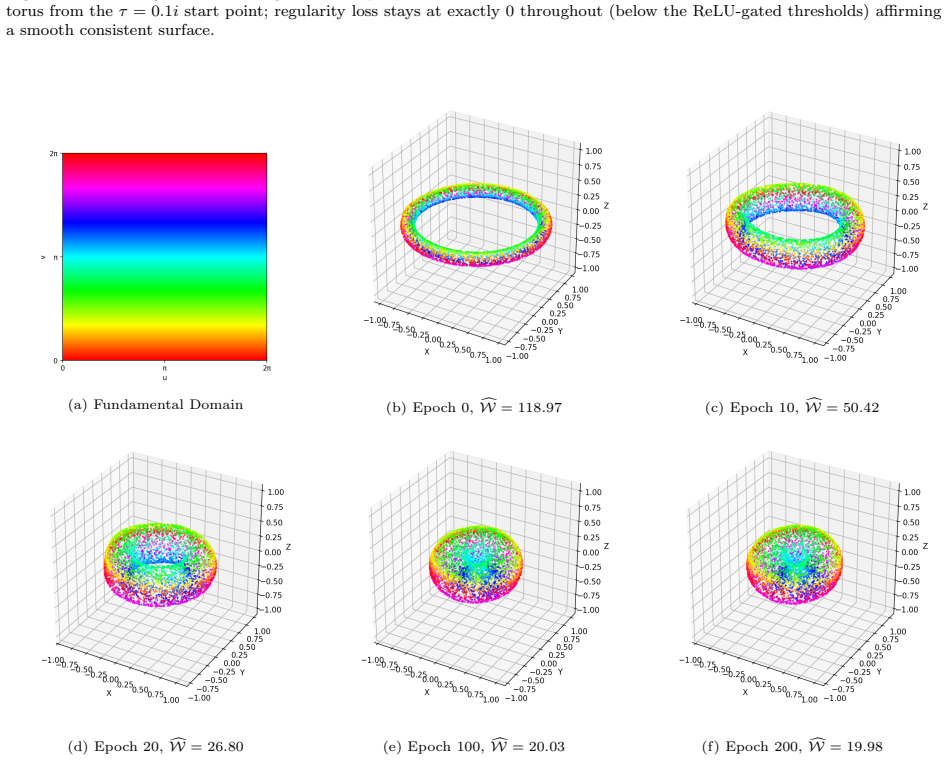
Neural networks trained to minimize Willmore energy recover the round sphere for genus 0 and the Clifford torus for genus 1.
A machine-rendered reading of the paper's core claim, the machinery that carries it, and where it could break.
Core claim
A neural parameterization of a surface embedding, evolved by minimizing a PINN-style loss on the Willmore energy, reproduces the round sphere when the surface has genus 0 and the Clifford torus when the surface has genus 1; the same procedure supplies a new numerical method for locating candidate minimal Willmore surfaces of genus 2.
What carries the argument
The neural Willmore flow: a map from a fixed 2-dimensional domain to R^3, realized by a neural network, whose parameters are updated to minimize a loss functional equal to the Willmore energy of the resulting embedding.
If this is right
- The method identifies the known minimizers of the Willmore functional for genus 0 and genus 1 surfaces.
- The same training procedure can be run on genus-2 surfaces to generate candidate minimal-energy embeddings.
- The neural flow supplies a variational search technique for the open Willmore problem in higher genus.
- Convergence of the loss to the known minimal values validates the use of PINN-style objectives for this geometric variational problem.
Where Pith is reading between the lines
- The approach could be tested on surfaces with prescribed topology or boundary conditions to locate other critical points of the Willmore functional.
- Success on the Clifford torus suggests that similar neural losses might locate minimal-energy embeddings in other curvature-based problems such as total curvature minimization.
- If the genus-2 output satisfies the Euler-Lagrange equation of the Willmore functional, it would constitute a new numerical candidate for the open problem.
Load-bearing premise
The neural network and the chosen loss function are expressive enough to locate the global minimizer of the Willmore energy rather than a local minimum or a discretization artifact.
What would settle it
Training the network on a genus-0 surface and obtaining a final embedding whose Willmore energy is strictly greater than 4 pi, or whose mean curvature is not constant, would show that the method does not reach the known minimizer.
Figures




read the original abstract
The neural Willmore flow of a closed oriented $2$-surface in $\mathbb{R}^3$ is introduced as a natural evolution process to minimise the Willmore energy, which is the squared $L^2$-norm of mean curvature. Neural architectures are used to model maps from topological $2d$ domains to $3d$ Euclidean space, where the learning process minimises a PINN-style loss for the Willmore energy as a functional on the embedding. Training reproduces the expected round sphere for genus $0$ surfaces, and the Clifford torus for genus $1$ surfaces, respectively. Furthermore, the experiment in the genus $2$ case provides a novel approach to search for minimal Willmore surfaces in this open problem.
Editorial analysis
A structured set of objections, weighed in public.
Referee Report
Summary. The manuscript introduces a neural Willmore flow that parameterizes closed oriented surfaces in R^3 via neural maps from 2D topological domains and minimizes the Willmore energy ∫H² dA through a PINN-style loss. Training is reported to recover the round sphere (genus 0) and Clifford torus (genus 1), while the genus-2 experiment is presented as a new search method for minimizers of this open problem.
Significance. If the neural parameterization and optimization reliably attain the global infimum rather than local critical points, the approach would supply a flexible computational tool for the Willmore problem and related geometric variational problems, especially for higher-genus surfaces where analytic candidates are unavailable. The method's strength would lie in its mesh-free nature and potential extensibility, provided quantitative validation against known energies and convergence diagnostics are supplied.
major comments (3)
- [Abstract / Experiments] Abstract and Experiments section: the claim that training 'reproduces the expected round sphere' and 'Clifford torus' is not supported by reported Willmore energy values, error bars, or direct comparison to the known analytic minima (4π for the sphere, 2π² for the Clifford torus). Without these diagnostics the recovery cannot be verified against the theoretical global minimum.
- [Method / Experiments] Method and Experiments: the Willmore functional is non-convex on the space of immersions, yet the manuscript provides no evidence of multiple random initializations, convergence plots of the loss, or comparison against established discretizations (e.g., discrete Willmore flow or finite-element methods). This leaves open the possibility that reported shapes are local minima or discretization artifacts of the chosen network and quadrature.
- [Experiments (genus 2)] Genus-2 experiment: the assertion that the procedure 'provides a novel approach to search for minimal Willmore surfaces' requires at least a quantitative comparison of the attained energy against previously published numerical upper bounds; absent such data the novelty claim rests only on the use of neural parameterization rather than on a demonstrably lower energy.
minor comments (2)
- [Method] Notation for the neural map and the precise quadrature rule used to evaluate the PINN loss should be stated explicitly in the Method section to allow reproducibility.
- [Method] The manuscript should clarify whether the neural parameterization enforces closedness and orientability by construction or via additional penalty terms.
Simulated Author's Rebuttal
We thank the referee for the constructive and detailed report. We address each major comment point by point below. The revisions will focus on adding the requested quantitative diagnostics and clarifying the scope of the genus-2 experiment without overstating the results.
read point-by-point responses
-
Referee: [Abstract / Experiments] Abstract and Experiments section: the claim that training 'reproduces the expected round sphere' and 'Clifford torus' is not supported by reported Willmore energy values, error bars, or direct comparison to the known analytic minima (4π for the sphere, 2π² for the Clifford torus). Without these diagnostics the recovery cannot be verified against the theoretical global minimum.
Authors: We agree that explicit numerical support is necessary for rigorous verification. The original manuscript presents the results primarily through visualizations of the recovered surfaces and the qualitative match to the known minimizers. In the revised version we will add a table reporting the final Willmore energies attained by the trained networks, together with standard deviations obtained from multiple independent training runs, and direct numerical comparisons against the analytic values 4π and 2π². revision: yes
-
Referee: [Method / Experiments] Method and Experiments: the Willmore functional is non-convex on the space of immersions, yet the manuscript provides no evidence of multiple random initializations, convergence plots of the loss, or comparison against established discretizations (e.g., discrete Willmore flow or finite-element methods). This leaves open the possibility that reported shapes are local minima or discretization artifacts of the chosen network and quadrature.
Authors: The non-convexity of the Willmore functional is a valid concern. Our experiments employed a deterministic initialization derived from the standard parametrization of the topological domain. We will augment the Experiments section with (i) loss-convergence plots for representative runs and (ii) results from at least five random initializations demonstrating that the same limiting shapes and energies are recovered. A short discussion comparing the neural energies to values reported in the discrete Willmore-flow literature will also be added; we note that a full side-by-side implementation of alternative discretizations lies beyond the scope of the present work but can be referenced for context. revision: partial
-
Referee: [Experiments (genus 2)] Genus-2 experiment: the assertion that the procedure 'provides a novel approach to search for minimal Willmore surfaces' requires at least a quantitative comparison of the attained energy against previously published numerical upper bounds; absent such data the novelty claim rests only on the use of neural parameterization rather than on a demonstrably lower energy.
Authors: The genus-2 experiment is presented as a proof-of-concept demonstration that the neural-flow framework can be applied to an open variational problem. We will revise the abstract and the relevant section to describe the result explicitly as a search procedure rather than a claim of a new global minimizer. In addition, we will locate the principal published numerical upper bounds for genus-2 Willmore surfaces and include a direct comparison of the energy obtained by our method against those bounds. revision: yes
Circularity Check
No significant circularity; direct minimization of classical functional
full rationale
The paper defines a neural parameterization of surfaces and minimizes a loss that is the direct discretization of the classical Willmore energy integrand (squared mean curvature) via standard PINN-style training. No equations or claims reduce by construction to fitted parameters renamed as predictions, self-definitional loops, or load-bearing self-citations. Reproduction of the round sphere and Clifford torus for genus 0/1 is presented as empirical validation against known analytic minimizers, while the genus-2 case is framed as an exploratory search without a uniqueness theorem or ansatz smuggled from prior author work. The derivation chain is therefore self-contained against the external mathematical definition of the Willmore functional.
Axiom & Free-Parameter Ledger
axioms (2)
- standard math Willmore energy equals the L2 norm squared of mean curvature on a closed oriented surface in R3.
- domain assumption A neural network can serve as a differentiable parameterization of an embedded surface whose energy can be minimized by gradient descent.
Forward citations
Cited by 2 Pith papers
-
A semicontinuous relaxation of Saito's criterion and freeness as angular minimization
A new functional S vanishes precisely on free line arrangements and enables discovery of verified free examples for every admissible exponent pair with up to 20 lines.
-
PINNs in More General Geometry
PINNs can address differential geometry problems by training neural networks to minimize functionals that encode geometric conditions, as shown through summaries of three related studies.
Reference graph
Works this paper leans on
-
[1]
Note on embedded surfaces,
T. J. Willmore, “Note on embedded surfaces,”An. S ¸tiint ¸. Univ. “Al. I. Cuza” Ia¸ si Sect ¸. I a Mat. (N.S.)11B(1965) 493–496
1965
-
[2]
Min-max theory and the willmore conjecture,
F. C. Marques and A. Neves, “Min-max theory and the willmore conjecture,”Annals of Mathematics 179no. 2, (2014) 683–782
2014
-
[3]
AInstein: Numerical Einstein Metrics via Machine Learning,
E. Hirst, T. S. Gherardini, and A. G. Stapleton, “AInstein: Numerical Einstein Metrics via Machine Learning,”arXiv:2502.13043 [hep-th]
-
[4]
A Machine Learning Approach to the Nirenberg Problem,
G. Cort´ es, M. Esteban-Casadevall, Y. Feng, J. Henkel, E. Hirst, T. S. Gherardini, and A. G. Stapleton, “A Machine Learning Approach to the Nirenberg Problem,”arXiv:2602.12368 [cs.LG]
-
[5]
Numerical Calabi–Yau metrics from holomorphic networks,
D. Michael, L. Subramanian, and Q. Yidi, “Numerical Calabi–Yau metrics from holomorphic networks,”Proceedings of Machine Learning Research145(2020) 223–252,arXiv:2012.04797 [hep-th]
-
[6]
Learning Size and Shape of Calabi-Yau Spaces,
M. Larfors, A. Lukas, F. Ruehle, and R. Schneider, “Learning Size and Shape of Calabi-Yau Spaces,” 11, 2021. 19
2021
-
[7]
arXiv , journal =:2211.12520 , journal =
M. Gerdes and S. Krippendorf, “CYJAX: A package for Calabi–Yau metrics with JAX,”Mach. Learn. Sci. Tech.4no. 2, (2023) 025031,arXiv:2211.12520 [hep-th]
-
[8]
Machine-learned Calabi–Yau metrics and curvature,
P. Berglund, G. Butbaia, T. H¨ uubsch, V. Jejjala, D. Mayorga Pe˜ na, C. Mishra, and J. Tan, “Machine-learned Calabi–Yau metrics and curvature,”Adv. Theor. Math. Phys.27no. 4, (2023) 1107–1158,arXiv:2211.09801 [hep-th]
-
[9]
Harmonic 1-forms on real loci of Calabi–Yau manifolds,
M. R. Douglas, D. Platt, and Y. Qi, “Harmonic 1-forms on real loci of Calabi–Yau manifolds,” May, 2024.https://arxiv.org/abs/2405.19402
-
[10]
https://arxiv.org/ abs/2602.12438
E. Heyes, E. Hirst, H. N. S. Earp, and T. S. R. Silva, “Neural and numerical methods for G2-structures on contact Calabi-Yau 7-manifolds,”arXiv:2602.12438 [math.DG]
-
[11]
Computer-assisted proofs in pde: A survey,
J. G´ omez-Serrano, “Computer-assisted proofs in pde: A survey,”Notices of the AMS66no. 3, (2019) 298–310
2019
-
[12]
Y. Wang, C.-Y. Lai, J. G´ omez-Serrano, and T. Buckmaster, “Asymptotic self-similar blow-up profile for three-dimensional axisymmetric Euler equations using neural networks,”Phys. Rev. Lett.130 (Jun, 2023) 244002.https://link.aps.org/doi/10.1103/PhysRevLett.130.244002
-
[13]
Non-uniqueness and symmetries for the nirenberg problem using computer assistance,
D. Platt, “Non-uniqueness and symmetries for the nirenberg problem using computer assistance,” 2026.https://arxiv.org/abs/2603.29544
-
[14]
Approximating high-dimensional minimal surfaces with physics-informed neural networks,
S. Zhou and X. Ye, “Approximating high-dimensional minimal surfaces with physics-informed neural networks,” 2023
2023
-
[15]
Physics-informed neural network solves minimal surfaces in curved spacetime,
K. Hashimoto, K. Kyo, M. Murata, G. Ogiwara, and N. Tanahashi, “Physics-informed neural network solves minimal surfaces in curved spacetime,”Mach. Learn. Sci. Tech.7no. 1, (2026) 015013, arXiv:2509.10866 [hep-th]
-
[16]
PyTorch: An Imperative Style, High-Performance Deep Learning Library
A. Paszke, S. Gross, F. Massa, A. Lerer, J. Bradbury, G. Chanan, T. Killeen, Z. Lin, N. Gimelshein, L. Antiga, A. Desmaison, A. K¨ opf, E. Yang, Z. DeVito, M. Raison, A. Tejani, S. Chilamkurthy, B. Steiner, L. Fang, J. Bai, and S. Chintala, “Pytorch: An imperative style, high-performance deep learning library,” 2019.https://arxiv.org/abs/1912.01703
work page internal anchor Pith review Pith/arXiv arXiv 2019
-
[17]
¨Uber konforme Geometrie I: Grundlagen der konformen Fl¨ achentheorie,
G. Thomsen, “ ¨Uber konforme Geometrie I: Grundlagen der konformen Fl¨ achentheorie,”Abh. Math. Semin. Univ. Hambg.3(1923) 31–56
1923
-
[18]
Blaschke,Vorlesungen ¨ uber Differentialgeometrie, III
W. Blaschke,Vorlesungen ¨ uber Differentialgeometrie, III. Springer, Berlin, 1929
1929
-
[19]
A global invariant of conformal mappings in space,
J. H. White, “A global invariant of conformal mappings in space,”Proc. Amer. Math. Soc.38no. 1, (1973) 162–164
1973
-
[20]
Metric flows with neural networks,
J. Halverson and F. Ruehle, “Metric flows with neural networks,”Mach. Learn. Sci. Tech.5no. 4, (2024) 045020,arXiv:2310.19870 [hep-th]
-
[21]
A new conformal invariant and its applications to the Willmore conjecture and the first eigenvalue of compact surfaces,
P. Li and S.-T. Yau, “A new conformal invariant and its applications to the Willmore conjecture and the first eigenvalue of compact surfaces,”Invent. Math.69no. 2, (1982) 269–291
1982
-
[22]
Existence of surfaces minimizing the willmore functional,
L. Simon, “Existence of surfaces minimizing the willmore functional,”Communications in Analysis and Geometry1no. 2, (1993) 281–326
1993
-
[23]
Existence of minimizing Willmore surfaces of prescribed genus,
M. Bauer and E. Kuwert, “Existence of minimizing Willmore surfaces of prescribed genus,”Int. Math. Res. Not.no. 10, (2003) 553–576
2003
-
[24]
Analysis aspects of Willmore surfaces,
T. Rivi` ere, “Analysis aspects of Willmore surfaces,”Invent. Math.174no. 1, (2008) 1–45
2008
-
[25]
Comparison surfaces for the Willmore problem,
R. Kusner, “Comparison surfaces for the Willmore problem,”Pacific J. Math.138no. 2, (1989) 317–345
1989
-
[26]
Complete minimal surfaces inS 3,
H. B. Lawson, “Complete minimal surfaces inS 3,”Ann. of Math. (2)92no. 3, (1970) 335–374. 20
1970
-
[27]
Minimizing the squared mean curvature integral for surfaces in space forms,
L. Hsu, R. Kusner, and J. Sullivan, “Minimizing the squared mean curvature integral for surfaces in space forms,”Experiment. Math.1no. 3, (1992) 191–207
1992
-
[28]
Goodfellow, Y
I. Goodfellow, Y. Bengio, and A. Courville,Deep Learning. MIT Press, 2016
2016
-
[29]
Learning representations by back-propagating errors,
D. E. Rumelhart, G. E. Hinton, and R. J. Williams, “Learning representations by back-propagating errors,”Nature323(1986) 533–536
1986
-
[30]
Adam: A Method for Stochastic Optimization
D. P. Kingma and J. Ba, “Adam: A method for stochastic optimization,”arXiv:1412.6980 [cs.LG]. https://arxiv.org/abs/1412.6980
work page internal anchor Pith review Pith/arXiv arXiv
-
[31]
Approximation by superpositions of a sigmoidal function,
G. Cybenko, “Approximation by superpositions of a sigmoidal function,”Math. Control Signals Systems2no. 4, (1989) 303–314
1989
-
[32]
Approximation capabilities of multilayer feedforward networks,
K. Hornik, “Approximation capabilities of multilayer feedforward networks,”Neural Netw.4no. 2, (1991) 251–257
1991
-
[33]
Universal approximation bounds for superpositions of a sigmoidal function,
A. R. Barron, “Universal approximation bounds for superpositions of a sigmoidal function,”IEEE Trans. Inform. Theory39no. 3, (1993) 930–945
1993
-
[34]
Neural network approximation,
R. DeVore, B. Hanin, and G. Petrova, “Neural network approximation,”Acta Numer.30(2021) 327–444
2021
-
[35]
Error bounds for approximations with deep ReLU networks,
D. Yarotsky, “Error bounds for approximations with deep ReLU networks,”Neural Netw.94(2017) 103–114
2017
-
[36]
Physics-informed neural networks: A deep learning framework for solving forward and inverse problems involving nonlinear partial differential equations,
M. Raissi, P. Perdikaris, and G. E. Karniadakis, “Physics-informed neural networks: A deep learning framework for solving forward and inverse problems involving nonlinear partial differential equations,” J. Comput. Phys.378(2019) 686–707
2019
-
[37]
Physics-informed machine learning,
G. E. Karniadakis, I. G. Kevrekidis, L. Lu, P. Perdikaris, S. Wang, and L. Yang, “Physics-informed machine learning,”Nat. Rev. Phys.3no. 6, (2021) 422–440
2021
-
[38]
Automatic differentiation in machine learning: a survey,
A. G. Baydin, B. A. Pearlmutter, A. A. Radul, and J. M. Siskind, “Automatic differentiation in machine learning: a survey,”J. Mach. Learn. Res.18no. 153, (2018) 1–43
2018
-
[39]
Finite elements on evolving surfaces,
G. Dziuk and C. M. Elliott, “Finite elements on evolving surfaces,”IMA J. Numer. Anal.27no. 2, (2007) 262–292
2007
-
[40]
Robust fairing via conformal curvature flow,
K. Crane, U. Pinkall, and P. Schr¨ oder, “Robust fairing via conformal curvature flow,”ACM Trans. Graph.32no. 4, (2013) 61:1–61:10
2013
-
[41]
Lawson surfaces
GeometrieWerkstatt, “Lawson surfaces.”http://geometriewerkstatt.com/LawsonSurfaces.html
-
[42]
C. M. Bishop,Pattern Recognition and Machine Learning. Information Science and Statistics. Springer, New York, NY, Aug., 2016
2016
-
[43]
Goodfellow, Y
I. Goodfellow, Y. Bengio, and A. Courville,Deep Learning. MIT Press, Cambridge, MA, 2016. http://www.deeplearningbook.org
2016
-
[44]
S. J. Prince,Understanding Deep Learning. The MIT Press, Cambridge, MA, 2023. http://udlbook.com. 21
2023
discussion (0)
Sign in with ORCID, Apple, or X to comment. Anyone can read and Pith papers without signing in.