Directional and correlated optical emission from a waveguide-engineered molecule with local control
Pith reviewed 2026-05-10 19:04 UTC · model grok-4.3
The pith
Two quantum dots 26 wavelengths apart in a waveguide form an artificial molecule whose emission direction is switched by driving phase.
A machine-rendered reading of the paper's core claim, the machinery that carries it, and where it could break.
Core claim
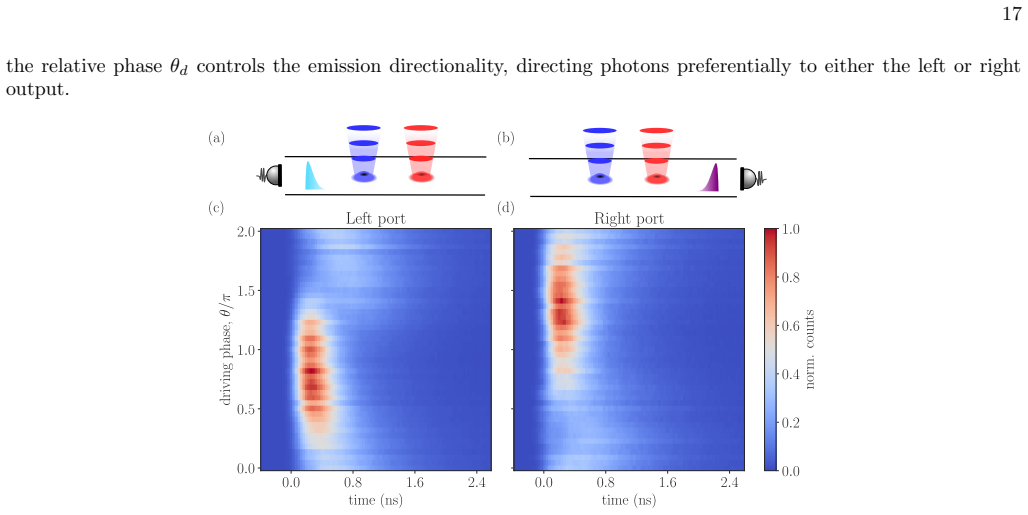
A pair of quantum dots embedded in a bidirectional photonic crystal waveguide, separated by 13 μm or 26 effective wavelengths, form an artificial molecule through a dispersive dipole-dipole interaction that shifts the energy of collective states. This interaction allows the emission direction to be switched from leftward to rightward by changing the relative phase of the collective driving fields. Under continuous driving, directional photon statistics appear, with single photons detected on one output port and photon pairs on the other. With pulsed excitation both emitters are fully inverted and correlated photon pairs are recorded in time-resolved intensity correlations. The setup realizes
What carries the argument
the artificial molecule created by two quantum dots via their dispersive dipole-dipole interaction in the waveguide, whose energy shifts enable phase-controlled switching of emission direction.
If this is right
- Emission direction switches from left to right by adjusting the relative phase of the driving fields during collective excitation.
- Under continuous driving, single photons appear on one output port while photon pairs appear on the other.
- Pulsed excitation fully inverts both emitters and produces time-resolved correlated photon pairs.
- The configuration realizes chiral quantum optics effects inside an ordinary non-chiral waveguide.
- The platform supplies concrete steps toward scaling to multi-emitter waveguide QED systems with local control.
Where Pith is reading between the lines
- Independent electrical tuning of each dot could enable selective addressing of individual collective states in larger arrays.
- Persistence of the coupling over 13 micrometers suggests that similar interactions could link emitters across integrated photonic circuits.
- The observed directional photon correlations could be used to route heralded single photons or entangled pairs to chosen outputs.
- Extending the same phase-control principle to three or more emitters might produce more complex directional and correlation patterns.
Load-bearing premise
The two emitters remain radiatively coupled via dispersive dipole-dipole interaction despite separation of 26 effective wavelengths, permitting collective states with usable energy shifts.
What would settle it
No measurable change in the left-to-right intensity ratio when the relative driving phase is varied, or absence of direction-dependent difference in the second-order correlation function between the two ports.
Figures




read the original abstract
Radiative coupling between quantum emitters leads to a range of spectacular emission phenomena. Dicke studied the foundations of collectively enhanced and suppressed decay, commonly referred to as super- and subradiance. Collective effects can further result in directionality of the emission, thus offering a complimentary implementation of chiral quantum optics. Waveguide quantum electrodynamics (QED) allows coupling between spatially separated emitters, enabling selective driving. In this work, we control the emission direction for a pair of quantum dots embedded in a bidirectional photonic crystal waveguide offering independent electrical tuning. Notably the emitters are 13 \micro m apart, which corresponds to 26 effective wavelengths, but are nevertheless radiatively coupled. The directionality arises from a dispersive dipole-dipole interaction, which shifts the energy of the collective states, so that the emitter pair effectively forms an artificial molecule. We show that the emission direction can be switched from left- to rightwards by manipulating the relative driving phase while collectively exciting the emitters. In addition, we observe directional photon statistics under continuous driving, with, for example, single photons detected on one output port, and photon pairs on the other. With pulsed excitation, both emitters are fully inverted and correlated photon pairs are observed in time-resolved intensity correlation measurements. This work demonstrates a novel implementation of chiral quantum optics using quantum dots coupled via a non-chiral waveguide, and reports key steps for scaling up as a multi-emitter waveguide QED platform.
Editorial analysis
A structured set of objections, weighed in public.
Referee Report
Summary. The paper experimentally demonstrates control over the direction of optical emission from two quantum dots in a photonic crystal waveguide separated by 13 μm (26 effective wavelengths). By adjusting the relative phase of the driving fields, the emission can be switched between left and right directions. Additionally, directional photon statistics are observed, with single photons and photon pairs detected on different output ports under continuous driving, and correlated pairs after pulsed excitation leading to full inversion. The results are attributed to the formation of an artificial molecule via long-range dispersive dipole-dipole coupling.
Significance. If validated, this represents a significant advance in chiral quantum optics and waveguide QED by achieving directional emission and correlated statistics without relying on chiral waveguides, using instead phase control and collective states in a standard bidirectional waveguide. The use of electrically tunable quantum dots with local control is a practical strength for scalability. The direct experimental signatures of phase-dependent directionality and port-specific photon correlations provide strong support for the collective coupling mechanism at unusually large separations.
major comments (1)
- The central interpretation relies on the dispersive dipole-dipole interaction persisting at 26 effective wavelengths to form collective states with energy shifts that enable phase-controlled directionality. The manuscript should include a quantitative estimate or measurement of the coupling strength (e.g., from observed spectral shifts in the results on collective excitation) and its comparison to theoretical expectations for the dipole-dipole interaction in the waveguide.
minor comments (3)
- Abstract: 'complimentary' should be corrected to 'complementary'.
- Results section on photon statistics: full datasets with error bars and detailed fitting procedures for the directional g^(2) functions should be provided to allow verification of the reported single-photon vs. pair detection on separate ports.
- Methods: clarify the independent electrical tuning procedure and any calibration for the relative driving phase to ensure reproducibility of the direction switching.
Simulated Author's Rebuttal
We thank the referee for their supportive review and recommendation for minor revision. We address the major comment below and have updated the manuscript to incorporate the requested analysis.
read point-by-point responses
-
Referee: The central interpretation relies on the dispersive dipole-dipole interaction persisting at 26 effective wavelengths to form collective states with energy shifts that enable phase-controlled directionality. The manuscript should include a quantitative estimate or measurement of the coupling strength (e.g., from observed spectral shifts in the results on collective excitation) and its comparison to theoretical expectations for the dipole-dipole interaction in the waveguide.
Authors: We thank the referee for this constructive suggestion. Direct extraction of the coupling strength from spectral shifts in our collective excitation data is not possible, as the expected energy shifts are smaller than the inhomogeneous linewidths of the quantum dots. In the revised manuscript we have added a new paragraph with a theoretical estimate of the dispersive dipole-dipole coupling strength. Using the measured waveguide dispersion relation, the emitter separation of 13 μm, and the known dipole moments, the calculated coupling is consistent with the observed phase-dependent directionality and the formation of collective states. We explicitly compare this value to the expected long-range 1/r form of the waveguide-mediated interaction and show that it remains sufficient to produce the reported directional single-photon and photon-pair statistics. revision: yes
Circularity Check
No significant circularity; results are direct experimental observations
full rationale
The paper reports experimental measurements of phase-tunable directional emission and port-specific photon statistics from two quantum dots in a photonic crystal waveguide, with the emitters separated by 13 μm. These outcomes are obtained via direct detection under controlled driving phases and excitation regimes rather than from any closed mathematical derivation. The physical interpretation invoking long-range dispersive dipole-dipole coupling to form collective states draws on established waveguide QED principles without reducing to self-defined quantities, fitted parameters renamed as predictions, or load-bearing self-citations. No step in the presented chain equates the claimed results to the paper's own inputs by construction.
Axiom & Free-Parameter Ledger
axioms (1)
- domain assumption Radiative coupling between spatially separated emitters produces collective states with energy shifts due to dispersive dipole-dipole interaction
invented entities (1)
-
artificial molecule
no independent evidence
Lean theorems connected to this paper
-
IndisputableMonolith/Cost/FunctionalEquation.leanwashburn_uniqueness_aczel unclear?
unclearRelation between the paper passage and the cited Recognition theorem.
The directionality arises from a dispersive dipole-dipole interaction, which shifts the energy of the collective states, so that the emitter pair effectively forms an artificial molecule.
-
IndisputableMonolith/Foundation/RealityFromDistinction.leanreality_from_one_distinction unclear?
unclearRelation between the paper passage and the cited Recognition theorem.
EL ∝ 1 + e^{i(θd+ϕ)}, ER ∝ 1 + e^{i(θd−ϕ)}
What do these tags mean?
- matches
- The paper's claim is directly supported by a theorem in the formal canon.
- supports
- The theorem supports part of the paper's argument, but the paper may add assumptions or extra steps.
- extends
- The paper goes beyond the formal theorem; the theorem is a base layer rather than the whole result.
- uses
- The paper appears to rely on the theorem as machinery.
- contradicts
- The paper's claim conflicts with a theorem or certificate in the canon.
- unclear
- Pith found a possible connection, but the passage is too broad, indirect, or ambiguous to say the theorem truly supports the claim.
Forward citations
Cited by 1 Pith paper
-
Realization of waveguide many-body quantum optics
Experimental demonstration of higher-order photon correlations controlled by the number of quantum emitters in a waveguide QED system, scaling to three emitters.
Reference graph
Works this paper leans on
-
[1]
H. J. Kimble, The quantum internet, Nature453, 1023 (2008)
work page 2008
- [2]
- [3]
-
[4]
B. C. Nichol, R. Srinivas, D. P. Nadlinger, P. Drmota, D. Main, G. Araneda, C. J. Ballance, and D. M. Lu- cas, An elementary quantum network of entangled opti- cal atomic clocks, Nature609, 689 (2022)
work page 2022
-
[5]
F. Xu, X. Ma, Q. Zhang, H.-K. Lo, and J.-W. Pan, Secure quantum key distribution with realistic devices, Reviews 9 of Modern Physics92, 025002 (2020)
work page 2020
-
[6]
E. M. Purcell, Spontaneous emission probabilities at ra- dio frequencies, Physical Review69, 674 (1946)
work page 1946
-
[7]
F. Ciccarello, P. Lodahl, and D. Schneble, Waveguide quantum electrodynamics, Optics and Photonics News 35, 34 (2024)
work page 2024
-
[8]
A. S. Sheremet, M. I. Petrov, I. V. Iorsh, A. V. Poshakin- skiy, and A. N. Poddubny, Waveguide quantum electro- dynamics: Collective radiance and photon-photon corre- lations, Reviews of Modern Physics95, 015002 (2023)
work page 2023
-
[9]
H. Pichler, T. Ramos, A. J. Daley, and P. Zoller, Quan- tum optics of chiral spin networks, Physical Review A 91, 042116 (2015)
work page 2015
- [10]
-
[11]
J. Petersen, J. Volz, and A. Rauschenbeutel, Chiral nanophotonic waveguide interface based on spin-orbit in- teraction of light, Science346, 67 (2014)
work page 2014
- [12]
- [13]
-
[14]
I. S¨ ollner, S. Mahmoodian, S. L. Hansen, L. Midolo, A. Javadi, G. Kirˇ sanske, T. Pregnolato, H. El-Ella, E. H. Lee, J. D. Song, S. Stobbe, and P. Lodahl, Determin- istic photon-emitter coupling in chiral photonic circuits, Nature Nanotechnology10, 775 (2015)
work page 2015
-
[15]
N. Gheeraert, S. Kono, and Y. Nakamura, Programmable directional emitter and receiver of itinerant microwave photons in a waveguide, Physical Review A102, 053720 (2020)
work page 2020
-
[16]
P. O. Guimond, B. Vermersch, M. L. Juan, A. Sharafiev, G. Kirchmair, and P. Zoller, A unidirectional on-chip photonic interface for superconducting circuits, npj Quantum Information6, 32 (2020)
work page 2020
-
[17]
B. Kannan, D. L. Campbell, F. Vasconcelos, R. Winik, D. K. Kim, M. Kjaergaard, P. Krantz, A. Melville, B. M. Niedzielski, J. L. Yoder, T. P. Orlando, S. Gustavsson, and W. D. Oliver, Generating spatially entangled itiner- ant photons with waveguide quantum electrodynamics, Science Advances6, eabb8780 (2020)
work page 2020
-
[18]
M. A. Aamir, C. C. Moreno, S. Sundelin, J. Bizn´ arov´ a, M. Scigliuzzo, K. E. Patel, A. Osman, D. P. Lozano, I. Strandberg, and S. Gasparinetti, Engineering symmetry-selective couplings of a superconducting artifi- cial molecule to microwave waveguides, Physical Review Letters129, 123604 (2022)
work page 2022
-
[19]
E. S. Redchenko, A. V. Poshakinskiy, R. Sett, M. ˇZemliˇ cka, A. N. Poddubny, and J. M. Fink, Tunable directional photon scattering from a pair of supercon- ducting qubits, Nature Communications14, 2998 (2023)
work page 2023
-
[20]
R. H. Dicke, Coherence in spontaneous radiation pro- cesses, Physical Review93, 99 (1954)
work page 1954
-
[21]
M. Gross and S. Haroche, Superradiance: an essay on the theory of collective spontaneous emission, Phys. Rep.93, 301 (1982)
work page 1982
- [22]
- [23]
-
[24]
J.-H. Kim, S. Aghaeimeibodi, C. J. K. Richardson, R. P. Leavitt, and E. Waks, Super-radiant emission from quan- tum dots in a nanophotonic waveguide, Nano Letters18, 4734 (2018)
work page 2018
-
[25]
J. Q. Grim, A. S. Bracker, M. Zalalutdinov, S. G. Carter, A. C. Kozen, M. Kim, C. S. Kim, J. T. Mlack, M. Yakes, B. Lee, and D. Gammon, Scalable in operando strain tun- ing in nanophotonic waveguides enabling three-quantum- dot superradiance, Nature Materials18, 963 (2019)
work page 2019
-
[26]
X.-L. Chu, C. Papon, N. Bart, A. D. Wieck, A. Ludwig, L. Midolo, N. Rotenberg, and P. Lodahl, Independent electrical control of two quantum dots coupled through a photonic-crystal waveguide, Physical Review Letters 131, 033606 (2023)
work page 2023
-
[27]
L. Hallacy, D. Hallett, A. Fenzl, N. J. Martin, R. Dost, A. Verma, J. Fletcher, I. Farrer, L. Antwis, M. S. Skol- nick, and L. R. Wilson, Chiral quantum optics with scal- able quantum dot dimers, arXiv:2511.07640 (2025)
-
[28]
A. Tiranov, V. Angelopoulou, C. J. van Diepen, B. Schrinski, O. A. D. Sandberg, Y. Wang, L. Midolo, S. Scholz, A. D. Wieck, A. Ludwig, and P. Lodahl, Col- lective super- and subradiant dynamics between distant optical quantum emitters, Science379, 389 (2023)
work page 2023
-
[29]
D. M. Lukin, M. A. Guidry, J. Yang, M. Ghezellou, S. D. Mishra, H. Abe, T. Ohshima, J. Ul-Hassan, and J. Vuˇ ckovi´ c, Two-emitter multimode cavity quantum electrodynamics in thin-film silicon carbide photonics, Physical Review X13, 011005 (2023)
work page 2023
- [30]
-
[31]
D. E. Chang, L. Jiang, A. V. Gorshkov, and H. J. Kimble, Cavity QED with atomic mirrors, New Journal of Physics 14, 063003 (2012)
work page 2012
-
[32]
Z. X. Koong, M. Cygorek, E. Scerri, T. S. Santana, S. I. Park, J. D. Song, E. M. Gauger, and B. D. Ger- ardot, Coherence in cooperative photon emission from indistinguishable quantum emitters, Science Advances8, eabm8171 (2022)
work page 2022
- [33]
-
[34]
X.-L. Chu, V. Angelopoulou, P. Lodahl, and N. Roten- berg, Subradiant states for two imperfect quantum emit- ters coupled by a nanophotonic waveguide, Physical Re- view A106, 053702 (2022)
work page 2022
-
[35]
H. J. Kimble, M. Dagenais, and L. Mandel, Photon anti- bunching in resonance fluorescence, Physical Review Let- ters39, 691 (1977)
work page 1977
-
[36]
D. Hallett, J. Wiercinski, L. Hallacy, S. Sheldon, R. Dost, N. Martin, A. Fenzl, I. Farrer, A. Verma, M. Cygorek, E. M. Gauger, M. S. Skolnick, and L. R. Wilson, Con- trolling coherence between waveguide-coupled quantum dots, Physical Review Applied25, L021003 (2026)
work page 2026
-
[37]
M. Cygorek, E. D. Scerri, T. S. Santana, Z. X. Koong, B. D. Gerardot, and E. M. Gauger, Signatures of coop- erative emission in photon coincidence: Superradiance 10 versus measurement-induced cooperativity, Physical Re- view A107, 023718 (2023)
work page 2023
-
[38]
C. J. van Diepen, V. Angelopoulou, O. A. D. Sand- berg, A. Tiranov, Y. Wang, S. Scholz, A. Ludwig, A. Søndberg Sørensen, and P. Lodahl, Resonant energy transfer and collectively driven emitters in waveguide QED, Physical Review Research7, 033169 (2025)
work page 2025
-
[39]
H. L. Jeannic, A. Tiranov, J. Carolan, T. Ramos, Y. Wang, M. H. Appel, S. Scholz, A. D. Wieck, A. Lud- wig, N. Rotenberg, L. Midolo, J. J. Garc´ ıa-Ripoll, A. S. Sørensen, and P. Lodahl, Dynamical photon–photon interaction mediated by a quantum emitter, Nature Physics18, 1191 (2022)
work page 2022
-
[40]
N. Tomm, N. O. Antoniadis, M. Janovitch, M. Brunelli, R. Schott, S. R. Valentin, A. D. Wieck, A. Ludwig, P. P. Potts, A. Javadi, and R. J. Warburton, Realization of a coherent and efficient one-dimensional atom, Physical Review Letters133, 083602 (2024)
work page 2024
-
[41]
S. Liu, O. A. D. Sandberg, M. L. Chan, B. Schrinski, Y. Anyfantaki, R. B. Nielsen, R. G. Larsen, A. Skalkin, Y. Wang, L. Midolo, S. Scholz, A. D. Wieck, A. Ludwig, A. S. Sørensen, A. Tiranov, and P. Lodahl, Violation of bell inequality by photon scattering on a two-level emit- ter, Nature Physics20, 1429–1433 (2024)
work page 2024
-
[42]
I. Schwartz, D. Cogan, E. R. Schmidgall, Y. Don, L. Gantz, O. Kenneth, N. H. Lindner, and D. Gershoni, Deterministic generation of a cluster state of entangled photons, Science354, 434 (2016)
work page 2016
-
[43]
Y. Meng, M. L. Chan, R. B. Nielsen, M. H. Appel, Z. Liu, Y. Wang, N. Bart, A. D. Wieck, A. Ludwig, L. Midolo, A. Tiranov, A. S. Sørensen, and P. Lodahl, Determinis- tic photon source of genuine three-qubit entanglement, Nature Communications15, 7774 (2024)
work page 2024
-
[44]
V. Paulisch, M. Perarnau-Llobet, A. Gonz´ alez-Tudela, and J. I. Cirac, Quantum metrology with one- dimensional superradiant photonic states, Physical Re- view A99, 043807 (2019)
work page 2019
- [45]
-
[46]
S. Cardenas-Lopez, S. J. Masson, Z. Zager, and A. Asenjo-Garcia, Many-body superradiance and dynam- ical mirror symmetry breaking in waveguide QED, Phys- ical Review Letters131, 033605 (2023)
work page 2023
-
[47]
C. Qvotrup, Y. Wang, M. Albrechtsen, R. A. Thomas, Z. Liu, S. Scholz, A. Ludwig, and L. Midolo, Integra- tion of a gaas-based nanomechanical phase shifter with quantum-dot single-photon sources, Physical Review Ap- plied24, 054016 (2025)
work page 2025
-
[48]
B. Kannan, A. Almanakly, Y. Sung, A. D. Paolo, D. A. Rower, J. Braum¨ uller, A. Melville, B. M. Niedziel- ski, A. Karamlou, K. Serniak, A. Veps¨ al¨ ainen, M. E. Schwartz, J. L. Yoder, R. Winik, J. I. Wang, T. P. Or- lando, S. Gustavsson, J. A. Grover, and W. D. Oliver, On-demand directional microwave photon emission using waveguide quantum electrodynamic...
work page 2023
-
[49]
T. C. Ralph, I. S¨ ollner, S. Mahmoodian, A. G. White, and P. Lodahl, Photon sorting, efficient bell measure- ments, and a deterministic controlled-zgate using a pas- sive two-level nonlinearity, Physical Review Letters114, 173603 (2015)
work page 2015
-
[50]
F. Yang, M. M. Lund, T. Pohl, P. Lodahl, and K. Mølmer, Deterministic photon sorting in waveg- uide qed systems, Physical Review Letters128, 213603 (2022)
work page 2022
-
[51]
S. Mahmoodian, P. Lodahl, and A. S. Sørensen, Quantum networks with chiral-light–matter interaction in waveg- uides, Physical Review Letters117, 240501 (2016)
work page 2016
-
[52]
R. J. Warburton, Single spins in self-assembled quantum dots, Nature Materials12, 483 (2013)
work page 2013
-
[53]
M. H. Appel, A. Tiranov, S. Pabst, M. L. Chan, C. Starup, Y. Wang, L. Midolo, K. Tiurev, S. Scholz, A. D. Wieck, A. Ludwig, A. S. Sørensen, and P. Lodahl, Entangling a hole spin with a time-bin photon: A waveg- uide approach for quantum dot sources of multipho- ton entanglement, Physical Review Letters128, 233602 (2022)
work page 2022
-
[54]
M. Gullans, T. G. Tiecke, D. E. Chang, J. Feist, J. D. Thompson, J. I. Cirac, P. Zoller, and M. D. Lukin, Nanoplasmonic lattices for ultracold atoms, Physical Re- view Letters109, 235309 (2012)
work page 2012
-
[55]
D. Dzsotjan, A. S. Sørensen, and M. Fleischhauer, Quan- tum emitters coupled to surface plasmons of a nanowire: A green’s function approach, Physical Review B82, 075427 (2010)
work page 2010
-
[56]
S. E. Economou, N. Lindner, and T. Rudolph, Optically generated 2-dimensional photonic cluster state from cou- pled quantum dots, Physical Review Letters105, 093601 (2010)
work page 2010
-
[57]
J. O’Sullivan, K. Reuer, A. Grigorev, X. Dai, A. Hern´ andez-Ant´ on, M. H. Mu˜ noz-Arias, C. Hellings, A. Flasby, D. C. Zanuz, J. C. Besse, A. Blais, D. Malz, C. Eichler, and A. Wallraff, Deterministic generation of two-dimensional multi-photon cluster states, Nature Communications16, 5505 (2025)
work page 2025
-
[58]
F. Nogrette, H. Labuhn, S. Ravets, D. Barredo, L. B´ eguin, A. Vernier, T. Lahaye, and A. Browaeys, Single-atom trapping in holographic 2d arrays of micro- traps with arbitrary geometries, Physical Review X4, 021034 (2014)
work page 2014
-
[59]
Scalable Quantum Interference from Indistinguishable Quantum Dots
S. Shaji, S. Goel, J. Wiercinski, F. B. Barnes, M. Cy- gorek, A. Borel, N. H. Valencia, E. M. Gauger, M. Ma- lik, and B. D. Gerardot, Scalable quantum interference from indistinguishable quantum dots, arXiv:2603.25684 (2026)
work page internal anchor Pith review Pith/arXiv arXiv 2026
-
[60]
C. N. Allen, J. J. Dubowski, P. G. Piva, and S. Fafard, Quantum dot intermixing with thermal and laser anneal- ing, Proc. SPIE 4087, Applications of Photonic Technol- ogy 4 (2000)
work page 2000
-
[61]
E. Kersting, H. G. Babin, N. Spitzer, J. Y. Yan, F. Liu, A. D. Wieck, and A. Ludwig, Shutter-synchronized molecular beam epitaxy for wafer-scale homogeneous gaas and telecom wavelength quantum emitter growth, Nanomaterials15, 157 (2025)
work page 2025
-
[62]
M. C. L¨ obl, I. S¨ ollner, A. Javadi, T. Pregnolato, R. Schott, L. Midolo, A. V. Kuhlmann, S. Stobbe, A. D. Wieck, P. Lodahl, A. Ludwig, and R. J. Warburton, Narrow optical linewidths and spin pumping on charge- tunable close-to-surface self-assembled quantum dots in an ultrathin diode, Physical Review B96, 165440 (2017)
work page 2017
-
[63]
A. J. Bennett, R. B. Patel, J. Skiba-Szymanska, C. A. Nicoll, I. Farrer, D. A. Ritchie, and A. J. Shields, Giant stark effect in the emission of single semiconductor quan- tum dots, Applied Physics Letters97, 031104 (2010). 11
work page 2010
-
[64]
L. N. McCabe and J. M. O. Zide, Techniques for epitaxial site-selective growth of quantum dots, Journal of Vacuum Science & Technology A39, 010802 (2021)
work page 2021
-
[65]
I. S. Han, Y. R. Wang, and M. Hopkinson, Ordered gaas quantum dots by droplet epitaxy using in situ di- rect laser interference patterning, Applied Physics Let- ters118, 142101 (2021)
work page 2021
-
[66]
K. D. J¨ ons, P. Atkinson, M. M¨ uller, M. Heldmaier, S. M. Ulrich, O. G. Schmidt, and P. Michler, Triggered in- distinguishable single photons with narrow line widths from site-controlled quantum dots, Nano Letters13, 126 (2013)
work page 2013
-
[67]
A. Badolato, K. Hennessy, M. Atat¨ ure, J. Dreiser, E. Hu, P. M. Petroff, and A. Imamo˘ glu, Deterministic coupling of single quantum dots to single nanocavity modes, Sci- ence308, 1158 (2005)
work page 2005
-
[68]
T. Pregnolato, X.-L. Chu, T. Schr¨ oder, R. Schott, A. D. Wieck, A. Ludwig, P. Lodahl, and N. Rotenberg, Deter- ministic positioning of nanophotonic waveguides around single self-assembled quantum dots, APL Photonics5, 086101 (2020)
work page 2020
-
[69]
R. B. Patel, A. J. Bennett, I. Farrer, C. A. Nicoll, D. A. Ritchie, and A. J. Shields, Two-photon interference of the emission from electrically tunable remote quantum dots, Nature Photonics4, 632 (2010)
work page 2010
-
[70]
L. Zhai, G. N. Nguyen, C. Spinnler, J. Ritzmann, M. C. L¨ obl, A. D. Wieck, A. Ludwig, A. Javadi, and R. J. War- burton, Quantum interference of identical photons from remote gaas quantum dots, Nature Nanotechnology17, 829 (2022)
work page 2022
-
[71]
I. Carusotto and C. Ciuti, Quantum fluids of light, Re- views of Modern Physics85, 299 (2013)
work page 2013
-
[72]
D. E. Chang, V. Vuleti´ c, and M. D. Lukin, Quantum nonlinear optics - photon by photon, Nature Photonics 8, 685 (2014)
work page 2014
- [73]
-
[74]
R. Uppu, F. T. Pedersen, Y. Wang, C. T. Olesen, C. Pa- pon, X. Zhou, L. Midolo, S. Scholz, A. D. Wieck, A. Lud- wig, and P. Lodahl, Scalable integrated single-photon source, Science Advances6, eabc8268 (2020)
work page 2020
-
[75]
H. Thyrrestrup, G. Kirˇ sanske, H. L. Jeannic, T. Preg- nolato, L. Zhai, L. Raahauge, L. Midolo, N. Rotenberg, A. Javadi, R. Schott, A. D. Wieck, A. Ludwig, M. C. L¨ obl, I. S¨ ollner, R. J. Warburton, and P. Lodahl, Quan- tum optics with near-lifetime-limited quantum-dot tran- sitions in a nanophotonic waveguide, Nano Letters18, 1801 (2018)
work page 2018
- [76]
-
[77]
Device fabrication The device, see Fig. 5(a), consists of a photonic crystal waveguide with both ends connected to grating couplers via nanobeams. The two grating couplers couple out light with opposite polarizations facilitating separation in collection afterwards. A shallow trench is etched into the middle of the photonic crystal waveguide to enable ind...
-
[78]
On top of the cryostat is an optical breadboard on which the spatial light modulator is mounted
Optical setup The device is placed on a printed-circuit board which is screwed onto a piezo stack and cooled down in a closed- cycle 4K cryostat with a confocal microscope configuration. On top of the cryostat is an optical breadboard on which the spatial light modulator is mounted. The breadboard furthermore holds linear polarizers, computer-controlled s...
-
[79]
Emitter locations The positions of the QDs are extracted from a combination of three images: an image of the device, and two images each with an optimized beam spot location for one of the two QDs. The beam spots were independently optimized 13 for excitation from free space on top of the waveguide in a resonant fluorescence scheme. A combination of the t...
-
[80]
The spectra show that the photonic crystal band edge is around 317.4 THz
T ransmission spectrum Figure 6(a) shows two waveguide transmission spectra using a weak continuous wave laser. The spectra show that the photonic crystal band edge is around 317.4 THz. The two spectra are taken with either one half or the other half of the waveguide at a voltage such that QDs can be resolved based on their radiative recombination. QDs in...
discussion (0)
Sign in with ORCID, Apple, or X to comment. Anyone can read and Pith papers without signing in.