Recognition: 2 theorem links
· Lean TheoremAperiodic metalenses: intrinsically near-achromatic visible focusing with identical nanocylinders
Pith reviewed 2026-05-10 18:17 UTC · model grok-4.3
The pith
Metalenses of identical nanocylinders achieve near-achromatic visible focusing solely by modulating local periodicity.
A machine-rendered reading of the paper's core claim, the machinery that carries it, and where it could break.
Core claim
Composing metalenses exclusively from identical dielectric nanorods and obtaining full 2π phase coverage through local periodicity modulation alone yields a linear effective-refractive-index scaling that intrinsically satisfies the wavelength-dependent condition required for near-achromatic focusing.
What carries the argument
Aperiodic array of identical nanorods whose local periodicity supplies the full 2π phase shift and produces linear effective-index scaling with spacing.
If this is right
- Longitudinal chromatic focal shift drops by nearly 42 percent for both moderate and high numerical apertures.
- Spectral efficiency remains higher than in conventional designs across the visible band.
- Focal spots stay tighter and diffraction-limited over a broader wavelength range.
- Fabrication simplifies to a single uniform nanostructure repeated with controlled spacing.
- The approach supplies a scalable route to broadband metasurfaces without geometric diversity.
Where Pith is reading between the lines
- The uniform-rod constraint may reduce sensitivity to fabrication errors in large-area devices where feature-size variation is hard to control.
- Similar periodicity-only phase control could be tested in reflective or transmissive beam-steering metasurfaces.
- The linear scaling relation invites direct numerical extraction of the effective index from finite arrays to check higher-order corrections at the design wavelengths.
Load-bearing premise
The effective refractive index of the aperiodic array of identical nanorods scales linearly with local periodicity and this scaling by itself meets the exact dispersive requirement for achromatic focusing without higher-order corrections.
What would settle it
Fabrication and focal-plane measurement of the proposed aperiodic designs showing that chromatic focal shift is not reduced by approximately 42 percent compared with conventional size-variant metalenses, or direct extraction of effective index versus periodicity that deviates from linearity.
Figures




read the original abstract
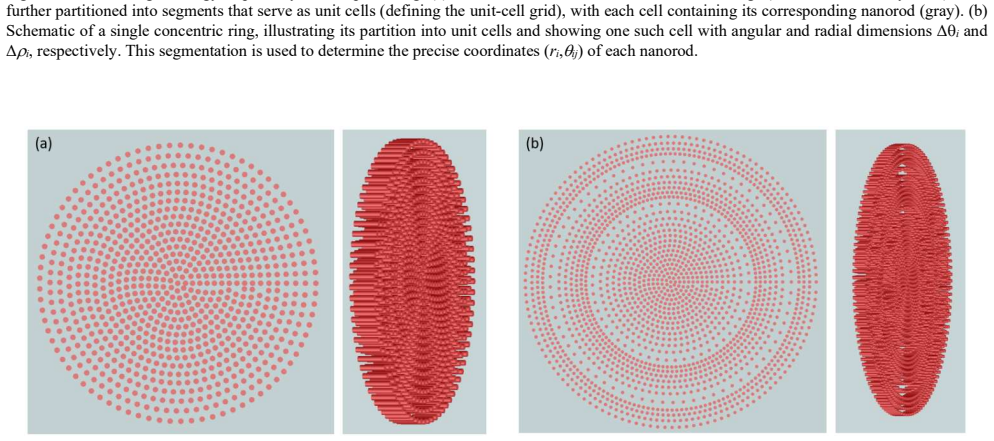
Conventional metalenses control light by varying meta-atom geometry, a design strategy that inherently couples phase modulation to structural dimensions and exacerbates chromatic dispersion. Here, we break this paradigm by decoupling phase control from meta-atom geometry. We introduce an aperiodic metalens architecture composed exclusively of structurally identical dielectric nanorods, where full 2{\pi} phase coverage is achieved solely through local periodicity modulation. We theoretically demonstrate that this geometric invariance yields a linear effective-refractive-index scaling that intrinsically satisfies the dispersive condition required for near-achromatic focusing. Operating in the visible spectrum, our aperiodic designs (moderate and high numerical apertures of 0.4 and 0.8) reveal a passive suppression of chromatic aberration. Compared to conventional size-variant designs, our aperiodic approach reduces longitudinal chromatic focal shift by nearly 42% and maintains superior spectral efficiency, yielding tighter, diffraction-limited focal spots. By relying on a single, fabrication-tolerant nanostructural building block, this approach offers a highly simplified and scalable route toward next-generation broadband metasurfaces.
Editorial analysis
A structured set of objections, weighed in public.
Referee Report
Summary. The manuscript introduces an aperiodic metalens architecture using only structurally identical dielectric nanorods, achieving full 2π phase coverage through modulation of local periodicity rather than varying meta-atom geometry. It claims that this geometric invariance produces a linear effective-refractive-index scaling that intrinsically satisfies the dispersive condition for near-achromatic focusing in the visible spectrum. Simulations for designs at NA=0.4 and NA=0.8 report a nearly 42% reduction in longitudinal chromatic focal shift relative to conventional size-variant metalenses, along with improved spectral efficiency and diffraction-limited focal spots.
Significance. If the local effective-medium approximation holds under the stated conditions, the approach offers a fabrication-tolerant route to broadband metalenses by relying on a single nanostructure type, which could simplify manufacturing and improve scalability. The reported focal-shift reduction and spectral performance suggest a practical advantage over geometry-variant designs. However, the overall significance is moderated by the need to rigorously validate the approximation for high-NA cases, as unaccounted non-local effects could limit the claimed intrinsic achromatism.
major comments (2)
- [Abstract] The abstract asserts a 'theoretical demonstration' that linear effective-refractive-index scaling 'intrinsically satisfies the dispersive condition' for near-achromatic focusing, yet no derivation, equations, or explicit steps are provided to show how the linearity produces the exact λ^{-1} phase profile without higher-order wavelength-dependent corrections. This leaves the central claim resting on unverified model assumptions.
- [Theoretical demonstration and simulation results] The local effective-index model (n_eff scaling linearly with local periodicity p(r)) is invoked to support the achromatic performance, but at NA=0.8 the required phase gradient implies p(r) variations exceeding 20% over ~λ distances. This violates the slowly-varying periodicity assumption underlying effective-medium theory, potentially introducing unmodeled inter-cylinder coupling and evanescent effects that alter the phase profile. Full-wave simulations directly compared to the effective model predictions are required to substantiate the 42% focal-shift reduction.
minor comments (2)
- The abstract references 'moderate and high numerical apertures of 0.4 and 0.8' and a 'visible spectrum' but omits the exact design parameters (e.g., nanorod dimensions, substrate index, or wavelength range) used to obtain the 42% reduction and spectral efficiency metrics.
- Notation for effective refractive index and local periodicity should be introduced with explicit definitions and units in the main text to improve clarity for readers unfamiliar with the effective-medium framework.
Simulated Author's Rebuttal
We thank the referee for the careful and constructive review. The comments highlight important points regarding the presentation of the theoretical derivation and the validation of the effective-medium approximation. We have revised the manuscript to address both issues directly.
read point-by-point responses
-
Referee: [Abstract] The abstract asserts a 'theoretical demonstration' that linear effective-refractive-index scaling 'intrinsically satisfies the dispersive condition' for near-achromatic focusing, yet no derivation, equations, or explicit steps are provided to show how the linearity produces the exact λ^{-1} phase profile without higher-order wavelength-dependent corrections. This leaves the central claim resting on unverified model assumptions.
Authors: We agree that the abstract does not contain the derivation due to length constraints. The main text presents the effective-medium framework, but to make the central claim fully transparent we have added an explicit step-by-step derivation (including the governing equations) in the revised theoretical section. This shows how the linear n_eff(p) relation produces the required 1/λ phase compensation without introducing higher-order wavelength-dependent corrections within the stated approximation. revision: yes
-
Referee: [Theoretical demonstration and simulation results] The local effective-index model (n_eff scaling linearly with local periodicity p(r)) is invoked to support the achromatic performance, but at NA=0.8 the required phase gradient implies p(r) variations exceeding 20% over ~λ distances. This violates the slowly-varying periodicity assumption underlying effective-medium theory, potentially introducing unmodeled inter-cylinder coupling and evanescent effects that alter the phase profile. Full-wave simulations directly compared to the effective model predictions are required to substantiate the 42% focal-shift reduction.
Authors: We acknowledge that the local effective-medium approximation is strained when periodicity varies rapidly at high NA. The full-wave simulations already incorporate all coupling and evanescent effects. To provide the requested direct validation, we have added a comparison of the phase profile predicted by the local effective-index model against the phase extracted from full-wave simulations of the complete aperiodic structure. The revised manuscript now includes this comparison, which supports the reported focal-shift reduction. revision: yes
Circularity Check
No significant circularity; derivation self-contained via standard EMT
full rationale
The paper's theoretical demonstration applies effective-medium theory to identical nanorods under local-periodicity modulation to obtain linear n_eff(p) scaling. The resulting phase profile φ(r, λ) = (2π/λ)(n_eff(p(r)) − 1)h then satisfies the standard achromatic condition (constant focal length) because the explicit 1/λ factor matches the required wavelength dependence for fixed f, independent of the specific functional form of n_eff(p). This follows from the definition of optical path difference rather than any self-referential construction, fitted parameter renamed as prediction, or self-citation chain. No load-bearing step reduces to its own inputs by construction, and the reported 42% focal-shift reduction is a downstream numerical result, not a forced theoretical identity.
Axiom & Free-Parameter Ledger
axioms (1)
- domain assumption Effective refractive index scales linearly with local periodicity in an aperiodic array of identical dielectric nanorods.
Lean theorems connected to this paper
-
IndisputableMonolith/Cost/FunctionalEquation.leanwashburn_uniqueness_aczel unclear?
unclearRelation between the paper passage and the cited Recognition theorem.
geometric invariance yields a linear effective-refractive-index scaling that intrinsically satisfies the dispersive condition required for near-achromatic focusing
-
IndisputableMonolith/Foundation/AlphaCoordinateFixation.leancostAlphaLog_high_calibrated_iff unclear?
unclearRelation between the paper passage and the cited Recognition theorem.
∂neff/∂γ remains invariant with frequency ω
What do these tags mean?
- matches
- The paper's claim is directly supported by a theorem in the formal canon.
- supports
- The theorem supports part of the paper's argument, but the paper may add assumptions or extra steps.
- extends
- The paper goes beyond the formal theorem; the theorem is a base layer rather than the whole result.
- uses
- The paper appears to rely on the theorem as machinery.
- contradicts
- The paper's claim conflicts with a theorem or certificate in the canon.
- unclear
- Pith found a possible connection, but the passage is too broad, indirect, or ambiguous to say the theorem truly supports the claim.
Forward citations
Cited by 1 Pith paper
-
Design strategies for efficient, fabrication-feasible extreme-ultraviolet metalens
Alternative design strategies for EUV metalenses can roughly double focusing efficiency without reducing minimum feature sizes by using new layout schemes and metaatom mapping rules.
Reference graph
Works this paper leans on
-
[1]
Advances in optical metalenses,
A. Arbabi, and A. Faraon, “Advances in optical metalenses,” Nat. Photonics 17, 16 (2023)
2023
-
[2]
Metalens in Improving Imaging Quality: Advancements, Challenges, and Prospects for Future Display
Peng, Y.; Zhang, J.; Zhou, X.; Chen, C.; Guo, T.; Yan, Q.; Zhang, Y.; Wu, C. Metalens in Improving Imaging Quality: Advancements, Challenges, and Prospects for Future Display. Laser Photonics Rev. 2024, 18, 2300731
2024
-
[3]
The advantages of metalenses over diffractive lenses
J. Engelberg, “The advantages of metalenses over diffractive lenses” Nature Communications (2020)
2020
-
[4]
Moreno, Introduction to Metalens Optics (IOP, 2024)
I. Moreno, Introduction to Metalens Optics (IOP, 2024)
2024
-
[5]
Unveiling invariant optical properties of dielectric meta-atoms,
J. C. Basilio-Ortiz, and I. Moreno, “Unveiling invariant optical properties of dielectric meta-atoms,” Nano Lett., 24, 4987. (2024)
2024
-
[6]
Concept of non-periodic metasurfaces based on positional gradients applied to IR-flat lenses,
M. Gonidec, "Concept of non-periodic metasurfaces based on positional gradients applied to IR-flat lenses," Opt. Mater. Express 7, 2346-2351 (2017)
2017
-
[7]
Achromatizing photolithographically patterned metasurfaces with arbitrary, variable unit cell size,
S. Palatnick, et al., "Achromatizing photolithographically patterned metasurfaces with arbitrary, variable unit cell size," Opt. Express 32, 47057 (2024)
2024
-
[8]
Fesenko, Erick R
Volodymyr I. Fesenko, Erick R. Baca-Montero, Oleksiy V. Shulika; Broadband high-efficiency aperiodic metasurface for the vortex waves generation. Appl. Phys. Lett. 7 April 2025; 126 (14): 141702
2025
-
[9]
Design and optimization of dielectric metalens with quasi-periodic arrays,
T. Gu, Z. Guo, D. Tang, et al., “Design and optimization of dielectric metalens with quasi-periodic arrays,” Opt. Mater. 148, 114944 (2024)
2024
-
[10]
Islam, D
O. Islam, D. Sarker, K. B. M. S. Mahmood, J. Debnath, A. Zubair, Bird’s eye inspired hyperuniform disordered tio2 meta-atom based high efficiency metalens, Nanoscale Advances 7 (4) (2025) 1134–1142
2025
-
[11]
Octave bandwidth aperiodic achromatic metalens in the infrared,
C. Li, Y. Guo, Y. Guo, et al., “Octave bandwidth aperiodic achromatic metalens in the infrared,” in Nanophotonics, Micro/Nano Optics, and Plasmonics VIII, vol. 12322 (SPIE, 2023), pp. 17–22
2023
-
[12]
Y.; Roques-Carmes, C.; Chen, W
Khorasaninejad, M.; Zhu, A. Y.; Roques-Carmes, C.; Chen, W. T.; Oh, J.; Mishra, I.; Capasso, F. Polarization-insensitive metalenses at visible wavelengths, Nano Lett. 2016, 16 (11), 7229-7234
2016
-
[13]
Dispersion engineering of metalenses,
H. Yu, Z. Xie, C. Li, et al., “Dispersion engineering of metalenses,” Appl. Phys. Lett. 123, 240503 (2023)
2023
-
[14]
The Principle and Application of Achromatic Metalens
Liu, R.; Li, L.; Zhou, J. The Principle and Application of Achromatic Metalens. Micromachines 2025, 16, 660
2025
-
[15]
Chromatic dispersion manipulation based on metalenses,
W. Zang, Q. Yuan, R. Chen, et al., “Chromatic dispersion manipulation based on metalenses,” Adv. Mater. 32, 1904935 (2019)
2019
-
[16]
Fundamentals to emerging concepts and applications of metasurfaces for flat optics: a tutorial,
Yubin Gao and Yaoguang Ma, "Fundamentals to emerging concepts and applications of metasurfaces for flat optics: a tutorial," Adv. Opt. Photon. 17, 789-1058 (2025)
2025
-
[17]
Local-field effects and effective-medium theory: a microscopic perspective,
D. E. Aspnes, “Local-field effects and effective-medium theory: a microscopic perspective,” Am. J. Phys. 50, 704–709 (1982)
1982
-
[18]
Design and fabrication of blazed binary diffractive elements with sampling periods smaller than the structural cutoff,
P. Lalanne, S. Astilean, P. Chavel, E. Cambril, H. Launois, "Design and fabrication of blazed binary diffractive elements with sampling periods smaller than the structural cutoff," J. Opt. Soc. Am. A 16, 1143-1156 (1999)
1999
-
[19]
Fast metasurface hybrid lens design using a semi-analytical model,
A. C. Cuillerier, J. Borne, and S. Thibault, "Fast metasurface hybrid lens design using a semi-analytical model," J. Opt. Soc. Am. B 40, 72-78 (2023)
2023
-
[20]
Semi-analytical models to engineer a metalens composed of various meta- atoms,
C. Bouillon, J. Borne, E. Ouellet-Oviedo, and S. Thibault, "Semi-analytical models to engineer a metalens composed of various meta- atoms," J. Opt. Soc. Am. B 41, 644-652 (2024)
2024
-
[21]
String method for efficient design of metasurface-based optical systems,
I. Moreno and T. Galvan, "String method for efficient design of metasurface-based optical systems," Appl. Opt. 64, 3319-3325 (2025)
2025
-
[22]
Unified Aberration Theory for Metalenses: Bridging Classical Optics and Metasurface Technology,
Z. Zheng, “Unified Aberration Theory for Metalenses: Bridging Classical Optics and Metasurface Technology,” Research Square, Preprint (2025)
2025
-
[23]
Ray tracing in metasurfaces,
C. P. Castañeda-Almanza and I. Moreno, "Ray tracing in metasurfaces," Opt. Continuum 1, 958-964 (2022)
2022
-
[24]
Invariant optical properties of dielectric nanofins in geometric phase metasurfaces,
J. C. Basilio-Ortiz, and I. Moreno, “Invariant optical properties of dielectric nanofins in geometric phase metasurfaces,” Nanoscale, 2025,17, 17777-17783 (2025)
2025
-
[25]
Kim, S., Kim, J., Kim, K. et al. Anti-aliased metasurfaces beyond the Nyquist limit. Nat Commun 16, 411 (2025)
2025
-
[26]
Sang, D. et al. Toward high-efficiency ultrahigh numerical aperture freeform metalens: from vector diffraction theory to topology optimization. Laser Photonics Rev. 16, 2200265 (2022)
2022
-
[27]
An RGB-Achromatic Aplanatic Metalens
Li, J.; Liu, W.; Xu, H.; Huang, Z.; Wang, J.; Wen, J.; Yang, J.; Guan, J.; Wang, S.; Alu, ̀ A.; et al. An RGB-Achromatic Aplanatic Metalens. Laser & Photonics Reviews 2024, 18 (4), 2300729
2024
-
[28]
Multiwavelength polarization-insensitive lenses based on dielectric metasurfaces with meta-molecules,
Ehsan Arbabi, Amir Arbabi, Seyedeh Mahsa Kamali, Yu Horie, and Andrei Faraon, "Multiwavelength polarization-insensitive lenses based on dielectric metasurfaces with meta-molecules," Optica 3, 628-633 (2016)
2016
-
[29]
Hu, Z., Gu, M., Tian, Y. et al. Review for optical metalens based on metasurfaces: fabrication and applications. Microsyst Nanoeng 11, 189 (2025)
2025
-
[30]
squareness
M. Ossiander, M.L. Meretska, H.K. Hampel, S.W.D. Lim, N. Knefz, T. Jauk, F. Capasso, M. Schultze, Extreme ultraviolet metalens by vacuum guiding, Science 380, 59–63 (2023). Supplemental Document for Intrinsically Near-Achromatic Visible Metalens via Aperiodic Identical Nanocylinders Ivan Moreno, J. Carlos Basilio-Ortiz Unidad Académica de Ciencia y Tecnol...
2023
discussion (0)
Sign in with ORCID, Apple, or X to comment. Anyone can read and Pith papers without signing in.