Recognition: no theorem link
Chemical Abundances Shape History (CASH). I. A Link between Giant Planets Orbital Periods and Host Stellar C/O Ratios
Pith reviewed 2026-05-10 18:29 UTC · model grok-4.3
The pith
Stars with higher C/O ratios are more likely to host giant planets on longer orbital periods.
A machine-rendered reading of the paper's core claim, the machinery that carries it, and where it could break.
Core claim
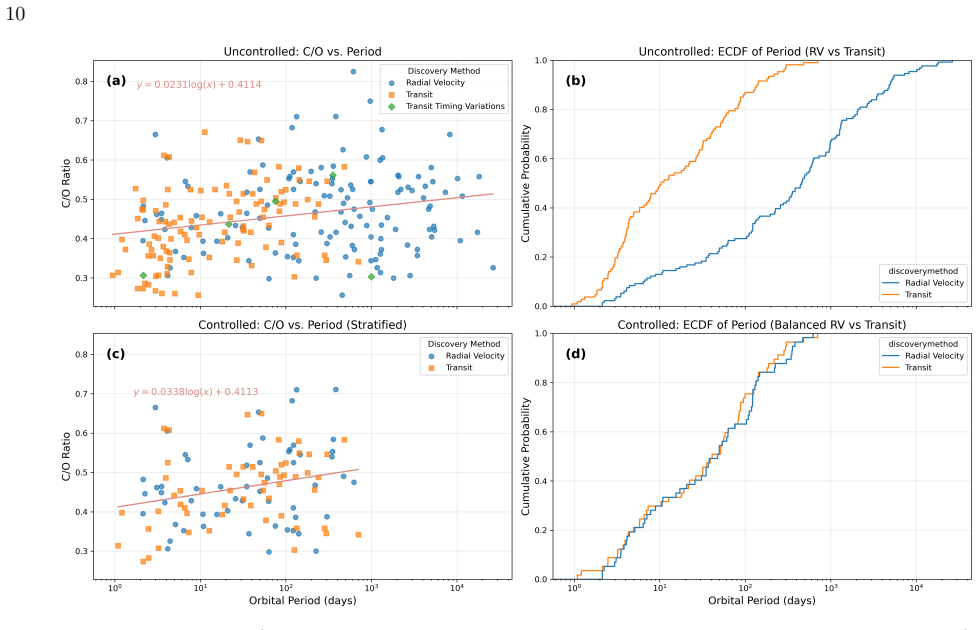
In a combined sample drawn from SDSS, Keck, and HARPS, stars with higher C/O ratios preferentially host longer-period giant planets; pebble-driven formation models reproduce the trend because elevated C/O boosts solid surface density at large radii, favoring formation at greater distances followed by limited inward migration.
What carries the argument
The observed correlation between host-star C/O ratio and giant-planet orbital period, interpreted through pebble-accretion and migration simulations that tie outer-disk solid abundance to C/O.
If this is right
- Giant-planet formation sites shift outward as C/O rises, increasing the fraction of planets that remain beyond the snow line.
- Moderate migration distances are favored in high-C/O disks because more massive cores form farther out.
- Stellar C/O can be used as an input to population-synthesis models to predict the period distribution of giant planets.
- Surveys that measure C/O for non-planet-hosting stars can test whether the same chemical signature predicts the absence of close-in giants.
Where Pith is reading between the lines
- Future radial-velocity or transit surveys could pre-select targets by C/O to increase the yield of long-period giants.
- The same chemistry that lengthens giant-planet periods may also alter the locations of smaller planets and the overall multiplicity of systems.
- If confirmed, C/O becomes one of the few directly observable stellar properties that maps onto a specific formation pathway rather than just bulk metallicity.
Load-bearing premise
The correlation arises from the chemical effect on where planets form rather than from detection biases or measurement errors in the known planet-host sample.
What would settle it
A new sample of several hundred planet-hosting stars with uniformly measured C/O ratios and orbital periods that shows no trend, or a trend in the opposite direction, between C/O and period.
Figures




read the original abstract
The chemical abundance of host stars plays a pivotal role in shaping the formation history of planetary systems, yet the influence of elements beyond iron remains poorly understood. Here, we investigate the relationship between the carbon-to-oxygen (C/O) ratio of host stars and the orbital periods of giant planets. By analyzing high-resolution spectroscopic data from 598 planet-hosting stars (hosting 929 planets) across SDSS, Keck, and HARPS surveys, we identify a correlation: stars with higher C/O ratios are more likely to host longer-period giant planets. Theoretical models of pebble-driven planet formation and migration further support this observation, demonstrating that elevated C/O ratios enhance solid material availability at outer disk regions, promoting giant planet formation at larger distances and subsequent moderate inward migration. Our findings establish stellar C/O as a critical factor in shaping the orbital architecture of giant planets, bridging disk chemistry to planetary system evolution.
Editorial analysis
A structured set of objections, weighed in public.
Referee Report
Summary. The manuscript analyzes high-resolution spectroscopic data for 598 planet-hosting stars (929 planets total) drawn from SDSS, Keck, and HARPS surveys and reports a correlation in which stars with higher C/O ratios are more likely to host longer-period giant planets. Theoretical models of pebble-driven formation and migration are invoked to argue that elevated C/O increases solid material availability at larger orbital distances, favoring giant-planet formation farther out followed by moderate inward migration.
Significance. If the correlation survives controls for survey heterogeneity, stellar-parameter covariances, and abundance systematics, the result would supply a direct observational link between host-star chemistry and giant-planet orbital architecture, strengthening the connection between disk composition and formation location. The sample size is a clear asset, and the use of formation models provides an independent theoretical anchor rather than a post-hoc fit.
major comments (3)
- [Abstract and sample-description section] Abstract and sample-description section: the three surveys are pooled without any stated matching, weighting, or survey-fixed-effect analysis. Because C/O derivation methods, wavelength coverage, and planet-detection completeness differ across SDSS, Keck, and HARPS, any unaccounted survey-specific bias in either abundance or period distribution is load-bearing for the claimed C/O–period trend.
- [Results section] Results section: no quantitative assessment is supplied of the partial correlation between C/O and period after regressing out [Fe/H], Teff, or stellar mass. The central claim that the trend reflects disk-chemistry effects on formation location cannot be evaluated until these confounders are explicitly controlled.
- [Theoretical-model section] Theoretical-model section: the models are described as providing independent support, yet the manuscript does not report whether the predicted period shift is robust to reasonable variations in disk viscosity, pebble size, or migration timescale. A sensitivity test is required to show that the C/O dependence is not an artifact of the particular parameter choices.
minor comments (3)
- [Abstract] Abstract: include at least the Spearman rank coefficient, its uncertainty, and a p-value for the reported correlation so readers can judge statistical significance directly.
- [Figure captions and text] Figure captions and text: ensure that error bars on C/O and period are shown and that the number of planets per bin is stated when histograms or binned trends are presented.
- [Notation] Notation: adopt a single consistent symbol and definition for the C/O ratio (e.g., (C/O)_star) throughout to avoid ambiguity with solar or disk values.
Simulated Author's Rebuttal
We thank the referee for their insightful comments on our manuscript. We have carefully considered each point and revised the paper accordingly to strengthen the analysis and address potential biases.
read point-by-point responses
-
Referee: [Abstract and sample-description section] Abstract and sample-description section: the three surveys are pooled without any stated matching, weighting, or survey-fixed-effect analysis. Because C/O derivation methods, wavelength coverage, and planet-detection completeness differ across SDSS, Keck, and HARPS, any unaccounted survey-specific bias in either abundance or period distribution is load-bearing for the claimed C/O–period trend.
Authors: We agree that differences between surveys could potentially introduce biases in the observed correlation. To address this, we have added a detailed description of the survey characteristics and performed additional statistical tests, including incorporating survey as a fixed effect in our regression models and conducting survey-specific analyses. The C/O-period trend persists in these controlled analyses, as now reported in the revised results section. revision: yes
-
Referee: [Results section] Results section: no quantitative assessment is supplied of the partial correlation between C/O and period after regressing out [Fe/H], Teff, or stellar mass. The central claim that the trend reflects disk-chemistry effects on formation location cannot be evaluated until these confounders are explicitly controlled.
Authors: This is a valid concern. We have now included a quantitative assessment using partial correlation analysis and multiple regression models that control for [Fe/H], Teff, and stellar mass. The results show that the correlation between C/O and orbital period remains significant even after accounting for these potential confounders. These new analyses are presented in the revised manuscript and support our interpretation linking the trend to disk chemistry. revision: yes
-
Referee: [Theoretical-model section] Theoretical-model section: the models are described as providing independent support, yet the manuscript does not report whether the predicted period shift is robust to reasonable variations in disk viscosity, pebble size, or migration timescale. A sensitivity test is required to show that the C/O dependence is not an artifact of the particular parameter choices.
Authors: We appreciate this suggestion for improving the robustness of our theoretical support. We have conducted sensitivity tests by varying key parameters such as disk viscosity, pebble size, and migration timescales within reasonable ranges. The dependence of longer orbital periods on higher C/O ratios is robust across these variations. Details of these tests have been added to the theoretical-model section of the revised manuscript. revision: yes
Circularity Check
No circularity: observational correlation supported by independent theoretical models
full rationale
The paper presents an empirical correlation derived from spectroscopic data on 598 planet-hosting stars across multiple surveys, then invokes separate theoretical models of pebble-driven formation and migration to interpret the trend. No equations or steps reduce the claimed link to a fitted parameter, self-definition, or self-citation chain; the models are described as providing explanatory support rather than being calibrated to reproduce the exact observed C/O-period relation. The derivation chain is self-contained, with the central result resting on external data and standard formation theory rather than internal redefinition or forced prediction.
Axiom & Free-Parameter Ledger
axioms (1)
- domain assumption Pebble-driven planet formation and migration models accurately capture the effect of C/O on solid material availability at different disk radii
Forward citations
Cited by 1 Pith paper
-
HAT-P-70b through the Eyes of MAROON-X: Constraining Elemental Abundances of Metals and Insights on Atmosphere Dynamics
New MAROON-X observations of HAT-P-70b detect multiple neutral and ionized metals with day-to-night wind signatures and demonstrate that ionization-aware retrievals yield abundance ratios closer to solar values except...
Reference graph
Works this paper leans on
-
[1]
Abdurro’uf, Accetta, K., Aerts, C., et al. 2022, ApJS, 259, 35, doi: 10.3847/1538-4365/ac4414
-
[2]
2019, Geosciences, 9, 105, doi: 10.3390/geosciences9030105
Adibekyan, V. 2019, Geosciences, 9, 105, doi: 10.3390/geosciences9030105
-
[3]
Gerasimov, R., & Hoch, K. K. W. 2026, AJ, 171, 21, doi: 10.3847/1538-3881/ae1a6b 18
-
[4]
Beleznay, M., & Kunimoto, M. 2022, MNRAS, 516, 75, doi: 10.1093/mnras/stac2179
-
[5]
Astronomy & Astrophysics , author =
Bitsch, B., Morbidelli, A., Johansen, A., et al. 2018, A&A, 612, A30, doi: 10.1051/0004-6361/201731931
-
[6]
2021, A&A, 647, A96, doi: 10.1051/0004-6361/202039272
Bitsch, B., & Savvidou, S. 2021, A&A, 647, A96, doi: 10.1051/0004-6361/202039272
-
[7]
Blanton, M. R., Bershady, M. A., Abolfathi, B., et al. 2017, AJ, 154, 28, doi: 10.3847/1538-3881/aa7567
-
[8]
Bond, J. C., O’Brien, D. P., & Lauretta, D. S. 2010, ApJ, 715, 1050, doi: 10.1088/0004-637X/715/2/1050
-
[9]
Brewer, J. M., & Fischer, D. A. 2018, ApJS, 237, 38, doi: 10.3847/1538-4365/aad501
-
[10]
Brewer, J. M., Fischer, D. A., Valenti, J. A., & Piskunov, N. 2016, ApJS, 225, 32, doi: 10.3847/0067-0049/225/2/32
-
[11]
Chen, J., & Kipping, D. 2017, ApJ, 834, 17, doi: 10.3847/1538-4357/834/1/17
-
[12]
Christiansen, J. L., McElroy, D. L., Harbut, M., et al. 2025, arXiv e-prints, arXiv:2506.03299, doi: 10.48550/arXiv.2506.03299
-
[13]
Cochran, W. G. 1977, Sampling Techniques, 3rd edn. (New York: John Wiley & Sons)
1977
-
[14]
Dattilo, A., Batalha, N. M., & Bryson, S. 2023, AJ, 166, 122, doi: 10.3847/1538-3881/acebc8
-
[15]
Dawson, R. I., & Johnson, J. A. 2018, ARA&A, 56, 175, doi: 10.1146/annurev-astro-081817-051853 Delgado Mena, E., Adibekyan, V., Santos, N. C., et al. 2021, A&A, 655, A99, doi: 10.1051/0004-6361/202141588
work page Pith review doi:10.1146/annurev-astro-081817-051853 2018
-
[16]
Proceedings of the National Academy of Sciences , publisher =
Dong, S., Xie, J.-W., Zhou, J.-L., Zheng, Z., & Luo, A. 2018, Proc. Natl. Acad. Sci. U.S.A., 115, 266, doi: 10.1073/pnas.1711406115 Drążkowska, J., & Alibert, Y. 2017, A&A, 608, A92, doi: 10.1051/0004-6361/201731491
-
[17]
Dullemond, C. P., & Dominik, C. 2004, A&A, 421, 1075, doi: 10.1051/0004-6361:20040284
-
[18]
Fischer, D. A., & Valenti, J. 2005, ApJ, 622, 1102, doi: 10.1086/428383
-
[19]
Garaud, P., & Lin, D. N. C. 2007, ApJ, 654, 606, doi: 10.1086/509041 Guzmán Franco, A. D., Savvidou, S., & Bitsch, B. 2026, A&A, 707, A276, doi: 10.1051/0004-6361/202556632
-
[20]
Hinkel, N. R., & Young, E. D. 2025, Treatise on Geochemistry, 7, 1, doi: 10.1016/B978-0-323-99762-1.00119-4
-
[21]
Isobe, T., Feigelson, E. D., Akritas, M. G., & Babu, G. J. 1990, ApJ, 364, 104, doi: 10.1086/169390
-
[22]
D., Tanaka, H., & Szuszkiewicz, E
Kanagawa, K. D., Tanaka, H., & Szuszkiewicz, E. 2018, ApJ, 861, 140, doi: 10.3847/1538-4357/aac8d9
-
[23]
Kuchner, M. J., & Seager, S. 2005, arXiv e-prints, astro. https://arxiv.org/abs/astro-ph/0504214
work page internal anchor Pith review arXiv 2005
-
[24]
Law, C. J., Loomis, R. A., Teague, R., et al. 2021, ApJS, 257, 3, doi: 10.3847/1538-4365/ac1434
-
[25]
2019, A&A, 632, A7, doi: 10.1051/0004-6361/201936309
Liu, B., Lambrechts, M., Johansen, A., & Liu, F. 2019, A&A, 632, A7, doi: 10.1051/0004-6361/201936309
-
[26]
Liu, B., & Ormel, C. W. 2018, A&A, 615, A138, doi: 10.1051/0004-6361/201732307
-
[27]
2021, MNRAS, 504, 4252, doi: 10.1093/mnras/stab1171
Kovtyukh, V. 2021, MNRAS, 504, 4252, doi: 10.1093/mnras/stab1171
-
[28]
2014, A&A, 568, A25, doi: 10.1051/0004-6361/201424184 ¨Oberg, K
Zhao, G. 2014, A&A, 568, A25, doi: 10.1051/0004-6361/201424184 Öberg, K. I., & Bergin, E. A. 2021, Phys. Rep., 893, 1, doi: 10.1016/j.physrep.2020.09.004 Öberg, K. I., Facchini, S., & Anderson, D. E. 2023, ARA&A, 61, 287, doi: 10.1146/annurev-astro-022823-040820 Öberg, K. I., Murray-Clay, R., & Bergin, E. A. 2011, ApJL, 743, L16, doi: 10.1088/2041-8205/74...
-
[29]
Ormel, C. W., & Liu, B. 2018, A&A, 615, A178, doi: 10.1051/0004-6361/201732562
-
[30]
Otegi, J. F., Bouchy, F., & Helled, R. 2020, A&A, 634, A43, doi: 10.1051/0004-6361/201936482
-
[31]
Paardekooper, S. J., Baruteau, C., & Kley, W. 2011, MNRAS, 410, 293, doi: 10.1111/j.1365-2966.2010.17442.x
-
[32]
Petigura, E. A., & Marcy, G. W. 2011, ApJ, 735, 41, doi: 10.1088/0004-637X/735/1/41
-
[33]
Santos, N. C., Israelian, G., & Mayor, M. 2001, A&A, 373, 1019, doi: 10.1051/0004-6361:20010648
-
[34]
Schoonenberg, D., & Ormel, C. W. 2017, A&A, 602, A21, doi: 10.1051/0004-6361/201630013 Suárez-Andrés, L., Israelian, G., González Hernández, J. I., et al. 2018, A&A, 614, A84, doi: 10.1051/0004-6361/201730743 Tautvaišien˙ e, G., Mikolaitis, Š., Drazdauskas, A., et al. 2022, ApJS, 259, 45, doi: 10.3847/1538-4365/ac50b5
-
[35]
Teske, J. K. 2024, ARA&A, 62, 333, doi: 10.1146/annurev-astro-071221-053007
-
[36]
2021, The Astrophysical Journal, 909, 40, doi: 10.3847/1538-4357/abd6e5
Turrini, D., Schisano, E., Fonte, S., et al. 2021, ApJ, 909, 40, doi: 10.3847/1538-4357/abd6e5
-
[37]
Villenave, M., Ménard, F., Dent, W. R. F., et al. 2020, A&A, 642, A164, doi: 10.1051/0004-6361/202038087
-
[38]
Wang, H. S., Quanz, S. P., Yong, D., et al. 2022, MNRAS, 513, 5829, doi: 10.1093/mnras/stac1119
-
[39]
Wang, J., & Fischer, D. A. 2015, AJ, 149, 14, doi: 10.1088/0004-6256/149/1/14
-
[40]
Wang, J., Wang, J. J., Ruffio, J.-B., et al. 2023, AJ, 165, 4, doi: 10.3847/1538-3881/ac9f19 19
-
[41]
Wright, J. T., Marcy, G. W., Howard, A. W., et al. 2012, ApJ, 753, 160, doi: 10.1088/0004-637X/753/2/160
-
[42]
Xenos, K. O., Bitsch, B., & Andama, G. 2025, A&A, 701, A47, doi: 10.1051/0004-6361/202555591
-
[43]
Zaveri, U., Wang, H. S., & Sossi, P. A. 2026, arXiv e-prints, arXiv:2603.15955, doi: 10.48550/arXiv.2603.15955
-
[44]
2024, AJ, 168, 246, doi: 10.3847/1538-3881/ad7ea9
Zhang, Y., González Picos, D., de Regt, S., et al. 2024, AJ, 168, 246, doi: 10.3847/1538-3881/ad7ea9
-
[45]
2021, ARA&A, 59, 291, doi: 10.1146/annurev-astro-112420-020055
Zhu, W., & Dong, S. 2021, ARA&A, 59, 291, doi: 10.1146/annurev-astro-112420-020055
discussion (0)
Sign in with ORCID, Apple, or X to comment. Anyone can read and Pith papers without signing in.