PRISM: Rethinking Scattered Atmosphere Reconstruction as a Unified Understanding and Generation Model for Real-world Dehazing
Pith reviewed 2026-05-10 18:46 UTC · model grok-4.3
The pith
PRISM jointly reconstructs clear scenes and scattering variables to improve real-world image dehazing.
A machine-rendered reading of the paper's core claim, the machinery that carries it, and where it could break.
Core claim
The paper claims that rethinking scattered atmosphere reconstruction as a unified understanding and generation model enables a physically structured approach to jointly recover clear images and atmospheric parameters, which enhances reliability in complex regions and supports effective self-adaptation for real-world dehazing without paired data.
What carries the argument
Proximal Scattered Atmosphere Reconstruction (PSAR), the physically structured framework that jointly reconstructs the clear scene and scattering variables under the atmospheric scattering model, combined with online non-uniform haze synthesis and selective self-distillation adaptation.
If this is right
- More reliable dehazing in areas with non-uniform haze distribution.
- Better handling of mixed-light conditions from multiple sources.
- Improved adaptation to real-world scenarios using only unpaired data.
- State-of-the-art results on real-world image dehazing benchmarks.
Where Pith is reading between the lines
- Similar joint reconstruction strategies could apply to other image restoration tasks involving physical models, such as deraining or low-light enhancement.
- The self-distillation approach might help close the synthetic-to-real gap in other computer vision domains.
- Future work could test if this method scales to video dehazing or more extreme weather conditions.
Load-bearing premise
The model's intrinsic understanding of scattering can reliably detect and guide removal of residual haze in real unpaired scenarios without introducing artifacts or overfitting.
What would settle it
Real hazy test images where the method leaves visible haze or introduces distortions while simpler baselines do not would show the joint reconstruction and self-refinement fail to deliver claimed reliability.
Figures
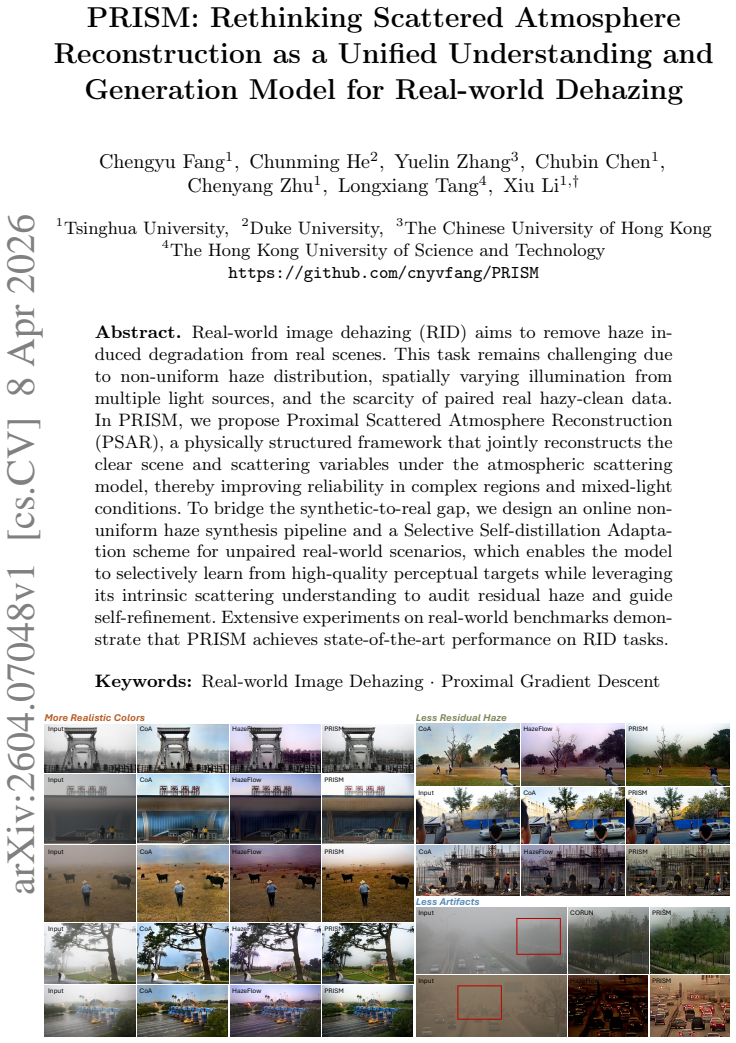


read the original abstract
Real-world image dehazing (RID) aims to remove haze induced degradation from real scenes. This task remains challenging due to non-uniform haze distribution, spatially varying illumination from multiple light sources, and the scarcity of paired real hazy-clean data. In PRISM, we propose Proximal Scattered Atmosphere Reconstruction (PSAR), a physically structured framework that jointly reconstructs the clear scene and scattering variables under the atmospheric scattering model, thereby improving reliability in complex regions and mixed-light conditions. To bridge the synthetic-to-real gap, we design an online non-uniform haze synthesis pipeline and a Selective Self-distillation Adaptation scheme for unpaired real-world scenarios, which enables the model to selectively learn from high-quality perceptual targets while leveraging its intrinsic scattering understanding to audit residual haze and guide self-refinement. Extensive experiments on real-world benchmarks demonstrate that PRISM achieves state-of-the-art performance on RID tasks.
Editorial analysis
A structured set of objections, weighed in public.
Referee Report
Summary. The paper proposes PRISM for real-world image dehazing (RID), introducing Proximal Scattered Atmosphere Reconstruction (PSAR) as a physically structured framework that jointly reconstructs the clear scene and scattering variables under the atmospheric scattering model. It adds an online non-uniform haze synthesis pipeline and a Selective Self-distillation Adaptation scheme that uses the model's intrinsic scattering understanding to audit residual haze and select perceptual targets for unpaired real data, claiming this yields state-of-the-art performance on real-world RID benchmarks.
Significance. If the joint reconstruction and auditing mechanism hold, the work would be significant for advancing RID by providing a more reliable bridge from synthetic training to real scenes with non-uniform haze and mixed illumination, potentially improving generalization where paired data is scarce.
major comments (2)
- [Method (Selective Self-distillation Adaptation)] The Selective Self-distillation Adaptation scheme (described after the online synthesis pipeline): the claim that intrinsic scattering understanding reliably audits residual haze to guide self-refinement on unpaired real images is load-bearing for the synthetic-to-real bridge and SOTA assertion, yet real scenes lack ground-truth scattering parameters or clean references, so the paper must demonstrate via ablation or qualitative analysis that auditing does not mislabel regions or introduce artifacts.
- [Method (PSAR)] PSAR framework (joint reconstruction under atmospheric scattering model): while the physical structure is presented as improving reliability in complex regions and mixed-light conditions, the manuscript should clarify how the proximal formulation avoids reducing to standard atmospheric model inversion or introducing free parameters that undermine the 'unified understanding' claim.
minor comments (2)
- [Abstract/Introduction] The abstract and introduction use 'Proximal Scattered Atmosphere Reconstruction' without an immediate equation or diagram defining the proximal operator in this context; add a brief formalization early for clarity.
- [Experiments] Figure captions and experimental tables should explicitly note the number of real-world benchmarks and whether improvements over baselines are consistent across all or only some datasets.
Simulated Author's Rebuttal
We thank the referee for the constructive comments, which help strengthen the presentation of our work. We address each major point below and will incorporate revisions to clarify the method and provide supporting analyses.
read point-by-point responses
-
Referee: [Method (Selective Self-distillation Adaptation)] The Selective Self-distillation Adaptation scheme (described after the online synthesis pipeline): the claim that intrinsic scattering understanding reliably audits residual haze to guide self-refinement on unpaired real images is load-bearing for the synthetic-to-real bridge and SOTA assertion, yet real scenes lack ground-truth scattering parameters or clean references, so the paper must demonstrate via ablation or qualitative analysis that auditing does not mislabel regions or introduce artifacts.
Authors: We agree that empirical validation of the auditing mechanism is essential for supporting the synthetic-to-real bridge. In the revised manuscript, we will add targeted qualitative visualizations and ablation studies on real-world benchmarks. These will illustrate the auditing process on unpaired real images, showing correct identification of residual haze regions, the resulting refinements, and direct comparisons to variants without auditing to confirm that no systematic mislabeling or artifacts are introduced. revision: yes
-
Referee: [Method (PSAR)] PSAR framework (joint reconstruction under atmospheric scattering model): while the physical structure is presented as improving reliability in complex regions and mixed-light conditions, the manuscript should clarify how the proximal formulation avoids reducing to standard atmospheric model inversion or introducing free parameters that undermine the 'unified understanding' claim.
Authors: We thank the referee for highlighting the need for clearer exposition. The proximal formulation in PSAR performs joint optimization of the clear scene and scattering variables via proximal operators that embed the atmospheric scattering model constraints directly into the reconstruction process. This differs from standard inversion, which typically performs sequential, independent estimation steps under uniformity assumptions. No extraneous free parameters are introduced; all variables remain governed by the physical model. We will revise the method section to include expanded mathematical details, operator definitions, and side-by-side comparisons with conventional inversion techniques to better substantiate the unified understanding claim. revision: yes
Circularity Check
No circularity: derivation relies on standard atmospheric model without self-referential reduction
full rationale
The provided abstract and description outline PSAR as jointly reconstructing clear scene and scattering variables under the atmospheric scattering model, plus an online synthesis pipeline and selective self-distillation for unpaired data. No equations, fitted parameters renamed as predictions, or self-citation chains are visible that would make any claimed prediction equivalent to its inputs by construction. The framework builds on the established atmospheric scattering model as an external physical prior rather than deriving it internally, and the self-distillation step is described as leveraging intrinsic understanding without evidence of it reducing to a tautological loop. This is the common case of a self-contained proposal whose central claims remain independently falsifiable on benchmarks.
Axiom & Free-Parameter Ledger
axioms (1)
- domain assumption Atmospheric scattering model applies to real-world non-uniform haze with multiple light sources
invented entities (2)
-
Proximal Scattered Atmosphere Reconstruction (PSAR)
no independent evidence
-
Selective Self-distillation Adaptation scheme
no independent evidence
Lean theorems connected to this paper
-
IndisputableMonolith/Cost/FunctionalEquation.leanwashburn_uniqueness_aczel unclear?
unclearRelation between the paper passage and the cited Recognition theorem.
We build our model directly on the atmospheric scattering equation: P(x)=T(x)J(x)+(1−T(x))A(x). ... Stage-wise scattering objective. We measure the mismatch to Eq.(1) by the quadratic data term D(J,T,A)=½∑x‖P(x)−T(x)J(x)−(1−T(x))A(x)‖₂²
-
IndisputableMonolith/Foundation/ArithmeticFromLogic.leanreality_from_one_distinction unclear?
unclearRelation between the paper passage and the cited Recognition theorem.
PSAR ... performs dehazing through a sequence of optimization-inspired stages. Each stage couples closed-form proximal updates for J,T, and A with lightweight refinement blocks
What do these tags mean?
- matches
- The paper's claim is directly supported by a theorem in the formal canon.
- supports
- The theorem supports part of the paper's argument, but the paper may add assumptions or extra steps.
- extends
- The paper goes beyond the formal theorem; the theorem is a base layer rather than the whole result.
- uses
- The paper appears to rely on the theorem as machinery.
- contradicts
- The paper's claim conflicts with a theorem or certificate in the canon.
- unclear
- Pith found a possible connection, but the passage is too broad, indirect, or ambiguous to say the theorem truly supports the claim.
Forward citations
Cited by 1 Pith paper
-
Embedding-perturbed Exploration Preference Optimization for Flow Models
E²PO uses embedding-level perturbations to maintain intra-group variance and discriminative signal in RL-based preference optimization for generative flow models.
Reference graph
Works this paper leans on
-
[1]
IEEE Transactions on Image Processing (TIP)25(11), 5187–5198 (2016)
Cai, B., Xu, X., Jia, K., Qing, C., Tao, D.: Dehazenet: An end-to-end system for single image haze removal. IEEE Transactions on Image Processing (TIP)25(11), 5187–5198 (2016)
work page 2016
-
[2]
In: Avidan, S., Brostow, G., Cissé, M., Farinella, G.M., Hassner, T
Chen, X., Fan, Z., Li, P., Dai, L., Kong, C., Zheng, Z., Huang, Y., Li, Y.: Unpaired deep image dehazing using contrastive disentanglement learning. In: Avidan, S., Brostow, G., Cissé, M., Farinella, G.M., Hassner, T. (eds.) Computer Vision – ECCV 2022. pp. 632–648. Springer Nature Switzerland, Cham (2022)
work page 2022
-
[3]
In: Proceedings of the IEEE/CVF Conference on Computer Vision and Pattern Recognition (CVPR)
Chen, Z., Wang, Y., Yang, Y., Liu, D.: Psd: Principled synthetic-to-real dehaz- ing guided by physical priors. In: Proceedings of the IEEE/CVF Conference on Computer Vision and Pattern Recognition (CVPR). pp. 7180–7189 (2021)
work page 2021
-
[4]
IEEE Transactions on Image Processing (TIP) 24(11), 3888–3901 (2015)
Choi, L.K., You, J., Bovik, A.C.: Referenceless prediction of perceptual fog density and perceptual image defogging. IEEE Transactions on Image Processing (TIP) 24(11), 3888–3901 (2015)
work page 2015
-
[5]
Cong, X., Gui, J., Zhang, J., Hou, J., Shen, H.: A semi-supervised nighttime de- hazing baseline with spatial-frequency aware and realistic brightness constraint (2024)
work page 2024
-
[6]
In: Proceedings of the IEEE/CVF Conference on Computer Vision and Pattern Recognition (CVPR)
Dong, H., Pan, J., Xiang, L., Hu, Z., Zhang, X., Wang, F., Yang, M.H.: Multi- scale boosted dehazing network with dense feature fusion. In: Proceedings of the IEEE/CVF Conference on Computer Vision and Pattern Recognition (CVPR). pp. 2157–2167 (2020)
work page 2020
-
[7]
IEEE Transactions on Circuits and Systems for Video Technology (2026)
Fan, J., Zheng, H., Wang, K., Yan, Z., Qian, J., Chang, H., Li, J., Yang, J.: Physics- guided posterior sampling for diffusion-based real-world dehazing and image en- hancement. IEEE Transactions on Circuits and Systems for Video Technology (2026)
work page 2026
-
[8]
Advances in Neural Information Processing Systems37, 97859–97883 (2024)
Fang,C.,He,C.,Xiao,F.,Zhang,Y.,Tang,L.,Zhang,Y.,Li,K.,Li,X.:Real-world image dehazing with coherence-based pseudo labeling and cooperative unfolding network. Advances in Neural Information Processing Systems37, 97859–97883 (2024)
work page 2024
-
[9]
ACM transactions on graphics (TOG)34(1), 1–14 (2014)
Fattal, R.: Dehazing using color-lines. ACM transactions on graphics (TOG)34(1), 1–14 (2014)
work page 2014
-
[10]
IEEE Transactions on Pattern Analysis and Machine Intelligence46(12), 9303–9320 (2024)
Feng, Y., Ma, L., Meng, X., Zhou, F., Liu, R., Su, Z.: Advancing real-world im- age dehazing: Perspective, modules, and training. IEEE Transactions on Pattern Analysis and Machine Intelligence46(12), 9303–9320 (2024)
work page 2024
-
[11]
In: Neural Information Processing Systems (NeruIPS) (2014)
Goodfellow, I.J., Pouget-Abadie, J., Mirza, M., Xu, B., Warde-Farley, D., Ozair, S., Courville, A.C., Bengio, Y.: Generative adversarial nets. In: Neural Information Processing Systems (NeruIPS) (2014)
work page 2014
-
[12]
In: Proceedings of the IEEE/CVF Conference on Computer Vision and Pattern Recognition (CVPR)
Guo, C.L., Yan, Q., Anwar, S., Cong, R., Ren, W., Li, C.: Image dehazing trans- former with transmission-aware 3d position embedding. In: Proceedings of the IEEE/CVF Conference on Computer Vision and Pattern Recognition (CVPR). pp. 5812–5820 (2022)
work page 2022
-
[13]
IEEE Transactions on Pattern Analysis and Machine Intelligence (TPAMI)33(12), 2341–2353 (2010)
He, K., Sun, J., Tang, X.: Single image haze removal using dark channel prior. IEEE Transactions on Pattern Analysis and Machine Intelligence (TPAMI)33(12), 2341–2353 (2010)
work page 2010
-
[14]
In: Proceedings of the AAAI Conference on Artificial Intelligence
Lan, Y., Cui, Z., Liu, C., Peng, J., Wang, N., Luo, X., Liu, D.: Exploiting diffusion prior for real-world image dehazing with unpaired training. In: Proceedings of the AAAI Conference on Artificial Intelligence. vol. 39, pp. 4455–4463 (2025)
work page 2025
-
[15]
Lan, Y., Cui, Z., Luo, X., Liu, C., Wang, N., Zhang, M., Su, Y., Liu, D.: When schrodinger bridge meets real-world image dehazing with unpaired training. In: 16 Fang et al. Proceedings of the IEEE/CVF International Conference on Computer Vision. pp. 8756–8765 (2025)
work page 2025
-
[16]
In: Proceedings of the IEEE International Conference on Computer Vision (ICCV)
Li, B., Peng, X., Wang, Z., Xu, J., Feng, D.: Aod-net: All-in-one dehazing network. In: Proceedings of the IEEE International Conference on Computer Vision (ICCV). pp. 4770–4778 (2017)
work page 2017
-
[17]
IEEE Transactions on Image Processing28(1), 492–505 (2019)
Li, B., Ren, W., Fu, D., Tao, D., Feng, D., Zeng, W., Wang, Z.: Benchmarking single-image dehazing and beyond. IEEE Transactions on Image Processing28(1), 492–505 (2019)
work page 2019
-
[18]
In: Proceedings of the IEEE/CVF Conference on Computer Vision and Pattern Recognition
Li, Y., Chang, Y., Gao, Y., Yu, C., Yan, L.: Physically disentangled intra-and inter- domain adaptation for varicolored haze removal. In: Proceedings of the IEEE/CVF Conference on Computer Vision and Pattern Recognition. pp. 5841–5850 (2022)
work page 2022
-
[19]
In: Proceedings of the IEEE International Conference on Computer Vision (ICCV)
Liu, X., Ma, Y., Shi, Z., Chen, J.: Griddehazenet: Attention-based multi-scale network for image dehazing. In: Proceedings of the IEEE International Conference on Computer Vision (ICCV). pp. 7314–7323 (2019)
work page 2019
-
[20]
In: Proceedings of the computer vision and pattern recognition conference
Ma, L., Feng, Y., Zhang, Y., Liu, J., Wang, W., Chen, G.Y., Xu, C., Su, Z.: Coa: Towards real image dehazing via compression-and-adaptation. In: Proceedings of the computer vision and pattern recognition conference. pp. 11197–11206 (2025)
work page 2025
-
[21]
In: Proceedings of the IEEE/CVF Conference on Computer Vision and Pattern Recognition
Mou, C., Wang, Q., Zhang, J.: Deep generalized unfolding networks for image restoration. In: Proceedings of the IEEE/CVF Conference on Computer Vision and Pattern Recognition. pp. 17399–17410 (2022)
work page 2022
-
[22]
Proceedings of the AAAI Conference on Artificial Intelligence34(07) (2020)
Qin, X., Wang, Z., Bai, Y., Xie, X., Jia, H.: Ffa-net: Feature fusion attention net- work for single image dehazing. Proceedings of the AAAI Conference on Artificial Intelligence34(07) (2020)
work page 2020
-
[23]
In: Proceedings of the IEEE/CVF International Conference on Computer Vision
Qiu, Y., Zhang, K., Wang, C., Luo, W., Li, H., Jin, Z.: Mb-taylorformer: Multi- branch efficient transformer expanded by taylor formula for image dehazing. In: Proceedings of the IEEE/CVF International Conference on Computer Vision. pp. 12802–12813 (2023)
work page 2023
-
[24]
In: Proceedings of the European Conference on Computer Vision (ECCV)
Ren, W., Liu, S., Zhang, H., Pan, J., Cao, X., Yang, M.H.: Single image dehazing via multi-scale convolutional neural networks. In: Proceedings of the European Conference on Computer Vision (ECCV). pp. 154–169. Springer (2016)
work page 2016
-
[25]
In: Proceedings of the IEEE/CVF Conference on Computer Vision and Pattern Recognition (CVPR)
Shao, Y., Li, L., Ren, W., Gao, C., Sang, N.: Domain adaptation for image de- hazing. In: Proceedings of the IEEE/CVF Conference on Computer Vision and Pattern Recognition (CVPR). pp. 2808–2817 (2020)
work page 2020
-
[26]
In: Proceedings of the IEEE/CVF International Conference on Computer Vision
Shin, J., Chung, S., Yang, Y., Kim, T.H.: Hazeflow: Revisit haze physical model as ode and non-homogeneous haze generation for real-world dehazing. In: Proceedings of the IEEE/CVF International Conference on Computer Vision. pp. 6263–6272 (2025)
work page 2025
-
[27]
IEEE Transactions on Image Processing32, 1927–1941 (2023)
Song, Y., He, Z., Qian, H., Du, X.: Vision transformers for single image dehazing. IEEE Transactions on Image Processing32, 1927–1941 (2023)
work page 1927
-
[28]
IEEE Transactions on Image Processing (TIP)27(8), 3998–4011 (2018)
Talebi, H., Milanfar, P.: Nima: Neural image assessment. IEEE Transactions on Image Processing (TIP)27(8), 3998–4011 (2018)
work page 2018
-
[29]
Tong, M., Wang, Y., Cui, P., Yan, X., Wei, M.: Semi-uformer: Semi-supervised uncertainty-aware transformer for image dehazing (2022)
work page 2022
-
[30]
In: Proceedings of the AAAI conference on artificial intelligence
Wang, J., Chan, K.C., Loy, C.C.: Exploring clip for assessing the look and feel of images. In: Proceedings of the AAAI conference on artificial intelligence. vol. 37, pp. 2555–2563 (2023)
work page 2023
-
[31]
Neural Networks175, 106281 (2024)
Wang, J., Wu, S., Yuan, Z., Tong, Q., Xu, K.: Frequency compensated diffusion model for real-scene dehazing. Neural Networks175, 106281 (2024)
work page 2024
-
[32]
PRISM 17 In: Proceedings of the IEEE/CVF Conference on Computer Vision and Pattern Recognition
Wang, R., Zheng, Y., Zhang, Z., Li, C., Liu, S., Zhai, G., Liu, X.: Learning haz- ing to dehazing: Towards realistic haze generation for real-world image dehazing. PRISM 17 In: Proceedings of the IEEE/CVF Conference on Computer Vision and Pattern Recognition. pp. 23091–23100 (2025)
work page 2025
-
[33]
IEEE Transactions on Image Processing33, 1361–1374 (2024)
Wang, Y., Yan, X., Wang, F.L., Xie, H., Yang, W., Zhang, X.P., Qin, J., Wei, M.: Ucl-dehaze: Toward real-world image dehazing via unsupervised contrastive learning. IEEE Transactions on Image Processing33, 1361–1374 (2024)
work page 2024
-
[34]
In: Proceedings of the IEEE/CVF conference on computer vision and pattern recognition
Wu, H., Qu, Y., Lin, S., Zhou, J., Qiao, R., Zhang, Z., Xie, Y., Ma, L.: Contrastive learning for compact single image dehazing. In: Proceedings of the IEEE/CVF conference on computer vision and pattern recognition. pp. 10551–10560 (2021)
work page 2021
-
[35]
In: Proceedings of the IEEE/CVF Conference on Computer Vision and Pattern Recognition (2023)
Wu, R., Duan, Z., Guo, C., Chai, Z., Li, C.: Ridcp: Revitalizing real image dehazing via high-quality codebook priors. In: Proceedings of the IEEE/CVF Conference on Computer Vision and Pattern Recognition (2023)
work page 2023
-
[36]
In: Proceedings of the european conference on computer vision (ECCV)
Yang, D., Sun, J.: Proximal dehaze-net: A prior learning-based deep network for single image dehazing. In: Proceedings of the european conference on computer vision (ECCV). pp. 702–717 (2018)
work page 2018
-
[37]
In: Proceedings of the IEEE/CVF conference on computer vision and pattern recog- nition
Yang, S., Wu, T., Shi, S., Lao, S., Gong, Y., Cao, M., Wang, J., Yang, Y.: Maniqa: Multi-dimension attention network for no-reference image quality assessment. In: Proceedings of the IEEE/CVF conference on computer vision and pattern recog- nition. pp. 1191–1200 (2022)
work page 2022
-
[38]
In: Proceedings of the IEEE/CVF Conference on Computer Vision and Pattern Recognition (CVPR)
Yang, Y., Wang, C., Liu, R., Zhang, L., Guo, X., Tao, D.: Self-augmented un- paired image dehazing via density and depth decomposition. In: Proceedings of the IEEE/CVF Conference on Computer Vision and Pattern Recognition (CVPR). pp. 2037–2046 (2022)
work page 2037
-
[39]
In: European conference on computer vision
Ye, T., Zhang, Y., Jiang, M., Chen, L., Liu, Y., Chen, S., Chen, E.: Perceiving and modeling density for image dehazing. In: European conference on computer vision. pp. 130–145. Springer (2022)
work page 2022
-
[40]
In: Proceedings of the IEEE/CVF conference on computer vision and pattern recognition
Ying, Z., Niu, H., Gupta, P., Mahajan, D., Ghadiyaram, D., Bovik, A.: From patches to pictures (paq-2-piq): Mapping the perceptual space of picture qual- ity. In: Proceedings of the IEEE/CVF conference on computer vision and pattern recognition. pp. 3575–3585 (2020)
work page 2020
-
[41]
In: Proceedings of the IEEE conference on computer vision and pattern recognition
Zhang, R., Isola, P., Efros, A.A., Shechtman, E., Wang, O.: The unreasonable effectiveness of deep features as a perceptual metric. In: Proceedings of the IEEE conference on computer vision and pattern recognition. pp. 586–595 (2018)
work page 2018
-
[42]
arXiv preprint arXiv:2403.01105 (2024)
Zhang, Y., Zhou, S., Li, H.: Depth information assisted collaborative mutual pro- motion network for single image dehazing. arXiv preprint arXiv:2403.01105 (2024)
-
[43]
In: Proceedings of the IEEE/CVF conference on computer vision and pattern recognition
Zheng, Y., Zhan, J., He, S., Dong, J., Du, Y.: Curricular contrastive regulariza- tion for physics-aware single image dehazing. In: Proceedings of the IEEE/CVF conference on computer vision and pattern recognition. pp. 5785–5794 (2023)
work page 2023
-
[44]
In: British Machine Vision Conference (BMVC)
Zhu, Q., Mai, J., Shao, L.: Single image dehazing using color attenuation prior. In: British Machine Vision Conference (BMVC). Citeseer (2014) 18 Fang et al. A Detailed Derivations of the Proximal Updates In this section, we provide the derivations for the closed-form proximal updates used in PSAR. At stagek, the network first computes the airlight and tr...
work page 2014
-
[45]
Differentiating with respect toAgives ∂E ∂A = (1−T k−1) (Jk−1Tk−1 + (1−T k−1)A−P) +λ A(A−A k−1)
(24) Here the optimization variable is the RGB vectorA, whileJk−1,T k−1,P, and Ak−1 are constants. Differentiating with respect toAgives ∂E ∂A = (1−T k−1) (Jk−1Tk−1 + (1−T k−1)A−P) +λ A(A−A k−1). (25) Setting the gradient to0yields (1−T k−1) (Jk−1Tk−1 + (1−T k−1)A−P) +λ A(A−A k−1) =0. (26) Collecting the terms involvingA, we obtain (1−T k−1)2 +λ A A= (1−T...
-
[46]
Differentiating with respect toJgives ∂E ∂J =T k (TkJ+ (1−T k)Ak −P) +λ J(J−J k−1)
(39) Here the optimization variable is the RGB vectorJ, whileTk,A k,P, andJ k−1 are constants. Differentiating with respect toJgives ∂E ∂J =T k (TkJ+ (1−T k)Ak −P) +λ J(J−J k−1). (40) Setting the gradient to0yields Tk (TkJ+ (1−T k)Ak −P) +λ J(J−J k−1) =0. (41) Collecting the terms involvingJ, we obtain T 2 k J+λ J J=T kP−T k(1−T k)Ak +λ J Jk−1. (42) Using...
discussion (0)
Sign in with ORCID, Apple, or X to comment. Anyone can read and Pith papers without signing in.