Chirality of Zitterbewegung and its relation to Berry curvature in Dirac systems
Pith reviewed 2026-05-10 17:57 UTC · model grok-4.3
The pith
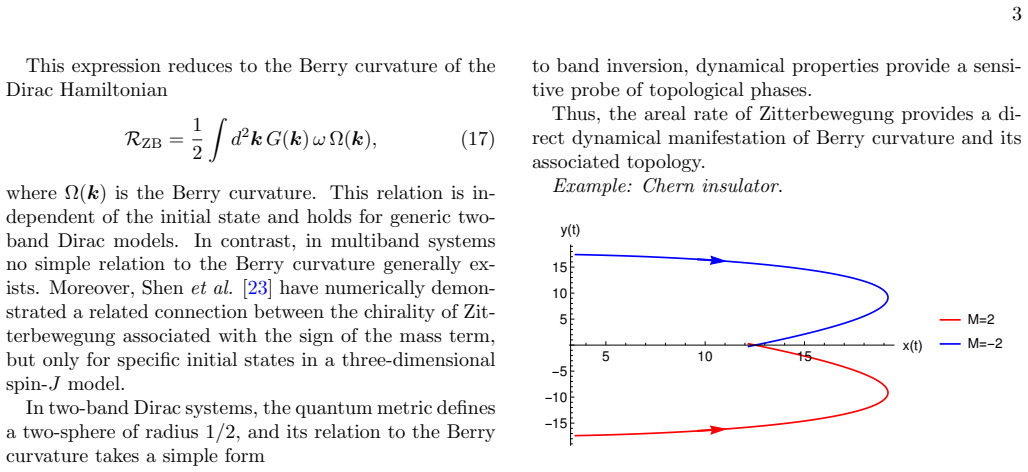
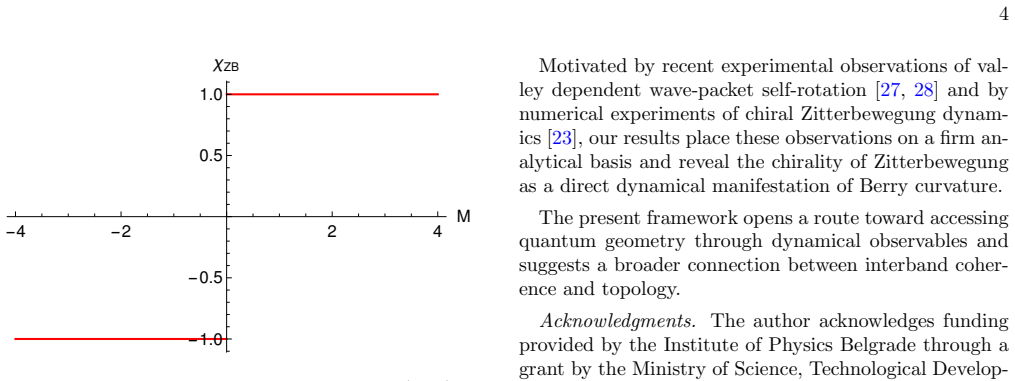
The areal rate of Zitterbewegung equals the Berry curvature and fixes the rotation sense at Dirac points.
A machine-rendered reading of the paper's core claim, the machinery that carries it, and where it could break.
Core claim
By defining the areal rate of Zitterbewegung as a time-independent antisymmetric observable, the authors show that this quantity is given directly by the Berry curvature. Its sign determines the sense of rotation and reproduces the Dirac-point contributions to the Chern number. The exact relation holds for any initial state and for generic two-band Dirac models, connecting interband quantum dynamics to topological band geometry beyond the semiclassical regime.
What carries the argument
The areal rate of Zitterbewegung, a time-independent antisymmetric observable extracted from the position-operator dynamics that equals the Berry curvature and encodes rotation chirality.
If this is right
- The rotation direction of Zitterbewegung is fixed by the sign of Berry curvature at each Dirac point.
- Dirac-point contributions to the Chern number are readable from the chirality of the areal rate.
- The link between interband dynamics and band geometry is exact and independent of specific Hamiltonian form or initial state.
- Topological invariants can be recovered from the real-space trembling motion of electrons.
Where Pith is reading between the lines
- Time-resolved position measurements in Dirac materials such as graphene could extract Berry curvature values directly.
- The same mapping might appear in other systems whose dynamics are governed by geometric phases.
- This relation offers a route to test topological properties through ultrafast electron motion rather than transport.
- Checking whether the time-independence survives in multi-band or higher-dimensional models would test the scope of the result.
Load-bearing premise
That a time-independent antisymmetric observable can be identified for Zitterbewegung and that its exact equality to Berry curvature holds for all generic two-band Dirac models without depending on Hamiltonian details or initial conditions.
What would settle it
A calculation or measurement in a standard two-band Dirac Hamiltonian that finds the areal rate either time-dependent or carrying the wrong sign relative to the Berry curvature at a Dirac point would disprove the claimed exact relation.
Figures
read the original abstract
We establish an exact analytical relation between Zitterbewegung dynamics and the band geometry in two-dimensional Dirac systems. By identifying a time-independent antisymmetric observable-the \textit{areal rate of Zitterbewegung}-we show that this quantity is directly determined by the Berry curvature. Its sign defines the sense of rotation and reproduces the contributions of Dirac points to the Chern number. This relation is independent of the initial state and holds for generic two-band Dirac models. Our findings reveal a direct connection between interband quantum dynamics and topological band geometry beyond the semiclassical regime.
Editorial analysis
A structured set of objections, weighed in public.
Referee Report
Summary. The manuscript establishes an exact analytical relation between Zitterbewegung dynamics and band geometry in two-dimensional Dirac systems. By defining a time-independent antisymmetric observable termed the areal rate of Zitterbewegung, the authors show that this quantity is determined by the Berry curvature, with its sign setting the sense of rotation and reproducing the Dirac-point contributions to the Chern number. The relation is asserted to hold independently of the initial state and for generic two-band Dirac models, linking interband quantum dynamics directly to topological invariants beyond the semiclassical regime.
Significance. If the central derivation is correct, the result provides a concrete dynamical observable whose time-averaged or constant value encodes the Berry curvature and Chern contributions in Dirac systems. This could enable direct experimental probes of topology via real-time dynamics in materials or cold-atom simulators, and it strengthens the connection between interband coherences and geometric phases without relying on semiclassical wave-packet approximations.
major comments (2)
- [Main derivation of the areal-rate observable] The central claim that the areal rate of Zitterbewegung is strictly time-independent and exactly equal to the Berry curvature for arbitrary initial states rests on a cancellation of state-dependent amplitudes in the Heisenberg evolution. Please provide the explicit operator construction and commutator algebra (likely in the section deriving the observable) that demonstrates [H, O] = 0 independently of the conduction/valence projections in the initial wave function, including for generic Hamiltonians with mass terms or trigonal warping.
- [Discussion of generic models] The universality for generic two-band Dirac models is asserted in the abstract and conclusion, but the velocity operator (and thus the position-velocity commutators entering the areal rate) changes under anisotropic velocities or warping. A concrete check or counter-example for at least one such perturbed Hamiltonian is needed to confirm that the time-independence and state-independence survive without additional assumptions.
minor comments (2)
- [Abstract and introduction] The abstract refers to the observable as 'the areal rate of Zitterbewegung' in italics; ensure consistent notation and definition when first introduced in the main text.
- [Statement of the main result] Clarify whether the reported relation is an operator identity or holds only after taking an expectation value; the current wording leaves this ambiguous.
Simulated Author's Rebuttal
We thank the referee for the positive summary and the valuable comments on our manuscript. We are pleased that the potential for experimental probes of topology via Zitterbewegung dynamics is recognized. We address each major comment below and will revise the manuscript accordingly to incorporate clarifications and additional checks.
read point-by-point responses
-
Referee: [Main derivation of the areal-rate observable] The central claim that the areal rate of Zitterbewegung is strictly time-independent and exactly equal to the Berry curvature for arbitrary initial states rests on a cancellation of state-dependent amplitudes in the Heisenberg evolution. Please provide the explicit operator construction and commutator algebra (likely in the section deriving the observable) that demonstrates [H, O] = 0 independently of the conduction/valence projections in the initial wave function, including for generic Hamiltonians with mass terms or trigonal warping.
Authors: We appreciate this request for more detail on the derivation. The observable O, termed the areal rate of Zitterbewegung, is constructed as an antisymmetric combination of position and velocity operators that is designed to be time-independent. In the manuscript, we show that its expectation value equals the Berry curvature. To address the request, we will add in the revised version the explicit definition of O and the full commutator calculation [H, O] = 0. This calculation uses the Dirac algebra and holds as an operator equation, thus independent of the initial state or its projections onto conduction or valence bands. The mass term is included in our general treatment, as it contributes to the Berry curvature but does not affect the commutator cancellation. For trigonal warping, which modifies the Hamiltonian with higher-order terms, the velocity operators are accordingly updated, and the same algebraic cancellation persists because O is defined using the model's velocity. We will include this explicit algebra in the revision. revision: yes
-
Referee: [Discussion of generic models] The universality for generic two-band Dirac models is asserted in the abstract and conclusion, but the velocity operator (and thus the position-velocity commutators entering the areal rate) changes under anisotropic velocities or warping. A concrete check or counter-example for at least one such perturbed Hamiltonian is needed to confirm that the time-independence and state-independence survive without additional assumptions.
Authors: We agree that demonstrating the result for a perturbed model would enhance the universality claim. Our derivation is based on the general two-band Dirac form, where the relation between the areal rate and Berry curvature follows from the geometric properties encoded in the Hamiltonian. For anisotropic velocities, the commutators scale accordingly, preserving the equality. We will add to the revised manuscript a concrete example, such as an anisotropic Dirac Hamiltonian or one with a trigonal warping term (e.g., including a cubic correction to the dispersion). In this example, we explicitly verify that O is time-independent, its value equals the modified Berry curvature, and this holds for arbitrary initial states. This check confirms that no additional assumptions are needed beyond the two-band Dirac structure. revision: yes
Circularity Check
No significant circularity; derivation is self-contained analytical result.
full rationale
The paper derives an exact relation between a constructed time-independent observable (areal rate of Zitterbewegung) and Berry curvature for generic two-band Dirac models, asserting independence from initial state via the Heisenberg picture or commutator properties. No load-bearing self-citations, fitted parameters renamed as predictions, self-definitional constructs, or ansatz smuggling appear in the abstract or context. The central claim rests on explicit operator identification and algebraic cancellation that is presented as holding universally, without reducing to input data or prior author results by construction. This is the expected honest non-finding for an analytical physics derivation that does not invoke external uniqueness theorems or empirical fits.
Axiom & Free-Parameter Ledger
axioms (1)
- domain assumption Two-band Dirac models in 2D have well-defined Berry curvature at Dirac points
invented entities (1)
-
areal rate of Zitterbewegung
no independent evidence
Lean theorems connected to this paper
-
IndisputableMonolith/Foundation/AlexanderDuality.leanalexander_duality_circle_linking unclear?
unclearRelation between the paper passage and the cited Recognition theorem.
By identifying a time-independent antisymmetric observable—the areal rate of Zitterbewegung—we show that this quantity is directly determined by the Berry curvature... holds for generic two-band Dirac models.
-
IndisputableMonolith/Cost/FunctionalEquation.leanwashburn_uniqueness_aczel unclear?
unclearRelation between the paper passage and the cited Recognition theorem.
RZB =−iω[∂kxQ−,∂kyQ−]+... Tr(RZB)=2ωΩ(k)
What do these tags mean?
- matches
- The paper's claim is directly supported by a theorem in the formal canon.
- supports
- The theorem supports part of the paper's argument, but the paper may add assumptions or extra steps.
- extends
- The paper goes beyond the formal theorem; the theorem is a base layer rather than the whole result.
- uses
- The paper appears to rely on the theorem as machinery.
- contradicts
- The paper's claim conflicts with a theorem or certificate in the canon.
- unclear
- Pith found a possible connection, but the passage is too broad, indirect, or ambiguous to say the theorem truly supports the claim.
Forward citations
Cited by 1 Pith paper
-
Jittery Quantum Boomerang Effect
In disordered Rashba 2DEG, transverse displacement returns to zero via viscous damping of Zitterbewegung while longitudinal dynamics exhibit Drude-like saturation at weak disorder or partial return signaling Anderson ...
Reference graph
Works this paper leans on
-
[1]
Xiao-Gang Wen,Topological orders in rigid states, Inter- national Journal of Modern Physics B 04:02, (1990)
work page 1990
-
[2]
D. J. Thouless, M. Kohmoto, M. P. Nightingale, and M. den Nijs,Quantized Hall Conductance in a Two- Dimensional Periodic Potential, Phys. Rev. Lett. 49, 405 (1982)
work page 1982
-
[3]
C. L. Kane and E. J. Mele,Z 2 topological order and the quantum spin hall effect, Phys. Rev. Lett. 95, 1468027 (2005)
work page 2005
-
[4]
Di Xiao, Ming-Che Chang, and Qian Niu,Berry phase effects on electronic properties, Rev. Mod. Phys. 82, 1959 (2010)
work page 1959
-
[5]
Naoto Nagaosa, Jairo Sinova, Shigeki Onoda, A. H. Mac- Donald, and N. P. OngAnomalous Hall effect, Rev. Mod. Phys. 82, 1539 (2010)
work page 2010
-
[6]
Xiao-Bin Qiang, Tianyu Liu, Hai-Zhou Lu, X. C. Xie, Quantum Geometric Origin of Orbital Magnetization, Appl. Phys. Lett. 128, 010501 (2026)
work page 2026
-
[7]
S. Peotta and P. T¨ orm¨ a,Superfluidity in topologically nontrivial flat bands, Nat. Commun. 6, 8944 (2015)
work page 2015
-
[8]
S. A. Parameswaran, R. Roy, and S. L. Sondhi,Fractional Chern insulators and theW inf algebra, Phys. Rev. B 85, 241308 (2012)
work page 2012
-
[9]
M. Aidelsburger, M. Atala, M. Lohse, J. T. Barreiro, B. Paredes, and I. Bloch,Realization of the Hofstadter Hamiltonian with Ultracold Atoms in Optical Lattices, Phys. Rev. Lett. 111, 185301 (2013)
work page 2013
-
[10]
N. Fl¨ aschner and B. S. Rem and M. Tarnowski and D. Vogel and D.-S. L¨ uhmann and K. Sengstock and C. Weit- enberg,Experimental reconstruction of the Berry curva- ture in a Floquet Bloch band, Science 352, 6289 (2016)
work page 2016
-
[11]
M. C. Rechtsman, J. M. Zeuner, Y. Plotnik, Y. Lumer, D. Podolsky, F. Dreisow, S. Nolte, M. Segev and A. Szameit, Photonic Floquet topological insulators, Nature 496, 196 (2013)
work page 2013
- [12]
-
[13]
L. Asteria, D. Thanh Tran, T. Ozawa, M. Tarnowski, B. S. Rem, N. Fl¨ aschner, K. Sengstock, N. Goldman and C. 5 Weitenberg,Measuring quantized circular dichroism in ultracold topological matter, Nat. Phys. 15, 449 (2019)
work page 2019
-
[14]
Wenjin Zhao, Kaifei Kang, Lizhong Li, Charles Tschirhart, Evgeny Redekop, Kenji Watanabe, Takashi Taniguchi, Andrea Young, Jie Shan, and Kin Fai Mak, Realization of the Haldane Chern insulator in a moir´ e lattice, Nat. Phys. 20, 275–280 (2024)
work page 2024
-
[15]
Schr¨ odinger, ¨Uber die kr¨ aftefreie Bewegung in der relativistischen Quantenmechanik, Sitzungsber
E. Schr¨ odinger, ¨Uber die kr¨ aftefreie Bewegung in der relativistischen Quantenmechanik, Sitzungsber. Preuss. Akad. Wiss. Phys. Math. Kl., 24, 418-428. (1930)
work page 1930
-
[16]
J. Schliemann, D. Loss, and R. M. Westervelt,Zit- terbewegung of electronic wave packets in iii-v zinc- blende semiconductor quantum wells, Phys. Rev. Lett. 94, 206801 (2005)
work page 2005
-
[17]
Rusin and Wlodek Zawadzki,Zitterbewegung of electrons in graphene in a magnetic field, Phys
Tomasz M. Rusin and Wlodek Zawadzki,Zitterbewegung of electrons in graphene in a magnetic field, Phys. Rev. B 78, 125419 (2008)
work page 2008
-
[18]
Alex Santacruz, Priscilla E. Iglesias, Ramon Carrillo- Bastos, and Francisco Mireles,Valley-driven Zitterbewe- gung in Kekul´ e-distorted graphene, Phys. Rev. B 105, 205405 (2022)
work page 2022
-
[19]
Zawadzki,One-dimensional semirelativity for elec- trons in carbon nanotubes, Phys
W. Zawadzki,One-dimensional semirelativity for elec- trons in carbon nanotubes, Phys. Rev. B 74, 205439 (2006)
work page 2006
-
[20]
J. Y. Vaishnav, Charles W. Clark,Observing Zitterbewe- gung in Ultracold Atoms, Phys. Rev. Lett. 100, 153002 (2008)
work page 2008
- [21]
-
[22]
Westervelt,Zitter- bewegung of electrons and holes in III-V semiconductor quantum wells, Phys
John Schliemann, Daniel Loss, R.M. Westervelt,Zitter- bewegung of electrons and holes in III-V semiconductor quantum wells, Phys. Rev. B 73, 085323 (2006)
work page 2006
-
[23]
Xin Shen, Yan-Qing Zhu, Zhi Li,Link between Zitterbe- wegung and topological phase transitions, Phys. Rev. B 106, L180301 (2022)
work page 2022
- [24]
-
[25]
L. K. Shi, S. C. Zhang, K. Chang,Anomalous electron trajectory in topological insulators, Phys. Rev. B. 87, 161115 (2013)
work page 2013
-
[26]
I. R. Lavor, D. R. da Costa, L. Covaci, M. V. Miloˇ sevi´ c, F. M. Peeters, and A. Chaves,Zitterbewegung of moir´ e excitons in twistedM oS 2/W Se2 heterobilayers, Phys. Rev. Lett. 127, 106801 (2021)
work page 2021
-
[27]
W. Ye, Y. Liu, J. Liu, S. A. R. Horsley, S. Wen, S. Zhang, Photonic Hall effect and helical Zitterbewegung in a syn- thetic Weyl system, Light: Sci. Appl., 8, 49 (2019)
work page 2019
-
[28]
Xiuying Liu, Frane Luni´ c, Daohong Song, Zhixuan Dai, Shiqi Xia, Liqin Tang, Jingjun Xu, Zhigang Chen, and Hrvoje Buljan,Valley-dependent wavepacket self-rotation and Zitterbewegung in symmetry- broken honeycomb lat- ticesLaser Photonics Rev. 15 (7), 2000563 (2021)
work page 2021
-
[29]
Gyula D´ avid and J´ ozsef Cserti,General theory of Zitter- bewegung, Phys. Rev. B 81, 121417(R) (2010)
work page 2010
-
[30]
X.-L. Qi, T. L. Hughes and S.-C. Zhang,Topological field theory of time-reversal invariant insulators, Phys. Rev. B 78, 195424 (2008)
work page 2008
-
[31]
F. D. M. Haldane,Model for a quantum Hall effect with- out Landau Levels: Condensed-matter realization of the ”parity anomaly”, Phys. Rev. Lett. 61, 2015 (1988)
work page 2015
- [32]
-
[33]
N. R. Cooper, J. Dalibard and I. B. Spielman,Topological bands for ultracold atoms, Rev. Mod. Phys. 91, 015005 (2019)
work page 2019
-
[34]
Doru Sticlet, Frederic Pi´ echon, Jean-No¨ el Fuchs, Pavel Kalugin, and Pascal Simon,Geometrical engineering of a two-band Chern insulator in two dimensions with arbi- trary topological index, Phys. Rev. B 85, 165456 (2012)
work page 2012
-
[35]
Bruno Mera, Anwei Zhang and Nathan Goldman,Relat- ing the topology of Dirac Hamiltonians to quantum geom- etry: When the quantum metric dictates Chern numbers and winding numbers, SciPost Phys. 12, 018 (2022)
work page 2022
discussion (0)
Sign in with ORCID, Apple, or X to comment. Anyone can read and Pith papers without signing in.