Recognition: unknown
Three-Dimensional Electronic Structures in Superconducting Ruddlesden-Popper Bilayer Nickelate Films
Pith reviewed 2026-05-10 17:00 UTC · model grok-4.3
The pith
ARPES reveals a large superconducting gap on the three-dimensional dz2 band in bilayer nickelate films.
A machine-rendered reading of the paper's core claim, the machinery that carries it, and where it could break.
Core claim
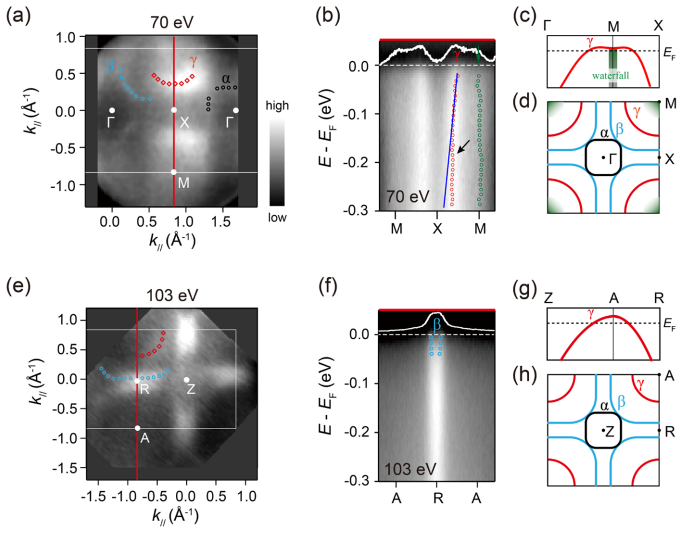
In (La,Pr,Sm)3Ni2O7 thin films with superconducting onset near 48 K, photon-energy variation in ARPES shows orbital-dependent dimensionality: dx2-y2 bands are quasi-2D while the dz2 band has finite kz dispersion. Finite gaps appear on all observed bands; the gap on the dz2-derived band closes with temperature in a manner that identifies it as superconducting, with size 18 meV and 2Δ/kBTc approximately 8. Spectral weight near the Fermi level remains suppressed above Tc, and waterfall-like features signal electron interactions.
What carries the argument
Photon-energy-dependent ARPES that resolves kz dispersion together with temperature tracking of orbital-specific gaps.
Load-bearing premise
Temperature dependence alone, combined with dispersion-based orbital assignments, is enough to confirm that the gap on the dz2 band is superconducting in origin.
What would settle it
If the gap on the identified dz2 band fails to close at the independently measured superconducting Tc or if orbital characters from dispersions disagree with independent calculations.
Figures



read the original abstract
Beyond the quasi-two-dimensional (2D) paradigm of cuprates, the role of the third dimension of the Ruddlesden-Popper bilayer nickelates is essential to decoding their superconducting mechanism. Here, using angle-resolved photoemission spectroscopy (ARPES) with varied photon energies, we systematically investigate the electronic band structures in three dimensions for superconducting (La,Pr,Sm)$_3$Ni$_2$O$_7$/SrLaAlO$_4$ thin films (superconducting onset temperature $T_c^{\text{onset}} \sim 48$ K) transferred via a cryogenic ultra-high vacuum suitcase. We reveal an orbital-dependent dimensionality: while the $d{x^2-y^2}$-dominant bands exhibit a quasi-2D character, the $d{z^2}$-dominant band displays a finite $k_z$ dispersion. Finite energy gaps are identified on all observed bands across multiple high-symmetry directions. Systematic temperature-dependent analysis characterizes the superconducting nature of the gap on the $d{z^2}$-derived band, revealing a large gap $\Delta\sim 18$ meV and a ratio $2\Delta/k_BT_c\sim 8$ exceeding the weak-coupling BCS limit. The suppression of spectral weight near the Fermi level persists above the superconducting transition temperature. Ubiquitous waterfall-like spectral features evidence the presence of electron interactions. These results underscore the role of the $d_{z^2}$ orbital and correlations, placing constraints on theoretical models for nickelate superconductivity.
Editorial analysis
A structured set of objections, weighed in public.
Referee Report
Summary. The manuscript reports ARPES measurements with variable photon energies on superconducting (La,Pr,Sm)3Ni2O7 thin films (Tc onset ~48 K), transferred in UHV. It identifies orbital-dependent dimensionality: dx2-y2 bands are quasi-2D while the dz2 band shows finite kz dispersion. Finite gaps are found on all bands; temperature-dependent analysis is presented to assign a large gap Δ~18 meV on the dz2-derived band with 2Δ/kBTc~8 (exceeding weak-coupling BCS), while noting that spectral-weight suppression near EF persists above Tc and that waterfall features indicate electron correlations. The work emphasizes the role of the dz2 orbital and 3D effects in nickelate superconductivity.
Significance. If the central assignment of the ~18 meV gap as the superconducting gap holds, the results provide important experimental constraints on models of bilayer nickelate superconductivity by highlighting the participation of the dz2 orbital, the departure from purely 2D cuprate-like physics, and the presence of strong correlations. The reported gap ratio and persistence of suppression above Tc would suggest either strong-coupling pairing or an interplay with pseudogap physics, both of which are valuable for theory.
major comments (3)
- [Abstract and temperature-dependent analysis] Abstract and temperature-dependent analysis: The assertion that temperature dependence alone establishes the superconducting origin of the gap on the dz2-derived band is weakened by the explicit statement that spectral-weight suppression near EF persists above Tc. Without data showing that the gap edge reaches EF precisely at Tc (or that coherence peaks appear exclusively below Tc), the temperature dependence does not isolate the superconducting contribution from possible pseudogap or correlation-induced features.
- [Orbital character assignment] Orbital character assignment: The identification of the band as dz2-dominant (and its separation from dx2-y2 bands) is load-bearing for the central claim. The manuscript must provide quantitative kz dispersion and photon-energy dependence data with explicit fitting or matrix-element analysis to confirm the orbital character unambiguously.
- [Gap extraction and ratio] Gap extraction and ratio: The reported Δ~18 meV and 2Δ/kBTc~8 uses Tc onset ~48 K. The fitting procedure, background subtraction, error bars on Δ, and the precise Tc value adopted for the ratio (onset vs. midpoint) must be documented, together with raw spectra or supplementary figures showing the temperature evolution of the gap edge.
minor comments (2)
- [Figures] Figure clarity: Ensure all ARPES maps and EDCs include explicit labels for high-symmetry cuts, photon energies, and temperatures; add scale bars or intensity normalizations where needed.
- [Notation] Notation: Define all symbols (e.g., Δ, Tc) consistently in the text and figure captions; clarify whether the reported gaps are leading-edge or fitted values.
Simulated Author's Rebuttal
We thank the referee for the careful and constructive review of our manuscript. The comments have prompted us to strengthen the presentation of our results. We address each major point below and indicate the revisions made.
read point-by-point responses
-
Referee: [Abstract and temperature-dependent analysis] Abstract and temperature-dependent analysis: The assertion that temperature dependence alone establishes the superconducting origin of the gap on the dz2-derived band is weakened by the explicit statement that spectral-weight suppression near EF persists above Tc. Without data showing that the gap edge reaches EF precisely at Tc (or that coherence peaks appear exclusively below Tc), the temperature dependence does not isolate the superconducting contribution from possible pseudogap or correlation-induced features.
Authors: We agree that the persistence of spectral-weight suppression above Tc, which we already note in the manuscript, means the temperature dependence alone does not fully isolate a purely superconducting gap from possible pseudogap or correlation effects. Our data show the gap magnitude decreasing with temperature in a manner consistent with the superconducting transition, but the broad spectral features arising from strong correlations (as evidenced by the waterfall features) preclude observation of sharp coherence peaks. We have revised the abstract and main text to describe the gap more cautiously as 'consistent with superconductivity' while retaining the reported value and ratio. Raw temperature-dependent spectra have been added to the supplementary information to allow readers to evaluate the evolution of the gap edge. revision: partial
-
Referee: [Orbital character assignment] Orbital character assignment: The identification of the band as dz2-dominant (and its separation from dx2-y2 bands) is load-bearing for the central claim. The manuscript must provide quantitative kz dispersion and photon-energy dependence data with explicit fitting or matrix-element analysis to confirm the orbital character unambiguously.
Authors: We accept that more quantitative support is needed for the orbital assignments. In the revised version we include supplementary figures that plot the extracted kz dispersion for the band identified as dz2-dominant, obtained from photon-energy-dependent measurements across multiple Brillouin zones. We have added explicit Lorentzian fits to the momentum distribution curves at the Fermi level and performed dipole matrix-element calculations using the known polarization and experimental geometry to confirm the dz2 character. These additions make the separation from the quasi-2D dx2-y2 bands unambiguous. revision: yes
-
Referee: [Gap extraction and ratio] Gap extraction and ratio: The reported Δ~18 meV and 2Δ/kBTc~8 uses Tc onset ~48 K. The fitting procedure, background subtraction, error bars on Δ, and the precise Tc value adopted for the ratio (onset vs. midpoint) must be documented, together with raw spectra or supplementary figures showing the temperature evolution of the gap edge.
Authors: We have expanded the methods and supplementary sections to document the gap-extraction procedure in full. This includes the phenomenological fitting function employed, the linear background subtraction applied, and the uncertainty estimation that yields the reported error bars on Δ. We explicitly state that the ratio 2Δ/kBTc uses the onset Tc of ~48 K (with the midpoint Tc noted as ~40 K for comparison). Raw energy-distribution curves at multiple temperatures and the resulting gap-edge positions versus temperature are now shown in supplementary figures. revision: yes
Circularity Check
No circularity: direct experimental measurements with no derivations or self-referential fits
full rationale
This is a pure experimental ARPES paper reporting measured band dispersions, orbital characters via photon-energy dependence, and temperature-dependent spectral gaps on the dz2 band. The abstract and claims contain no equations, no fitted parameters renamed as predictions, no ansatzes, and no load-bearing self-citations to prior uniqueness theorems. The temperature-dependent characterization of the ~18 meV gap and the 2Δ/kBTc ratio are standard data analysis steps that do not reduce to the inputs by construction; they are falsifiable observations. The persistence of spectral suppression above Tc is explicitly noted and does not create a definitional loop. The derivation chain is therefore self-contained against external benchmarks.
Axiom & Free-Parameter Ledger
axioms (2)
- domain assumption ARPES spectra directly reflect single-particle band dispersions and energy gaps in these nickelate films
- domain assumption Temperature dependence of the gap closing at Tc confirms its superconducting origin
Forward citations
Cited by 3 Pith papers
-
$3d_{z^2}$ orbital delocalization and magnetic collapse in superconducting (La,Pr)$_3$Ni$_2$O$_{7-\delta}$ films
Compressive strain and oxygenation in (La,Pr)₃Ni₂O₇₋δ films delocalize Ni 3d_z² and O 2p_z orbitals, suppress long-range spin-density-wave order, and preserve short-range magnons as prerequisites for superconductivity.
-
Superconductivity in bilayer La$_3$Ni$_2$O$_7$: A review focusing on the strong-coupling Hund's rule assisted pairing mechanism
Superconductivity in La3Ni2O7 arises from interlayer Cooper pairs of 3d_x2-y2 electrons driven by effective J_perp from Hund-assisted AFM exchange transfer, while localized 3d_z2 electrons form rung singlets that prod...
-
Experimental Progress in Ambient-Pressure Superconducting Bilayer Nickelate Films
Epitaxial strain enables ambient-pressure superconductivity in bilayer nickelate films, facilitating detailed studies of their properties and phase diagrams.
Reference graph
Works this paper leans on
-
[1]
Y . Wang, K. Jiang, J. Ying, T. Wu, J. Cheng, J. Hu, and X. Chen, Recent progress in nickelate superconductors Natl. Sci. Rev 12, nwaf373 (2025)
2025
-
[2]
Chen and H
Z. Chen and H. Huang, The nickelate bridge between cuprate and iron -based superconductivity Quantum Frontiers 4, 17 (2025)
2025
-
[3]
Yang, G.-M
Y.-f. Yang, G.-M. Zhang, and F.-C. Zhang, Interlayer valence bonds and two-component theory for high- Tc superconductivity of La3Ni2O7 under pressure Phys. Rev. B 108 , L201108 (2023)
2023
-
[4]
Y . Gu, C. Le, Z. Yang, X. Wu, and J. Hu, Effective model and pairing tendency in the bilayer Ni-based superconductor La3Ni2O7 Phys. Rev. B 111, 174506 (2025)
2025
-
[5]
Liu, J.-W
Y.-B. Liu, J.-W. Mei, F. Ye, W.-Q. Chen, and F. Yang, s±-wave pairing and the destructive role of apical -oxygen deficiencies in La 3Ni2O7 under pressure Phys. Rev. Lett. 131, 236002 (2023)
2023
-
[6]
Yue et al., Correlated electronic structures and unconventional superconductivity in bilayer nickelate heterostructures Natl
C. Yue et al., Correlated electronic structures and unconventional superconductivity in bilayer nickelate heterostructures Natl. Sci. Rev 12, nwaf253 (2025)
2025
- [7]
-
[8]
K. Ushio, S. Kamiyama, Y. Hoshi, R. Mizuno, M . Ochi, K. Kuroki, and H . Sakakibara. Theoretical study on ambient pressure superconductivity in La 3Ni2O7 thin films : structural analysis, model construction, and robustness of s ±-wave pairing. Preprint at https://arxiv.org/abs/2506.20497v2 (2025)
work page internal anchor Pith review Pith/arXiv arXiv 2025
-
[9]
Sun et al., Signatures of superconductivity near 80 K in a nickelate under high pressure Nature 621, 493 (2023)
H. Sun et al., Signatures of superconductivity near 80 K in a nickelate under high pressure Nature 621, 493 (2023)
2023
-
[10]
Zhang et al
Y . Zhang et al. , High-temperature superconductivity with zero resistance and strange- metal behaviour in La3Ni2O7−δ Nat. Phys. 20, 1269 (2024)
2024
-
[11]
Wang et al
N. Wang et al. , Bulk high -temperature superconductivity in pressurized tetragonal La2PrNi2O7 Nature 634, 579 (2024)
2024
-
[12]
Li, Y .- J
Q. Li, Y .- J. Zhang, Z.- N. Xiang, Y . Zhang, X. Zhu, and H.- H. Wen, Signature of superconductivity in pressurized La4Ni3O10 Chin. Phys. Lett 41, 017401 (2024)
2024
-
[13]
Zhu et al., Superconductivity in pressurized trilayer La4Ni3O10−δ single crystals Nature 631, 531 (2024)
Y . Zhu et al., Superconductivity in pressurized trilayer La4Ni3O10−δ single crystals Nature 631, 531 (2024)
2024
-
[14]
Zhang et al., Superconductivity in Trilayer Nickelate La4Ni3O10 under Pressure Phys
M. Zhang et al., Superconductivity in Trilayer Nickelate La4Ni3O10 under Pressure Phys. Rev. X 15 (2025)
2025
-
[15]
Shi et al., Pressure induced superconductivity in hybrid Ruddlesden‒Popper La5Ni3O11 single crystals Nat
M. Shi et al., Pressure induced superconductivity in hybrid Ruddlesden‒Popper La5Ni3O11 single crystals Nat. Phys. 21, 1780 (2025)
2025
- [16]
-
[17]
E. K. Ko et al., Signatures of ambient pressure superconductivity in thin film La 3Ni2O7 Nature 638, 935 (2025)
2025
-
[18]
Zhou et al
G. Zhou et al. , Ambient-pressure superconductivity onset above 40 K in (La,Pr) 3Ni2O7 films Nature 640, 641 (2025)
2025
-
[19]
Hao et al., Superconductivity and phase diagram in Sr-doped La3Ni2O7 thin films Nat
B. Hao et al., Superconductivity and phase diagram in Sr-doped La3Ni2O7 thin films Nat. Mater. 24, 1756 (2025)
2025
-
[20]
Li et al
P. Li et al. , Angle-resolved photoemission spectroscopy of superconducting (La,Pr)3Ni2O7/SrLaAlO4 heterostructures Natl. Sci. Rev 12, nwaf205 (2025)
2025
-
[21]
J. Shen et al. Nodeless superconducting gap and electron -boson coupling in (La,Pr,Sm)3Ni2O7 films. Preprint at https://arxiv.org/abs/2502.17831v2 (2025)
- [22]
- [23]
-
[24]
Z. Nie et al. Ambient-pressure superconductivity and electronic structures of engineered hybrid nickelate films. Nature doi: 10.1038/s41586-026-10352-7 (2026)
-
[25]
Z. Luo, X. Hu, M. Wang, W. Wú, and D.-X. Yao, Bilayer two-orbital model of La3Ni2O7 under pressure Phys. Rev. Lett. 131, 126001 (2023)
2023
-
[26]
Q.-G. Yang, D. Wang, and Q.-H. Wang, Possible s±-wave superconductivity in La3Ni2O7 Phys. Rev. B 108, L140505 (2023)
2023
-
[27]
Lechermann, J
F. Lechermann, J. Gondolf, S. Bötzel, and I. M. Eremin, Electronic correlations and superconducting instability in La3Ni2O7 under high pressure Phys. Rev. B 108, L201121 (2023)
2023
-
[28]
Zhao and A
Y.-F. Zhao and A. S. Botana, Electronic structure of Ruddlesden-Popper nickelates: strain to mimic the effects pressure Phys. Rev. B 111, 115154 (2025)
2025
-
[29]
Fan, J.- F
Z. Fan, J.- F. Zhang, B. Zhan, D. Lv, X.- Y . Jiang, B. Normand, and T. Xiang, Superconductivity in nickelate and cuprate superconductors with strong bilayer coupling Phys. Rev. B 110, 024514 (2024). [30]K. Jiang, Z. Wang, and F.-C. Zhang, High-temperature superconductivity in La3Ni2O7 Chin. Phys. Lett 41, 017402 (2024)
2024
-
[30]
Zhou et al., Gigantic-oxidative atomic-layer-by-layer epitaxy for artificially designed complex oxides Natl
G. Zhou et al., Gigantic-oxidative atomic-layer-by-layer epitaxy for artificially designed complex oxides Natl. Sci. Rev 12, nwae429 (2024)
2024
-
[31]
W. Lyu, Z. Nie, H. Wang, H. Huang, Q.-K. Xue, G. Zhou, and Z. Chen, Preparation and optimization of high -temperature superconducting Ruddlesden-Popper nickelate thin films Acta Phys. Sin. 74, 227403 (2025)
2025
-
[32]
H. Wang et al. Electronic structures across the superconductor -insulator transition at La2.85Pr0.15Ni2O7/SrLaAlO4 interfaces. Preprint at https://arxiv.org/abs/2502.18068 (2025)
work page internal anchor Pith review Pith/arXiv arXiv 2025
-
[33]
Bansil, R
A. Bansil, R. S. Markiewicz, C. Kusko, M. Lindroos, and S. Sahrakorpi, Matrix element and strong electron correlation effects in ARPES from cuprates J. Phys. Chem. Solids 65, 1417 12 (2004)
2004
-
[34]
Strain-Engineered Electronic Structure and Superconductivity in La$_3$Ni$_2$O$_7$ Thin Films
Y.-H. Cao, K.-Y . Jiang, H.-Y . Lu, D. Wang, and Q.-H. Wang. Strain-engineered electronic structure and superconductivity in La 3Ni2O7 thin films. Preprint at https://arxiv.org/abs/2507.13694 (2025)
work page internal anchor Pith review Pith/arXiv arXiv 2025
-
[35]
Ouyang, R.- Q
Z. Ouyang, R.- Q. He, and Z.- Y . Lu, Phase diagrams and two key factors to superconductivity of Ruddlesden-Popper nickelates Phys. Rev. B 112, 045127 (2025)
2025
-
[36]
S ha o , Y.-B
Z.-Y. S ha o , Y.-B. Liu, M. Liu, and F. Yang, Band structure and pairing nature of La3Ni2O7 thin film at ambient pressure Phys. Rev. B 112, 024506 (2025)
2025
-
[37]
Hu et al., Momentum-resolved visualization of electronic evolution in doping a Mott insulator Nat
C. Hu et al., Momentum-resolved visualization of electronic evolution in doping a Mott insulator Nat. Commun. 12, 1356 (2021)
2021
-
[38]
J. Graf, G. H. Gweon, and A. Lanzara, Universal waterfall -like feature in the spectral function of high temperature superconductors PHYSICA C 460-462, 194 (2007)
2007
-
[39]
Yang et al., Orbital-dependent electron correlation in double-layer nickelate La3Ni2O7 Nat
J. Yang et al., Orbital-dependent electron correlation in double-layer nickelate La3Ni2O7 Nat. Commun. 15, 4373 (2024)
2024
-
[40]
Zhang, L.-F
Y . Zhang, L.-F. Lin, A. Moreo, and E. Dagotto, Electronic structure, dimer physics, orbital- selective behavior, and magnetic tendencies in the bilayer nickelate superconductor La3Ni2O7 under pressure Phys. Rev. B 108, L180510 (2023)
2023
-
[41]
Li et al
P. Li et al. , Revealing the Electron -Spin Fluctuation Coupling by Photoemission in CaKFe4As4 Phys. Rev. X 15 (2025)
2025
-
[42]
Xie et al., Odd and Even Modes of Neutron Spin Resonance in the Bilayer Iron -Based Superconductor CaKFe4As4 Phys
T. Xie et al., Odd and Even Modes of Neutron Spin Resonance in the Bilayer Iron -Based Superconductor CaKFe4As4 Phys. Rev. Lett. 120, 267003 (2018)
2018
-
[43]
Matsui, T
H. Matsui, T. Sato, T. Takahashi, S. C. Wang, H. B. Yang, H. Ding, T. Fujii, T. Watanabe, and A. Matsuda, BCS-Like Bogoliubov Quasiparticles in High -Tc Superconductors Observed by Angle-Resolved Photoemission Spectroscopy Phys. Rev. Lett. 90, 217002 (2003)
2003
-
[44]
Qin and Y.-f
Q. Qin and Y.-f. Yang, High-𝑇𝑇𝑐𝑐 superconductivity by mobilizing local spin singlets and possible route to higher 𝑇𝑇𝑐𝑐 in pressurized La3Ni2O7 Phys. Rev. B 108, L140504 (2023). 13 FIG. 1. Experimental procedures of this study. (a) Schematic diagram of the workflow. The samples were grown and optimized by GAE technique, then in situ transferred via a UHV c...
2023
discussion (0)
Sign in with ORCID, Apple, or X to comment. Anyone can read and Pith papers without signing in.