Deriving volume density profiles of filaments from observed surface densities
Pith reviewed 2026-05-15 07:01 UTC · model grok-4.3
The pith
Observed surface density profiles of filaments cannot be translated to volume densities using the simple Plummer assumptions that have been standard.
A machine-rendered reading of the paper's core claim, the machinery that carries it, and where it could break.
Core claim
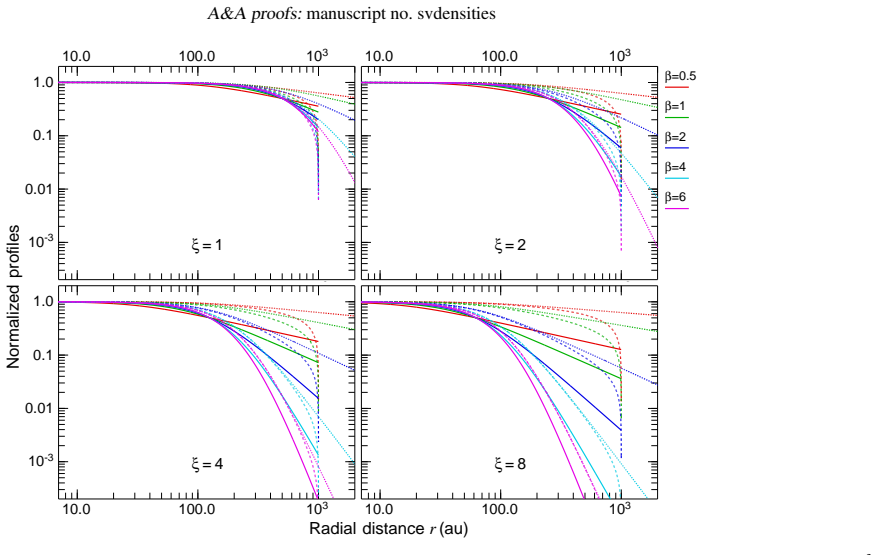
Fitting observed surface density profiles Σ(r) with slope γ and width H by the Plummer function under the assumptions β = γ + 1 and h ≈ H produces systematic errors that grow for shallow slopes; a new method that accounts for finite cylindrical geometry supplies self-consistent empirical relations between the observed parameters and the volume density parameters β and h, with the slope difference δ = β − γ falling below unity for shallow compact cases and the width ratio h/H differing by more than an order of magnitude for extended shallow filaments.
What carries the argument
Finite-cylindrical-geometry fitting method that derives empirical relations between the parameters of the projected surface density profile Σ(r) and the intrinsic volume density profile ρ(r).
If this is right
- The slope difference δ ≡ β − γ falls below unity for shallow (β ≲ 2) and compact profiles.
- Widths h and H can differ by over an order of magnitude for extended filaments with shallow slopes.
- Accurate parameter recovery requires resolvedness R ≡ H/O ≳ 10; lower values cause severe slope overestimation.
- The traditional Plummer function yields systematically overestimated slopes.
- Current far-infrared observations typically lack the resolution needed for reliable deconvolution.
Where Pith is reading between the lines
- Many existing catalogs of filament slopes and widths derived from low-resolution data would shift if reprocessed with the geometry-aware relations.
- The circular requirement of knowing true parameters to deconvolve observations can only be broken by pushing angular resolution well above the current typical values.
- The same finite-cylinder correction could be tested on other elongated structures such as jets or galactic arms where projection effects are similarly important.
Load-bearing premise
The model profiles chosen to build the empirical relations accurately represent the true three-dimensional geometry and density structure of real molecular-cloud filaments.
What would settle it
Apply the new method to synthetic surface-density maps generated from known volume-density cylinders with β < 2 and compare the recovered β and h against the input values; systematic mismatch would falsify the claimed relations.
Figures


read the original abstract
Accurate characterization of filamentary structures in star-forming clouds is essential for understanding star formation. Traditional methods fit observed surface density profiles $\Sigma(r)$ with slope $\gamma$ and width $H$ using the Plummer function, assuming $\beta=\gamma+1$ and $h\approx H$ for the volume density slope and width. These assumptions break down for shallow profiles, with the slope and width relations deviating progressively more for compact and extended filaments, respectively. We present a new fitting method that explicitly accounts for finite cylindrical geometry and establishes self-consistent empirical relationships between the parameters of $\Sigma(r)$ and those of the volume density profile $\rho(r)$ with slope $\beta$ and width $h$. The method was validated on model profiles and applied to selected filaments in the California molecular cloud. The slope difference $\delta\equiv\beta-\gamma$ falls below unity for shallow ($\beta\lesssim 2$) and compact profiles; $h$ and $H$ can differ by over an order of magnitude for extended filaments with shallow slopes. Accurate parameter recovery requires high resolvedness $R\equiv H/O\gtrsim 10$ (where $O$ is the beam width); at lower resolvedness, slopes are severely overestimated and filaments remain unresolved even when $H\gg O$. The traditional Plummer function yields systematically overestimated slopes. Accurate deconvolution requires a priori knowledge of the true parameters, creating a fundamental circular problem whose only robust solution is obtaining sufficiently high angular resolution. Current far-infrared observations typically lack sufficient resolution, and some previously reported filament properties may require reinterpretation.
Editorial analysis
A structured set of objections, weighed in public.
Referee Report
Summary. The paper claims to introduce a new fitting method that explicitly accounts for finite cylindrical geometry when deriving volume density profile parameters (slope β and width h) from observed surface density profiles (slope γ and width H). It establishes self-consistent empirical relationships between these parameters, validates the approach on families of model profiles, applies it to selected filaments in the California molecular cloud, and argues that traditional Plummer-function assumptions (β=γ+1, h≈H) lead to overestimated slopes, that accurate recovery requires resolvedness R≡H/O ≳10, and that deconvolution suffers from a fundamental circularity problem resolvable only by high angular resolution.
Significance. If the empirical Σ–ρ mappings prove robust beyond the idealized models, the work would meaningfully improve quantitative characterization of filament density structures, which are central to star-formation theory in molecular clouds. The explicit treatment of finite-cylinder projection effects and the resolution requirement are useful additions. The paper correctly flags the circularity in traditional deconvolution and the need for high-resolution data, both of which have direct observational implications.
major comments (3)
- [Abstract] Abstract and validation description: the method is stated to have been validated on model profiles, yet no quantitative recovery metrics (RMS errors, bias, or scatter in recovered β and h versus input values) are supplied. This absence is load-bearing because the central claim is that the new empirical relations enable accurate parameter recovery.
- [Method] Derivation of empirical relations: the self-consistent mappings between (γ,H) and (β,h) are obtained by fitting the same class of idealized finite-cylinder models that are later used for validation. This circularity, already flagged in the manuscript for traditional deconvolution, is not resolved by the new procedure and directly affects the reliability of the reported δ≡β−γ and h/H offsets.
- [Application to California Cloud] Application section: the reinterpretation of California Cloud filament properties rests on the assumption that real filaments match the constant-β, constant-h, perfectly cylindrical models used to calibrate the corrections. No test is shown for the impact of longitudinal density variations or non-circular cross-sections, which are known to exist in observed filaments and would propagate into biased β and h.
minor comments (2)
- The definition of resolvedness R≡H/O appears only in the abstract; it should be introduced with an explicit equation in the main text before the resolution-requirement discussion.
- Notation for the Plummer-function parameters (γ,H) versus the intrinsic (β,h) should be tabulated once for quick reference, as the many comparisons between them are central to the argument.
Simulated Author's Rebuttal
We thank the referee for the constructive and detailed report. The comments highlight important aspects of validation, model assumptions, and applicability that we address below. We have revised the manuscript to incorporate quantitative metrics and expanded discussion of limitations.
read point-by-point responses
-
Referee: [Abstract] Abstract and validation description: the method is stated to have been validated on model profiles, yet no quantitative recovery metrics (RMS errors, bias, or scatter in recovered β and h versus input values) are supplied. This absence is load-bearing because the central claim is that the new empirical relations enable accurate parameter recovery.
Authors: We agree that explicit quantitative metrics strengthen the validation. In the revised manuscript we have added a new table (Table 2) reporting RMS errors, mean biases, and standard deviations in recovered β and h as functions of input β, h, and resolvedness R. These metrics show that the empirical mappings recover input values with bias <0.05 and scatter <0.15 for R ≳ 10, while confirming the systematic overestimation under the traditional Plummer assumptions. The abstract has been updated to reference these results. revision: yes
-
Referee: [Method] Derivation of empirical relations: the self-consistent mappings between (γ,H) and (β,h) are obtained by fitting the same class of idealized finite-cylinder models that are later used for validation. This circularity, already flagged in the manuscript for traditional deconvolution, is not resolved by the new procedure and directly affects the reliability of the reported δ≡β−γ and h/H offsets.
Authors: The empirical relations are constructed by forward-projecting a grid of finite-cylinder models (varying β and h) to obtain synthetic Σ profiles, measuring γ and H from those profiles, and then fitting the inverse mappings. Validation then applies the fitted mappings to recover the original β and h from the same synthetic Σ profiles. While this uses the model family for both steps, it is not circular in the same sense as traditional deconvolution: the latter assumes a functional form to invert the projection, whereas here the mapping is an empirical calibration whose accuracy can be tested on the models themselves. We have added text in Section 3 clarifying this distinction and noting that the relations remain model-dependent; users should treat them as approximate corrections when real filaments depart from the assumed geometry. revision: partial
-
Referee: [Application to California Cloud] Application section: the reinterpretation of California Cloud filament properties rests on the assumption that real filaments match the constant-β, constant-h, perfectly cylindrical models used to calibrate the corrections. No test is shown for the impact of longitudinal density variations or non-circular cross-sections, which are known to exist in observed filaments and would propagate into biased β and h.
Authors: We acknowledge that the California Cloud application is an illustrative demonstration rather than a comprehensive re-analysis. Real filaments exhibit longitudinal variations and non-circular cross-sections that are not captured by our idealized models. In the revised manuscript we have expanded Section 5 to discuss these limitations explicitly, citing observational evidence for such complexities and noting that they would likely increase scatter in recovered parameters. We have also added a forward-looking statement that more realistic 3-D simulations will be needed to quantify the resulting biases. The original application is retained as a proof-of-concept showing how the new relations alter inferred slopes relative to Plummer fits. revision: yes
Circularity Check
Empirical Σ–ρ mappings calibrated and validated exclusively on the same family of idealized finite-cylinder models
specific steps
-
fitted input called prediction
[Abstract]
"establishes self-consistent empirical relationships between the parameters of Σ(r) and those of the volume density profile ρ(r) with slope β and width h. The method was validated on model profiles and applied to selected filaments in the California molecular cloud."
The relationships are obtained by fitting the very same class of model profiles (finite cylinders with fixed β, h) that are later used for validation; parameter recovery on those models is therefore forced by the calibration procedure rather than independently verified.
full rationale
The paper derives its central empirical relationships by generating and fitting families of model surface-density profiles that assume perfect finite cylinders with constant β and h, then recovers the input (β, h) values from the fitted (γ, H) parameters. Validation is performed on the identical model set, confirming the mapping by construction within the assumed geometry. While the paper correctly diagnoses circularity in traditional Plummer deconvolution, its own correction inherits the same model-class dependence; success on synthetic data does not independently test applicability to real filaments with longitudinal variations or non-circular cross-sections. This produces partial circularity in the load-bearing empirical step, though the underlying radiative-transfer modeling itself remains non-circular.
Axiom & Free-Parameter Ledger
free parameters (1)
- empirical mapping coefficients
axioms (1)
- domain assumption Filaments can be modeled as finite-length cylinders with power-law volume density profiles
Forward citations
Cited by 3 Pith papers
-
A Salpeter-like filament linear density function across nearby molecular clouds
Filament linear density functions integrated over spatial scales in multiple molecular clouds follow a power law with slope ~1.3, matching the Salpeter IMF.
-
A Salpeter-like filament linear density function across nearby molecular clouds
Across seven molecular clouds the integrated filament linear density function follows a power law with slope 1.30-1.34, matching the Salpeter IMF slope of 1.35.
-
Scale-dependent surface and volume density properties of filaments in molecular clouds
Filament widths in molecular clouds scale with spatial scale following power laws H ∝ Y^0.50 and h ∝ Y^0.37, with volume density slopes of 2.1-2.4 and contrasts 17-52 versus 1.1-2.7 for surface densities.
Reference graph
Works this paper leans on
-
[1]
André, P., Di Francesco, J., Ward-Thompson, D., et al. 2014, in Protostars and Planets VI, ed. H. Beuther, R. S. Klessen, C. P. Dullemond, & Th. Henning, Space Science Series, 27–51 André, P., Men’shchikov, A., Bontemps, S., et al. 2010, A&A, 518, L102+ André, P., Palmeirim, P., & Arzoumanian, D. 2022, A&A, 667, L1 Arzoumanian, D., André, P., Didelon, P.,...
work page 2014
-
[2]
The inaccuracies of Eq. (A.2) are mostly within a few percent, except near the lower bounds of resolved- ness (see below), where errors become larger. For Gaussian pro- files (γ→ ∞), the formula is accurate within 12%. The concept of resolvedness becomes more complex for “in- finite” power-law structures (Men’shchikov 2023), becauseR has its lower bound o...
work page 2023
discussion (0)
Sign in with ORCID, Apple, or X to comment. Anyone can read and Pith papers without signing in.