Conflict-Aware Robust Design for Covert Wireless Communications
Pith reviewed 2026-05-10 16:23 UTC · model grok-4.3
The pith
In covert wireless communications under bounded uncertainty, reliability and covertness are limited by different adverse conditions.
A machine-rendered reading of the paper's core claim, the machinery that carries it, and where it could break.
Core claim
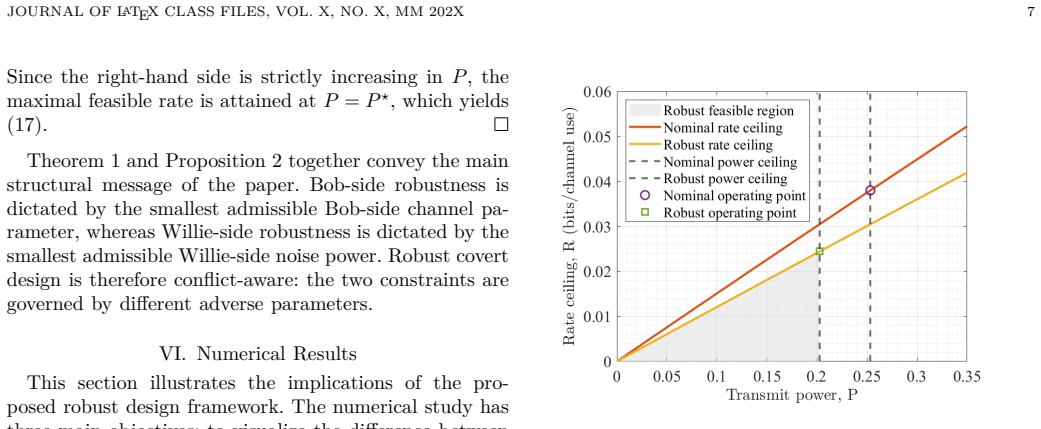
In a covert wireless model with quasi-static fading, outage-based reliability at Bob, and radiometric detection at Willie, bounded uncertainty intervals for Bob's average channel strength and Willie's noise power cause the reliability constraint to be governed by Bob's smallest admissible channel parameter while the covertness constraint is governed by Willie's smallest admissible noise level. This establishes a conflict-aware robust-design principle in which the adverse realizations for reliability and covertness differ, enabling derivation of closed-form robust feasible transmit power and the corresponding robust optimal rate.
What carries the argument
The conditional large-N midpoint-threshold surrogate for Willie's radiometric detector, parameterized by a Willie-side fading realization, used to tractably characterize the covertness constraint.
If this is right
- Bounded uncertainty contracts the region of feasible transmit powers and rates for the covert link.
- The robust optimal rate decreases monotonically as the uncertainty bounds on channel strength and noise power widen.
- Substantial rate loss occurs relative to a nominal design that ignores uncertainty.
- The surrogate detector closely tracks the midpoint-threshold radiometer in the low-effective-SNR regime.
Where Pith is reading between the lines
- The same separation of adverse cases may appear in other wireless security problems that combine reliability with a detection or secrecy constraint.
- Real-time estimation of uncertainty bounds could allow adaptive adjustment of power and rate to track the conflict-aware limits.
- Extensions to multi-antenna or time-varying channels could reveal whether the conflict between reliability and covertness persists or intensifies.
- Hardware experiments with measured fading and noise distributions would test whether the derived closed-form expressions remain predictive outside idealized models.
Load-bearing premise
The conditional large-N midpoint-threshold surrogate for Willie's radiometric detector accurately tracks the true detector in the intended low-effective-SNR regime.
What would settle it
A Monte Carlo comparison showing that the actual detection probability under Willie's true radiometer deviates substantially from the surrogate prediction for some Willie-side fading realizations and noise levels.
Figures


read the original abstract
Covert wireless communication aims to establish a reliable link while hiding the transmission from an adversary. In wireless settings, uncertainty plays a central role in this tradeoff: it can help mask the signal from a warden, but it also complicates robust system design. This raises a basic question: under bounded uncertainty, are reliability and covertness governed by the same adverse conditions? If not, robust covert design cannot be reduced to a single worst-case environment. In this paper, we study this question in a covert wireless model with quasi-static fading, outage-based reliability at Bob and radiometric detection at Willie. Uncertainty is represented through bounded intervals for Bob's average channel strength and Willie's noise power. To obtain a tractable characterization, we adopt a conditional large-N midpoint-threshold surrogate for Willie's detector, parameterized by a Willie-side fading realization. Within this framework, we show that the reliability constraint is governed by Bob's smallest admissible channel parameter, whereas the covertness constraint is governed by Willie's smallest admissible noise level. This establishes a conflict-aware robust-design principle: the adverse realizations for reliability and covertness differ. Based on this result, we derive closed-form expressions for the robustly feasible transmit power and the corresponding robust optimal rate. Numerical results show that bounded uncertainty contracts the feasible region, monotonically reduces the robust optimal rate, and can cause substantial loss relative to the nominal design. Monte Carlo results further show that the conditional surrogate closely tracks the midpoint-threshold radiometer in the intended low-effective-SNR regime. Overall, the paper shows that even in a streamlined wireless setting, robust covert design requires different adverse-case reasoning for reliability and covertness.
Editorial analysis
A structured set of objections, weighed in public.
Referee Report
Summary. The paper studies robust covert wireless communication under bounded uncertainty intervals on Bob's average channel strength and Willie's noise power, with outage reliability at Bob and radiometric detection at Willie. Adopting a conditional large-N midpoint-threshold surrogate for Willie's detector (parameterized by Willie-side fading), it derives closed-form expressions showing that the reliability constraint is governed by Bob's smallest admissible channel parameter while the covertness constraint is governed by Willie's smallest admissible noise level. This yields a conflict-aware robust design principle, closed-form robust transmit power and optimal rate, and numerical results on the contraction of the feasible region due to uncertainty. Monte Carlo simulations are presented to support the surrogate's accuracy in the low-effective-SNR regime.
Significance. If the surrogate remains accurate at the operating points used for the robust constraints, the work establishes a useful distinction between adverse realizations for reliability versus covertness, moving beyond single worst-case analysis. The closed-form derivations under the surrogate and the explicit separation of governing parameters are strengths that could inform practical robust covert system design.
major comments (1)
- [Monte Carlo validation and results] Monte Carlo validation (abstract and results section): the surrogate is validated only in the nominal (non-robust) setting and asserted to track the true radiometer in the low-effective-SNR regime. The covertness constraint, however, is evaluated at Willie's minimum admissible noise level, which maximizes effective SNR for any fixed power and lies outside the claimed validity regime of the midpoint-threshold approximation. No explicit error quantification or Monte Carlo comparison is reported at this boundary point, which directly governs the closed-form robust power and rate. This leaves the central claim about differing adverse realizations dependent on an unverified extrapolation of the surrogate.
minor comments (1)
- [System model] The description of the conditional large-N midpoint-threshold surrogate could include a brief statement of the precise conditioning and the large-N limit used, to make the transition from the true radiometer to the surrogate fully explicit.
Simulated Author's Rebuttal
We thank the referee for the careful reading and for highlighting the need for stronger validation of the surrogate at the robust operating point. We address the major comment below and commit to revisions that directly respond to the concern.
read point-by-point responses
-
Referee: [Monte Carlo validation and results] Monte Carlo validation (abstract and results section): the surrogate is validated only in the nominal (non-robust) setting and asserted to track the true radiometer in the low-effective-SNR regime. The covertness constraint, however, is evaluated at Willie's minimum admissible noise level, which maximizes effective SNR for any fixed power and lies outside the claimed validity regime of the midpoint-threshold approximation. No explicit error quantification or Monte Carlo comparison is reported at this boundary point, which directly governs the closed-form robust power and rate. This leaves the central claim about differing adverse realizations dependent on an unverified extrapolation of the surrogate.
Authors: We agree that the existing Monte Carlo results are confined to the nominal setting and that explicit verification at Willie's minimum admissible noise level is required to support the robust power and rate derivations. Although the robust design selects transmit power to keep the effective SNR low even under the worst-case (minimum) noise, we acknowledge that this does not substitute for direct comparison. In the revised manuscript we will add Monte Carlo simulations that evaluate the conditional large-N midpoint-threshold surrogate against the true radiometer specifically at the boundary noise level used for the covertness constraint, including quantitative error metrics. This addition will confirm the surrogate's accuracy for the robust case and remove reliance on extrapolation. revision: yes
Circularity Check
No circularity: closed-form robust rate derived analytically from constraint intersection under explicit surrogate model
full rationale
The paper's central result—that reliability is governed by Bob's minimum channel parameter while covertness is governed by Willie's minimum noise level—follows from intersecting the two constraints inside the adopted conditional large-N midpoint-threshold surrogate for Willie's detector. This produces closed-form expressions for feasible power and optimal rate without any fitted parameter being relabeled as a prediction, without self-definitional loops, and without load-bearing self-citations or ansatzes imported from prior author work. The surrogate is introduced explicitly for tractability in the low-effective-SNR regime, with Monte Carlo checks reported for the nominal case; the derivation chain remains self-contained against the model assumptions and does not reduce to its inputs by construction.
Axiom & Free-Parameter Ledger
axioms (3)
- domain assumption Quasi-static fading channel model
- domain assumption Bounded-interval uncertainty on Bob's average channel strength and Willie's noise power
- ad hoc to paper Conditional large-N midpoint-threshold surrogate for Willie's radiometer
Forward citations
Cited by 1 Pith paper
-
A Risk-Aware Framework for Covert Quantum Communication under Stochastic Channel Uncertainty
A risk-aware stochastic framework models uncertain quantum channels with chance constraints on covertness and reliability, yielding quantile reformulations and Monte Carlo results that expand feasible regions and impr...
Reference graph
Works this paper leans on
-
[1]
Covert communication over noisy channels: A resolvability perspective,
M. R. Bloch, “Covert communication over noisy channels: A resolvability perspective,” IEEE Transactions on Information Theory, vol. 62, no. 5, pp. 2334–2354, 2016
work page 2016
-
[2]
Fundamental limits of communication with low probability of detection,
L. Wang, G. W. Wornell, and L. Zheng, “Fundamental limits of communication with low probability of detection,” IEEE Transactions on Information Theory, vol. 62, no. 6, pp. 3493– 3503, 2016
work page 2016
-
[3]
Hiding information in noise: Fundamental limits of covert wireless communication,
B. A. Bash, D. Goeckel, D. Towsley, and S. Guha, “Hiding information in noise: Fundamental limits of covert wireless communication,” IEEE Communications Magazine, vol. 53, no. 12, pp. 26–31, 2015
work page 2015
-
[4]
Low probability of detection communication: Opportunities and challenges,
S. Yan, X. Zhou, J. Hu, and S. V. Hanly, “Low probability of detection communication: Opportunities and challenges,” IEEE Wireless Communications, vol. 26, no. 5, pp. 19–25, 2019. JOURNAL OF LATEX CLASS FILES, VOL. X, NO. X, MM 202X 10
work page 2019
-
[5]
Covert communications: A comprehensive survey,
X. Chen, J. An, Z. Xiong, C. Xing, N. Zhao, F. R. Yu, and A. Nallanathan, “Covert communications: A comprehensive survey,” IEEE Communications Surveys & Tutorials, vol. 25, no. 2, pp. 1173–1198, 2023
work page 2023
-
[6]
Fat tissue-based in-body covert communication,
M. Padmal, J. Engstrand, A. Arghavani, S. Dey, R. Augustine, R. Jäntti, and T. Voigt, “Fat tissue-based in-body covert communication,” in 2025 IEEE 26th International Symposium on a World of Wireless, Mobile and Multimedia Networks (WoWMoM). IEEE, 2025, pp. 61–71
work page 2025
-
[7]
Covert com- munications when the warden does not know the background noise power,
D. Goeckel, B. Bash, S. Guha, and D. Towsley, “Covert com- munications when the warden does not know the background noise power,” IEEE Communications Letters, vol. 20, no. 2, pp. 236–239, 2015
work page 2015
-
[8]
On covert communi- cation with noise uncertainty,
B. He, S. Yan, X. Zhou, and V. K. Lau, “On covert communi- cation with noise uncertainty,” IEEE Communications Letters, vol. 21, no. 4, pp. 941–944, 2017
work page 2017
-
[9]
On covert communication with interference uncertainty,
Z. Liu, J. Liu, Y. Zeng, J. Ma, and Q. Huang, “On covert communication with interference uncertainty,” in 2018 IEEE International Conference on Communications (ICC). IEEE, 2018, pp. 1–6
work page 2018
-
[10]
Covert communication in fading channels under channel uncertainty,
K. Shahzad, X. Zhou, and S. Yan, “Covert communication in fading channels under channel uncertainty,” in 2017 IEEE 85th Vehicular technology conference (VTC Spring). IEEE, 2017, pp. 1–5
work page 2017
-
[11]
Covert wireless communications under quasi-static fading with channel uncertainty,
K. Shahzad and X. Zhou, “Covert wireless communications under quasi-static fading with channel uncertainty,” IEEE Transactions on Information Forensics and Security, vol. 16, pp. 1104–1116, 2020
work page 2020
-
[12]
Covert communication with the help of relay and channel uncertainty,
J. Wang, W. Tang, Q. Zhu, X. Li, H. Rao, and S. Li, “Covert communication with the help of relay and channel uncertainty,” IEEE Wireless Communications Letters, vol. 8, no. 1, pp. 317– 320, 2018
work page 2018
-
[13]
Covert communication under channel uncertainty and noise uncertainty,
H. Q. Ta and S. W. Kim, “Covert communication under channel uncertainty and noise uncertainty,” in ICC 2019-2019 IEEE International Conference on Communications (ICC). IEEE, 2019, pp. 1–6
work page 2019
-
[14]
Covert communication with noise and channel uncertainties,
H. Q. Ta, Q.-V. Pham, K. Ho-Van, and S. W. Kim, “Covert communication with noise and channel uncertainties,” Wireless Networks, vol. 28, no. 1, pp. 161–172, 2022
work page 2022
-
[15]
Achieving covert wireless communications using a full-duplex receiver,
K. Shahzad, X. Zhou, S. Yan, J. Hu, F. Shu, and J. Li, “Achieving covert wireless communications using a full-duplex receiver,” IEEE Transactions on Wireless Communications, vol. 17, no. 12, pp. 8517–8530, 2018
work page 2018
-
[16]
Covert wireless communication with artificial noise genera- tion,
R. Soltani, D. Goeckel, D. Towsley, B. A. Bash, and S. Guha, “Covert wireless communication with artificial noise genera- tion,” IEEE Transactions on Wireless Communications, vol. 17, no. 11, pp. 7252–7267, 2018
work page 2018
-
[17]
Optimal power adaptation in covert communication with an uninformed jammer,
K. Li, P. A. Kelly, and D. Goeckel, “Optimal power adaptation in covert communication with an uninformed jammer,” IEEE Transactions on Wireless Communications, vol. 19, no. 5, pp. 3463–3473, 2020
work page 2020
-
[18]
Robust power allocation in covert communication: Imperfect cdi,
M. Forouzesh, P. Azmi, N. Mokari, and D. Goeckel, “Robust power allocation in covert communication: Imperfect cdi,” IEEE Transactions on Vehicular Technology, vol. 70, no. 6, pp. 5789– 5802, 2021
work page 2021
-
[19]
Strategies in covert communication with imperfect channel state information,
X. Peng, J. Wang, S. Xiao, and W. Tang, “Strategies in covert communication with imperfect channel state information,” in 2021 IEEE Global Communications Conference (GLOBE- COM). IEEE, 2021, pp. 1–6
work page 2021
-
[20]
Robust beamforming design for covert communications,
S. Ma, Y. Zhang, H. Li, S. Lu, N. Al-Dhahir, S. Zhang, and S. Li, “Robust beamforming design for covert communications,” IEEE Transactions on Information Forensics and Security, vol. 16, pp. 3026–3038, 2021
work page 2021
-
[21]
Adaptive power control for cooperative covert communication with partial channel state information,
R. He, G. Li, H. Wang, Y. Jiao, and J. Cai, “Adaptive power control for cooperative covert communication with partial channel state information,” IEEE Wireless Communications Letters, vol. 11, no. 7, pp. 1428–1432, 2022
work page 2022
-
[22]
Channel-aware jammer selection and power control in covert communication,
R. He, J. Chen, G. Li, H. Wang, Y. Xu, W. Yang, Y. Jiao, and W. He, “Channel-aware jammer selection and power control in covert communication,” IEEE Transactions on Vehicular Technology, vol. 73, no. 2, pp. 2266–2279, 2023
work page 2023
-
[23]
Robust transmission design for covert satellite communication systems with dual-csi uncertainty,
H. Jia, Y. Wang, W. Wu, and J. Yuan, “Robust transmission design for covert satellite communication systems with dual-csi uncertainty,” IEEE Internet of Things Journal, 2025
work page 2025
-
[24]
Uav- enabled robust covert communication against active wardens,
F. Yang, C. Wang, J. Xiong, N. Deng, N. Zhao, and Y. Li, “Uav- enabled robust covert communication against active wardens,” IEEE Transactions on Vehicular Technology, no. 6, pp. 9159– 9164, 2024
work page 2024
-
[25]
Covert outage minimiza- tion in the presence of multiple wardens,
A. Arghavani, S. Dey, and A. Ahlén, “Covert outage minimiza- tion in the presence of multiple wardens,” IEEE Transactions on Signal Processing, vol. 71, pp. 686–700, 2023
work page 2023
-
[26]
Covert communication over a compound channel,
S. Salehkalaibar, M. H. Yassaee, and V. Y. Tan, “Covert communication over a compound channel,” arXiv preprint arXiv:1906.06675, 2019
-
[27]
Covert communication over a compound discrete mem- oryless channel,
M. Ahmadipour, S. Salehkalaibar, M. H. Yassaee, and V. Y. Tan, “Covert communication over a compound discrete mem- oryless channel,” in 2019 IEEE International Symposium on Information Theory (ISIT). IEEE, 2019, pp. 982–986
work page 2019
-
[28]
W. Chen, H. Ding, S. Wang, L. Hu, J. Luo, and F. Gong, “Covert communication based on noise uncertainty against multi-antenna detection: Analyses of limit covert and reliable rate,” IEEE Wireless Communications Letters, vol. 13, no. 1, pp. 148–152, 2023
work page 2023
-
[29]
Covert communication in uplink noma systems under channel distribu- tion information uncertainty,
Z. Duan, X. Yang, Y. Gong, D. Wang, and L. Wang, “Covert communication in uplink noma systems under channel distribu- tion information uncertainty,” IEEE Communications Letters, vol. 27, no. 5, pp. 1282–1286, 2023
work page 2023
-
[30]
Robust power and position optimization for the full-duplex receiver in covert communication,
R. Xu, L. Guan, Y. Zhao, Z. Li, and D. Wang, “Robust power and position optimization for the full-duplex receiver in covert communication,” in 2021 IEEE Global Communications Conference (GLOBECOM). IEEE, 2021, pp. 1–6
work page 2021
-
[31]
A game- theoretic approach to covert communications in the presence of multiple colluding wardens,
A. Arghavani, A. Ahlén, A. Teixeira, and S. Dey, “A game- theoretic approach to covert communications in the presence of multiple colluding wardens,” in 2021 IEEE Wireless Commu- nications and Networking Conference (WCNC). IEEE, 2021, pp. 1–7
work page 2021
-
[32]
Dynamic role-switching for cooperative covert communication,
A. Arghavani and E. Uhlemann, “Dynamic role-switching for cooperative covert communication,” in 2024 IEEE 100th Vehic- ular Technology Conference (VTC2024-Fall). IEEE, 2024, pp. 1–5
work page 2024
-
[33]
R. He, G. Li, J. Chen, H. Wang, R. Ma, W. Yang, W. He, and Y. Xu, “When the warden does not know transmit power: Detection performance analysis and covertness strategy design,” IEEE Transactions on Communications, vol. 72, no. 6, pp. 3184– 3198, 2024
work page 2024
discussion (0)
Sign in with ORCID, Apple, or X to comment. Anyone can read and Pith papers without signing in.