When structure does not imply symmetry
Pith reviewed 2026-05-10 08:06 UTC · model grok-4.3
The pith
Microstructural anisotropy in fungal materials does not necessarily produce anisotropic mechanics or sensory perception.
A machine-rendered reading of the paper's core claim, the machinery that carries it, and where it could break.
Core claim
Fungal protein materials formed by anisotropic networks of hyphae exhibit mechanical symmetry classes ranging from strongly anisotropic to effectively isotropic, identified through orthogonal tension, compression, and shear experiments; automated model discovery includes fiber-dependent invariants only when they are mechanically relevant and thereby determines the symmetry class directly from the data.
What carries the argument
Automated model discovery that selects active constitutive invariants, including fiber-dependent ones, from orthogonal mechanical test data to identify material symmetry class.
If this is right
- Fungal materials can behave isotropically in mechanics and perception despite visibly anisotropic microstructure.
- Fiber-dependent terms enter constitutive models only when required by the data rather than by structural images.
- Symmetry class can be inferred directly from mechanical experiments without assuming it from hyphal alignment.
- The same experimental and discovery protocol applies to other soft materials whose microstructure and macro response may decouple.
Where Pith is reading between the lines
- Texture perception in fungi-based meat alternatives may be tuned more by processing than by initial hyphal orientation.
- The framework could classify symmetry in other biological or engineered fibrous soft materials where imaging alone is inconclusive.
- Correlating the identified mechanical symmetry classes with human sensory panels would test whether isotropy in mechanics predicts isotropy in mouthfeel.
Load-bearing premise
The orthogonal tension, compression, and shear experiments on the three fungi-based materials capture every relevant directional dependence and symmetry class.
What would settle it
An additional loading direction or test on one of the materials reveals mechanical anisotropy inconsistent with the symmetry class assigned by the model discovery procedure.
Figures



read the original abstract
Fungal protein materials exhibit inherently anisotropic microstructures formed by networks of hyphae, which suggest a natural pathway to replicate the fibrous texture of animal meat. We probe whether this structural anisotropy translates into macroscopic mechanical and sensory anisotropy. Using orthogonal tension, compression, and shear experiments on three fungi-based materials, we identify distinct symmetry classes that range from strongly anisotropic to effectively isotropic behavior. Automated model discovery reveals that fiber-dependent invariants emerge only when mechanically relevant, and enables direct identification of material symmetry from data. These results demonstrate that microstructural anisotropy does not universally imply anisotropic mechanics or perception and establish a data-driven framework to infer symmetry in complex soft materials.
Editorial analysis
A structured set of objections, weighed in public.
Referee Report
Summary. The manuscript claims that fungal protein materials with inherently anisotropic hyphal microstructures do not necessarily exhibit anisotropic macroscopic mechanical or sensory behavior. Orthogonal tension, compression, and shear experiments on three fungi-based materials, combined with automated model discovery of invariants, identify symmetry classes ranging from strongly anisotropic to effectively isotropic. The central conclusion is that microstructural anisotropy does not universally imply anisotropic mechanics or perception, and the work establishes a data-driven framework to infer material symmetry classes directly from experimental data.
Significance. If the central claim holds, the result would be significant for soft-matter mechanics and biomimetic materials design, particularly in food science applications aiming to replicate isotropic textures from fibrous networks. It challenges the common assumption that structural anisotropy necessarily produces mechanical anisotropy and demonstrates a practical automated approach to symmetry classification without a priori model assumptions. The absence of free parameters in the discovery step and the falsifiable experimental basis are strengths that would elevate the contribution if the data and validation are robust.
major comments (1)
- [Abstract and experimental protocol] The claim that microstructural anisotropy does not universally imply anisotropic mechanics (Abstract) requires at least one material to be verifiably isotropic despite anisotropic hyphal networks. This rests on the orthogonal tension/compression/shear data plus automated invariant selection declaring fiber terms unnecessary. For fiber-reinforced or transversely isotropic soft solids, principal-axis tests alone cannot exclude directional dependence at intermediate angles; the model-discovery step could therefore omit mechanically relevant invariants that only appear off-axis, leaving the 'effectively isotropic' classification and the universality negation insecure.
minor comments (2)
- The abstract and manuscript description reference experiments and automated discovery but provide no details on sample preparation, number of replicates, error bars, statistical measures, or full datasets.
- Reproducibility would be strengthened by including the full experimental data, the specific invariants considered in the automated discovery algorithm, and any code or pseudocode for the model-selection procedure.
Simulated Author's Rebuttal
We thank the referee for their thorough and constructive review. The major comment raises an important methodological point about the sufficiency of principal-axis testing, which we address directly below. We maintain that our data-driven results support the central claim while agreeing that additional context on limitations will strengthen the manuscript.
read point-by-point responses
-
Referee: [Abstract and experimental protocol] The claim that microstructural anisotropy does not universally imply anisotropic mechanics (Abstract) requires at least one material to be verifiably isotropic despite anisotropic hyphal networks. This rests on the orthogonal tension/compression/shear data plus automated invariant selection declaring fiber terms unnecessary. For fiber-reinforced or transversely isotropic soft solids, principal-axis tests alone cannot exclude directional dependence at intermediate angles; the model-discovery step could therefore omit mechanically relevant invariants that only appear off-axis, leaving the 'effectively isotropic' classification and the universality negation insecure.
Authors: We agree that principal-axis testing alone cannot exhaustively rule out all possible directional dependencies that might appear only at intermediate angles in a transversely isotropic solid. Our automated invariant discovery procedure, however, operates without a priori symmetry assumptions and selects the minimal set of invariants required to fit the full set of orthogonal tension, compression, and shear measurements. For the material classified as effectively isotropic, the algorithm returned only the isotropic invariants; fiber-dependent terms were not selected because they did not improve the fit and produced no systematic residuals across the three loading modes. This outcome is consistent with isotropic behavior under the experimentally probed conditions and thereby falsifies the universal mapping from hyphal anisotropy to macroscopic anisotropy. We nevertheless recognize the value of off-axis data for a more complete characterization. In the revised manuscript we will add an explicit limitations paragraph that (i) qualifies the isotropy classification as “effective” under the tested principal directions and (ii) recommends off-axis experiments for future validation studies. This addition clarifies the scope of the claim without altering the reported findings or the data-driven framework. revision: partial
Circularity Check
No significant circularity; results derive directly from experimental data
full rationale
The paper's derivation chain begins with orthogonal tension, compression, and shear experiments on three fungi-based materials, followed by automated invariant selection to classify symmetry groups. The central claim—that microstructural anisotropy does not universally imply mechanical anisotropy—follows from the data fits identifying cases where fiber-dependent invariants are not selected as mechanically relevant. No step reduces a prediction to a fitted parameter by construction, invokes a self-citation as the sole justification for a uniqueness theorem, or renames a known result; the framework remains self-contained against the provided test data without load-bearing self-referential definitions.
Axiom & Free-Parameter Ledger
Reference graph
Works this paper leans on
-
[1]
to modern descriptions of fiber-reinforced solids [3], scientists have linked macroscopic behavior to underlying microstructure through invariant-based constitutive laws [4]. In this framework,anisotropyarises when internal architecture introduces preferred directions that break rotationalsymmetryand produce direction-dependent stiffness, strength, and de...
work page internal anchor Pith review Pith/arXiv arXiv 2026
-
[3]
L. R. G. Treloar, Trans. Faraday Soc.44, 592 (1948)
work page 1948
- [4]
- [5]
-
[8]
Flory,Principles of Polymer Chemistry(Cornell University Press, 1953)
P.J. Flory,Principles of Polymer Chemistry(Cornell University Press, 1953)
work page 1953
- [9]
-
[10]
G. Franceschini, D. Bigoni, P. Regitnig, and G.A. Holzapfel, J. Biomech.39, 1448 (2006)
work page 2006
- [11]
-
[12]
S.C. Watkinson, L. Boddy, and N.P. Money,The Fungi, 3rd ed. (Academic Press, 2016)
work page 2016
- [13]
-
[14]
T.J.A. Finnigan, H.E. Theobald, and B. Bajka, Annu. Rev. Food Sci. Technol.16, 105–25 (2025)
work page 2025
- [19]
- [20]
- [21]
-
[22]
M.A. Holland, S. Budday, A. Goriely, and E. Kuhl, Phys. Rev. Lett.121, 228002 (2018). 6 SUPPLEMENTARY MATERIAL In this study, we test three fungi-based materials: mycelium,fruiting body, and aprotein myceliumblend. The materials originate from commercially available products (Meati Foods, Boulder, CO; OMNI, New York, NY; Beyond, El Segundo, CA), but we re...
work page 2018
-
[23]
Dunneet al., Food Res Int.205115876 (2025)
R.A. Dunneet al., Food Res Int.205115876 (2025)
work page 2025
-
[24]
Holzapfel,Nonlinear Solid Mechanics(Wiley, 2000)
G.A. Holzapfel,Nonlinear Solid Mechanics(Wiley, 2000)
work page 2000
- [25]
- [26]
-
[27]
J. A. McCullochet al., Int. J. Num. Meth. Eng.125 e7481 (2024)
work page 2024
- [28]
-
[29]
R. W. Ogden,Non-Linear Elastic Deformations(Dover, 1984)
work page 1984
-
[30]
A. J. M. Spencer,Theory of Invariants, (in: Continuum Physics, Academic Press, 1971)
work page 1971
-
[31]
S.R. St. Pierreet al., npj Sci. Food.8, 94 (2024)
work page 2024
-
[32]
S.R. St. Pierreet al., Curr. Res. Food Sci10101080 (2025)
work page 2025
- [33]
- [34]
-
[35]
C. Truesdell and W. Noll,The Non-Linear Field Theories of Mechanics(Springer, 1965)
work page 1965
-
[36]
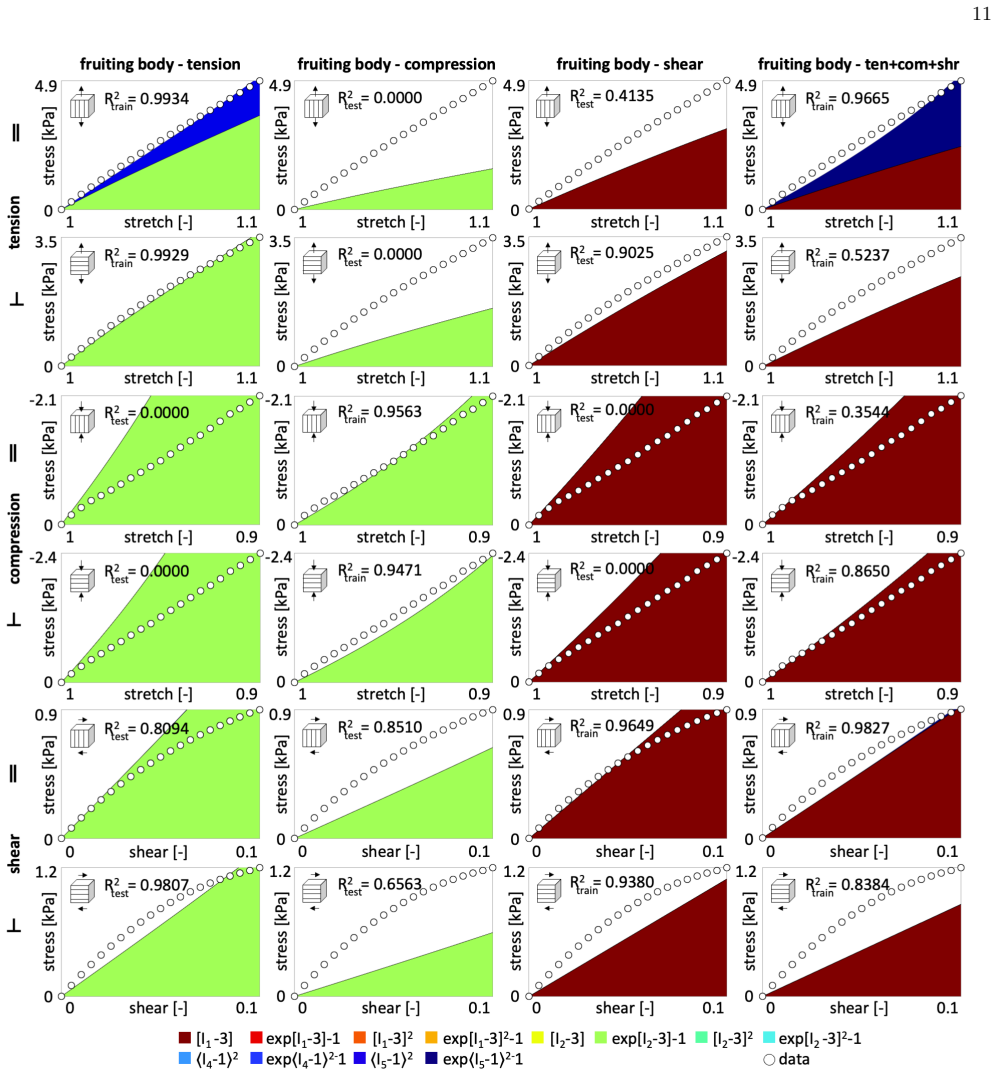
T. Vervenne, S.R. St Pierre, N. Famaey and E. Kuhl, Acta Biomat.202341-351 (2025). 10 FIG. 9.Discovered models for mycelium.We train the transversely isotropic constitutive neural network in Fig. 8 with tension, compression, shear, and all three loading modes simultaneously and applyL 1-regularization. Pictograms show the fiber orientation, in-plane (∥) o...
work page 2025
discussion (0)
Sign in with ORCID, Apple, or X to comment. Anyone can read and Pith papers without signing in.