Intrinsic i-wave altermagnetism in 2D graphene superlattices
Pith reviewed 2026-05-10 01:46 UTC · model grok-4.3
The pith
Graphene antidot superlattices develop an interaction-induced i-wave altermagnetic splitting from their intrinsic magnetic instability.
A machine-rendered reading of the paper's core claim, the machinery that carries it, and where it could break.
Core claim
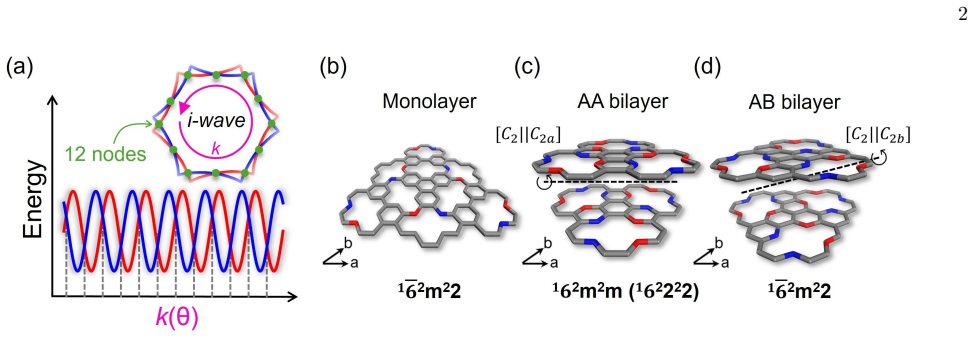
We establish a symmetry-guided design principle to engineer i-wave altermagnets in graphene antidot superlattices and demonstrate the emergence of altermagnetic states in specific monolayer and bilayer graphene superlattices. By combining first principles methods and atomistic tight binding models, we show the appearance of an interaction-induced i-wave altermagnetic splitting, stemming from the intrinsic magnetic instability of 2D graphene antidot superlattices.
What carries the argument
The interaction-induced i-wave altermagnetic splitting, a momentum-dependent spin splitting that appears once the antidot lattice's magnetic instability is accounted for in the electronic structure calculations.
If this is right
- Graphene antidot superlattices become a concrete carbon-based platform for realizing altermagnetic order.
- The same symmetry-design approach can be applied to other graphene-based 2D superlattices to generate i-wave altermagnetism.
- Magnetic instabilities already known in graphene nanostructures can be repurposed to produce functional spin splitting without external fields.
- Both monolayer and bilayer versions of the antidot lattice are shown to support the altermagnetic state, broadening the range of candidate structures.
Where Pith is reading between the lines
- If the altermagnetic order remains robust against disorder or edge effects common in real nanostructures, the design could integrate directly with existing graphene device fabrication methods.
- Similar antidot patterns in other 2D carbon lattices might produce related altermagnetic states, extending the approach beyond graphene.
- The absence of transition metals simplifies potential device integration with silicon or other conventional electronics.
Load-bearing premise
The magnetic instability in the antidot superlattices produces a stable, long-range altermagnetic order that survives in real fabricated samples and is accurately captured by the chosen first-principles and tight-binding approximations.
What would settle it
Angle-resolved photoemission spectroscopy on fabricated graphene antidot superlattice samples that either detects or fails to detect the predicted momentum-dependent spin splitting at the expected wavevectors would confirm or refute the central claim.
Figures


read the original abstract
Altermagnets feature unconventional magnetism due to their momentum-dependent spin splitting purely driven by magnetic order, for which a variety of transition-metal-based d-wave altermagnets have been proposed. However, carbon-based altermagnets in graphene structures remain elusive, even though magnetism in graphene nanostructures has been widely demonstrated. Here, we establish a symmetry-guided design principle to engineer i-wave altermagnets in graphene antidot superlattices and demonstrate the emergence of altermagnetic states in specific monolayer and bilayer graphene superlattices. By combining first principles methods and atomistic tight binding models, we show the appearance of an interaction-induced i-wave altermagnetic splitting, stemming from the intrinsic magnetic instability of 2D graphene antidot superlattices. Our work establishes a strategy to engineer i-wave altermagnetism in a graphene platform, putting forward a carbon-based platform for altermagnetic spintronics.
Editorial analysis
A structured set of objections, weighed in public.
Referee Report
Summary. The paper claims to introduce a symmetry-guided design principle for engineering i-wave altermagnets in graphene antidot superlattices. Using first-principles methods combined with atomistic tight-binding models, it reports the emergence of interaction-induced i-wave altermagnetic states with momentum-dependent spin splitting and zero net magnetization in specific monolayer and bilayer graphene structures, arising from the intrinsic magnetic instability of these 2D superlattices.
Significance. If the central results hold, the work would establish a carbon-based platform for altermagnetism, extending the concept beyond d-wave transition-metal systems to graphene nanostructures and offering a route to altermagnetic spintronics without heavy elements. The symmetry-design approach and demonstration of splitting in antidot lattices represent a potentially useful addition to the field.
major comments (2)
- [Methods / Computational Details] The computational methods section provides no details on convergence criteria (energy cutoff, k-point sampling density, vacuum spacing), error bars, or validation against known limits such as the non-interacting or non-magnetic graphene case. This directly affects assessment of the reported splitting magnitudes and the claim of an intrinsic instability.
- [Results on Altermagnetic Splitting] The results on magnetic instability (likely in the DFT/TB sections) rely on mean-field or collinear spin-polarized approximations that presuppose long-range order. No analysis of spin-wave spectrum, renormalization-group flow, or finite-temperature effects is presented to address Mermin-Wagner considerations for 2D magnetism, leaving the extrapolation from local instability to stable macroscopic i-wave altermagnetic order unverified.
minor comments (2)
- [Abstract / Introduction] The abstract and introduction could more explicitly state the superlattice periodicity and antidot size parameters used in the calculations to allow direct comparison with future experiments.
- [Theory / Symmetry Analysis] Notation for the i-wave symmetry (e.g., the precise form of the momentum-dependent spin splitting) should be defined with an equation or figure early in the text rather than assumed from context.
Simulated Author's Rebuttal
We thank the referee for the constructive comments and for recognizing the potential significance of a carbon-based altermagnetic platform. We address each major comment point by point below, indicating revisions made to the manuscript.
read point-by-point responses
-
Referee: [Methods / Computational Details] The computational methods section provides no details on convergence criteria (energy cutoff, k-point sampling density, vacuum spacing), error bars, or validation against known limits such as the non-interacting or non-magnetic graphene case. This directly affects assessment of the reported splitting magnitudes and the claim of an intrinsic instability.
Authors: We agree that the original Methods section lacked sufficient detail on these parameters. In the revised manuscript we have added an expanded computational details subsection specifying the plane-wave cutoff, k-point meshes, vacuum spacing, and convergence thresholds employed. We have also included explicit validation against the known non-magnetic, non-interacting graphene band structure and reported error estimates on the altermagnetic splitting obtained from parameter-variation tests. These additions directly support the reliability of the reported interaction-induced splitting. revision: yes
-
Referee: [Results on Altermagnetic Splitting] The results on magnetic instability (likely in the DFT/TB sections) rely on mean-field or collinear spin-polarized approximations that presuppose long-range order. No analysis of spin-wave spectrum, renormalization-group flow, or finite-temperature effects is presented to address Mermin-Wagner considerations for 2D magnetism, leaving the extrapolation from local instability to stable macroscopic i-wave altermagnetic order unverified.
Authors: The referee correctly notes that our calculations are performed within a mean-field framework. The manuscript demonstrates a symmetry-allowed local magnetic instability that produces the i-wave altermagnetic spin splitting; the symmetry-design principle itself is independent of the mechanism that ultimately stabilizes long-range order. In the revised version we have added a dedicated paragraph discussing the Mermin-Wagner considerations, noting that weak anisotropies or substrate coupling can lift the strict prohibition on order in real 2D systems, and clarifying that the work does not claim finite-temperature stability. A full spin-wave or renormalization-group analysis, however, lies outside the present scope. revision: partial
- Complete spin-wave spectrum and renormalization-group analysis required to rigorously verify long-range order stability against 2D thermal fluctuations
Circularity Check
No circularity: results from explicit first-principles and tight-binding computations
full rationale
The paper's central result—an interaction-induced i-wave altermagnetic splitting—is obtained by direct numerical modeling via DFT and atomistic tight-binding calculations on graphene antidot superlattices. No parameter is fitted to the target splitting itself, no quantity is defined in terms of the output, and no load-bearing step reduces to a self-citation or ansatz that presupposes the claimed altermagnetism. The derivation chain consists of standard electronic-structure methods applied to a symmetry-guided lattice geometry; the computed instability and momentum-dependent spin texture therefore constitute independent output rather than a tautological restatement of the inputs.
Axiom & Free-Parameter Ledger
axioms (1)
- domain assumption Density functional theory approximations reliably capture magnetic instabilities in graphene-based systems
Forward citations
Cited by 1 Pith paper
-
Ligand-mediated Origin of Altermagnetic Spin-Splitting
First-principles and tight-binding analysis shows ligand-assisted coupling dominates altermagnetic spin-splitting in Co1/4NbSe2.
Reference graph
Works this paper leans on
-
[1]
T. Jungwirth, J. Sinova, R. M. Fernandes, Q. Liu, H. Watanabe, S. Murakami, S. Nakatsuji, and L.ˇSmejkal, Symmetry, microscopy and spectroscopy signatures of al- termagnetism, Nature649, 837 (2026)
work page 2026
-
[2]
L. Bai, W. Feng, S. Liu, L. ˇSmejkal, Y. Mokrousov, and Y. Yao, Altermagnetism: Exploring new frontiers in mag- netism and spintronics, Adv. Funct. Mater.34, 2409327 (2024)
work page 2024
-
[3]
C. Song, H. Bai, Z. Zhou, L. Han, H. Reichlova, J. H. Dil, J. Liu, X. Chen, and F. Pan, Altermagnets as a new class of functional materials, Nat. Rev. Mater.10, 473 (2025)
work page 2025
-
[4]
S. S. Fender, O. Gonzalez, and D. K. Bediako, Altermag- netism: A chemical perspective, J. Am. Chem. Soc.147, 2257 (2025)
work page 2025
-
[5]
Z. Guo, X. Wang, W. Wang, G. Zhang, X. Zhou, and Z. Cheng, Spin-polarized antiferromagnets for spintron- ics, Adv. Mater.37, 2505779 (2025)
work page 2025
-
[6]
H. G. Giil and J. Linder, Superconductor-altermagnet memory functionality without stray fields, Phys. Rev. B. 109, 134511 (2024)
work page 2024
-
[7]
J. Krempask` y, L. ˇSmejkal, S. Dsouza, M. Hajlaoui, G. Springholz, K. Uhl´ ıˇ rov´ a, F. Alarab, P. Constantinou, V. Strocov, D. Usanov,et al., Altermagnetic lifting of kramers spin degeneracy, Nature626, 517 (2024)
work page 2024
-
[8]
H. Chen, Z.-A. Wang, P. Qin, Z. Meng, X. Zhou, X. Wang, L. Liu, G. Zhao, Z. Duan, T. Zhang,et al., Spin-splitting magnetoresistance in altermagnetic ruo2 thin films, Adv. Mater.37, 2507764 (2025)
work page 2025
- [9]
-
[10]
M. Ezawa, Third-order and fifth-order nonlinear spin- current generation in g-wave and i-wave altermagnets and perfectly nonreciprocal spin current in f-wave magnets, Phys. Rev. B.111, 125420 (2025)
work page 2025
- [11]
-
[12]
Y. Zhu, M. Gu, Y. Liu, X. Chen, Y. Li, S. Du, and Q. Liu, Sliding ferroelectric control of unconventional magnetism in stacked bilayers, Phys. Rev. Lett.135, 056801 (2025)
work page 2025
-
[13]
C. Liu, X. Li, X. Li, and J. Yang, Realizing abundant two- dimensional altermagnets with anisotropic spin current via spatial inversion symmetry breaking, Nano Lett.25, 9197 (2025)
work page 2025
-
[14]
Y. Liu, J. Yu, and C.-C. Liu, Twisted magnetic van der waals bilayers: An ideal platform for altermagnetism, Phys. Rev. Lett.133, 206702 (2024)
work page 2024
-
[15]
D. Wang, H. Wang, L. Liu, J. Zhang, and H. Zhang, Electric-field-induced switchable two-dimensional alter- magnets, Nano Lett.25, 498 (2024)
work page 2024
- [16]
-
[17]
Z. Li, Z. Zhang, Y. Chen, S. Hu, Y. Ji, Y. Yan, J. Du, Y. Li, L. He, X. Wang,et al., Fully field-free spin-orbit torque switching induced by spin splitting effect in alter- magnetic ruo2, Adv. Mater.37, 2416712 (2025)
work page 2025
-
[18]
M. Naka, Y. Motome, and H. Seo, Altermagnetic per- ovskites, npj Spintron.3, 1 (2025)
work page 2025
-
[19]
S. Lee, S. Lee, S. Jung, J. Jung, D. Kim, Y. Lee, B. Seok, J. Kim, B. G. Park, L. ˇSmejkal,et al., Broken kramers degeneracy in altermagnetic mnte, Phys. Rev. Lett.132, 036702 (2024)
work page 2024
-
[20]
O. Amin, A. Dal Din, E. Golias, Y. Niu, A. Zakharov, S. Fromage, C. Fields, S. Heywood, R. Cousins, F. Mac- cherozzi,et al., Nanoscale imaging and control of alter- magnetism in mnte, Nature636, 348 (2024)
work page 2024
-
[21]
I. Mazin, R. Gonz´ alez-Hern´ andez, and L. ˇSmejkal, Induced monolayer altermagnetism in mnp(s,se) 3 and fese, arXiv 10.48550/arXiv.2309.02355 (2023), arXiv:2309.02355 [cond-mat.mes-hall]
-
[22]
L. Camerano, A. O. Fumega, J. L. Lado, A. Stroppa, and G. Profeta, Multiferroic nematic d-wave altermagnetism driven by orbital-order on the honeycomb lattice, npj 2D Mater. Appl.9, 75 (2025)
work page 2025
-
[23]
O. V. Yazyev, Emergence of magnetism in graphene ma- terials and nanostructures, Rep. Prog. Phys.73, 056501 (2010)
work page 2010
-
[24]
K. Wakabayashi, M. Fujita, H. Ajiki, and M. Sigrist, Electronic and magnetic properties of nanographite rib- bons, Phys. Rev. B59, 8271 (1999)
work page 1999
-
[25]
O. V. Yazyev and M. I. Katsnelson, Magnetic correlations at graphene edges: Basis for novel spintronics devices, 8 Phys. Rev. Lett.100, 047209 (2008)
work page 2008
-
[26]
J. Jung, T. Pereg-Barnea, and A. H. MacDonald, The- ory of interedge superexchange in zigzag edge magnetism, Phys. Rev. Lett.102, 227205 (2009)
work page 2009
-
[27]
P. Ruffieux, S. Wang, B. Yang, C. Snchez-Snchez, J. Liu, T. Dienel, L. Talirz, P. Shinde, C. A. Pignedoli, D. Passerone, T. Dumslaff, X. Feng, K. M¨ ullen, and R. Fasel, On-surface synthesis of graphene nanoribbons with zigzag edge topology, Nature531, 489492 (2016)
work page 2016
-
[28]
G. Z. Magda, X. Jin, I. Hagymsi, P. Vancs, Z. Osvth, P. Nemes-Incze, C. Hwang, L. P. Bir, and L. Tapaszt, Room-temperature magnetic order on zigzag edges of narrow graphene nanoribbons, Nature514, 608611 (2014)
work page 2014
-
[29]
H. Gonzlez-Herrero, J. M. Gmez-Rodrguez, P. Mallet, M. Moaied, J. J. Palacios, C. Salgado, M. M. Ugeda, J.- Y. Veuillen, F. Yndurain, and I. Brihuega, Atomic-scale control of graphene magnetism by using hydrogen atoms, Science352, 437441 (2016)
work page 2016
-
[30]
J. Fern´ andez-Rossier and J. J. Palacios, Magnetism in graphene nanoislands, Phys. Rev. Lett.99, 177204 (2007)
work page 2007
-
[31]
J. Su, M. Telychko, P. Hu, G. Macam, P. Mutombo, H. Zhang, Y. Bao, F. Cheng, Z.-Q. Huang, Z. Qiu,et al., Atomically precise bottom-up synthesis ofπ-extended [5] triangulene, Sci. Adv.5, 1 (2019)
work page 2019
-
[32]
S. Mishra, X. Yao, Q. Chen, K. Eimre, O. Gr¨ oning, R. Ortiz, M. Di Giovannantonio, J. C. Sancho-Garca, J. Fernndez-Rossier, C. A. Pignedoli, K. M¨ ullen, P. Ruffieux, A. Narita, and R. Fasel, Large magnetic ex- change coupling in rhombus-shaped nanographenes with zigzag periphery, Nat. Chem.13, 581586 (2021)
work page 2021
-
[33]
J. Li, S. Sanz, J. Castro-Esteban, M. Vilas-Varela, N. Friedrich, T. Frederiksen, D. Pe˜ na, and J. I. Pas- cual, Uncovering the triplet ground state of triangular graphene nanoflakes engineered with atomic precision on a metal surface, Phys. Rev. Lett.124, 177201 (2020)
work page 2020
- [34]
-
[35]
K. Sun, N. Cao, O. J. Silveira, A. O. Fumega, F. Hanin- dita, S. Ito, J. L. Lado, P. Liljeroth, A. S. Foster, and S. Kawai, On-surface synthesis of heisenberg spin- 1/2 antiferromagnetic molecular chains, Sci. Adv.11, 10.1126/sciadv.ads1641 (2025)
-
[36]
C. Zhao, L. Yang, J. C. G. Henriques, M. Ferri-Corts, G. Catarina, C. A. Pignedoli, J. Ma, X. Feng, P. Ruffieux, J. Fernndez-Rossier, and R. Fasel, Spin excitations in nanographene-based antiferromagnetic spin-1/2 heisen- berg chains, Nat. Mater.24, 722727 (2025)
work page 2025
- [37]
-
[38]
C. Zhao, G. Catarina, J.-J. Zhang, J. C. G. Henriques, L. Yang, J. Ma, X. Feng, O. Gr¨ oning, P. Ruffieux, J. Fernndez-Rossier, and R. Fasel, Tunable topologi- cal phases in nanographene-based spin-1/2 alternating- exchange heisenberg chains, Nat. Nanotechnol.19, 17891795 (2024)
work page 2024
- [39]
-
[40]
Y. Xie, A. T. Pierce, J. M. Park, D. E. Parker, E. Kha- laf, P. Ledwith, Y. Cao, S. H. Lee, S. Chen, P. R. Forrester, K. Watanabe, T. Taniguchi, A. Vishwanath, P. Jarillo-Herrero, and A. Yacoby, Fractional chern in- sulators in magic-angle twisted bilayer graphene, Nature 600, 439443 (2021)
work page 2021
-
[41]
Z. Lu, T. Han, Y. Yao, Z. Hadjri, J. Yang, J. Seo, L. Shi, S. Ye, K. Watanabe, T. Taniguchi, and L. Ju, Extended quantum anomalous hall states in graphene/hbn moir su- perlattices, Nature637, 10901095 (2025)
work page 2025
-
[42]
T. Han, Z. Lu, Y. Yao, J. Yang, J. Seo, C. Yoon, K. Watanabe, T. Taniguchi, L. Fu, F. Zhang, and L. Ju, Large quantum anomalous hall effect in spin-orbit prox- imitized rhombohedral graphene, Science384, 647651 (2024)
work page 2024
-
[43]
T. Han, Z. Lu, G. Scuri, J. Sung, J. Wang, T. Han, K. Watanabe, T. Taniguchi, H. Park, and L. Ju, Cor- related insulator and chern insulators in pentalayer rhombohedral-stacked graphene, Nat. Nanotechnol.19, 181187 (2023)
work page 2023
- [44]
-
[45]
B. Vi˜ na-Baus´ a, M. A. Garc´ ıa-Bl´ azquez, S. Chourasia, R. Carrasco, D. Exp´ osito, I. Brihuega, and J. J. Palacios, Building unconventional magnetic phases on graphene by h atom manipulation: From altermagnets to lieb ferri- magnets, Nano Lett.25, 11554 (2025)
work page 2025
-
[46]
M. Sch¨ uler, M. R¨ osner, T. O. Wehling, A. I. Lichtenstein, and M. I. Katsnelson, Optimal hubbard models for mate- rials with nonlocal coulomb interactions: Graphene, sil- icene, and benzene, Phys. Rev. Lett.111, 036601 (2013)
work page 2013
-
[47]
A. L. Grushina, D.-K. Ki, M. Koshino, A. A. L. Nicolet, C. Faugeras, E. McCann, M. Potemski, and A. F. Mor- purgo, Insulating state in tetralayers reveals an evenodd interaction effect in multilayer graphene, Nat. Commun. 6, 6419 (2015)
work page 2015
-
[48]
J. Velasco, L. Jing, W. Bao, Y. Lee, P. Kratz, V. Aji, M. Bockrath, C. N. Lau, C. Varma, R. Stillwell, D. Smirnov, F. Zhang, J. Jung, and A. H. MacDonald, Transport spectroscopy of symmetry-broken insulating states in bilayer graphene, Nat. Nanotechnol.7, 156160 (2012)
work page 2012
-
[49]
F. Freitag, J. Trbovic, M. Weiss, and C. Sch¨ onenberger, Spontaneously gapped ground state in suspended bilayer graphene, Phys. Rev. Lett.108, 076602 (2012)
work page 2012
-
[50]
R. T. Weitz, M. T. Allen, B. E. Feldman, J. Martin, and A. Yacoby, Broken-symmetry states in doubly gated suspended bilayer graphene, Science330, 812816 (2010)
work page 2010
-
[51]
T. G. Pedersen, C. Flindt, J. Pedersen, N. A. Mortensen, A.-P. Jauho, and K. Pedersen, Graphene antidot lattices: Designed defects and spin qubits, Phys. Rev. Lett.100, 136804 (2008)
work page 2008
-
[52]
J. A. F¨ urst, J. G. Pedersen, C. Flindt, N. A. Mortensen, M. Brandbyge, T. G. Pedersen, and A.-P. Jauho, Elec- tronic properties of graphene antidot lattices, New J. Phys.11, 095020 (2009)
work page 2009
-
[53]
T. G. Pedersen, C. Flindt, J. Pedersen, A.-P. Jauho, N. A. Mortensen, and K. Pedersen, Optical properties of graphene antidot lattices, Phys. Rev. B77, 245431 9 (2008)
work page 2008
-
[54]
A. Sandner, T. Preis, C. Schell, P. Giudici, K. Watanabe, T. Taniguchi, D. Weiss, and J. Eroms, Ballistic transport in graphene antidot lattices, Nano Lett.15, 84028406 (2015)
work page 2015
- [55]
-
[56]
K. Xu, J. I. Urgel, K. Eimre, M. Di Giovannantonio, A. Keerthi, H. Komber, S. Wang, A. Narita, R. Berger, P. Ruffieux,et al., On-surface synthesis of a nonpla- nar porous nanographene, J. Am. Chem. Soc.141, 7726 (2019)
work page 2019
-
[57]
M. Ajayakumar, M. Di Giovannantonio, C. A. Pignedoli, L. Yang, P. Ruffieux, J. Ma, R. Fasel, and X. Feng, On- surface synthesis of porous graphene nanoribbons con- taining nonplanar [14] annulene pores, J. Polym. Sci.60, 1912 (2022)
work page 1912
-
[58]
T. Qin, D. Guo, J. Xiong, X. Li, L. Hu, W. Yang, Z. Chen, Y. Wu, H. Ding, J. Hu,et al., Synthesis of a porous [14] annulene graphene nanoribbon and a porous [30] annulene graphene nanosheet on metal sur- faces, Angew. Chem. Int. Ed.135, e202306368 (2023)
work page 2023
-
[59]
O. V. Yazyev and L. Helm, Defect-induced magnetism in graphene, Phys. Rev. B75, 125408 (2007)
work page 2007
-
[60]
D. W. Boukhvalov, M. I. Katsnelson, and A. I. Lichten- stein, Hydrogen on graphene: Electronic structure, total energy, structural distortions and magnetism from first- principles calculations, Phys. Rev. B77, 035427 (2008)
work page 2008
-
[61]
J. O. Sofo, G. Usaj, P. S. Cornaglia, A. M. Suarez, A. D. Hern´ andez-Nieves, and C. A. Balseiro, Magnetic struc- ture of hydrogen-induced defects on graphene, Phys. Rev. B85, 115405 (2012)
work page 2012
-
[62]
E. H. Lieb, Two theorems on the hubbard model, Phys. Rev. Lett.62, 1201 (1989)
work page 1989
-
[63]
J. J. Palacios, J. Fern´ andez-Rossier, and L. Brey, Vacancy-induced magnetism in graphene and graphene ribbons, Phys. Rev. B77, 195428 (2008)
work page 2008
-
[64]
L. ˇSmejkal, J. Sinova, and T. Jungwirth, Emerging re- search landscape of altermagnetism, Phys. Rev. X12, 040501 (2022)
work page 2022
-
[65]
Y. Wang, H. Wang, J.-H. Gao, and F.-C. Zhang, Layer antiferromagnetic state in bilayer graphene: A first- principles investigation, Phys. Rev. B87, 195413 (2013)
work page 2013
-
[66]
L. ˇSmejkal, J. Sinova, and T. Jungwirth, Beyond conven- tional ferromagnetism and antiferromagnetism: A phase with nonrelativistic spin and crystal rotation symmetry, Phys. Rev. X12, 031042 (2022)
work page 2022
-
[67]
A. H. Castro Neto, F. Guinea, N. M. R. Peres, K. S. Novoselov, and A. K. Geim, The electronic properties of graphene, Rev. Mod. Phys.81, 109 (2009)
work page 2009
-
[68]
G. Kresse and J. Furthm¨ uller, Efficient iterative schemes for ab initio total-energy calculations using a plane-wave basis set, Phys. Rev. B54, 11169 (1996)
work page 1996
-
[69]
G. Kresse and J. Furthm¨ uller, Efficiency of ab-initio total energy calculations for metals and semiconductors using a plane-wave basis set, Comput. Mater. Sci.6, 15 (1996)
work page 1996
-
[70]
G. Kresse and D. Joubert, From ultrasoft pseudopoten- tials to the projector augmented-wave method, Phys. Rev. B59, 1758 (1999)
work page 1999
-
[71]
P. E. Bl¨ ochl, Projector augmented-wave method, Phys. Rev. B50, 17953 (1994)
work page 1994
-
[72]
J. P. Perdew, K. Burke, and M. Ernzerhof, Generalized gradient approximation made simple, Phys. Rev. Lett. 77, 3865 (1996)
work page 1996
-
[73]
S. Grimme, Semiempirical gga-type density functional constructed with a long-range dispersion correction, J. Comput. Chem.27, 1787 (2006)
work page 2006
-
[74]
J. Sun, A. Ruzsinszky, and J. P. Perdew, Strongly con- strained and appropriately normed semilocal density functional, Phys. Rev. Lett.115, 036402 (2015)
work page 2015
-
[75]
A. Veligura, H. Van Elferen, N. Tombros, J. Maan, U. Zeitler, and B. Van Wees, Transport gap in suspended bilayer graphene at zero magnetic field, Phys. Rev. B.85, 155412 (2012)
work page 2012
-
[76]
S. Zihlmann, P. Makk, M. K. Rehmann, L. Wang, M. Kedves, D. I. Indolese, K. Watanabe, T. Taniguchi, D. M. Zumb¨ uhl, and C. Sch¨ onenberger, Out-of-plane cor- rugations in graphene based van der waals heterostruc- tures, Phys. Rev. B102, 195404 (2020)
work page 2020
-
[77]
E. Y. Andrei and A. H. MacDonald, Graphene bilayers with a twist, Nat. Mater.19, 1265 (2020)
work page 2020
-
[78]
H. Yoo, R. Engelke, S. Carr, S. Fang, K. Zhang, P. Cazeaux, S. H. Sung, R. Hovden, A. W. Tsen, T. Taniguchi,et al., Atomic and electronic reconstruction at the van der waals interface in twisted bilayer graphene, Nat. Mater.18, 448 (2019)
work page 2019
-
[79]
T. He, L. Li, C. Cui, R.-W. Zhang, Z.-M. Yu, G. Liu, and X. Zhang, Quasi-one-dimensional spin transport in altermagneticZ 3 nodal net metals, Phys. Rev. Lett.133, 146602 (2024)
work page 2024
-
[80]
M. Ezawa, Nonlinear spin-seebeck diode inf-wave mag- nets, third-order spin-nernst effects ing-wave magnets and spin-nernst effects ini-wave altermagnets, arXiv 10.48550/arXiv.2602.19034 (2026), arXiv:2602.19034 [cond-mat.mes-hall]
discussion (0)
Sign in with ORCID, Apple, or X to comment. Anyone can read and Pith papers without signing in.