Metallic crossover through the tilt-free transition in La₃Ni₂O₇ at high pressure and temperature
Pith reviewed 2026-07-01 00:54 UTC · model grok-4.3
The pith
The Amam-to-Fmmm transition in La3Ni2O7 drives a two-order-of-magnitude rise in carrier density.
A machine-rendered reading of the paper's core claim, the machinery that carries it, and where it could break.
Core claim
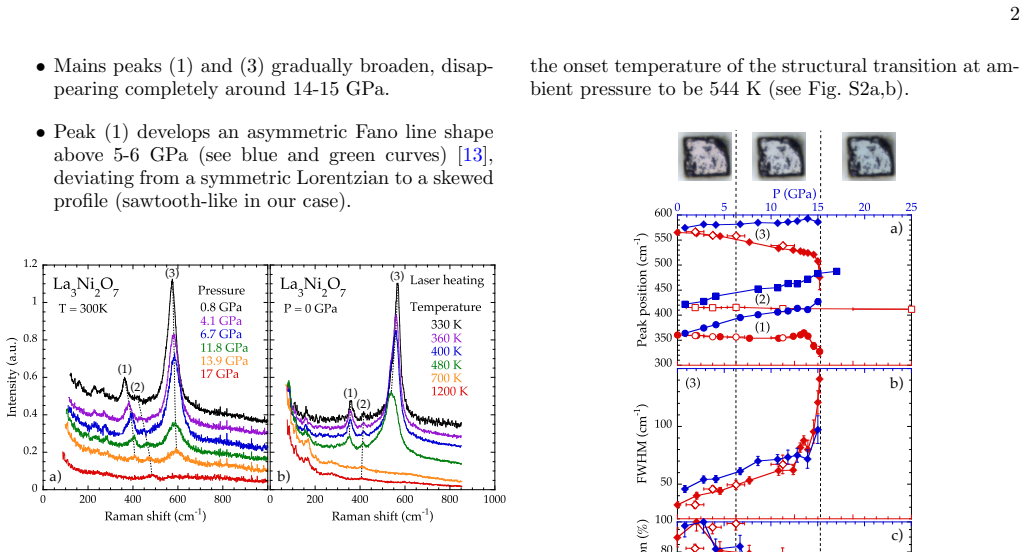
Infrared reflectivity measurements evidence a concomitant enhanced metallicity, with a tremendous two-order-of-magnitude increase in carrier density, marking a crossover from a weakly to highly metallic state. Raman measurements confirm the pressure-driven structural transition from the tilted Amam phase to the untilted Fmmm phase and reveal the emergence of Fano line shapes indicating enhanced electron-phonon coupling. High-temperature data show analogous spectral signatures above 544 K, suggesting an unreported upper temperature limit of the Amam phase.
What carries the argument
The Amam-to-Fmmm tilt-free structural transition and its coupling to electronic properties, tracked through infrared reflectivity changes that quantify carrier density.
If this is right
- High-Tc superconductivity appears in the highly metallic untilted phase.
- Electron-phonon coupling strengthens across the structural boundary.
- The tilted Amam phase is stable only up to approximately 544 K.
- Electronic properties in this nickelate are strongly coupled to the presence or absence of octahedral tilts.
Where Pith is reading between the lines
- Similar tilt-removal transitions in related Ruddlesden-Popper nickelates may also produce large metallicity jumps.
- High-pressure Hall or optical conductivity measurements could test whether the reported carrier-density increase is robust against different analysis models.
- The temperature-driven loss of tilt at ambient pressure offers a route to study the metallic crossover without pressure cells.
Load-bearing premise
Infrared reflectivity changes directly and quantitatively reflect a two-order-of-magnitude carrier-density increase caused by the Amam-to-Fmmm structural transition.
What would settle it
An independent transport measurement such as the Hall coefficient showing no large jump in carrier density exactly at the pressure where the structural transition occurs.
Figures


read the original abstract
La$_3$Ni$_2$O$_7$, a bilayer nickelate with Ruddlesden-Popper structure, undergoes a pressure-induced structural transition from a tilted Amam phase to an untilted Fmmm (or I4/mmm) phase near 10-15 GPa, concomitant with the emergence of high-T$_c$ superconductivity ($T_c \sim 80$ K). Despite intense interest, the phase boundaries and the impact of structural changes on the electronic properties remain unclear. Here, we combine high-pressure and high-temperature Raman and synchrotron-based infrared spectroscopies to map the structural and electronic evolutions. Raman measurements confirm the pressure-driven structural transition and reveal the emergence of Fano line shapes, indicating enhanced electron-phonon coupling. High-temperature data show analogous spectral signatures above 544 K, suggesting an unreported upper temperature limit of the \textit{Amam} phase within the T-P phase diagram of this system. Infrared reflectivity measurements evidence a concomitant enhanced metallicity, with a tremendous two-order-of-magnitude increase in carrier density, marking a crossover from a weakly to highly metallic state. These results establish a unified picture of the structural transition and its strong coupling to the electronic properties.
Editorial analysis
A structured set of objections, weighed in public.
Referee Report
Summary. The manuscript reports combined high-pressure/high-temperature Raman and synchrotron infrared spectroscopy on the bilayer nickelate La3Ni2O7. Raman spectra confirm the pressure-driven Amam-to-Fmmm structural transition near 10-15 GPa and show Fano lineshapes indicative of enhanced electron-phonon coupling; analogous signatures appear above 544 K at ambient pressure. Infrared reflectivity data are interpreted as showing a concomitant two-order-of-magnitude increase in carrier density, marking a crossover from weakly to highly metallic behavior tied to the tilt-free transition.
Significance. If the quantitative carrier-density extraction is shown to be robust, the work would establish a direct link between the structural transition and a dramatic electronic crossover, strengthening the case that the untilted phase is key to the high-Tc superconductivity observed in this system. The dual high-P/high-T mapping is a methodological strength.
major comments (2)
- [Infrared reflectivity analysis] Infrared reflectivity analysis (abstract and corresponding results section): the central claim of a two-order-of-magnitude carrier-density increase is presented without any description of the fitting procedure (Drude or Drude-Lorentz model, plasma-frequency extraction, or partial sum-rule integration), error estimation, baseline handling, or tests that isolate the structural-transition contribution from pressure-dependent changes in background dielectric constant, interband transitions, or scattering rate. This omission directly undermines evaluation of the load-bearing claim that the Amam-to-Fmmm change drives the metallicity crossover.
- [Results section on pressure-dependent spectra] Results section on pressure-dependent spectra: the interpretation that reflectivity changes quantitatively reflect carrier-density changes caused by the tilt-free transition requires explicit discussion or supplementary analysis ruling out pressure-induced optical effects that are independent of the Amam/Fmmm symmetry change; without such controls the attribution remains untested.
Simulated Author's Rebuttal
We thank the referee for the constructive report and for recognizing the methodological strength of the dual high-P/high-T mapping. We agree that the infrared analysis requires substantially more detail to support the central claim of a carrier-density crossover. We address each major comment below and will revise the manuscript accordingly.
read point-by-point responses
-
Referee: [Infrared reflectivity analysis] Infrared reflectivity analysis (abstract and corresponding results section): the central claim of a two-order-of-magnitude carrier-density increase is presented without any description of the fitting procedure (Drude or Drude-Lorentz model, plasma-frequency extraction, or partial sum-rule integration), error estimation, baseline handling, or tests that isolate the structural-transition contribution from pressure-dependent changes in background dielectric constant, interband transitions, or scattering rate. This omission directly undermines evaluation of the load-bearing claim that the Amam-to-Fmmm change drives the metallicity crossover.
Authors: We acknowledge the omission. The submitted manuscript does not contain the requested methodological details. In the revised version we will insert a new subsection (Methods or supplementary) that specifies: (i) the Drude-Lorentz model employed, (ii) the procedure for extracting the plasma frequency and converting it to carrier density via the partial sum rule, (iii) baseline subtraction and error estimation from fit covariance, and (iv) explicit checks that the reflectivity jump remains after subtracting a pressure-dependent background dielectric constant. These additions will allow quantitative evaluation of the two-order-of-magnitude claim. revision: yes
-
Referee: [Results section on pressure-dependent spectra] Results section on pressure-dependent spectra: the interpretation that reflectivity changes quantitatively reflect carrier-density changes caused by the tilt-free transition requires explicit discussion or supplementary analysis ruling out pressure-induced optical effects that are independent of the Amam/Fmmm symmetry change; without such controls the attribution remains untested.
Authors: We agree that an explicit discussion is required. In revision we will add a dedicated paragraph that (a) notes the coincidence of the reflectivity jump with the Raman-determined transition pressure, (b) compares the pressure-driven change with the analogous high-temperature transition at ambient pressure (where no hydrostatic compression occurs), and (c) discusses why a gradual pressure dependence of the background dielectric constant or interband transitions cannot account for the observed step-like increase. If space permits we will also include a supplementary figure showing the pressure evolution of the fitted scattering rate and background permittivity. revision: yes
Circularity Check
No circularity: purely experimental spectroscopic observations with no derivations or self-referential predictions
full rationale
The manuscript reports Raman and infrared reflectivity measurements on La3Ni2O7 under pressure and temperature, documenting a structural transition and associated spectral changes including increased carrier density inferred from reflectivity. No equations, ansatzes, fitted parameters renamed as predictions, or uniqueness theorems are presented; the central claims are direct experimental observations rather than derivations that reduce to their own inputs by construction. Self-citations, if present, are not load-bearing for any mathematical step. The work is self-contained as an experimental report against external benchmarks.
Axiom & Free-Parameter Ledger
Forward citations
Cited by 1 Pith paper
-
Density waves in low-pressure bilayer nickelates
Unrestricted Hartree-Fock calculations show the second density-wave transition in La3Ni2O7 originates from double-stripe spin order becoming unstable toward a commensurate charge-density wave, yielding intertwined spi...
Reference graph
Works this paper leans on
-
[1]
Puphal, T
P. Puphal, T. Sch¨ afer, B. Keimer, and M. Hepting, Nat. Rev. Phys.8, 70–85 (2026)
2026
-
[2]
Catalano, M
S. Catalano, M. Gibert, J. Fowlie, J. ´I˜ niguez, J.-M. Triscone, and J. Kreisel, Rep. Prog. Phys.81, 046501 (2018)
2018
-
[3]
Ardizzone, J
I. Ardizzone, J. Teyssier, I. Crassee, A. B. Kuzmenko, D. G. Mazzone, D. J. Gawryluk, M. Medarde, and D. van der Marel, Phys. Rev. Res.3, 033007 (2021)
2021
-
[4]
D. Li, K. Lee, B. Y. Wang, M. Osada, S. Crossley, H. R. Lee, Y. Cui, Y. Hikita, and H. Y. Hwang, Nature572, 624–627 (2019)
2019
-
[5]
Osada, B
M. Osada, B. Y. Wang, B. H. Goodge, S. P. Harvey, K. Lee, D. Li, L. F. Kourkoutis, and H. Y. Hwang, Adv. Mater.33, 2104083 (2021)
2021
-
[6]
H. Sun, M. Huo, X. Hu, J. Li, Z. Liu, Y. Han, L. Tang, Z. Mao, P. Yang, B. Wang, J. Cheng, D.-X. Yao, G.-M. Zhang, and M. Wang, Nature621, 493–498 (2023)
2023
-
[7]
G. Wang, N. N. Wang, X. L. Shen, J. Hou, L. Ma, L. F. Shi, Z. A. Ren, Y. D. Gu, H. M. Ma, P. T. Yang, Z. Y. Liu, H. Z. Guo, J. P. Sun, G. M. Zhang, S. Calder, J.-Q. Yan, B. S. Wang, Y. Uwatoko, and J.-G. Cheng, Phys. Rev. X14, 011040 (2024)
2024
-
[8]
L. Wang, Y. Li, S.-Y. Xie, F. Liu, H. Sun, C. Huang, Y. Gao, T. Nakagawa, B. Fu, B. Dong, Z. Cao, R. Yu, S. I. Kawaguchi, H. Kadobayashi, M. Wang, C. Jin, H.-K. Mao, and H. Liu, J. Am. Chem. Soc.146, 7506–7514 (2024)
2024
-
[9]
G. Wang, N. Wang, T. Lu, S. Calder, J. Yan, L. Shi, J. Hou, L. Ma, L. Zhang, J. Sun, B. Wang, S. Meng, M. Liu, and J. Cheng, npj Quant. Mat.10, 1 (2025)
2025
-
[10]
J. Li, D. Peng, P. Ma, H. Zhang, Z. Xing, X. Huang, C. Huang, M. Huo, D. Hu, Z. Dong, X. Chen, T. Xie, H. Dong, H. Sun, Q. Zeng, H. Mao, and M. Wang, Nat. Scie. Rev.12, 10 (2025)
2025
-
[11]
Geisler, J
B. Geisler, J. J. Hamlin, G. R. Stewart, R. G. Hennig, and P. J. Hirschfeld, npj Quant. Mat.9, 38 (2024)
2024
- [12]
-
[15]
Gyakwaa, M
F. Gyakwaa, M. Aula, T. Alatarvas, T. Vuolio, M. Hut- tula, and T. Fabritius, ISIJ Inter.59, 1846–1852 (2019)
2019
-
[16]
Z. Liu, M. Huo, J. Li, Q. Li, Y. Liu, Y. Dai, X. Zhou, J. Hao, Y. Lu, M. Wang, and H.-H. Wen, Nat. Comm. 15, 7570 (2024)
2024
-
[17]
N. Wang, G. Wang, X. Shen, J. Hou, J. Luo, X. Ma, H. Yang, L. Shi, J. Dou, J. Feng, J. Yang, Y. Shi, Z. Ren, H. Ma, P. Yang, Z. Liu, Y. Liu, H. Zhang, X. Dong, Y. Wang, K. Jiang, J. Hu, S. Nagasaki, K. Kitagawa, S. Calder, J. Yan, J. Sun, B. Wang, R. Zhou, Y. Uwatoko, and J. Cheng, Nature634, 579–584 (2024)
2024
-
[18]
Zhang, D
Y. Zhang, D. Su, Y. Huang, Z. Shan, H. Sun, M. Huo, K. Ye, J. Zhang, Z. Yang, Y. Xu, Y. Su, R. Li, M. Smid- man, M. Wang, L. Jiao, and H. Yuan, Nat. Phys.20, 1269–1273 (2024)
2024
-
[19]
M. Shi, D. Peng, Y. Li, S. Yang, Z. Xing, Y. Wang, K. Fan, H. Li, R. Wu, B. Ge, Z. Zeng, Q. Zeng, J. Ying, T. Wu, and X. Chen, Nat. Comm.15, 9141 (2025)
2025
-
[20]
Michon, A
B. Michon, A. B. Kuzmenko, M. K. Tran, B. McElfresh, S. Komiya, S. Ono, S. Uchida, and D. van der Marel, Phys. Rev. Lett.3, 043125 (2021)
2021
-
[21]
Michon, C
B. Michon, C. Berthod, C. W. Rischau, A. Ataei, L. Chen, S. Komiya, S. Ono, L. Taillefer, D. van der Marel, and A. Georges, Nat. Comm.14, 3033 (2023). Supplementary: Metallic crossover through the tilt-free transition in La 3Ni2O7 at high pressure and temperature Bastien Michon,1 Yingpeng Yu,2, 3 Beatrice D’Al` o,1 Elena Stellino, 4 Gergely N´ emeth,1 Bos...
2023
-
[22]
F. Li, Z. Xing, D. Peng, J. Dou, N. Guo, L. Ma, Y. Zhang, L. Wang, J. Luo, J. Yang, J. Zhang, T. Chang, Y.-S. Chen, W. Cai, J. Cheng, Y. Wang, Y. Liu, T. Luo, N. Hi- rao, T. Matsuoka, H. Kadobayashi, Z. Zeng, Q. Zheng, R. Zhou, Q. Zeng, X. Tao, and J. Zhang, Nature649, 871–878 (2026)
2026
-
[23]
T. P. Devereaux and R. Hackl, Rev. Mod. Phys.79, 175 (2007)
2007
-
[24]
Fano, Phys
U. Fano, Phys. Rev.124, 1866 (1961)
1961
-
[25]
A. B. Kuzmenko, Rev. Sci. Instrum.76, 083108 (2005). 3 SECTION 2. ADDITIONAL DATA AND ANALYSIS 0 0.2 0.4 0.6 0.8 1 1.2 02004006008001000 Intensity (a.u.) Raman shift (cm-1) La3Ni2O7 2.8 GPa8.6 GPa10.7 GPa12.8 GPa15 GPa PressureT = 300K FIG. S1. Extra HP Raman data not plotted in Fig. 1 for clarity but fitted and used in Fig. 2. 0 0.3 0.6 0.9 1.2 1.5 1.8 0...
2005
discussion (0)
Sign in with ORCID, Apple, or X to comment. Anyone can read and Pith papers without signing in.