REVIEW 2 major objections 2 minor 2 cited by
An Einstein-Boltzmann code can find a gauge where linear relativistic clustering matches Newtonian equations with scale-independent growth.
Reviewed by Pith at T0; open to challenge. T0 means a machine referee read the full paper against a public rubric. the ladder, T0–T4 →
T0 review · grok-4.3
2026-06-30 23:20 UTC pith:5L5EMPUQ
load-bearing objection The paper gives a practical gauge-mapping trick to run standard Newtonian EFTofLSS on cosmologies with scale-dependent linear growth, but the control on nonlinear back-transformation errors rests on an unquantified assumption. the 2 major comments →
Effective Field Theory of Large Scale Structure and Newtonian Motion Gauges
The pith
A machine-rendered reading of the paper's core claim, the machinery that carries it, and where it could break.
Core claim
For a given cosmology, an Einstein-Boltzmann code can find the exact gauge transformation that brings the full linear equations of motion of the clustering matter components into a form where they are identical to Newtonian equations for a self-gravitating fluid with scale-independent growth. Non-linear clustering can be consistently computed in this gauge, and the results can be transformed back to the initial gauge in order to incorporate GR and scale-dependent-growth effects.
What carries the argument
Newtonian motion gauges: the coordinate frame identified by the gauge transformation that equates the linear relativistic equations of the clustering components to Newtonian fluid equations with constant growth.
Load-bearing premise
The gauge transformation field remains small enough that nonlinear evolution performed inside the transformed gauge stays valid once the results are mapped back to the original gauge.
What would settle it
A direct comparison showing that the one-loop redshift-space quadrupole at k=0.3 h/Mpc and z=0 deviates by more than 2 percent from full relativistic N-body results in a cosmology with M_nu=0.3 eV would falsify the claimed accuracy.
If this is right
- Nonlinear clustering can be computed with existing Newtonian EFTofLSS codes without modification.
- The nonlinear results can be transformed back to recover linear GR corrections and scale-dependent growth.
- Redshift-space distortions are incorporated by applying an analogous gauge transformation to the velocity field.
- The method applies to massive-neutrino cosmologies with one-loop power-spectrum errors below 0.7 percent in real space and 1.7 percent in the quadrupole.
- No additional computational cost is incurred beyond one standard Einstein-Boltzmann solve.
Where Pith is reading between the lines
- The same gauge construction could be applied to other models that produce scale-dependent growth, such as certain modified-gravity scenarios, provided the smallness condition holds.
- Higher-order statistics such as the bispectrum may exhibit larger residuals than the power spectrum once transformed back to redshift space.
- The approach could be combined with existing EFT counterterms to absorb residual scale-dependent effects that survive the gauge mapping.
- Future high-precision surveys sensitive to velocity fields at k greater than 0.2 h/Mpc would benefit most from the redshift-space correction term identified here.
Editorial analysis
A structured set of objections, weighed in public.
Referee Report
Summary. The paper proposes using Newtonian Motion Gauges to extend the Newtonian EFTofLSS framework to cosmologies with scale-dependent growth and linear GR corrections. For a given cosmology, an Einstein-Boltzmann code determines an exact gauge transformation that recasts the linear clustering equations of matter components into Newtonian form with scale-independent growth. Nonlinear clustering is then computed using standard EFT kernels in this gauge and transformed back to incorporate the original gauge's GR and scale-dependent effects. Redshift-space distortions are handled analogously. The method incurs no extra computational cost. As a demonstration for massive-neutrino models, the real-space one-loop power spectrum deviates by at most 0.7% for M_nu < 0.3 eV, while the redshift-space quadrupole reaches 1.7% at k=0.3 h/Mpc and z=0.
Significance. If the linear gauge transformation suffices to control nonlinear mapping errors, the approach provides a low-cost route to embed linear GR corrections and scale-dependent growth into existing Newtonian EFTofLSS pipelines. It reuses standard Einstein-Boltzmann solvers and EFT kernels, and the reported sub-percent accuracy for neutrino masses relevant to Stage-III surveys indicates potential practical value. The absence of additional parameters or new fitting procedures is a methodological strength.
major comments (2)
- [Abstract] Abstract and method description: the central claim that nonlinear one-loop results can be mapped back while keeping errors below the quoted 0.7% (real space) and 1.7% (redshift space) thresholds rests on the linear-order gauge field remaining sufficiently small; however, no explicit bound, derivation, or error budget is supplied showing that the EB-code self-consistency condition on the linear gauge field suffices to suppress higher-order gauge corrections at one-loop order.
- [Results section (neutrino showcase)] The validation of the back-transformation step lacks comparison against independent relativistic perturbation-theory or N-body codes; without such a cross-check, the percent-level accuracy statements for the neutrino models cannot be independently verified from quantities internal to the EFT calculation.
minor comments (2)
- The notation for the gauge transformation field and the precise definition of the self-consistency condition should be introduced with an equation early in the text rather than referenced only in the abstract.
- Figure captions for the power-spectrum comparisons should explicitly state the redshift and wavenumber range over which the quoted maximum deviations apply.
Simulated Author's Rebuttal
We thank the referee for their thoughtful review and constructive comments on our manuscript. We address each major comment below, providing clarifications and indicating where revisions will be made.
read point-by-point responses
-
Referee: [Abstract] Abstract and method description: the central claim that nonlinear one-loop results can be mapped back while keeping errors below the quoted 0.7% (real space) and 1.7% (redshift space) thresholds rests on the linear-order gauge field remaining sufficiently small; however, no explicit bound, derivation, or error budget is supplied showing that the EB-code self-consistency condition on the linear gauge field suffices to suppress higher-order gauge corrections at one-loop order.
Authors: The self-consistency condition implemented in the Einstein-Boltzmann solver enforces that the linear gauge transformation field remains small throughout the relevant range of scales and redshifts. Because the gauge transformation is defined at linear order, any higher-order gauge corrections to the one-loop power spectrum are suppressed by additional powers of this small parameter (typically entering at O(ε²) where ε ≪ 1 is the gauge-field amplitude). The quoted 0.7% and 1.7% figures are precisely the differences obtained when the same EFT calculation is performed with and without the gauge transformation, thereby providing a direct numerical estimate of the size of the correction. We agree that an explicit scaling argument and error-budget paragraph were not included in the original text; we will add a short subsection in the revised manuscript deriving the expected suppression of nonlinear gauge errors from the linear self-consistency condition. revision: partial
-
Referee: [Results section (neutrino showcase)] The validation of the back-transformation step lacks comparison against independent relativistic perturbation-theory or N-body codes; without such a cross-check, the percent-level accuracy statements for the neutrino models cannot be independently verified from quantities internal to the EFT calculation.
Authors: The showcase is designed to quantify the difference between the standard Newtonian EFTofLSS pipeline and the Newtonian-Motion-Gauge extension within a single, internally consistent framework. The back-transformation is performed with the exact linear gauge field extracted from the Einstein-Boltzmann solver, while the nonlinear kernels remain the standard EdS kernels evaluated in the transformed gauge. This construction guarantees that any discrepancy arises solely from the linear GR and scale-dependent-growth effects that the gauge transformation is constructed to capture. While external validation against fully relativistic N-body or higher-order relativistic perturbation theory would be valuable, such comparisons lie outside the scope of the present work, which focuses on a computationally inexpensive extension of existing Newtonian pipelines. The internal difference reported in the paper already supplies a conservative estimate of the correction size for the neutrino masses considered. revision: no
Circularity Check
No significant circularity; derivation relies on external codes
full rationale
The paper determines the gauge transformation via an external Einstein-Boltzmann code applied to the linear equations, then computes nonlinear clustering with standard Newtonian EFT kernels in the transformed gauge before mapping results back. No step reduces by construction to a parameter fitted inside the paper, a self-defined quantity, or a load-bearing self-citation chain; the central claim remains independent of the paper's own inputs and is externally falsifiable via the EB code's self-consistency check on the gauge field.
Axiom & Free-Parameter Ledger
axioms (2)
- domain assumption An exact gauge transformation exists that renders the linear equations of motion for clustering components identical to Newtonian self-gravitating fluid equations with scale-independent growth.
- domain assumption The nonlinear clustering computed in the Newtonian Motion Gauge remains valid when transformed back, provided the gauge transformation field remains small.
invented entities (1)
-
Newtonian Motion Gauge
no independent evidence
read the original abstract
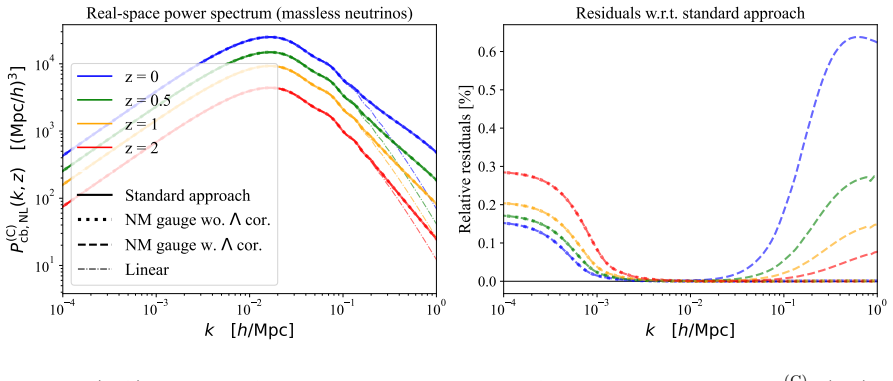
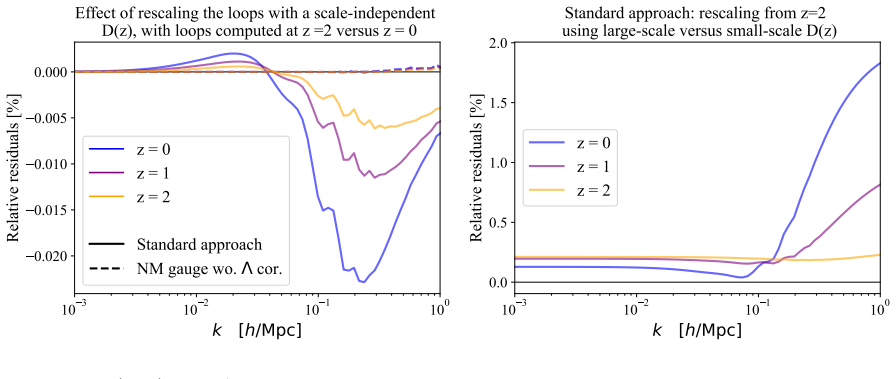
The simplest flavor of the Effective Field Theory of Large Scale Structure is based on Newtonian equations and describes the nonlinear matter density and velocity using Einstein-de-Sitter kernels. Even in the presence of massive neutrinos, this has been argued to be sufficient for the analysis of data from Stage-III galaxy surveys. In this paper, we show that there exists a simple way to extend the validity range of this framework to more complex problems with a scale-dependent growth factor, while incorporating linear general relativistic (GR) corrections as well. For a given cosmology, an Einstein-Boltzmann code can find the exact gauge transformation that brings the full linear equations of motion of the clustering matter components into a form where they are identical to Newtonian equations for a self-gravitating fluid with scale-independent growth. Non-linear clustering can be consistently computed in this gauge, and the results can be transformed back to the initial gauge in order to incorporate GR and scale-dependent-growth effects. Redshift-space distortions can also be accounted for with a similar strategy. Our method does not incur any additional computational cost. As a showcase, we apply this method to cosmologies with massive neutrinos. For the real-space one-loop power spectrum, we find that the largest deviation between the accurate and standard methods remains below 0.7% for M_nu<0.30 eV. However, in redshift space, it reaches 1.7% for the one-loop quadrupole spectrum at k=0.3 h/Mpc and z=0, with the largest contribution coming from the effect of the cosmological constant on the growth of the velocity field. Our method could be applied to a much wider range of models with more significant scale-dependent growth, as long as a self-consistency condition evaluated by the Einstein-Boltzmann code (on the smallness of a gauge transformation field) is fulfilled.
Figures




Forward citations
Cited by 2 Pith papers
-
gevolution 2.0: GPU-accelerated relativistic N-body simulations for cosmology
gevolution 2.0 accelerates relativistic N-body cosmological simulations on Nvidia GPUs, achieving a ~4.5x node-hour speed-up over its CPU-only predecessor.
-
GGI Lectures on Large-Scale Structure Perturbation Theory (Effective Field Theory)
Pedagogical notes derive large-scale-structure EFT from symmetries, covering SPT failures, BAO IR resummation, counterterms, galaxy bias, redshift-space distortions, and Lagrangian PT.
Reference graph
Works this paper leans on
-
[1]
The DESI Experiment Part I: Science,Targeting, and Survey Design
DESI Collaboration, A. Aghamousa et al., “The DESI Experiment Part I: Science,Targeting, and Survey Design,” arXiv:1611.00036 [astro-ph.IM]
work page internal anchor Pith review Pith/arXiv arXiv
- [2]
-
[3]
Cosmology with the SPHEREX All-Sky Spectral Survey
SPHEREx Collaboration, O. Dor´ eet al., “Cosmology with the SPHEREX All-Sky Spectral Survey,” arXiv:1412.4872 [astro-ph.CO]
work page internal anchor Pith review Pith/arXiv arXiv
-
[4]
The High Latitude Spectroscopic Survey on the Nancy Grace Roman Space Telescope,
Y. Wang et al., “The High Latitude Spectroscopic Survey on the Nancy Grace Roman Space Telescope,” Astrophys. J. 928 no. 1, (2022) 1, arXiv:2110.01829 [astro-ph.CO]
-
[5]
PFS Team Collaboration, R. Ellis et al., “Extragalactic science, cosmology, and Galactic archaeology with the Subaru Prime Focus Spectrograph,” Publ. Astron. Soc. Jap. 66 no. 1, (2014) R1, arXiv:1206.0737 [astro-ph.CO]
work page internal anchor Pith review Pith/arXiv arXiv 2014
-
[6]
Large Synoptic Survey Telescope: Dark Energy Science Collaboration
LSST Dark Energy Science Collaboration, A. Abate et al., “Large Synoptic Survey Telescope: Dark Energy Science Collaboration,” arXiv:1211.0310 [astro-ph.CO] . – 37 –
work page internal anchor Pith review Pith/arXiv arXiv
-
[7]
Cosmological Non-Linearities as an Effective Fluid
D. Baumann, A. Nicolis, L. Senatore, and M. Zaldarriaga, “Cosmological Non-Linearities as an Effective Fluid,” JCAP 07 (2012) 051, arXiv:1004.2488 [astro-ph.CO]
work page internal anchor Pith review Pith/arXiv arXiv 2012
-
[8]
The Effective Field Theory of Cosmological Large Scale Structures
J. J. M. Carrasco, M. P. Hertzberg, and L. Senatore, “The Effective Field Theory of Cosmological Large Scale Structures,” JHEP 09 (2012) 082, arXiv:1206.2926 [astro-ph.CO]
work page internal anchor Pith review Pith/arXiv arXiv 2012
-
[9]
Biased Tracers in Redshift Space in the EFT of Large-Scale Structure
A. Perko, L. Senatore, E. Jennings, and R. H. Wechsler, “Biased Tracers in Redshift Space in the EFT of Large-Scale Structure,” arXiv:1610.09321 [astro-ph.CO]
work page internal anchor Pith review Pith/arXiv arXiv
-
[10]
On the IR-Resummation in the EFTofLSS
L. Senatore and G. Trevisan, “On the IR-Resummation in the EFTofLSS,” JCAP 05 (2018) 019, arXiv:1710.02178 [astro-ph.CO]
work page internal anchor Pith review Pith/arXiv arXiv 2018
-
[11]
Snowmass White Paper: Effective Field Theories in Cosmology
G. Cabass, M. M. Ivanov, M. Lewandowski, M. Mirbabayi, and M. Simonovi´ c, “Snowmass white paper: Effective field theories in cosmology,” Phys. Dark Univ. 40 (2023) 101193, arXiv:2203.08232 [astro-ph.CO]
work page Pith review arXiv 2023
-
[12]
General relativistic corrections to $N$-body simulations and the Zel'dovich approximation
C. Fidler, C. Rampf, T. Tram, R. Crittenden, K. Koyama, and D. Wands, “General relativistic corrections to N-body simulations and the Zel’dovich approximation,” Phys. Rev. D 92 no. 12, (2015) 123517, arXiv:1505.04756 [astro-ph.CO]
work page internal anchor Pith review Pith/arXiv arXiv 2015
-
[13]
Relativistic Interpretation of Newtonian Simulations for Cosmic Structure Formation
C. Fidler, T. Tram, C. Rampf, R. Crittenden, K. Koyama, and D. Wands, “Relativistic Interpretation of Newtonian Simulations for Cosmic Structure Formation,” JCAP 09 (2016) 031, arXiv:1606.05588 [astro-ph.CO]
work page internal anchor Pith review Pith/arXiv arXiv 2016
-
[14]
General relativistic weak-field limit and Newtonian N-body simulations
C. Fidler, T. Tram, C. Rampf, R. Crittenden, K. Koyama, and D. Wands, “General relativistic weak-field limit and Newtonian N-body simulations,” JCAP 12 (2017) 022, arXiv:1708.07769 [astro-ph.CO]
work page internal anchor Pith review Pith/arXiv arXiv 2017
-
[15]
FAST-PT: a novel algorithm to calculate convolution integrals in cosmological perturbation theory
J. E. McEwen, X. Fang, C. M. Hirata, and J. A. Blazek, “FAST-PT: a novel algorithm to calculate convolution integrals in cosmological perturbation theory,” JCAP 09 (2016) 015, arXiv:1603.04826 [astro-ph.CO]
work page internal anchor Pith review Pith/arXiv arXiv 2016
-
[16]
Fast Large Scale Structure Perturbation Theory using 1D FFTs
M. Schmittfull, Z. Vlah, and P. McDonald, “Fast large scale structure perturbation theory using one-dimensional fast Fourier transforms,” Phys. Rev. D 93 no. 10, (2016) 103528, arXiv:1603.04405 [astro-ph.CO]
work page internal anchor Pith review Pith/arXiv arXiv 2016
-
[17]
Cosmological Perturbation Theory Using the FFTLog: Formalism and Connection to QFT Loop Integrals
M. Simonovi´ c, T. Baldauf, M. Zaldarriaga, J. J. Carrasco, and J. A. Kollmeier, “Cosmological perturbation theory using the FFTLog: formalism and connection to QFT loop integrals,” JCAP 04 (2018) 030, arXiv:1708.08130 [astro-ph.CO]
work page internal anchor Pith review Pith/arXiv arXiv 2018
-
[18]
Cosmological Parameters from the BOSS Galaxy Power Spectrum
M. M. Ivanov, M. Simonovi´ c, and M. Zaldarriaga, “Cosmological Parameters from the BOSS Galaxy Power Spectrum,” JCAP 05 (2020) 042, arXiv:1909.05277 [astro-ph.CO]
work page Pith review arXiv 2020
-
[19]
Cosmology from large-scale structure: Constraining ΛCDM with BOSS,
T. Tr¨ osteret al., “Cosmology from large-scale structure: Constraining ΛCDM with BOSS,” Astron. Astrophys. 633 (2020) L10, arXiv:1909.11006 [astro-ph.CO]
-
[20]
G. D’Amico, J. Gleyzes, N. Kokron, K. Markovic, L. Senatore, P. Zhang, F. Beutler, and H. Gil-Mar´ ın, “The Cosmological Analysis of the SDSS/BOSS data from the Effective Field Theory of Large-Scale Structure,” JCAP 05 (2020) 005, arXiv:1909.05271 [astro-ph.CO]
-
[21]
S.-F. Chen, Z. Vlah, and M. White, “A new analysis of galaxy 2-point functions in the BOSS survey, including full-shape information and post-reconstruction BAO,” JCAP 02 no. 02, (2022) 008, arXiv:2110.05530 [astro-ph.CO]
-
[22]
Cosmological inference from the EFTofLSS: the eBOSS QSO full-shape analysis,
T. Simon, P. Zhang, and V. Poulin, “Cosmological inference from the EFTofLSS: the eBOSS QSO full-shape analysis,” JCAP 07 (2023) 041, arXiv:2210.14931 [astro-ph.CO]
-
[23]
O. H. E. Philcox and M. M. Ivanov, “BOSS DR12 full-shape cosmology: ΛCDM constraints from the large-scale galaxy power spectrum and bispectrum monopole,” Phys. Rev. D 105 no. 4, (2022) 043517, arXiv:2112.04515 [astro-ph.CO] . – 38 –
-
[24]
G. D’Amico, Y. Donath, M. Lewandowski, L. Senatore, and P. Zhang, “The BOSS bispectrum analysis at one loop from the Effective Field Theory of Large-Scale Structure,” JCAP 05 (2024) 059, arXiv:2206.08327 [astro-ph.CO]
-
[25]
S. Spaar and P. Zhang, “Cosmological constraints from combined probes with the three-point statistics of galaxies at one-loop precision,” Phys. Rev. D 111 no. 2, (2025) 023529, arXiv:2312.15164 [astro-ph.CO]
-
[26]
DESI 2024 V: Full-Shape Galaxy Clustering from Galaxies and Quasars
DESI Collaboration, A. G. Adame et al., “DESI 2024 V: Full-Shape Galaxy Clustering from Galaxies and Quasars,” arXiv:2411.12021 [astro-ph.CO]
work page internal anchor Pith review Pith/arXiv arXiv 2024
-
[27]
Constraints on Neutrino Physics from DESI DR2 BAO and DR1 Full Shape
W. Elbers et al., “Constraints on neutrino physics from DESI DR2 BAO and DR1 full shape,” Phys. Rev. D 112 no. 8, (2025) 083513, arXiv:2503.14744 [astro-ph.CO]
work page internal anchor Pith review Pith/arXiv arXiv 2025
-
[28]
Reanalyzing DESI DR1: 2. Constraints on Dark Energy, Spatial Curvature, and Neutrino Masses
A. Chudaykin, M. M. Ivanov, and O. H. E. Philcox, “Reanalyzing DESI DR1: 2. Constraints on Dark Energy, Spatial Curvature, and Neutrino Masses,” arXiv:2511.20757 [astro-ph.CO]
work page internal anchor Pith review Pith/arXiv arXiv
-
[29]
A. Chudaykin, M. M. Ivanov, and O. H. E. Philcox, “Reanalyzing DESI DR1. III. Constraints on inflation from galaxy power spectra and bispectra,” Phys. Rev. D 113 no. 6, (2026) 063552, arXiv:2512.04266 [astro-ph.CO]
-
[30]
A. Chudaykin, M. M. Ivanov, and O. H. E. Philcox, “Reanalyzing DESI DR1. I. ΛCDM constraints from the power spectrum and bispectrum,” Phys. Rev. D 113 no. 6, (2026) 063502, arXiv:2507.13433 [astro-ph.CO]
-
[31]
M. M. Ivanov, J. M. Sullivan, S.-F. Chen, A. Chudaykin, M. Maus, and O. H. E. Philcox, “Reanalyzing DESI DR1: 4. Percent-Level Cosmological Constraints from Combined Probes and Robust Evidence for the Normal Neutrino Mass Hierarchy,” arXiv:2601.16165 [astro-ph.CO]
work page internal anchor Pith review arXiv
-
[32]
A. Chudaykin, M. M. Ivanov, and O. H. E. Philcox, “Reanalyzing DESI DR1: 5. Cosmological Constraints with Simulation-Based Priors,” arXiv:2602.18554 [astro-ph.CO]
work page internal anchor Pith review arXiv
-
[33]
Limits on wCDM from the EFTofLSS with the PyBird code,
G. D’Amico, L. Senatore, and P. Zhang, “Limits on wCDM from the EFTofLSS with the PyBird code,” JCAP 01 (2021) 006, arXiv:2003.07956 [astro-ph.CO]
-
[34]
A. Chudaykin, K. Dolgikh, and M. M. Ivanov, “Constraints on the curvature of the Universe and dynamical dark energy from the Full-shape and BAO data,” Phys. Rev. D 103 no. 2, (2021) 023507, arXiv:2009.10106 [astro-ph.CO]
-
[35]
The Effective Field Theory of Large-scale Structures of a Fuzzy Dark Matter Universe,
H. M. Kousha, S. Hooshangi, and A. Abolhasani, “The Effective Field Theory of Large-scale Structures of a Fuzzy Dark Matter Universe,” Astrophys. J. 961 no. 1, (2024) 131, arXiv:2305.20075 [astro-ph.CO]
-
[36]
DESI forecast for Dark Matter-Neutrino interactions using EFTofLSS,
M. R. Mosbech, S. Casas, J. Lesgourgues, D. Linde, A. Moradinezhad Dizgah, C. Radermacher, and J. Truong, “DESI forecast for Dark Matter-Neutrino interactions using EFTofLSS,” arXiv:2410.08163 [astro-ph.CO]
-
[37]
Biased Tracers in Redshift Space in the EFTofLSS with exact time dependence,
Y. Donath and L. Senatore, “Biased Tracers in Redshift Space in the EFTofLSS with exact time dependence,” JCAP 10 (2020) 039, arXiv:2005.04805 [astro-ph.CO]
-
[38]
BOSS full-shape analysis from the EFTofLSS with exact time dependence,
P. Zhang and Y. Cai, “BOSS full-shape analysis from the EFTofLSS with exact time dependence,” JCAP 01 no. 01, (2022) 031, arXiv:2111.05739 [astro-ph.CO]
-
[39]
An effective description of dark matter and dark energy in the mildly non-linear regime
M. Lewandowski, A. Maleknejad, and L. Senatore, “An effective description of dark matter and dark energy in the mildly non-linear regime,” JCAP 05 (2017) 038, arXiv:1611.07966 [astro-ph.CO]
work page internal anchor Pith review Pith/arXiv arXiv 2017
-
[40]
G. D’Amico, Y. Donath, L. Senatore, and P. Zhang, “Limits on clustering and smooth quintessence from the EFTofLSS,” JCAP 03 (2024) 032, arXiv:2012.07554 [astro-ph.CO]
-
[41]
Preference for evolving dark energy in light of the galaxy bispectrum,
Z. Lu, T. Simon, and P. Zhang, “Preference for evolving dark energy in light of the galaxy bispectrum,” arXiv:2503.04602 [astro-ph.CO] . – 39 –
-
[42]
Dark Energy and Modified Gravity in the Effective Field Theory of Large-Scale Structure,
G. Cusin, M. Lewandowski, and F. Vernizzi, “Dark Energy and Modified Gravity in the Effective Field Theory of Large-Scale Structure,” JCAP 04 (2018) 005, arXiv:1712.02783 [astro-ph.CO]
-
[43]
S. Hirano and T. Fujita, “Effective Field Theory of Large Scale Structure in modified gravity and application to Degenerate Higher-Order Scalar-Tensor theories,” arXiv:2210.00772 [gr-qc]
-
[44]
M. A. Rodriguez-Meza, A. Aviles, H. E. Noriega, C.-Z. Ruan, B. Li, M. Vargas-Maga˜ na, and J. L. Cervantes-Cota, “fkPT: constraining scale-dependent modified gravity with the full-shape galaxy power spectrum,” JCAP 03 (2024) 049, arXiv:2312.10510 [astro-ph.CO]
-
[45]
A. Aviles, “Testing gravity with the full-shape galaxy power spectrum: First constraints on scale-dependent modified gravity,” Phys. Rev. D 111 no. 2, (2025) L021301, arXiv:2409.15640 [astro-ph.CO]
-
[46]
The Effective Field Theory of Large-Scale Structure in the presence of Massive Neutrinos
L. Senatore and M. Zaldarriaga, “The Effective Field Theory of Large-Scale Structure in the presence of Massive Neutrinos,” arXiv:1707.04698 [astro-ph.CO]
work page internal anchor Pith review Pith/arXiv arXiv
-
[47]
M. Garny and P. Taule, “Loop corrections to the power spectrum for massive neutrino cosmologies with full time- and scale-dependence,” JCAP 01 (2021) 020, arXiv:2008.00013 [astro-ph.CO]
-
[48]
The Effective Field Theory of Large Scale Structure for mixed dark matter scenarios,
F. Verdiani, E. Castorina, E. Salvioni, and E. Sefusatti, “The Effective Field Theory of Large Scale Structure for mixed dark matter scenarios,” JCAP 01 (2026) 047, arXiv:2507.08792 [astro-ph.CO]
-
[49]
New Perspective on Galaxy Clustering as a Cosmological Probe: General Relativistic Effects
J. Yoo, A. L. Fitzpatrick, and M. Zaldarriaga, “A New Perspective on Galaxy Clustering as a Cosmological Probe: General Relativistic Effects,” Phys. Rev. D 80 (2009) 083514, arXiv:0907.0707 [astro-ph.CO]
work page internal anchor Pith review Pith/arXiv arXiv 2009
-
[50]
J. Yoo, “General Relativistic Description of the Observed Galaxy Power Spectrum: Do We Understand What We Measure?,” Phys. Rev. D 82 (2010) 083508, arXiv:1009.3021 [astro-ph.CO]
work page internal anchor Pith review Pith/arXiv arXiv 2010
-
[51]
What galaxy surveys really measure
C. Bonvin and R. Durrer, “What galaxy surveys really measure,” Phys. Rev. D 84 (2011) 063505, arXiv:1105.5280 [astro-ph.CO]
work page internal anchor Pith review Pith/arXiv arXiv 2011
-
[52]
The linear power spectrum of observed source number counts
A. Challinor and A. Lewis, “The linear power spectrum of observed source number counts,” Phys. Rev. D 84 (2011) 043516, arXiv:1105.5292 [astro-ph.CO]
work page internal anchor Pith review Pith/arXiv arXiv 2011
-
[53]
The CLASSgal code for Relativistic Cosmological Large Scale Structure
E. Di Dio, F. Montanari, J. Lesgourgues, and R. Durrer, “The CLASSgal code for Relativistic Cosmological Large Scale Structure,” JCAP 11 (2013) 044, arXiv:1307.1459 [astro-ph.CO]
work page internal anchor Pith review Pith/arXiv arXiv 2013
-
[54]
The observed galaxy power spectrum in General Relativity
E. Castorina and E. di Dio, “The observed galaxy power spectrum in General Relativity,” JCAP 01 no. 01, (2022) 061, arXiv:2106.08857 [astro-ph.CO]
work page Pith review arXiv 2022
-
[55]
Large Scale Limit of the Observed Galaxy Power Spectrum
M. Foglieni, M. Pantiri, E. Di Dio, and E. Castorina, “Large Scale Limit of the Observed Galaxy Power Spectrum,” Phys. Rev. Lett. 131 no. 11, (2023) 111201, arXiv:2303.03142 [astro-ph.CO]
work page Pith review arXiv 2023
-
[56]
A new approach to cosmological structure formation with massive neutrinos
C. Fidler, A. Kleinjohann, T. Tram, C. Rampf, and K. Koyama, “A new approach to cosmological structure formation with massive neutrinos,” JCAP 01 (2019) 025, arXiv:1807.03701 [astro-ph.CO]
work page internal anchor Pith review Pith/arXiv arXiv 2019
-
[57]
A minimal model for massive neutrinos in Newtonian N-body simulations,
P. Heuschling, C. Partmann, and C. Fidler, “A minimal model for massive neutrinos in Newtonian N-body simulations,” JCAP 09 (2022) 068, arXiv:2201.13186 [astro-ph.CO]
-
[58]
Euclid: Modelling massive neutrinos in cosmology – a code comparison,
Euclid Collaboration, J. Adamek et al., “Euclid: Modelling massive neutrinos in cosmology – a code comparison,” JCAP 06 (2023) 035, arXiv:2211.12457 [astro-ph.CO]
-
[59]
Gauge Invariant Cosmological Perturbations,
J. M. Bardeen, “Gauge Invariant Cosmological Perturbations,” Phys. Rev. D 22 (1980) 1882–1905
work page 1980
-
[60]
Cosmological Perturbation Theory,
H. Kodama and M. Sasaki, “Cosmological Perturbation Theory,” Prog. Theor. Phys. Suppl. 78 (1984) 1–166. – 40 –
work page 1984
-
[61]
Covariant Linear Perturbation Formalism
W. Hu, “Covariant linear perturbation formalism,” ICTP Lect. Notes Ser. 14 (2003) 145–185, arXiv:astro-ph/0402060
work page internal anchor Pith review Pith/arXiv arXiv 2003
-
[62]
K. A. Malik and D. Wands, “Cosmological perturbations,” Phys. Rept. 475 (2009) 1–51, arXiv:0809.4944 [astro-ph]
work page internal anchor Pith review Pith/arXiv arXiv 2009
-
[63]
Durrer, The Cosmic Microwave Background
R. Durrer, The Cosmic Microwave Background . Cambridge University Press, 12, 2020
work page 2020
-
[64]
Cosmological Constraints from High-Redshift Damped Lyman-Alpha Systems
C.-P. Ma, E. Bertschinger, L. Hernquist, D. H. Weinberg, and N. Katz, “Cosmological constraints from high redshift damped Lyman alpha systems,” Astrophys. J. Lett. 484 (1997) L1–L5, arXiv:astro-ph/9705113
work page internal anchor Pith review Pith/arXiv arXiv 1997
-
[65]
The Cosmic Linear Anisotropy Solving System (CLASS) II: Approximation schemes
D. Blas, J. Lesgourgues, and T. Tram, “The Cosmic Linear Anisotropy Solving System (CLASS) II: Approximation schemes,” JCAP 07 (2011) 034, arXiv:1104.2933 [astro-ph.CO]
work page internal anchor Pith review Pith/arXiv arXiv 2011
-
[66]
Large-scale clustering of galaxies in general relativity
D. Jeong, F. Schmidt, and C. M. Hirata, “Large-scale clustering of galaxies in general relativity,” Phys. Rev. D 85 (2012) 023504, arXiv:1107.5427 [astro-ph.CO]
work page internal anchor Pith review Pith/arXiv arXiv 2012
-
[67]
Large-Scale Structure Observables in General Relativity
D. Jeong and F. Schmidt, “Large-Scale Structure Observables in General Relativity,” Class. Quant. Grav. 32 no. 4, (2015) 044001, arXiv:1407.7979 [astro-ph.CO]
work page internal anchor Pith review Pith/arXiv arXiv 2015
-
[68]
Relativistic initial conditions for N-body simulations
C. Fidler, T. Tram, C. Rampf, R. Crittenden, K. Koyama, and D. Wands, “Relativistic initial conditions for N-body simulations,” JCAP 06 (2017) 043, arXiv:1702.03221 [astro-ph.CO]
work page internal anchor Pith review Pith/arXiv arXiv 2017
-
[69]
M. Garny and P. Taule, “Two-loop power spectrum with full time- and scale-dependence and EFT corrections: impact of massive neutrinos and going beyond EdS,” JCAP 09 (2022) 054, arXiv:2205.11533 [astro-ph.CO]
-
[70]
Skewness and Kurtosis in Large-Scale Cosmic Fields
F. Bernardeau, “Skewness and Kurtosis in large scale cosmic fields,” Astrophys. J. 433 (1994) 1, arXiv:astro-ph/9312026
work page internal anchor Pith review Pith/arXiv arXiv 1994
-
[71]
IR-safe and UV-safe integrands in the EFTofLSS with exact time dependence
M. Lewandowski and L. Senatore, “IR-safe and UV-safe integrands in the EFTofLSS with exact time dependence,” JCAP 08 (2017) 037, arXiv:1701.07012 [astro-ph.CO]
work page internal anchor Pith review Pith/arXiv arXiv 2017
-
[72]
The effect of early radiation in N-body simulations of cosmic structure formation
J. Adamek, J. Brandbyge, C. Fidler, S. Hannestad, C. Rampf, and T. Tram, “The effect of early radiation in N-body simulations of cosmic structure formation,” Mon. Not. Roy. Astron. Soc. 470 no. 1, (2017) 303–313, arXiv:1703.08585 [astro-ph.CO]
work page internal anchor Pith review Pith/arXiv arXiv 2017
-
[73]
Massive Neutrinos and the Large Scale Structure of the Universe,
J. R. Bond, G. Efstathiou, and J. Silk, “Massive Neutrinos and the Large Scale Structure of the Universe,” Phys. Rev. Lett. 45 (1980) 1980–1984
work page 1980
-
[74]
Massive neutrinos and cosmology
J. Lesgourgues and S. Pastor, “Massive neutrinos and cosmology,” Phys. Rept. 429 (2006) 307–379, arXiv:astro-ph/0603494
work page internal anchor Pith review Pith/arXiv arXiv 2006
-
[75]
J. Lesgourgues, G. Mangano, G. Miele, and S. Pastor, Neutrino Cosmology. Cambridge University Press, 2, 2013
work page 2013
-
[76]
Analytic Prediction of Baryonic Effects from the EFT of Large Scale Structures
M. Lewandowski, A. Perko, and L. Senatore, “Analytic Prediction of Baryonic Effects from the EFT of Large Scale Structures,” JCAP 05 (2015) 019, arXiv:1412.5049 [astro-ph.CO]
work page internal anchor Pith review Pith/arXiv arXiv 2015
-
[77]
D. P. L. Bragan¸ ca, M. Lewandowski, D. Sekera, L. Senatore, and R. Sgier, “Baryonic effects in the Effective Field Theory of Large-Scale Structure and an analytic recipe for lensing in CMB-S4,” JCAP 10 (2021) 074, arXiv:2010.02929 [astro-ph.CO]
-
[78]
Structure formation with massive neutrinos: going beyond linear theory
D. Blas, M. Garny, T. Konstandin, and J. Lesgourgues, “Structure formation with massive neutrinos: going beyond linear theory,” JCAP 11 (2014) 039, arXiv:1408.2995 [astro-ph.CO]
work page internal anchor Pith review Pith/arXiv arXiv 2014
-
[79]
Redshift space power spectrum beyond Einstein-de Sitter kernels,
A. Aviles, G. Valogiannis, M. A. Rodriguez-Meza, J. L. Cervantes-Cota, B. Li, and R. Bean, “Redshift space power spectrum beyond Einstein-de Sitter kernels,” JCAP 04 (2021) 039, arXiv:2012.05077 [astro-ph.CO]
- [80]
discussion (0)
Sign in with ORCID, Apple, or X to comment. Anyone can read and Pith papers without signing in.