REVIEW 3 major objections 4 minor 1 cited by
This paper argues that the Milky Way's recent white dwarf merger rate is a direct tracer of the number of LISA gravitational wave sources present in the Galaxy today.
Reviewed by Pith at T0; open to challenge. T0 means a machine referee read the full paper against a public rubric. the ladder, T0–T4 →
New public mock catalogs of Milky Way white dwarf mergers show how rates of outcomes (AM CVn, R CrB stars, SNe Ia, neutron stars) vary with binary evolution assumptions.
T0 review reviewed 2026-08-02 challenge →
load-bearing objection A useful, well-documented resource paper: public Milky Way white-dwarf merger catalogs from COSMIC+FIRE-2, with outcomes and rates, though the headline LISA correlation is mostly a modeling consistency effect and needs softer framing. the 3 major comments →
The diverse outcomes of binary white dwarf mergers and connections to Galactic LISA sources
The pith
A machine-rendered reading of the paper's core claim, the machinery that carries it, and where it could break.
The reading
Core claim
We present mock catalogs of the Milky Way's white dwarf merger history and show that the recent white dwarf merger rate correlates directly with the number of LISA sources present in the Milky Way today. Across four binary evolution models, panels with more mergers consistently contain more binaries with gravitational wave frequencies above 10^-3 Hz, the rough threshold for individual LISA detection. The merger rate varies by more than an order of magnitude across models with different common-envelope efficiencies and mass-transfer stability assumptions, but the merger-rate-to-LISA-source-count relation persists. The paper deliberately remains agnostic about whether interacting white dwarf b
What carries the argument
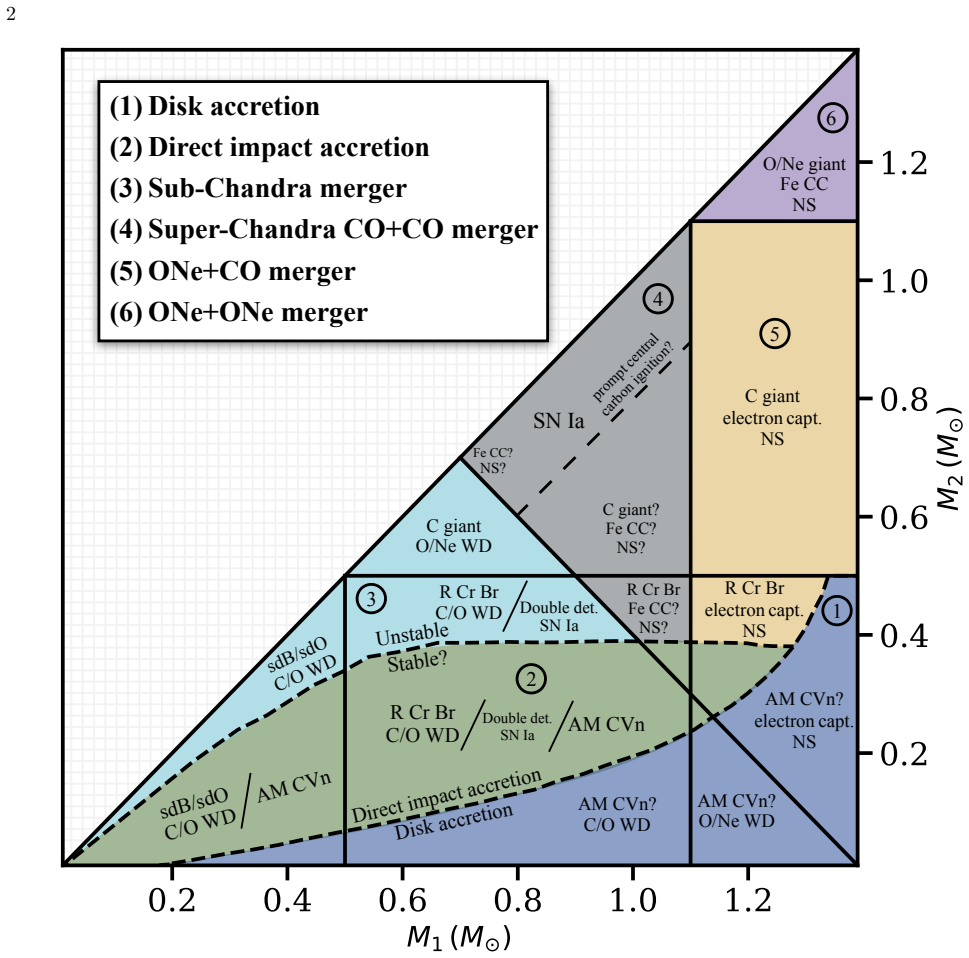
The central object is the primary-mass versus secondary-mass plane for double white dwarf binaries, divided into six outcome regions (disk accretion, direct-impact accretion, sub-Chandrasekhar mergers, super-Chandrasekhar CO+CO mergers, ONe+CO mergers, and ONe+ONe mergers). The population synthesis pipeline assigns simulated binaries to star particles in a Milky Way-mass galaxy simulation using a metallicity-dependent binary fraction, then evolves them by gravitational wave emission to the present day. The key mechanism is the correlation between recent merger rate and the number of binaries currently emitting at fGW > 10^-3 Hz, which connects the present-day LISA source population to the pa
Load-bearing premise
The simulated Milky Way galaxy's star formation history, metallicity distribution, and assumed binary fraction must accurately represent the real Milky Way; if they do not, the absolute merger rates and LISA source counts shift, though the relative trends across models may persist.
What would settle it
Count the number of individually resolved double white dwarf binaries in LISA's first few years of data and compare it to the merger-rate-to-LISA-source-count relation predicted here; a mismatch far outside the factor-of-20 spread across models would falsify the central correlation, as would a survey-based census of R Cor Bor stars that deviates strongly from the predicted 100–1000 Galactic systems.
If this is right
- Electromagnetic surveys of white dwarf merger products—R Cor Bor stars, AM CVn systems, young magnetic white dwarfs, and neutron stars—can directly constrain the number of LISA sources expected in the Milky Way.
- The predicted rates of Type Ia supernovae from white dwarf mergers fall below the observed Galactic rate unless sub-Chandrasekhar detonations contribute, supporting the double-detonation channel.
- Model variations in common-envelope efficiency change the total white dwarf merger rate by roughly a factor of 20, so LISA source counts can help pin down this uncertain binary evolution parameter.
- The local population of mergers within 1 kpc reflects the global merger population, so nearby observations of merger remnants are representative of the whole Galaxy.
- The predicted population of neutron stars born from white dwarf mergers, roughly 10^3 to 10^5 radio pulsars, provides a testable prediction for pulsar surveys.
Where Pith is reading between the lines
- If the merger-rate/LISA-source correlation holds, LISA's detected source count could serve as a prior on the birthrates of exotic remnants like millisecond magnetars and sub-Chandrasekhar supernovae, an implication the paper leaves implicit.
- The paper's deliberate agnosticism about mass-transfer stability means the fraction of interacting systems that become AM CVn binaries is highly uncertain; a future search for 'reverse chirp' gravitational wave sources in LISA data would directly test which stability assumption is correct.
- The same methodology could be applied to other simulated galaxies with different star formation histories to predict how white dwarf merger rates and LISA source populations vary across cosmic time and environment.
- A testable extension is to use the kinematics of massive white dwarfs in Gaia, thought to be merger products, to independently estimate the recent merger rate and compare it with LISA's predicted source count.
Editorial analysis
A structured set of objections, weighed in public.
Referee Report
Summary. The paper presents a suite of mock catalogs of Milky Way double white dwarf (DWD) populations, constructed by combining the COSMIC binary population synthesis code with the metallicity-dependent star formation history of the m12i FIRE-2 Latte galaxy and Ananke stellar positions. Four model variants are considered (fiducial, alpha=0.25, alpha=5, qc=3), and the authors report total and recent (100 Myr) interaction/merger rates by white dwarf composition and by outcome region, along with delay-time and merger-time distributions. The outcome regions are based on literature criteria, and the paper discusses observable connections to AM CVn binaries, R Coronae Borealis stars, hot subdwarfs, single white dwarfs, SNe Ia, and neutron stars. The headline result, stated in Section 5.1 and the abstract, is that the recent DWD merger rate correlates directly with the number of LISA sources in the Milky Way today, so that electromagnetic observations of merger products can constrain LISA source counts. The catalogs and analysis scripts are publicly released.
Significance. If the central correlation claim held, the paper would provide a useful bridge between LISA's expected DWD census and the electromagnetic signatures of DWD mergers. The main strengths are the public release of the mock catalogs, the use of established COSMIC machinery with explicit model variations bracketing common-envelope efficiency and mass-transfer stability assumptions, and the fact that the rates are direct simulation outputs rather than fits to the observations with which they are compared. The outcome classification, though qualitative, gives a useful framework for interpreting future LISA and transient surveys. The principal weakness is that the key 'correlation' is between two quantities derived from the same population synthesis models, so its interpretation as an independent constraint needs either additional analysis or reframing.
major comments (3)
- [Section 5.1, Figures 5–6] The abstract and Section 5.1 claim that the recent DWD merger rate 'correlates directly with the number of LISA sources' and that EM observations of merger products 'directly constrain' LISA source counts. However, the LISA count is defined as the number of binaries with f_GW > 1e-3 Hz, a rough frequency proxy with no SNR or confusion-noise calculation, and both this count and the 100 Myr merger rate are integrals over the same COSMIC model output. Models that produce more DWDs will naturally produce more of both, so a positive correlation is expected by construction. The paper does not quantify the scatter around the correlation, the ratio of merger rate to LISA count, or whether an EM-inferred rate would select a model with useful predictive power for LISA. To support the stated claim, please add a LISA detectability model (or explicitly state that this is a consistency check within th
- [Section 2.2 and Table 2] The paper states in Section 2.2 that systems that may undergo stable mass transfer are not separated from those that merge, yet Table 2 and Figures 2–3 repeatedly label all Roche-lobe-contact events as 'mergers' (e.g., 'All mergers' in Table 2). Region 1 (disk accretion) and Region 2 (direct-impact accretion) include systems that, under the stable mass-transfer hypothesis, would survive as AM CVn binaries rather than merge. Consequently, the quoted rates for these regions are upper limits to true merger rates, and the comparisons in Section 4 to observed AM CVn, R CrB, and SN Ia populations are ambiguous. Please either relabel these consistently as 'interaction rates' throughout the text, or split the rates into stable and unstable branches to make the merger interpretation explicit.
- [Table 2, Section 2.1] The absolute rates in Table 2 are quoted to three significant figures without any uncertainty, and the entire Milky Way population rests on a single FIRE-2 galaxy realization (m12i). The paper uses these absolute rates to make statements such as 'of order 1–30 Galactic objects' and '10^3–10^5 radio pulsars' in Section 4. The Poisson uncertainty alone for the smallest rates is not negligible, and the systematic uncertainty from the galaxy's star formation history and metallicity distribution is likely larger. Please add at least Poisson/sampling uncertainties to Table 2 and a clear caveat that the absolute rates depend on the single m12i realization, even if the relative trends across model variations are robust.
minor comments (4)
- [Section 4.2] Typo: 'the mass transfer exepcted to be dynamically unstable' should read 'is expected to be dynamically unstable.' Also in Section 5.2, 'summarize two alternative here' should be 'two alternative channels here' or similar.
- [Section 3.2] The statement 't_insp ∝ m^{-3} for M1 = M2 = m' assumes fixed initial orbital separation. Since the delay time also depends on the separation at DWD formation, this scaling should be qualified to avoid overgeneralization.
- [Section 4.1] The direct-impact source-count estimate is quoted as 'anywhere from 10 to 10^4 sources present in the Galaxy today.' Using the stated rate range (5e-4 to 1e-2 yr^-1) and lifetime range (1e4 to 1e6 yr) gives 5 to 1e4, so the lower end of the quoted range appears inconsistent by a factor of two.
- [Figure 3] The caption says 'near Earth,' while the text defines the selection as within 1 kpc and within the last 100 Myr. Please make the caption consistent with the text.
Circularity Check
No significant circularity; merger rates are direct forward-model outputs, and the LISA correlation is a model-internal consistency check rather than a fitted prediction.
full rationale
The paper's merger rates and outcome distributions are direct outputs of the COSMIC population synthesis forward model, normalized to FIRE-2 star particles via Eq. 1. No observed LISA source count or electromagnetic merger-product census is used as an input or fitting target, and the outcome classification in Figure 1 is imported from external literature (Marsh et al. 2004; Shen 2015; Pakmor et al. 2012; Schwab 2021) rather than fitted here. The 'key result' that the recent merger rate correlates with the number of f_GW > 10^-3 Hz binaries is indeed a relation between two quantities drawn from the same simulated catalog, and the paper itself labels the latter a 'rough proxy' for resolvable LISA sources; this makes the correlation a useful model-internal consistency check rather than an independent empirical test. However, this does not amount to circularity: the LISA proxy is defined by a frequency threshold, not by the merger rate, and the connection is a physical consequence of gravitational-wave inspiral (Peters 1964), not a fitted equality. Self-citations appear for stability boundaries, reverse-chirping sources, and multimessenger phenomenology, but these are peripheral, publicly available results and are not used to forbid alternatives or to justify the central rates. No step in the derivation chain is equivalent to its own input, so the circularity score is low.
Axiom & Free-Parameter Ledger
free parameters (3)
- Common envelope efficiency alpha =
0.25, 1, 5 (varied)
- Critical mass ratio for stable mass transfer qc =
1.6 (fiducial, Claeys 2014/Hurley 2002); 3 (variation)
- Minimum secondary mass ratio qmin =
0.01
axioms (5)
- standard math Peters (1964) gravitational wave driven orbital decay governs inspiral after the double white dwarf forms
- domain assumption Metallicity-dependent close binary fraction of Moe et al. (2019)
- domain assumption m12i FIRE-2 galaxy star formation history and metallicity distribution represent the Milky Way
- domain assumption COSMIC stellar/binary evolution prescriptions (Hurley et al. 2002; Breivik et al. 2020b) are correct for double white dwarf formation
- domain assumption Outcome classification in Figure 1 (Marsh et al. 2004; Shen 2015; Pakmor et al. 2012; Dan et al. 2014; Schwab 2021)
Cite this review
Pith. "Pith review of The diverse outcomes of binary white dwarf mergers and connections to Galactic LISA sources." pith.science (2026). https://pith.science/paper/74AVIYHO
@misc{pith2026260505308,
  author       = {Pith},
  title        = {Pith review of: The diverse outcomes of binary white dwarf mergers and connections to Galactic LISA sources},
  year         = {2026},
  howpublished = {\url{https://pith.science/paper/74AVIYHO}},
  note         = {Machine review of arXiv:2605.05308}
}
read the original abstract
In the coming decade, the millihertz gravitational wave observatory LISA will provide the best constraints yet on the tens of thousands of close white dwarf binaries in the Milky Way, yielding unprecedented insights into the most abundant class of compact object binaries. Following inspiral via gravitational wave emission, interacting white dwarf binary pairs can lead to a multitude of outcomes, including AM Canum Venaticorum (AM CVn) binaries, R Coronae Borealis stars, young, rapidly-spinning single white dwarfs, (millisecond) magnetars, and a variety of explosive transients, most notably Type Ia supernovae. Current and future electromagnetic observations of these various outcomes coupled with the forthcoming flood of data from LISA place us on the precipice of a significant advance in our understanding of the long-term fate of white dwarf binaries. In this paper, we present a suite of mock catalogs of the Milky Way's white dwarf merger history, created using the population synthesis code $\texttt{COSMIC}$ combined with a metallicity-dependent star formation history from FIRE-2 galaxy simulations. We summarize the various merger outcomes expected (based upon varying white dwarf masses and chemical compositions) and explore ways the rates of these outcomes may vary with model uncertainties pertaining to binary evolution. We publicly release these merger catalogs as a tool for facilitating connections between gravitational wave science and white dwarf binary astrophysics.
Figures


Forward citations
Cited by 1 Pith paper
-
LISA's view of the Galactic Halo: forecasts for the Galactic double white dwarf population using Gaia data
Including the metal-richer, triaxial GSE halo alters chirp-mass and distance distributions of LISA-resolved DWDs while leaving the DWD gravitational-wave foreground strength unchanged.
Reference graph
Works this paper leans on
-
[1]
2023, Living Reviews in Relativity, 26, 2, doi: 10.1007/s41114-022-00041-y
Amaro-Seoane, P., Andrews, J., Arca Sedda, M., et al. 2023, Living Reviews in Relativity, 26, 2, doi: 10.1007/s41114-022-00041-y
-
[2]
2014, MNRAS, 439, 1079, doi: 10.1093/mnras/stu039
Amaro-Seoane, P. 2014, MNRAS, 439, 1079, doi: 10.1093/mnras/stu039
-
[3]
Gladstone, J. C. 2013, ApJ, 766, 136, doi: 10.1088/0004-637X/766/2/136
-
[4]
Belczynski, K., Bulik, T., & Ruiter, A. J. 2005, ApJ, 629, 915, doi: 10.1086/431578
doi:10.1086/431578 2005
-
[5]
Belczynski, K., Kalogera, V., Rasio, F. A., et al. 2008, ApJS, 174, 223, doi: 10.1086/521026 16
doi:10.1086/521026 2008
-
[6]
Benz, W., Bowers, R. L., Cameron, A. G. W., & Press, W. H. . 1990, ApJ, 348, 647, doi: 10.1086/168273
doi:10.1086/168273 1990
-
[7]
Bildsten, L., Shen, K. J., Weinberg, N. N., & Nelemans, G. 2007, ApJL, 662, L95, doi: 10.1086/519489
doi:10.1086/519489 2007
-
[8]
Bregman, J. N., Gnedin, O. Y., Seitzer, P. O., & Qu, Z. 2024, ApJL, 968, L6, doi: 10.3847/2041-8213/ad498f
-
[9]
2018, ApJL, 854, L1, doi: 10.3847/2041-8213/aaaa23
Breivik, K., Kremer, K., Bueno, M., et al. 2018, ApJL, 854, L1, doi: 10.3847/2041-8213/aaaa23
-
[10]
Breivik, K., Mingarelli, C. M. F., & Larson, S. L. 2020a, ApJ, 901, 4, doi: 10.3847/1538-4357/abab99
-
[11]
2020b, ApJ, 898, 71, doi: 10.3847/1538-4357/ab9d85
Breivik, K., Coughlin, S., Zevin, M., et al. 2020b, ApJ, 898, 71, doi: 10.3847/1538-4357/ab9d85
-
[12]
2017, ApJ, 850, 127, doi: 10.3847/1538-4357/aa9568
Brooks, J., Schwab, J., Bildsten, L., et al. 2017, ApJ, 850, 127, doi: 10.3847/1538-4357/aa9568
-
[13]
P., Ferrario, L., Pakmor, R., et al
Burmester, U. P., Ferrario, L., Pakmor, R., et al. 2023, MNRAS, 523, 527, doi: 10.1093/mnras/stad1394
-
[14]
Caiazzo, I., Burdge, K. B., Fuller, J., et al. 2021, Nature, 595, 39, doi: 10.1038/s41586-021-03615-y
-
[15]
Caiazzo, I., Burdge, K. B., Tremblay, P.-E., et al. 2023, Nature, 620, 61, doi: 10.1038/s41586-023-06171-9
-
[16]
2014, A&A, 566, A86, doi: 10.1051/0004-6361/201323052
Camacho, J., Torres, S., Garc ´ ıa-Berro, E., et al. 2014, A&A, 566, A86, doi: 10.1051/0004-6361/201323052
-
[17]
Carter, P. J., Marsh, T. R., Steeghs, D., et al. 2013, MNRAS, 429, 2143, doi: 10.1093/mnras/sts485
-
[18]
Cheng, S., Cummings, J. D., & M´ enard, B. 2019, ApJ, 886, 100, doi: 10.3847/1538-4357/ab4989
-
[19]
Cheng, S., Cummings, J. D., M´ enard, B., & Toonen, S. 2020, ApJ, 891, 160, doi: 10.3847/1538-4357/ab733c
-
[20]
Verbunt, F. W. M. 2014, A&A, 563, A83, doi: 10.1051/0004-6361/201322714
-
[21]
Clark, G. W. 1975, ApJL, 199, L143, doi: 10.1086/181869
doi:10.1086/181869 1975
-
[22]
Clayton, G. C. 1996, PASP, 108, 225, doi: 10.1086/133715
doi:10.1086/133715 1996
-
[23]
2007, ApJ, 662, 1220, doi: 10.1086/518307
Asplund, M. 2007, ApJ, 662, 1220, doi: 10.1086/518307
doi:10.1086/518307 2007
-
[24]
Cool, A. M., Piotto, G., & King, I. R. 1996, ApJ, 468, 655, doi: 10.1086/177723
doi:10.1086/177723 1996
-
[25]
2019, ApJ, 885, 74, doi: 10.3847/1538-4357/ab46b9
Coutu, S., Dufour, P., Bergeron, P., et al. 2019, ApJ, 885, 74, doi: 10.3847/1538-4357/ab46b9
-
[26]
2014, MNRAS, 438, 14, doi: 10.1093/mnras/stt1766
Dan, M., Rosswog, S., Br¨ uggen, M., & Podsiadlowski, P. 2014, MNRAS, 438, 14, doi: 10.1093/mnras/stt1766
-
[27]
2011, ApJ, 737, 89, doi: 10.1088/0004-637X/737/2/89 De Marco, O
Dan, M., Rosswog, S., Guillochon, J., & Ramirez-Ruiz, E. 2011, ApJ, 737, 89, doi: 10.1088/0004-637X/737/2/89 De Marco, O. 2009, PASP, 121, 316, doi: 10.1086/597765
-
[28]
Dessart, L., Burrows, A., Ott, C. D., et al. 2006, ApJ, 644, 1063, doi: 10.1086/503626
doi:10.1086/503626 2006
-
[29]
R., Chornock, R., Soderberg, A
Drout, M. R., Chornock, R., Soderberg, A. M., et al. 2014, ApJ, 794, 23, doi: 10.1088/0004-637X/794/1/23
-
[30]
H., & Clemens, J
Dunlap, B. H., & Clemens, J. C. 2015, in Astronomical Society of the Pacific Conference Series, Vol. 493, 19th European Workshop on White Dwarfs, ed. P. Dufour, P. Bergeron, & G. Fontaine, 547
2015
-
[31]
Fang, X., Thompson, T. A., & Hirata, C. M. 2018, MNRAS, 476, 4234, doi: 10.1093/mnras/sty472
-
[32]
Ferrario, L., de Martino, D., & G¨ ansicke, B. T. 2015, SSRv, 191, 111, doi: 10.1007/s11214-015-0152-0
-
[33]
Fink, M., R¨ opke, F. K., Hillebrandt, W., et al. 2010, A&A, 514, A53, doi: 10.1051/0004-6361/200913892
-
[34]
Rasio, F. A. 2019, ApJ, 872, 165, doi: 10.3847/1538-4357/ab0214
-
[35]
Gokhale, V., Peng, X. M., & Frank, J. 2007, ApJ, 655, 1010, doi: 10.1086/510119
doi:10.1086/510119 2007
-
[36]
J., van Roestel, J., & Wong, T
Green, M. J., van Roestel, J., & Wong, T. L. S. 2025, A&A, 700, A107, doi: 10.1051/0004-6361/202554925
-
[37]
2004, A&A, 413, 257, doi: 10.1051/0004-6361:20031504
Guerrero, J., Garc ´ ıa-Berro, E., & Isern, J. 2004, A&A, 413, 257, doi: 10.1051/0004-6361:20031504
-
[38]
2010, ApJL, 709, L64, doi: 10.1088/2041-8205/709/1/L64
Guillochon, J., Dan, M., Ramirez-Ruiz, E., & Rosswog, S. 2010, ApJL, 709, L64, doi: 10.1088/2041-8205/709/1/L64
-
[39]
V., Gr¨ afener, G., Langer, N., et al
Gvaramadze, V. V., Gr¨ afener, G., Langer, N., et al. 2019, Nature, 569, 684, doi: 10.1038/s41586-019-1216-1
-
[40]
Han, Z., Podsiadlowski, P., & Eggleton, P. P. 1995, MNRAS, 272, 800, doi: 10.1093/mnras/272.4.800
-
[42]
Hansen, B. M. S., Kalirai, J. S., Anderson, J., et al. 2013, Nature, 500, 51, doi: 10.1038/nature12334
-
[43]
2025, ApJ, 986, 123, doi: 10.3847/1538-4357/add32b
He, W., Zhou, P., Gjergo, E., & Fu, X. 2025, ApJ, 986, 123, doi: 10.3847/1538-4357/add32b
-
[44]
2016, PASP, 128, 082001, doi: 10.1088/1538-3873/128/966/082001
Heber, U. 2016, PASP, 128, 082001, doi: 10.1088/1538-3873/128/966/082001
-
[45]
F., Wetzel, A., Kereˇ s, D., et al
Hopkins, P. F., Wetzel, A., Kereˇ s, D., et al. 2018, MNRAS, 480, 800, doi: 10.1093/mnras/sty1690
-
[46]
Hurley, J. R., Tout, C. A., & Pols, O. R. 2002, MNRAS, 329, 897, doi: 10.1046/j.1365-8711.2002.05038.x
arXiv 2002
-
[47]
1990, ApJ, 353, 215, doi: 10.1086/168609
Iben, Jr., I. 1990, ApJ, 353, 215, doi: 10.1086/168609
doi:10.1086/168609 1990
-
[48]
Iben, Jr., I., & Tutukov, A. V. 1984, ApJS, 54, 335, doi: 10.1086/190932 —. 1985, ApJS, 58, 661, doi: 10.1086/191054 —. 1987, ApJ, 313, 727, doi: 10.1086/165011
doi:10.1086/190932 1984
-
[49]
Iben, Jr., I., Tutukov, A. V., & Yungelson, L. R. 1997, ApJ, 475, 291, doi: 10.1086/303525
doi:10.1086/303525 1997
-
[50]
2011, MNRAS, 410, 984, doi: 10.1111/j.1365-2966.2010.17497.x
Justham, S., Podsiadlowski, P., & Han, Z. 2011, MNRAS, 410, 984, doi: 10.1111/j.1365-2966.2010.17497.x
arXiv 2011
-
[51]
Katz, J. I. 1975, Nature, 253, 698, doi: 10.1038/253698a0
doi:10.1038/253698a0 1975
-
[52]
Kilic, M., Hermes, J. J., Gianninas, A., et al. 2014, MNRAS, 438, L26, doi: 10.1093/mnrasl/slt151 17
-
[53]
King, A. R., Pringle, J. E., & Wickramasinghe, D. T. 2001, MNRAS, 320, L45, doi: 10.1046/j.1365-8711.2001.04184.x
arXiv 2001
-
[54]
2022, Nature, 602, 585, doi: 10.1038/s41586-021-04354-w
Kirsten, F., Marcote, B., Nimmo, K., et al. 2022, Nature, 602, 585, doi: 10.1038/s41586-021-04354-w
-
[55]
S., Janka, H.-T., & Hillebrandt, W
Kitaura, F. S., Janka, H.-T., & Hillebrandt, W. 2006, A&A, 450, 345, doi: 10.1051/0004-6361:20054703
-
[56]
Koester, D., & Kepler, S. O. 2019, A&A, 628, A102, doi: 10.1051/0004-6361/201935946
-
[57]
2022, MNRAS, 511, 5936, doi: 10.1093/mnras/stac415
Korol, V., Hallakoun, N., Toonen, S., & Karnesis, N. 2022, MNRAS, 511, 5936, doi: 10.1093/mnras/stac415
-
[58]
Korol, V., Rossi, E. M., Groot, P. J., et al. 2017, MNRAS, 470, 1894, doi: 10.1093/mnras/stx1285
-
[59]
1962, AJ, 67, 591, doi: 10.1086/108790
Kozai, Y. 1962, AJ, 67, 591, doi: 10.1086/108790
doi:10.1086/108790 1962
-
[60]
2026, in Encyclopedia of Astrophysics, Volume 3, Vol
Kremer, K. 2026, in Encyclopedia of Astrophysics, Volume 3, Vol. 3, 458–472, doi: 10.1016/B978-0-443-21439-4.00103-6
-
[61]
Kremer, K., Breivik, K., Larson, S. L., & Kalogera, V. 2017, ApJ, 846, 95, doi: 10.3847/1538-4357/aa8557
-
[62]
Kremer, K., Fuller, J., Piro, A. L., & Ransom, S. M. 2023, MNRAS, 525, L22, doi: 10.1093/mnrasl/slad088
-
[63]
Kremer, K., Piro, A. L., & Li, D. 2021a, ApJL, 917, L11, doi: 10.3847/2041-8213/ac13a0
-
[64]
Kremer, K., Rui, N. Z., Weatherford, N. C., et al. 2021b, ApJ, 917, 28, doi: 10.3847/1538-4357/ac06d4
-
[65]
2015, ApJ, 806, 76, doi: 10.1088/0004-637X/806/1/76
Kremer, K., Sepinsky, J., & Kalogera, V. 2015, ApJ, 806, 76, doi: 10.1088/0004-637X/806/1/76
-
[66]
2001, MNRAS, 322, 231
Kroupa, P. 2001, MNRAS, 322, 231
2001
-
[67]
Lamberts, A., Blunt, S., Littenberg, T. B., et al. 2019, MNRAS, 490, 5888, doi: 10.1093/mnras/stz2834
-
[68]
2011, MNRAS, 412, 1473, doi: 10.1111/j.1365-2966.2011.18162.x
Li, W., Chornock, R., Leaman, J., et al. 2011, MNRAS, 412, 1473, doi: 10.1111/j.1365-2966.2011.18162.x
arXiv 2011
-
[69]
Lidov, M. L. 1962, Planet. Space Sci., 9, 719, doi: 10.1016/0032-0633(62)90129-0
-
[70]
Lipunov, V. M., & Postnov, K. A. 1988, Ap&SS, 145, 1, doi: 10.1007/BF00645692
-
[71]
Liu, Z.-W., R¨ opke, F. K., & Han, Z. 2023, Research in Astronomy and Astrophysics, 23, 082001, doi: 10.1088/1674-4527/acd89e
-
[72]
1990, ApJL, 354, L53, doi: 10.1086/185721 Lor´ en-Aguilar, P., Isern, J., & Garc ´ ıa-Berro, E
Livne, E. 1990, ApJL, 354, L53, doi: 10.1086/185721 Lor´ en-Aguilar, P., Isern, J., & Garc ´ ıa-Berro, E. 2009, A&A, 500, 1193, doi: 10.1051/0004-6361/200811060
doi:10.1086/185721 1990
-
[73]
Lorimer, D. R. 2008, Living Reviews in Relativity, 11, 8, doi: 10.12942/lrr-2008-8
-
[74]
2022, MNRAS, 510, 1867, doi: 10.1093/mnras/stab3500
Lu, W., Beniamini, P., & Kumar, P. 2022, MNRAS, 510, 1867, doi: 10.1093/mnras/stab3500
-
[75]
2012, PASA, 29, 447, doi: 10.1071/AS11052
Maoz, D., & Mannucci, F. 2012, PASA, 29, 447, doi: 10.1071/AS11052
doi:10.1071/as11052 2012
-
[76]
2014, ARA&A, 52, 107, doi: 10.1146/annurev-astro-082812-141031
Maoz, D., Mannucci, F., & Nelemans, G. 2014, ARA&A, 52, 107, doi: 10.1146/annurev-astro-082812-141031
-
[77]
R., Nelemans, G., & Steeghs, D
Marsh, T. R., Nelemans, G., & Steeghs, D. 2004, MNRAS, 350, 113, doi: 10.1111/j.1365-2966.2004.07564.x
arXiv 2004
-
[78]
2021, ApJ, 923, 100, doi: 10.3847/1538-4357/ac2a39
Strader, J. 2021, ApJ, 923, 100, doi: 10.3847/1538-4357/ac2a39
-
[79]
1980, PASJ, 32, 303, doi: 10.1093/pasj/32.2.303
Miyaji, S., Nomoto, K., Yokoi, K., & Sugimoto, D. 1980, PASJ, 32, 303, doi: 10.1093/pasj/32.2.303
-
[80]
2017, ApJS, 230, 15, doi: 10.3847/1538-4365/aa6fb6
Moe, M., & Di Stefano, R. 2017, ApJS, 230, 15, doi: 10.3847/1538-4365/aa6fb6
-
[81]
Moe, M., Kratter, K. M., & Badenes, C. 2019, ApJ, 875, 61, doi: 10.3847/1538-4357/ab0d88
This paper was first reviewed by deepseek-v4-flash on August 2, 2026.
discussion (0)
Sign in with ORCID, Apple, or X to comment. Anyone can read and Pith papers without signing in.