REVIEW 3 minor 1 cited by
On the Role of Language Representations in Auto-Bidding: Findings and Implications
T0 review · 0 major / 3 minor · reviewed 2026-05-08 · grok-4.3
Pith's one-line read Injecting LLM-encoded semantics as tokens into bidding trajectories improves performance and constraint satisfaction in auto-bidding.
desk verdict SemBid adds three LLM semantic tokens to bidding trajectories via self-attention and reports gains over offline RL baselines, but the experimental evidence stays thin on specifics. read the letter →
The pith
A machine-rendered reading of the paper's core claim, the machinery that carries it, and where it could break.
The reading
What carries the argument
SemBid, which encodes Task, History, and Strategy semantics from LLMs as tokens and injects them into numerical bidding trajectories for self-attention integration.
What would settle it
Running SemBid on a fresh advertising dataset with previously unseen budget distributions and campaign objectives and finding no improvement over the strongest numerical baseline in either value or constraint metrics would falsify the central claim.
Extended reading notes
Core claim
The paper claims that language representations from LLMs contain useful bidding cues that become effective only when injected at the token level into offline trajectories and fused via self-attention with numerical features. The resulting framework, which supplies Task, History, and Strategy semantics as additional tokens, yields higher overall performance, better constraint satisfaction, and greater robustness than competitive baselines from offline reinforcement learning and generative sequence modeling across varied scenarios and budget regimes.
Load-bearing premise
That language model embeddings supply bidding-relevant cues which improve outcomes only when fused carefully with numerical features rather than used alone or concatenated naively.
Editorial extensions
If this is right
- SemBid produces more consistent gains than offline RL and generative sequence baselines across scenarios and budget regimes.
- Constraint satisfaction and robustness both increase while numerical precision is preserved.
- Explicit semantic inputs enable greater controllability and generalization across different campaign objectives.
- Token-level injection avoids the loss of precision that occurs with naive concatenation of embeddings.
Reading between the lines
- The same token-level fusion pattern could be tested in other long-horizon control tasks that combine high-level instructions with precise numeric feedback, such as inventory management or energy bidding.
- If the pattern holds, bidding systems might shift from hand-crafted numerical features toward hybrid semantic-numeric trajectories, reducing the cost of manual state engineering.
- The finding that pure language representations are insufficient implies that any deployment must retain a numerical backbone rather than attempting end-to-end language-based bidding.
Editorial analysis
A structured set of objections, weighed in public.
Referee Report
Summary. The paper investigates the role of LLM-based language representations in auto-bidding for real-time advertising auctions. Preliminary studies establish that LLM embeddings encode bidding-relevant cues but cannot substitute for numerical state features, and that performance gains require careful semantic-numeric integration rather than naive concatenation. Motivated by these findings, the authors propose SemBid, which augments offline bidding trajectories with three semantic token types (Task, History, Strategy) and fuses them via self-attention alongside numerical tokens. Empirical results across diverse scenarios and budget regimes claim that SemBid yields more consistent improvements than offline RL and generative sequence-modeling baselines in overall performance, constraint satisfaction, and robustness. Code is released.
Significance. If the empirical claims hold, the work offers actionable guidance on integrating semantic signals into numerical control policies without sacrificing precision, which could extend to other long-horizon constrained RL settings. The emphasis on preliminary ablation-style findings before proposing the fusion architecture is a constructive contribution, and the public code release supports reproducibility.
minor comments (3)
- [Abstract] Abstract: the claim of 'consistent gains' across 'diverse scenarios and budget regimes' would benefit from a brief quantitative summary (e.g., number of scenarios, average relative improvement, or mention of statistical testing) to orient readers before the detailed experiments.
- [Methods] Methods section: the precise tokenization and self-attention integration of the three semantic inputs (Task/History/Strategy) with numerical trajectory tokens should be illustrated with a diagram or pseudocode, as the current description leaves the exact fusion architecture ambiguous.
- [Experiments] Experiments: baseline implementations (offline RL and generative sequence models) require explicit hyperparameter ranges, training budgets, and any data-filtering rules to allow fair replication; without these, the reported outperformance is harder to interpret.
Simulated Author's Rebuttal
We thank the referee for their positive and accurate summary of our work, including the value placed on our preliminary studies and the SemBid framework. The assessment correctly notes the empirical claims and code release. As no specific major comments were raised in the report, we interpret the minor_revision recommendation as guidance to polish presentation and ensure full reproducibility details are explicit in the final version.
Circularity Check
No significant circularity identified
full rationale
The paper's argument proceeds from preliminary empirical studies (finding that LLM embeddings carry bidding signals but cannot replace numerical features, and that naive concatenation fails) to the design of SemBid (token-level semantic-numeric fusion via self-attention on Task/History/Strategy tokens) and then to comparative evaluation against offline-RL and generative baselines. All load-bearing claims are experimental performance deltas across scenarios and budgets; no equations, fitted parameters, or self-citations are invoked to derive the reported gains by construction. The central result is an empirical comparison of trained policies on offline trajectories, which remains independent of any internal definitional reduction.
Assumptions & free parameters
Cite this review
Pith. "Pith review of On the Role of Language Representations in Auto-Bidding: Findings and Implications." pith.science (2026). https://pith.science/paper/2605.05833
@misc{pith2026260505833,
  author       = {Pith},
  title        = {Pith review of: On the Role of Language Representations in Auto-Bidding: Findings and Implications},
  year         = {2026},
  howpublished = {\url{https://pith.science/paper/2605.05833}},
  note         = {Machine review of arXiv:2605.05833}
}
read the original abstract
Auto-bidding is a crucial task in real-time advertising markets, where policies must optimize long-horizon value under delivery constraints (e.g., budget and CPA). Existing methods for auto-bidding rely on compact numerical state representations: while they can implicitly capture delivery dynamics, they offer limited support for explicitly representing and controlling high-level intent, evolving feedback, and operator-style strategic guidance in real campaigns. Meanwhile, Large Language Models (LLMs) offer a powerful method for encoding semantic information, it remains unclear when LLMs help and how to integrate them without sacrificing numerical precision. Through systematic preliminary studies, we find that (1) LLM embeddings contain bidding-relevant cues yet cannot replace numerical features, and (2) gains emerge only with careful semantic--numeric integration rather than naive concatenation. Motivated by these findings, we propose \textit{SemBid}, a novel auto-bidding framework that injects LLM-encoded semantics into offline bidding trajectories at the token level. SemBid introduces three semantic inputs: \textit{Task}, \textit{History}, and \textit{Strategy}. It injects these semantics as tokens alongside numerical trajectory tokens and uses self-attention to integrate them, improving controllability and generalization across objectives. Across diverse scenarios and budget regimes, SemBid outperforms competitive baselines from offline RL and generative sequence modeling, with more consistent gains in overall performance, constraint satisfaction, and robustness. Our code is available at: \href{https://github.com/AlanYu04/SemBid-KDD2026}{\textcolor{blue}{here}}.
Figures


Figures from the paper (7 more)




Forward citations
Cited by 1 Pith paper
-
AIGB-R1: Self-Evolving Generative Auto-Bidding via Hierarchical Planner-Executor Optimization
AIGB-R1 couples an LLM strategy planner with a prompt-conditioned Decision Transformer executor and trains both end-to-end with a decoupled-GRPO self-evolving loop, reporting the highest Score on the AuctionNet benchmark.
Reference graph
Works this paper leans on
-
[1]
Gagan Aggarwal, Ashwinkumar Badanidiyuru, Santiago R Balseiro, Kshipra Bhawalkar, Yuan Deng, Zhe Feng, Gagan Goel, Christopher Liaw, Haihao Lu, Mohammad Mahdian, et al. 2024. Auto-bidding and auctions in online advertising: A survey.ACM SIGecom Exchanges22, 1 (2024), 159–183
work page 2024
-
[2]
Cameron Allen, Neev Parikh, Omer Gottesman, and George Konidaris. 2021. Learning markov state abstractions for deep reinforcement learning.Advances in Neural Information Processing Systems34 (2021), 8229–8241
work page 2021
-
[3]
David Brandfonbrener, Alberto Bietti, Jacob Buckman, Romain Laroche, and Joan Bruna. 2022. When does return-conditioned supervised learning work for offline reinforcement learning?Advances in Neural Information Processing Systems35 (2022), 1542–1553
work page 2022
-
[4]
Andrei Broder, Marcus Fontoura, Vanja Josifovski, and Lance Riedel. 2007. A semantic approach to contextual advertising. InProceedings of the 30th annual international ACM SIGIR conference on Research and development in information retrieval. 559–566
work page 2007
-
[5]
Tom Brown, Benjamin Mann, Nick Ryder, Melanie Subbiah, Jared D Kaplan, Prafulla Dhariwal, Arvind Neelakantan, Pranav Shyam, Girish Sastry, Amanda Askell, et al. 2020. Language models are few-shot learners.Advances in neural information processing systems33 (2020), 1877–1901
work page 2020
-
[6]
Han Cai, Kan Ren, Weinan Zhang, Kleanthis Malialis, Jun Wang, Yong Yu, and Defeng Guo. 2017. Real-time bidding by reinforcement learning in display adver- tising. InProceedings of the tenth ACM international conference on web search and data mining. 661–670
work page 2017
-
[7]
Leng Cai, Junxuan He, Yikai Li, Junjie Liang, Yuanping Lin, Ziming Quan, Yawen Zeng, and Jin Xu. 2025. RTBAgent: A LLM-based Agent System for Real-Time Bidding. InCompanion Proceedings of the ACM on Web Conference 2025. 104–113
work page 2025
-
[8]
Lili Chen, Kevin Lu, Aravind Rajeswaran, Kimin Lee, Aditya Grover, Misha Laskin, Pieter Abbeel, Aravind Srinivas, and Igor Mordatch. 2021. Decision transformer: Reinforcement learning via sequence modeling.Advances in neural information processing systems34 (2021), 15084–15097
work page 2021
Show all 45 references
-
[9]
Jinren Ding, Xuejian Xu, Shen Jiang, Zhitong Hao, Jinhui Yang, and Peng Jiang
-
[10]
C2: Cross learning module enhanced decision transformer with Constraint- aware loss for auto-bidding.arXiv preprint arXiv:2601.20257(2026)
2026
-
[11]
Benjamin Edelman, Michael Ostrovsky, and Michael Schwarz. 2007. Internet advertising and the generalized second-price auction: Selling billions of dollars worth of keywords.American economic review97, 1 (2007), 242–259
2007
-
[12]
Dylan J Foster, Akshay Krishnamurthy, David Simchi-Levi, and Yunzong Xu
-
[13]
Offline reinforcement learning: Fundamental barriers for value function approximation.arXiv preprint arXiv:2111.10919(2021)
2021
-
[14]
Scott Fujimoto and Shixiang Shane Gu. 2021. A minimalist approach to offline reinforcement learning.Advances in neural information processing systems34 (2021), 20132–20145
2021
-
[15]
Scott Fujimoto, David Meger, and Doina Precup. 2019. Off-policy deep rein- forcement learning without exploration. InInternational conference on machine learning. PMLR, 2052–2062
2019
-
[16]
Jingtong Gao, Bo Chen, Menghui Zhu, Xiangyu Zhao, Xiaopeng Li, Yuhao Wang, Yichao Wang, Huifeng Guo, and Ruiming Tang. 2024. Hierrec: Scenario-aware hierarchical modeling for multi-scenario recommendations. InProceedings of the 33rd ACM International Conference on Information ...
2024
-
[17]
Jingtong Gao, Yewen Li, Shuai Mao, Peng Jiang, Nan Jiang, Yejing Wang, Qing- peng Cai, Fei Pan, Peng Jiang, Kun Gai, et al. 2025. Generative auto-bidding with value-guided explorations. InProceedings of the 48th International ACM SIGIR Conference on Research and Development in...
2025
-
[18]
Team GLM, Aohan Zeng, Bin Xu, Bowen Wang, Chenhui Zhang, Da Yin, Dan Zhang, Diego Rojas, Guanyu Feng, Hanlin Zhao, et al. 2024. Chatglm: A fam- ily of large language models from glm-130b to glm-4 all tools.arXiv preprint arXiv:2406.12793(2024)
2024
-
[19]
Daya Guo, Dejian Yang, Haowei Zhang, Junxiao Song, Ruoyu Zhang, Runxin Xu, Qihao Zhu, Shirong Ma, Peiyi Wang, Xiao Bi, et al . 2025. Deepseek-r1: Incentivizing reasoning capability in llms via reinforcement learning.arXiv preprint arXiv:2501.12948(2025)
2025
-
[20]
Jiayan Guo, Yusen Huo, Zhilin Zhang, Tianyu Wang, Chuan Yu, Jian Xu, Yan Zhang, and Bo Zheng. 2024. AIGB: Generative Auto-bidding via Conditional Diffusion Modeling. arXiv:2405.16141 [cs.LG] https://arxiv.org/abs/2405.16141
2024
-
[21]
Binyuan Hui, Jian Yang, Zeyu Cui, Jiaxi Yang, Dayiheng Liu, Lei Zhang, Tianyu Liu, Jiajun Zhang, Bowen Yu, Keming Lu, et al. 2024. Qwen2. 5-coder technical report.arXiv preprint arXiv:2409.12186(2024)
2024
-
[22]
Michael Janner, Qiyang Li, and Sergey Levine. 2021. Offline reinforcement learning as one big sequence modeling problem.Advances in neural information processing systems34 (2021), 1273–1286
2021
-
[23]
Hao Jiang, Yongxiang Tang, Yanxiang Zeng, Pengjia Yuan, Yanhua Cheng, Teng Sha, Xialong Liu, and Peng Jiang. 2025. Optimal Return-to-Go Guided Decision Transformer for Auto-Bidding in Advertisement. InCompanion Proceedings of the ACM on Web Conference 2025. 1033–1037
2025
-
[24]
Junqi Jin, Chengru Song, Han Li, Kun Gai, Jun Wang, and Weinan Zhang. 2018. Real-time bidding with multi-agent reinforcement learning in display advertis- ing. InProceedings of the 27th ACM international conference on information and knowledge management. 2193–2201
2018
-
[25]
Ilya Kostrikov, Ashvin Nair, and Sergey Levine. 2021. Offline reinforcement learning with implicit q-learning.arXiv preprint arXiv:2110.06169(2021)
2021
-
[26]
Aviral Kumar, Aurick Zhou, George Tucker, and Sergey Levine. 2020. Conserva- tive q-learning for offline reinforcement learning.Advances in neural information processing systems33 (2020), 1179–1191
2020
-
[27]
Sergey Levine, Aviral Kumar, George Tucker, and Justin Fu. 2020. Offline rein- forcement learning: Tutorial, review, and perspectives on open problems.arXiv preprint arXiv:2005.01643(2020)
2020
-
[28]
Haoming Li, Yusen Huo, Shuai Dou, Zhenzhe Zheng, Zhilin Zhang, Chuan Yu, Jian Xu, and Fan Wu. 2024. Trajectory-wise iterative reinforcement learning framework for auto-bidding. InProceedings of the ACM Web Conference 2024. 4193–4203
2024
-
[29]
Yewen Li, Shuai Mao, Jingtong Gao, Nan Jiang, Yunjian Xu, Qingpeng Cai, Fei Pan, Peng Jiang, and Bo An. 2025. GAS: Generative Auto-bidding with Post-training Search. InCompanion Proceedings of the ACM on Web Conference 2025. 315–324
2025
-
[30]
Ollie Liu, Deqing Fu, Dani Yogatama, and Willie Neiswanger. 2024. Dellma: A framework for decision making under uncertainty with large language models. arXiv preprint arXiv:2402.023921 (2024)
2024
-
[31]
Zhiyu Mou, Yusen Huo, Rongquan Bai, Mingzhou Xie, Chuan Yu, Jian Xu, and Bo Zheng. 2022. Sustainable online reinforcement learning for auto-bidding. Advances in Neural Information Processing Systems35 (2022), 2651–2663
2022
-
[32]
Cuong V Nguyen, Sanjiv R Das, John He, Shenghua Yue, Vinay Hanumaiah, Xavier Ragot, and Li Zhang. 2021. Multimodal machine learning for credit mod- eling. In2021 IEEE 45th Annual Computers, Software, and Applications Conference (COMPSAC). IEEE, 1754–1759
2021
-
[33]
Machel Reid, Yutaro Yamada, and Shixiang Shane Gu. 2022. Can wikipedia help offline reinforcement learning?arXiv preprint arXiv:2201.12122(2022)
2022
-
[34]
Nils Reimers and Iryna Gurevych. 2019. Sentence-bert: Sentence embeddings using siamese bert-networks.arXiv preprint arXiv:1908.10084(2019)
2019
-
[35]
Kefan Su, Yusen Huo, Zhilin Zhang, Shuai Dou, Chuan Yu, Jian Xu, Zongqing Lu, and Bo Zheng. 2024. Auctionnet: A novel benchmark for decision-making in large-scale games.Advances in Neural Information Processing Systems37 (2024), 94428–94452
2024
-
[36]
Faraz Torabi, Garrett Warnell, and Peter Stone. 2018. Behavioral cloning from observation.arXiv preprint arXiv:1805.01954(2018)
2018
-
[37]
Jun Wang and Shuai Yuan. 2015. Real-time bidding: A new frontier of com- putational advertising research. InProceedings of the Eighth ACM International Conference on Web Search and Data Mining. 415–416
2015
-
[38]
Di Wu, Xiujun Chen, Xun Yang, Hao Wang, Qing Tan, Xiaoxun Zhang, Jian Xu, and Kun Gai. 2018. Budget constrained bidding by model-free reinforcement learning in display advertising. InProceedings of the 27th ACM International Conference on Information and Knowledge Management. ...
2018
-
[39]
Jian Xu, Kuang-chih Lee, Wentong Li, Hang Qi, and Quan Lu. 2015. Smart pacing for effective online ad campaign optimization. InProceedings of the 21th ACM SIGKDD international conference on knowledge discovery and data mining. 2217–2226
2015
-
[40]
Yong Yuan, Feiyue Wang, Juanjuan Li, and Rui Qin. 2014. A survey on real time bidding advertising. InProceedings of 2014 IEEE International Conference on Service Operations and Logistics, and Informatics. IEEE, 418–423
2014
-
[41]
Weinan Zhang, Yifei Rong, Jun Wang, Tianchi Zhu, and Xiaofan Wang. 2016. Feedback control of real-time display advertising. InProceedings of the Ninth ACM International Conference on Web Search and Data Mining. 407–416
2016
-
[42]
Budget: 80%. pValue: High. Time remaining: 2 hours
Chujie Zhao, Qun Hu, Shiping Song, Dagui Chen, Han Zhu, Jian Xu, and Bo Zheng. 2025. LLM-Auction: Generative Auction towards LLM-Native Advertising. arXiv preprint arXiv:2512.10551(2025). 9 A Preliminary Study: Detailed Results This appendix reports thecompleteset of prelimina...
2025 arXiv
-
[43]
High pValue indi- cates good opportunity
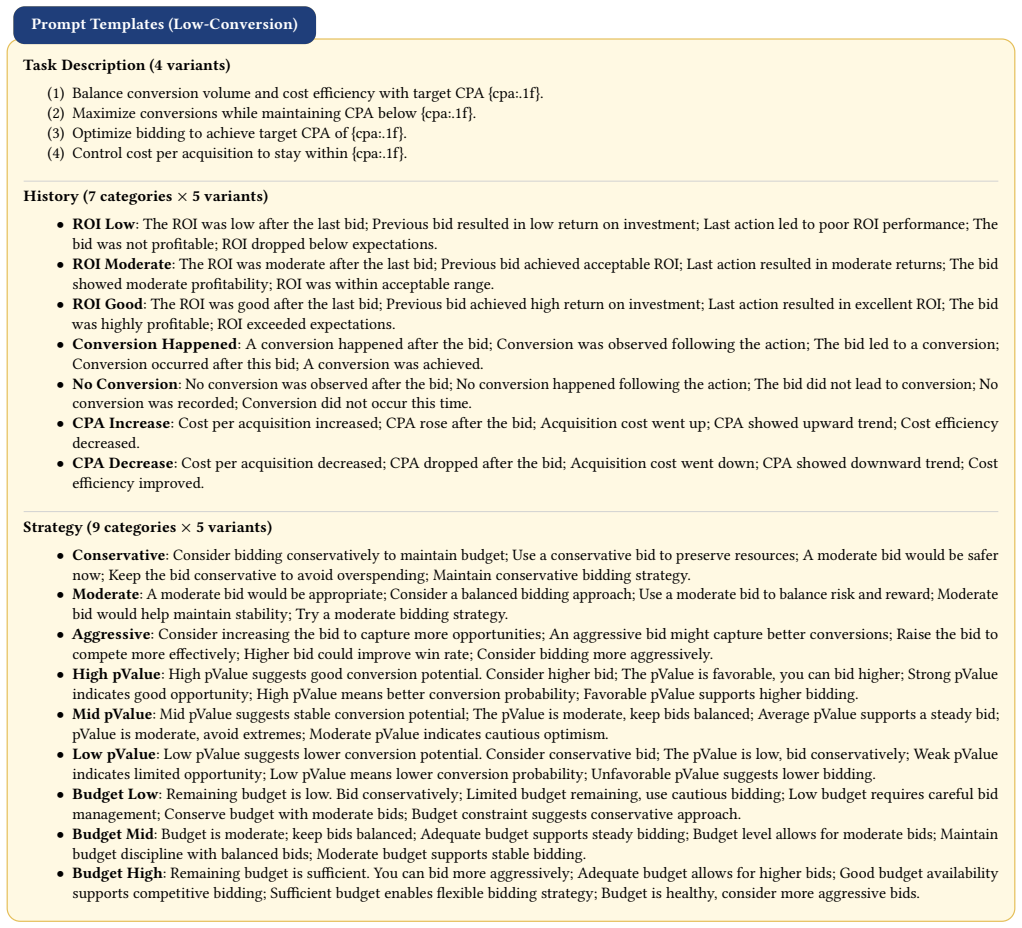
Value Analysis (pValue):Evaluates the conversion probability 𝑝of the current impression batch. • High Opportunity( 𝑝> 0.01): Suggests “High pValue indi- cates good opportunity. ” • Low Opportunity( 𝑝< 0.001): Suggests “Low pValue sug- gests lower conversion potential. ”
-
[44]
Remaining budget is low. Bid conser- vatively
Budget Health:Evaluates the remaining budget ratio 𝑅𝑏 = 𝐵𝑙𝑒 𝑓 𝑡 /𝐵𝑡𝑜𝑡𝑎𝑙 . • Scarcity( 𝑅𝑏 < 0.2): “Remaining budget is low. Bid conser- vatively. ” • Abundance( 𝑅𝑏 > 0.7): “Remaining budget is sufficient. You can bid more aggressively. ”
-
[45]
Consider increasing the bid
Reference-based Guidance:To facilitate stable learning, we pro- vide bidding suggestions based on the magnitude of the suggested bid𝑏 𝑡 . •If𝑏 𝑡 >50: “Consider increasing the bid... ” (Aggressive) • If 𝑏𝑡 < 10: “Consider bidding conservatively... ” (Conserva- tive) • Otherwise...
Reviewed May 8, 2026 · model on record in the stance chip above.
Discussion (0). Sign in to comment.