REVIEW 1 major objections 2 minor 1 cited by
Elevated HCN-to-HCO+ flux ratios in ULIRG nuclei originate from resolved outflows in seven galaxies and from AGN or unresolved outflows in nine others.
Reviewed by Pith at T0; open to challenge. T0 means a machine referee read the full paper against a public rubric. the ladder, T0–T4 →
T0 review · grok-4.3
2026-05-11 01:15 UTC
load-bearing objection New ALMA resolved HCN/HCO+ maps in 18 ULIRGs extend prior work, but the PPV geometry classifications rest on untested visual assignments to physical origins. the 1 major comments →
Spectrally and spatially resolved (sub)millimeter HCN-to-HCO⁺ flux ratios in nearby ultraluminous infrared galaxies
The pith
A machine-rendered reading of the paper's core claim, the machinery that carries it, and where it could break.
Core claim
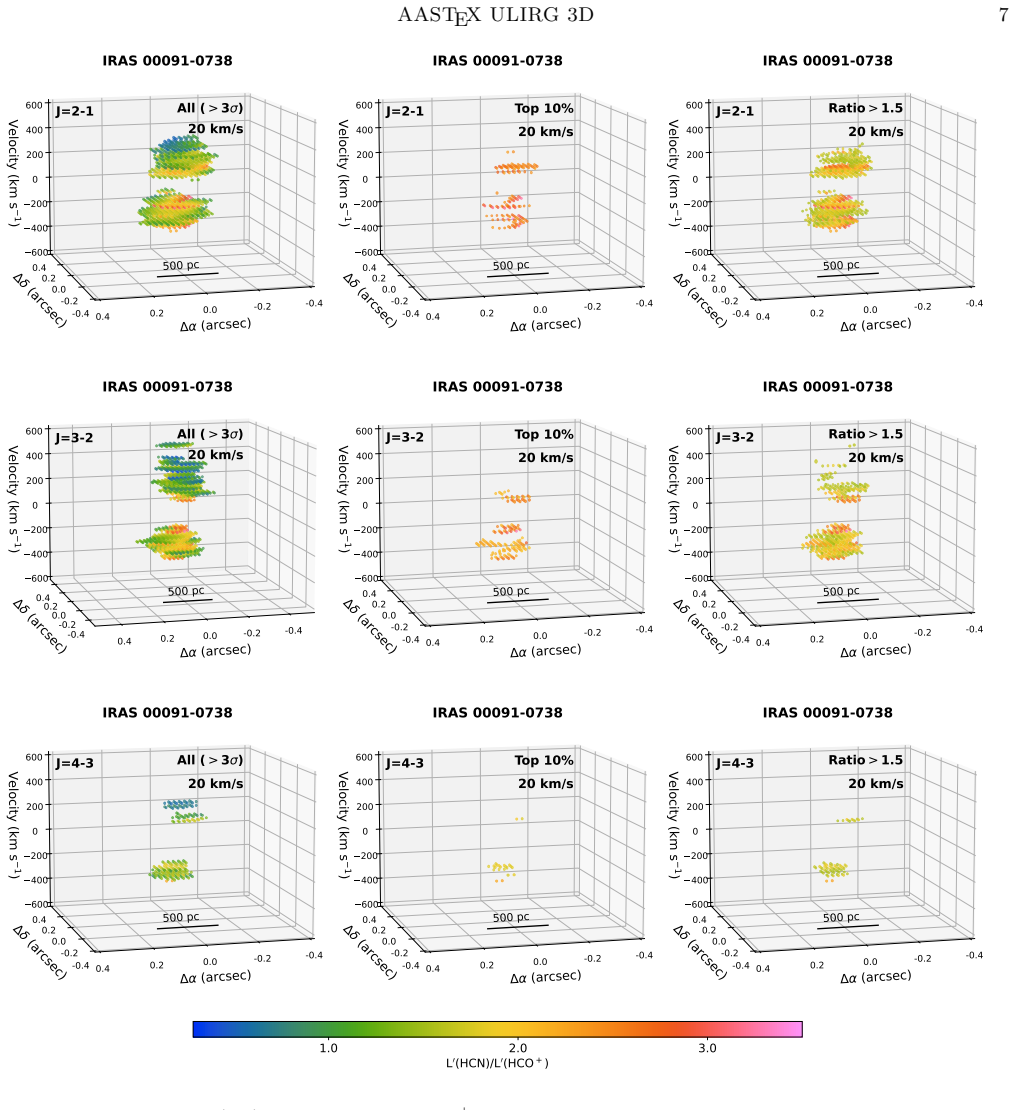
By examining spectrally and spatially resolved HCN-to-HCO+ flux ratios at J=2-1, 3-2, and 4-3, the authors classify elevated-ratio geometries in PPV space into spherical shell (spectrally and spatially distinct), spectrally distinct and spatially compact, and filled (spectrally filled and spatially compact) types. These correspond respectively to spatially resolved outflows, AGN and/or spatially unresolved outflows with separated velocity components, and AGN and/or spatially confined outflows. Signatures of the first type appear in seven ULIRGs and the second type in nine ULIRGs; in the resolved-outflow cases the elevated ratios preferentially appear at modest velocities relative to the full
What carries the argument
Visual classification of elevated HCN-to-HCO+ flux ratio geometries into spherical shell, spectrally distinct compact, and filled types within position-position-velocity space.
Load-bearing premise
The three visual geometry classes in PPV space correctly correspond to distinct physical origins of resolved outflow, AGN or unresolved outflow, and confined outflow.
What would settle it
Finding a ULIRG in which a spherical-shell geometry of elevated ratios shows no kinematic match to an outflow in independent tracers such as CO or OH line wings would falsify the mapping.
If this is right
- In the seven galaxies with resolved-outflow signatures, spaxels showing elevated ratios preferentially sample modest-velocity rather than maximum-velocity outflow material.
- The resolved-ratio approach supplies additional constraints on physical origin that spatially or velocity integrated measurements alone cannot provide.
- Nine galaxies exhibit geometries consistent with AGN or spatially unresolved outflows.
- The same classification can be applied to future higher-resolution data on more distant ULIRGs to track how outflow and AGN contributions evolve with redshift.
Where Pith is reading between the lines
- The method may help separate starburst-driven feedback from AGN-driven feedback in statistical samples of infrared-luminous galaxies.
- Cross-matching these ratio maps with independent outflow indicators could test whether the modest-velocity preference is a general feature of resolved molecular winds.
- If the classification holds, many ULIRG nuclei may host co-existing resolved outflows and compact AGN contributions rather than a single dominant mechanism.
Editorial analysis
A structured set of objections, weighed in public.
Referee Report
Summary. The manuscript presents ALMA observations of spectrally and spatially resolved HCN-to-HCO+ flux ratios (J=2-1, 3-2, and/or 4-3) in 18 nearby (z<0.15) ULIRGs at ≲0.2″ resolution. Elevated-ratio regions (>3σ detections) in PPV space are visually classified into three geometry types—spherical shell, spectrally distinct compact, and filled—which are interpreted as arising from (i) spatially resolved outflows, (ii) AGN and/or unresolved outflows, and (iii) AGN and/or confined outflows, respectively. The work reports such signatures in seven ULIRGs for resolved-outflow cases and nine for AGN/unresolved-outflow cases, and argues that the resolved analysis supplies additional physical-origin information beyond integrated studies.
Significance. If the visual-to-physical mapping can be placed on firmer quantitative footing, the approach supplies a new spatially-spectrally resolved diagnostic for separating outflow and AGN contributions in ULIRG nuclei. The use of multiple transitions and sub-arcsecond ALMA data is a clear strength relative to prior integrated analyses.
major comments (1)
- [Abstract and classification section] Abstract and classification description: the central counts (7 ULIRGs with resolved-outflow signatures, 9 with AGN/unresolved-outflow signatures) rest on assigning the three visual PPV geometry categories to distinct physical mechanisms. The text states only that the geometries “can naturally be explained by” those origins, without radiative-transfer simulations, mock ALMA cubes, quantitative classification criteria, inter-observer tests, or cross-checks against independent tracers (e.g., OH absorption or [O III] kinematics). This renders the reported tallies interpretive rather than demonstrated.
minor comments (2)
- [Abstract] The abstract and results do not define quantitative thresholds or velocity ranges for “modest-velocity components” or “elevated” ratios beyond the >3σ detection criterion, nor do they report uncertainties or reproducibility metrics for the visual classifications.
- [Figures and methods] Figure captions and text should explicitly state the exact velocity integration ranges and spatial masking criteria used to construct the PPV diagrams shown for each source.
Simulated Author's Rebuttal
We thank the referee for their constructive review and for highlighting the interpretive aspects of our visual classification. We address the major comment below and have revised the manuscript to clarify the basis and limitations of our approach.
read point-by-point responses
-
Referee: [Abstract and classification section] Abstract and classification description: the central counts (7 ULIRGs with resolved-outflow signatures, 9 with AGN/unresolved-outflow signatures) rest on assigning the three visual PPV geometry categories to distinct physical mechanisms. The text states only that the geometries “can naturally be explained by” those origins, without radiative-transfer simulations, mock ALMA cubes, quantitative classification criteria, inter-observer tests, or cross-checks against independent tracers (e.g., OH absorption or [O III] kinematics). This renders the reported tallies interpretive rather than demonstrated.
Authors: We agree that the reported counts of 7 and 9 ULIRGs derive from visual classification of PPV geometries and that the physical interpretations are suggested rather than quantitatively demonstrated. The manuscript already employs the phrasing 'can naturally be explained by' and 'visually classified' to signal this. In the revised version we have added an explicit paragraph in the classification section stating that the assignments are qualitative and visual, discussing the absence of radiative-transfer simulations or mock cubes in the present work, and noting that quantitative criteria and inter-observer tests lie beyond the current scope. Where literature cross-checks with OH absorption or [O III] kinematics exist for individual sources we have referenced them; a systematic comparison for the full sample is not available. Full radiative-transfer modeling and mock ALMA observations would require a separate, computationally intensive study and cannot be completed within the revisions to this observational paper. revision: partial
- Conducting new radiative-transfer simulations and generating mock ALMA cubes to place the geometry-to-mechanism mapping on quantitative footing
- Developing quantitative classification criteria and performing inter-observer reliability tests for the PPV geometries
Circularity Check
No circularity: purely observational classification of ALMA data features with no fitted parameters or self-referential derivations
full rationale
The paper reports direct measurements of HCN-to-HCO+ flux ratios from ALMA (sub)millimeter data in 18 ULIRGs and performs visual classification of elevated-ratio geometries in PPV space into three categories (spherical shell, spectrally distinct compact, filled). These are tallied as 7 ULIRGs showing resolved-outflow signatures and 9 showing AGN/unresolved-outflow signatures. The text states that the geometries 'can naturally be explained by' the listed physical origins but provides no equations, model fits, or derivations that reduce the classifications or counts to the input data by construction. No self-citations, ansatzes, or uniqueness theorems are invoked as load-bearing steps. The analysis is self-contained against the observed cubes and does not rename known results or smuggle assumptions via prior work by the same authors.
Axiom & Free-Parameter Ledger
axioms (1)
- domain assumption Elevated HCN-to-HCO+ flux ratios trace regions influenced by AGN radiation or shocks in outflows
read the original abstract
We present the results of our investigations of spectrally and spatially resolved (sub)millimeter HCN-to-HCO$^{+}$ flux ratios at J=2-1, J=3-2, and/or J=4-3 in 18 nearby ($z <$ 0.15) ultraluminous infrared galaxies (ULIRGs), using ALMA $\lesssim$0.2" ($\lesssim$500 pc) resolution data. The geometry of elevated HCN-to-HCO$^{+}$ flux ratios (with $>$3$\sigma$ detections for both molecular lines) in position-position-velocity (PPV) space is visually classified into (i) spherical shell (spectrally and spatially distinct), (ii) spectrally distinct and spatially compact, and (iii) filled (spectrally filled and spatially compact). These can naturally be explained by the elevation of the flux ratio due to (i) a spatially resolved outflow, (ii) an AGN and/or a spatially unresolved outflow with blueshifted and redshifted emission components, and (iii) an AGN and/or a spatially confined outflow with not clearly separated blueshifted and redshifted velocity components, respectively. Signatures of elevated HCN-to-HCO$^{+}$ flux ratios originated from (a) spatially resolved outflow and (b) AGN and/or spatially unresolved outflow are seen in seven and nine ULIRGs, respectively. In the former spatially resolved outflow-origin case, modest-velocity components relative to the maximum outflow velocity tend to be probed by spaxels with elevated HCN-to-HCO$^{+}$ flux ratios. The spectrally and spatially resolved HCN-to-HCO$^{+}$ flux ratios can provide additional information on the physical origin of the elevated flux ratios in nearby ULIRG nuclei, compared to previously conducted spatially integrated and/or velocity-integrated analyses.
Figures


Forward citations
Cited by 1 Pith paper
-
Advancing extragalactic spectral line studies with the Square Kilometre Array Observatory
SKAO will extend maser, molecular, recombination-line and isotope studies across cosmic time, with AA4 and a high-frequency extension enabling transformative surveys including possible HeH+ detection.
Reference graph
Works this paper leans on
- [1]
- [2]
-
[3]
Aladro, R., Martin, S., Riquelme, D., et al. 2015, A&A, 579, A101
work page 2015
-
[4]
Alonso-Herrero, A., Ward, M. J., & Kotilainen, J. K. 1997, MNRAS, 288, 977
work page 1997
-
[5]
Antonucci, R. R. J. & Miller, J. S. 1985, ApJ, 297, 621
work page 1985
-
[6]
2007, ApJ, 656, 148 Astropy Collaboration, Price-Whelan, A
Armus, L., Charmandaris, V., Bernard-Salas, J., et al. 2007, ApJ, 656, 148 Astropy Collaboration, Price-Whelan, A. M., Lim, P. L., et al. 2022, ApJ, 935, 167
work page 2007
- [7]
- [8]
-
[9]
Barcos-Munoz, L., Leroy, A. K., Evans, A. S., et al. 2017, ApJ, 843, 117
work page 2017
-
[10]
Burtscher, L., Davies, R. I., Gracia-Carpio, J., et al. 2016, A&A, 586, A28
work page 2016
-
[11]
Butterworth, J., Holdship, J., Viti, S., & Garcia-Burillo, S., et al. 2022, A&A, 667, A131
work page 2022
- [12]
- [13]
- [14]
-
[15]
Diaz-Santos, T., Charmandaris, V., Armus, L., et al. 2010, ApJ, 723, 993
work page 2010
- [16]
-
[17]
Falstad, N., Hallqvist, F., Aalto, S., et al. 2019, A&A, 623, A29
work page 2019
-
[18]
2019, MNRAS, 483, 4586 AASTEX ULIRG 3D23
Fluetsch, A.; Maiolino, R.; Carniani, S., et al. 2019, MNRAS, 483, 4586 AASTEX ULIRG 3D23
work page 2019
- [19]
-
[20]
Gonzalez-Alfonso, E., Fischer, J., Spoon, H. W. W., et al. 2017, ApJ, 836, 11
work page 2017
-
[21]
Gracia-Carpio, J., Garcia-Burillo, S., Planesas, P., Fuente, A., & Usero, A. 2008, A&A, 479, 703
work page 2008
-
[22]
Harris, C. R., Millman, K. J., van der Walt, S., et al. 2020, Nature, 585, 357
work page 2020
-
[23]
Hildebrand, R. H. 1983, QJRAS, 24, 267
work page 1983
-
[24]
Hopkins, P. F., Hernquist, L., Cox, T. J., et al. 2006, ApJS, 163, 1
work page 2006
-
[25]
Hopkins, P. F., Hernquist, L., Cox, T. J., & Keres, D. 2008, ApJS, 175, 356
work page 2008
-
[26]
Hunter, J. D. 2007, Computing in Science and Engineering, 9, 90
work page 2007
- [27]
-
[28]
Imanishi, M., Imase, K., Oi, N., & Ichikawa, K. 2011, AJ, 141, 156
work page 2011
-
[29]
Imanishi, M., Nakagawa, T., Ohyama, Y., et al. 2008, PASJ, 60, S489
work page 2008
- [30]
- [31]
- [32]
- [33]
- [34]
- [35]
-
[36]
Imanishi, M., Nakanishi, K., Tamura, Y., & Peng, C. -H. 2009, AJ, 137, 3581
work page 2009
- [37]
-
[38]
Imanishi, M., Vollmer, B., Hagiwara, Y., et al. 2025, ApJ, 995, 211
work page 2025
-
[39]
Israel, F. P. 2023, A&A, 671, A59
work page 2023
- [40]
- [41]
- [42]
-
[43]
Kohno, K. 2005, in AIP Conf. Ser. 783, The Evolution of Starbursts, ed. S. H¨ uttemeister, E. Manthey, D. Bomans, & K. Weis (New York: AIP), 203 (astro-ph/0508420)
work page internal anchor Pith review arXiv 2005
-
[44]
Krips, M., Neri, R., Garcia-Burillo, S., Martin, S., Combes, F., Gracia-Carpio, J., & Eckart, A. 2008, ApJ, 677, 262
work page 2008
-
[45]
Lamperti, I., Pereira-Santaella, M., Perna, M., et al. 2022, A&A, 668, A45
work page 2022
-
[46]
E., Aalto, S., Muller, S., et al
Lindberg, J. E., Aalto, S., Muller, S., et al. 2016, A&A, 587, A15
work page 2016
- [47]
-
[48]
Mizukoshi, S., Minezaki, T., Tsunetsugu, S., et al. 2022, MNRAS, 516, 2876
work page 2022
-
[49]
Nardini, E., Risaliti, G., Salvati, M., et al. 2008, MNRAS, 385, L130
work page 2008
-
[50]
Nardini, E., Risaliti, G., Salvati, M., et al. 2009, MNRAS, 399, 1373
work page 2009
-
[51]
Nardini, E., Risaliti, G., Watabe, Y., Salvati, M., & Sani, E. 2010, MNRAS, 405, 2505
work page 2010
- [52]
-
[53]
Pereira-Santaella, M., Colina, L., Garcia-Burillo, S., et al. 2018, A&A, 616, A171
work page 2018
-
[54]
Pereira-Santaella, M., Colina, L., Garcia-Burillo, S., et al. 2021, A&A, 651, A42
work page 2021
-
[55]
C., Aalto, S., Falstad, N., et al
Privon, G. C., Aalto, S., Falstad, N., et al. 2017, ApJ, 835, 213
work page 2017
-
[56]
C., Herrero-Illana, R., Evans, A
Privon, G. C., Herrero-Illana, R., Evans, A. S., et al. 2015, ApJ, 814, 39
work page 2015
-
[57]
C., Ricci, C., Aalto, S., et al
Privon, G. C., Ricci, C., Aalto, S., et al. 2020, ApJ, 893, 149
work page 2020
-
[58]
Ricci, C., Bauer, F. E., Treister, E., et al. 2017, MNRAS, 468, 1273
work page 2017
-
[59]
Ricci, C., Privon, G. C., Pfeifle, R. W., et al. 2021, MNRAS, 506, 5935
work page 2021
-
[60]
Rigopoulou, D., Spoon, H. W. W., Genzel, R., et al. 1999, AJ, 118, 1625
work page 1999
- [61]
- [62]
- [63]
- [64]
-
[65]
T., Neugebauer, G., Matthews, K., et al
Soifer, B. T., Neugebauer, G., Matthews, K., et al. 2000, AJ, 119, 509
work page 2000
-
[66]
Spoon, H. W. W., Farrah, D., Lebouteiller, V., et al. 2013, ApJ, 775, 127 24Imanishi et al
work page 2013
-
[67]
Teng, S. H., Rigby, J. R., Stern, D,. et al. 2015, ApJ, 814, 56 The CASA Team, et al. 2022, PASP, 134, 114501
work page 2015
-
[68]
D., Lutz, D., Genzel, R., et al
Tran, Q. D., Lutz, D., Genzel, R., et al. 2001, ApJ, 552, 527
work page 2001
-
[69]
Varnava, C., Efstathiou, A., Farrah, D., & Rigopoulou, D. 2025, MNRAS, 538, 426
work page 2025
- [70]
-
[71]
Veilleux, S., & Osterbrock, D. E. 1987, ApJS, 63, 295
work page 1987
-
[72]
Veilleux, S., Melendez, M., & Sturm, E., et al. 2013, ApJ, 776, 27
work page 2013
-
[73]
Veilleux, S., Rupke, D. S. N., Kim, D.-C., et al. 2009, ApJS, 182, 628
work page 2009
-
[74]
Viti, S., Garcia-Burillo, S., Fuente, A., et al. 2014, A&A, 570, A28
work page 2014
-
[75]
Vollmer, B., Davies, R. I., Gratier, P., et al. 2022, A&A, 665, A102
work page 2022
-
[76]
Wu, Z., Sotnikova, Y., Mufakharov, T., et al. 2024, A&A, 687, A193
work page 2024
discussion (0)
Sign in with ORCID, Apple, or X to comment. Anyone can read and Pith papers without signing in.