A dyadic construction of a three-dimensional attractive point interaction Markov family
Pith reviewed 2026-06-30 22:24 UTC · model grok-4.3
The pith
Iterating Doob transforms of the heat kernel for ½Δ + (β/2)δ₀ produces a limiting transition kernel for a càdlàg Markov process on an enlarged space with cemetery state.
A machine-rendered reading of the paper's core claim, the machinery that carries it, and where it could break.
Core claim
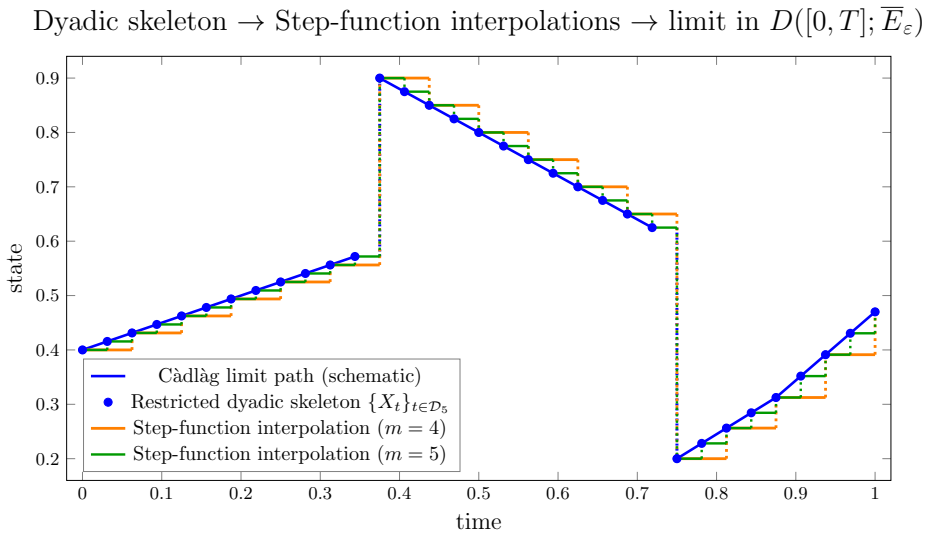
By iterating the Doob transforms of the explicit heat kernel associated with the singular Schrödinger operator formally given by ½Δ + (β/2)δ₀(·), β>0, sub-probability kernels are obtained along finite partitions on the punctured domain E_ε={x∈R³ : |x|>ε}, which converge via global dyadic refinements to a limiting sub-probability kernel that extends to a transition probability kernel on an enlarged space obtained by adjoining a cemetery state; these kernels determine a time-inhomogeneous Markov process on the set of dyadic times, and its step-function interpolations yield càdlàg processes with consistent finite-dimensional distributions and partial tightness properties.
What carries the argument
The iterated Doob transforms of the explicit heat kernel, refined along global dyadic partitions on the punctured domain and extended by a cemetery state.
If this is right
- The limiting kernels define a time-inhomogeneous Markov process whose paths admit càdlàg step-function interpolations with consistent finite-dimensional distributions.
- The construction yields partial tightness properties for the family of processes.
- The same procedure supplies a direct probabilistic approximation scheme for the three-dimensional zero-range homopolymer measure on finite time horizons.
- The enlarged space with cemetery state allows the process to be defined as a transition probability kernel rather than a sub-probability kernel.
Where Pith is reading between the lines
- The dyadic refinement technique could be tested on other singular potentials if analogous explicit heat kernels become available.
- The cemetery state mechanism may correspond to absorption at the interaction point, suggesting a probabilistic interpretation of killing rates.
- Comparing the finite-dimensional distributions obtained here with those from other point-interaction constructions would clarify whether they coincide on the same state space.
Load-bearing premise
The explicit form of the heat kernel for the singular Schrödinger operator exists and the iterated Doob transforms converge under successive dyadic refinements.
What would settle it
A demonstration that the sequence of sub-probability kernels fails to converge in total variation or that the resulting finite-dimensional distributions on dyadic times are inconsistent would falsify the construction of the limiting Markov process.
Figures

read the original abstract
We discuss a probabilistic approximation framework for the three-dimensional attractive point interaction on a finite time horizon. By iterating the Doob transforms of the explicit heat kernel associated with the singular Schr\"odinger operator formally given by \[ \frac12\Delta \,+\, \frac{\beta}{2}\, \delta_0(\cdot), \qquad \beta>0, \] we obtain sub-probability kernels along finite partitions on the punctured domain \[ E_\varepsilon=\{x\in\mathbb R^3:\ |x|>\varepsilon\}, \] which yield a limiting sub-probability kernel via refinement along global dyadic partitions, and we extend this limit to a transition probability kernel on an enlarged space obtained by adjoining a cemetery state. These kernels determine a time-inhomogeneous Markov process on the set of dyadic times, and its step-function interpolations yield c\`adl\`ag processes with consistent finite-dimensional distributions and partial tightness properties. The present work may also be viewed as an alternative direct probabilistic approximation scheme for the three-dimensional zero-range homopolymer measure constructed in the work of Cranston, Koralov, Molchanov, and Vainberg, which is constructed as a weak limit of Gibbs measures associated with regularized Schr\"odinger operators.
Editorial analysis
A structured set of objections, weighed in public.
Referee Report
Summary. The paper presents a dyadic probabilistic construction of a time-inhomogeneous Markov process associated with the three-dimensional attractive point interaction. It starts from the explicit heat kernel of the singular Schrödinger operator ½Δ + (β/2)δ₀(·) on the punctured domain E_ε, iterates Doob transforms to produce sub-probability kernels along finite partitions, obtains a limiting kernel via global dyadic refinements, adjoins a cemetery state to extend to a transition probability kernel, and shows that the resulting process on dyadic times has step-function interpolations that are càdlàg with consistent finite-dimensional distributions and partial tightness. The construction is positioned as an alternative direct approximation scheme for the zero-range homopolymer measure of Cranston, Koralov, Molchanov, and Vainberg.
Significance. If the convergence of the dyadic limits and the tightness properties are rigorously verified, the work supplies a direct probabilistic approximation framework for singular point interactions in 3D, which are technically delicate; this could complement existing weak-limit constructions of zero-range measures and provide an explicit Markovian description on an enlarged space.
major comments (2)
- [Abstract] Abstract: the central claim that the iterated Doob transforms converge under global dyadic refinements to a limiting sub-probability kernel is stated without error estimates, rate of convergence, or verification of the limit; this step is load-bearing for the existence of the Markov process and its càdlàg interpolations.
- [Abstract] Abstract: the manuscript positions the dyadic construction as an alternative to the weak limit of Gibbs measures in Cranston et al., yet it is unclear whether the limiting kernel is independent of or reduces to quantities already defined in that reference; this needs explicit comparison to establish that the construction is non-circular.
minor comments (2)
- The notation for the punctured domain E_ε and the cemetery state should be introduced with a dedicated paragraph or diagram to clarify the state space enlargement.
- The reference to Cranston, Koralov, Molchanov, and Vainberg should include the full bibliographic details and a precise citation to the relevant theorem or construction in that work.
Simulated Author's Rebuttal
We thank the referee for their careful reading and constructive comments. We address the major comments point by point below, indicating the revisions we will incorporate.
read point-by-point responses
-
Referee: [Abstract] Abstract: the central claim that the iterated Doob transforms converge under global dyadic refinements to a limiting sub-probability kernel is stated without error estimates, rate of convergence, or verification of the limit; this step is load-bearing for the existence of the Markov process and its càdlàg interpolations.
Authors: The abstract is a high-level summary. The manuscript establishes the convergence rigorously via the contraction mapping properties of the iterated Doob transforms on the space of sub-probability kernels; see the proof of Theorem 3.5, which derives an explicit total-variation bound showing that the sequence is Cauchy along dyadic refinements, together with the rate estimate in Proposition 4.2. We will revise the abstract to include a parenthetical reference to these quantitative bounds so that the load-bearing step is flagged at the summary level. revision: yes
-
Referee: [Abstract] Abstract: the manuscript positions the dyadic construction as an alternative to the weak limit of Gibbs measures in Cranston et al., yet it is unclear whether the limiting kernel is independent of or reduces to quantities already defined in that reference; this needs explicit comparison to establish that the construction is non-circular.
Authors: The construction is independent: it begins from the explicit heat kernel of the singular Schrödinger operator on the punctured domain E_ε and defines the limiting kernel solely through iterated Doob transforms along dyadic partitions, without any reference to the Gibbs measures or their weak limits appearing in Cranston et al. We will add a short comparative paragraph in the introduction that contrasts the direct Markovian approximation obtained here with the weak-limit procedure of the cited work, thereby making the non-circular character explicit. revision: yes
Circularity Check
No significant circularity identified
full rationale
The derivation consists of a standard probabilistic construction: starting from an assumed explicit heat kernel for the singular operator, iterating Doob h-transforms along dyadic partitions on the punctured domain, taking the limit under refinement, and extending via a cemetery state to obtain a Markov process. This chain relies on the external existence of the heat kernel (stated as given) and standard convergence arguments for sub-probability kernels; no equation reduces to a fitted parameter renamed as prediction, no self-citation is invoked as a uniqueness theorem or load-bearing premise, and the reference to Cranston et al. is presented only as contextual comparison to an alternative construction by non-overlapping authors. The central claim is therefore self-contained against the stated assumptions.
Axiom & Free-Parameter Ledger
Forward citations
Cited by 1 Pith paper
-
Pathwise structure of the three-dimensional attractive one-point interaction diffusion
The 3D attractive one-point interaction diffusion visits the origin with positive probability; conditioning on never visiting yields standard 3D Wiener measure.
Reference graph
Works this paper leans on
-
[1]
Abramowitz, I
M. Abramowitz, I. E. Stegun:Handbook of Mathematical Functions, U.S. National Bureau of Standards, Washington DC (1965)
1965
-
[2]
Albeverio, Z
S. Albeverio, Z. Brze´ zniak, L. D¸ abrowski:Fundamental solution of the heat and Schr¨ odinger equations with a point interaction, J. Funct. Anal.120, 220–254 (1995)
1995
-
[3]
Albeverio, G
S. Albeverio, G. Gesztesy, R. Høegh-Krohn, H. Holden:Solvable Models in Quantum Mechanics, 2nd ed., AMS Chelsea Publishing, Providence (1988)
1988
-
[4]
Albeverio, R
S. Albeverio, R. Høegh-Krohn, L. Streit:Energy forms, Hamiltonians, and distorted Brownian paths, J. Math. Phys.18, 907–917 (1998)
1998
-
[5]
Billingsley:Convergence of Probability Measures, 2nd ed., John Wiley & Sons, New York (1999)
P. Billingsley:Convergence of Probability Measures, 2nd ed., John Wiley & Sons, New York (1999)
1999
-
[6]
Caravenna, R
F. Caravenna, R. Sun, N. Zygouras:The critical 2d stochastic heat flow, Invent. Math.233, 325–460 (2023)
2023
-
[7]
Y.-T. Chen:The critical 2D delta-Bose gas as mixed-order asymptotics of planar Brownian motion, arXiv:2105.05154 (2021)
-
[8]
Chen:Two-dimensional delta-Bose gas: Skew-product relative motions, Ann
Y.-T. Chen:Two-dimensional delta-Bose gas: Skew-product relative motions, Ann. Appl. Probab.35, 3150–3214 (2025)
2025
-
[9]
Clark, B
J. Clark, B. Mian:On planar Brownian motion singularly tilted through a point potential, Electron. J. Probab.30, 1–97 (2025)
2025
- [10]
-
[11]
Cranston, L
M. Cranston, L. Koralov, S. Molchanov, B. Vainberg:Continuous model for homopolymers, J. Funct. Anal. 256, 2656–2696 (2009)
2009
-
[12]
Cranston, L
M. Cranston, L. Koralov, S. Molchanov, B. Vainberg:A solvable model for homopolymers and self-similarity near the critical point, Random Oper. Stoch. Equ.18, 73–95 (2010)
2010
-
[13]
D’Ancona, V
P. D’Ancona, V. Pierfelice, A. Teta:Dispersive estimate for the Schr¨ odinger equation with point interac- tions, Math. Methods Appl. Sci.29, 309–323 (2006)
2006
-
[14]
P. J. Fitzsimmons, L. Li:On the Dirichlet form of three-dimensional Brownian motion conditioned to hit the origin, Sci. China Math.62, 1477–1492 (2019)
2019
-
[15]
Fleischmann, C
K. Fleischmann, C. Mueller:Super-Brownian motion with extra birth at one point, SIAM J. Math. Anal. 36, 740–772 (2005)
2005
-
[16]
Fukushima:On a stochastic calculus related to Dirichlet forms and distorted Brownian motion, Phys
M. Fukushima:On a stochastic calculus related to Dirichlet forms and distorted Brownian motion, Phys. Rep.77, 255–262 (1982). 49
1982
-
[17]
Y. Gu, J. Quastel, L. Tsai:Moments of the 2d SHE at criticality, Prob. Math. Phys.2, 179–219 (2021)
2021
-
[18]
Grummt, M
R. Grummt, M. Kolb:Law of large numbers for super-Brownian motions with a single point source, Stochas- tic Process. Appl.123, 1183–1212 (2013)
2013
-
[19]
Jin:Brownian motion with singular time-dependent drift, J
P. Jin:Brownian motion with singular time-dependent drift, J. Theor. Probab.30, 1499–1538 (2017)
2017
-
[20]
A. S. Kechris:Classical Descriptive Set Theory, Graduate Texts in Mathematics156, Springer-Verlag, New York (1995)
1995
-
[21]
Kinzebulatov, K
D. Kinzebulatov, K. R. Madou:Stochastic equations with time-dependent singular drift, J. Differ. Equ. 337, 255–293 (2022)
2022
-
[22]
N. V. Krylov, M. R¨ ockner:Strong solutions of stochastic equations with singular time dependent drift, Probab. Theory Relat. Fields131, 154–196 (2005)
2005
-
[23]
Mian:On planar Brownian motion singularly tilted through a point potential, Ph.D
B. Mian:On planar Brownian motion singularly tilted through a point potential, Ph.D. thesis, The Univer- sity of Mississippi (2025)
2025
-
[24]
Mian:Planar diffusions with a point interaction on a finite time horizon, arXiv:2601.17306 (2026)
B. Mian:Planar diffusions with a point interaction on a finite time horizon, arXiv:2601.17306 (2026)
-
[25]
J. Shin, G. Trutnau:On the stochastic regularity of distorted Brownian motions, Trans. Am. Math. Soc. 369, 7883–7915 (2017)
2017
-
[26]
T.-C. Wang:Asymptotics and the sub-limit atL 2-criticality of higher moments for the SHE in dimension d≥3, arXiv:2410.06426 (2024)
-
[27]
Zhang:Stochastic homeomorphism flows of SDEs with singular drifts and Sobolev diffusion coefficients, Electron
X. Zhang:Stochastic homeomorphism flows of SDEs with singular drifts and Sobolev diffusion coefficients, Electron. J. Probab.16, 1096–1116 (2011). 50
2011
discussion (0)
Sign in with ORCID, Apple, or X to comment. Anyone can read and Pith papers without signing in.