A Resource-Driven Framework for Configurable Entanglement in Quantum Networks
Pith reviewed 2026-06-30 20:21 UTC · model grok-4.3
The pith
Multipartite entanglement acts as a programmable resource that induces a space of admissible entanglement-graph configurations in quantum networks.
A machine-rendered reading of the paper's core claim, the machinery that carries it, and where it could break.
Core claim
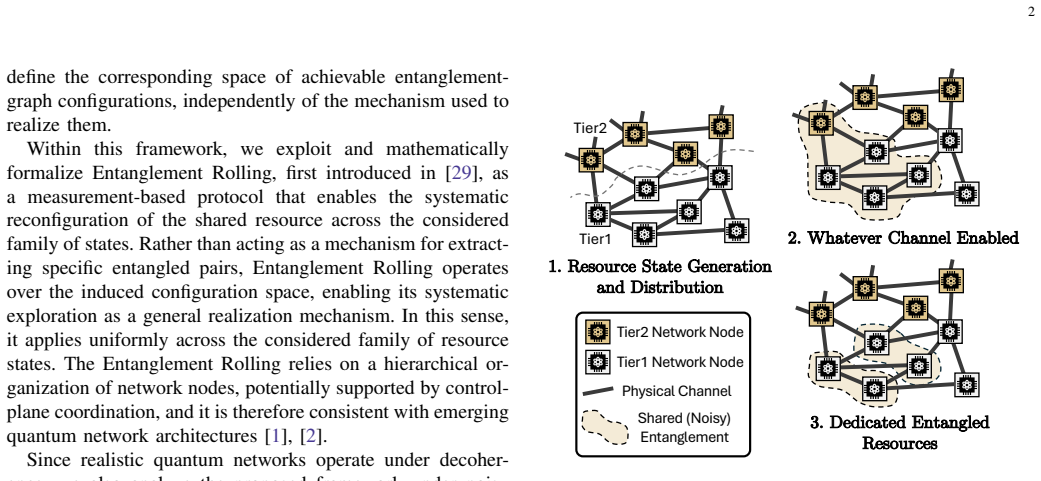
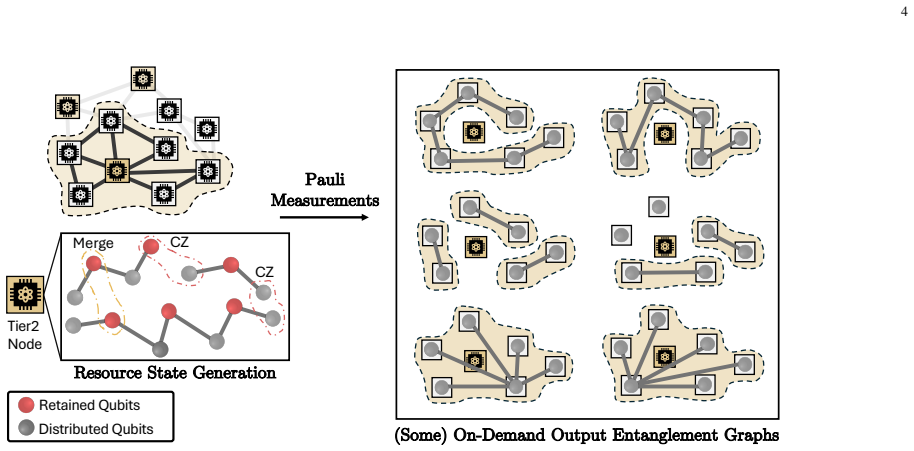
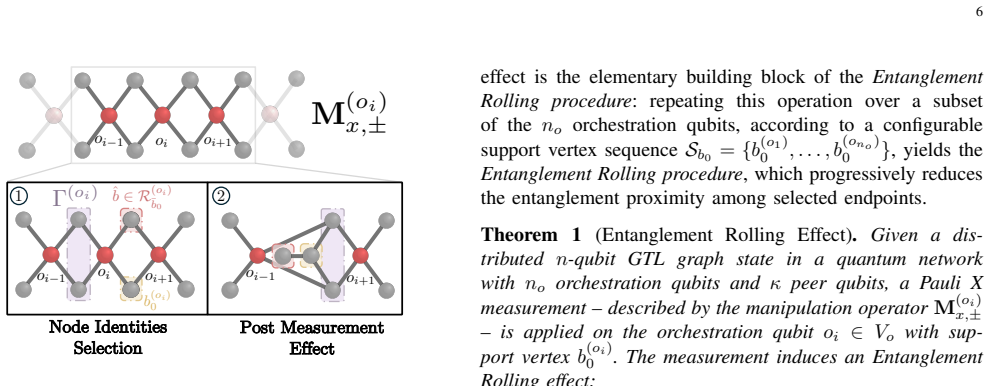
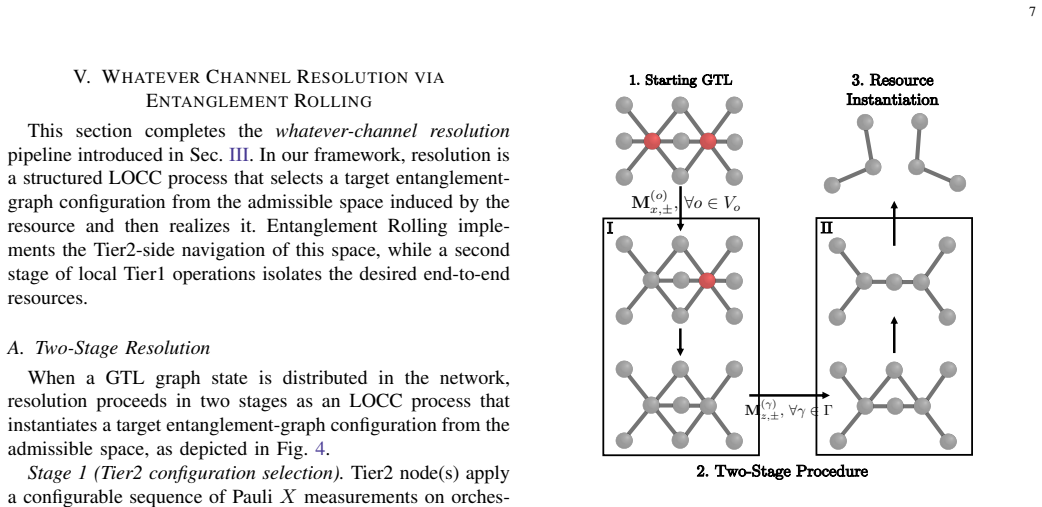
Shared multipartite entanglement defines a whatever channel, a latent communication substrate that does not fix end-to-end links in advance but can be configured to support varying entanglement-connectivity graphs. The resource-driven framework treats this entanglement as a programmable resource that induces a space of admissible graph configurations. Structural design parameters characterize the operational degrees of freedom and define admissible transformations independently of the physical mechanism that realizes them. Entanglement Rolling operates as the measurement-based protocol over this configuration space, and the Noisy Stabilizer Formalism supplies closed-form noise maps that char
What carries the argument
The resource-driven framework, which models multipartite entanglement as inducing an admissible space of entanglement-graph configurations whose transformations are governed by structural design parameters and executed by the Entanglement Rolling protocol.
If this is right
- Connectivity provisioning reduces to a special case of general resource reconfiguration.
- Admissible transformations are defined without dependence on any particular physical realization mechanism.
- Entanglement Rolling supplies a systematic measurement-based method to move across a family of multipartite states.
- Closed-form noise maps obtained from the Noisy Stabilizer Formalism fully characterize how noise acts on the resource transformations.
- The overall procedure sustains reliable performance under relevant noise processes.
Where Pith is reading between the lines
- The same reconfiguration logic could be applied to other quantum resources such as quantum memories or channels, treating them as programmable substrates.
- Dynamic on-demand adjustment of entanglement topology becomes feasible in large networks without requiring new physical links to be established.
- The structural design parameters might serve as a starting point for optimization routines that select the most efficient configuration for a given network task.
Load-bearing premise
Multipartite entanglement can be treated as a programmable resource inducing a space of admissible entanglement-graph configurations independently of the specific physical mechanism used to realize the transformations.
What would settle it
An experiment that measures the actual noise effect on resource transformations and finds that it deviates from the closed-form maps derived via the Noisy Stabilizer Formalism would falsify the claim of maintained reliable performance.
Figures
read the original abstract
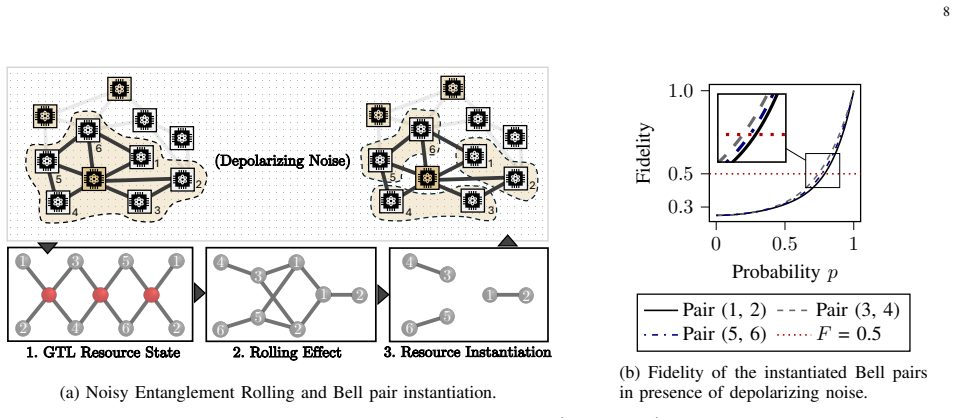
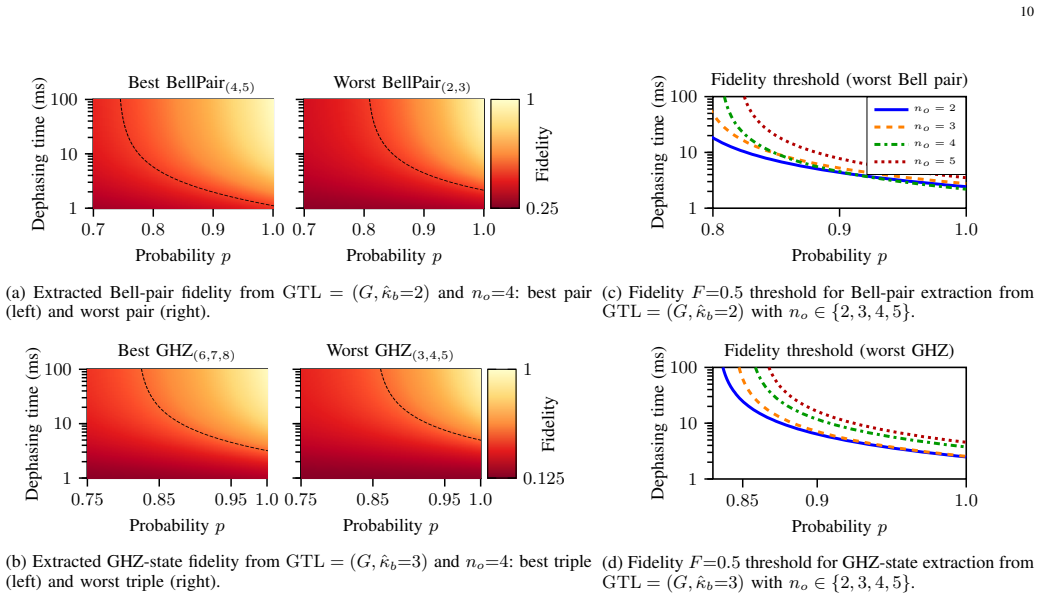
Shared multipartite entanglement defines a ``whatever channel'', i.e., a latent communication substrate that does not determine a priori which end-to-end entangled links are activated, but can be configured to support different entanglement-connectivity graphs through Local Operations and Classical Communication (LOCC). Building on this, we propose a resource-driven framework in which multipartite entanglement is treated as a programmable resource that induces a space of admissible entanglement-graph configurations. Within this framework, connectivity provisioning emerges as a particular instance of a more general resource reconfiguration process. To support this paradigm, we introduce a set of structural design parameters that characterize the operational degrees of freedom of the resource and define the admissible transformations independently of the specific mechanism used to realize them. We then formalize Entanglement Rolling as a measurement-based protocol that operates over the induced configuration space, enabling the systematic reconfiguration of the shared resource across a family of multipartite states. Finally, we analyze the proposed framework under realistic noise conditions. Leveraging the Noisy Stabilizer Formalism (NSF), we derive closed-form noise maps that characterize the effect of noise on the resource transformations and show that the proposed approach maintains reliable performance under relevant noise processes.
Editorial analysis
A structured set of objections, weighed in public.
Referee Report
Summary. The manuscript proposes a resource-driven framework for configurable entanglement in quantum networks. Multipartite entanglement is treated as a programmable resource inducing a space of admissible entanglement-graph configurations via LOCC, with connectivity provisioning as one instance of resource reconfiguration. Structural design parameters are introduced to define admissible transformations independently of physical mechanism. The 'Entanglement Rolling' measurement-based protocol is formalized to reconfigure the shared resource across a family of multipartite states. Closed-form noise maps are derived via the Noisy Stabilizer Formalism (NSF) and used to claim reliable performance under relevant noise processes.
Significance. If the central derivations hold, the separation of resource configuration from physical mechanism could provide a useful abstraction for quantum network architecture, allowing systematic analysis of entanglement reconfiguration without committing to specific gate decompositions or loss models. The emphasis on closed-form NSF maps rather than simulation is a methodological strength that could support analytical comparisons across protocols.
major comments (2)
- [NSF analysis and resource-driven framework] Resource-driven framework and NSF analysis sections: the assertion that admissible transformations (and thus their NSF noise maps) are independent of the specific physical mechanism is load-bearing for the reliability claim, yet the manuscript does not explicitly demonstrate how the stabilizer generators and measurement patterns chosen for Entanglement Rolling avoid encoding mechanism-specific details (e.g., particular photon-loss channels or gate decompositions). Without this verification, the closed-form maps may not transfer across realizations as stated.
- [Entanglement Rolling protocol] Entanglement Rolling protocol definition: the protocol is presented as operating over the induced configuration space, but the manuscript does not provide an explicit mapping from the structural design parameters to the admissible stabilizer generators used in the NSF derivation; this gap prevents independent verification that the noise maps remain mechanism-independent.
minor comments (2)
- [Abstract] Abstract and introduction: the phrase 'whatever channel' is used without a formal definition or reference; a brief clarifying sentence would improve readability.
- [Structural design parameters] Notation: the structural design parameters are introduced as a set but never enumerated with symbols or ranges; adding an explicit list or table would aid reproducibility.
Simulated Author's Rebuttal
We thank the referee for their constructive comments and recommendation for major revision. We address each major comment below, agreeing that greater explicitness is needed to support the mechanism-independence claims, and we commit to the corresponding revisions.
read point-by-point responses
-
Referee: [NSF analysis and resource-driven framework] Resource-driven framework and NSF analysis sections: the assertion that admissible transformations (and thus their NSF noise maps) are independent of the specific physical mechanism is load-bearing for the reliability claim, yet the manuscript does not explicitly demonstrate how the stabilizer generators and measurement patterns chosen for Entanglement Rolling avoid encoding mechanism-specific details (e.g., particular photon-loss channels or gate decompositions). Without this verification, the closed-form maps may not transfer across realizations as stated.
Authors: We agree that an explicit demonstration is required to substantiate the central claim. In the revised manuscript we will expand the NSF analysis section with a dedicated derivation showing that the stabilizer generators are obtained solely from the structural design parameters via the admissible transformation rules (as defined in the resource-driven framework), without reference to any specific loss channel or gate decomposition. We will also include a general argument that the Entanglement Rolling measurement patterns are specified at the level of the configuration space, ensuring the resulting NSF maps inherit the same mechanism independence. This addition will directly support transferability across realizations. revision: yes
-
Referee: [Entanglement Rolling protocol] Entanglement Rolling protocol definition: the protocol is presented as operating over the induced configuration space, but the manuscript does not provide an explicit mapping from the structural design parameters to the admissible stabilizer generators used in the NSF derivation; this gap prevents independent verification that the noise maps remain mechanism-independent.
Authors: We acknowledge the absence of an explicit mapping. The revised version will add a new subsection (or appendix) that supplies the direct correspondence between each structural design parameter and the admissible stabilizer generators employed in the NSF derivation. The mapping will be given formally, together with illustrative examples, to allow independent verification that the noise maps depend only on the parameters and not on underlying physical mechanisms. revision: yes
Circularity Check
No circularity in the resource-driven framework or NSF noise map derivations
full rationale
The paper defines a resource-driven framework treating multipartite entanglement as a programmable resource via LOCC, introduces structural design parameters to characterize admissible transformations independently of physical mechanisms, formalizes Entanglement Rolling as a measurement-based protocol, and derives closed-form noise maps using the established Noisy Stabilizer Formalism to analyze performance under noise. No load-bearing steps reduce by construction to inputs via self-definition, fitted parameters presented as predictions, or self-citation chains; the framework builds on external concepts without the target claims being equivalent to the definitions or assumptions by the paper's own equations.
Axiom & Free-Parameter Ledger
free parameters (1)
- structural design parameters
axioms (1)
- domain assumption Multipartite entanglement defines a whatever channel that can be configured through LOCC to support different entanglement-connectivity graphs
invented entities (1)
-
Entanglement Rolling
no independent evidence
Forward citations
Cited by 1 Pith paper
-
Quantum Routers: A Switching-Fabric Framework for Quantum-Native Forwarding
The paper introduces an entanglement-based switching fabric for quantum routers using graph states and local measurements to achieve non-blocking operation with constant forwarding depth.
Reference graph
Works this paper leans on
-
[1]
A quantum internet protocol suite beyond layering,
A. S. Cacciapuoti and M. Caleffi, “A quantum internet protocol suite beyond layering,”IEEE TNSE, 2026. invited paper
2026
-
[2]
Quantum Internet Architecture: unlocking Quantum-Native Routing via Quantum Addressing,
M. Caleffi and A. S. Cacciapuoti, “Quantum Internet Architecture: unlocking Quantum-Native Routing via Quantum Addressing,”IEEE Transactions on Communications, 2026. invited paper
2026
-
[3]
Quantum-Native Architectural Tenets and Philosophy for the Quantum Internet,
A. S. Cacciapuoti, M. Caleffi, J. Illiano, C. D. Risi, A. Abane, and J. Chung, “Quantum-Native Architectural Tenets and Philosophy for the Quantum Internet,” Internet-Draft draft-cacciapuoti-qirg-quantum- native-architecture-01, Internet Engineering Task Force, Apr. 2026. Work in Progress
2026
-
[4]
The quantum internet,
H. J. Kimble, “The quantum internet,”Nature, vol. 453, no. 7198, pp. 1023–1030, 2008
2008
-
[5]
Towards a quantum internet,
W. Dür, R. Lamprecht, and S. Heusler, “Towards a quantum internet,” European Journal of Physics, vol. 38, no. 4, p. 043001, 2017
2017
-
[6]
When entanglement meets classical communications: Quantum teleportation for the quantum internet,
A. S. Cacciapuoti, M. Caleffi, R. Van Meter, and L. Hanzo, “When entanglement meets classical communications: Quantum teleportation for the quantum internet,”IEEE TCOM, vol. 68, no. 6, pp. 3808–3833,
-
[7]
Quantum repeaters: From quantum networks to the quantum internet,
K. Azuma, S. E. Economou, D. Elkouss,et al., “Quantum repeaters: From quantum networks to the quantum internet,”Rev. Mod. Phys., vol. 95, p. 045006, Dec 2023
2023
-
[8]
A quantum network stack and protocols for reliable entanglement-based networks,
A. Pirker and W. Dür, “A quantum network stack and protocols for reliable entanglement-based networks,”New Journal of Physics, vol. 21, p. 033003, mar 2019
2019
-
[9]
Distributed quantum computation over noisy channels,
J. I. Cirac, A. K. Ekert, S. F. Huelga,et al., “Distributed quantum computation over noisy channels,”Phys. Rev. A, vol. 59, pp. 4249–4254, Jun 1999
1999
-
[10]
Verifiable measurement-only blind quan- tum computing with stabilizer testing,
M. Hayashi and T. Morimae, “Verifiable measurement-only blind quan- tum computing with stabilizer testing,”Phys. Rev. Lett., vol. 115, p. 220502, Nov 2015
2015
-
[11]
Distributed quantum computing: A survey,
M. Caleffi, M. Amoretti, D. Ferrari, J. Illiano, A. Manzalini, and A. S. Cacciapuoti, “Distributed quantum computing: A survey,”Computer Networks, vol. 254, p. 110672, 2024
2024
-
[12]
Quantum cryptography,
N. Gisin, G. Ribordy, W. Tittel,et al., “Quantum cryptography,”Rev. Mod. Phys., vol. 74, pp. 145–195, Mar 2002
2002
-
[13]
Advances in quantum cryptography,
S. Pirandola, U. L. Andersen, L. Banchi,et al., “Advances in quantum cryptography,”Advances in Optics and Photonics, vol. 12, p. 1012, Dec. 2020
2020
-
[14]
Advances in quantum metrology,
V . Giovannetti, S. Lloyd, and L. Maccone, “Advances in quantum metrology,”Nature Photonics, vol. 5, pp. 222–229, Mar. 2011
2011
-
[15]
Quantum error correction for metrology,
E. M. Kessler, I. Lovchinsky, A. O. Sushkov,et al., “Quantum error correction for metrology,”Phys. Rev. Lett., vol. 112, p. 150802, Apr 2014
2014
-
[16]
Optimal distributed sensing in noisy environments,
P. Sekatski, S. Wölk, and W. Dür, “Optimal distributed sensing in noisy environments,”Phys. Rev. Research, vol. 2, p. 023052, Apr 2020
2020
-
[17]
Quantum sensing and communi- cation via non-gaussian states,
A. Giani, M. Z. Win, and A. Conti, “Quantum sensing and communi- cation via non-gaussian states,”IEEE JSAIT, vol. 6, pp. 18–33, 2025
2025
-
[18]
On the role of entanglement in quantum- computational speed-up,
R. Jozsa and N. Linden, “On the role of entanglement in quantum- computational speed-up,”Proc. R. Soc of London. A, vol. 459, no. 2036, pp. 2011–2032, 2003
2036
-
[19]
Analysis of multipartite entan- glement distribution using a central quantum-network node,
G. Avis, F. Rozp˛ edek, and S. Wehner, “Analysis of multipartite entan- glement distribution using a central quantum-network node,”Phys. Rev. A, vol. 107, p. 012609, Jan 2023
2023
-
[20]
Optimal entanglement distribution policies in homogeneous repeater chains with cutoffs,
Á. G. Iñestaet al., “Optimal entanglement distribution policies in homogeneous repeater chains with cutoffs,”npj Quantum Info., vol. 9, no. 1, p. 46, 2023
2023
-
[21]
Orchestration of Entanglement Distribution over a Q- LAN using the IEQNET Controller,
J. Chunget al., “Orchestration of Entanglement Distribution over a Q- LAN using the IEQNET Controller,” inOFC, 2024
2024
-
[22]
Entanglement routing in quantum networks: A com- prehensive survey,
A. Abaneet al., “Entanglement routing in quantum networks: A com- prehensive survey,”IEEE TQE, vol. 6, pp. 1–39, 2025
2025
-
[23]
Quantum state transfer and entanglement distribution among distant nodes in a quantum network,
J. I. Cirac, P. Zoller, H. J. Kimble,et al., “Quantum state transfer and entanglement distribution among distant nodes in a quantum network,” Phys. Rev. Lett., vol. 78, no. 16, p. 3221, 1997
1997
-
[24]
Quantum internet address- ing,
A. S. Cacciapuoti, J. Illiano, and M. Caleffi, “Quantum internet address- ing,”IEEE Network, pp. 1–1, 2023
2023
-
[25]
Genuine quantum networks with superposed tasks and addressing,
J. Miguel-Ramiro, A. Pirker, and W. Dür, “Genuine quantum networks with superposed tasks and addressing,”npj Quantum Info., vol. 7, p. 135, 2021
2021
-
[26]
Quantum MAC: Genuine entanglement access control via many-body dicke states,
J. Illiano, M. Caleffi,et al., “Quantum MAC: Genuine entanglement access control via many-body dicke states,”IEEE TCOM, 2023
2023
-
[27]
Quantum internet protocol stack: a comprehensive survey,
J. Illiano, M. Caleffi, A. Manzalini, and A. S. Cacciapuoti, “Quantum internet protocol stack: a comprehensive survey,”Computer Networks, vol. 213, 2022
2022
-
[28]
Quantum routing beyond pathfinding: Multipartite entanglement complementation,
S.-Y . Chen, A. S. Cacciapuoti, and M. Caleffi, “Quantum routing beyond pathfinding: Multipartite entanglement complementation,” 2026
2026
-
[29]
Intra-qlan connectivity via graph states: Beyond the physical topology,
F. Mazza, M. Caleffi, and A. S. Cacciapuoti, “Intra-qlan connectivity via graph states: Beyond the physical topology,”IEEE TNSE, 2025
2025
-
[30]
Noisy stabilizer formalism,
M. F. Mor-Ruiz and W. Dür, “Noisy stabilizer formalism,”Physical Review A, vol. 107, no. 3, p. 032424, 2023
2023
-
[31]
Qudit noisy stabilizer formal- ism,
P. Aigner, M. F. Mor-Ruiz, and W. Dür, “Qudit noisy stabilizer formal- ism,”Phys. Rev. A, vol. 112, p. 022402, Aug 2025
2025
-
[32]
Deterministic generation of all-photonic quantum repeaters from solid- state emitters,
Buterakos, Donovan and Barnes, Edwin and Economou, Sophia E., “Deterministic generation of all-photonic quantum repeaters from solid- state emitters,”Phys. Rev. X, vol. 7, p. 041023, Oct 2017
2017
-
[33]
Generation of arbitrary all- photonic graph states from quantum emitters,
A. Russo, E. Barnes, and S. E. Economou, “Generation of arbitrary all- photonic graph states from quantum emitters,”New Journal of Physics, vol. 21, no. 5, p. 055002, 2019
2019
-
[34]
Efficient generation of entangled multiphoton graph states from a single atom,
P. Thomaset al., “Efficient generation of entangled multiphoton graph states from a single atom,”Nature, vol. 608, no. 7924, pp. 677–681, 2022
2022
-
[35]
Fusion of deterministically generated photonic graph states,
P. Thomaset al., “Fusion of deterministically generated photonic graph states,”Nature, vol. 629, pp. 567–572, 2024
2024
-
[36]
Temporal fusion of entangled resource states from a quantum emitter,
Y . Menget al., “Temporal fusion of entangled resource states from a quantum emitter,”Nature Communications, vol. 16, no. 1, p. 7602, 2025
2025
-
[37]
All-photonic quantum repeaters,
K. Azuma, K. Tamaki, and H.-K. Lo, “All-photonic quantum repeaters,” Nature communications, vol. 6, no. 1, p. 6787, 2015
2015
-
[38]
Merging-based quantum repeater,
M. F. Mor-Ruiz, J. Miguel-Ramiro, J. Wallnöfer,et al., “Merging-based quantum repeater,”arXiv preprint arXiv:2502.04450, 2025
-
[39]
Transforming graph states using single- qubit operations,
A. Dahlberg and S. Wehner, “Transforming graph states using single- qubit operations,”Philos. Trans. R. Soc. A, vol. 376, no. 2123, p. 20170325, 2018
2018
-
[40]
Transforming graph states to bell-pairs is np-complete,
A. Dahlberg, J. Helsen, and S. Wehner, “Transforming graph states to bell-pairs is np-complete,”Quantum, vol. 4, p. 348, 2020
2020
-
[41]
Multiparty entanglement in graph states,
M. Hein, J. Eisert, and H. J. Briegel, “Multiparty entanglement in graph states,”Physical Review A, vol. 69, no. 6, p. 062311, 2004
2004
-
[42]
Entanglement in graph states and its applications,
M. Heinet al., “Entanglement in graph states and its applications,” 2006
2006
-
[43]
Quantum network routing and local complementation,
F. Hahn, A. Pappa, and J. Eisert, “Quantum network routing and local complementation,”npj Quantum Info., vol. 5, no. 1, p. 76, 2019
2019
-
[44]
Flexible qubit allocation of network resource states,
F. Mazza, J. Miguel-Ramiro, J. Illiano, A. Pirker, M. Caleffi, A. S. Cacciapuoti, and W. Dür, “Flexible qubit allocation of network resource states,”arXiv preprint arXiv:2510.15776, 2025
-
[45]
Distributing graph states with a photon- weaving quantum server,
D. Bhatti and K. Goodenough, “Distributing graph states with a photon- weaving quantum server,”arXiv preprint arXiv:2504.07410, 2025
-
[46]
Qping: a quantum ping primitive for quantum networks,
J. Miguel-Ramiro, J. Illiano, F. Mazza, A. Pirker, J. Freund, A. S. Cacciapuoti, M. Caleffi, and W. Dür, “Qping: a quantum ping primitive for quantum networks,”IEEE JSAC, 2026
2026
-
[47]
Simulation of Entanglement-Enabled Connectivity in QLANs using SeQUeNCe,
F. Mazza, C. Zhan, J. Chung, R. Kettimuthu, M. Caleffi, and A. S. Cac- ciapuoti, “Simulation of Entanglement-Enabled Connectivity in QLANs using SeQUeNCe,” inIEEE ICC 2025, 2025
2025
-
[48]
An extensible quantum network simulator built on ns-3: Q2ns design and evaluation,
A. Pearson, F. Mazza, M. Caleffi, and A. S. Cacciapuoti, “An extensible quantum network simulator built on ns-3: Q2ns design and evaluation,” Computer Networks, p. 112292, 2026
2026
-
[49]
Imperfect quantum networks with tailored resource states,
M. F. Mor-Ruiz, J. Wallnöfer, and W. Dür, “Imperfect quantum networks with tailored resource states,”Quantum, vol. 9, p. 1605, 2025
2025
-
[50]
noisy-graph-states (GitHub) v0.4
“noisy-graph-states (GitHub) v0.4.” https://github.com/jwallnoefer/ noisy_graph_states, 2025
2025
-
[51]
Purification of noisy entanglement and faithful teleportation via noisy channels,
C. H. Bennett, ,et al., “Purification of noisy entanglement and faithful teleportation via noisy channels,”Phys. Rev. Lett., vol. 76, pp. 722–725, Jan 1996
1996
-
[52]
Efficient entanglement purification for green- berger–horne–zeilinger states via the distributed parity-check detector,
M.-Z. Zhu and L. Ye, “Efficient entanglement purification for green- berger–horne–zeilinger states via the distributed parity-check detector,” Optics Communications, vol. 334, pp. 51–57, 2015
2015
-
[53]
Schmidt measure as a tool for quantifying multiparticle entanglement,
J. Eisert and H. J. Briegel, “Schmidt measure as a tool for quantifying multiparticle entanglement,”Physical Review A, vol. 64, July 2001
2001
discussion (0)
Sign in with ORCID, Apple, or X to comment. Anyone can read and Pith papers without signing in.