REVIEW 2 major objections 1 minor 2 cited by
Mechanisms for magnetic braking boost and disruption: the role of irradiation-driven winds and convective turnover time spike in cataclysmic variables
T0 review · 2 major / 1 minor · reviewed 2026-05-19 · grok-4.3
Pith's one-line read A spike in convective turnover time at the fully convective boundary disrupts magnetic braking in cataclysmic variables while irradiation-driven winds supply the boost during accretion.
desk verdict The paper grounds the SBD boost and disruption in a MESA-derived tau_c spike plus irradiation winds, but the efficiencies still need tuning to match the same observations the model aims to explain. read the letter →
The pith
A machine-rendered reading of the paper's core claim, the machinery that carries it, and where it could break.
The reading
What carries the argument
Convective turnover time τ_c computed directly from the donor's internal structure, together with irradiation-driven winds from the heated outer layers.
What would settle it
High-precision measurements of mass-loss rates or spin-down in CVs just above the period gap that show neither the expected wind enhancement from irradiation nor the structural signature of a τ_c spike would falsify the proposed mechanisms.
Extended reading notes
Core claim
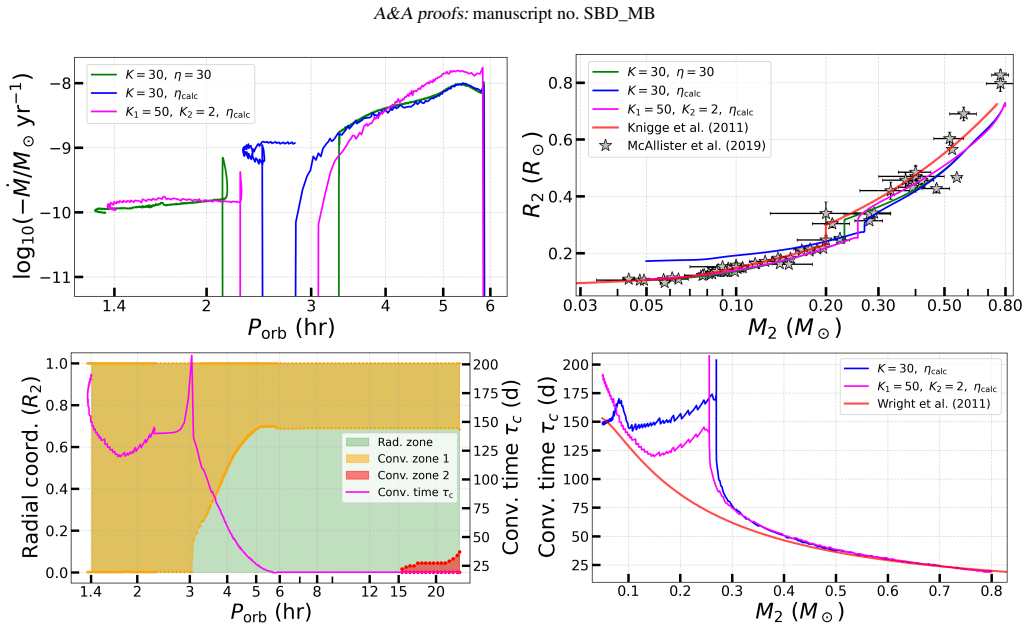
The structure-based convective turnover time calculation shows a pronounced spike as the donor approaches full convection, which drives the disruption parameter η and initiates the period gap in CVs. Plausible choices for accretion, irradiation, and wind efficiencies allow irradiation-driven winds to provide the boost K during accreting phases. The resulting iτSBD MB framework supplies a physically motivated account of the empirical factors in the SBD model.
Load-bearing premise
Uncertain efficiencies for accretion, irradiation, and winds can be chosen in a way that simultaneously reproduces the needed boost K while remaining consistent with the modeled donor structure.
Editorial extensions
If this is right
- Magnetic braking disruption at the fully convective boundary produces the observed period gap.
- Irradiation-driven winds account for the boosted braking rate while mass transfer is active.
- The iτSBD prescription yields evolutionary tracks consistent with main CV observables.
- The same τ_c spike may disrupt braking in other fast-rotating saturated stars.
Reading between the lines
- The irradiation-wind mechanism could operate in other strongly irradiated close binaries beyond CVs.
- Stellar models that track τ_c explicitly might predict activity changes at the convective boundary in single stars.
- Direct detection of enhanced winds or altered magnetic activity near the period gap would test the model.
Editorial analysis
A structured set of objections, weighed in public.
Referee Report
Summary. The paper proposes an iτSBD magnetic braking model for cataclysmic variables, in which MESA evolutionary calculations with structure-derived convective turnover time τ_c produce a pronounced spike near the fully convective boundary that sets the disruption parameter η and initiates the period gap; irradiation from the white dwarf is invoked to drive winds that supply the boost factor K during accretion, with the combined prescription yielding tracks broadly consistent with observed CV properties when plausible (but poorly constrained) values are chosen for accretion, irradiation, and wind efficiencies.
Significance. If the central results hold, the work supplies a physically motivated origin for the empirical boost K and disruption η parameters of the SBD framework, linking the τ_c spike directly to the fully convective transition and irradiation-driven mass loss to enhanced angular-momentum loss in accreting systems. The direct computation of τ_c from the stellar structure rather than empirical fits is a clear methodological strength.
major comments (2)
- [Abstract and §3] Abstract and §3 (model description): the statement that 'plausible parameter choices allow irradiation-driven winds to provide the required boost K' is load-bearing for the central claim, yet no quantitative scan, grid, or posterior over the joint space of accretion efficiency, irradiation efficiency, and wind efficiency is presented to demonstrate that any single vector simultaneously reproduces both the observed K values across the period gap and the location of the gap when τ_c is computed self-consistently from the MESA donor structure.
- [Abstract] The abstract notes that the outcome of irradiation is sensitive to the three efficiencies, all stated to be poorly constrained; because these same efficiencies enter both the wind mass-loss rate (hence K) and the heating that affects the outer layers (hence radius and τ_c), the absence of a consistency check between the two requirements constitutes a circularity risk for the validation of the physical mechanism.
minor comments (1)
- [Abstract] The acronym iτSBD is used without an explicit expansion on first appearance in the abstract, although the meaning is recoverable from context.
Simulated Author's Rebuttal
We thank the referee for their constructive and insightful report, which highlights both the strengths of our approach and areas where additional clarification would strengthen the manuscript. We address the major comments point by point below.
read point-by-point responses
-
Referee: [Abstract and §3] Abstract and §3 (model description): the statement that 'plausible parameter choices allow irradiation-driven winds to provide the required boost K' is load-bearing for the central claim, yet no quantitative scan, grid, or posterior over the joint space of accretion efficiency, irradiation efficiency, and wind efficiency is presented to demonstrate that any single vector simultaneously reproduces both the observed K values across the period gap and the location of the gap when τ_c is computed self-consistently from the MESA donor structure.
Authors: We agree that a systematic scan or grid over the joint efficiency space would provide stronger quantitative support for the claim that plausible choices simultaneously satisfy both the boost K and the gap location. The manuscript demonstrates the mechanism using representative values for the three efficiencies that are consistent with existing observational estimates in the literature, and shows that these choices produce evolutionary tracks matching key CV observables when τ_c is computed directly from the MESA structure. A full multi-dimensional exploration is computationally demanding for full evolutionary sequences and lies beyond the scope of the present study; however, we will add a dedicated subsection in §3 together with a table of the adopted parameter values, their literature justification, and a limited sensitivity test for a small number of nearby combinations to illustrate robustness. revision: partial
-
Referee: [Abstract] The abstract notes that the outcome of irradiation is sensitive to the three efficiencies, all stated to be poorly constrained; because these same efficiencies enter both the wind mass-loss rate (hence K) and the heating that affects the outer layers (hence radius and τ_c), the absence of a consistency check between the two requirements constitutes a circularity risk for the validation of the physical mechanism.
Authors: We acknowledge the referee's concern regarding potential circularity. The efficiencies do affect both the irradiation-driven wind mass-loss rate (which supplies K) and the outer-layer heating (which can influence radius and, indirectly, the computed τ_c). Nevertheless, our MESA calculations show that the pronounced spike in τ_c arises primarily from the interior structural transition at the fully convective boundary and remains present across the range of irradiation levels explored; the outer heating modifies the envelope but does not erase or relocate the spike. We will revise the abstract and the model-description section to explicitly separate these effects, state that the chosen parameters satisfy both requirements simultaneously in the presented models, and add a short consistency check confirming that the τ_c spike location is robust to moderate changes in irradiation efficiency. revision: yes
Circularity Check
Irradiation-driven wind boost K achieved via selection of poorly constrained efficiencies rather than independent prediction
-
fitted input called prediction
[Abstract]
"The outcome of irradiation is sensitive to the accretion, irradiation, and wind efficiencies, all of which are poorly constrained from observations. Despite these uncertainties, plausible parameter choices allow irradiation-driven winds to provide the required boost K during accreting phases."
The required boost K is supplied by selecting the very efficiencies the paper states are poorly constrained; the mechanism therefore reproduces the target observational quantity by construction of the parameter choice rather than predicting it from the donor structure or irradiation physics alone.
full rationale
The paper computes τ_c directly from MESA donor structure, yielding a spike at the fully convective boundary that sets η; this step is independent. However, the claimed boost mechanism relies on choosing accretion/irradiation/wind efficiencies (explicitly called poorly constrained) so that irradiation-driven winds reproduce the empirically required K. The abstract states that only 'plausible parameter choices' work and that the model is then 'broadly consistent' with CV properties. This reduces the boost claim to a fit of the same adjustable parameters introduced to explain the observed boost, constituting partial circularity of the fitted-input-called-prediction type. No quantitative scan or self-consistent posterior is described that simultaneously satisfies both K and the gap location without retuning.
Assumptions & free parameters
free parameters (3)
- accretion efficiency
- irradiation efficiency
- wind efficiency
assumptions (1)
- domain assumption MESA stellar structure calculations accurately reproduce the convective turnover time profile of the donor star near the fully convective boundary.
Cite this review
Pith. "Pith review of Mechanisms for magnetic braking boost and disruption: the role of irradiation-driven winds and convective turnover time spike in cataclysmic variables." pith.science (2026). https://pith.science/paper/7USJEWE5
@misc{pith2026260515897,
  author       = {Pith},
  title        = {Pith review of: Mechanisms for magnetic braking boost and disruption: the role of irradiation-driven winds and convective turnover time spike in cataclysmic variables},
  year         = {2026},
  howpublished = {\url{https://pith.science/paper/7USJEWE5}},
  note         = {Machine review of arXiv:2605.15897}
}
abstract
The saturated, boosted, and disrupted magnetic braking (SBD MB) model is an empirical prescription that has recently gained support from close-binary observations. Different boosting ($K$) and disruption ($\eta$) parameters appear necessary for different systems, but their physical origins remain uncertain. We aim to identify the mechanisms that boost magnetic braking (MB) and cause its disruption at the fully convective boundary in cataclysmic variables (CVs). We modelled CV evolution with MESA and compared the results with observed CV properties. We computed the convective turnover time ($\tau_c$) directly from the donor's structure rather than adopting empirical relations. We also included irradiation from the accreting white dwarf, which heats the donor's outer layers and can drive additional winds that enhance MB. The structure-based $\tau_c$ calculation reveals a pronounced spike as the donor approaches full convection, which drives the disruption parameter $\eta$ and initiates the period gap in CVs. The outcome of irradiation is sensitive to the accretion, irradiation, and wind efficiencies, all of which are poorly constrained from observations. Despite these uncertainties, plausible parameter choices allow irradiation-driven winds to provide the required boost $K$ during accreting phases. We refer to the combined prescription as the i$\tau$SBD MB model and find that it yields evolutionary tracks broadly consistent with the main CV properties. Our i$\tau$SBD MB framework offers a physically motivated interpretation of the empirical boost and disruption factors in SBD MB for CV evolution. We suggest that the convective turnover time spike at the fully convective boundary may drive MB disruption for fast-rotating stars in the saturated regime, while irradiation-driven winds may be the dominant mechanism boosting MB in accreting binaries and other strongly irradiated close systems.
Figures


Figures from the paper (7 more)


Forward citations
Cited by 2 Pith papers
-
A survey of ultra-compact high-state AM CVn binaries with ZTF and Gaia: New discoveries and observational constraints on Galactic space density
Three new high-state AM CVn binaries are discovered, giving a local space density of about 1 to 3 per 10^8 cubic parsecs and LISA detection estimates near 36% of the Galactic population.
-
Cataclysmic Variables Photometric Periods from TESS
TESS photometry yields coherent periods for 1,362 CVs, including roughly 465–565 first determinations, and confirms the 2–3 h period gap with a median period near 3.68 h.
Reference graph
Works this paper leans on
- [1]
- [2]
- [3]
-
[4]
Barnes, S. A. 2003, ApJ, 586, 464
work page 2003
-
[5]
Barnes, S. A. 2007, ApJ, 669, 1167
work page 2007
-
[6]
Barraza-Jorquera, J. A., Schreiber, M. R., & Belloni, D. 2025, A&A, 696, A92
work page 2025
-
[7]
Barraza-Jorquera, J. A., Schreiber, M. R., Littlefair, S., Belloni, D., & Schwope, A. D. 2026, A&A, 708, L11
work page 2026
-
[8]
M., Hatchett, S., McCray, R., & Sunyaev, R
Basko, M. M., Hatchett, S., McCray, R., & Sunyaev, R. A. 1977, ApJ, 215, 276
work page 1977
Show all 124 references
-
[9]
Basko, M. M. & Sunyaev, R. A. 1973, Ap&SS, 23, 117
1973
-
[10]
M., Sunyaev, R
Basko, M. M., Sunyaev, R. A., & Titarchuk, L. G. 1974, A&A, 31, 249
1974
-
[11]
& Schreiber, M
Belloni, D. & Schreiber, M. R. 2023, in Handbook of X-ray and Gamma-ray Astrophysics, 129
2023
-
[12]
R., Moe, M., El-Badry, K., & Shen, K
Belloni, D., Schreiber, M. R., Moe, M., El-Badry, K., & Shen, K. J. 2024, A&A, 682, A33
2024
-
[13]
R., Pala, A
Belloni, D., Schreiber, M. R., Pala, A. F., et al. 2020, MNRAS, 491, 5717
2020
-
[14]
R., Zorotovic, M., et al
Belloni, D., Schreiber, M. R., Zorotovic, M., et al. 2018, MNRAS, 478, 5626
2018
-
[15]
2024, PASP, 136, 124201
Blomberg, L., El-Badry, K., Breivik, K., et al. 2024, PASP, 136, 124201
2024
-
[16]
& Subramanian, K
Brandenburg, A. & Subramanian, K. 2005, Phys. Rep., 417, 1 Büning, A. & Ritter, H. 2004, A&A, 423, 281
2005
-
[17]
Canuto, V . M. 2000, ApJ, 534, L113
2000
-
[18]
Chaboyer, B., Demarque, P., & Pinsonneault, M. H. 1995, ApJ, 441, 865
1995
-
[19]
& Baraffe, I
Chabrier, G. & Baraffe, I. 1997, A&A, 327, 1039
1997
-
[20]
& Podsiadlowski, P
Chen, W.-C. & Podsiadlowski, P. 2016, ApJ, 830, 131
2016
-
[21]
L., Heintz, T
Chiti, F., van Saders, J. L., Heintz, T. M., et al. 2024, ApJ, 977, 15
2024
-
[22]
2023, MNRAS, 525, 2708
Conrad-Burton, J., Shabi, A., & Ginzburg, S. 2023, MNRAS, 525, 2708
2023
-
[23]
L., Körding, E
Coppejans, D. L., Körding, E. G., Miller-Jones, J. C. A., et al. 2015, MNRAS, 451, 3801 de Jager, C., Nieuwenhuijzen, H., & van der Hucht, K. A. 1988, A&AS, 72, 259
2015
-
[24]
1998, A&A, 331, 581
Delfosse, X., Forveille, T., Perrier, C., & Mayor, M. 1998, A&A, 331, 581
1998
-
[25]
2021, ApJ, 909, 174
Deng, Z.-L., Li, X.-D., Gao, Z.-F., & Shao, Y . 2021, ApJ, 909, 174
2021
-
[26]
2018, A&A, 617, A26
Dubus, G., Otulakowska-Hypka, M., & Lasota, J.-P. 2018, A&A, 617, A26
2018
-
[27]
Eggleton, P. P. 1983, ApJ, 268, 368
1983
-
[28]
2022, MNRAS, 517, 4916
El-Badry, K., Conroy, C., Fuller, J., et al. 2022, MNRAS, 517, 4916
2022
-
[29]
& Prša, A
Fabry, M. & Prša, A. 2025, ApJ, 995, 19
2025
-
[30]
& Opher, R
Felsteiner, J. & Opher, R. 1976, A&A, 46, 189
1976
-
[31]
2014, A&A, 569, A63
Gabriel, M., Noels, A., Montalbán, J., & Miglio, A. 2014, A&A, 569, A63
2014
-
[32]
C., El-Badry, K., et al
Galiullin, I., Rodriguez, A. C., El-Badry, K., et al. 2024, A&A, 690, A374 Gänsicke, B. T., Dillon, M., Southworth, J., et al. 2009, MNRAS, 397, 2170
2024
-
[33]
J., & Cohen, O
Garraffo, C., Drake, J. J., & Cohen, O. 2016, A&A, 595, A110
2016
-
[34]
J., Dotter, A., et al
Garraffo, C., Drake, J. J., Dotter, A., et al. 2018, ApJ, 862, 90
2018
-
[35]
Gilliland, R. L. 1985, ApJ, 299, 286
1985
-
[36]
& Selvelli, P
Gilmozzi, R. & Selvelli, P. 2024, A&A, 681, A83
2024
-
[37]
& Quataert, E
Ginzburg, S. & Quataert, E. 2020, MNRAS, 495, 3656
2020
-
[38]
& Quataert, E
Ginzburg, S. & Quataert, E. 2021, MNRAS, 500, 1592
2021
-
[39]
2023, ApJ, 950, 27
Gossage, S., Kalogera, V ., & Sun, M. 2023, ApJ, 950, 27
2023
-
[40]
2025, ApJ, 988, 102
Gossage, S., Kiman, R., Monsch, K., et al. 2025, ApJ, 988, 102
2025
-
[41]
K., de Gouveia Dal Pino, E
Guerrero, G., Smolarkiewicz, P. K., de Gouveia Dal Pino, E. M., Kosovichev, A. G., & Mansour, N. N. 2016, ApJ, 819, 104
2016
-
[42]
M., Pretorius, M
Hewitt, D. M., Pretorius, M. L., Woudt, P. A., et al. 2020, MNRAS, 496, 2542 Article number, page 14 Vladislav Dodon et al.: Physical SBD magnetic braking in CVs
2020
-
[43]
B., Nelson, L
Howell, S. B., Nelson, L. A., & Rappaport, S. 2001, ApJ, 550, 897
2001
-
[44]
V ., & Fedorova, A
Iben, Jr., I., Tutukov, A. V ., & Fedorova, A. V . 1997, ApJ, 486, 955
1997
-
[45]
T., Breedt, E., et al
Inight, K., Gänsicke, B. T., Breedt, E., et al. 2023, MNRAS, 524, 4867
2023
-
[46]
K., Burke, C
Irwin, J., Berta, Z. K., Burke, C. J., et al. 2011, ApJ, 727, 56
2011
-
[47]
S., Bauer, E
Jermyn, A. S., Bauer, E. B., Schwab, J., et al. 2023, ApJS, 265, 15
2023
-
[48]
& Chaboyer, B
Joyce, M. & Chaboyer, B. 2018, ApJ, 856, 10
2018
-
[49]
2006, MNRAS, 366, 1415 Käpylä, P
Justham, S., Rappaport, S., & Podsiadlowski, P. 2006, MNRAS, 366, 1415 Käpylä, P. J., Browning, M. K., Brun, A. S., Guerrero, G., & Warnecke, J. 2023, Space Sci. Rev., 219, 58
2006
-
[50]
Kawaler, S. D. 1988, ApJ, 333, 236
1988
-
[51]
& Lasota, J.-P
King, A. & Lasota, J.-P. 2021, arXiv e-prints, arXiv:2112.03779
2021
-
[52]
& Lasota, J.-P
King, A. & Lasota, J.-P. 2024, arXiv e-prints, arXiv:2406.03948
2024
-
[53]
R., Frank, J., Kolb, U., & Ritter, H
King, A. R., Frank, J., Kolb, U., & Ritter, H. 1996, ApJ, 467, 761
1996
-
[54]
King, A. R. & Kolb, U. 1995, ApJ, 439, 330
1995
-
[55]
2006, MNRAS, 373, 484
Knigge, C. 2006, MNRAS, 373, 484
2006
-
[56]
2011, ApJS, 194, 28
Knigge, C., Baraffe, I., & Patterson, J. 2011, ApJS, 194, 28
2011
-
[57]
& Baraffe, I
Kolb, U. & Baraffe, I. 1999, MNRAS, 309, 1034
1999
-
[58]
Landau, L. D. & Lifshitz, E. M. 1975, The classical theory of fields
1975
-
[59]
1947, ApJ, 105, 305
Ledoux, P. 1947, ApJ, 105, 305
1947
-
[60]
K., Wu, K
Li, J. K., Wu, K. W., & Wickramasinghe, D. T. 1994, MNRAS, 268, 61
1994
-
[61]
London, R., McCray, R., & Auer, L. H. 1981, ApJ, 243, 970
1981
-
[62]
L., See, V ., Amard, L., Angus, R., & Matt, S
Lu, Y . L., See, V ., Amard, L., Angus, R., & Matt, S. P. 2024, Nature Astronomy, 8, 223
2024
-
[63]
R., et al
Magaudda, E., Stelzer, B., Covey, K. R., et al. 2020, A&A, 638, A20
2020
-
[64]
J., Kashyap, V ., & Steeghs, D
Matranga, M., Drake, J. J., Kashyap, V ., & Steeghs, D. 2012, ApJ, 747, 132
2012
-
[65]
P., Brun, A
Matt, S. P., Brun, A. S., Baraffe, I., Bouvier, J., & Chabrier, G. 2015, ApJ, 799, L23
2015
-
[66]
P., MacGregor, K
Matt, S. P., MacGregor, K. B., Pinsonneault, M. H., & Greene, T. P. 2012, ApJ, 754, L26
2012
-
[67]
P., Parsons, S
McAllister, M., Littlefair, S. P., Parsons, S. G., et al. 2019, MNRAS, 486, 5535
2019
-
[68]
1968, MNRAS, 138, 359
Mestel, L. 1968, MNRAS, 138, 359
1968
-
[69]
2017, PASP, 129, 062001
Mukai, K. 2017, PASP, 129, 062001
2017
-
[70]
1972, ApJ, 175, 417 Nebot Gómez-Morán, A., Gänsicke, B
Nauenberg, M. 1972, ApJ, 175, 417 Nebot Gómez-Morán, A., Gänsicke, B. T., Schreiber, M. R., et al. 2011, A&A, 536, A43
1972
-
[71]
R., Irwin, J., Charbonneau, D., et al
Newton, E. R., Irwin, J., Charbonneau, D., et al. 2016, ApJ, 821, 93
2016
-
[72]
W., Hartmann, L
Noyes, R. W., Hartmann, L. W., Baliunas, S. L., Duncan, D. K., & Vaughan, A. H. 1984, ApJ, 279, 763 Paczy´nski, B. 1967, Acta Astron., 17, 287
1984
-
[73]
F., Gänsicke, B
Pala, A. F., Gänsicke, B. T., Belloni, D., et al. 2022, MNRAS, 510, 6110
2022
-
[74]
Parker, E. N. 1955, ApJ, 122, 293
1955
-
[75]
Parker, E. N. 1975, ApJ, 198, 205
1975
-
[76]
1984, ApJS, 54, 443
Patterson, J. 1984, ApJS, 54, 443
1984
-
[77]
& Raymond, J
Patterson, J. & Raymond, J. C. 1985, ApJ, 292, 535
1985
-
[78]
2011, ApJS, 192, 3
Paxton, B., Bildsten, L., Dotter, A., et al. 2011, ApJS, 192, 3
2011
-
[79]
2013, ApJS, 208, 4
Paxton, B., Cantiello, M., Arras, P., et al. 2013, ApJS, 208, 4
2013
-
[80]
2015, ApJS, 220, 15
Paxton, B., Marchant, P., Schwab, J., et al. 2015, ApJS, 220, 15
2015
-
[81]
B., et al
Paxton, B., Schwab, J., Bauer, E. B., et al. 2018, ApJS, 234, 34
2018
-
[82]
2019, ApJS, 243, 10
Paxton, B., Smolec, R., Schwab, J., et al. 2019, ApJS, 243, 10
2019
-
[83]
2003, A&A, 397, 147
Pizzolato, N., Maggio, A., Micela, G., Sciortino, S., & Ventura, P. 2003, A&A, 397, 147
2003
-
[84]
Podsiadlowski, P., Rappaport, S., & Pfahl, E. D. 2002, ApJ, 565, 1107
2002
-
[85]
E., Diaz, M
Puebla, R. E., Diaz, M. P., & Hubeny, I. 2007, AJ, 134, 1923
2007
-
[86]
& Nelson, L
Quintin, J. & Nelson, L. 2013, in American Astronomical Society Meeting Ab- stracts, V ol. 221, American Astronomical Society Meeting Abstracts #221, 202.05
2013
-
[87]
Rappaport, S., Verbunt, F., & Joss, P. C. 1983, ApJ, 275, 713
1983
-
[88]
1975, Memoires of the Societe Royale des Sciences de Liege, 8, 369
Reimers, D. 1975, Memoires of the Societe Royale des Sciences de Liege, 8, 369
1975
-
[89]
& Basri, G
Reiners, A. & Basri, G. 2008, ApJ, 684, 1390
2008
-
[90]
2009, ApJ, 692, 538 Réville, V ., Brun, A
Reiners, A., Basri, G., & Browning, M. 2009, ApJ, 692, 538 Réville, V ., Brun, A. S., Matt, S. P., Strugarek, A., & Pinto, R. F. 2015, ApJ, 798, 116
2009
-
[91]
2000, A&A, 360, 959
Ritter, H., Zhang, Z.-Y ., & Kolb, U. 2000, A&A, 360, 959
2000
-
[92]
C., El-Badry, K., Suleimanov, V ., et al
Rodriguez, A. C., El-Badry, K., Suleimanov, V ., et al. 2025, PASP, 137, 014201 Rodríguez-Gil, P., Gänsicke, B. T., Hagen, H.-J., et al. 2007a, MNRAS, 377, 1747 Rodríguez-Gil, P., Schmidtobreick, L., & Gänsicke, B. T. 2007b, MNRAS, 374, 1359
2025
-
[93]
1989, ApJ, 343, 292
Ruderman, M., Shaham, J., Tavani, M., & Eichler, D. 1989, ApJ, 343, 292
1989
-
[94]
& Tout, C
Sarkar, A. & Tout, C. A. 2022, MNRAS, 513, 4169
2022
-
[95]
Schaefer, B. E. 2024, ApJ, 966, 155
2024
-
[96]
1962, Annales d’Astrophysique, 25, 18
Schatzman, E. 1962, Annales d’Astrophysique, 25, 18
1962
-
[97]
Schreiber, M. R. & Belloni, D. 2025, A&A, 698, L22
2025
-
[98]
R., Belloni, D., Gänsicke, B
Schreiber, M. R., Belloni, D., Gänsicke, B. T., Parsons, S. G., & Zorotovic, M. 2021, Nature Astronomy, 5, 648
2021
-
[99]
R., Belloni, D., & Schwope, A
Schreiber, M. R., Belloni, D., & Schwope, A. D. 2024, A&A, 682, L7
2024
-
[100]
Schreiber, M. R. & Gänsicke, B. T. 2003, A&A, 406, 305
2003
-
[101]
R., Gänsicke, B
Schreiber, M. R., Gänsicke, B. T., Rebassa-Mansergas, A., et al. 2010, A&A, 513, L7
2010
-
[102]
R., Zorotovic, M., & Wijnen, T
Schreiber, M. R., Zorotovic, M., & Wijnen, T. P. G. 2016, MNRAS, 455, L16 Schröder, K.-P. & Cuntz, M. 2005, ApJ, 630, L73
2016
-
[103]
H., & Terndrup, D
Sills, A., Pinsonneault, M. H., & Terndrup, D. M. 2000, ApJ, 534, 335
2000
-
[104]
1972, ApJ, 171, 565
Skumanich, A. 1972, ApJ, 171, 565
1972
-
[105]
Spiegel, E. A. & Zahn, J.-P. 1992, A&A, 265, 106
1992
-
[106]
Spruit, H. C. & Ritter, H. 1983, A&A, 124, 267
1983
-
[107]
2024, ApJ, 977, 34
Tang, W.-S., Li, X.-D., & Cui, Z. 2024, ApJ, 977, 34
2024
-
[108]
Tauris, T. M. & Savonije, G. J. 1999, A&A, 350, 928
1999
-
[109]
& London, R
Tavani, M. & London, R. 1993, ApJ, 410, 281
1993
-
[110]
Van, K. X. & Ivanova, N. 2019, ApJ, 886, L31
2019
-
[111]
X., Ivanova, N., & Heinke, C
Van, K. X., Ivanova, N., & Heinke, C. O. 2019, MNRAS, 483, 5595 van Teeseling, A. & King, A. R. 1998, A&A, 338, 957
2019
-
[112]
& Zwaan, C
Verbunt, F. & Zwaan, C. 1981, A&A, 100, L7
1981
-
[113]
S., & Izzard, R
Walters, N., Farihi, J., Dufour, P., Pineda, J. S., & Izzard, R. G. 2023, MNRAS, 524, 5096
2023
-
[114]
2003, Cataclysmic Variable Stars
Warner, B. 2003, Cataclysmic Variable Stars
2003
-
[115]
Webbink, R. F. & Wickramasinghe, D. T. 2005, in Astronomical Society of the Pacific Conference Series, V ol. 330, The Astrophysics of Cataclysmic Vari- ables and Related Objects, ed. J. M. Hameury & J. P. Lasota, 137
2005
-
[116]
Weber, E. J. & Davis, Jr., L. 1967, ApJ, 148, 217
1967
-
[117]
E., Müller, H.-R., Redfield, S., et al
Wood, B. E., Müller, H.-R., Redfield, S., et al. 2021, ApJ, 915, 37
2021
-
[118]
J., Drake, J
Wright, N. J., Drake, J. J., Mamajek, E. E., & Henry, G. W. 2011, ApJ, 743, 48
2011
-
[119]
J., Newton, E
Wright, N. J., Newton, E. R., Williams, P. K. G., Drake, J. J., & Yadav, R. K. 2018, MNRAS, 479, 2351
2018
-
[120]
& Li, X.-D
Xing, Z.-P. & Li, X.-D. 2019, ApJ, 887, 201
2019
-
[121]
M., & Kovetz, A
Yaron, O., Prialnik, D., Shara, M. M., & Kovetz, A. 2005, ApJ, 623, 398
2005
-
[122]
2026, ApJ, 997, 162
Zhao, W., Meng, X., Cui, Y ., & Guo, Y . 2026, ApJ, 997, 162
2026
-
[123]
2026, A&A, 707, A76
Zhou, B., Zhu, C., Lü, G., et al. 2026, A&A, 707, A76
2026
-
[124]
& Schreiber, M
Zorotovic, M. & Schreiber, M. R. 2020, Advances in Space Research, 66, 1080
2020
Reviewed May 19, 2026 · model on record in the stance chip above.
Discussion (0). Continue with ORCID to comment.