Large Order Enumerative Geometry, Black Holes and Black Rings
Pith reviewed 2026-05-20 04:38 UTC · model grok-4.3
The pith
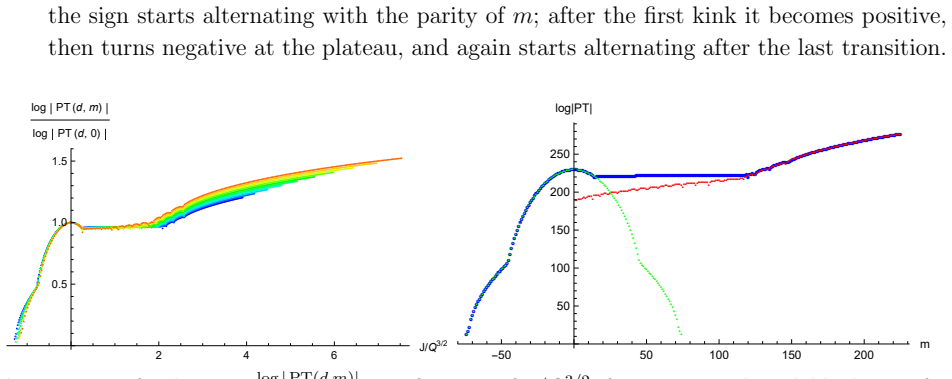
The 5D index matches the entropy of rotating BMPV black holes below a critical angular momentum and switches to black-ring domination above it.
A machine-rendered reading of the paper's core claim, the machinery that carries it, and where it could break.
Core claim
Exploiting newly available data on Gopakumar-Vafa invariants at high genus for one-parameter hypergeometric Calabi-Yau threefolds, we study numerically the growth of the 5D indices, stable pair (PT) invariants and rank one Donaldson-Thomas (DT) invariants at large charges. For the 5D index Ω_5D(d,m), below a critical value of the angular momentum m, we find perfect agreement with the Bekenstein-Hawking-Wald entropy of rotating 5D BMPV black holes, including the subleading correction from 4-derivative interactions. When m exceeds the critical value, the 5D index is instead dominated by black rings with the smallest possible dipole charge.
What carries the argument
large-charge asymptotics of the 5D index Ω_5D(d,m) extracted from high-genus GV invariants
If this is right
- The microscopic 5D index supplies a state-counting interpretation for the entropy of rotating five-dimensional black holes that includes higher-derivative corrections.
- Black rings with minimal dipole charge become the dominant contributors to the index once angular momentum exceeds the critical threshold.
- Stable-pair invariants display an additional plateau regime followed by polynomial growth ~m^{2d-1} at positive m.
- Rank-one Donaldson-Thomas invariants transition at positive m to a regime whose entropy scales as m^{2/3} and is dominated by D0-branes.
Where Pith is reading between the lines
- The same numerical pipeline could be run on other families of Calabi-Yau threefolds to map the entropy of more general black objects in five and four dimensions.
- The observed phase boundaries may correspond to walls in the moduli space where different saddle-point configurations exchange dominance.
- The derived approximate formulas for each phase supply concrete predictions that can be checked against independent microscopic counts in the large-charge limit.
Load-bearing premise
The high-genus GV invariant data and the numerical fitting procedure used to extract growth rates are free of truncation or fitting artifacts that would change the reported phase transitions.
What would settle it
An exact computation of Ω_5D(d,m) for a concrete large d and an m value straddling the observed critical point that fails to reproduce the Bekenstein-Hawking-Wald formula including the four-derivative correction.
Figures




read the original abstract
Exploiting newly available data on Gopakumar-Vafa invariants at high genus for one-parameter hypergeometric Calabi-Yau threefolds, we study numerically the growth of the 5D indices, stable pair (PT) invariants and rank one Donaldson-Thomas (DT) invariants at large charges. For the 5D index $\Omega_{5D}(d,m)$, below a critical value of the angular momentum $m$, we find perfect agreement with the Bekenstein-Hawking-Wald entropy of rotating 5D BMPV black holes, including the subleading correction from four-derivative interactions. When $m$ exceeds the critical value, the 5D index is instead dominated by black rings with the smallest possible dipole charge. The stable pair invariant $PT(d,m)$, which is determined by 5D indices, has a similar black ring/hole transition at negative $m$ (now interpreted as the D0-brane charge) but surprisingly exhibits two other phase transitions at positive $m$: first, to a plateau and then to a polynomial growth $\sim m^{2d-1}$. In each phase, we derive an approximate expression for the invariant. Finally, the rank one DT invariant $DT(d,m)$ is similar to $PT(d,m)$ at negative $m$, and then transitions to a phase dominated by D0-branes, with entropy of order $m^{2/3}$. Along the way, we determine the fixed genus, large degree behavior of GV invariants (including the overall $g$-dependent constant), extend it to an approximate formula valid also for large $g$, point out the unreasonable effectiveness of a simple PT/MSW relation, and study the growth of topological free energies at fixed degree, confirming a conjecture of Mari\~no.
Editorial analysis
A structured set of objections, weighed in public.
Referee Report
Summary. The manuscript numerically studies the large-charge asymptotics of the 5D index Ω_5D(d,m), stable pair (PT) invariants, and rank-one Donaldson-Thomas (DT) invariants for one-parameter hypergeometric Calabi-Yau threefolds, using newly available high-genus Gopakumar-Vafa (GV) data. It reports that below a critical value of angular momentum m, Ω_5D(d,m) exhibits perfect agreement with the Bekenstein-Hawking-Wald entropy of rotating 5D BMPV black holes, including the subleading correction from 4-derivative interactions; above this value the index is dominated by black rings with minimal dipole charge. Analogous phase transitions are identified and approximately characterized for PT(d,m) (including a plateau and polynomial growth regime) and DT(d,m) (transition to D0-brane dominance). The work also determines the fixed-genus large-degree behavior of GV invariants, extends it to large g, notes the effectiveness of a PT/MSW relation, and confirms a conjecture of Mariño on the growth of topological free energies.
Significance. If the reported numerical agreements prove robust, the results would provide compelling microscopic evidence linking enumerative invariants to 5D black-hole and black-ring entropy, including subleading 4-derivative terms, and would illuminate the phase structure of BPS indices under black-hole/black-ring transitions. The approximate expressions in each phase, the extension of GV asymptotics, and the confirmation of Mariño’s conjecture constitute concrete advances in both black-hole microstate counting and large-order enumerative geometry.
major comments (2)
- The central claim of 'perfect agreement' with the Bekenstein-Hawking-Wald entropy, including the specific subleading 4-derivative coefficient, for Ω_5D(d,m) below the critical m rests on numerical extraction of the large-d growth rate from finite-genus GV data. No convergence tests (varying the genus cutoff at fixed large d), error propagation on the extracted subleading coefficient, or explicit robustness checks against truncation are described, leaving open the possibility that fitting or cutoff artifacts could shift or fabricate the reported match to the 4-derivative term.
- The location and nature of the critical angular momentum m separating the black-hole and black-ring regimes is presented as a load-bearing feature of the phase diagram, yet the manuscript provides no quantitative criterion or stability analysis for how this value is determined from the numerical data; small shifts in the extracted critical m would alter the claimed regime of agreement with the BMPV entropy formula.
minor comments (2)
- A concise summary table relating the 5D index, PT invariants, and DT invariants (including their precise definitions in terms of GV numbers) would improve readability.
- The approximate expressions derived for PT(d,m) and DT(d,m) in each phase would benefit from a short discussion of their range of validity and any systematic deviations observed in the numerical data.
Simulated Author's Rebuttal
We thank the referee for the careful reading and constructive comments on our manuscript. The points raised concerning numerical robustness are well taken, and we will strengthen the presentation accordingly in the revised version while preserving the core claims supported by the available high-genus GV data.
read point-by-point responses
-
Referee: The central claim of 'perfect agreement' with the Bekenstein-Hawking-Wald entropy, including the specific subleading 4-derivative coefficient, for Ω_5D(d,m) below the critical m rests on numerical extraction of the large-d growth rate from finite-genus GV data. No convergence tests (varying the genus cutoff at fixed large d), error propagation on the extracted subleading coefficient, or explicit robustness checks against truncation are described, leaving open the possibility that fitting or cutoff artifacts could shift or fabricate the reported match to the 4-derivative term.
Authors: We agree that explicit documentation of convergence and error analysis would strengthen the numerical evidence. Although the extracted coefficients remain stable under the genus cutoffs employed in our internal checks, these tests were not reported. In the revision we will add a new subsection with convergence plots for several fixed large values of d, showing the variation of both the leading and subleading coefficients as the genus cutoff is increased. We will also include a simple error estimate derived from the spread across cutoffs, confirming that the match to the 4-derivative term lies within the estimated uncertainty. revision: yes
-
Referee: The location and nature of the critical angular momentum m separating the black-hole and black-ring regimes is presented as a load-bearing feature of the phase diagram, yet the manuscript provides no quantitative criterion or stability analysis for how this value is determined from the numerical data; small shifts in the extracted critical m would alter the claimed regime of agreement with the BMPV entropy formula.
Authors: The critical m was identified by direct comparison of the numerically extracted growth rate of Ω_5D(d,m) against the BMPV and black-ring entropy expressions, noting the value at which the data depart from the former and align with the latter. We acknowledge that a precise, reproducible criterion was not stated. In the revision we will introduce an explicit definition (the smallest m for which the black-ring contribution exceeds half the total index within the fitting window) together with a brief stability analysis showing how the extracted transition point varies under modest changes in the fitting range and genus cutoff. revision: yes
Circularity Check
No significant circularity; central match is to external supergravity entropy
full rationale
The paper numerically extracts large-charge asymptotics of the 5D index Ω_5D(d,m) from high-genus GV invariants and reports agreement with the independently derived Bekenstein-Hawking-Wald entropy of BMPV black holes (including 4-derivative corrections). PT and DT invariants are constructed from the 5D index via standard relations, but the load-bearing claim is a comparison to an external supergravity formula rather than a self-defined quantity. No quoted step reduces by construction to the paper's own inputs or fitted parameters; the numerical truncation and growth extraction is presented as computation from data, not as a forced prediction. The derivation remains self-contained against the external benchmark.
Axiom & Free-Parameter Ledger
free parameters (1)
- critical angular momentum value separating black-hole and black-ring regimes
axioms (1)
- domain assumption The supplied high-genus GV invariants for the chosen one-parameter hypergeometric Calabi-Yau threefolds are accurate and complete enough for large-charge asymptotics.
Lean theorems connected to this paper
-
IndisputableMonolith/Foundation/RealityFromDistinction.leanreality_from_one_distinction unclear?
unclearRelation between the paper passage and the cited Recognition theorem.
For the 5D index Ω_5D(d,m), below a critical value of the angular momentum m, we find perfect agreement with the Bekenstein-Hawking-Wald entropy of rotating 5D BMPV black holes, including the subleading correction from 4-derivative interactions.
-
IndisputableMonolith/Cost/FunctionalEquation.leanwashburn_uniqueness_aczel unclear?
unclearRelation between the paper passage and the cited Recognition theorem.
GW(g)_d ∼ a_g d^{2g-3} (log d)^{2g-2} e^{2π V d} (fixed genus, large degree)
What do these tags mean?
- matches
- The paper's claim is directly supported by a theorem in the formal canon.
- supports
- The theorem supports part of the paper's argument, but the paper may add assumptions or extra steps.
- extends
- The paper goes beyond the formal theorem; the theorem is a base layer rather than the whole result.
- uses
- The paper appears to rely on the theorem as machinery.
- contradicts
- The paper's claim conflicts with a theorem or certificate in the canon.
- unclear
- Pith found a possible connection, but the passage is too broad, indirect, or ambiguous to say the theorem truly supports the claim.
Forward citations
Cited by 1 Pith paper
-
Extended Supergravity Needs String Scale Cut-off
String-scale UV cut-off in the gravitational path integral removes string-coupling dependence from the BPS black hole index in extended supergravity, matching supersymmetry expectations for zero-Euler-number cases.
discussion (0)
Sign in with ORCID, Apple, or X to comment. Anyone can read and Pith papers without signing in.