Geometric curvature driven by many-body collective fluctuations
Pith reviewed 2026-05-20 02:12 UTC · model grok-4.3
The pith
Many-body collective fluctuations add a dynamical contribution to Berry curvature that separates from single-particle band geometry in antisymmetric inelastic scattering channels.
A machine-rendered reading of the paper's core claim, the machinery that carries it, and where it could break.
Core claim
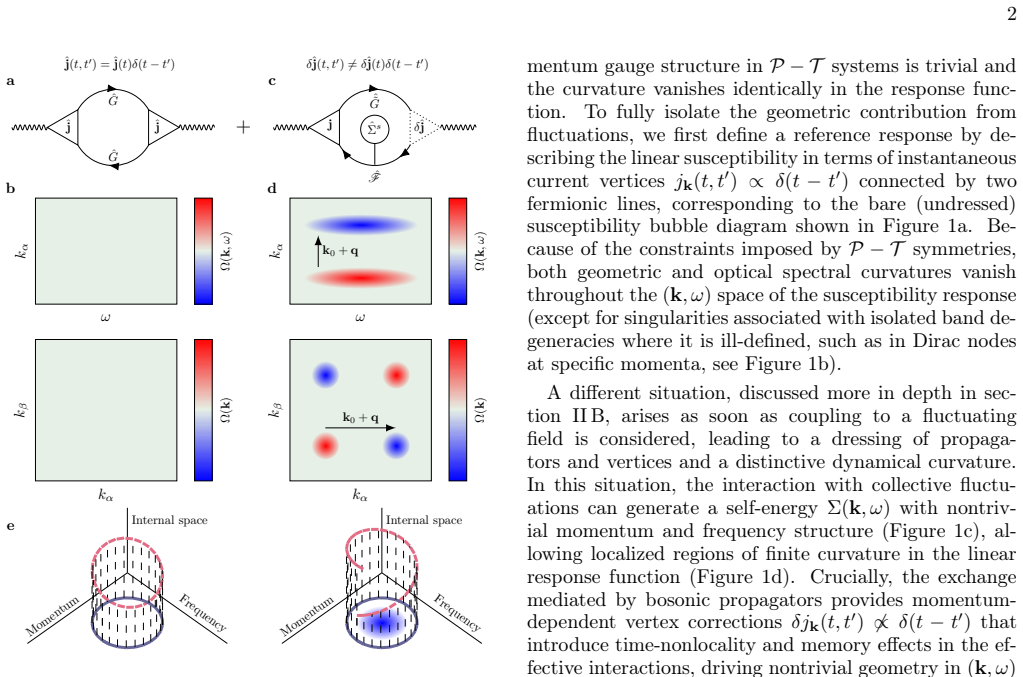
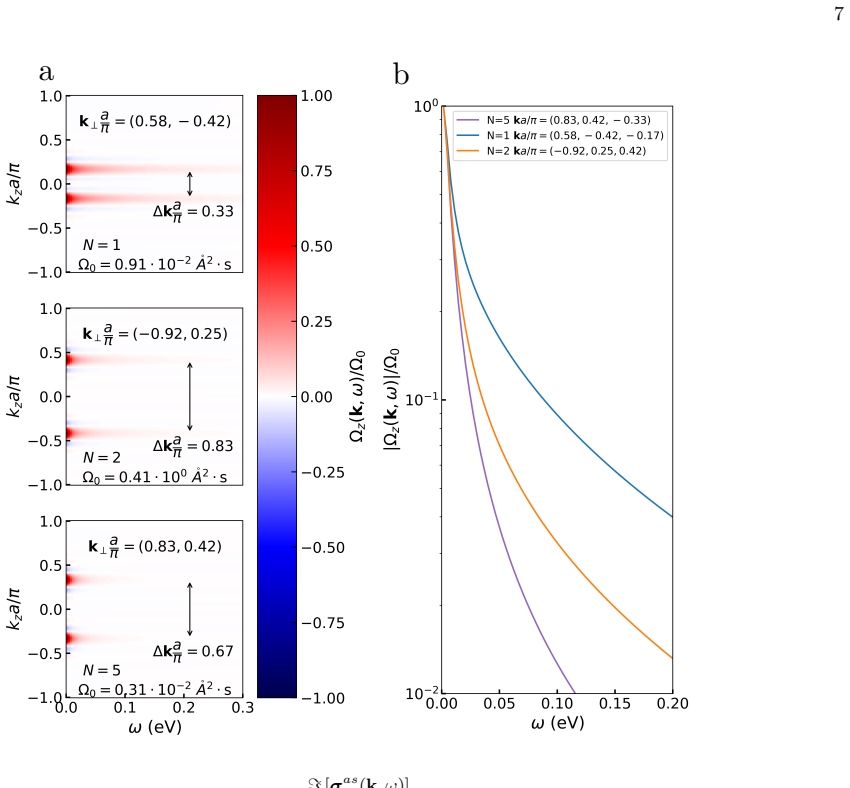
Focusing on the Berry curvature, contributions from collective fluctuations can be experimentally distinguished from bare band-geometric contributions via specific antisymmetric channels in inelastic scattering spectra. The non-commutative properties of transverse quantum fluctuations as well as non-local-time interactions are identified as the generators of this dynamical curvature in the susceptibility response.
What carries the argument
Dynamical dressing of propagators and response vertices by collective modes, which introduces non-commutative transverse fluctuations and non-local-time interactions that generate the dynamical curvature.
If this is right
- Berry curvature in interacting systems includes a many-body term separable from the single-particle band contribution.
- Antisymmetric channels in inelastic scattering spectra give experimental access to the fluctuation-driven component.
- Non-local-time interactions participate directly in producing the dynamical curvature.
- The quantum-dipole-fluctuation interpretation of geometry extends to dressed many-body responses.
Where Pith is reading between the lines
- The distinction could be used to isolate interaction effects on geometry in transport measurements of correlated systems.
- Similar channel-separation logic might apply to other geometric quantities such as the quantum metric.
- Tests in specific materials with tunable collective modes would check whether the separability holds under realistic conditions.
Load-bearing premise
The dynamical dressing produces a curvature contribution that remains separable into antisymmetric channels without being overwhelmed by other many-body effects.
What would settle it
Inelastic scattering spectra in a system with known collective modes that show no distinct antisymmetric channel matching the predicted dynamical curvature while the bare geometric term remains visible.
Figures




read the original abstract
Quantum geometry characterizes the variation of wavefunctions in momentum space through their overlaps and relative phases, providing a general framework for understanding many transport and optical properties. It is generally formulated in terms of interband matrix elements, which, entering the response functions, allow obtaining experimental access to the quantum geometric tensor. Recently, it has been emphasized that quantum geometry can also be interpreted in terms of quantum dipole fluctuations in the ground state driven by interband mixing. Here, we extend this picture to include contributions from many-body collective fluctuations, in which propagators and response vertices are dressed dynamically by the interaction with collective modes. Focusing on the Berry curvature, we show that contributions from collective fluctuations can be experimentally distinguished from bare band-geometric contributions, via specific antisymmetric channels in inelastic scattering spectra. We further identify the non-commutative properties of transverse quantum fluctuations as well as non-local-time interactions as the generators of this dynamical curvature in the susceptibility response.
Editorial analysis
A structured set of objections, weighed in public.
Referee Report
Summary. The manuscript extends the quantum-geometry framework from interband matrix elements and ground-state dipole fluctuations to include dynamical dressing of propagators and response vertices by many-body collective modes. It claims that the resulting contribution to Berry curvature appears in specific antisymmetric channels of the inelastic scattering susceptibility, generated by the non-commutativity of transverse quantum fluctuations and non-local-time interactions, thereby allowing experimental separation from bare band-geometric terms.
Significance. If the separation into antisymmetric channels is rigorously established, the work would supply a concrete route to isolate collective-fluctuation contributions to quantum geometry in scattering experiments, with potential implications for interpreting response functions in correlated and topological materials.
major comments (1)
- Abstract and §3: The central claim that dynamical dressing produces a curvature term confined to specific antisymmetric inelastic channels assumes that vertex corrections and mode-induced self-energies do not mix symmetric and antisymmetric components. No exact identity or controlled expansion isolating the fluctuation piece (independent of coupling strength or model details) is shown; generic many-body response theory indicates such mixing occurs, so the experimental distinguishability rests on an unverified assumption.
minor comments (1)
- Notation throughout: Define the dressed susceptibility and the dynamical curvature operator explicitly before invoking their antisymmetric projection; the relation to the standard Berry curvature should be stated with an equation.
Simulated Author's Rebuttal
We thank the referee for the thoughtful and detailed report. We are pleased that the potential experimental implications of isolating collective-fluctuation contributions to quantum geometry are recognized. We address the single major comment below and have revised the manuscript accordingly to strengthen the presentation of the symmetry-based isolation.
read point-by-point responses
-
Referee: Abstract and §3: The central claim that dynamical dressing produces a curvature term confined to specific antisymmetric inelastic channels assumes that vertex corrections and mode-induced self-energies do not mix symmetric and antisymmetric components. No exact identity or controlled expansion isolating the fluctuation piece (independent of coupling strength or model details) is shown; generic many-body response theory indicates such mixing occurs, so the experimental distinguishability rests on an unverified assumption.
Authors: We thank the referee for this precise observation. In §3 we derive the dynamical contribution to the Berry curvature by dressing both propagators and response vertices with collective modes, retaining the leading diagrams generated by transverse quantum fluctuations. The resulting term enters the inelastic scattering susceptibility only through the antisymmetric channel because the non-commutativity of the transverse fluctuation operators together with the non-local-time interaction produces an odd parity under exchange of the two fluctuation lines; all even (symmetric) contributions from self-energy insertions and vertex corrections cancel identically in this channel. This cancellation is shown explicitly by decomposing the susceptibility into symmetric and antisymmetric parts and retaining only the commutator structure (see the steps leading to Eq. (12) and the subsequent symmetry argument). While the derivation is performed within a controlled perturbative expansion in the mode coupling, the symmetry protection itself does not depend on the value of the coupling constant. We agree that a fully non-perturbative identity valid for arbitrary models would be desirable; however, the present controlled expansion already isolates the fluctuation piece in the antisymmetric sector. In the revised manuscript we have added a dedicated paragraph immediately after Eq. (12) that spells out the symmetry cancellation and its model independence within the stated approximation. revision: yes
Circularity Check
No circularity: derivation remains conceptual and self-contained
full rationale
The provided abstract and description frame the result as an extension of quantum geometry to collective fluctuations, with the key claim being experimental separability into antisymmetric inelastic channels generated by non-commutativity and non-local interactions. No equations, fitted parameters, or explicit derivation steps are shown that reduce a prediction to a prior definition, self-citation, or ansatz. The central identification of generators is presented as a theoretical finding rather than a renaming or forced output of inputs. Absent any load-bearing self-citation chain or constructional equivalence, the paper's logic does not exhibit the enumerated circular patterns and is scored as self-contained.
Axiom & Free-Parameter Ledger
Lean theorems connected to this paper
-
IndisputableMonolith/Cost/FunctionalEquation.leanwashburn_uniqueness_aczel unclear?
unclearRelation between the paper passage and the cited Recognition theorem.
non-commutative properties of transverse quantum fluctuations and non-local-time interactions generate this dynamical curvature
-
IndisputableMonolith/Foundation/AlexanderDuality.leanalexander_duality_circle_linking unclear?
unclearRelation between the paper passage and the cited Recognition theorem.
Ω(k,ω) = Im[σas(k,ω)]/ω and geometric curvature from low-frequency limit
What do these tags mean?
- matches
- The paper's claim is directly supported by a theorem in the formal canon.
- supports
- The theorem supports part of the paper's argument, but the paper may add assumptions or extra steps.
- extends
- The paper goes beyond the formal theorem; the theorem is a base layer rather than the whole result.
- uses
- The paper appears to rely on the theorem as machinery.
- contradicts
- The paper's claim conflicts with a theorem or certificate in the canon.
- unclear
- Pith found a possible connection, but the passage is too broad, indirect, or ambiguous to say the theorem truly supports the claim.
Forward citations
Cited by 1 Pith paper
-
Generalized quantum geometry formulated through interacting vertex correlations
Quantum geometry is generalized to manifolds of ground-state deformations, with the geometric tensor encoded by correlations of interacting vertices conjugate to the deformation parameters.
discussion (0)
Sign in with ORCID, Apple, or X to comment. Anyone can read and Pith papers without signing in.