Geodesics and Thermodynamics of a Schwarzschild Black Hole with Hernquist Dark Matter
Pith reviewed 2026-06-30 15:42 UTC · model grok-4.3
The pith
Incorporating a Hernquist dark matter halo into the Schwarzschild metric produces corrections to geodesics, thermodynamics, and scalar perturbations.
A machine-rendered reading of the paper's core claim, the machinery that carries it, and where it could break.
Core claim
By incorporating the Hernquist dark matter profile into the Schwarzschild geometry, the authors obtain a metric whose dark matter parameters produce nontrivial corrections to the optical, thermodynamic, and perturbative properties of the black hole, leading to deviations from the standard vacuum solution. This is shown through explicit null geodesic solutions, derived thermodynamic expressions, and the scalar perturbation equations.
What carries the argument
The composite metric obtained by superimposing the Hernquist density profile onto the Schwarzschild line element, which encodes all modifications to geodesics, thermodynamics, and perturbations.
If this is right
- Null geodesic solutions exhibit deformed photon paths generated by the dark matter distribution.
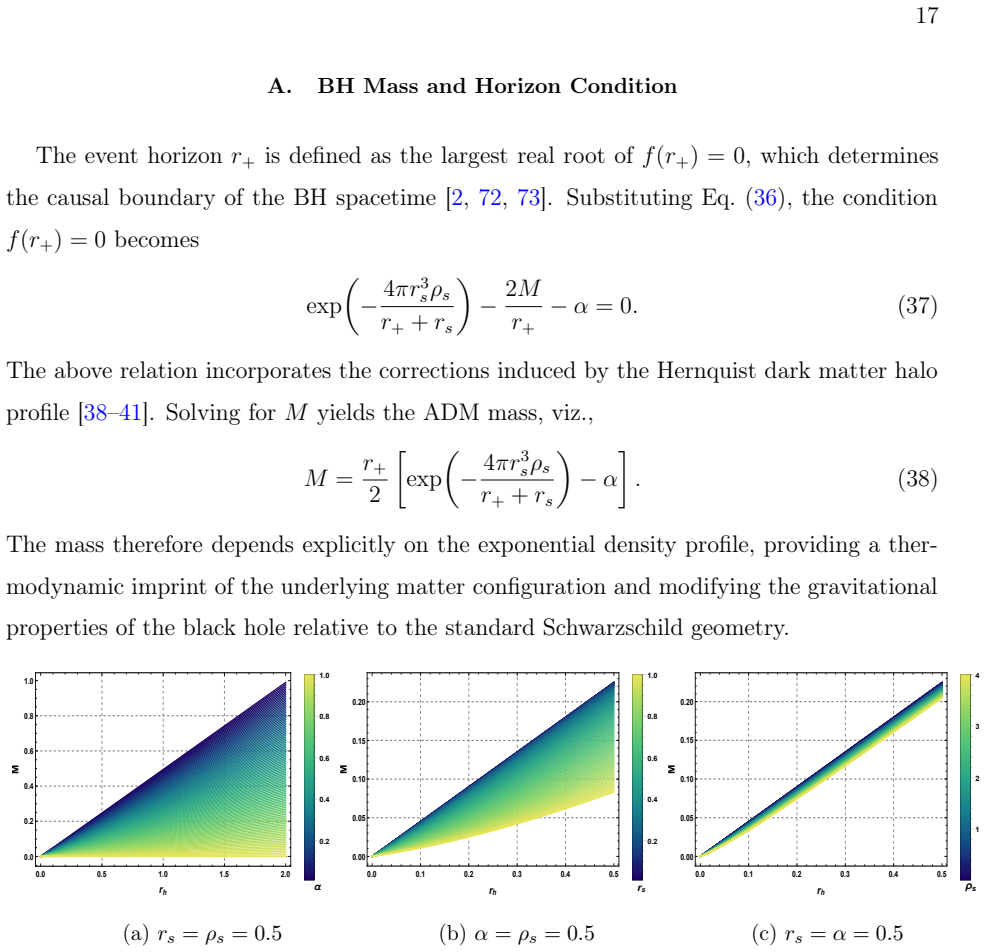
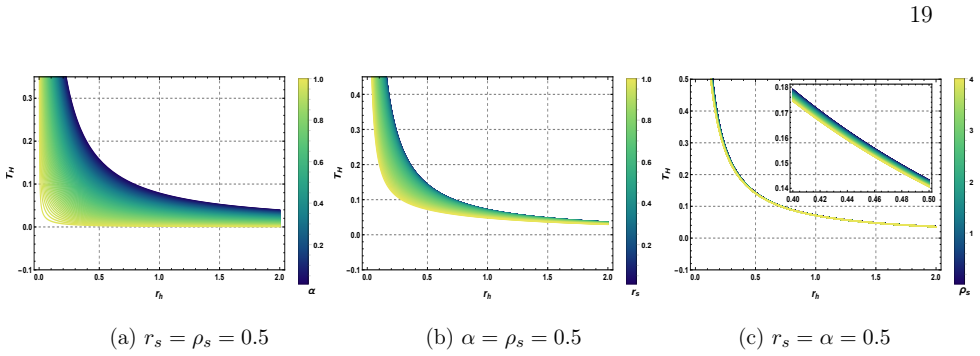
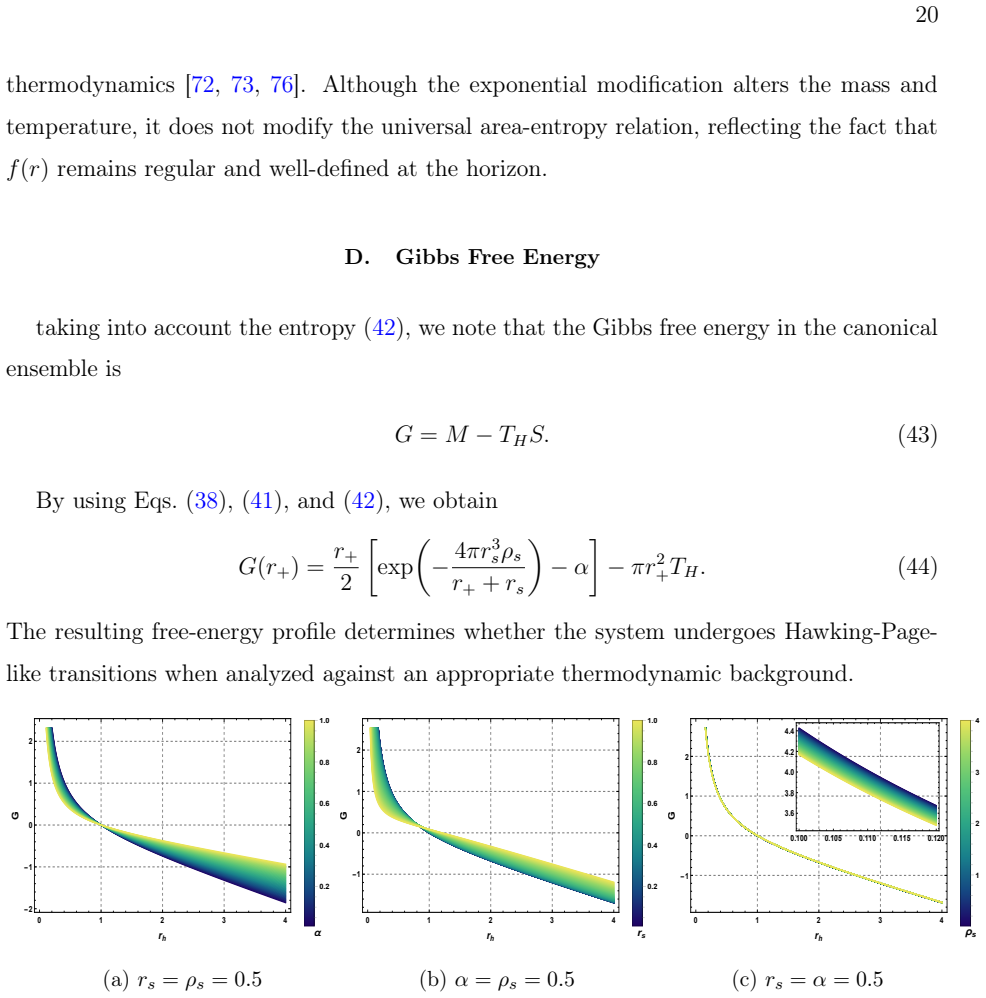
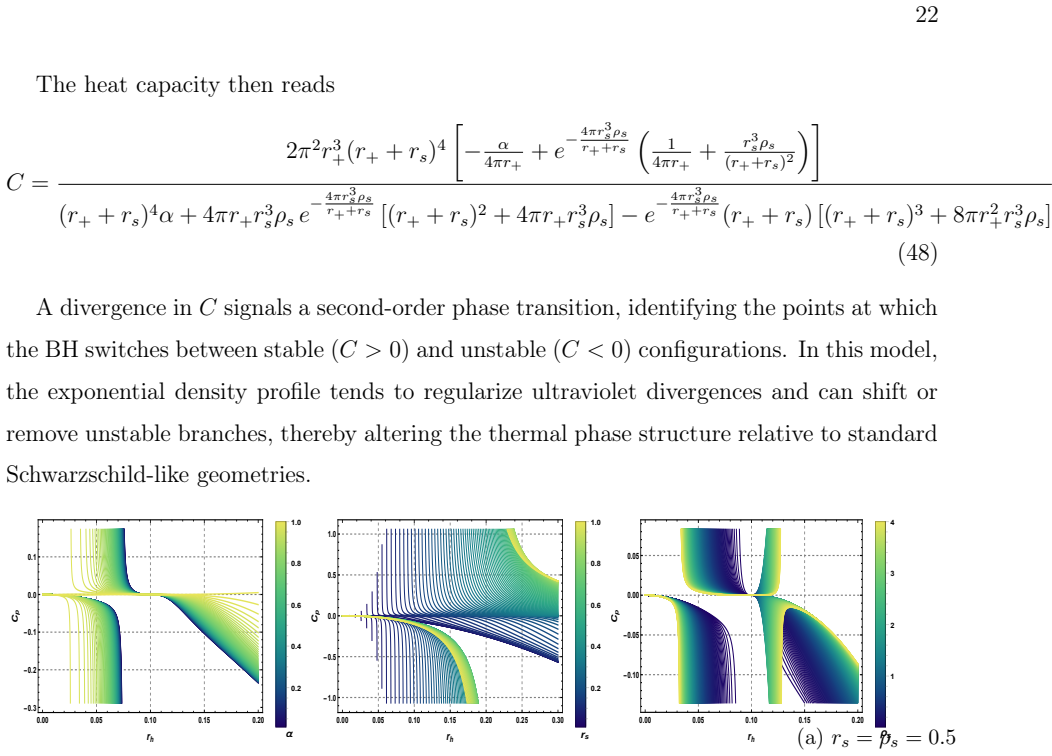
- Thermodynamic quantities including mass, horizon condition, Hawking temperature, entropy, Gibbs free energy, and heat capacity all receive corrections that alter stability conditions.
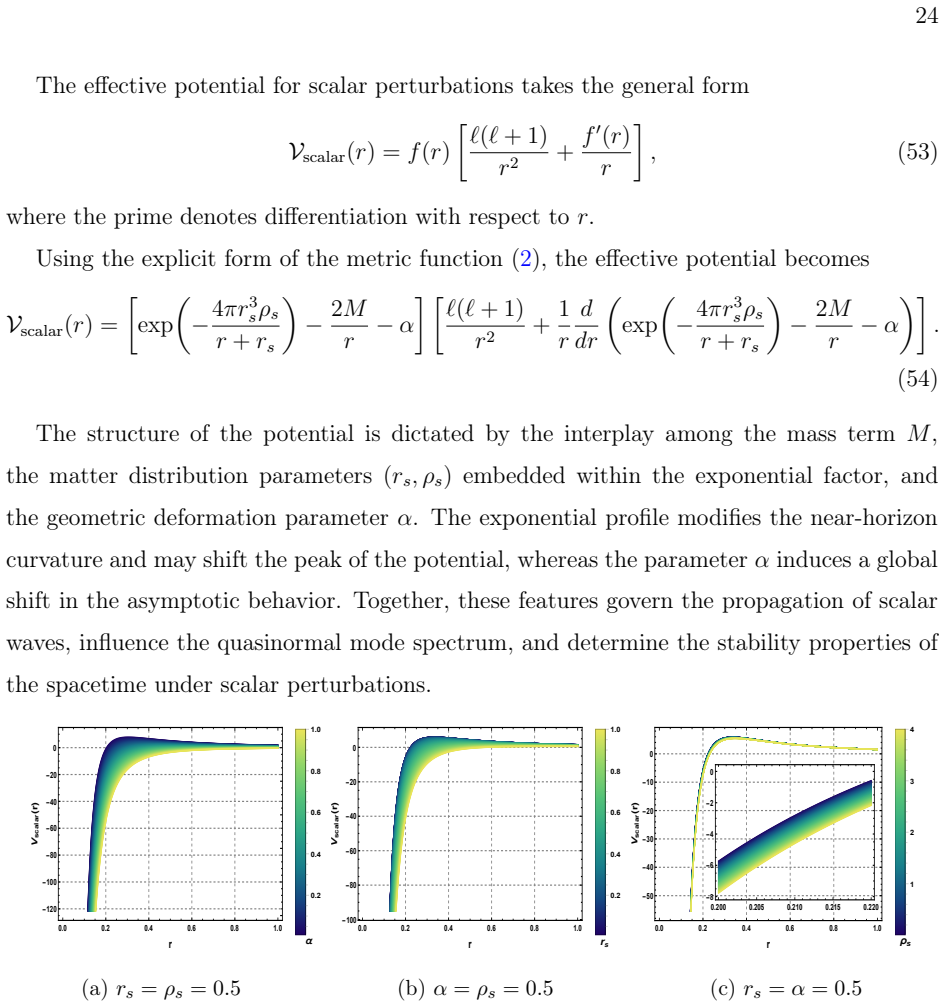
- Scalar perturbations show modified dynamical propagation under the influence of the Hernquist halo parameters.
- The configuration deviates from the vacuum Schwarzschild solution across optical, thermodynamic, and perturbative sectors.
Where Pith is reading between the lines
- If the construction holds, black hole shadow measurements in galaxies with Hernquist halos could reveal measurable deviations from vacuum predictions.
- The thermodynamic shifts suggest possible changes in evaporation timescales when black holes evolve inside dense dark matter regions.
- The same metric-building approach could be applied to other density profiles to isolate which corrections are universal.
- Full numerical solutions of Einstein's equations with the halo would be needed to test whether the direct superposition remains consistent at strong-field scales.
Load-bearing premise
The Hernquist density profile can be directly superimposed onto the Schwarzschild geometry to produce a valid solution of Einstein's equations without additional consistency conditions or back-reaction terms.
What would settle it
An explicit check that the proposed metric fails to satisfy the Einstein equations with the stress-energy tensor of the Hernquist profile, or an observation of photon-sphere radius matching the pure Schwarzschild value for a black hole known to sit in a Hernquist halo.
Figures
read the original abstract
In this work, we investigate the physical and geometrical properties of a Schwarzschild black hole (BH) immersed in a Hernquist dark matter halo. To accomplish our purpose, one builds the BH metric by incorporating the Hernquist dark matter profile into the Schwarzschild geometry. In addition, we verify the null geodesic solutions and the Halo effect on photon dynamics. Within this framework, one examines the corresponding light trajectories to determine the deformation of photon paths generated by the dark matter distribution. Furthermore, the thermodynamic properties of the system are studied by deriving expressions for the black hole mass, the horizon condition, the Hawking temperature, the entropy, the Gibbs free energy, and the heat capacity. Our results show that the dark matter halo modifies the thermal structure and stability conditions of the black hole configuration. Finally, we investigate the scalar perturbations to examine the influence of the Hernquist halo on the dynamical propagation of scalar fields in the BH background. In this framework, the results obtained demonstrate that the dark matter parameters yield nontrivial corrections to the optical, thermodynamic, and perturbative properties of the Schwarzschild black hole, producing deviations from the standard vacuum solution.
Editorial analysis
A structured set of objections, weighed in public.
Referee Report
Summary. The manuscript claims to construct a metric for a Schwarzschild black hole immersed in a Hernquist dark matter halo by incorporating the Hernquist density profile into the Schwarzschild geometry, then derives null geodesics and photon trajectories, computes thermodynamic quantities (horizon condition, Hawking temperature, entropy, Gibbs free energy, heat capacity), and analyzes scalar perturbations, concluding that the dark matter parameters produce nontrivial corrections to the optical, thermodynamic, and perturbative properties relative to the vacuum Schwarzschild solution.
Significance. If the metric construction yields a consistent solution of Einstein's equations, the results would quantify how a Hernquist halo modifies black-hole thermodynamics and dynamics in a galactic-center context, extending standard vacuum analyses to include dark-matter effects.
major comments (1)
- [Abstract and metric-construction section] Abstract and metric-construction section: the metric is obtained by defining an enclosed mass M(r) = M_BH + ∫_0^r 4πr'^2 ρ_H(r') dr' and setting f(r) = 1 - 2M(r)/r for both g_tt and g_rr. For a static spherical source with nonzero pressure (as required by the Hernquist halo's velocity dispersion), the Einstein equations fix dm/dr = 4πr²ρ but also require a separate integration for the redshift function via the hydrostatic-equilibrium (TOV) condition; the pure Schwarzschild form for the redshift function is recovered only when p = 0. No indication is given that the TOV equation or an equation of state for the halo is solved, so the resulting background is not guaranteed to satisfy G_μν = 8πT_μν for the Hernquist stress-energy tensor. This assumption is load-bearing for every subsequent derivation.
minor comments (1)
- [Abstract] Abstract: the claim that 'derivations exist' for geodesics, thermodynamics, and perturbations is stated without any displayed equations or verification steps; key expressions should appear in the main text with explicit error analysis or numerical checks.
Simulated Author's Rebuttal
We thank the referee for their thorough review and valuable comments on our manuscript. We address the major comment regarding the metric construction in detail below.
read point-by-point responses
-
Referee: [Abstract and metric-construction section] Abstract and metric-construction section: the metric is obtained by defining an enclosed mass M(r) = M_BH + ∫_0^r 4πr'^2 ρ_H(r') dr' and setting f(r) = 1 - 2M(r)/r for both g_tt and g_rr. For a static spherical source with nonzero pressure (as required by the Hernquist halo's velocity dispersion), the Einstein equations fix dm/dr = 4πr²ρ but also require a separate integration for the redshift function via the hydrostatic-equilibrium (TOV) condition; the pure Schwarzschild form for the redshift function is recovered only when p = 0. No indication is given that the TOV equation or an equation of state for the halo is solved, so the resulting background is not guaranteed to satisfy G_μν = 8πT_μν for the Hernquist stress-energy tensor. This assumption is load-bearing for every subsequent derivation.
Authors: We thank the referee for highlighting this important point. The metric in our manuscript is constructed by integrating the Hernquist density profile to obtain the enclosed mass M(r) and adopting the Schwarzschild-like form for the metric function. This is a standard approximation in the literature for modeling black holes in dark matter halos, where the dark matter is treated as a static, pressureless distribution for the purpose of determining the gravitational potential. However, we acknowledge that the Hernquist profile is typically associated with a velocity dispersion that implies nonzero pressure, and thus the full Einstein equations would require solving the TOV equation to find the correct redshift function. Our work does not solve the TOV equation or specify an equation of state, as the focus is on the effects of the density profile within this commonly used framework. We agree that this should be made explicit. In the revised manuscript, we will add a paragraph in the metric construction section clarifying that the metric is an approximation that assumes the pressureless form for the metric functions, and we will discuss the validity of this approximation for galactic dark matter halos. We will also note that a complete solution would involve numerical methods to solve the coupled Einstein equations with the appropriate stress-energy tensor. This revision will be partial, as the core calculations remain based on the presented metric. revision: partial
Circularity Check
No significant circularity; derivations follow from external profile ansatz without self-referential reduction
full rationale
The paper constructs the metric via direct incorporation of the standard Hernquist density profile into the Schwarzschild form (abstract), then computes null geodesics, thermodynamic quantities (mass, temperature, entropy, heat capacity), and scalar perturbations from the resulting line element using standard GR methods. No quoted equation or step equates a claimed prediction to a fitted input by construction, renames a known result, or relies on a load-bearing self-citation chain. The profile parameters are external literature inputs, and all outputs are computed forward from the assumed metric without redefinition or statistical forcing. This is the normal case of an ansatz-based study whose internal chain remains self-contained.
Axiom & Free-Parameter Ledger
free parameters (1)
- Hernquist scale radius and central density
axioms (2)
- domain assumption The combined metric is obtained by direct substitution of the Hernquist density into the Schwarzschild geometry
- standard math Standard general-relativity definitions of Hawking temperature, entropy, and heat capacity remain valid after the halo is added
Forward citations
Cited by 1 Pith paper
-
Mass-Varying Dark Matter Induced Scalarization and Scalar Clouds around Black Holes
Scalar clouds around black holes in mass-varying dark matter halos exist only for quantized scalar-dark matter couplings set by halo parameters such as compactness.
Reference graph
Works this paper leans on
-
[1]
Let us start analyzing the conditionρ s →0
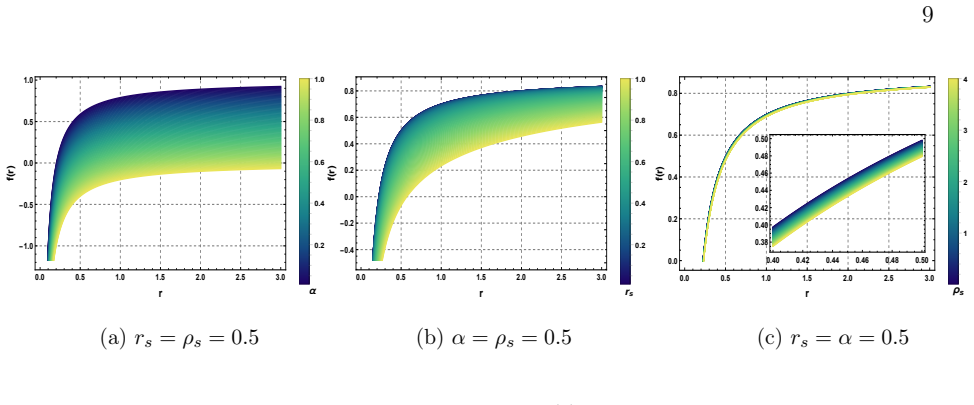
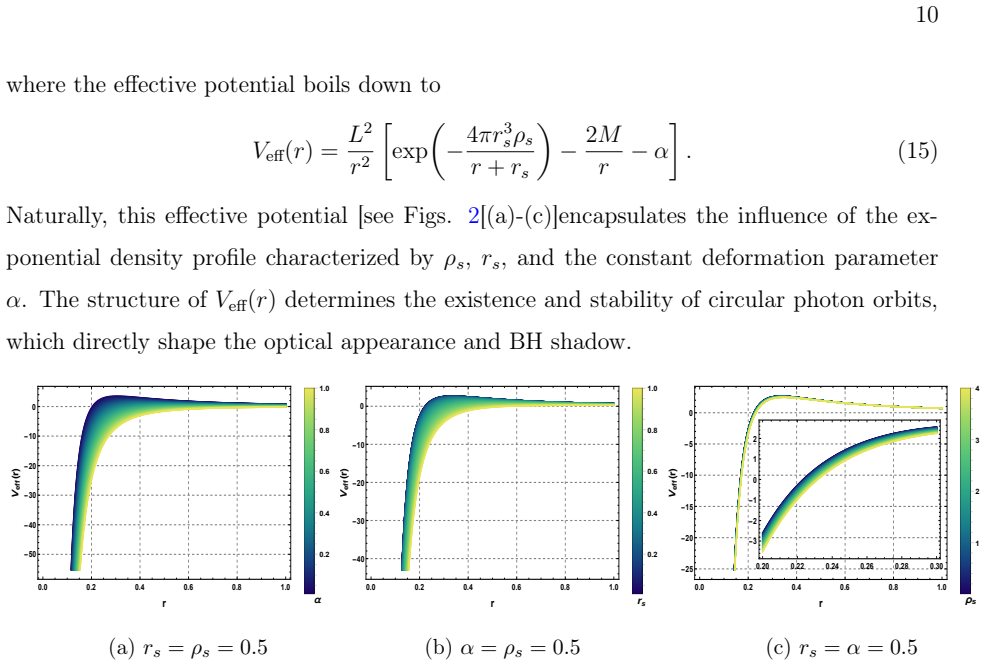
Particular Limits It is useful to analyze a few specific limiting cases of the metric function (2), i.e.,ρs →0, α→0, andr s →0. Let us start analyzing the conditionρ s →0. Within this regime, the exponential term becomes unity and the metric function is f(r) = 1− 2M r −α,(16) which leads us to the effective potential, Veff(r) = L2 r2 1− 2M r −α .(17) Note...
-
[2]
Starting from Eq
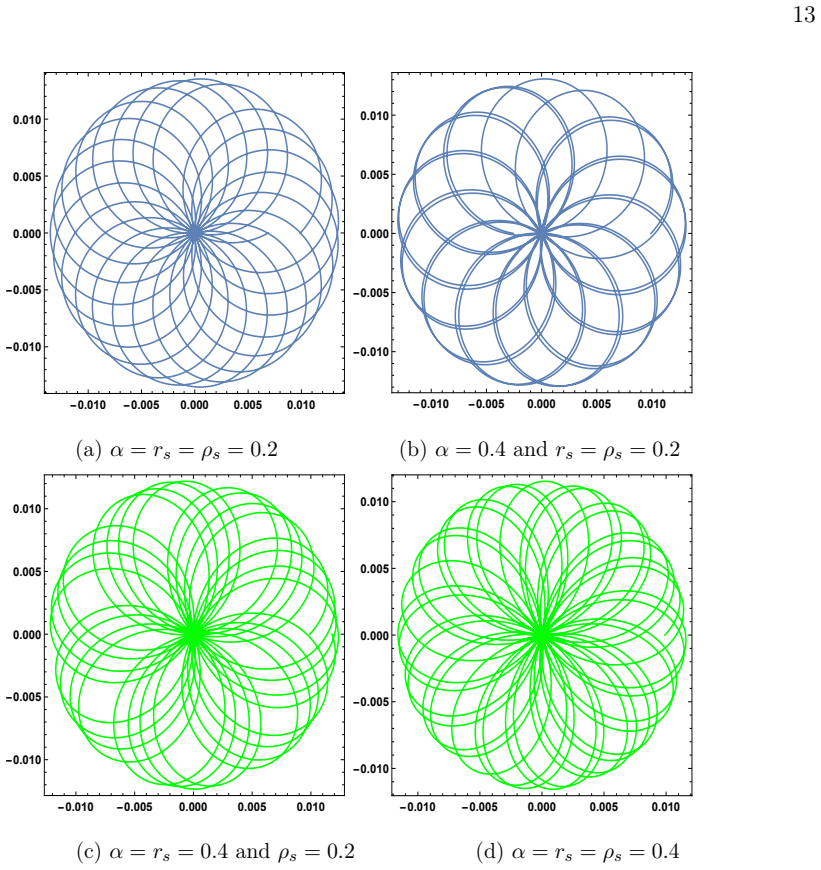
Particular cases The limiting configurations of the orbital equation provide useful physical insight into the separate roles played by the BH mass, the Hernquist halo parameters, and the constant 14 deformation parameter in the propagation of photons. Starting from Eq. (22), one notes that the motion of light is controlled by three distinct contributions,...
2023
-
[3]
Einstein, Ann
A. Einstein, Ann. Phys. (Berlin)354, 769 (1916)
1916
-
[4]
S. M. Carroll,Spacetime and geometry, Cambridge University Press (2019)
2019
-
[5]
Abbott, et al., Phys
B. Abbott, et al., Phys. Rev. Lett.116, 061102 (2016)
2016
-
[6]
K.Akiyama, etal.[EventHorizonTelescopeCollaboration], Astrophys.J.Lett.875, L1(2019)
2019
-
[7]
K.Akiyama, etal.[EventHorizonTelescopeCollaboration], Astrophys.J.Lett.875, L2(2019)
2019
-
[8]
K.Akiyama, etal.[EventHorizonTelescopeCollaboration], Astrophys.J.Lett.875, L3(2019)
2019
-
[9]
K.Akiyama, etal.[EventHorizonTelescopeCollaboration], Astrophys.J.Lett.875, L4(2019)
2019
-
[10]
K.Akiyama, etal.[EventHorizonTelescopeCollaboration], Astrophys.J.Lett.875, L5(2019)
2019
-
[11]
K.Akiyama, etal.[EventHorizonTelescopeCollaboration], Astrophys.J.Lett.875, L6(2019)
2019
-
[12]
Akiyama, et al
K. Akiyama, et al. [Event Horizon Telescope Collaboration], Astrophys. J.910, L12 (2021)
2021
-
[13]
Akiyama, et al
K. Akiyama, et al. [Event Horizon Telescope Collaboration], Astrophys. J. Lett.910, L13 (2021)
2021
-
[14]
Akiyama, et al
K. Akiyama, et al. [Event Horizon Telescope Collaboration], Astrophys. J. Lett.930, L12 (2022)
2022
-
[15]
Akiyama, et al
K. Akiyama, et al. [Event Horizon Telescope Collaboration], Astrophys. J. Lett.930, L13 (2022)
2022
-
[16]
Akiyama, et al
K. Akiyama, et al. [Event Horizon Telescope Collaboration], Astrophys. J. Lett.930, L14 (2022)
2022
-
[17]
Akiyama, et al
K. Akiyama, et al. [Event Horizon Telescope Collaboration], Astrophys. J. Lett.930, L15 (2022)
2022
-
[18]
Akiyama, et al
K. Akiyama, et al. [Event Horizon Telescope Collaboration], Astrophys. J. Lett.930, L16 (2022)
2022
-
[19]
Akiyama, et al
K. Akiyama, et al. [Event Horizon Telescope Collaboration], Astrophys. J. Lett.930, L17 31 (2022)
2022
-
[20]
Ditta, et al., Phys
A. Ditta, et al., Phys. Dark Universe,46, 101573 (2024)
2024
-
[21]
Mustafa, et al., Phys
G. Mustafa, et al., Phys. Dark Universe,47, 101753 (2025)
2025
-
[22]
Mustafa, et al., Phys
G. Mustafa, et al., Phys. Dark Universe,47, 101765 (2025)
2025
-
[23]
Ditta, et al., Phys
A. Ditta, et al., Phys. Dark Universe,47, 101818 (2025)
2025
-
[24]
Ditta, et al., J
A. Ditta, et al., J. High Energy Astrophys.,45, 62-74 (2025)
2025
-
[25]
Ashraf, et al., Nucl
A. Ashraf, et al., Nucl. Phys.B 1014, 116873 (2025)
2025
-
[26]
Ashraf, et al., Phys
A. Ashraf, et al., Phys. Dark Universe,47, 101787 (2025)
2025
-
[27]
Ashraf, et al., Phys
A. Ashraf, et al., Phys. Dark Universe,47, 101725 (2025)
2025
-
[28]
Ashraf, et al., Phys
A. Ashraf, et al., Phys. Dark Universe,47, 101823 (2025)
2025
-
[29]
Ashraf, et al., Phys
A. Ashraf, et al., Phys. Dark Universe,48, 101836 (2025)
2025
-
[30]
Saleem, et al., Nucl
A. Saleem, et al., Nucl. Phys.B 1017, 116926 (2025)
2025
-
[31]
Persic, P
M. Persic, P. Salucci, F. Stel, Mon. Not. R. Astron. Soc.281, 27 (1996)
1996
-
[32]
Rubin, N
V.C. Rubin, N. Thonnard, W.K. Ford Jr., Astrophys. J.238, 471 (1980)
1980
-
[33]
Lelli, S.S
F. Lelli, S.S. McGaugh, J.M. Schombert, Astron. J.152(6), 157 (2016)
2016
-
[34]
Clowe, et al., Astrophys
D. Clowe, et al., Astrophys. J. Lett.648, L109-L113 (2006)
2006
-
[35]
Eisenstein et al
D.J. Eisenstein et al. [SDSS], Astrophys. J.633, 560-574 (2005)
2005
-
[36]
Navarro, C.S
J.F. Navarro, C.S. Frenk, S.D.M. White, Astrophys. J.462, 563-575 (1996)
1996
-
[37]
Ludlow, et al., Mon
A.D. Ludlow, et al., Mon. Not. R. Astron. Soc.441(1), 378-388 (2014)
2014
-
[38]
Burkert, Astrophys
A. Burkert, Astrophys. J. Lett.447, L25 (1995)
1995
-
[39]
Dehnen, Mon
W. Dehnen, Mon. Not. R. Astron. Soc.265, 250 (1993)
1993
-
[40]
Gohain, P
M.M. Gohain, P. Phukon, K. Bhuyan, Phys. Dark Univ.46, 101683 (2024)
2024
-
[41]
Pantig, A
R.C. Pantig, A. Övgün, JCAP08, 056 (2022)
2022
-
[42]
Hernquist, Astrophys
L. Hernquist, Astrophys. J.356, 359 (1990)
1990
-
[43]
Jha, JCAP06, 033 (2025)
S.K. Jha, JCAP06, 033 (2025)
2025
- [44]
-
[45]
M. Cirelli, A. Strumia, J. Zupan, arXiv preprint arXiv:2406.01705 (2024)
work page internal anchor Pith review Pith/arXiv arXiv 2024
-
[46]
Begeman, A
K.G. Begeman, A. H. Broeils, R. H. Sanders, Mon. Not. R. Astron. Soc.249, 523 (1991)
1991
-
[47]
Burkert, Astrophys
A. Burkert, Astrophys. J. Lett.447, L25 (1995),
1995
-
[48]
Bartelmann, P
M. Bartelmann, P. Schneider, Phys. Rept.340291-472 (2001)
2001
-
[49]
Sofue, V
Y. Sofue, V. Rubin, Ann. Rev. Astron. Astrophys.39, 137-174 (2001). 32
2001
-
[50]
Springel, C.S
V. Springel, C.S. Frenk, S. D. M. White, Nature440, 1137 (2006)
2006
-
[51]
Aghanim et al., Astron
N. Aghanim et al., Astron. Astrophys.641, A6 (2020)
2020
-
[52]
Milgrom, Astrophys
M. Milgrom, Astrophys. J.270, 365-370 (1983)
1983
-
[53]
Aguirre, J
A. Aguirre, J. Schaye, E. Quataert, Astrophys. J.561, 550 (2001)
2001
-
[54]
Clowe et al., Astrophys
D. Clowe et al., Astrophys. J. Lett.648, L109-L113 (2006)
2006
-
[55]
Dodelson, Int
S. Dodelson, Int. J. Mod. Phys.D 20, 2749-2753 (2011)
2011
-
[56]
McGaugh, Can
S.S. McGaugh, Can. J. Phys.93, 250-259 (2015)
2015
-
[57]
Bertone, D
G. Bertone, D. Hooper, J. Silk, Phys. Rept.405, 279-390 (2005)
2005
-
[58]
Arkani-Hamed, N
N. Arkani-Hamed, N. Weiner, JHEP2008(12), 104 (2008)
2008
-
[59]
Silk et al., Particle Dark Matter: Observations, Models and Searches, Cambridge Univ
J. Silk et al., Particle Dark Matter: Observations, Models and Searches, Cambridge Univ. Press, Cambridge (2010)
2010
-
[60]
Vogelsberger, J
M. Vogelsberger, J. Zavala, A. Loeb, Mon. Not. Roy. Astron. Soc.423, 3740 (2012)
2012
-
[61]
Tulin, H.-B
S. Tulin, H.-B. Yu, Phys. Rept.730, 1-57 (2018),
2018
-
[62]
Han, K.-P
C. Han, K.-P. Xie, J.M. Yang, M. Zhang, Phys. Rev.D 109, 115025 (2024)
2024
-
[63]
Bouzenada, et al., Nucl
A. Bouzenada, et al., Nucl. Phys.B 1017, 116928 (2025)
2025
-
[64]
Ashraf, et al., Eur
A. Ashraf, et al., Eur. Phys. J.C 85(4), 383 (2025)
2025
-
[65]
S. K. Maurya, et al., Nucl. Phys.B 1020, 117139 (2025)
2025
-
[66]
Ditta, et al., Nucl
A. Ditta, et al., Nucl. Phys.B 1019, 117099 (2025)
2025
-
[67]
Ashraf, et al., Phys
A. Ashraf, et al., Phys. Dark Universe,48, 101874 (2025)
2025
-
[68]
Ditta, et al., Nucl
A. Ditta, et al., Nucl. Phys.B 1018, 117059 (2025)
2025
-
[69]
Bouzenada, et al., Phys
A. Bouzenada, et al., Phys. Dark Universe51, 102216 (2025)
2025
-
[70]
Ashraf, et al., Int
A. Ashraf, et al., Int. J. Geom. Methods Mod. Phys., 2650052 (2025)
2025
-
[71]
Bouzenada, et al., Nucl
A. Bouzenada, et al., Nucl. Phys.B 1021, 117192 (2025)
2025
-
[72]
Ditta, et al
A. Ditta, et al. Phys. Dark Universe,47, 101818 (2025)
2025
-
[73]
Banerjee, D
A. Banerjee, D. Budker, J. Eby, H. Kim, G. Perez, Commun. Phys.3, 1 (2020)
2020
-
[74]
J. D. Bekenstein, Phys. Rev.D 7, 2333 (1973)
1973
-
[75]
S. W. Hawking, Commun. Math. Phys.43, 199 (1975), Erratum: Commun. Math. Phys.46, 206 (1976)
1975
-
[76]
N. D. Birrell, P. C. W. Davies, Cambridge University Press (1982)
1982
-
[77]
J. B. Hartle, S. W. Hawking, Phys. Rev.D 13, 2188 (1976)
1976
-
[78]
G. W. Gibbons, S. W. Hawking, Phys. Rev.D 15, 2752 (1977). 33
1977
-
[79]
S. W. Hawking, D. N. Page, Commun. Math. Phys.87, 577 (1983)
1983
-
[80]
Chamblin, R
A. Chamblin, R. Emparan, C. V. Johnson, R. C. Myers, Phys. Rev.D 60, 064018 (1999)
1999
discussion (0)
Sign in with ORCID, Apple, or X to comment. Anyone can read and Pith papers without signing in.