Dynamical self-dual criticality in Fibonacci-monitored quantum Ising chains
Pith reviewed 2026-06-30 15:43 UTC · model grok-4.3
The pith
Fibonacci measurement sequences extend Kramers-Wannier duality into monitored quantum dynamics without time-translation symmetry.
A machine-rendered reading of the paper's core claim, the machinery that carries it, and where it could break.
Core claim
The dynamical extension of the Kramers-Wannier non-invertible symmetry to monitored dynamics with Fibonacci measurements organizes the dynamical phase diagram, predicts the locations of the critical lines, and protects universal critical behavior in the absence of time-translation symmetry.
What carries the argument
Dynamical self-duality arising from the quasiperiodic Fibonacci sequence of measurements, which extends the non-invertible Kramers-Wannier symmetry to out-of-equilibrium monitored evolution.
If this is right
- Two distinct critical lines, both related to the golden ratio, appear for weak measurements and for projective measurements.
- The projective measurement critical line matches the transition point of a pure imaginary-time evolution viewed as post-selected trajectory.
- Universality classes are fixed for the long-time critical steady states reached at Fibonacci times.
- Transient dynamics between those times realize measurement-altered quantum criticality in real time.
Where Pith is reading between the lines
- Similar quasiperiodic protocols might protect criticality in other monitored systems or higher dimensions.
- The connection to imaginary-time evolution suggests links between monitored dynamics and statistical mechanics models.
- Experimental platforms with programmable measurements could test the predicted golden-ratio critical points.
Load-bearing premise
That arranging measurements in a Fibonacci sequence extends the Kramers-Wannier non-invertible symmetry to the monitored dynamics without requiring time-translation symmetry.
What would settle it
A numerical simulation or experiment showing that the phase transitions do not occur at the specific parameter values determined by the golden ratio or that the critical behavior lacks the predicted universality.
Figures
read the original abstract
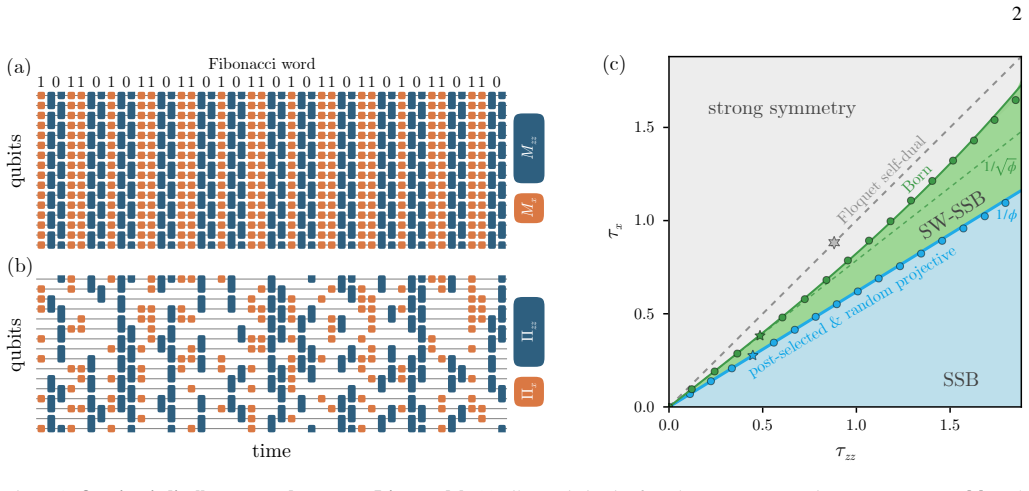
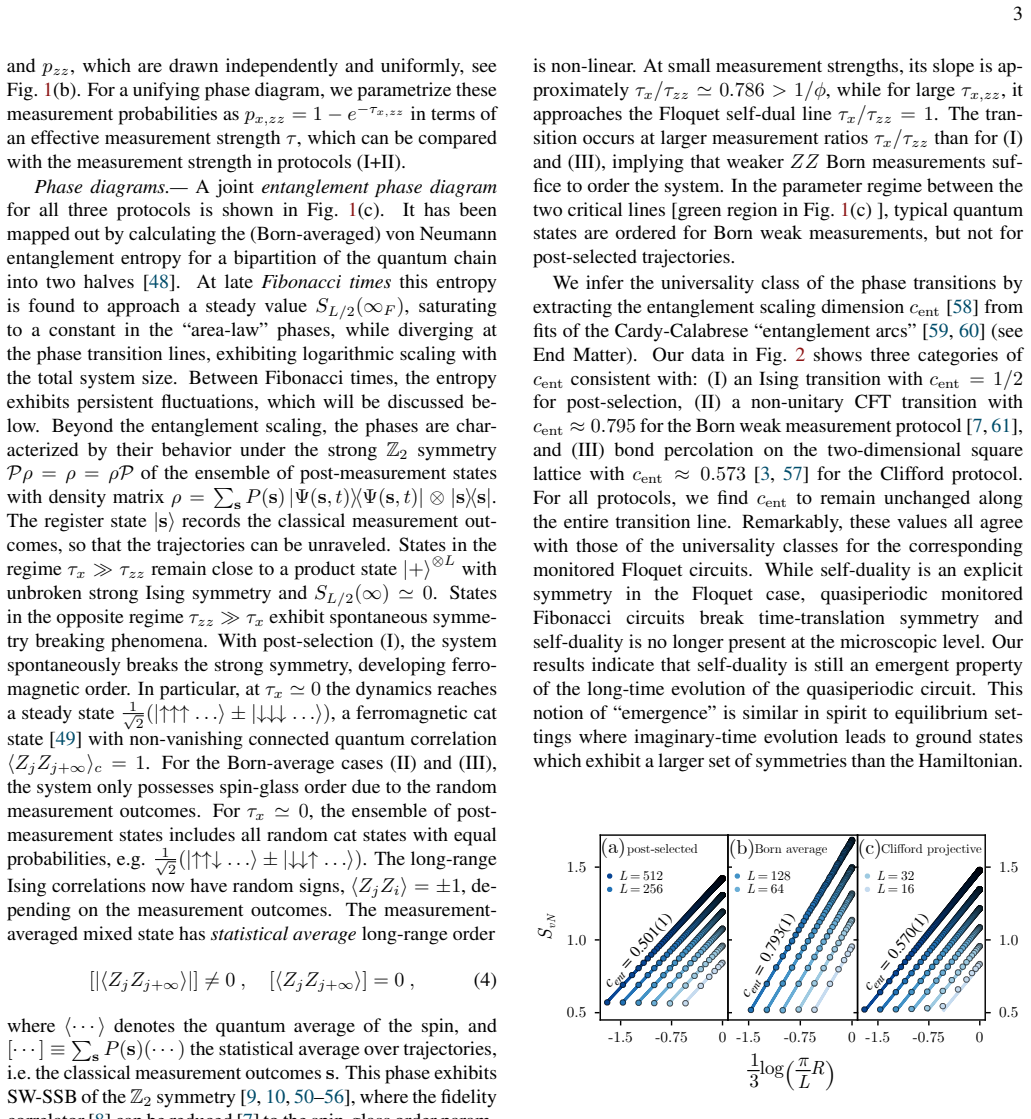
For the quantum phase transition in the transverse-field Ising chain, Kramers-Wannier duality not only protects its critical properties but also pinpoints the location of the phase transition. Its role in out-of-equilibrium, monitored dynamics, however, remains largely unexplored beyond time-periodic Floquet protocols where self-duality turns into a statistical average symmetry. Here we explore the emergence of dynamical self-duality in the absence of time-translation symmetry by investigating the monitored dynamics of one-dimensional Ising/Majorana chains where measurements are arranged in a quasiperiodic Fibonacci sequence. We find that the dynamical extension of this non-invertible symmetry to an out-of-equilibrium setting allows one to organize the dynamical phase diagram of entangled phases, both predicting the transition locations and protecting universal critical behavior. Analytically and numerically, we identify two distinct critical lines, both related to the golden ratio, for Born-rule weak measurements and for random Clifford projective measurements. The latter coincides with the transition of a pure imaginary-time evolution, which can be viewed as a post-selected trajectory. The universality classes of the long-time critical steady states at Fibonacci times are determined, while the transient dynamics between Fibonacci times is deformed by measurements, realizing dynamical measurement-altered quantum criticality in real time.
Editorial analysis
A structured set of objections, weighed in public.
Referee Report
Summary. The manuscript studies monitored dynamics of the transverse-field Ising/Majorana chain with measurements arranged in a quasiperiodic Fibonacci sequence. It claims that this setup extends the Kramers-Wannier non-invertible duality to a dynamical self-duality (without time-translation invariance), thereby organizing the phase diagram of entangled phases by predicting two distinct critical lines related to the golden ratio—one for Born-rule weak measurements and one for random Clifford projective measurements (the latter coinciding with a post-selected imaginary-time evolution)—while also determining the universality classes of the long-time critical steady states at Fibonacci times and showing measurement-altered transient dynamics.
Significance. If the claimed extension of the non-invertible symmetry holds and the transition locations are independently fixed rather than inherited from the Fibonacci definition, the work would provide a concrete framework for using self-duality to predict and protect critical behavior in quasiperiodic monitored systems, extending Floquet results to the absence of time-translation symmetry and offering falsifiable predictions for both weak and projective measurement protocols.
major comments (3)
- [Abstract] Abstract (paragraph beginning 'Here we explore...'): The central claim that the Fibonacci measurement sequence extends Kramers-Wannier duality to fix the locations of the two golden-ratio-related critical lines requires an explicit derivation showing how the quasiperiodic drive pins the self-dual points independently; the abstract states the lines are 'related to the golden ratio' without demonstrating that this is not fixed by construction from the sequence itself.
- [Symmetry extension discussion] Section on symmetry extension (likely near the discussion of Floquet vs. quasiperiodic): The mechanism replacing the statistical-average symmetry of the periodic Floquet case with a quasiperiodic one must be constructed explicitly to show that the duality protects the universality classes and predicts the transition points; without this step the organization of the dynamical phase diagram rests on an unverified assumption.
- [Clifford measurements section] Section on Clifford projective measurements: The assertion that this critical line 'coincides with the transition of a pure imaginary-time evolution, which can be viewed as a post-selected trajectory' needs to clarify whether the coincidence is exact (including for the universality class) or holds only after post-selection, and how this affects the claimed protection of critical behavior.
minor comments (2)
- [Numerical results] Ensure all numerical identifications of critical lines include error bars, fitting procedures, and explicit exclusion criteria for the two lines.
- [Results and figures] Clarify notation for the two critical lines (e.g., their explicit golden-ratio expressions) and how they are compared between analytical predictions and numerics.
Simulated Author's Rebuttal
We thank the referee for the careful reading and constructive comments on our manuscript. We address each major comment point by point below, providing clarifications from the full text and indicating revisions where appropriate to improve clarity.
read point-by-point responses
-
Referee: [Abstract] Abstract (paragraph beginning 'Here we explore...'): The central claim that the Fibonacci measurement sequence extends Kramers-Wannier duality to fix the locations of the two golden-ratio-related critical lines requires an explicit derivation showing how the quasiperiodic drive pins the self-dual points independently; the abstract states the lines are 'related to the golden ratio' without demonstrating that this is not fixed by construction from the sequence itself.
Authors: The full manuscript provides the explicit derivation in Section III (and Appendix B), where the self-duality is applied to the effective transfer matrix at Fibonacci times. The duality maps a measurement strength parameter g to its dual 1/g (or equivalent for the Clifford case), and the fixed point is fixed by the golden ratio φ satisfying φ = 1 + 1/φ independently of how the Fibonacci word arranges the sequence; the sequence only dictates the timing, while the duality condition itself locates the critical lines. This is confirmed both analytically and by independent numerical scans. To address the abstract concern, we will add a short clause clarifying the independence from sequence construction. revision: partial
-
Referee: [Symmetry extension discussion] Section on symmetry extension (likely near the discussion of Floquet vs. quasiperiodic): The mechanism replacing the statistical-average symmetry of the periodic Floquet case with a quasiperiodic one must be constructed explicitly to show that the duality protects the universality classes and predicts the transition points; without this step the organization of the dynamical phase diagram rests on an unverified assumption.
Authors: Section IV constructs this mechanism explicitly: the Fibonacci recursion (F_{n} = F_{n-1} + F_{n-2}) induces a self-similar mapping under the Kramers-Wannier duality that preserves the non-invertible symmetry at Fibonacci times without invoking time-translation invariance or ensemble averaging. This directly pins the transition points and protects the universality classes, as verified by the collapse of correlation functions and entanglement scaling onto the expected conformal data. The construction is therefore not an assumption but is derived from the recursive structure matching the duality. revision: no
-
Referee: [Clifford measurements section] Section on Clifford projective measurements: The assertion that this critical line 'coincides with the transition of a pure imaginary-time evolution, which can be viewed as a post-selected trajectory' needs to clarify whether the coincidence is exact (including for the universality class) or holds only after post-selection, and how this affects the claimed protection of critical behavior.
Authors: The coincidence is exact for both the critical line location and the universality class when restricted to post-selected trajectories, as the random Clifford measurements map precisely onto imaginary-time evolution under post-selection (detailed in Section V and Appendix C). The self-duality protects the criticality in this post-selected sector, providing an additional consistency check rather than weakening the claim; the protection for the full monitored dynamics follows from the same duality at Fibonacci times. We will insert one clarifying sentence to distinguish the post-selected interpretation. revision: yes
Circularity Check
No significant circularity; derivation of critical lines from extended Kramers-Wannier symmetry is self-contained
full rationale
The paper derives the locations of two critical lines (related to the golden ratio) analytically and numerically from the extension of non-invertible Kramers-Wannier duality to quasiperiodic Fibonacci-monitored dynamics in the absence of time-translation symmetry. No quoted step reduces the transition locations to a fit, self-definition, or self-citation chain; the golden-ratio relation emerges as a mathematical consequence of the Fibonacci recurrence under the symmetry extension rather than being presupposed. The central claim of organizing the dynamical phase diagram and protecting universality classes rests on explicit construction of the dynamical self-duality, which is independently verifiable via the stated analytical/numerical methods and does not collapse to its inputs by construction.
Axiom & Free-Parameter Ledger
axioms (1)
- domain assumption Kramers-Wannier duality protects critical properties and locates the phase transition in the transverse-field Ising chain
Forward citations
Cited by 1 Pith paper
-
Emergent Self-Similar Quantum Revivals in Spiral Drives
Self-similar quantum revivals emerge in quasiperiodically driven many-body systems from an emergent dynamical attractor where momentum modes follow closed orbits at nested times.
Reference graph
Works this paper leans on
-
[1]
dynamical
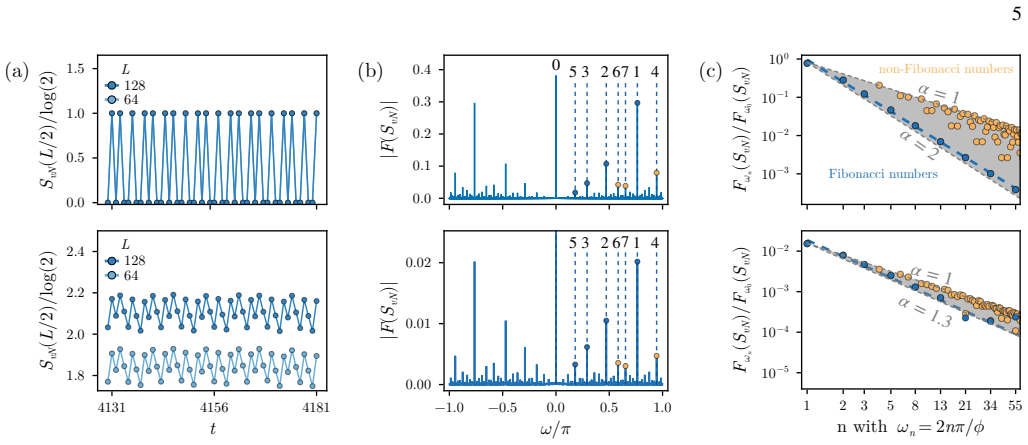
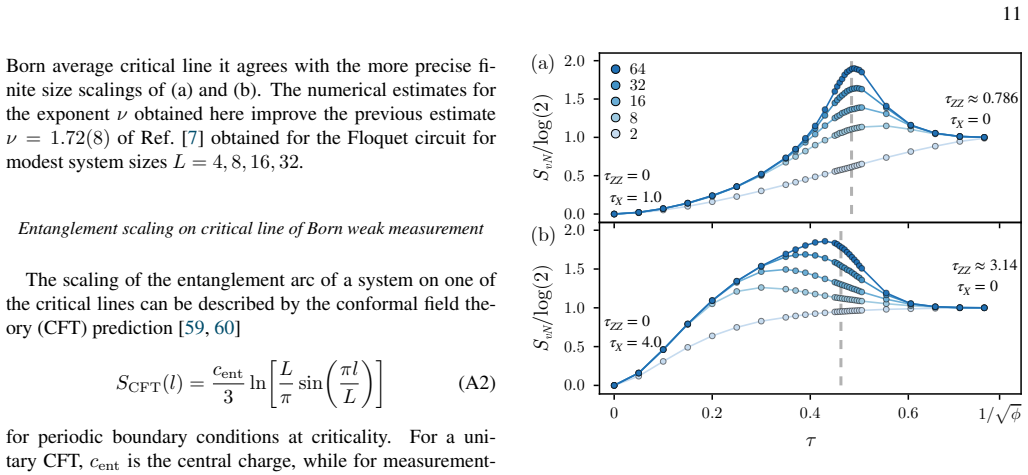
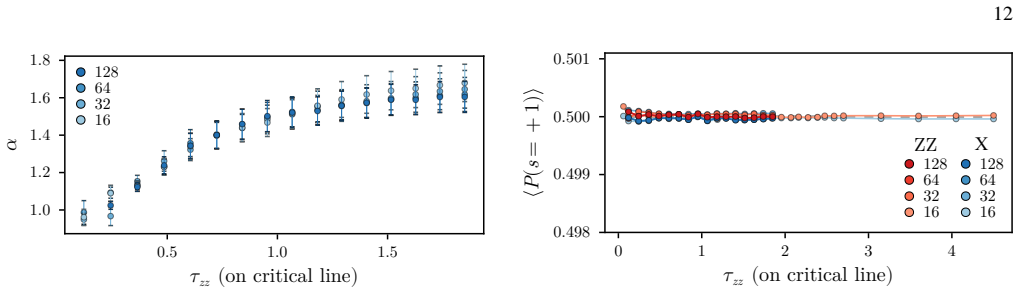
as illustrated in the End Matter. Entanglement dynamics.—Away from Fibonacci times, the quasiperiodicity of the circuit induces adynamically- deformedcriticality. We analyze the entanglement evolu- tion in the Born weak measurement protocol (II) at critical- ity in the “steady” state. While the entropy saturates to a constant at Fibonacci times, it fluctu...
2004
-
[2]
11” appears in the Fibonacci word, never “00
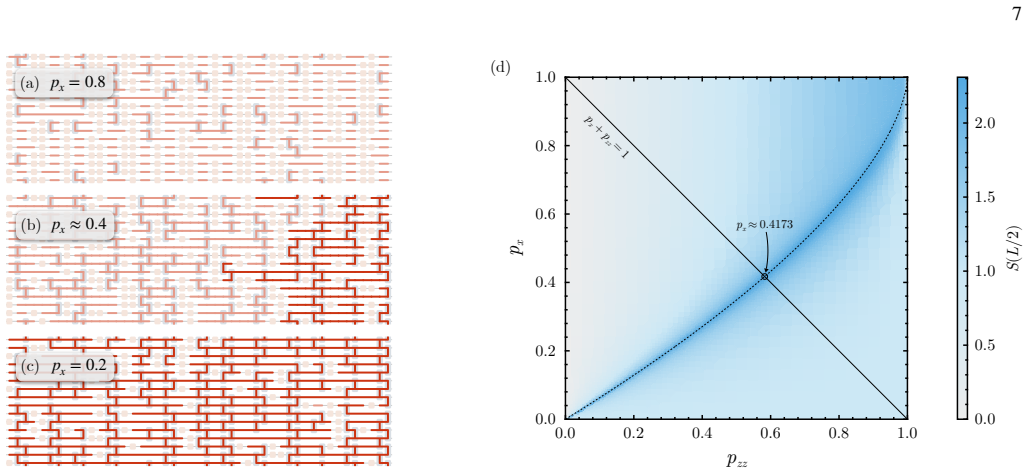
0 (d) (a)px=0.8 (b)px≈0.4 (c)px=0.2 Figure 5.Bond-percolation transition in space-time (protocol III).(a–c) AZZprojective measurement entangles two neighboring qubits and corresponds to a vertical link gluing the two sites; the qubit world lines stretch left to right. AnXprojective measurement disentangles a qubit and corresponds to a broken horizontal li...
-
[3]
M. P. Fisher, V . Khemani, A. Nahum, and S. Vijay, Random Quantum Circuits, Annu. Rev. Condens. Matter Phys.14, 335 (2023)
2023
-
[4]
A. C. Potter and R. Vasseur, Entanglement Dynamics in Hybrid 8 Quantum Circuits, inEntanglement in Spin Chains: From The- ory to Quantum Technology Applications, edited by A. Bayat, S. Bose, and H. Johannesson (Springer International Publish- ing, Cham, 2022) pp. 211–249
2022
-
[5]
Lang and H
N. Lang and H. P. B ¨uchler, Entanglement transition in the pro- jective transverse field Ising model, Phys. Rev. B102, 094204 (2020)
2020
-
[6]
Sang and T
S. Sang and T. H. Hsieh, Measurement-protected quantum phases, Phys. Rev. Res.3, 023200 (2021)
2021
-
[7]
Pfeuty, The one-dimensional Ising model with a transverse field, Ann
P. Pfeuty, The one-dimensional Ising model with a transverse field, Ann. Phys.57, 79 (1970)
1970
-
[8]
Sachdev,Quantum phase transitions, 2nd ed
S. Sachdev,Quantum phase transitions, 2nd ed. (Cambridge University Press, Cambridge, 2011)
2011
- [9]
-
[10]
L. A. Lessa, R. Ma, J.-H. Zhang, Z. Bi, M. Cheng, and C. Wang, Strong-to-Weak Spontaneous Symmetry Breaking in Mixed Quantum States, PRX Quantum6, 010344 (2025)
2025
- [11]
-
[12]
P. Sala, S. Gopalakrishnan, M. Oshikawa, and Y . You, Sponta- neous strong symmetry breaking in open systems: Purification perspective, Phys. Rev. B110, 155150 (2024)
2024
-
[13]
N. Sun, P. Zhang, and L. Feng, Scheme to Detect the Strong- to-Weak Symmetry Breaking via Randomized Measurements, Phys. Rev. Lett.135, 090403 (2025)
2025
-
[14]
2025.arXiv e-prints:arXiv:2509.09669
N. Ziereis, S. Moudgalya, and M. Knap, Strong-to-Weak Sym- metry Breaking Phases in Steady States of Quantum Operations (2025), arXiv:2509.09669 [cond-mat.stat-mech]
-
[15]
Jian, Y .-Z
C.-M. Jian, Y .-Z. You, R. Vasseur, and A. W. W. Ludwig, Measurement-induced criticality in random quantum circuits, Phys. Rev. B101, 104302 (2020)
2020
-
[16]
Y . Bao, S. Choi, and E. Altman, Theory of the phase transi- tion in random unitary circuits with measurements, Phys. Rev. B101, 104301 (2020)
2020
-
[17]
Zabalo, M
A. Zabalo, M. J. Gullans, J. H. Wilson, S. Gopalakrish- nan, D. A. Huse, and J. H. Pixley, Critical properties of the measurement-induced transition in random quantum circuits, Phys. Rev. B101, 060301 (2020)
2020
-
[18]
Roser, H
F. Roser, H. P. B ¨uchler, and N. Lang, Decoding the projective transverse field Ising model, Phys. Rev. B107, 214201 (2023)
2023
-
[19]
Roser, E
F. Roser, E. M. Springer, H. P. B ¨uchler, and N. Lang, Ro- bust Detection of an Entanglement Transition in the Projec- tive Transverse-Field Ising Model, Phys. Rev. Lett.136, 140403 (2026)
2026
-
[20]
Ippoliti, M
M. Ippoliti, M. J. Gullans, S. Gopalakrishnan, D. A. Huse, and V . Khemani, Entanglement Phase Transitions in Measurement- Only Dynamics, Phys. Rev. X11, 011030 (2021)
2021
-
[21]
Lavasani, Y
A. Lavasani, Y . Alavirad, and M. Barkeshli, Measurement- induced topological entanglement transitions in symmetric ran- dom quantum circuits, Nat. Phys.17, 342 (2021)
2021
-
[22]
Nahum, S
A. Nahum, S. Roy, B. Skinner, and J. Ruhman, Measurement and Entanglement Phase Transitions in All-To-All Quantum Circuits, on Quantum Trees, and in Landau-Ginsburg Theory, PRX Quantum2, 010352 (2021)
2021
-
[23]
G.-Y . Zhu, N. Tantivasadakarn, and S. Trebst, Structured volume-law entanglement in an interacting, monitored Majo- rana spin liquid, Phys. Rev. Res.6, L042063 (2024)
2024
-
[24]
Klocke, D
K. Klocke, D. Simm, G.-Y . Zhu, S. Trebst, and M. Buchhold, Entanglement dynamics in monitored Kitaev circuits: Loop models, symmetry classification, and quantum Lifshitz scaling, Phys. Rev. B111, 224301 (2025)
2025
-
[25]
Nahum and B
A. Nahum and B. Skinner, Entanglement and dynamics of diffusion-annihilation processes with Majorana defects, Phys. Rev. Res.2, 023288 (2020)
2020
-
[26]
Kells, D
G. Kells, D. Meidan, and A. Romito, Topological transitions in weakly monitored free fermions, SciPost Phys.14, 031 (2023)
2023
-
[27]
A. Y . Kitaev, Unpaired Majorana fermions in quantum wires, Physics-Uspekhi44, 131 (2001)
2001
-
[28]
P. T. Dumitrescu, R. Vasseur, and A. C. Potter, Logarithmi- cally Slow Relaxation in Quasiperiodically Driven Random Spin Chains, Phys. Rev. Lett.120, 070602 (2018)
2018
-
[29]
Maity, U
S. Maity, U. Bhattacharya, A. Dutta, and D. Sen, Fibonacci steady states in a driven integrable quantum system, Phys. Rev. B99, 020306 (2019)
2019
-
[30]
Lapierre, K
B. Lapierre, K. Choo, A. Tiwari, C. Tauber, T. Neupert, and R. Chitra, Fine structure of heating in a quasiperiodically driven critical quantum system, Phys. Rev. Res.2, 033461 (2020)
2020
-
[31]
X. Wen, R. Fan, A. Vishwanath, and Y . Gu, Periodically, quasiperiodically, and randomly driven conformal field theo- ries, Phys. Rev. Res.3, 023044 (2021)
2021
-
[32]
Bhattacharjee, S
S. Bhattacharjee, S. Bandyopadhyay, and A. Dutta, Quasilocal- ization dynamics in a Fibonacci quantum rotor, Phys. Rev. A 106, 022206 (2022)
2022
-
[33]
Schmid, Y
H. Schmid, Y . Peng, G. Refael, and F. von Oppen, Self-Similar Phase Diagram of the Fibonacci-Driven Quantum Ising Model, Phys. Rev. Lett.134, 240404 (2025)
2025
-
[34]
B. Lapierre, L.-H. Mo, and S. Ryu, Entanglement transitions in structured and random nonunitary Gaussian circuits (2025), arXiv:2507.03768 [quant-ph]
-
[35]
Kohmoto, L
M. Kohmoto, L. P. Kadanoff, and C. Tang, Localization Prob- lem in One Dimension: Mapping and Escape, Phys. Rev. Lett. 50, 1870 (1983)
1983
-
[36]
Ostlund, R
S. Ostlund, R. Pandit, D. Rand, H. J. Schellnhuber, and E. D. Siggia, One-Dimensional Schr¨odinger Equation with an Almost Periodic Potential, Phys. Rev. Lett.50, 1873 (1983)
1983
-
[37]
Chandran and C
A. Chandran and C. R. Laumann, Localization and Symmetry Breaking in the Quantum Quasiperiodic Ising Glass, Phys. Rev. X7, 031061 (2017)
2017
-
[38]
P. J. D. Crowley, C. R. Laumann, and A. Chandran, Critical behaviour of the quasi-periodic quantum Ising chain, J. Stat. Mech.: Theory Exp.2022(8), 083102
2022
-
[39]
Peng and G
Y . Peng and G. Refael, Time-quasiperiodic topological su- perconductors with Majorana multiplexing, Phys. Rev. B98, 220509 (2018)
2018
-
[40]
D. V . Else, W. W. Ho, and P. T. Dumitrescu, Long-Lived Inter- acting Phases of Matter Protected by Multiple Time-Translation Symmetries in Quasiperiodically Driven Systems, Phys. Rev. X 10, 021032 (2020)
2020
-
[41]
S. J. Garratt, Z. Weinstein, and E. Altman, Measurements Con- spire Nonlocally to Restructure Critical Quantum States, Phys. Rev. X13, 021026 (2023)
2023
-
[42]
Weinstein, R
Z. Weinstein, R. Sajith, E. Altman, and S. J. Garratt, Nonlocal- ity and entanglement in measured critical quantum Ising chains, Phys. Rev. B107, 245132 (2023)
2023
-
[43]
Murciano, P
S. Murciano, P. Sala, Y . Liu, R. S. K. Mong, and J. Alicea, Measurement-Altered Ising Quantum Criticality, Phys. Rev. X 13, 041042 (2023)
2023
-
[44]
Z. Yang, D. Mao, and C.-M. Jian, Entanglement in a one- dimensional critical state after measurements, Phys. Rev. B108, 165120 (2023)
2023
- [45]
-
[46]
Paviglianiti, X
A. Paviglianiti, X. Turkeshi, M. Schir `o, and A. Silva, En- hanced Entanglement in the Measurement-Altered Quantum 9 Ising Chain, Quantum8, 1576 (2024)
2024
-
[47]
Such an initialization allows for the formation of LRE states in the SSB phase. More concretely,Z 2 symmetry is preserved through the circuit, and thus the late-time state in the SSB phase corresponds to a Greenberger-Horne-Zeilinger type cat state, with long-range entanglement
-
[48]
The Heisenberg Representation of Quantum Computers
D. Gottesman, The Heisenberg Representation of Quantum Computers, preprint (1998), arXiv:quant-ph/9807006
work page internal anchor Pith review Pith/arXiv arXiv 1998
-
[49]
Aaronson and D
S. Aaronson and D. Gottesman, Improved simulation of stabi- lizer circuits, Phys. Rev. A70, 052328 (2004)
2004
-
[50]
coherent information
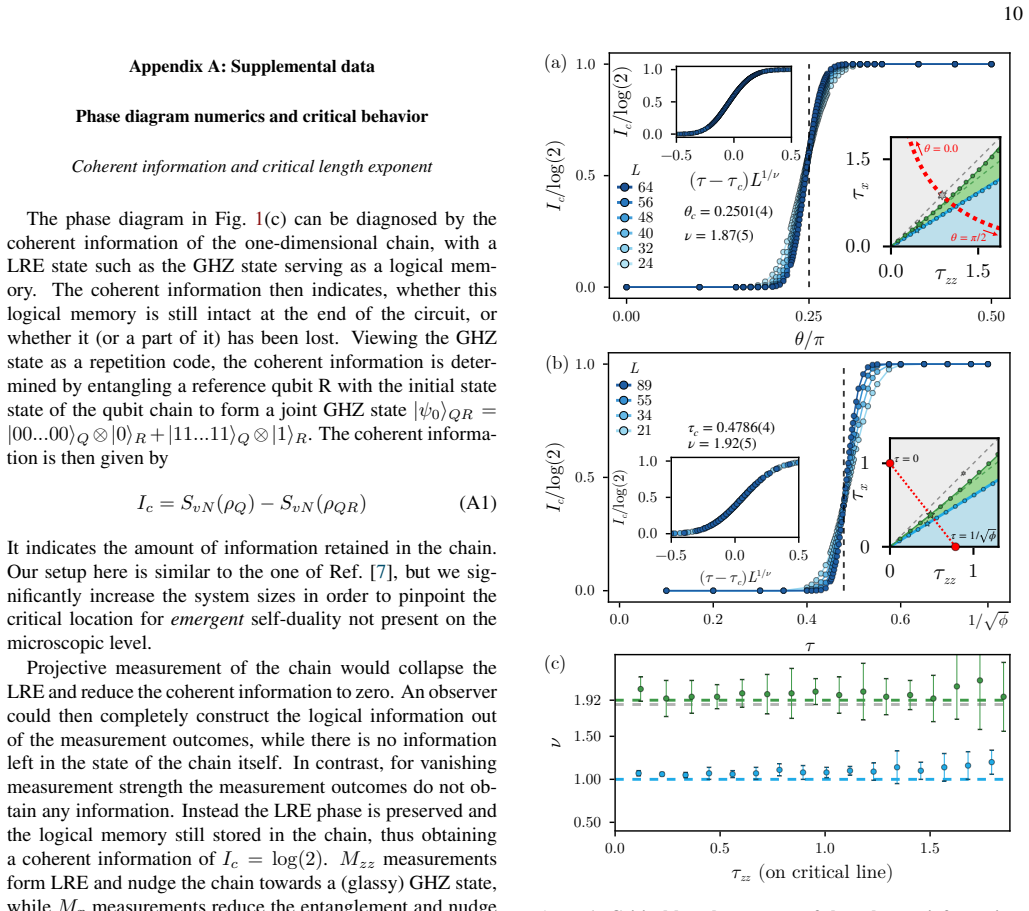
For a more precise determination of the critical locations we also adopt the “coherent information” as a diagnostic, which shows the best finite-size scaling data collapse performance [7, 61, 82]
-
[51]
Note that while the cat state maintainsZ 2 symmetry microscop- ically, in terms of phase of matter we still refer to it asZ 2 SSB phase, defined by the long-range correlation
-
[52]
Bu ˇca and T
B. Bu ˇca and T. Prosen, A note on symmetry reductions of the Lindblad equation: transport in constrained open spin chains, New J. Phys.14, 073007 (2012)
2012
-
[53]
V . V . Albert and L. Jiang, Symmetries and conserved quantities in Lindblad master equations, Phys. Rev. A89, 022118 (2014)
2014
-
[54]
S. Lieu, R. Belyansky, J. T. Young, R. Lundgren, V . V . Albert, and A. V . Gorshkov, Symmetry Breaking and Error Correc- tion in Open Quantum Systems, Phys. Rev. Lett.125, 240405 (2020)
2020
-
[55]
Ma and C
R. Ma and C. Wang, Average Symmetry-Protected Topological Phases, Phys. Rev. X13, 031016 (2023)
2023
-
[56]
J. Y . Lee, C.-M. Jian, and C. Xu, Quantum Criticality Under Decoherence or Weak Measurement, PRX Quantum4, 030317 (2023)
2023
-
[57]
Ma, J.-H
R. Ma, J.-H. Zhang, Z. Bi, M. Cheng, and C. Wang, Topologi- cal Phases with Average Symmetries: The Decohered, the Dis- ordered, and the Intrinsic, Phys. Rev. X15, 021062 (2025)
2025
-
[58]
K. Su, N. Myerson-Jain, C. Wang, C.-M. Jian, and C. Xu, Higher-Form Symmetries under Weak Measurement, Phys. Rev. Lett.132, 200402 (2024)
2024
-
[59]
P ¨utz, R
M. P ¨utz, R. Vasseur, A. W. Ludwig, S. Trebst, and G.-Y . Zhu, Flow to Nishimori Universality in Weakly Monitored Quantum Circuits with Qubit Loss, PRX Quantum6, 040372 (2025)
2025
-
[60]
For the special case of unitary conformal field theory (such as for the post-selected trajectory), cent is equivalent to the “Casimir” central charge determined via the free energy
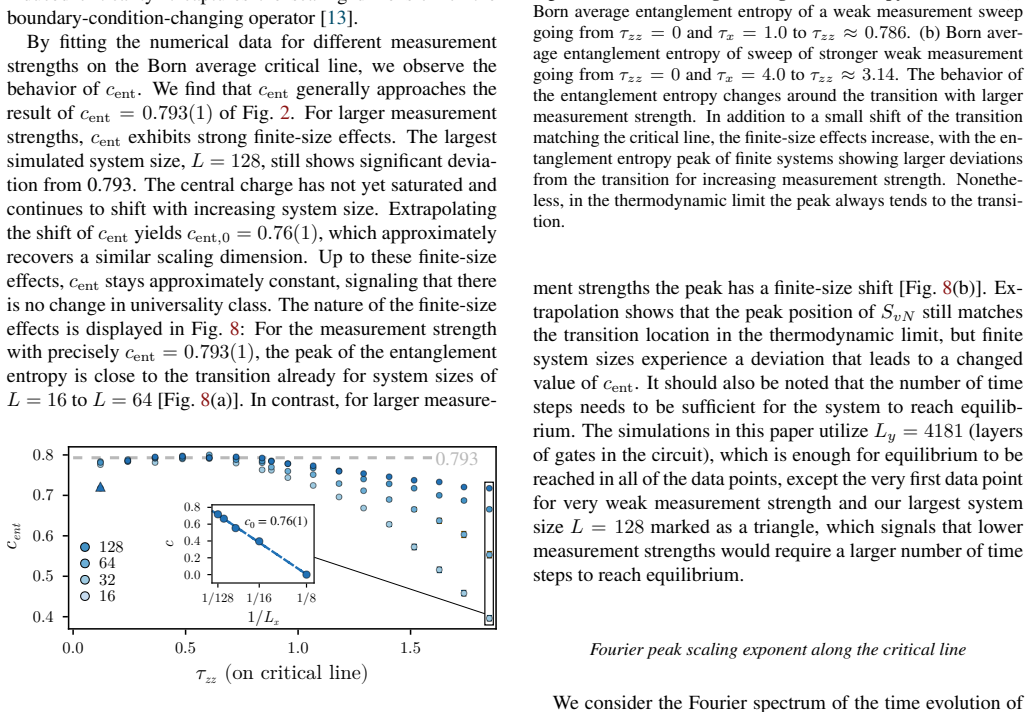
Generallyc ent is the scaling dimension of the boundary con- dition changing operator [13]. For the special case of unitary conformal field theory (such as for the post-selected trajectory), cent is equivalent to the “Casimir” central charge determined via the free energy
-
[61]
Calabrese and J
P. Calabrese and J. Cardy, Entanglement entropy and quantum field theory, J. Stat. Mech.2004, P06002 (2004)
2004
-
[62]
Calabrese and J
P. Calabrese and J. Cardy, Entanglement entropy and conformal field theory, J. Phys. A: Math. Theor.42, 504005 (2009)
2009
-
[63]
F. Eckstein, B. Han, S. Trebst, and G.-Y . Zhu, Learning transi- tions of topological surface codes (2025), arXiv:2512.19786
-
[64]
1”s and “0
Notice that with our convention of the iterative rule0→ 1,1→10, the ratio between the total number of “1”s and “0”s in a finite subsequence of the infinite Fibonacci word 10110101· · ·is asymptotically given byϕ= 1.618
-
[65]
Szyniszewski, A
M. Szyniszewski, A. Romito, and H. Schomerus, Universality of Entanglement Transitions from Stroboscopic to Continuous Measurements, Phys. Rev. Lett.125, 210602 (2020)
2020
-
[66]
Fuji and Y
Y . Fuji and Y . Ashida, Measurement-induced quantum critical- ity under continuous monitoring, Phys. Rev. B102, 054302 (2020)
2020
-
[67]
D. S. Fisher, Random transverse field Ising spin chains, Phys. Rev. Lett.69, 534 (1992)
1992
-
[68]
I. A. Gruzberg, N. Read, and A. W. W. Ludwig, Random-bond Ising model in two dimensions: The Nishimori line and super- symmetry, Phys. Rev. B63, 104422 (2001)
2001
-
[69]
Levine and P
D. Levine and P. J. Steinhardt, Quasicrystals. I. Definition and structure, Phys. Rev. B34, 596 (1986)
1986
-
[70]
D’Alessio and M
L. D’Alessio and M. Rigol, Long-time Behavior of Isolated Pe- riodically Driven Interacting Lattice Systems, Phys. Rev. X4, 041048 (2014)
2014
-
[71]
Lazarides, A
A. Lazarides, A. Das, and R. Moessner, Equilibrium states of generic quantum systems subject to periodic driving, Phys. Rev. E90, 012110 (2014)
2014
-
[72]
D. A. Abanin, W. De Roeck, W. W. Ho, and F. Huveneers, Ef- fective Hamiltonians, prethermalization, and slow energy ab- sorption in periodically driven many-body systems, Phys. Rev. B95, 014112 (2017)
2017
-
[73]
H. Zhao, F. Mintert, R. Moessner, and J. Knolle, Random Mul- tipolar Driving: Tunably Slow Heating through Spectral Engi- neering, Phys. Rev. Lett.126, 040601 (2021)
2021
-
[74]
H. Zhao, J. Knolle, and R. Moessner, Temporal disorder in spa- tiotemporal order, Phys. Rev. B108, L100203 (2023)
2023
-
[75]
Z.-H. Liu, Y . Liu, G.-H. Liang, C.-L. Deng, K. Chen, Y .-H. Shi, T.-M. Li, L. Zhang, B.-J. Chen, C.-P. Fang, D. Feng, X.-Y . Gu, Y . He, K. Huang, H. Li, H.-T. Liu, L. Li, Z.-Y . Mei, Z.-Y . Peng, J.-C. Song, M.-C. Wang, S.-L. Wang, Z. Wang, Y . Xiao, M. Xu, Y .-S. Xu, Y . Yan, Y .-H. Yu, W.-P. Yuan, J.-C. Zhang, J.- J. Zhao, K. Zhao, S.-Y . Zhou, Z.-A. ...
2026
-
[76]
M. B. Hastings and J. Haah, Dynamically Generated Logical Qubits, Quantum5, 564 (2021)
2021
-
[77]
Aasen, Z
D. Aasen, Z. Wang, and M. B. Hastings, Adiabatic paths of Hamiltonians, symmetries of topological order, and automor- phism codes, Phys. Rev. B106, 085122 (2022)
2022
-
[78]
Davydova, N
M. Davydova, N. Tantivasadakarn, and S. Balasubramanian, Floquet Codes without Parent Subsystem Codes, PRX Quan- tum4, 020341 (2023)
2023
- [79]
-
[80]
Dynamical self-dual critical- ity in Fibonacci-monitored quantum Ising chains
F. Eckstein, H. Schmid, Q. Preiss, S. Trebst, F. von Op- pen, and G.-Y . Zhu, Data for “Dynamical self-dual critical- ity in Fibonacci-monitored quantum Ising chains”, Zenodo 10.5281/zenodo.20266376 (2026)
discussion (0)
Sign in with ORCID, Apple, or X to comment. Anyone can read and Pith papers without signing in.