A Redshift-based Red Selection of Dusty Star-forming Galaxies
Pith reviewed 2026-06-30 14:36 UTC · model grok-4.3
The pith
Galaxies with rest-frame f_J/f_V > 3 at z=1.5-5.5 match most ALMA dusty star-forming sources.
A machine-rendered reading of the paper's core claim, the machinery that carries it, and where it could break.
Core claim
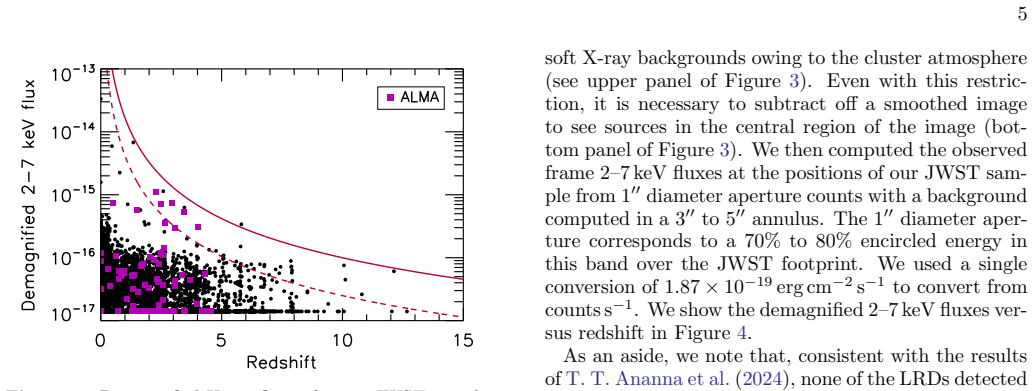
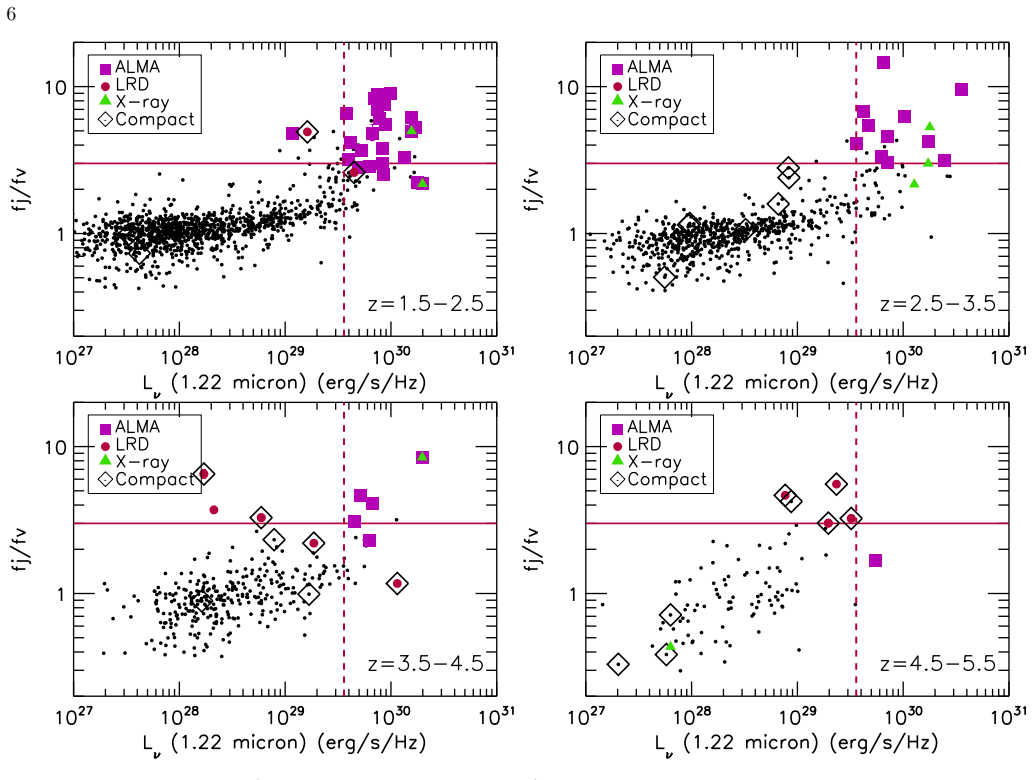
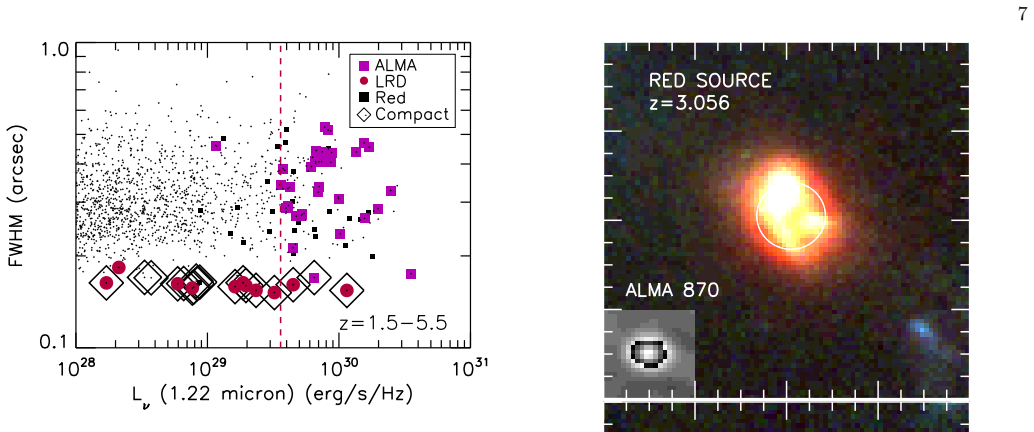
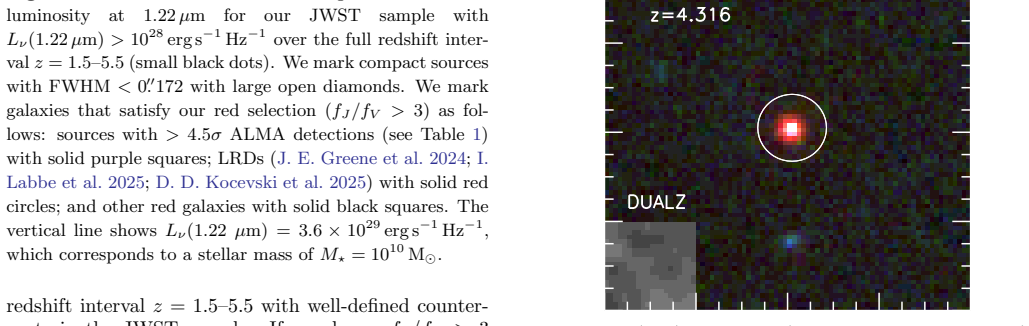
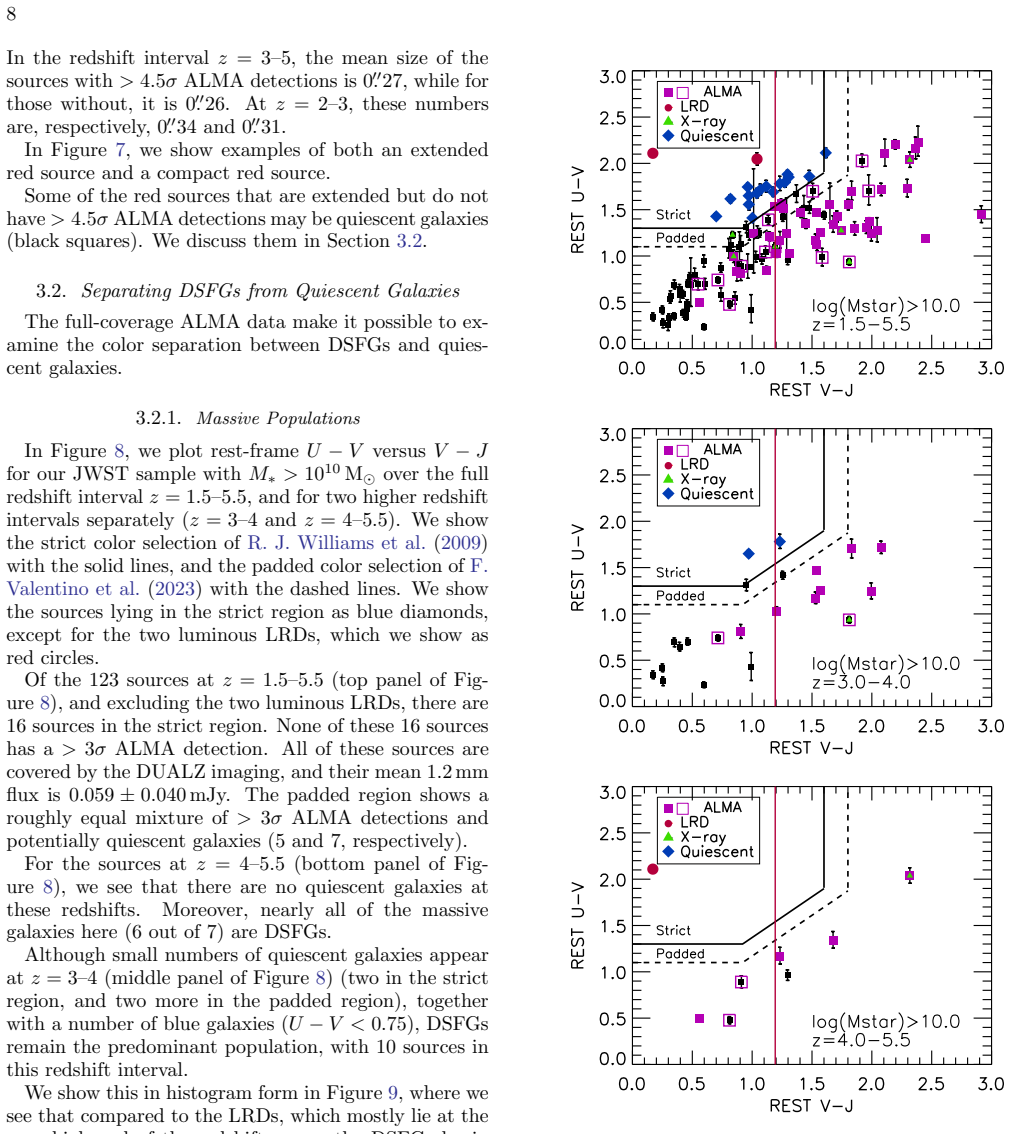
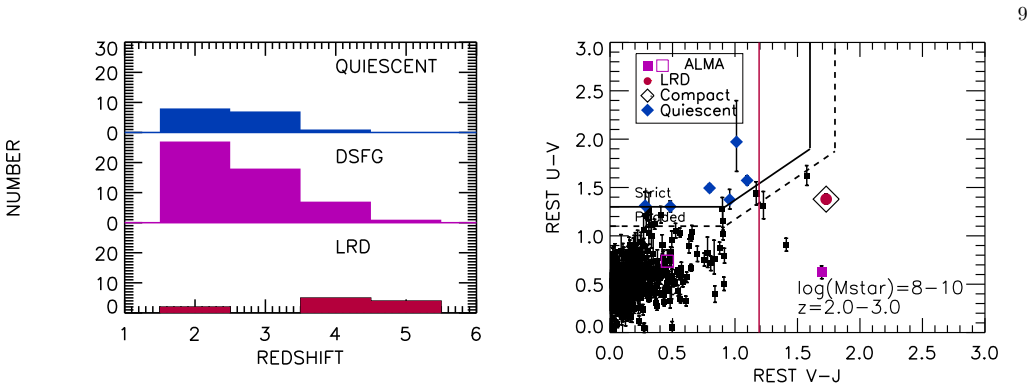
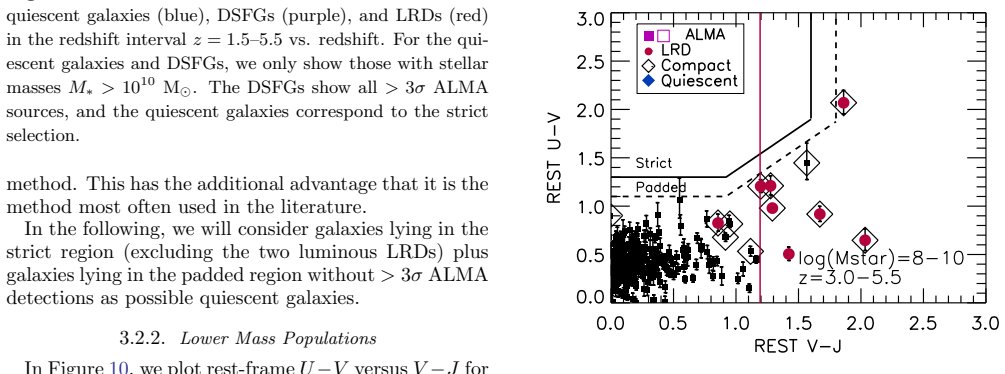
The authors establish that galaxies between z=1.5 and z=5.5 with rest-frame red colors f_J/f_V > 3 correspond to dusty star-forming galaxies (DSFGs), little red dots (LRDs), and quiescent galaxies. This color selection identifies 34 of the 41 >4.5-sigma ALMA sources (83%). Luminous red sources tend to be extended and are generally DSFGs according to ALMA data, with a few quiescent galaxies at z less than 3-4 identified via U-V versus V-J diagram, while less luminous red sources are mostly compact LRDs. Neither LRDs nor quiescent galaxies are detected above 3-sigma in ALMA images. Roughly 10 percent of the DSFGs exhibit high rest-frame X-ray luminosities and are likely AGN dominated. The DSFG
What carries the argument
Redshift-based rest-frame color cut f_J/f_V > 3 applied to JWST photometry to select red galaxy populations linked to ALMA-detectable dusty star formation.
If this is right
- The color selection recovers 83% of the bright ALMA sources.
- Luminous extended red sources are predominantly DSFGs with high stellar masses.
- Compact red sources correspond to LRDs without significant ALMA emission.
- Massive red galaxies selected this way decline in number at redshifts above 5.
- About 10% of selected DSFGs show signs of AGN activity through elevated X-ray output.
Where Pith is reading between the lines
- This selection technique could be used on larger JWST imaging surveys to pre-select DSFG candidates for targeted ALMA observations.
- The physical difference between extended DSFGs and compact LRDs may point to separate pathways in galaxy evolution.
- Extending the method to other cluster or blank fields would test its robustness across different environments.
- Combining this with X-ray data could help quantify the AGN fraction in dusty galaxies more broadly.
Load-bearing premise
The photometric or spectroscopic redshifts are accurate enough to correctly compute the rest-frame colors and ensure the galaxies lie within the specified redshift interval.
What would settle it
Detection of many galaxies satisfying the red color criterion but showing no ALMA continuum emission above 4.5 sigma, or conversely many strong ALMA sources that do not meet the color threshold when redshifts are known precisely.
Figures
read the original abstract
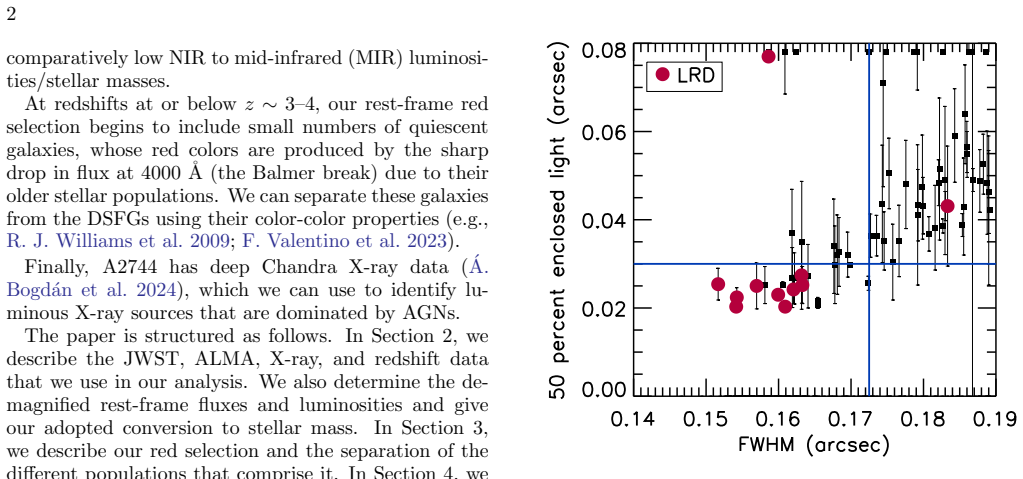
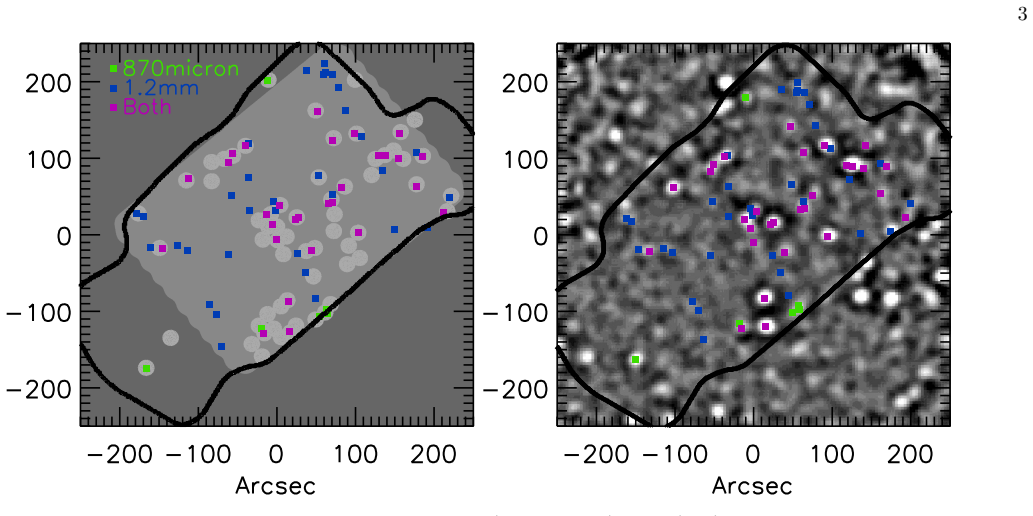
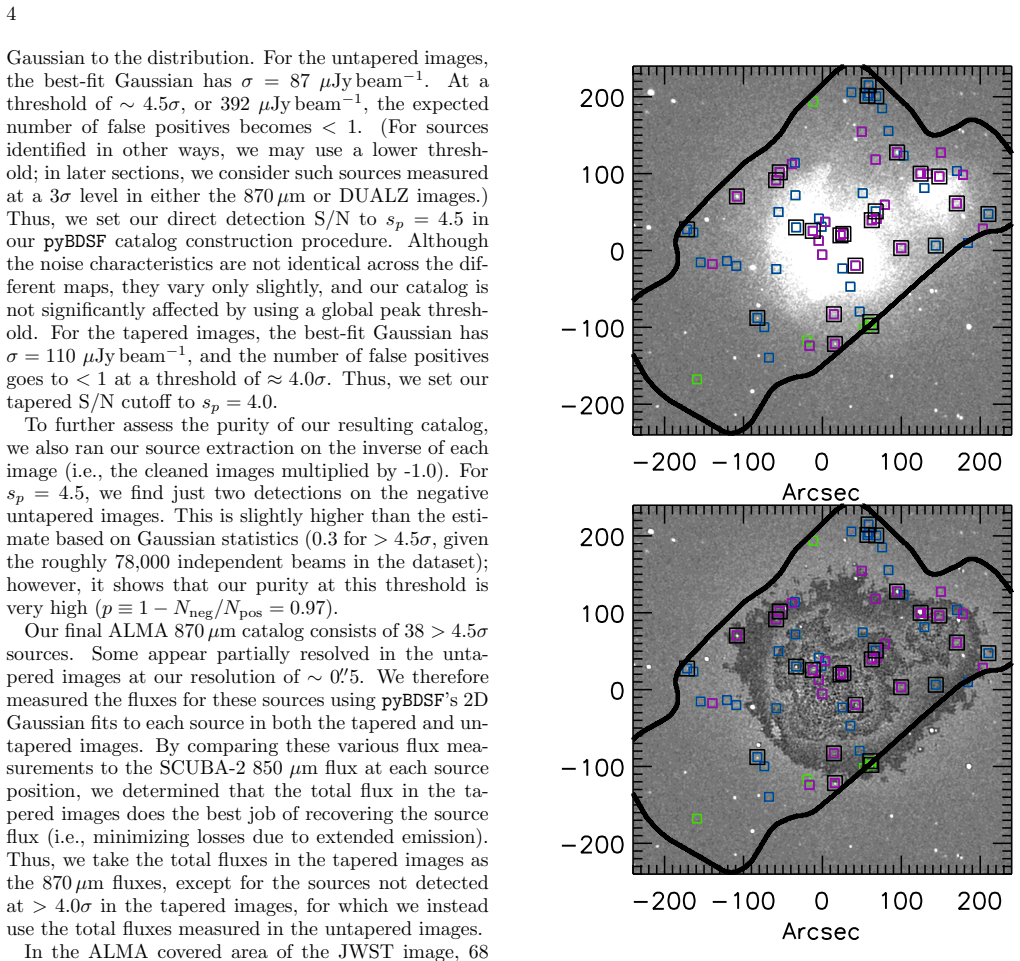
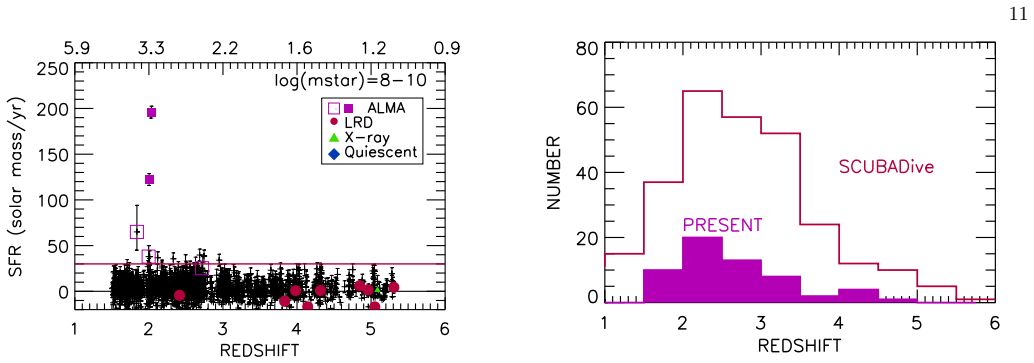
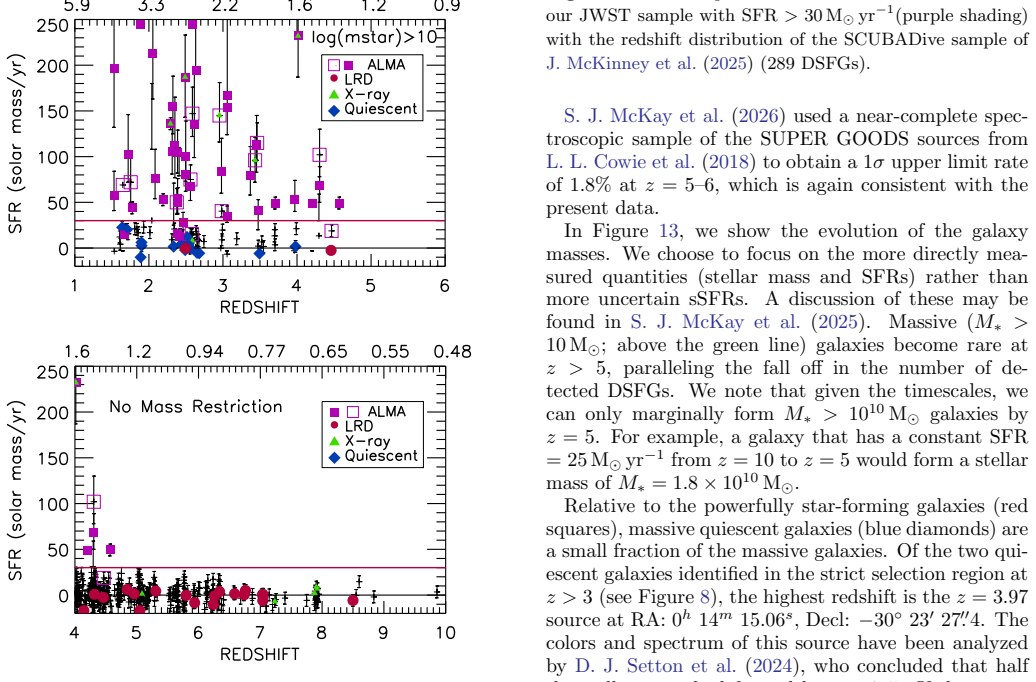
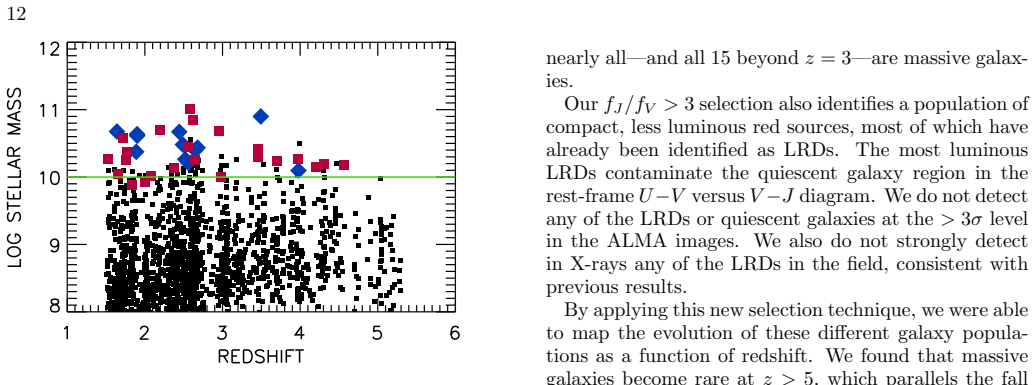
We use JWST observations (1.5 micron to 4.44 micron), together with complete ALMA observations (870 micron and/or 1.2 mm), of the massive lensing cluster field A2744 to show that galaxies between z=1.5 and z=5.5 with rest-frame red colors f_J/f_V > 3 correspond to dusty star-forming galaxies (DSFGs), little red dots (LRDs), and quiescent galaxies. The color selection picks out 34 of the 41 >4.5-sigma ALMA sources in the field (83%). We find that the luminous red sources are generally extended, while the less luminous red sources are almost all compact and correspond to the LRD population. We also find that the great majority of the luminous, extended red sources are DSFGs based on the ALMA data, with a small admixture of quiescent galaxies at z<3-4 that we identify based on their location in the rest-frame U-V versus V-J diagram. We do not detect any LRDs or quiescent galaxies at the >3-sigma level in the ALMA images. Roughly 10% of the DSFGs have high rest-frame X-ray luminosities and must be AGN dominated. The DSFGs and quiescent galaxies nearly all have M_star>10^{10} solar masses. These massive galaxies become rare at z>5, paralleling the fall off in the number of detected DSFGs.
Editorial analysis
A structured set of objections, weighed in public.
Referee Report
Summary. The paper uses JWST (1.5–4.44 µm) and complete ALMA (870 µm and/or 1.2 mm) observations of the A2744 lensing cluster field to argue that galaxies at 1.5 < z < 5.5 with rest-frame f_J/f_V > 3 correspond to dusty star-forming galaxies (DSFGs), little red dots (LRDs), and quiescent galaxies. The color cut recovers 34 of 41 >4.5-σ ALMA sources (83%), with luminous extended red sources mostly DSFGs, compact ones mostly LRDs, no ALMA detections of LRDs or quiescent galaxies, and ~10% of DSFGs being X-ray AGN; all such massive galaxies (M_star > 10^10 M_⊙) become rare above z ~ 5.
Significance. If robust, the result supplies an empirical, photometry-only selection that links a simple rest-frame color threshold to ALMA-detected DSFGs and related populations, offering a practical tool for identifying high-redshift massive dusty galaxies in wide JWST surveys. The direct cross-match with independent ALMA continuum detections provides concrete empirical grounding for the claimed correspondence.
major comments (2)
- [Abstract] Abstract: the quoted 83% recovery (34/41) and the classification into DSFGs vs. LRDs vs. quiescent galaxies both require that photometric redshifts accurately place each source inside 1.5 < z < 5.5 and correctly identify which observed JWST bands bracket rest-frame V and J. No photo-z validation (scatter, outlier fraction, or Monte-Carlo error propagation) is supplied, so it is unclear whether modest Δz/(1+z) ~ 0.05–0.15 errors near the boundaries or across the 4000 Å break would move sources in/out of the color-selected sample or change the ratio by >30%.
- [Abstract] Abstract: the statement that 'the great majority of the luminous, extended red sources are DSFGs' with only 'a small admixture of quiescent galaxies at z<3-4' is not accompanied by a quantitative breakdown (numbers or fractions) of how the 34 recovered ALMA sources are partitioned among the three populations, making it impossible to assess the strength of the DSFG association.
minor comments (1)
- The abstract refers to 'complete ALMA observations' but does not list the precise continuum depths, beam sizes, or source extraction thresholds beyond the >4.5-σ and >3-σ mentions.
Simulated Author's Rebuttal
We thank the referee for their thoughtful comments, which highlight areas where the presentation can be clarified and strengthened. We address each major comment below and will revise the manuscript accordingly.
read point-by-point responses
-
Referee: [Abstract] Abstract: the quoted 83% recovery (34/41) and the classification into DSFGs vs. LRDs vs. quiescent galaxies both require that photometric redshifts accurately place each source inside 1.5 < z < 5.5 and correctly identify which observed JWST bands bracket rest-frame V and J. No photo-z validation (scatter, outlier fraction, or Monte-Carlo error propagation) is supplied, so it is unclear whether modest Δz/(1+z) ~ 0.05–0.15 errors near the boundaries or across the 4000 Å break would move sources in/out of the color-selected sample or change the ratio by >30%.
Authors: We agree that explicit validation of the photometric redshifts is needed to quantify robustness near the redshift boundaries and across the 4000 Å break. The redshifts are drawn from existing public catalogs for the A2744 field; however, the current manuscript does not include a dedicated assessment. In the revised version we will add a short subsection (or appendix) reporting the photo-z scatter and outlier fraction against available spectroscopic redshifts in the field, together with a simple Monte Carlo propagation of redshift uncertainties to show the impact on the f_J/f_V > 3 selection and on the 83% recovery fraction. revision: yes
-
Referee: [Abstract] Abstract: the statement that 'the great majority of the luminous, extended red sources are DSFGs' with only 'a small admixture of quiescent galaxies at z<3-4' is not accompanied by a quantitative breakdown (numbers or fractions) of how the 34 recovered ALMA sources are partitioned among the three populations, making it impossible to assess the strength of the DSFG association.
Authors: We accept that the abstract would be clearer with explicit numbers. The body of the paper already classifies the sources (luminous extended red ALMA sources are predominantly DSFGs; compact red sources are LRDs; no >3σ ALMA detections among LRDs or quiescent galaxies), but the abstract omits the partition of the 34 recovered ALMA sources. We will revise the abstract to state the breakdown (e.g., X DSFGs, Y quiescent galaxies, and 0 LRDs among the 34), using the classifications already performed in the analysis. revision: yes
Circularity Check
No circularity: empirical cross-match of JWST colors/redshifts against independent ALMA detections
full rationale
The paper reports a direct observational count: galaxies selected by rest-frame f_J/f_V > 3 at 1.5 < z < 5.5 recover 34/41 ALMA sources (83%). Redshifts and JWST photometry are external inputs; ALMA continuum is an independent tracer. No equations, fitted parameters, or self-citations are shown that would make the recovery fraction reduce to a definition or prior result by construction. The redshift-accuracy issue raised by the skeptic is a potential systematic uncertainty, not a circularity in the derivation chain.
Axiom & Free-Parameter Ledger
free parameters (1)
- color threshold f_J/f_V =
3
axioms (2)
- domain assumption Redshifts are known with sufficient precision to compute accurate rest-frame f_J/f_V colors from the observed JWST bands
- domain assumption ALMA >4.5-sigma detections provide a reliable census of dusty star-forming galaxies above the flux limit
Forward citations
Cited by 1 Pith paper
-
Double Dots: Compact Pairs Mark Little Red Dots and High-Redshift Broad-line AGNs
Close compact pairs mark ~67% of known Little Red Dots and both high-redshift BLAGNs in the A2744 field, suggesting merger-driven accretion at high redshift.
Reference graph
Works this paper leans on
-
[1]
Strength in Numbers: Red Galaxies Bolster the Cosmic Star Formation Rate Density at z > 3
Ananna, T. T., Bogd´ an,´A., Kov´ acs, O. E., Natarajan, P., & Hickox, R. C. 2024, ApJL, 969, L18 Antwi-Danso, J., Papovich, C., Leja, J., et al. 2023, ApJ, 943, 166 Aravena, M., Boogaard, L., G´ onzalez-L´ opez, J., et al. 2020, ApJ, 901, 79 Barger, A. J., & Cowie, L. L. 2023, ApJ, 956, 95 Barger, A. J., Cowie, L. L., Bauer, F. E., & Gonz´ alez-L´ opez, ...
work page internal anchor Pith review Pith/arXiv arXiv 2024
-
[2]
Name R.A
JWST Sample with ALMA>4.5σDetections No. Name R.A. Decl. 870µm 1.2 mm F444Wf J /fV z µ0.5–1.2 keV 1.2–2 keV 2–8 keV J2000.0 J2000.0 (mJy) (mJy) (µJy) (10 −17 erg s−1) (1) (2) (3) (4) (5) (6) (7) (8) (9) (10) (11) (12) (13) 1 A001411-302317 3.5474167 -30.388277 4.70(0.19) 2.81(0.07) 20.86 9.00 2.05 1.61 10 5 12 2 A001408-302137 3.5362918 -30.360334 6.71(0....
2024
-
[3]
Bezanson et al
′′5 radius aperture on the R. Bezanson et al. (2024) F444W image. The 68% confidence errors on the magnification are all less than 25%, with only four greater than 10%. Two of the lowest S/N submillimeter sources have no F444W counterparts (sources 64 and
2024
discussion (0)
Sign in with ORCID, Apple, or X to comment. Anyone can read and Pith papers without signing in.