Double Dots: Compact Pairs Mark Little Red Dots and High-Redshift Broad-line AGNs
Pith reviewed 2026-06-29 11:27 UTC · model grok-4.3
The pith
Close pairs of compact sources account for most Little Red Dots and high-redshift broad-line AGNs
A machine-rendered reading of the paper's core claim, the machinery that carries it, and where it could break.
Core claim
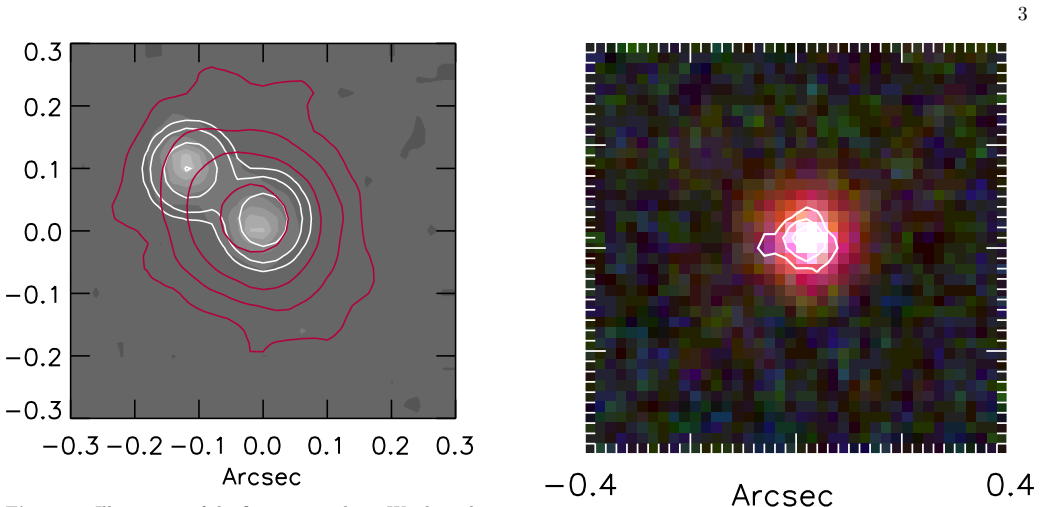
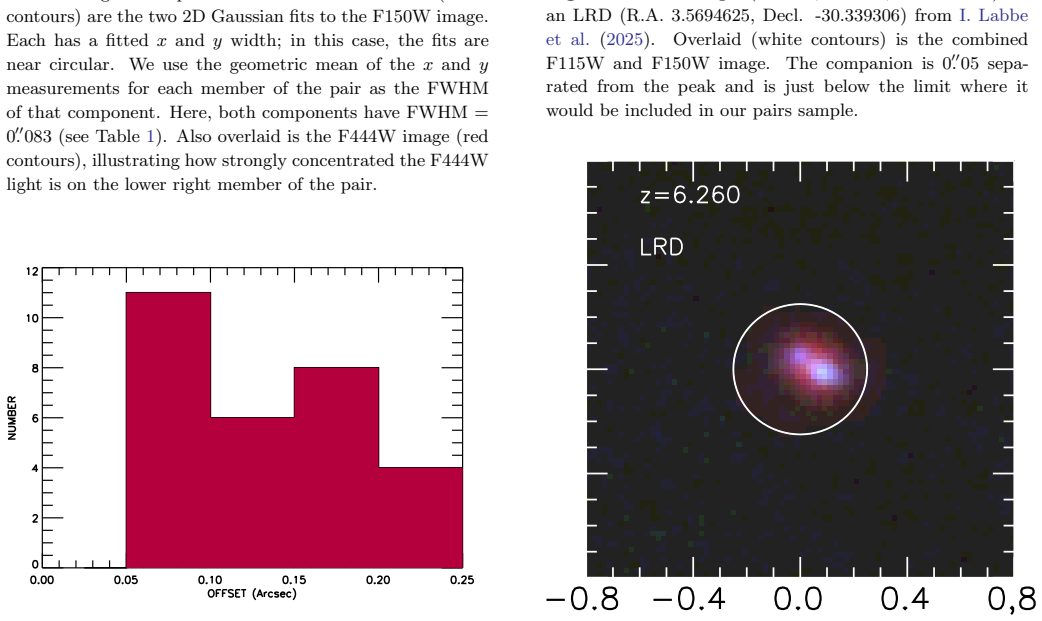
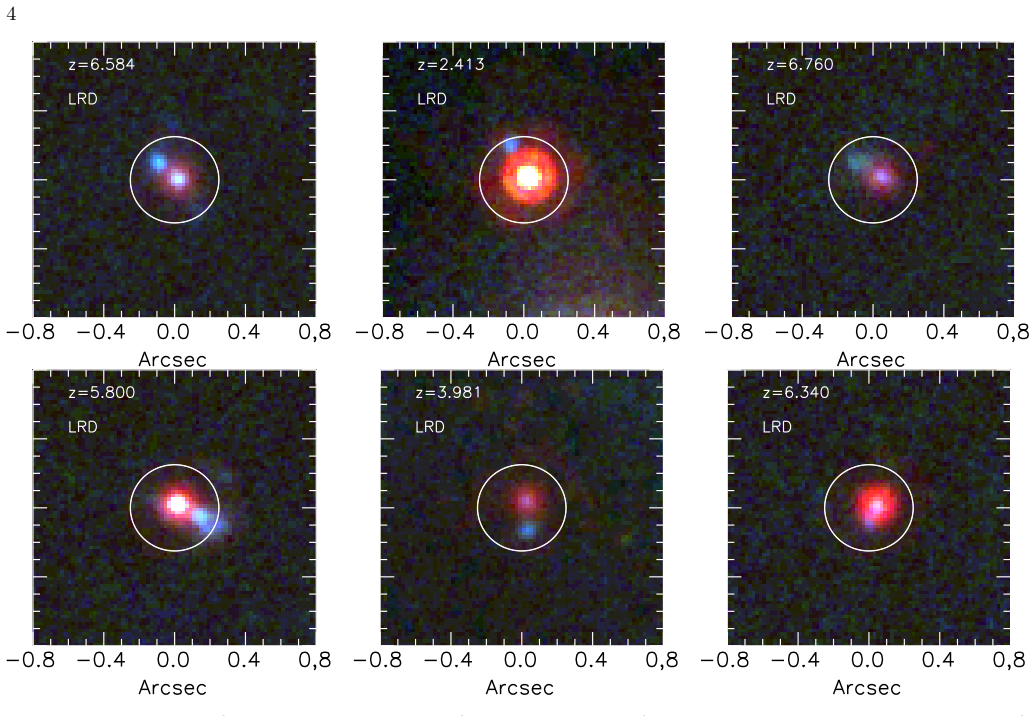
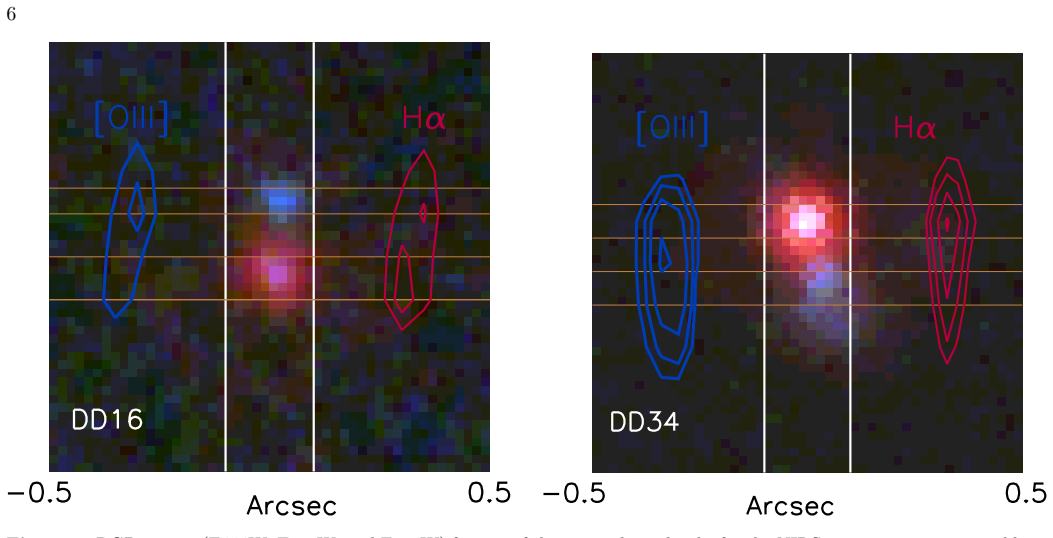
Analysis of JWST imaging reveals 31 close pairs of compact sources with separations under 0.25 arcseconds in the A2744 field. At least 16 of 24 previously published LRDs are such pairs, as are the two high-redshift BLAGNs. Statistical tests indicate these are predominantly physical pairs. Spectroscopic data show broad-line AGN activity can come from either member, and the companion often contaminates the spectral energy distribution enough to hide the characteristic v-shape used to select LRDs. The authors conclude that close pairs effectively mark high-redshift galaxies with broad emission lines and are likely produced by merger-driven accretion.
What carries the argument
Double Dots, defined as close pairs of compact sources with separations less than 0.25 arcseconds, identified through JWST imaging and shown to correspond to LRDs and BLAGNs.
If this is right
- The presence of a companion can mask the v-shape in the spectral energy distribution used for LRD classification.
- BLAGN activity is not limited to the redder member of the pair.
- Close pairs serve as effective markers for galaxies with broad lines at high redshift.
- Mergers are likely driving the accretion in these systems.
Where Pith is reading between the lines
- This association may mean that many LRD properties previously attributed to single galaxies actually reflect interacting systems.
- Surveys targeting LRDs could benefit from searching for close companions to confirm AGN activity.
- Similar pair statistics in other fields would strengthen the case for merger-driven origins of high-redshift AGNs.
- The finding raises questions about how often such pairs occur in the general high-redshift galaxy population.
Load-bearing premise
That the identified close pairs are physical associations rather than chance projections of unrelated sources.
What would settle it
Finding that the fraction of LRDs appearing as close pairs drops significantly in a large sample from a non-lensed field, or obtaining redshifts showing many pairs are at different distances.
Figures
read the original abstract
We utilize JWST imaging of the massive lensing cluster field A2744 to find close pairs of compact sources with separations less than 0.25". A large fraction of these "Double Dots" correspond to Little Red Dots (LRDs) or high-redshift broad-line active galactic nuclei (BLAGNs). Our analysis of 31 identified pairs reveals a median separation of 0.15". Statistical comparison against a uniform background shows that these are mostly physical pairs. We find that at least 16 of the 24 previously published LRDs in this field (~67%) are such pairs, as are both of the high-redshift BLAGNs. We demonstrate that the presence of a companion can significantly contaminate the measured spectral energy distribution, potentially masking the characteristic ``v-shape" used for LRD classification. Furthermore, our 2D spectroscopic analysis of several pairs reveals that BLAGN activity is not confined to the redder member of the pair but can originate in either one. Since most LRDs contain broad emission lines, our findings suggest that close pairs are extremely effective markers of galaxies with broad lines at high redshift. We speculate on possible mechanisms, concluding that we are likely seeing merger-driven accretion.
Editorial analysis
A structured set of objections, weighed in public.
Referee Report
Summary. The manuscript reports JWST imaging results from the A2744 lensing cluster field, identifying 31 close pairs ('Double Dots') of compact sources with separations <0.25 arcsec. It claims these pairs show a statistical excess over a uniform random background, indicating they are mostly physical associations; at least 16 of 24 previously published Little Red Dots (~67%) and both high-redshift broad-line AGNs in the field are such pairs. The work further argues that companions contaminate SEDs (potentially masking the v-shape LRD signature), that 2D spectroscopy shows BLAGN activity can arise in either component, and speculates that the pairs trace merger-driven accretion at high redshift.
Significance. If the pairs are confirmed as physical and the association with broad-line activity holds after proper accounting for lensing effects, the result would suggest close companions are efficient markers for high-redshift BLAGNs, with potential implications for merger-triggered AGN fueling models. The noted SED contamination effect would also be relevant for photometric classification in deep JWST fields.
major comments (2)
- [statistical comparison / background model] The statistical comparison against a uniform background (described in the abstract and the section on pair identification) does not incorporate the spatially varying magnification or shear from the published A2744 lensing maps. In a massive cluster field this can bias the chance-alignment rate at <0.25 arcsec separations, directly affecting the claim that the pairs are 'mostly physical' and the derived 67% fraction of LRDs.
- [LRD pair matching] The identification of 'at least 16 of the 24' published LRDs as pairs lacks an accompanying table or explicit matching criteria (e.g., coordinate tolerances, magnitude cuts) that would allow verification of the cross-match and assessment of completeness or false positives.
minor comments (2)
- The manuscript would benefit from including the full list of 31 pairs with coordinates, separations, and cross-identifications as a machine-readable table or supplementary data file.
- [2D spectroscopy] Details of the 2D spectroscopic analysis (specific pairs examined, extraction apertures, line-fitting methods) are referenced but not described at a level that permits independent assessment of the claim that BLAGN activity occurs in either member.
Simulated Author's Rebuttal
We thank the referee for their constructive comments, which highlight important considerations for our analysis in the A2744 field. We address each major comment below and will incorporate revisions to strengthen the manuscript.
read point-by-point responses
-
Referee: [statistical comparison / background model] The statistical comparison against a uniform background (described in the abstract and the section on pair identification) does not incorporate the spatially varying magnification or shear from the published A2744 lensing maps. In a massive cluster field this can bias the chance-alignment rate at <0.25 arcsec separations, directly affecting the claim that the pairs are 'mostly physical' and the derived 67% fraction of LRDs.
Authors: We agree that the uniform background model is an approximation and does not fully capture the effects of spatially varying magnification and shear in the A2744 lensing maps. This is a valid concern that could affect the precise quantification of the excess. In revision, we will incorporate the published lensing maps to generate a more accurate background model for chance alignments at <0.25 arcsec, including magnification and shear effects. We will update the statistical comparison, the claim regarding mostly physical pairs, and the 67% fraction accordingly if changes are material. revision: yes
-
Referee: [LRD pair matching] The identification of 'at least 16 of the 24' published LRDs as pairs lacks an accompanying table or explicit matching criteria (e.g., coordinate tolerances, magnitude cuts) that would allow verification of the cross-match and assessment of completeness or false positives.
Authors: We acknowledge that explicit documentation is needed for reproducibility. We will add a table (or supplementary table) listing the 16 matched LRDs, including their coordinates, companion separations, and the matching criteria applied (e.g., coordinate tolerance within 0.25 arcsec and any magnitude or color cuts). This will allow full verification of the cross-match, completeness, and potential false positives. revision: yes
Circularity Check
No circularity: purely observational statistical excess test
full rationale
The paper reports an empirical search for compact pairs in JWST imaging of A2744, followed by a direct count of how many published LRDs coincide with those pairs and a standard statistical comparison of pair separations against a uniform random background. No equations, fitted parameters, ansatzes, or derivations are present that could reduce any claimed result to its own inputs by construction. The central claim (excess of pairs) is an observational measurement against an external null model and does not rely on self-citation chains, uniqueness theorems, or renaming of prior results. The analysis is therefore self-contained as a discovery paper.
Axiom & Free-Parameter Ledger
Forward citations
Cited by 1 Pith paper
-
A Population of Little Red Dot-like Quasars in SDSS
Defines a sample of ~1300 SDSS quasars as Local Red Dots matching LRD photometric colors at z~0.4-0.8, with a V-shaped subset showing Balmer absorption and [NeV] emission, and SEDs modeled as reddened AGN plus host ga...
Reference graph
Works this paper leans on
-
[1]
T., Bogd´ an,´A., Kov´ acs, O
Ananna, T. T., Bogd´ an,´A., Kov´ acs, O. E., Natarajan, P., & Hickox, R. C. 2024, ApJL, 969, L18
2024
-
[2]
Baggen, J. F. W., Scoggins, M. T., van Dokkum, P., et al. 2026, arXiv e-prints, arXiv:2602.02702
work page internal anchor Pith review Pith/arXiv arXiv 2026
-
[3]
A Redshift-based Red Selection of Dusty Star-forming Galaxies
Barger, A. J., Cowie, L. L., McKay, S. J., & Bauer, F. E. 2026, arXiv e-prints, arXiv:2605.24264
work page internal anchor Pith review Pith/arXiv arXiv 2026
-
[4]
C., Volonteri, M., & Rees, M
Begelman, M. C., Volonteri, M., & Rees, M. J. 2006, MNRAS, 370, 289
2006
-
[5]
E., et al
Bezanson, R., Labbe, I., Whitaker, K. E., et al. 2024, ApJ, 974, 92
2024
-
[6]
Chisholm, J., Berg, D. A., Boylan-Kolchin, M., et al. 2026, arXiv e-prints, arXiv:2602.15935 de Graaff, A., Brammer, G., Weibel, A., et al. 2025, Astronomy & Astrophysics, 697, A189
-
[7]
Golubchik, M., Furtak, L. J., Allingham, J. F. V., et al. 2025, arXiv e-prints, arXiv:2512.02117
work page internal anchor Pith review Pith/arXiv arXiv 2025
-
[8]
E., Labbe, I., Goulding, A
Greene, J. E., Labbe, I., Goulding, A. D., et al. 2024, ApJ, 964, 39
2024
-
[9]
2023, ApJ, 959, 39
Harikane, Y., Zhang, Y., Nakajima, K., et al. 2023, ApJ, 959, 39
2023
-
[10]
Hausen, R., & Robertson, B. E. 2022, Astronomy and Computing, 39, 100586
2022
-
[11]
E., Brammer, G
Heintz, K. E., Brammer, G. B., Watson, D., et al. 2025, Astronomy & Astrophysics, 693, A60
2025
-
[12]
D., Finkelstein, S
Kocevski, D. D., Finkelstein, S. L., Barro, G., et al. 2025, ApJ, 986, 126
2025
-
[13]
2001, MNRAS, 322, 231
Kroupa, P. 2001, MNRAS, 322, 231
2001
-
[14]
E., Bezanson, R., et al
Labbe, I., Greene, J. E., Bezanson, R., et al. 2025, ApJ, 978, 92
2025
-
[15]
2011, ApJS, 192, 16
Larson, D., Dunkley, J., Hinshaw, G., et al. 2011, ApJS, 192, 16
2011
-
[16]
2006, MNRAS, 371, 1813
Lodato, G., & Natarajan, P. 2006, MNRAS, 371, 1813
2006
-
[17]
2007, MNRAS, 377, L64
Lodato, G., & Natarajan, P. 2007, MNRAS, 377, L64
2007
-
[18]
Loeb, A., & Rasio, F. A. 1994, ApJ, 432, 52
1994
-
[19]
2024, A&A, 691, A145
Maiolino, R., Scholtz, J., Curtis-Lake, E., et al. 2024, A&A, 691, A145
2024
-
[20]
Markwardt, C. B. 2009, in Astronomical Society of the Pacific Conference Series, Vol. 411, Astronomical Data Analysis Software and Systems XVIII, ed. D. A
2009
-
[21]
P., Brammer, G., et al
Matthee, J., Naidu, R. P., Brammer, G., et al. 2024, ApJ, 963, 129
2024
-
[22]
2026, A&A, 706, A372
Mazzolari, G., Gilli, R., Maiolino, R., et al. 2026, A&A, 706, A372
2026
- [23]
-
[24]
2024, ApJ, 976, 96
Pacucci, F., & Narayan, R. 2024, ApJ, 976, 96
2024
-
[25]
J., Finkelstein, S
Taylor, A. J., Finkelstein, S. L., Kocevski, D. D., et al. 2025, ApJ, 986, 165
2025
-
[26]
2022, ApJ, 935, 110
Treu, T., Roberts-Borsani, G., Bradac, M., et al. 2022, ApJ, 935, 110
2022
-
[27]
Volonteri, M., & Rees, M. J. 2005, ApJ, 633, 624
2005
-
[28]
R., Cutler, S
Weaver, J. R., Cutler, S. E., Pan, R., et al. 2024, ApJS, 270, 7 15 ACKNOWLEDGEMENTS We thank Anthony Taylor for helpful discussions. We gratefully acknowledge support for this research from the University of Wisconsin-Madison, Office of the Vice Chancellor for Research with funding from the Wisconsin Alumni Research Foundation (A. J. B.) and NASA grant 8...
2024
discussion (0)
Sign in with ORCID, Apple, or X to comment. Anyone can read and Pith papers without signing in.