On the Relation Between String Order Parameters, Entanglement, and Dynamical Quantum Phase Transitions in Topological Dynamics
Pith reviewed 2026-06-29 20:52 UTC · model grok-4.3
The pith
String order parameters show zeroes at critical times but these do not match dynamical quantum phase transition times in topological quenches.
A machine-rendered reading of the paper's core claim, the machinery that carries it, and where it could break.
Core claim
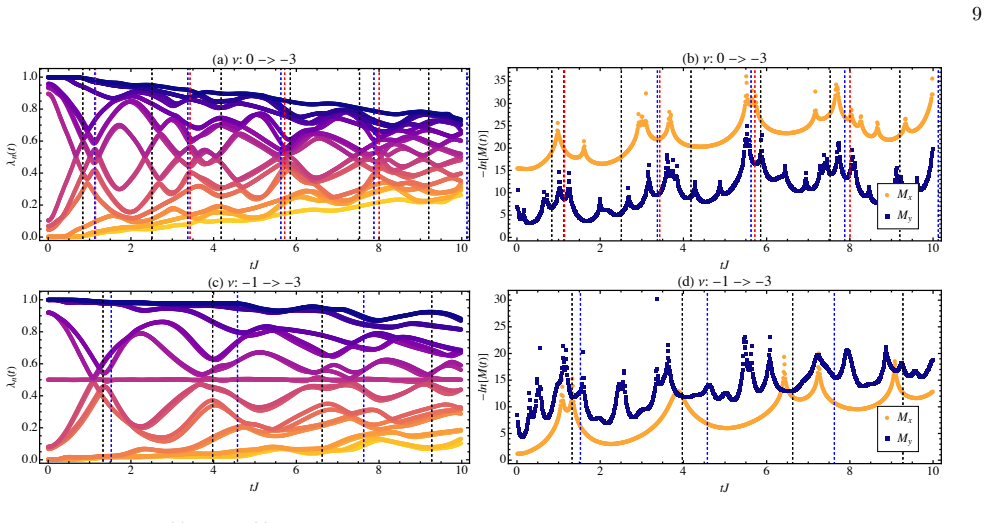
In one-dimensional Z-invariant topological systems, string order parameters and entanglement spectra evolve independently of dynamical quantum phase transitions after a quench. Clear zeroes appear in the order parameters at critical times, yet these do not correspond quantitatively or qualitatively to the critical times of the Loschmidt echo rate function. Connections to entanglement-spectrum crossings are occasional rather than general. String order parameters can exhibit non-trivial dynamics even in quenches between other topological phases.
What carries the argument
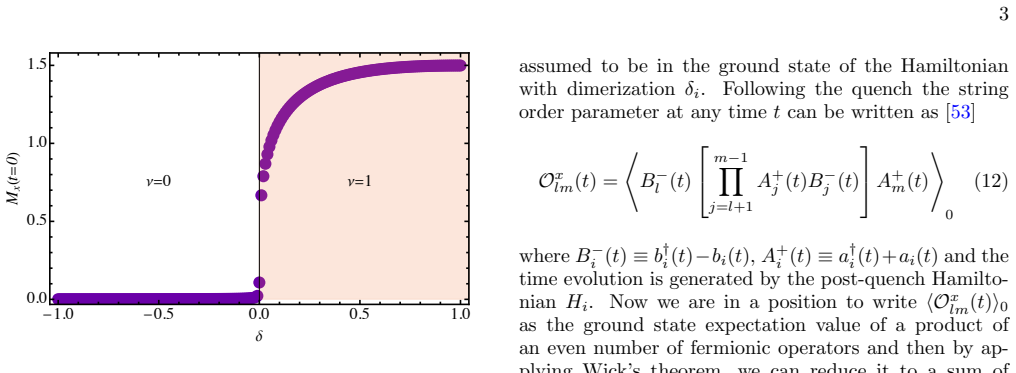
The string order parameter, used to label topological phases, whose time-dependent zeroes are compared against the non-analytic points of the Loschmidt echo that mark dynamical quantum phase transitions.
If this is right
- String order parameters labeling one phase can change non-trivially after quenches between other phases.
- Critical times of order-parameter zeroes, entanglement crossings, and dynamical quantum phase transitions tend to share the same order of magnitude.
- Each form of dynamical criticality in these models proceeds independently of the others.
- Reported connections between order-parameter zeroes and dynamical quantum phase transitions arise only when models are not chosen generally enough.
Where Pith is reading between the lines
- Experiments seeking to detect dynamical quantum phase transitions via string order parameters would need additional observables.
- The independence of these dynamical features may extend to other symmetry-protected topological systems beyond one dimension.
- Theoretical work on genuine dynamical phases after quenches may require probes that are not tied to equilibrium topological invariants.
Load-bearing premise
The one-dimensional Z-invariant models studied capture the general behavior of topological systems under quench dynamics.
What would settle it
A simulation or analytic calculation in a wider family of models that finds consistent quantitative matching between string-order-parameter zeroes and Loschmidt-echo critical times would contradict the reported absence of connection.
Figures




read the original abstract
Topological order is defined by topological invariants, rather than symmetries and local order parameters. Nonetheless some topological phases can be characterized by string order parameters and entanglement. In this article we study how string order parameters and entanglement spectra behave out-of-equilibrium following quenches in one dimensional topological models with $\mathbb{Z}$ invariants. Previously it has been suggested that string order parameters could serve as an experimental probe of dynamical quantum phase transitions. Despite the existence of clear zeroes in the order parameters at critical times, we show that in general there is no exact quantitative or qualitative connection with the critical times of dynamical quantum phase transitions. Another possible connection is of dynamical string order parameter zeroes and dynamical crossings at the center of entanglement spectra. Here we see that there can sometimes be a connection, but it is not typical. Again there is no general quantitative or qualitative connection. Each dynamical form of criticality behaves independently, though we do see that critical times tend to be of the same order of magnitude and give an argument for why this is the case. We also find that a string order parameter which labels one topological phase can undergo non-trivial dynamics even following a quench between \emph{other} topological phases. We elucidate where connections can be made, and where they result from a consideration of insufficiently general models. These results cast doubt on the idea of genuine dynamical phases following quenches in such models.
Editorial analysis
A structured set of objections, weighed in public.
Referee Report
Summary. The manuscript studies the out-of-equilibrium dynamics of string order parameters and entanglement spectra following quenches in one-dimensional topological models protected by ℤ invariants. It reports that, despite zeros appearing in the string order parameters near DQPT critical times, there is in general neither quantitative nor qualitative correspondence between these zeros and the critical times of dynamical quantum phase transitions. A similar absence of general connection is found between string-order zeros and dynamical crossings in the entanglement spectrum. The authors conclude that the two forms of dynamical criticality evolve independently (though critical times are typically of the same order of magnitude), that string order parameters can exhibit nontrivial dynamics even when the quench does not cross the phase they label, and that these observations cast doubt on the notion of genuine dynamical phases in such systems.
Significance. If the central claim holds, the work weakens the proposal that string order parameters can serve as experimental proxies for DQPTs and indicates that distinct dynamical signatures in topological quenches are not structurally linked. The observation that critical times share the same order of magnitude, together with the argument supplied for this fact, is a positive contribution. The finding that a string order parameter can evolve nontrivially under quenches between other phases is also of interest. The strength of these conclusions rests on whether the specific models examined are representative of the broader class of ℤ-invariant 1D systems.
major comments (2)
- [Abstract and §6] Abstract and §6 (Conclusions): the repeated claim of 'no exact quantitative or qualitative connection ... in general' is load-bearing for the central thesis, yet the manuscript provides no classification of ℤ-protected 1D Hamiltonians or completeness argument showing that the examined quenches (including interaction range, symmetry content, and initial-state choice) exhaust the relevant dynamical regimes. Without such an argument, the extrapolation from the studied cases to the full class remains unsupported.
- [§4] §4 (Entanglement-spectrum analysis): the statement that connections between string-order zeros and entanglement-spectrum crossings 'can sometimes be a connection, but it is not typical' is presented as a general result. The section should explicitly list the models and quench protocols in which a connection appears versus those in which it does not, together with a quantitative measure (e.g., time-difference histograms or correlation coefficients) that justifies calling the connection 'not typical.'
minor comments (2)
- [§2] Notation: the symbol for the string order parameter is introduced without an explicit definition in the main text; a short equation or reference to the standard definition (e.g., Eq. (X) in the supplemental material) should be added at first use.
- [Figures 3–5] Figure captions: several panels lack labels for the time axis units or the precise quench parameters; this reduces readability when comparing multiple models.
Simulated Author's Rebuttal
Thank you for the referee's insightful comments. We have carefully considered the points raised and provide point-by-point responses below. We believe our work provides valuable insights into the independence of different dynamical signatures in topological quenches, and we will make revisions to strengthen the presentation of our results.
read point-by-point responses
-
Referee: [Abstract and §6] Abstract and §6 (Conclusions): the repeated claim of 'no exact quantitative or qualitative connection ... in general' is load-bearing for the central thesis, yet the manuscript provides no classification of ℤ-protected 1D Hamiltonians or completeness argument showing that the examined quenches (including interaction range, symmetry content, and initial-state choice) exhaust the relevant dynamical regimes. Without such an argument, the extrapolation from the studied cases to the full class remains unsupported.
Authors: While an exhaustive classification of all possible ℤ-protected 1D Hamiltonians is outside the scope of this work, the models we consider include both non-interacting and interacting cases with varying ranges of interactions and different symmetry contents, as detailed in Sections 2 and 3. These cover the standard examples in the literature for 1D topological systems with ℤ invariants. We will revise the abstract and §6 to clarify the scope of our claims, specifying that the lack of connection is observed across this representative class of models. We argue that the topological nature of the invariants suggests the independence is a general feature, though we acknowledge the need for future work on a full classification. revision: partial
-
Referee: [§4] §4 (Entanglement-spectrum analysis): the statement that connections between string-order zeros and entanglement-spectrum crossings 'can sometimes be a connection, but it is not typical' is presented as a general result. The section should explicitly list the models and quench protocols in which a connection appears versus those in which it does not, together with a quantitative measure (e.g., time-difference histograms or correlation coefficients) that justifies calling the connection 'not typical.'
Authors: We agree that providing more explicit details would strengthen the section. In the revised manuscript, we will add a table in §4 listing all models and quench protocols examined, indicating for each whether a connection between string-order zeros and entanglement-spectrum crossings is present. Furthermore, we will include quantitative analysis, such as histograms of the time differences between these features and correlation coefficients where applicable, to demonstrate that connections are atypical. revision: yes
- Providing a complete classification of ℤ-protected 1D Hamiltonians and an exhaustive argument covering all possible quenches, interaction ranges, symmetry contents, and initial states.
Circularity Check
No significant circularity; central claim follows from explicit model calculations
full rationale
The paper derives its main result—that string-order-parameter zeros lack exact quantitative or qualitative connection to DQPT critical times or entanglement-spectrum crossings—via direct computation on representative 1D Z-invariant quenches. No equation reduces a claimed prediction to a fitted input by construction, no load-bearing premise rests solely on self-citation, and no uniqueness theorem or ansatz is imported from the authors' prior work. The representativeness assumption for generalization is an ordinary modeling choice, not a definitional loop. The derivation chain is therefore self-contained against external benchmarks.
Axiom & Free-Parameter Ledger
Forward citations
Cited by 3 Pith papers
-
Unified resonant-manifold framework for dynamical quantum phase transitions
A resonant-manifold framework unifies manifold and branch DQPTs by attributing them to resonances within the initial manifold and with a transitional manifold connected by low-order processes, shown in Z2 LGT quenches.
-
The Two Dimensional Dynamical Bulk Boundary Correspondence: Beyond Two Band Models
In a multi-Chern-number 2D topological superconductor, dynamical bulk-boundary correspondence after quenches shows no simple mapping to equilibrium invariants and depends on edge orientation.
-
Unified resonant-manifold framework for dynamical quantum phase transitions
A resonant-manifold framework unifies manifold and branch DQPTs by linking them to resonances within the initial manifold or a transitional manifold, with regularity tied to manifold multiplicity, shown in Z2 LGT quenches.
Reference graph
Works this paper leans on
-
[1]
Panel (a) is the string order parameter rescaled by its maximum value, and panel (b) is the ln of the string order parameter
Vertical dashed black lines show the DQPT critical times and red dotted lines are plotted half way between the critical times as a visual aid. Panel (a) is the string order parameter rescaled by its maximum value, and panel (b) is the ln of the string order parameter. Zeroes are clearly visible in the non- trivial to trivial quench,ν: 1→0 whereδ: 0.4→ −0....
2024
-
[2]
S. Ryu, A. P. Schnyder, A. Furusaki, and A. W. W. Lud- wig, Topological insulators and superconductors: Tenfold way and dimensional hierarchy, New Journal of Physics 12, 65010 (2010)
2010
-
[3]
M. Z. Hasan and C. L. Kane, Colloquium: Topological insulators, Reviews of Modern Physics82, 3045 (2010)
2010
-
[4]
Trifunovic and P
L. Trifunovic and P. W. Brouwer, Higher-Order Topo- logical Band Structures, physica status solidi (b)258, 2000090 (2021)
2021
-
[5]
C. K. Chiu, J. C. Teo, A. P. Schnyder, and S. Ryu, Classi- fication of topological quantum matter with symmetries, Reviews of Modern Physics88, 035005 (2016)
2016
-
[6]
Trifunovic and P
L. Trifunovic and P. W. Brouwer, Higher-order bulk- boundary correspondence for topological crystalline phases, Physical Review X9, 011012 (2019)
2019
-
[7]
G lodzik and N
S. G lodzik and N. Sedlmayr, Quantized thermal Hall conductance and the topological phase diagram of a su- perconducting bismuth bilayer, Physical Review B108, 184502 (2023). 13 0 2 4 6 8 10 0.0 0.2 0.4 0.6 0.8 1.0 tJ λn(t) (a)ν : -3 -> 0 Mx My 0 2 4 6 8 10 0 10 20 30 40 50 tJ -ln[M(t)] (b)ν : -3 -> 0 0 2 4 6 8 10 0.0 0.2 0.4 0.6 0.8 1.0 tJ λn(t) (c)ν : -...
2023
-
[8]
Den Nijs and K
M. Den Nijs and K. Rommelse, Preroughening transi- tions in crystal surfaces and valence-bond phases in quan- tum spin chains, Physical Review B40, 4709 (1989)
1989
-
[9]
Hida, Crossover between the Haldane-gap phase and the dimer phase in the spin-1/2 alternating Heisenberg chain, Physical Review B45, 2207 (1992)
K. Hida, Crossover between the Haldane-gap phase and the dimer phase in the spin-1/2 alternating Heisenberg chain, Physical Review B45, 2207 (1992)
1992
-
[10]
Hida, Ground-state phase diagram of the spin-1/2 ferromagnetic-antiferromagnetic alternating Heisenberg chain with anisotropy, Physical Review B46, 8268 (1992)
K. Hida, Ground-state phase diagram of the spin-1/2 ferromagnetic-antiferromagnetic alternating Heisenberg chain with anisotropy, Physical Review B46, 8268 (1992)
1992
-
[11]
G. Y. Chitov, Local and nonlocal order parameters in the Kitaev chain, Physical Review B97, 085131 (2018)
2018
-
[12]
M. S. Bahovadinov, O. G¨ ulseren, and J. Schnack, Lo- cal entanglement and string order parameter in dimer- ized models, Journal of Physics: Condensed Matter31, 505602 (2019)
2019
- [13]
-
[14]
Pezz` e, M
L. Pezz` e, M. Gabbrielli, L. Lepori, and A. Smerzi, Mul- tipartite Entanglement in Topological Quantum Phases, Physical Review Letters119, 1 (2017)
2017
-
[15]
Zhang, Y
Y.-r. Zhang, Y. Zeng, H. Fan, J. Q. You, and F. Nori, Characterization of Topological States via Dual Mul- tipartite Entanglement, Physical Review Letters120, 250501 (2018)
2018
-
[16]
Calvanese Strinati, L
M. Calvanese Strinati, L. Mazza, M. Endres, D. Rossini, and R. Fazio, Destruction of string order after a quantum quench, Physical Review B94, 024302 (2016)
2016
-
[17]
Anfuso and A
F. Anfuso and A. Rosch, Fragility of string orders, Phys- ical Review B76, 085124 (2007)
2007
-
[18]
M. Heyl, A. Polkovnikov, and S. Kehrein, Dynamical quantum phase transitions in the transverse-field ising model, Physical Review Letters110, 135704 (2013)
2013
-
[19]
Andraschko and J
F. Andraschko and J. Sirker, Dynamical quantum phase transitions and the Loschmidt echo: A transfer matrix approach, Physical Review B89, 125120 (2014)
2014
-
[20]
Heyl, Dynamical quantum phase transitions: A re- view, Reports on Progress in Physics81, 054001 (2018)
M. Heyl, Dynamical quantum phase transitions: A re- view, Reports on Progress in Physics81, 054001 (2018)
2018
-
[21]
Heyl, Dynamical quantum phase transitions: A brief survey, EPL (Europhysics Letters)125, 26001 (2019)
M. Heyl, Dynamical quantum phase transitions: A brief survey, EPL (Europhysics Letters)125, 26001 (2019)
2019
-
[22]
Sedlmayr, Dynamical Phase Transitions in Topologi- cal Insulators, Acta Physica Polonica A135, 1191 (2019)
N. Sedlmayr, Dynamical Phase Transitions in Topologi- cal Insulators, Acta Physica Polonica A135, 1191 (2019). 14
2019
-
[23]
Schmitt and S
M. Schmitt and S. Kehrein, Dynamical quantum phase transitions in the Kitaev honeycomb model, Physical Re- view B92, 075114 (2015)
2015
-
[24]
Vajna and B
S. Vajna and B. D´ ora, Topological classification of dy- namical phase transitions, Physical Review B91, 155127 (2015)
2015
-
[25]
Mas lowski, H
T. Mas lowski, H. Cheraghi, J. Sirker, and N. Sedlmayr, Fisher zeroes and dynamical quantum phase transitions for two- and three-dimensional models, Physical Review B110, 224302 (2024)
2024
-
[26]
Jurcevic, H
P. Jurcevic, H. Shen, P. Hauke, C. Maier, T. Brydges, C. Hempel, B. P. Lanyon, M. Heyl, R. Blatt, and C. F. Roos, Direct Observation of Dynamical Quantum Phase Transitions in an Interacting Many-Body System, Phys- ical Review Letters119, 080501 (2017)
2017
-
[27]
Fl¨ aschner, D
N. Fl¨ aschner, D. Vogel, M. Tarnowski, B. S. Rem, D. S. L¨ uhmann, M. Heyl, J. C. Budich, L. Mathey, K. Seng- stock, and C. Weitenberg, Observation of dynamical vor- tices after quenches in a system with topology, Nature Physics14, 265 (2018)
2018
-
[28]
Zhang, G
J. Zhang, G. Pagano, P. W. Hess, A. Kyprianidis, P. Becker, H. Kaplan, A. V. Gorshkov, Z.-X. Gong, and C. Monroe, Observation of a many-body dynamical phase transition with a 53-qubit quantum simulator, Nature 551, 601 (2017)
2017
-
[29]
X.-Y. Guo, C. Yang, Y. Zeng, Y. Peng, H.-K. Li, H. Deng, Y.-R. Jin, S. Chen, D. Zheng, and H. Fan, Observation of a Dynamical Quantum Phase Transition by a Super- conducting Qubit Simulation, Physical Review Applied 11, 044080 (2019)
2019
-
[30]
Smale, P
S. Smale, P. He, B. A. Olsen, K. G. Jackson, H. Sharum, S. Trotzky, J. Marino, A. M. Rey, and J. H. Thywissen, Observation of a transition between dynamical phases in a quantum degenerate Fermi gas, Science Advances5, eaax1568 (2019)
2019
-
[31]
Nie, B.-B
X. Nie, B.-B. Wei, X. Chen, Z. Zhang, X. Zhao, C. Qiu, Y. Tian, Y. Ji, T. Xin, D. Lu, and J. Li, Experimen- tal Observation of Equilibrium and Dynamical Quantum Phase Transitions via Out-of-Time-Ordered Correlators, Physical Review Letters124, 250601 (2020)
2020
-
[32]
Tian, H.-X
T. Tian, H.-X. Yang, L.-Y. Qiu, H.-Y. Liang, Y.-B. Yang, Y. Xu, and L.-M. Duan, Observation of Dynamical Quan- tum Phase Transitions with Correspondence in an Ex- cited State Phase Diagram, Physical Review Letters124, 043001 (2020)
2020
-
[33]
R. Jafari, Quench dynamics and ground state fidelity of the one-dimensional extended quantum compass model in a transverse field, Journal of Physics A: Mathematical and Theoretical49, 185004 (2016)
2016
-
[34]
Bhattacharya and A
U. Bhattacharya and A. Dutta, Interconnections between equilibrium topology and dynamical quantum phase transitions in a linearly ramped Haldane model, Phys- ical Review B95, 184307 (2017)
2017
-
[35]
Jafari and H
R. Jafari and H. Johannesson, Loschmidt Echo Revivals: Critical and Noncritical, Physical Review Letters118, 015701 (2017)
2017
-
[36]
Sedlmayr, P
N. Sedlmayr, P. Jaeger, M. Maiti, and J. Sirker, Bulk- boundary correspondence for dynamical phase transi- tions in one-dimensional topological insulators and su- perconductors, Physical Review B97, 064304 (2018)
2018
-
[37]
Jafari, H
R. Jafari, H. Johannesson, A. Langari, and M. A. Martin- Delgado, Quench dynamics and zero-energy modes: The case of the Creutz model, Physical Review B99, 054302 (2019)
2019
-
[38]
T. V. Zache, N. Mueller, J. T. Schneider, F. Jendrze- jewski, J. Berges, and P. Hauke, Dynamical Topolog- ical Transitions in the Massive Schwinger Model with a$\theta$Term, Physical Review Letters122, 050403 (2019)
2019
-
[39]
Mas lowski and N
T. Mas lowski and N. Sedlmayr, Quasiperiodic dynamical quantum phase transitions in multiband topological in- sulators and connections with entanglement entropy and fidelity susceptibility, Physical Review B101, 014301 (2020)
2020
-
[40]
Okugawa, H
R. Okugawa, H. Oshiyama, and M. Ohzeki, Mirror- symmetry-protected dynamical quantum phase transi- tions in topological crystalline insulators, Physical Re- view Research3, 043064 (2021)
2021
-
[41]
Rossi and F
L. Rossi and F. Dolcini, Nonlinear current and dynami- cal quantum phase transitions in the flux-quenched Su- Schrieffer-Heeger model, Physical Review B106, 045410 (2022)
2022
-
[42]
Mas lowski and N
T. Mas lowski and N. Sedlmayr, Dynamical bulk- boundary correspondence and dynamical quantum phase transitions in higher-order topological insulators, Physi- cal Review B108, 094306 (2023)
2023
-
[43]
T. Mas lowski and N. Sedlmayr, The dynamical bulk boundary correspondence and dynamical quantum phase transitions in the Benalcazar-Bernevig-Hughes model, Journal of Physics: Condensed Matter36, 10.1088/1361- 648X/ad4a16 (2024)
-
[44]
A Dynamical Bulk-Boundary Correspondence in Two Dimensional Topological Matter
T. Mas lowski, J. Sirker, and N. Sedlmayr, A Dynami- cal Bulk-Boundary Correspondence in Two Dimensional Topological Matter (2025), arXiv:2508.11521 [cond-mat]
work page internal anchor Pith review Pith/arXiv arXiv 2025
-
[45]
J. C. Budich and M. Heyl, Dynamical topological order parameters far from equilibrium, Physical Review B93, 085416 (2016)
2016
-
[46]
Heyl and J
M. Heyl and J. C. Budich, Dynamical topological quan- tum phase transitions for mixed states, Physical Review B96, 180304(R) (2017)
2017
-
[47]
Bhattacharya, S
U. Bhattacharya, S. Bandyopadhyay, and A. Dutta, Mixed state dynamical quantum phase transitions, Phys- ical Review B96, 180303(R) (2017)
2017
-
[48]
Cheraghi and N
H. Cheraghi and N. Sedlmayr, Dynamical quantum phase transitions following double quenches: Persistence of the initial state vs dynamical phases, New Journal of Physics 25, 103035 (2023)
2023
-
[49]
Karrasch and D
C. Karrasch and D. Schuricht, Dynamical phase transi- tions after quenches in nonintegrable models, Physical Review B87, 195104 (2013)
2013
-
[50]
Heyl, Dynamical quantum phase transitions in sys- tems with broken-symmetry phases, Physical Review Letters113, 205701 (2014)
M. Heyl, Dynamical quantum phase transitions in sys- tems with broken-symmetry phases, Physical Review Letters113, 205701 (2014)
2014
-
[51]
Wrze´ sniewski, I
K. Wrze´ sniewski, I. Weymann, N. Sedlmayr, and T. Doma´ nski, Dynamical quantum phase transitions in a mesoscopic superconducting system, Physical Review B 105, 094514 (2022)
2022
-
[52]
J. C. Halimeh, M. Van Damme, V. Zauner-Stauber, and L. Vanderstraeten, Quasiparticle Origin of Dynamical Quantum Phase Transitions, Physical Review Research 2, 033111 (2020)
2020
-
[53]
Hagym´ asi, C
I. Hagym´ asi, C. Hubig, ¨O. Legeza, and U. Schollw¨ ock, Dynamical Topological Quantum Phase Transitions in Nonintegrable Models, Physical Review Letters122, 250601 (2019)
2019
-
[54]
Uhrich, N
P. Uhrich, N. Defenu, R. Jafari, and J. C. Halimeh, Out- of-equilibrium phase diagram of long-range superconduc- 15 tors, Physical Review B101, 245148 (2020)
2020
-
[55]
C. H. Bennett, H. J. Bernstein, S. Popescu, and B. Schu- macher, Concentrating partial entanglement by local op- erations, Physical Review A53, 2046 (1996)
2046
-
[56]
Vidal, J
G. Vidal, J. I. Latorre, E. Rico, and A. Kitaev, Entangle- ment in Quantum Critical Phenomena, Physical Review Letters90, 4 (2003)
2003
-
[57]
Torlai, L
G. Torlai, L. Tagliacozzo, and G. De Chiara, Dynam- ics of the entanglement spectrum in spin chains, Journal of Statistical Mechanics: Theory and Experiment2014, P06001 (2014)
2014
-
[58]
K. P¨ oyh¨ onen and T. Ojanen, Entanglement echo and dynamical entanglement transitions, arXiv:2106.10043 [cond-mat, physics:quant-ph] (2021)
-
[59]
Gong and M
Z. Gong and M. Ueda, Topological Entanglement- Spectrum Crossing in Quench Dynamics, Physical Re- view Letters121, 250601 (2018)
2018
-
[60]
W. P. Su, J. R. Schrieffer, and A. J. Heeger, Soliton ex- citations in polyacetylene, Physical Review B22, 2099 (1980)
2099
-
[61]
Sirker, M
J. Sirker, M. Maiti, N. P. Konstantinidis, and N. Sedl- mayr, Boundary fidelity and entanglement in the symme- try protected topological phase of the SSH model, Jour- nal of Statistical Mechanics: Theory and Experiment 2014, P10032 (2014)
2014
-
[62]
E. Lieb, T. Schultz, and D. Mattis, Two soluble models of an antiferromagnetic chain, Annals of Physics16, 407 (1961)
1961
-
[63]
Barouch and B
E. Barouch and B. M. McCoy, Statistical Mechanics of the X Y Model. II. Spin-Correlation Functions, Physical Review A3, 786 (1971)
1971
-
[64]
A. Y. Kitaev, Unpaired Majorana fermions in quantum wires, Physics-Uspekhi44, 131 (2001)
2001
-
[65]
Kitaev, Periodic table for topological insulators and superconductors, AIP Conference Proceedings1134, 22 (2009)
A. Kitaev, Periodic table for topological insulators and superconductors, AIP Conference Proceedings1134, 22 (2009)
2009
-
[66]
J. C. Y. Teo and C. L. Kane, Topological defects and gapless modes in insulators and superconductors, Physi- cal Review B82, 115120 (2010)
2010
-
[67]
Vajna and B
S. Vajna and B. D´ ora, Disentangling dynamical phase transitions from equilibrium phase transitions, Physical Review B89, 161105(R) (2014)
2014
-
[68]
Yang and Z
J. Yang and Z. Yan, Universal criterion and topological characterization of dynamical quantum phase transitions in quenched Dirac Hamiltonians, Physical Review B113, 184309 (2026)
2026
-
[69]
Micallo, V
T. Micallo, V. Vitale, M. Dalmonte, and P. Fromholz, Topological entanglement properties of disconnected par- titions in the Su-Schrieffer-Heeger model, SciPost Physics Core3, 012 (2020)
2020
-
[70]
Bhattacharyya, S
S. Bhattacharyya, S. G lodzik, and N. Sedlmayr, On the Relation Between String Order Parameters, Entangle- ment, and Dynamical Quantum Phase Transitions in Topological Dynamics (2026)
2026
discussion (0)
Sign in with ORCID, Apple, or X to comment. Anyone can read and Pith papers without signing in.