Black string immersed in perfect fluid dark matter
Pith reviewed 2026-06-29 20:41 UTC · model grok-4.3
The pith
An exact black string solution in anti-de Sitter space incorporates perfect fluid dark matter via a logarithmic metric term and shows heat capacity divergence at a critical radius.
A machine-rendered reading of the paper's core claim, the machinery that carries it, and where it could break.
Core claim
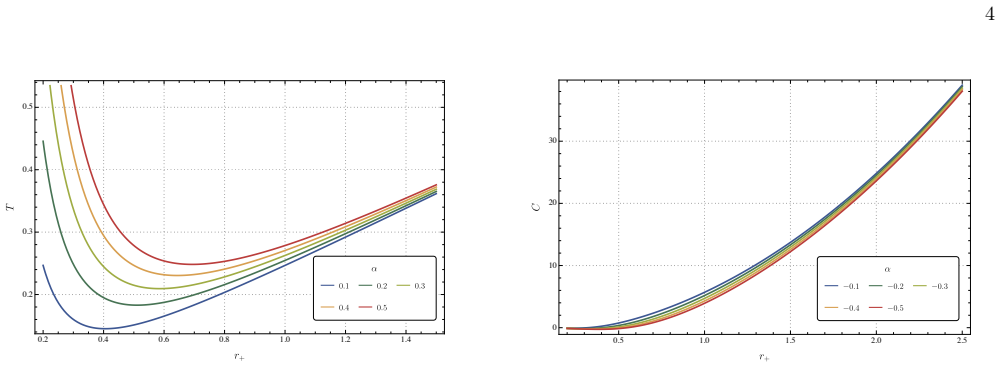
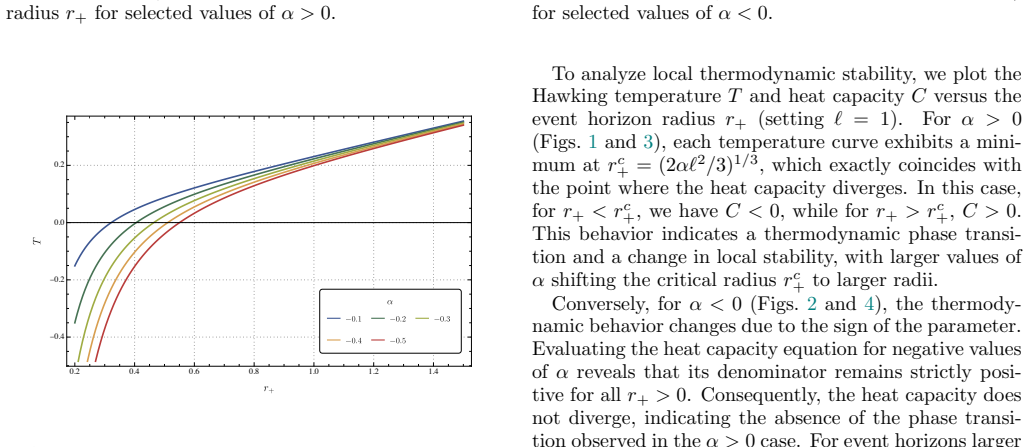
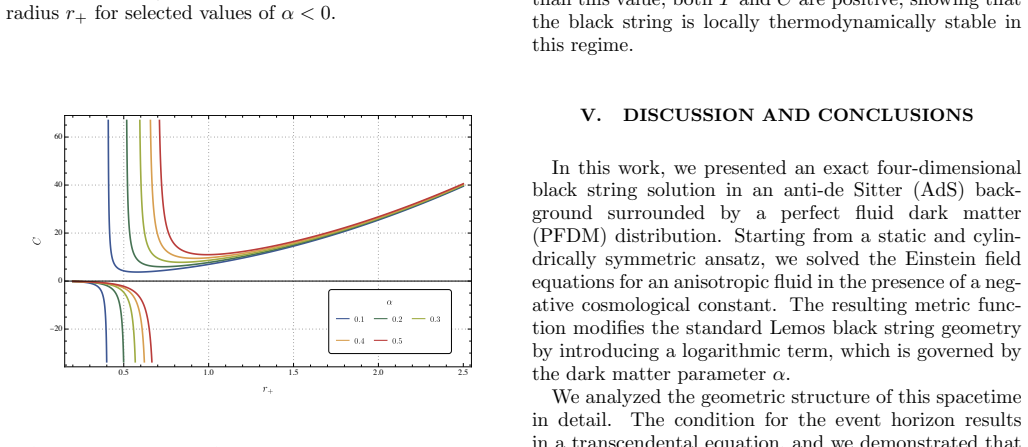
We present an exact four-dimensional black string solution immersed in perfect fluid dark matter within an anti-de Sitter background. By solving the Einstein field equations for an anisotropic fluid, we obtain a metric function that modifies the standard black string geometry through a logarithmic term governed by the dark matter parameter α. The event horizon radii are analytically determined using the Lambert W function, and the Kretschmann scalar confirms a genuine curvature singularity at the origin alongside the expected asymptotic behavior. Furthermore, we evaluate the thermodynamic properties of the solution. The heat capacity diverges at a critical horizon radius for α>0, a behavior
What carries the argument
The metric function containing a logarithmic correction set by the dark matter parameter α, obtained from an anisotropic perfect fluid stress-energy tensor in AdS spacetime.
If this is right
- Event horizon locations are given explicitly by the Lambert W function.
- The Kretschmann scalar identifies a true curvature singularity at the origin.
- Heat capacity diverges at a critical radius for positive alpha, indicating a thermodynamic phase transition despite violation of the weak energy condition.
Where Pith is reading between the lines
- Such solutions could serve as models for black strings embedded in dark matter distributions around galaxies.
- The regime of weak energy condition violation may require further checks on causal structure or stability under perturbations.
- Similar logarithmic corrections might appear in generalizations to rotating or higher-dimensional black strings.
Load-bearing premise
Dark matter can be represented by a perfect fluid with a specific anisotropic stress-energy tensor that permits an exact solution of the Einstein equations in anti-de Sitter space.
What would settle it
Calculate the heat capacity from the derived metric function and verify whether it diverges at the predicted critical horizon radius when alpha is positive.
Figures
read the original abstract
We present an exact four-dimensional black string solution immersed in perfect fluid dark matter within an anti-de Sitter background. By solving the Einstein field equations for an anisotropic fluid, we obtain a metric function that modifies the standard black string geometry through a logarithmic term governed by the dark matter parameter $\alpha$. The event horizon radii are analytically determined using the Lambert $W$ function, and the Kretschmann scalar confirms a genuine curvature singularity at the origin alongside the expected asymptotic behavior. Furthermore, we evaluate the thermodynamic properties of the solution. The heat capacity diverges at a critical horizon radius for $\alpha>0$, a behavior commonly associated with a thermodynamic phase transition in a regime where the weak energy condition is violated.
Editorial analysis
A structured set of objections, weighed in public.
Referee Report
Summary. The paper claims to present an exact four-dimensional black string solution in an AdS background immersed in perfect fluid dark matter, obtained by solving the Einstein equations for an anisotropic fluid. The metric function includes a logarithmic term controlled by the dark matter parameter α. Event horizons are determined analytically using the Lambert W function, the Kretschmann scalar is evaluated to confirm a curvature singularity at the origin, and thermodynamic quantities are computed, with the heat capacity diverging at a critical horizon radius for α>0, interpreted as indicating a thermodynamic phase transition in a regime where the weak energy condition is violated.
Significance. If the solution is correctly derived and the thermodynamic interpretation is justified, the work supplies an analytic example of black string geometry and thermodynamics in the presence of anisotropic dark matter, which could be useful for exploring modified black hole solutions in AdS. The exact solvability and closed-form horizon radii via the Lambert W function are explicit strengths that facilitate further analysis.
major comments (2)
- [Thermodynamics analysis] Thermodynamics section: the claim that heat capacity divergence signals a thermodynamic phase transition (abstract and thermodynamics analysis) is presented without additional support such as a stability analysis or comparison to known phantom-fluid cases, despite the explicit statement that this occurs in a WEC-violating regime; this interpretation is load-bearing for the central thermodynamic claim.
- [Metric derivation] Solution construction: while the abstract states that the metric is obtained by direct solution of the Einstein equations with the given anisotropic stress-energy tensor, the manuscript provides no explicit verification (e.g., substitution back into the field equations or component-by-component check) that the logarithmic term satisfies the equations for the chosen fluid; this is necessary to confirm the exact solution.
minor comments (1)
- [Horizon radii] The range of α for which the solution is physically relevant (e.g., positive mass or horizon existence) could be stated more explicitly with reference to the Lambert W branch used.
Simulated Author's Rebuttal
We thank the referee for the careful reading and constructive comments on our manuscript. We respond point by point to the major comments below, indicating the revisions we will make.
read point-by-point responses
-
Referee: [Thermodynamics analysis] Thermodynamics section: the claim that heat capacity divergence signals a thermodynamic phase transition (abstract and thermodynamics analysis) is presented without additional support such as a stability analysis or comparison to known phantom-fluid cases, despite the explicit statement that this occurs in a WEC-violating regime; this interpretation is load-bearing for the central thermodynamic claim.
Authors: We agree that the interpretation would be strengthened by additional support. While divergence of heat capacity is a standard indicator of phase transitions in black hole thermodynamics, the WEC-violating regime warrants explicit caveats. We will revise the thermodynamics section to include a brief comparison with known phantom-fluid examples and clarify the limitations of the phase-transition claim. revision: yes
-
Referee: [Metric derivation] Solution construction: while the abstract states that the metric is obtained by direct solution of the Einstein equations with the given anisotropic stress-energy tensor, the manuscript provides no explicit verification (e.g., substitution back into the field equations or component-by-component check) that the logarithmic term satisfies the equations for the chosen fluid; this is necessary to confirm the exact solution.
Authors: The referee correctly notes the absence of explicit verification. Although the metric was obtained by solving the Einstein equations, we will add the component-by-component substitution of the metric and stress-energy tensor into the field equations to confirm consistency. This verification will be inserted in the solution construction section of the revised manuscript. revision: yes
Circularity Check
No circularity: direct solution of Einstein equations yields metric and thermodynamics
full rationale
The derivation proceeds by assuming an anisotropic perfect-fluid stress-energy tensor in AdS, substituting into the Einstein equations, and integrating to obtain the metric function containing the logarithmic term controlled by α. Horizon locations follow from solving f(r)=0 with the Lambert W function; curvature invariants and thermodynamic quantities (mass, temperature, heat capacity) are then computed directly from the metric. No parameter is fitted to data and then relabeled as a prediction, no self-citation supplies a load-bearing uniqueness theorem, and the WEC violation is stated explicitly rather than hidden by redefinition. The heat-capacity divergence is a straightforward algebraic consequence of the explicit C(r) expression and is not forced by any prior fit or circular definition.
Axiom & Free-Parameter Ledger
free parameters (1)
- α
axioms (2)
- standard math Einstein field equations in four dimensions with negative cosmological constant
- domain assumption Dark matter modeled as perfect fluid with anisotropic pressure allowing exact solution
Forward citations
Cited by 1 Pith paper
-
Charged black string immersed in a quintessence fluid and string cloud
New exact charged black-string solution in Einstein gravity coupled to Kiselev quintessence plus string cloud, with horizon, curvature, energy-condition, thermodynamic, and null-geodesic analysis.
Reference graph
Works this paper leans on
-
[1]
Sumati Surya, Kristin Schleich, and Donald M. Witt. Phase transitions for flat AdS black holes.Phys. Rev. Lett., 86:5231–5234, 2001.arXiv:hep-th/0101134,doi: 10.1103/PhysRevLett.86.5231
work page internal anchor Pith review Pith/arXiv arXiv doi:10.1103/physrevlett.86.5231 2001
-
[2]
Vitor Cardoso and Jose P. S. Lemos. Quasinormal modes of toroidal, cylindrical and planar black holes in anti-de Sitter space-times.Class. Quant. Grav., 18:5257–5267, 2001.arXiv:gr-qc/0107098,doi:10.1088/0264-9381/ 18/23/319
work page internal anchor Pith review Pith/arXiv arXiv doi:10.1088/0264-9381/ 2001
-
[3]
Vacuum polarization on topological black holes
Thomas Morley, Peter Taylor, and Elizabeth Winstanley. Vacuum polarization on topological black holes.Class. Quant. Grav., 35(23):235010, 2018.arXiv:1808.04386, doi:10.1088/1361-6382/aae45b
work page internal anchor Pith review Pith/arXiv arXiv doi:10.1088/1361-6382/aae45b 2018
-
[4]
Md Sabir Ali, Fazlay Ahmed, and Sushant G. Ghosh. Black string surrounded by a static anisotropic quintessence fluid.Annals Phys., 412:168024, 2020. arXiv:1911.10946,doi:10.1016/j.aop.2019.168024
-
[5]
Barbosa, and Celso de Camargo Barros
Maria de Lourdes Deglmann, Leonardo G. Barbosa, and Celso de Camargo Barros. Black strings and string clouds embedded in anisotropic quintessence: Solutions for scalar particles and implications.Annals Physics, 475:169948, 2025.doi:10.1016/j.aop.2025.169948
-
[7]
Barbosa, Victor Hugo M
Leonardo G. Barbosa, Victor Hugo M. Ramos, Luis Ce- sar N. dos Santos, and Celso C. Barros. Kiselev black strings: the charged rotating solutions.Classical and Quantum Gravity, 42(9):095016, 2025.doi:10.1088/ 1361-6382/add078
2025
-
[9]
J. P. S. Lemos. Cylindrical black hole in general relativ- ity.Physics Letters B, 353:46–51, 1995.doi:10.1016/ 0370-2693(95)00533-Q
1995
-
[10]
Jose P. S. Lemos and Vilson T. Zanchin. Rotating charged black string and three-dimensional black holes. Physical Review D, 54:3840–3853, 1996.doi:10.1103/ PhysRevD.54.3840
1996
-
[11]
BLACK HOLES IN THREE-DIMENSIONAL DILATON GRAVITY THEORIES
Paulo M. Sa, Antares Kleber, and Jose P. S. Lemos. Black holes in three-dimensional dilaton gravity theories.Class. Quant. Grav., 13:125–138, 1996.arXiv:hep-th/9503089, doi:10.1088/0264-9381/13/1/011
work page internal anchor Pith review Pith/arXiv arXiv doi:10.1088/0264-9381/13/1/011 1996
-
[12]
Black string in mas- sive gravity.Nucl
Seyed Hossein Hendi, Hayedeh Zarei, Mir Faizal, Behnam Pourhassan, and Zahra Armanfard. Black string in mas- sive gravity.Nucl. Phys. B, 965:115362, 2021.arXiv: 2004.13143,doi:10.1016/j.nuclphysb.2021.115362
-
[13]
Mimetic Black Strings.JHEP, 07:031, 2020.arXiv:2002.11718,doi:10.1007/JHEP07(2020) 031
Ahmad Sheykhi. Mimetic Black Strings.JHEP, 07:031, 2020.arXiv:2002.11718,doi:10.1007/JHEP07(2020) 031
-
[14]
Ghosh, Rahul Kumar, Lunchakorn Tannukij, and Pitayuth Wongjun
Sushant G. Ghosh, Rahul Kumar, Lunchakorn Tannukij, and Pitayuth Wongjun. Rotating black strings in de Rham-Gabadadze-Tolley massive gravity.Phys. Rev. D, 101(10):104042, 2020.arXiv:1903.08809,doi:10.1103/ PhysRevD.101.104042
-
[15]
Greybody factor for black string in dRGT massive gravity
P. Boonserm, T. Ngampitipan, and P. Wongjun. Grey- body factor for black string in dRGT massive gravity. Eur. Phys. J. C, 79(4):330, 2019.arXiv:1902.05215, doi:10.1140/epjc/s10052-019-6827-z
work page internal anchor Pith review Pith/arXiv arXiv doi:10.1140/epjc/s10052-019-6827-z 2019
-
[16]
Roberta D´ arlla, Francisco A. Brito, and Job Furtado. Black String Solutions in Rainbow Gravity.Uni- 6 verse, 9(6):297, 2023.arXiv:2301.03921,doi:10.3390/ universe9060297
- [17]
-
[18]
L. A. Lessa, J. E. G. Silva, and J. Furtado. Black string solutions in Lifshitz spacetime.Eur. Phys. J. C, 85(1):62, 2025.arXiv:2406.10138,doi:10.1140/epjc/ s10052-025-13818-6
-
[19]
R. Darlla, ¨O. Ye¸ silta¸ s, and J. Furtado. Massless fermions in black string spacetime.EPL, 149(1):19001, 2025. arXiv:2403.17604,doi:10.1209/0295-5075/ada0d6
-
[20]
Small black string thermodynamics
Jyotish Kumar, Sudhaker Upadhyay, and Himanshu Ku- mar Sudhanshu. Small black string thermodynamics. Phys. Scripta, 98(9):095306, 2023.arXiv:2308.11695, doi:10.1088/1402-4896/aceec3
-
[21]
Matheus E. Pereira and Alexandre G. M. Schmidt. Ana- logue black string in a quantum harmonic oscillator. Phys. Lett. A, 554:130764, 2025.arXiv:2501.00478, doi:10.1016/j.physleta.2025.130764
-
[22]
Galactic Dark Matter in the Phantom Field
Ming-Hsun Li and Kwei-Chou Yang. Galactic Dark Mat- ter in the Phantom Field.Phys. Rev. D, 86:123015, 2012. arXiv:1204.3178,doi:10.1103/PhysRevD.86.123015
work page internal anchor Pith review Pith/arXiv arXiv doi:10.1103/physrevd.86.123015 2012
-
[23]
Zhaoyi Xu, Xian Hou, Jiancheng Wang, and Yi Liao. Per- fect fluid dark matter influence on thermodynamics and phase transition for a Reissner-Nordstrom-anti-de Sitter black hole.Adv. High Energy Phys., 2019:2434390, 2019. arXiv:1610.05454,doi:10.1155/2019/2434390
work page internal anchor Pith review Pith/arXiv arXiv doi:10.1155/2019/2434390 2019
-
[24]
B. Hamil and B. C. L¨ utf¨ uo˘ glu. Schwarzschild black hole surrounded by perfect fluid dark matter in the presence of quintessence matter field.Annals Phys., 472:169861, 2025.arXiv:2404.06575,doi:10.1016/j. aop.2024.169861
work page doi:10.1016/j 2025
-
[25]
Bilel Hamil and Bekir Can L¨ utf¨ uo˘ glu. Schwarzschild black hole surrounded by a cloud of strings in the back- ground of perfect fluid dark matter*.Chin. Phys. C, 49(2):025107, 2025.arXiv:2410.09551,doi:10.1088/ 1674-1137/ad9894
-
[26]
Marcony S. Cunha, G. Alencar, Celio R. Muniz, Valdir B. Bezerra, and Hor´ acio S. Vieira. Black strings from dark matter.Annals Phys., 453:169324, 2023.arXiv:2205. 07642,doi:10.1016/j.aop.2023.169324
-
[27]
S. W. Hawking. Particle Creation by Black Holes. Commun. Math. Phys., 43:199–220, 1975. [Erratum: Commun.Math.Phys. 46, 206 (1976)].doi:10.1007/ BF02345020
1975
-
[28]
Jacob D. Bekenstein. Black holes and entropy.Phys. Rev. D, 7:2333–2346, 1973.doi:10.1103/PhysRevD.7.2333
discussion (0)
Sign in with ORCID, Apple, or X to comment. Anyone can read and Pith papers without signing in.