Relaxation-driven topological domains in moir\'e materials
Pith reviewed 2026-06-29 16:25 UTC · model grok-4.3
The pith
Structural relaxation in twisted bilayer BiSb creates coexisting topological and trivial domains inside each moiré unit cell.
A machine-rendered reading of the paper's core claim, the machinery that carries it, and where it could break.
Core claim
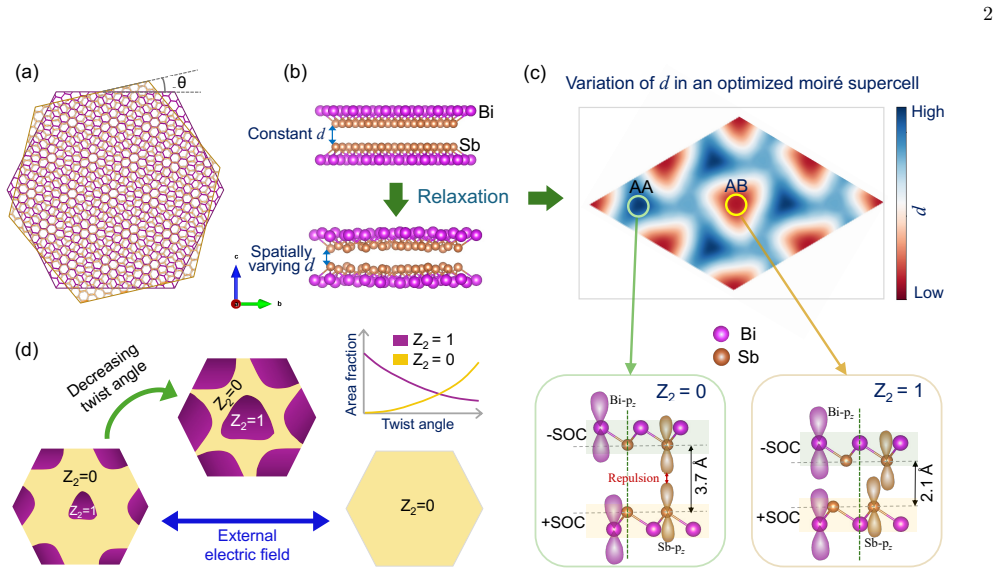
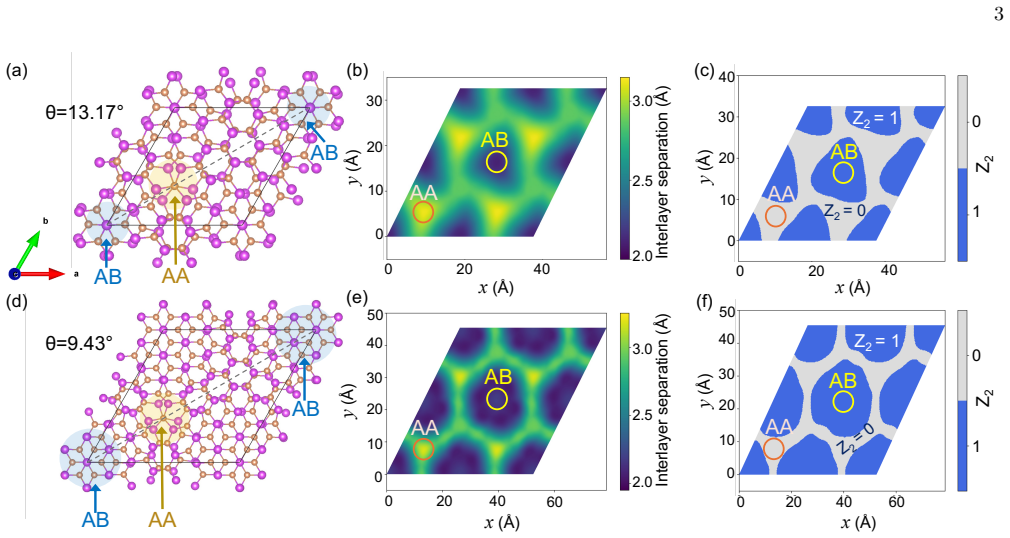
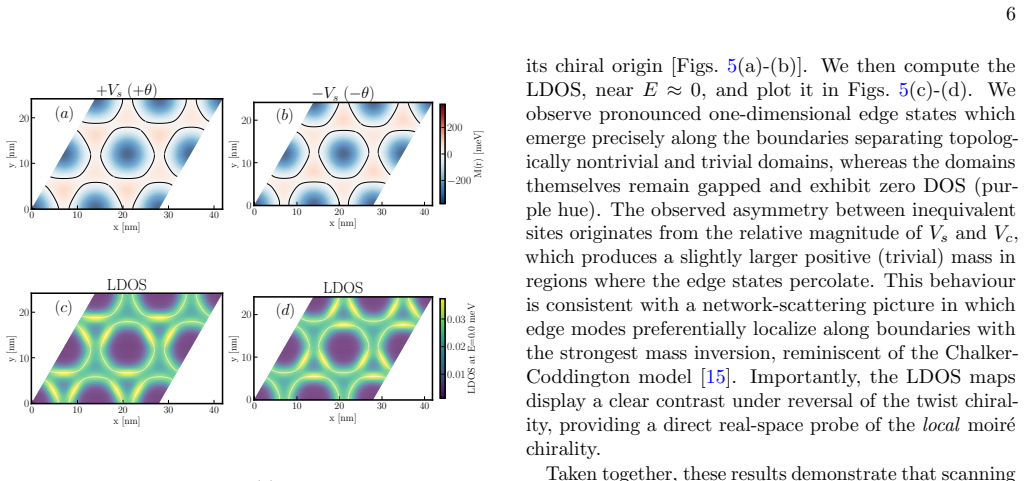
Structural relaxation in twisted bilayer BiSb drives the formation of a distinct moiré topological phase, characterized by coexisting topologically nontrivial (Z₂ = 1) and trivial (Z₂ = 0) domains within a single moiré unit cell. As the twist angle is reduced, relaxation-induced modulation of the interlayer separation stabilizes an expanding network of topological regions embedded within trivial backgrounds. The resulting internal domain boundaries host topologically-protected gapless 1D edge states. The real-space topological domain structure and associated gapless edge states can be reversibly tuned by an out-of-plane electric field.
What carries the argument
Relaxation-induced modulation of interlayer separation that alters the local Z2 invariant across the moiré cell.
If this is right
- Topological domains expand with decreasing twist angle.
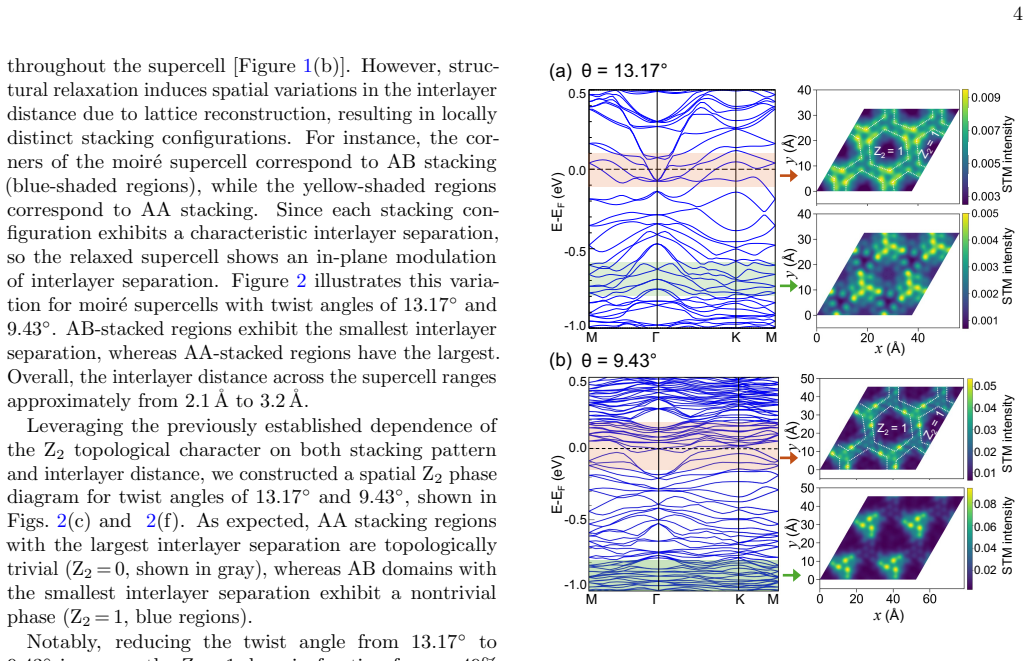
- Domain boundaries host gapless 1D edge states visible in STM simulations.
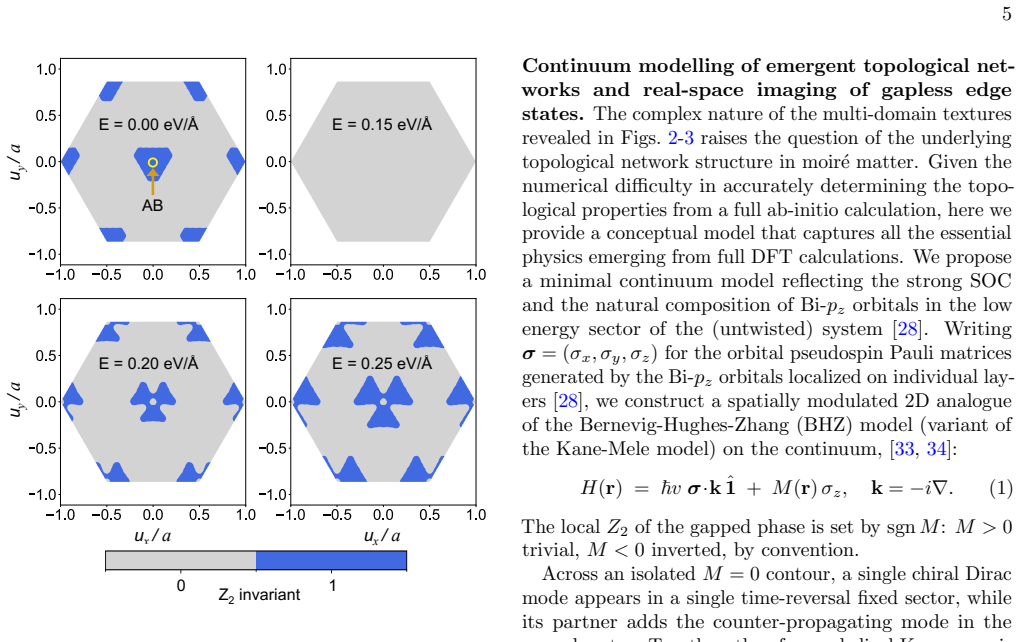
- The domain structure is reversibly tunable by out-of-plane electric field.
- Twisted BiSb becomes a platform for programmable topological domain patterning.
Where Pith is reading between the lines
- Similar relaxation-driven domain formation may occur in other twisted van der Waals heterostructures with suitable band topology.
- The tunable edge channels could enable reconfigurable topological quantum devices without lithographic patterning.
- Electric field control suggests potential for dynamic switching of topological transport in moiré systems.
Load-bearing premise
The structural relaxation calculation accurately captures how interlayer separation changes with twist angle to stabilize the topological domains.
What would settle it
A direct measurement of interlayer separation as a function of twist angle that fails to match the modulation needed to produce the Z2 domain pattern would falsify the mechanism.
Figures
read the original abstract
Spatial control of topology is highly desirable for realizing tunable quantum functionalities in materials. Moir\'e superlattices formed by twisting van der Waals heterostructures provide a natural platform for spatially modulated electronic phases, yet the emergence of tunable topological domains in these systems remains largely unexplored. Here we show that structural relaxation in twisted bilayer BiSb drives the formation of a distinct moir\'e topological phase, characterized by coexisting topologically nontrivial (Z$_2$ = 1) and trivial (Z$_2$ = 0) domains within a single moir\'e unit cell. As the twist angle is reduced, relaxation-induced modulation of the interlayer separation stabilizes an expanding network of topological regions embedded within trivial backgrounds of the moir\'e unit cell. The resulting internal domain boundaries host topologically-protected gapless 1D edge states that are directly visible in our simulated scanning-tunnelling microscopy maps.Furthermore, we demonstrate that the real-space topological domain structure and associated gapless edge states can be reversibly tuned by an out-of-plane electric field. Together, these results establish twisted BiSb as a promising platform for programmable topological domain patterning, where intrinsic networks of edge channels can be continuously tuned and electrically reconfigured in moir\'e materials.
Editorial analysis
A structured set of objections, weighed in public.
Referee Report
Summary. The manuscript claims that structural relaxation in twisted bilayer BiSb produces a moiré topological phase featuring coexisting Z₂=1 nontrivial and Z₂=0 trivial domains inside a single moiré unit cell. Relaxation-induced interlayer separation modulation is asserted to drive an expanding network of topological domains as twist angle decreases, with topologically protected gapless 1D edge states at domain boundaries that are visible in simulated STM maps and reversibly tunable by out-of-plane electric field.
Significance. If the central claim holds, the work would identify a concrete, electrically reconfigurable platform for spatial control of topology in moiré systems, with intrinsic networks of 1D edge channels that could be continuously tuned. The combination of relaxation-driven domain formation and field tunability would be a notable addition to the literature on moiré topological phases.
major comments (1)
- [Methods / structural relaxation calculations] The central claim that relaxation-induced interlayer separation modulation stabilizes an expanding network of Z₂=1 domains as twist angle is reduced rests on the quantitative accuracy of the separation profile versus twist angle. No explicit convergence tests with respect to supercell size, k-point density, or van der Waals functional choice are reported for the small-angle regime where the domain expansion is claimed; such checks are required because DFT supercell calculations of relaxation can contain uncontrolled errors that directly affect the modulation amplitude and therefore the predicted topological domain structure.
minor comments (2)
- [Abstract] The abstract and introduction would benefit from a brief statement of the specific twist-angle range over which the domain expansion is observed.
- [Introduction] Notation for the Z₂ invariant should be defined at first use and consistently applied when distinguishing domains.
Simulated Author's Rebuttal
We thank the referee for their careful reading and constructive feedback. We address the single major comment below.
read point-by-point responses
-
Referee: [Methods / structural relaxation calculations] The central claim that relaxation-induced interlayer separation modulation stabilizes an expanding network of Z₂=1 domains as twist angle is reduced rests on the quantitative accuracy of the separation profile versus twist angle. No explicit convergence tests with respect to supercell size, k-point density, or van der Waals functional choice are reported for the small-angle regime where the domain expansion is claimed; such checks are required because DFT supercell calculations of relaxation can contain uncontrolled errors that directly affect the modulation amplitude and therefore the predicted topological domain structure.
Authors: We agree that explicit convergence tests are necessary to substantiate the relaxation profiles and resulting domain structures at small twist angles. Our calculations used standard converged parameters validated on related systems, but we acknowledge that dedicated tests for the smallest angles were not reported. In the revised manuscript we will add a new subsection (or supplementary note) that presents convergence checks with respect to supercell size, k-point density, and van der Waals functional choice for representative small angles (e.g., 1° and 2°), including quantitative comparisons of interlayer separation modulation and the resulting Z₂ domain patterns. revision: yes
Circularity Check
No circularity identified; claims rest on independent relaxation and topology calculations
full rationale
The provided abstract and description present the central result as arising from structural relaxation computations in twisted bilayer BiSb that then feed into topological (Z2) calculations. No equations, self-citations, fitted parameters renamed as predictions, or ansatzes are visible that would reduce any load-bearing step to its own inputs by construction. The derivation chain therefore remains self-contained against external benchmarks such as DFT relaxation followed by band-structure topology evaluation.
Axiom & Free-Parameter Ledger
Forward citations
Cited by 1 Pith paper
-
Helical Domain-Wall-Ring Networks Reshape Superconducting Correlations
Finite-size confinement in helical domain-wall-ring networks suppresses inter-ring phase locking while the SC scaling dimension decreases with twist angle independent of tunneling strength, yielding qualitatively dist...
Reference graph
Works this paper leans on
-
[1]
Strongly correlated electrons and hybrid excitons in a moir´ e het- erostructure,
Yuya Shimazaki, Ido Schwartz, Kenji Watanabe, Takashi Taniguchi, Martin Kroner, and Ata¸ c Imamo˘ glu, “Strongly correlated electrons and hybrid excitons in a moir´ e het- erostructure,” Nature580, 472–477 (2020)
2020
-
[2]
Correlated elec- tronic phases in twisted bilayer transition metal dichalco- genides,
Lei Wang, En-Min Shih, Augusto Ghiotto, Lede Xian, Daniel A Rhodes, Cheng Tan, Martin Claassen, Dante M Kennes, Yusong Bai, Bumho Kim,et al., “Correlated elec- tronic phases in twisted bilayer transition metal dichalco- genides,” Nature materials19, 861–866 (2020)
2020
-
[3]
Observation of fraction- ally quantized anomalous hall effect,
Heonjoon Park, Jiaqi Cai, Eric Anderson, Yinong Zhang, Jiayi Zhu, Xiaoyu Liu, Chong Wang, William Holtzmann, Chaowei Hu, Zhaoyu Liu,et al., “Observation of fraction- ally quantized anomalous hall effect,” Nature622, 74–79 (2023)
2023
-
[4]
Sig- natures of fractional quantum anomalous hall states in twisted mote2,
Jiaqi Cai, Eric Anderson, Chong Wang, Xiaowei Zhang, Xiaoyu Liu, William Holtzmann, Yinong Zhang, Fengren Fan, Takashi Taniguchi, Kenji Watanabe,et al., “Sig- natures of fractional quantum anomalous hall states in twisted mote2,” Nature622, 63–68 (2023)
2023
-
[5]
Superconductiv- ity in twisted bilayer wse2,
Yiyu Xia, Zhongdong Han, Kenji Watanabe, Takashi Taniguchi, Jie Shan, and Kin Fai Mak, “Superconductiv- ity in twisted bilayer wse2,” Nature637, 833–838 (2025)
2025
-
[6]
Superconductivity in 5.0°twisted bilayer wse2,
Yinjie Guo, Jordan Pack, Joshua Swann, Luke Holtzman, Matthew Cothrine, Kenji Watanabe, Takashi Taniguchi, David G Mandrus, Katayun Barmak, James Hone,et al., “Superconductivity in 5.0°twisted bilayer wse2,” Nature 637, 839–845 (2025)
2025
-
[7]
Bilayer wigner crys- tals in a transition metal dichalcogenide heterostructure,
You Zhou, Jiho Sung, Elise Brutschea, Ilya Esterlis, Yao Wang, Giovanni Scuri, Ryan J Gelly, Hoseok Heo, Takashi Taniguchi, Kenji Watanabe,et al., “Bilayer wigner crys- tals in a transition metal dichalcogenide heterostructure,” Nature595, 48–52 (2021)
2021
-
[8]
Imaging two- dimensional generalized wigner crystals,
Hongyuan Li, Shaowei Li, Emma C Regan, Danqing Wang, Wenyu Zhao, Salman Kahn, Kentaro Yumigeta, Mark Blei, Takashi Taniguchi, Kenji Watanabe,et al., “Imaging two- dimensional generalized wigner crystals,” Nature597, 650–654 (2021)
2021
-
[9]
Mott and generalized wigner crystal states in wse2/ws2 moir´ e superlattices,
Emma C Regan, Danqing Wang, Chenhao Jin, M Iqbal Bakti Utama, Beini Gao, Xin Wei, Sihan Zhao, Wenyu Zhao, Zuocheng Zhang, Kentaro Yumigeta,et al., “Mott and generalized wigner crystal states in wse2/ws2 moir´ e superlattices,” Nature579, 359–363 (2020)
2020
-
[10]
Photoinduced twist and untwist of moir´ e superlattices,
Cameron JR Duncan, Amalya C Johnson, Indrajit Maity, Angel Rubio, Matthew Gordon, Adam C Bartnik, Michael Kaemingk, William H Li, Matthew B Andorf, Chad A Pennington,et al., “Photoinduced twist and untwist of moir´ e superlattices,” Nature , 1–6 (2025)
2025
-
[11]
Reconstruction of moir´ e lattices in twisted transition metal dichalcogenide bilayers,
Indrajit Maity, Prabal K Maiti, HR Krishnamurthy, and Manish Jain, “Reconstruction of moir´ e lattices in twisted transition metal dichalcogenide bilayers,” Physical Review B103, L121102 (2021)
2021
-
[12]
Interfacial ferroelectricity in marginally twisted 2d semiconductors,
Astrid Weston, Eli G Castanon, Vladimir Enaldiev, Fabio Ferreira, Shubhadeep Bhattacharjee, Shuigang Xu, H´ ector Corte-Le´ on, Zefei Wu, Nicholas Clark, Alex Summerfield, et al., “Interfacial ferroelectricity in marginally twisted 2d semiconductors,” Nature nanotechnology17, 390–395 (2022)
2022
-
[13]
Twist angle-dependent atomic reconstruction and moir´ e patterns in transition metal dichalcogenide heterostructures,
Matthew R Rosenberger, Hsun-Jen Chuang, Madeleine Phillips, Vladimir P Oleshko, Kathleen M McCreary, Saujan V Sivaram, C Stephen Hellberg, and Berend T Jonker, “Twist angle-dependent atomic reconstruction and moir´ e patterns in transition metal dichalcogenide heterostructures,” ACS nano14, 4550–4558 (2020)
2020
-
[14]
Piezoelectric networks and ferroelec- tric domains in twistronic superlattices in ws2/mos2 and wse2/mose2 bilayers,
VV Enaldiev, Fabio Ferreira, SJ Magorrian, and Vladimir I Fal’ko, “Piezoelectric networks and ferroelec- tric domains in twistronic superlattices in ws2/mos2 and wse2/mose2 bilayers,” 2D Materials8, 025030 (2021)
2021
-
[15]
Percolation, quantum tunnelling and the integer hall effect,
JT Chalker and PD Coddington, “Percolation, quantum tunnelling and the integer hall effect,” Journal of Physics C: Solid State Physics21, 2665–2679 (1988)
1988
-
[16]
Topological mosaics in moir´ e superlattices of van der waals heterobilayers,
Qingjun Tong, Hongyi Yu, Qizhong Zhu, Yong Wang, Xiaodong Xu, and Wang Yao, “Topological mosaics in moir´ e superlattices of van der waals heterobilayers,” Na- ture Physics13, 356–362 (2017)
2017
-
[17]
Quantum spin hall effect from multiscale band inversion in twisted bilayer bi 2 (te 1- x se x) 3,
Ikuma Tateishi and Motoaki Hirayama, “Quantum spin hall effect from multiscale band inversion in twisted bilayer bi 2 (te 1- x se x) 3,” Physical Review Research4, 043045 (2022)
2022
-
[18]
Helical networks in twisted bilayer graphene under interlayer bias,
Pablo San-Jose and Elsa Prada, “Helical networks in twisted bilayer graphene under interlayer bias,” Phys. Rev. B88, 121408(R) (2013)
2013
-
[19]
Helical network model for twisted bilayer graphene,
Dmitry K. Efimkin and Allan H. MacDonald, “Helical network model for twisted bilayer graphene,” Phys. Rev. B98, 035404 (2018)
2018
-
[20]
Electronic-structure methods for twisted moir´ e layers,
Stephen Carr, Shiang Fang, and Efthimios Kaxiras, “Electronic-structure methods for twisted moir´ e layers,” Nature Reviews Materials5, 748–763 (2020)
2020
-
[21]
Re- laxation and domain formation in incommensurate two- dimensional heterostructures,
Stephen Carr, Daniel Massatt, Steven B Torrisi, Paul Cazeaux, Mitchell Luskin, and Efthimios Kaxiras, “Re- laxation and domain formation in incommensurate two- dimensional heterostructures,” Physical Review B98, 224102 (2018)
2018
-
[22]
Lattice re- laxation and energy band modulation in twisted bilayer graphene,
Nguyen N. T. Nam and Mikito Koshino, “Lattice re- laxation and energy band modulation in twisted bilayer graphene,” Phys. Rev. B96, 075311 (2017)
2017
-
[23]
Effective con- tinuum model for relaxed twisted bilayer graphene and moir´ e electron-phonon interaction,
Mikito Koshino and Nguyen NT Nam, “Effective con- tinuum model for relaxed twisted bilayer graphene and moir´ e electron-phonon interaction,” Physical Review B 101, 195425 (2020)
2020
-
[24]
Multiscale lattice relaxation in general twisted trilayer graphenes,
Naoto Nakatsuji, Takuto Kawakami, and Mikito Koshino, “Multiscale lattice relaxation in general twisted trilayer graphenes,” Physical Review X13, 041007 (2023)
2023
-
[25]
Spontaneous twirls and structural frus- tration in moir´ e materials,
Jingtian Shi, Gaurav Chaudhary, Allan H. MacDonald, and Ivar Martin, “Spontaneous twirls and structural frus- tration in moir´ e materials,” Phys. Rev. Lett.136, 026101 (2026)
2026
-
[26]
Giant tunable rashba spin splitting in a two-dimensional bisb monolayer and in bisb/aln heterostructures,
Sobhit Singh and Aldo H. Romero, “Giant tunable rashba spin splitting in a two-dimensional bisb monolayer and in bisb/aln heterostructures,” Phys. Rev. B95, 165444 (2017)
2017
-
[27]
Even integer quantum hall effect in materials with hidden spin texture,
Daniel Kaplan, Ady Stern, and Binghai Yan, “Even integer quantum hall effect in materials with hidden spin texture,” (2024), arXiv:2406.03448 [cond-mat.mes-hall]
-
[28]
En- gineering stacking-induced topological phase transitions in bilayer heterostructures,
Arjyama Bordoloi, Daniel Kaplan, and Sobhit Singh, “En- gineering stacking-induced topological phase transitions in bilayer heterostructures,” 2D Materials13, 015006 (2026)
2026
-
[29]
Direct observation of spin-polarized bulk bands in an inversion-symmetric semiconductor,
Jonathon Mark Riley, F Mazzola, M Dendzik, M Michiardi, T Takayama, Lewis Bawden, C Granerød, Mats Leandersson, T Balasubramanian, M Hoesch,et al., “Direct observation of spin-polarized bulk bands in an inversion-symmetric semiconductor,” Nature Physics10, 835–839 (2014)
2014
-
[30]
Uncovering and tailoring 9 hidden Rashba spin–orbit splitting in centrosymmetric crystals,
Linding Yuan, Qihang Liu, Xiuwen Zhang, Jun-Wei Luo, Shu-Shen Li, and Alex Zunger, “Uncovering and tailoring 9 hidden Rashba spin–orbit splitting in centrosymmetric crystals,” Nature Communications10, 906 (2019)
2019
-
[31]
Twistronics: Manipulating the electronic properties of two-dimensional layered structures through their twist angle,
Stephen Carr, Daniel Massatt, Shiang Fang, Paul Cazeaux, Mitchell Luskin, and Efthimios Kaxiras, “Twistronics: Manipulating the electronic properties of two-dimensional layered structures through their twist angle,” Physical Review B95, 075420 (2017)
2017
-
[32]
Relaxation and domain wall structure of bilayer moir´ e systems,
Paul Cazeaux, Drake Clark, Rebecca Engelke, Philip Kim, and Mitchell Luskin, “Relaxation and domain wall structure of bilayer moir´ e systems,” Journal of Elasticity 154, 443–466 (2023)
2023
-
[33]
Quantum spin hall effect and topological phase transition in hgte quantum wells,
B Andrei Bernevig, Taylor L Hughes, and Shou-Cheng Zhang, “Quantum spin hall effect and topological phase transition in hgte quantum wells,” science314, 1757–1761 (2006)
2006
-
[34]
Quantum Spin hall effect in graphene,
C. L. Kane and E. J. Mele, “Quantum Spin hall effect in graphene,” Physical Review Letters95, 226801 (2005)
2005
-
[35]
Solitons with fermion number 1/2,
Roman Jackiw and Cl´ audio Rebbi, “Solitons with fermion number 1/2,” Physical Review D13, 3398 (1976)
1976
-
[36]
Mapping the moir \’e potential in multi-layer rhombohe- dral graphene,
Eric Seewald, Sanat Ghosh, Nishchhal Verma, John Cenker, Yinan Dong, Birui Yang, Amit Basu, Takashi Taniguchi, Kenji Watanabe, Mandar M Deshmukh,et al., “Mapping the moir \’e potential in multi-layer rhombohe- dral graphene,” arXiv preprint arXiv:2510.09548 (2025)
-
[37]
Imaging the sub-moir´ e potential using an atomic single electron transistor,
Dahlia R Klein, Uri Zondiner, Amit Keren, John Birkbeck, Alon Inbar, Jiewen Xiao, Yuval Zamir, Mariia Sidorova, Mohammed M Al Ezzi, Liangtao Peng,et al., “Imaging the sub-moir´ e potential using an atomic single electron transistor,” Nature , 1–7 (2026)
2026
-
[38]
Topological superconductivity from repulsive interactions in twisted wse 2,
Daniele Guerci, Daniel Kaplan, Julian Ingham, JH Pixley, and Andrew J Millis, “Topological superconductivity from repulsive interactions in twisted wse 2,” arXiv preprint arXiv:2408.16075 (2024)
-
[39]
Polarization-driven band topol- ogy evolution in twisted mote2 and wse2,
Xiao-Wei Zhang, Chong Wang, Xiaoyu Liu, Yueyao Fan, Ting Cao, and Di Xiao, “Polarization-driven band topol- ogy evolution in twisted mote2 and wse2,” Nature Com- munications15, 4223 (2024)
2024
-
[40]
Itinerant mag- netism in twisted bilayer wse 2 and mote 2,
Liangtao Peng, Christophe De Beule, Yiyang Lai, Du Li, Li Yang, EJ Mele, and Shaffique Adam, “Itinerant mag- netism in twisted bilayer wse 2 and mote 2,” Physical Review B113, L161119 (2026)
2026
-
[41]
Real-space imaging of the band topology of transition metal dichalco- genides,
Madisen Holbrook, Julian Ingham, Daniel Kaplan, Luke N Holtzman, Brenna Bierman, Bowen Hou, Nicholas Olsen, Luca Nashabeh, Yiliu Li, Song Liu,et al., “Real-space imaging of the band topology of transition metal dichalco- genides,” Nature Physics , 1–6 (2026)
2026
-
[42]
Ob- servation of an obstructed atomic band in a transition metal dichalcogenide,
Dumitru C˘ alug˘ aru, Yi Jiang, Haojie Guo, Sandra Sa- jan, Yongsong Wang, Haoyu Hu, Jiabin Yu, B Andrei Bernevig, Fernando de Juan, and Miguel M Ugeda, “Ob- servation of an obstructed atomic band in a transition metal dichalcogenide,” Nature Physics , 1–6 (2026)
2026
-
[43]
Efficient iterative schemes for ab initio total-energy calculations using a plane-wave basis set,
G. Kresse and J. Furthm¨ uller, “Efficient iterative schemes for ab initio total-energy calculations using a plane-wave basis set,” Phys. Rev. B54, 11169–11186 (1996)
1996
-
[44]
Efficiency of ab-initio total energy calculations for metals and semiconductors using a plane-wave basis set,
G. Kresse and J. Furthm¨ uller, “Efficiency of ab-initio total energy calculations for metals and semiconductors using a plane-wave basis set,” Comput. Mater. Sci.6, 15 – 50 (1996)
1996
-
[45]
Restoring the density-gradient expansion for exchange in solids and surfaces,
John P. Perdew, Adrienn Ruzsinszky, G´ abor I. Csonka, Oleg A. Vydrov, Gustavo E. Scuseria, Lucian A. Con- stantin, Xiaolan Zhou, and Kieron Burke, “Restoring the density-gradient expansion for exchange in solids and surfaces,” Phys. Rev. Lett.100, 136406 (2008)
2008
-
[46]
A consistent and accurate ab initio parametriza- tion of density functional dispersion correction (dft-d) for the 94 elements h-pu,
Stefan Grimme, Jens Antony, Stephan Ehrlich, and Helge Krieg, “A consistent and accurate ab initio parametriza- tion of density functional dispersion correction (dft-d) for the 94 elements h-pu,” J. Chem. Phys.132, 154104 (2010)
2010
-
[47]
VASPKIT: A user-friendly interface facilitating high-throughput computing and analysis using VASP code,
Vei Wang, Nan Xu, Jin-Cheng Liu, Gang Tang, and Wen-Tong Geng, “VASPKIT: A user-friendly interface facilitating high-throughput computing and analysis using VASP code,” Computer Physics Communications267, 108033 (2021)
2021
-
[48]
An updated version of wannier90: A tool for obtaining maximally-localised wannier functions,
Arash A Mostofi, Jonathan R Yates, Giovanni Pizzi, Young-Su Lee, Ivo Souza, David Vanderbilt, and Nicola Marzari, “An updated version of wannier90: A tool for obtaining maximally-localised wannier functions,” Com- puter Physics Communications185, 2309–2310 (2014)
2014
-
[49]
Wannier- tools: An open-source software package for novel topolog- ical materials,
QuanSheng Wu, ShengNan Zhang, Hai-Feng Song, Matthias Troyer, and Alexey A. Soluyanov, “Wannier- tools: An open-source software package for novel topolog- ical materials,” Comput. Phys. Commun.224, 405 – 416 (2018)
2018
discussion (0)
Sign in with ORCID, Apple, or X to comment. Anyone can read and Pith papers without signing in.