Asynchronous Remote Sensing Time-Series Fusion for Cloud Removal and Anytime Reconstruction
Pith reviewed 2026-06-29 17:59 UTC · model grok-4.3
The pith
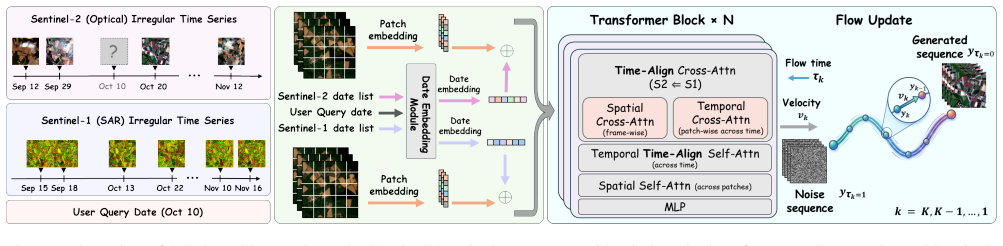
AGFlow fuses asynchronous Sentinel-1 SAR and Sentinel-2 optical data through timestamp-conditioned flow matching to enable cloud removal and on-demand reconstruction at any timestamp.
A machine-rendered reading of the paper's core claim, the machinery that carries it, and where it could break.
Core claim
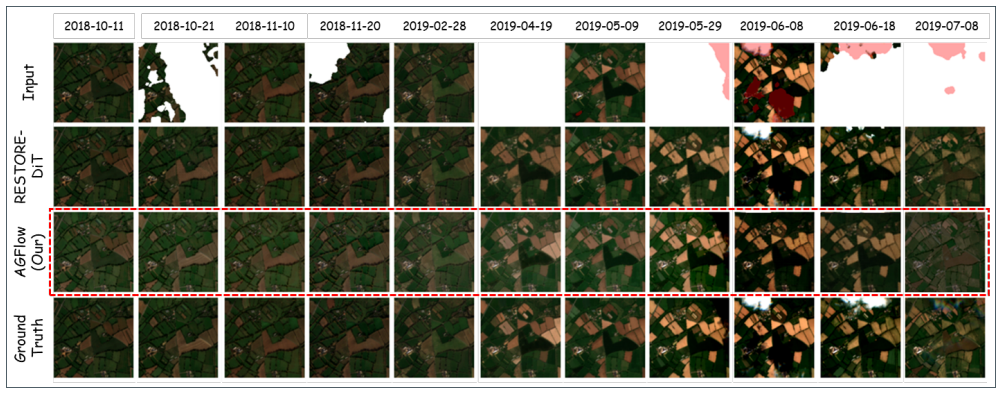
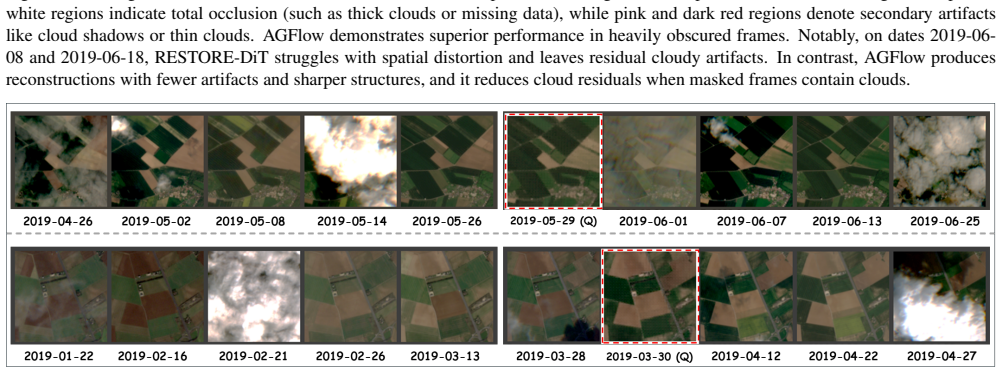
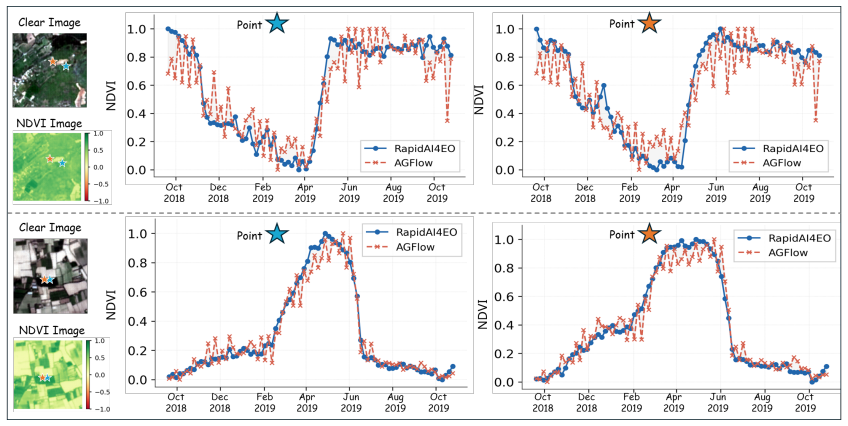
AGFlow performs timestamp-conditioned internal alignment to fuse asynchronous S1 and cloudy S2 observations without any preprocessing-based pairing, applies spatiotemporal context-aware denoising that models spatial structure jointly with temporal dynamics, and enables anytime querying to generate cloud-free S2 frames at both observed and arbitrary user-specified timestamps. On the RESTORE-DiT protocol this yields 16-19 percent lower MAE and RMSE for fully missing-frame reconstruction, reliable results under persistent gaps, competitive cloud-removal accuracy, and flexible temporal synthesis for tasks such as dense vegetation monitoring.
What carries the argument
Timestamp-conditioned internal alignment and spatiotemporal context-aware denoising inside a generative flow-matching model.
If this is right
- Reconstruction quality improves for frames with no direct observations.
- The model remains usable when gaps persist across multiple time steps.
- Cloud removal performance stays competitive with existing methods.
- Downstream tasks gain the ability to query any timestamp inside the monitoring window.
Where Pith is reading between the lines
- The same internal-alignment approach could reduce preprocessing requirements when fusing other pairs of asynchronous remote-sensing sensors.
- Anytime querying opens the possibility of generating synthetic observations matched to specific ground-event dates rather than sensor overpass times.
- Joint spatiotemporal modeling may transfer to other domains where observations arrive at irregular intervals, such as multi-modal medical imaging sequences.
Load-bearing premise
Timestamp information alone can internally align and fuse S1 and S2 observations without external pairing or nearest-date matching steps.
What would settle it
Apply the model to a held-out set of S1/S2 acquisitions with known large temporal gaps and measure whether reconstruction error for fully missing frames remains lower than RESTORE-DiT by at least 10 percent.
Figures
read the original abstract
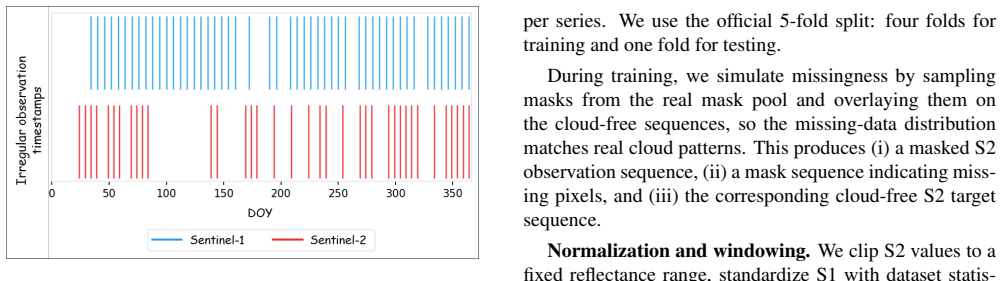
Frequent cloud cover severely limits the usability of Sentinel-2 (S2) optical time series for Earth surface monitoring. Sentinel-1 (S1) SAR provides all-weather complementary observations, but practical S1/S2 fusion remains difficult because acquisitions are irregular and asynchronous. Many existing approaches assume temporally aligned inputs (or require external nearest-date matching) and typically restore only observed timestamps, limiting reconstruction under long gaps and preventing on-demand synthesis. We propose AGFlow (Time Aligned Generative Flow Matching), a spatiotemporal flow-matching model for S1/S2 cloud removal and time-series reconstruction with three capabilities: (1) timestamp-conditioned internal alignment that fuses asynchronous S1 and cloudy S2 observations without preprocessing-based pairing; (2) spatiotemporal, context-aware denoising that models spatial structure jointly with temporal dynamics (rather than independent per-pixel time series); and (3) anytime querying, enabling generation of cloud-free S2 frames at both observed and user-specified timestamps within the monitoring window. We evaluate on the RESTORE-DiT benchmark protocol with quantitative metrics, qualitative comparisons, and component ablations. AGFlow notably improves fully missing-frame reconstruction (MAE and RMSE reduce by 16-19% over RESTORE-DiT) and provides reliable reconstructions under persistent gaps, while also yielding competitive cloud removal performance and flexible temporal querying for downstream tasks such as dense vegetation monitoring.
Editorial analysis
A structured set of objections, weighed in public.
Referee Report
Summary. The paper proposes AGFlow, a spatiotemporal flow-matching model for asynchronous Sentinel-1 SAR and Sentinel-2 optical time-series fusion. It introduces timestamp-conditioned internal alignment to fuse irregular acquisitions without preprocessing pairing, spatiotemporal context-aware denoising that jointly models spatial and temporal structure, and anytime querying to generate cloud-free S2 frames at arbitrary timestamps. Evaluation follows the RESTORE-DiT benchmark protocol and reports 16-19% reductions in MAE and RMSE for fully missing-frame reconstruction relative to RESTORE-DiT, along with competitive cloud removal and support for downstream tasks such as vegetation monitoring.
Significance. If the quantitative gains and architectural claims hold under full scrutiny, the approach would meaningfully advance practical S1/S2 fusion by removing the need for external date matching and enabling on-demand reconstruction under persistent gaps. The explicit use of flow matching, component ablations, and flexible temporal querying represents a clear technical contribution over prior aligned-input methods.
major comments (1)
- Abstract: the 16-19% MAE/RMSE reduction for fully missing-frame reconstruction is presented as the primary result, yet the abstract provides no detail on the exact RESTORE-DiT protocol, number of test scenes, gap-length distribution, or statistical significance testing; without these, the improvement cannot be assessed for robustness against the benchmark's own variability.
minor comments (2)
- Abstract: the three listed capabilities are described at a high level; a short table or enumerated list in the introduction would clarify how each maps to the model components (e.g., which loss or conditioning mechanism implements timestamp alignment).
- Abstract: the phrase 'spatiotemporal, context-aware denoising' is used without a brief contrast to per-pixel time-series baselines; adding one sentence would help readers immediately see the modeling distinction.
Simulated Author's Rebuttal
We thank the referee for their careful review and constructive feedback on the abstract. We address the single major comment below.
read point-by-point responses
-
Referee: Abstract: the 16-19% MAE/RMSE reduction for fully missing-frame reconstruction is presented as the primary result, yet the abstract provides no detail on the exact RESTORE-DiT protocol, number of test scenes, gap-length distribution, or statistical significance testing; without these, the improvement cannot be assessed for robustness against the benchmark's own variability.
Authors: We agree the abstract is concise and omits granular experimental parameters to respect length limits. The RESTORE-DiT protocol (including test scenes, gap-length distributions, and evaluation splits) is fully specified in Section 4.1 and the supplementary material; the abstract already references this protocol explicitly. Results are reported as means with standard deviations across the test set and multiple runs. Formal statistical significance testing (e.g., paired t-tests) was not performed. We will revise the abstract to add a brief clause on the number of test scenes and gap configurations if the editor permits modest expansion, while retaining the high-level summary style. revision: partial
Circularity Check
No significant circularity
full rationale
The paper introduces AGFlow as a timestamp-conditioned flow-matching architecture for asynchronous S1/S2 fusion and anytime reconstruction. Its central claims consist of empirical improvements (16-19% MAE/RMSE reduction on fully missing frames) measured against the external RESTORE-DiT benchmark protocol, together with qualitative and ablation results. No equations, fitted parameters, or derivation steps are described that reduce by construction to the model's own inputs or to self-citations; the evaluation protocol and performance metrics remain independent of the proposed method's internal definitions.
Axiom & Free-Parameter Ledger
Forward citations
Cited by 1 Pith paper
-
Spatial Representation Learning Beyond Pixels: Unifying Raster Data and Vector Semantics for Human-Centric Geospatial Foundation Models
Perspective paper calling for unified spatial representation learning that integrates raster imagery with vector semantics in geospatial foundation models.
Reference graph
Works this paper leans on
-
[1]
Fusing sentinel-1 and sentinel-2 data with diffusion models for cloud removal.Re- mote Sensing of Environment, 331:115049, 2025
Jiajun Cai, Bo Huang, and Hao Liu. Fusing sentinel-1 and sentinel-2 data with diffusion models for cloud removal.Re- mote Sensing of Environment, 331:115049, 2025. 1, 2, 3
2025
-
[2]
Rapidai4eo: A corpus of dense time series satellite imagery, 2023
Timothy Davis, Benjamin Bischke, Patrick Helber, Caglar Senaras, Akhil Rana, Annett Wania, Ruben Van De Ker- chove, Daniele Zanaga, Wanda De Keersmaecker, Myroslava Lesiv, Franck Ranera, and Giovanni Marchisio. Rapidai4eo: A corpus of dense time series satellite imagery, 2023. 6
2023
-
[3]
Integrating multitempo- ral sar and optical information for missing optical imagery generation.IEEE Transactions on Geoscience and Remote Sensing, 62:1–14, 2024
Chunyu Dong, Gang Yang, Yumiao Wang, Weiwei Sun, Xi- angchao Meng, and Binjie Chen. Integrating multitempo- ral sar and optical information for missing optical imagery generation.IEEE Transactions on Geoscience and Remote Sensing, 62:1–14, 2024. 2, 3
2024
-
[4]
Sentinel-2: Esa’s optical high-resolution mission for gmes operational services.Remote sensing of Environment, 120:25–36, 2012
Matthias Drusch, Umberto Del Bello, S ´ebastien Carlier, Olivier Colin, Veronica Fernandez, Ferran Gascon, Bianca Hoersch, Claudia Isola, Paolo Laberinti, Philippe Martimort, et al. Sentinel-2: Esa’s optical high-resolution mission for gmes operational services.Remote sensing of Environment, 120:25–36, 2012. 1
2012
-
[5]
Uncrtaints: Un- certainty quantification for cloud removal in optical satellite time series
Patrick Ebel, Vivien Sainte Fare Garnot, Michael Schmitt, Jan Dirk Wegner, and Xiao Xiang Zhu. Uncrtaints: Un- certainty quantification for cloud removal in optical satellite time series. InProceedings of the IEEE/CVF Conference on Computer Vision and Pattern Recognition, pages 2086– 2096, 2023. 2
2086
-
[6]
Forouzan Fallah, Wenwen Li, Chia-Yu Hsu, Hyunho Lee, and Yezhou Yang. Rareflow: Physics-aware flow-matching for cross-sensor super-resolution of rare-earth features.arXiv preprint arXiv:2510.23816, 2025. 2
-
[7]
Multi-modal temporal attention models for crop mapping from satellite time series.ISPRS Journal of Pho- togrammetry and Remote Sensing, 187:294–305, 2022
Vivien Sainte Fare Garnot, Loic Landrieu, and Nesrine Chehata. Multi-modal temporal attention models for crop mapping from satellite time series.ISPRS Journal of Pho- togrammetry and Remote Sensing, 187:294–305, 2022. 5
2022
-
[8]
Spatial and temporal dis- tribution of clouds observed by modis onboard the terra and aqua satellites.IEEE transactions on geoscience and remote sensing, 51(7):3826–3852, 2013
Michael D King, Steven Platnick, W Paul Menzel, Steven A Ackerman, and Paul A Hubanks. Spatial and temporal dis- tribution of clouds observed by modis onboard the terra and aqua satellites.IEEE transactions on geoscience and remote sensing, 51(7):3826–3852, 2013. 1
2013
-
[9]
Yaron Lipman, Ricky T. Q. Chen, Heli Ben-Hamu, Maxi- milian Nickel, and Matt Le. Flow matching for generative modeling. InInternational Conference on Learning Repre- sentations (ICLR), 2023. 2
2023
-
[10]
Shuaijun Liu, Hui Chen, Kai Tang, Yang Chen, Hongtao Shu, Tianyu Zan, Yong Xue, and Jin Chen. Innovative sar- optical data fusion for reflectance time series reconstruction in vegetation-covered regions.International Journal of Ap- plied Earth Observation and Geoinformation, 140:104567,
-
[11]
Effective cloud removal for remote sens- ing images by an improved mean-reverting denoising model with elucidated design space
Yi Liu, Wengen Li, Jihong Guan, Shuigeng Zhou, and Yichao Zhang. Effective cloud removal for remote sens- ing images by an improved mean-reverting denoising model with elucidated design space. InProceedings of the Com- puter Vision and Pattern Recognition Conference, pages 17851–17861, 2025. 2, 3
2025
-
[12]
Cloud removal in sentinel-2 imagery using a deep residual neural network and sar-optical data fusion.ISPRS Journal of Photogrammetry and Remote Sensing, 166:333– 346, 2020
Andrea Meraner, Patrick Ebel, Xiao Xiang Zhu, and Michael Schmitt. Cloud removal in sentinel-2 imagery using a deep residual neural network and sar-optical data fusion.ISPRS Journal of Photogrammetry and Remote Sensing, 166:333– 346, 2020. 1, 2
2020
-
[13]
Julien Michel and Jordi Inglada. Temporal attention multi- resolution fusion of satellite image time-series, applied to landsat-8/9 and sentinel-2: all bands, any time, at best spa- tial resolution.Remote Sensing of Environment, 334:115159,
-
[14]
Cross-sensor super-resolution of irreg- ularly sampled sentinel-2 time series
Aimi Okabayashi, Nicolas Audebert, Simon Donike, and Charlotte Pelletier. Cross-sensor super-resolution of irreg- ularly sampled sentinel-2 time series. InProceedings of the IEEE/CVF Conference on Computer Vision and Pattern Recognition, pages 502–511, 2024. 3
2024
-
[15]
Scalable diffusion mod- els with transformers
William Peebles and Saining Xie. Scalable diffusion mod- els with transformers. InProceedings of the IEEE/CVF In- ternational Conference on Computer Vision (ICCV), pages 4195–4205, 2023. 4
2023
-
[16]
Restore-dit: Reliable satellite image time series re- construction by multimodal sequential diffusion transformer
Qidi Shu, Xiaolin Zhu, Shuai Xu, Yan Wang, and Denghong Liu. Restore-dit: Reliable satellite image time series re- construction by multimodal sequential diffusion transformer. Remote Sensing of Environment, 328:114872, 2025. 2, 3
2025
-
[17]
U-TILISE: A sequence-to-sequence model for cloud removal in optical satellite time series.IEEE Trans- actions on Geoscience and Remote Sensing, 61:1–16, 2023
Corinne Stucker, Vivien Sainte Fare Garnot, and Konrad Schindler. U-TILISE: A sequence-to-sequence model for cloud removal in optical satellite time series.IEEE Trans- actions on Geoscience and Remote Sensing, 61:1–16, 2023. 2
2023
-
[18]
RoFormer: Enhanced transformer with rotary position embedding.Neurocomputing, 568: 127063, 2024
Jianlin Su, Yu Lu, Shengfeng Pan, Ahmed Murtadha, Bo Wen, and Yunfeng Liu. RoFormer: Enhanced transformer with rotary position embedding.Neurocomputing, 568: 127063, 2024. 5
2024
-
[19]
Anytimeformer: Fusing irregular and asynchronous sar-optical time series to reconstruct re- flectance at any given time.Remote Sensing of Environment, 333:115120, 2026
Kai Tang, Xuehong Chen, Tianyu Liu, Anqi Li, Yao Tang, Peng Yang, and Jin Chen. Anytimeformer: Fusing irregular and asynchronous sar-optical time series to reconstruct re- flectance at any given time.Remote Sensing of Environment, 333:115120, 2026. 2, 3, 6
2026
-
[20]
The sentinel-1 mission and its appli- cation capabilities
Ram ´on Torres, Paul Snoeij, Malcolm Davidson, David Bibby, and Svein Lokas. The sentinel-1 mission and its appli- cation capabilities. In2012 IEEE International Geoscience and Remote Sensing Symposium, pages 1703–1706. IEEE,
-
[21]
Gmes sentinel-1 mission.Remote sensing of environment, 120:9–24, 2012
Ramon Torres, Paul Snoeij, Dirk Geudtner, David Bibby, Malcolm Davidson, Evert Attema, Pierre Potin, Bj¨Orn Rom- men, Nicolas Floury, Mike Brown, et al. Gmes sentinel-1 mission.Remote sensing of environment, 120:9–24, 2012. 1
2012
discussion (0)
Sign in with ORCID, Apple, or X to comment. Anyone can read and Pith papers without signing in.