Realization of the Ruby Lattice Antiferromagnet in Layered Transition-Metal Fluorides
Pith reviewed 2026-06-29 09:40 UTC · model grok-4.3
The pith
Two layered transition-metal fluorides realize the ruby lattice antiferromagnet with dominant short-range couplings.
A machine-rendered reading of the paper's core claim, the machinery that carries it, and where it could break.
Core claim
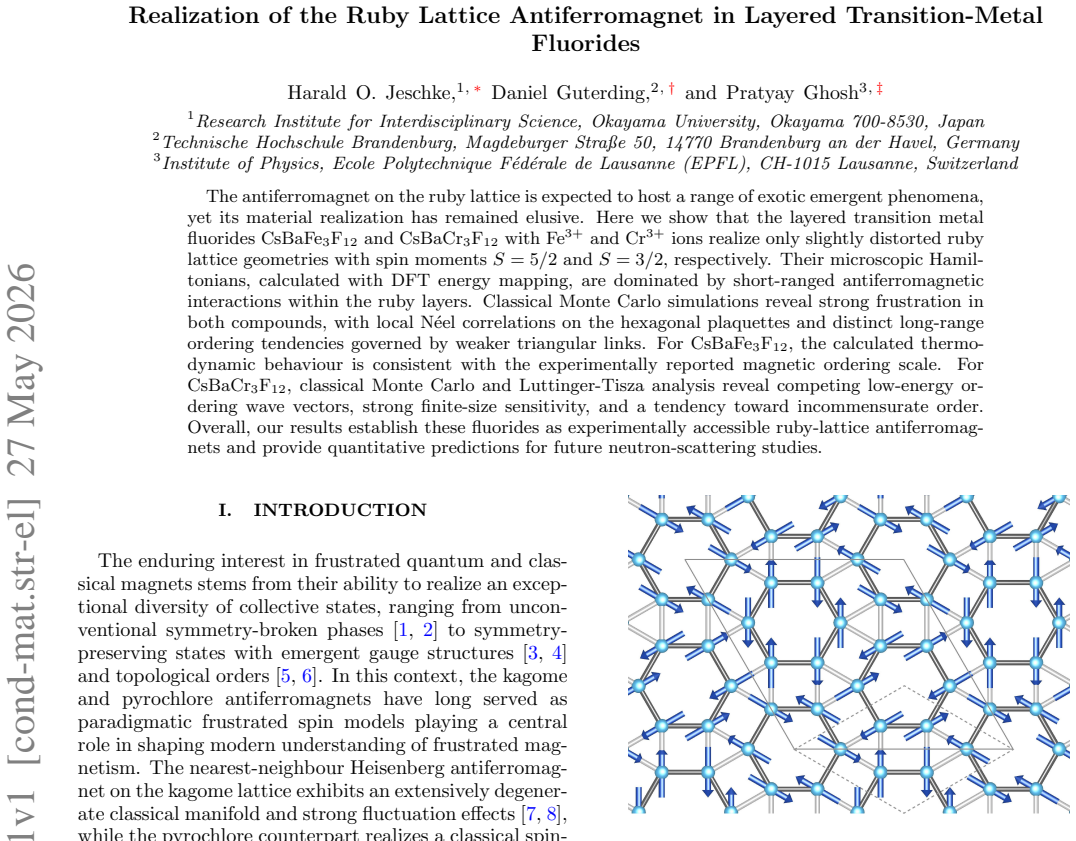
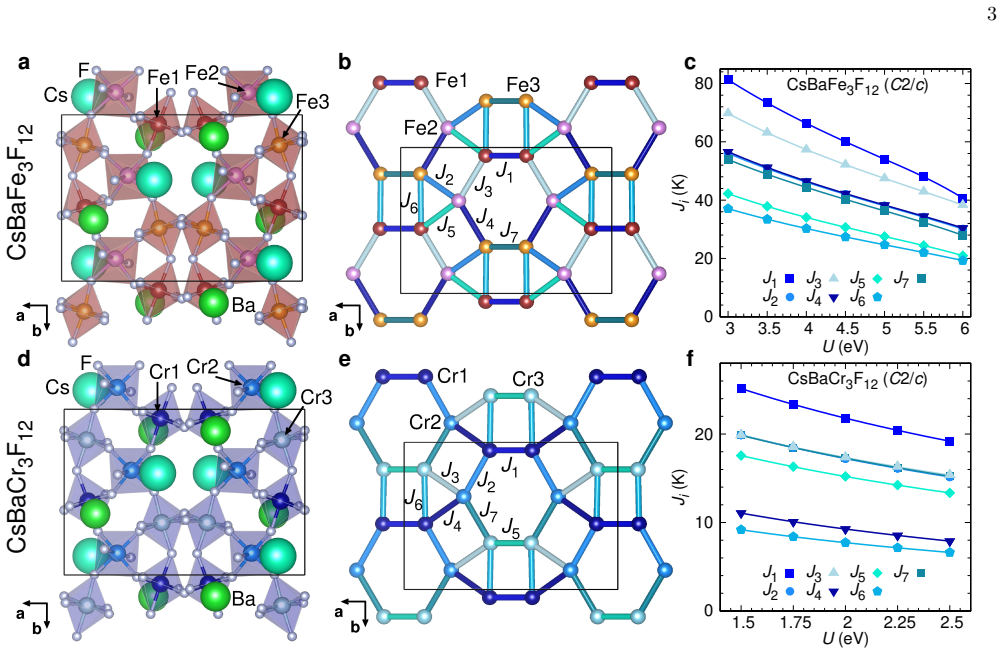
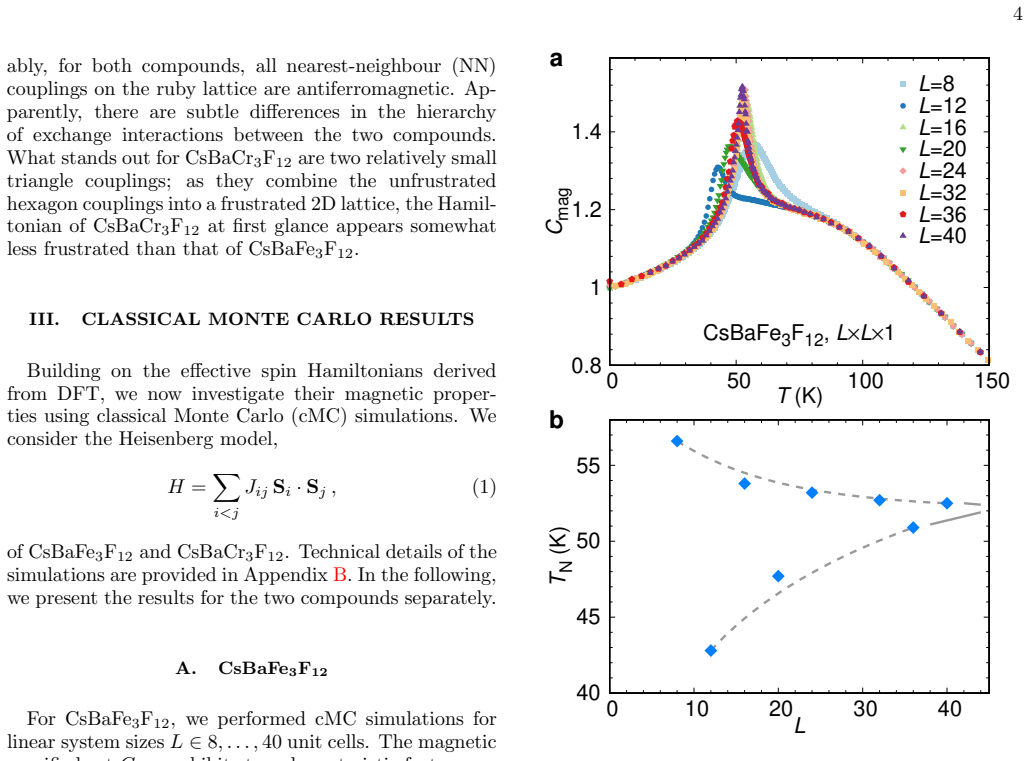
The layered transition metal fluorides CsBaFe₃F₁₂ and CsBaCr₃F₁₂ realize only slightly distorted ruby lattice geometries with spin moments S=5/2 and S=3/2, respectively. Their microscopic Hamiltonians, calculated with DFT energy mapping, are dominated by short-ranged antiferromagnetic interactions within the ruby layers. Classical Monte Carlo simulations reveal strong frustration in both compounds, with local Néel correlations on the hexagonal plaquettes and distinct long-range ordering tendencies governed by weaker triangular links.
What carries the argument
Ruby lattice geometry realized in CsBaFe₃F₁₂ and CsBaCr₃F₁₂, with DFT-mapped Hamiltonians dominated by intra-layer antiferromagnetic interactions that produce frustration.
If this is right
- Classical Monte Carlo simulations reveal strong frustration with local Néel correlations on hexagonal plaquettes and distinct long-range ordering tendencies governed by weaker triangular links.
- For CsBaFe₃F₁₂ the calculated thermodynamic behaviour is consistent with the experimentally reported magnetic ordering scale.
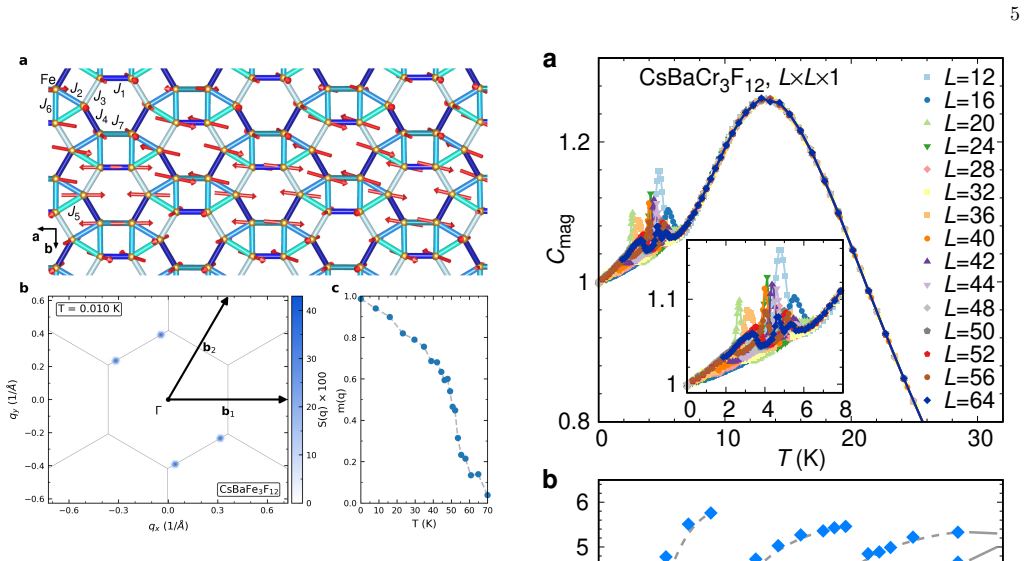
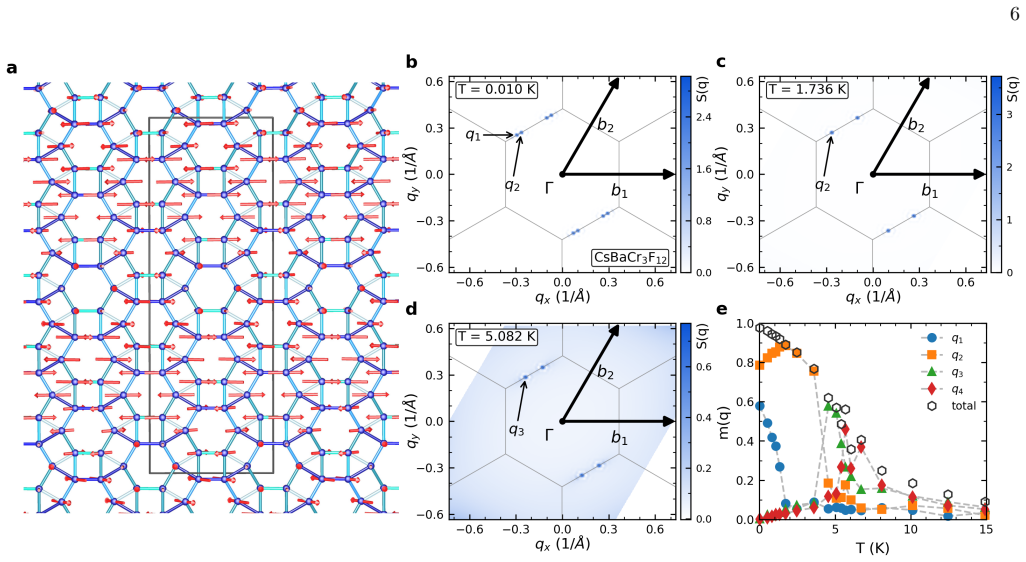
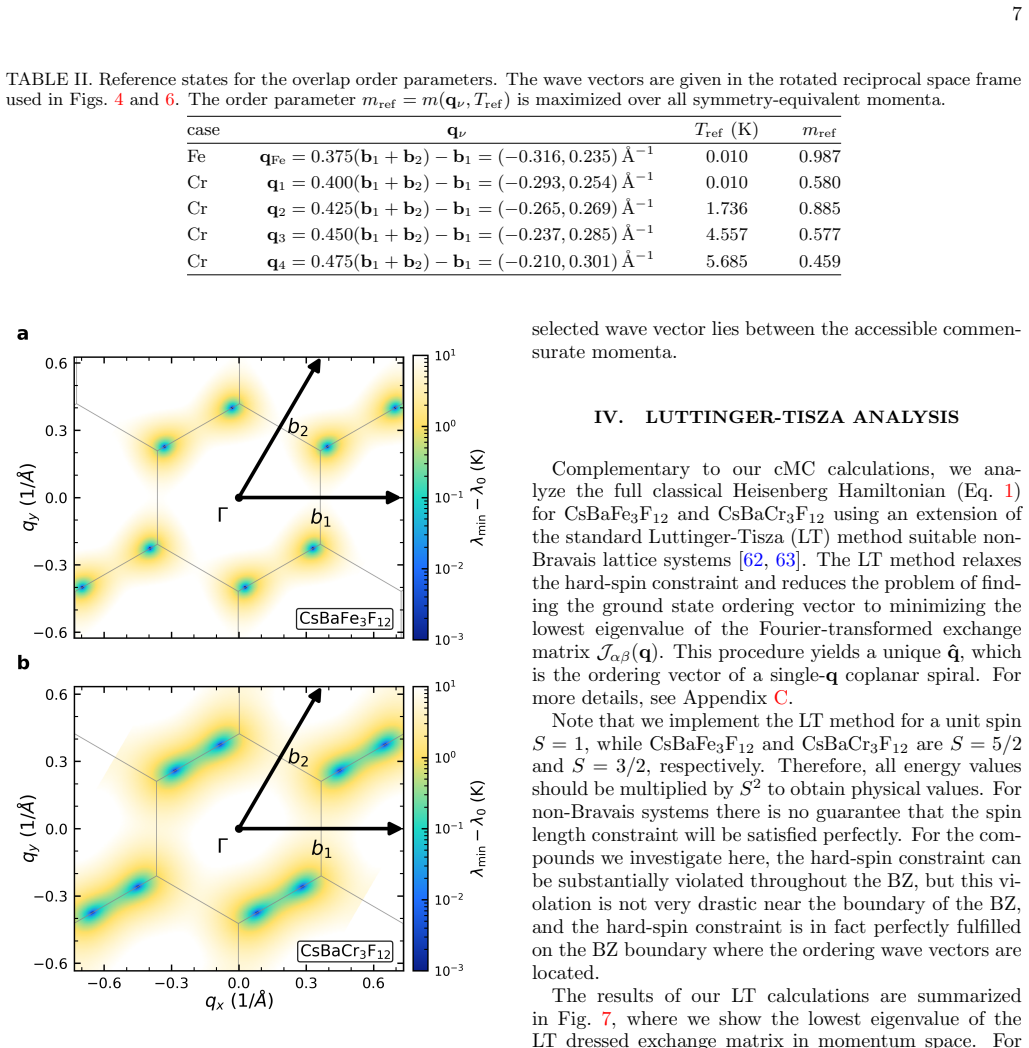
- For CsBaCr₃F₁₂ classical Monte Carlo and Luttinger-Tisza analysis reveal competing low-energy ordering wave vectors, strong finite-size sensitivity, and a tendency toward incommensurate order.
- These fluorides provide quantitative predictions for future neutron-scattering studies.
Where Pith is reading between the lines
- If the predicted local Néel correlations are confirmed, these materials could allow direct tests of how slight lattice distortions affect the ideal ruby lattice antiferromagnet.
- The chromium compound's sensitivity to finite size and competing wave vectors suggests it may be tunable by pressure or doping toward different ordered or disordered states.
- Matching the iron compound's ordering scale supports using the same DFT mapping approach to predict behavior in related layered fluorides.
Load-bearing premise
The DFT energy mapping procedure accurately determines the microscopic spin Hamiltonian parameters without significant errors from functional choice or neglected interactions.
What would settle it
Neutron scattering on CsBaCr₃F₁₂ that fails to show the competing low-energy ordering wave vectors or incommensurate tendencies predicted by the Monte Carlo and Luttinger-Tisza analysis.
Figures
read the original abstract
The antiferromagnet on the ruby lattice is expected to host a range of exotic emergent phenomena, yet its material realization has remained elusive. Here we show that the layered transition metal fluorides CsBaFe$_3$F$_{12}$ and CsBaCr$_3$F$_{12}$ with Fe$^{3+}$ and Cr$^{3+}$ ions realize only slightly distorted ruby lattice geometries with spin moments $S=5/2$ and $S=3/2$, respectively. Their microscopic Hamiltonians, calculated with DFT energy mapping, are dominated by short-ranged antiferromagnetic interactions within the ruby layers. Classical Monte Carlo simulations reveal strong frustration in both compounds, with local N\'eel correlations on the hexagonal plaquettes and distinct long-range ordering tendencies governed by weaker triangular links. For CsBaFe$_3$F$_{12}$, the calculated thermodynamic behaviour is consistent with the experimentally reported magnetic ordering scale. For CsBaCr$_3$F$_{12}$, classical Monte Carlo and Luttinger-Tisza analysis reveal competing low-energy ordering wave vectors, strong finite-size sensitivity, and a tendency toward incommensurate order. Overall, our results establish these fluorides as experimentally accessible ruby-lattice antiferromagnets and provide quantitative predictions for future neutron-scattering studies.
Editorial analysis
A structured set of objections, weighed in public.
Referee Report
Summary. The manuscript claims that CsBaFe₃F₁₂ (S=5/2) and CsBaCr₃F₁₂ (S=3/2) realize only slightly distorted ruby-lattice geometries whose microscopic Hamiltonians, obtained via DFT energy mapping, are dominated by short-ranged antiferromagnetic interactions within the layers. Classical Monte Carlo simulations show strong frustration with local Néel correlations on hexagonal plaquettes and distinct long-range ordering tendencies set by weaker triangular couplings; the Fe compound’s thermodynamic scale is stated to be consistent with experiment while the Cr compound exhibits competing low-energy wave-vectors and a tendency toward incommensurate order. Luttinger-Tisza analysis is used to identify the ordering vectors.
Significance. If the DFT-derived Hamiltonians are robust, the work supplies the first experimentally accessible material realizations of the ruby-lattice antiferromagnet together with quantitative predictions for neutron scattering. The combination of DFT mapping, classical Monte Carlo, and Luttinger-Tisza analysis constitutes a standard but reproducible workflow that directly links microscopic parameters to observable ordering tendencies.
major comments (2)
- [Abstract, §3] Abstract and §3 (DFT energy mapping): the central assertion that the Hamiltonians are “dominated by short-ranged antiferromagnetic interactions” rests entirely on the fitted J values; no error bars, sensitivity to Hubbard U, or comparison between at least two exchange-correlation functionals are reported, leaving open the possibility that relative strengths of nearest-neighbor versus triangular couplings could be reordered.
- [§4.2] §4.2 (Monte Carlo results for CsBaCr₃F₁₂): the claim of competing low-energy ordering wave-vectors and incommensurate tendency is load-bearing for the distinction drawn between the two compounds, yet the manuscript provides neither finite-size scaling of the structure factor nor explicit comparison of the Luttinger-Tisza eigenvalues against the Monte Carlo ordering temperatures.
minor comments (2)
- [Figure 3] Figure 3 caption: the color scale for the structure-factor plots is not defined, making it impossible to judge the relative intensity of the reported Bragg peaks.
- [Table 1] Table 1: the experimental lattice parameters are listed without estimated standard deviations, which should be included for direct comparison with the DFT-optimized structures.
Simulated Author's Rebuttal
We thank the referee for the careful reading and constructive comments on our manuscript. The points raised identify areas where additional validation will strengthen the presentation of the DFT-derived Hamiltonians and the Monte Carlo analysis. We address each comment below and will incorporate the suggested improvements in the revised version.
read point-by-point responses
-
Referee: [Abstract, §3] Abstract and §3 (DFT energy mapping): the central assertion that the Hamiltonians are “dominated by short-ranged antiferromagnetic interactions” rests entirely on the fitted J values; no error bars, sensitivity to Hubbard U, or comparison between at least two exchange-correlation functionals are reported, leaving open the possibility that relative strengths of nearest-neighbor versus triangular couplings could be reordered.
Authors: We agree that the robustness of the fitted exchange parameters can be better demonstrated. In the revised manuscript we will report error bars from the least-squares fitting procedure, present results for a range of Hubbard U values, and compare the extracted J values obtained with two different exchange-correlation functionals. These additions will confirm that the dominance of the short-ranged antiferromagnetic interactions is not sensitive to the specific methodological choices. revision: yes
-
Referee: [§4.2] §4.2 (Monte Carlo results for CsBaCr₃F₁₂): the claim of competing low-energy ordering wave-vectors and incommensurate tendency is load-bearing for the distinction drawn between the two compounds, yet the manuscript provides neither finite-size scaling of the structure factor nor explicit comparison of the Luttinger-Tisza eigenvalues against the Monte Carlo ordering temperatures.
Authors: We acknowledge that a more quantitative link between the Luttinger-Tisza analysis and the Monte Carlo results would strengthen the discussion of the Cr compound. In the revision we will include finite-size scaling of the structure factor from simulations performed on multiple lattice sizes and will explicitly compare the Luttinger-Tisza eigenvalues with the ordering temperatures extracted from the Monte Carlo runs. This will better document the competing low-energy wave vectors and the tendency toward incommensurate order. revision: yes
Circularity Check
No circularity: standard DFT-to-MC workflow with independent parameter extraction
full rationale
The derivation proceeds from first-principles DFT total-energy calculations on multiple spin configurations to extract exchange parameters via linear mapping, followed by independent classical Monte Carlo simulations on the resulting Hamiltonian to obtain ordering tendencies and thermodynamic quantities. These steps are sequential and non-reductive: the DFT energies are computed ab initio without reference to the target ordering wavevectors or temperatures, and the MC predictions are generated from the fitted parameters rather than being used to constrain them. No self-definitional relations, fitted inputs relabeled as predictions, or load-bearing self-citations appear in the abstract or described workflow. Experimental consistency for one compound is presented as qualitative validation, not as input to the mapping. The paper is therefore self-contained against external benchmarks with no reduction of claims to their own inputs.
Axiom & Free-Parameter Ledger
free parameters (1)
- DFT-derived exchange constants J
axioms (2)
- domain assumption Standard DFT exchange-correlation functionals and supercell energy mapping yield accurate nearest- and next-nearest-neighbor Heisenberg exchanges for these fluorides.
- domain assumption Classical Monte Carlo simulations on the extracted Hamiltonian capture the essential thermodynamic behavior and ordering wave-vectors.
Forward citations
Cited by 1 Pith paper
-
Finite-temperature formation of magnetic plateaus and simplex liquid states on the frustrated ruby lattice
Tensor-network simulation of the ruby-lattice antiferromagnet finds magnetic plateaus hosting simplex liquid states with residual entropy and continuous heat capacity at low but finite temperature.
Reference graph
Works this paper leans on
-
[1]
& Mila, F.Introduction to frustrated magnetism: materials, experiments, theory (Springer Science & Business Media, New York, 2011)
Lacroix, C., Mendels, P. & Mila, F.Introduction to frustrated magnetism: materials, experiments, theory (Springer Science & Business Media, New York, 2011)
2011
-
[2]
T.Frustrated Spin Systems(World Scientific, 2013), 2nd edn
Diep, H. T.Frustrated Spin Systems(World Scientific, 2013), 2nd edn
2013
-
[3]
Gingras, M. J. P. & McClarty, P. A. Quantum spin ice: a search for gapless quantum spin liquids in pyrochlore magnets.Rep. Prog. Phys.77, 056501 (2014)
2014
-
[4]
Emergent gauge fields and the high- temperature superconductors.Philos
Sachdev, S. Emergent gauge fields and the high- temperature superconductors.Philos. Trans. R. Soc. A. 374, 20150248 (2016)
2016
-
[5]
Spin liquids in frustrated magnets.Nature 464, 199–208 (2010)
Balents, L. Spin liquids in frustrated magnets.Nature 464, 199–208 (2010)
2010
-
[6]
& Balents, L
Savary, L. & Balents, L. Quantum spin liquids: a review. Rep. Prog. Phys.80, 016502 (2017)
2017
-
[7]
B., Kallin, C
Harris, A. B., Kallin, C. & Berlinsky, A. J. Possible N´ eel orderings of the Kagom´ e antiferromagnet.Phys. Rev. B 45, 2899–2919 (1992)
1992
-
[8]
T., Holdsworth, P
Chalker, J. T., Holdsworth, P. C. W. & Shender, E. F. Hidden order in a frustrated system: Properties of the Heisenberg Kagom´ e antiferromagnet.Phys. Rev. Lett. 68, 855–858 (1992)
1992
-
[9]
& Chalker, J
Moessner, R. & Chalker, J. T. Properties of a classical spin liquid: The Heisenberg pyrochlore antiferromagnet. Phys. Rev. Lett.80, 2929–2932 (1998)
1998
-
[10]
P., Nytko, E
Shores, M. P., Nytko, E. A., Bartlett, B. M. & Nocera, D. G. A structurally perfects= 1/2 Kagom´ e antiferro- magnet.J. Am. Chem. Soc.127, 13462–13463 (2005)
2005
-
[11]
Han, T.-H.et al.Fractionalized excitations in the spin- liquid state of a kagome-lattice antiferromagnet.Nature 492, 406–410 (2012)
2012
-
[12]
S., Gingras, M
Gardner, J. S., Gingras, M. J. P. & Greedan, J. E. Mag- netic pyrochlore oxides.Rev. Mod. Phys.82, 53–107 (2010)
2010
-
[13]
Beck, J.et al.Phase diagram of theJ-J d Heisenberg model on the maple leaf lattice: Neural networks and density matrix renormalization group.Phys. Rev. B109, 184422 (2024)
2024
-
[14]
Gemb´ e, M.et al.Noncoplanar orders and quantum dis- ordered states in maple-leaf antiferromagnets.Phys. Rev. B110, 085151 (2024)
2024
-
[15]
Niggemann, N.et al.Quantum paramagnetism in the decorated square-kagome antiferromagnet Na6Cu7BiO4(PO4)4Cl3.Phys. Rev. B108, L241117 (2023)
2023
-
[16]
A., Nyckees, S., Schmidt, K
Ghosh, P., Koziol, J. A., Nyckees, S., Schmidt, K. P. & Mila, F. Symmetry breaking and competing valence bond states in the star lattice Heisenberg antiferromag- net.Phys. Rev. B112, 144423 (2025)
2025
-
[17]
Chatterjee, S.et al.Semi-Dirac spin liquids and frus- trated quantum magnetism on the trellis lattice.Phys. Rev. Res.8, 013191 (2026)
2026
-
[18]
& Takagi, H
Okamoto, Y., Nohara, M., Aruga-Katori, H. & Takagi, H. Spin-liquid state in theS= 1/2 hyperkagome antifer- romagnet Na4Ir3O8.Phys. Rev. Lett.99, 137207 (2007)
2007
-
[19]
Commun.11, 2348 (2020)
Chillal, S.et al.Evidence for a three-dimensional quan- tum spin liquid in PbCuTe2O6.Nat. Commun.11, 2348 (2020)
2020
-
[20]
ˇZivkovi´ c, I.et al.Magnetic field induced quantum spin liquid in the two coupled trillium lattices of K2Ni2(SO4)3. Phys. Rev. Lett.127, 157204 (2021)
2021
-
[21]
Lin, K. Y. & Ma, W. J. Two-dimensional Ising model on a ruby lattice.J. Phys. A: Math. Gen.16, 3895 (1983)
1983
-
[22]
Suding, P. N. & Ziff, R. M. Site percolation thresholds for Archimedean lattices.Phys. Rev. E60, 275–283 (1999)
1999
-
[23]
Ising antiferromagnet on the Archimedean lat- tices.Phys
Yu, U. Ising antiferromagnet on the Archimedean lat- tices.Phys. Rev. E91, 062121 (2015)
2015
-
[24]
Farnell, D. J. J., Darradi, R., Schmidt, R. & Richter, J. Spin-half Heisenberg antiferromagnet on two archime- dian lattices: From the bounce lattice to the maple-leaf lattice and beyond.Phys. Rev. B84, 104406 (2011)
2011
-
[25]
& Thomale, R
Ghosh, P., M¨ uller, T. & Thomale, R. Another exact ground state of a two-dimensional quantum antiferro- magnet.Phys. Rev. B105, L180412 (2022)
2022
-
[26]
& Martin-Delgado, M
Bombin, H., Kargarian, M. & Martin-Delgado, M. A. Interacting anyonic fermions in a two-body color code model.Phys. Rev. B80, 075111 (2009)
2009
-
[27]
Verresen, R., Lukin, M. D. & Vishwanath, A. Prediction of toric code topological order from Rydberg blockade. Phys. Rev. X11, 031005 (2021)
2021
-
[28]
& Vishwanath, A
Verresen, R. & Vishwanath, A. Unifying Kitaev magnets, kagom´ e dimer models, and ruby Rydberg spin liquids. Phys. Rev. X12, 041029 (2022)
2022
-
[29]
Joseph, D. N. & Boettcher, I. Walking on Archimedean lattices: Insights from Bloch band theory.Phys. Rev. E 112, 044118 (2025)
2025
-
[30]
& Li, X.-B
Yang, Y., Shu, C.-R. & Li, X.-B. Topological phase tran- sitions and topological flat bands on the ruby lattice. Phys. Scr.98, 085948 (2023)
2023
-
[31]
& Fiete, G
Hu, X., Kargarian, M. & Fiete, G. A. Topological in- sulators and fractional quantum Hall effect on the ruby lattice.Phys. Rev. B84, 155116 (2011)
2011
-
[32]
Semeghini, G.et al.Probing topological spin liquids on a programmable quantum simulator.Science374, 1242– 1247 (2021)
2021
-
[33]
& Honecker, A.Quantum magnetism in two dimensions: From semi-classical N´ eel order to magnetic disorder, 85–153 (Springer Berlin Hei- delberg, Berlin, Heidelberg, 2004)
Richter, J., Schulenburg, J. & Honecker, A.Quantum magnetism in two dimensions: From semi-classical N´ eel order to magnetic disorder, 85–153 (Springer Berlin Hei- delberg, Berlin, Heidelberg, 2004)
2004
-
[34]
Maity, A., Samajdar, R. & Iqbal, Y. Gapped and gap- less quantum spin liquids on the ruby lattice (2024). 2409.16344
-
[35]
S., Kargarian, M., Masoudi, S
Jahromi, S. S., Kargarian, M., Masoudi, S. F. & Lan- gari, A. Topological spin liquids in the ruby lattice with 10 anisotropic Kitaev interactions.Phys. Rev. B94, 125145 (2016)
2016
-
[36]
S., Or´ us, R., Kargarian, M
Jahromi, S. S., Or´ us, R., Kargarian, M. & Langari, A. Infinite projected entangled-pair state algorithm for ruby and triangle-honeycomb lattices.Phys. Rev. B97, 115161 (2018)
2018
-
[37]
Lukin, I. V. & Sotnikov, A. G. Corner transfer matrix renormalization group approach in the zoo of Archimedean lattices.Phys. Rev. E109, 045305 (2024)
2024
-
[38]
& Moessner, R
Sch¨ afer, R., Placke, B., Benton, O. & Moessner, R. Abundance of hard-hexagon crystals in the quantum py- rochlore antiferromagnet.Phys. Rev. Lett.131, 096702 (2023)
2023
- [39]
-
[40]
Semeghini, G.et al.Probing topological spin liquids on a programmable quantum simulator.Science374, 1242–1247 (2021)
2021
-
[41]
Giudici, G., Lukin, M. D. & Pichler, H. Dynamical prepa- ration of quantum spin liquids in rydberg atom arrays. Phys. Rev. Lett.129, 090401 (2022)
2022
-
[42]
W., Pichler, H., Lukin, M
Samajdar, R., Ho, W. W., Pichler, H., Lukin, M. D. & Sachdev, S. Quantum phases of Rydberg atoms on a kagome lattice.Proc. Natl. Acad. Sci. U.S.A.118, e2015785118 (2021)
2021
-
[43]
G., Teng, Y
Samajdar, R., Joshi, D. G., Teng, Y. & Sachdev, S. EmergentZ 2 gauge theories and topological excitations in Rydberg atom arrays.Phys. Rev. Lett.130, 043601 (2023)
2023
-
[44]
Guo, S.et al.Magnetic compounds with exotic Archimedean lattices.The Innovation6, 100981 (2025)
2025
-
[45]
Renaudin, J.et al.The magnetic properties of the frus- trated bidimensional antiferromagnet CsBaFe 3F12.J. Mag. Mag. Mater.92, 381–387 (1991)
1991
-
[46]
& Renaudin, J
F´ erey, G. & Renaudin, J. Crystal chemistry, plane nets and arabic mosaics: the structure of CsBaCr 3F12, a new MX4 network.Z. Kristallogr.189, 181–190 (1989)
1989
-
[47]
A study of structural and thermodynamic properties of the YNi5 –x Alx–hydrogen system.J
ˇSorgi´ c, B., ˇZ Blaˇ zina & Draˇ sner, A. A study of structural and thermodynamic properties of the YNi5 –x Alx–hydrogen system.J. Alloys Comp.265, 185– 189 (1998)
1998
-
[48]
C., McMillen, C
Heyward, C. C., McMillen, C. D. & Kolis, J. W. Hy- drothermal growth of lanthanide borosilicates: A useful approach to new acentric crystals including a derivative of cappelenite.Inorg. Chem.54, 905–913 (2015)
2015
-
[49]
& Ferey, G
Renaudin, J., Laligant, Y., Samou¨ el, M., de Kozak, A. & Ferey, G. Complex copper(II) fluorides: III. crystal struc- ture of Ba2CuV2F12: A new bidimensional MX4 network. J. Solid State Chem.62, 158–163 (1986)
1986
-
[50]
Mosaics, quilts, science and crystal structures – which one inspires the other?Z
F´ erey, G. Mosaics, quilts, science and crystal structures – which one inspires the other?Z. Anorg. Allg. Chem. 640, 3212–3216 (2014)
2014
-
[51]
I., Anisimov, V
Liechtenstein, A. I., Anisimov, V. I. & Zaanen, J. Density-functional theory and strong interactions: Or- bital ordering in Mott-Hubbard insulators.Phys. Rev. B 52, R5467–R5470 (1995)
1995
-
[52]
Ghosh, P.et al.Breathing chromium spinels: a showcase for a variety of pyrochlore Heisenberg Hamiltonians.npj Quantum Mater.4, 63 (2019)
2019
-
[53]
& Jeschke, H
Xu, H.-X., Shimizu, M., Guterding, D., Otsuki, J. & Jeschke, H. O. Pressure evolution of electronic structure and magnetism in the layered van der Waals ferromagnet CrGeTe3.Phys. Rev. B108, 125142 (2023)
2023
-
[54]
J.et al.Spin waves and magnetic hamiltonian in the low-temperature phase of LiInCr 4O8.Phys
Nilsen, G. J.et al.Spin waves and magnetic hamiltonian in the low-temperature phase of LiInCr 4O8.Phys. Rev. B112, L020403 (2025)
2025
-
[55]
O., Nakano, H
Jeschke, H. O., Nakano, H. & Sakai, T. From kagome strip to kagome lattice: Realizations of frustratedS= 1 2 antiferromagnets in Ti(III) fluorides.Phys. Rev. B99, 140410 (2019)
2019
-
[56]
Shirakami, R.et al.Two magnetization plateaus in the kagome fluoride Cs2LiTi3F12.Phys. Rev. B100, 174401 (2019)
2019
-
[57]
Jaubert, L. D. C., Iqbal, Y. & Jeschke, H. O. Spin- peierls transition in the frustrated spinels ZnCr 2O4 and MgCr2O4.Phys. Rev. Lett.134, 086702 (2025)
2025
-
[58]
& Conte, R
Villain, J., Bidaux, R., Carton, J.-P. & Conte, R. Order as an effect of disorder.J. Phys. France41, 1263–1272 (1980)
1980
-
[59]
Henley, C. L. Ordering due to disorder in a frustrated vector antiferromagnet.Phys. Rev. Lett.62, 2056–2059 (1989)
2056
-
[60]
& Balents, L
Bergman, D., Alicea, J., Gull, E., Trebst, S. & Balents, L. Order-by-disorder and spiral spin-liquid in frustrated diamond-lattice antiferromagnets.Nat. Phys.3, 487–491 (2007)
2007
-
[61]
& Paramekanti, A
Mulder, A., Ganesh, R., Capriotti, L. & Paramekanti, A. Spiral order by disorder and lattice nematic order in a frustrated Heisenberg antiferromagnet on the honeycomb lattice.Phys. Rev. B81, 214419 (2010)
2010
-
[62]
Luttinger, J. M. & Tisza, L. Theory of dipole interaction in crystals.Phys. Rev.70, 954–964 (1946)
1946
-
[63]
& Richter, J
Schmidt, H.-J. & Richter, J. Classical ground states of spin lattices.J. Phys. A: Math. Theor.55, 465005 (2022)
2022
-
[64]
Goto, M.et al.Ising-like anisotropy stabilized 1 3 and 2 3 magnetization plateaus in the V3+ kagome lattice antifer- romagnets Cs 2KV3F12, Cs 2NaV3F12, and Rb 2NaV3F12. Phys. Rev. B95, 134436 (2017)
2017
-
[65]
Goto, M.et al.Various disordered ground states and 1 3 magnetization-plateau-like behavior in thes= 1 2 Ti3+ kagome lattice antiferromagnets Rb 2NaTi3F12, Cs2NaTi3F12, and Cs2KTi3F12.Phys. Rev. B94, 104432 (2016)
2016
-
[66]
& Eschrig, H
Koepernik, K. & Eschrig, H. Full-potential nonorthogo- nal local-orbital minimum-basis band-structure scheme. Phys. Rev. B59, 1743–1757 (1999)
1999
-
[67]
P., Burke, K
Perdew, J. P., Burke, K. & Ernzerhof, M. Generalized gradient approximation made simple.Phys. Rev. Lett. 77, 3865–3868 (1996)
1996
-
[68]
& Fujimori, A
Mizokawa, T. & Fujimori, A. Electronic structure and orbital ordering in perovskite-type 3d transition-metal oxides studied by Hartree-Fock band-structure calcula- tions.Phys. Rev. B54, 5368–5380 (1996)
1996
-
[69]
W., Rosenbluth, M
Metropolis, N., Rosenbluth, A. W., Rosenbluth, M. N., Teller, A. H. & Teller, E. Equation of state calculations by fast computing machines.J. Chem. Phys.21, 1087– 1092 (1953)
1953
-
[70]
Hastings, W. K. Monte Carlo sampling methods using Markov chains and their applications.Biometrika57, 97–109 (1970)
1970
-
[71]
D., Sabogal-Su´ arez, D., Evans, R
Alzate-Cardona, J. D., Sabogal-Su´ arez, D., Evans, R. F. L. & Restrepo-Parra, E. Optimal phase space sam- pling for Monte Carlo simulations of Heisenberg spin sys- tems.J. Phys. Condens. Matter31, 095802 (2019)
2019
-
[72]
& Mori, J
Kadena, Y. & Mori, J. An effective Monte Carlo simula- tion on classical spin systems.Phys. Lett. A190, 323–326 11 (1994). Appendix A: DFT energy mapping We employ the full potential local orbital (FPLO) ba- sis [66] in combination with a generalized gradient ex- change correlation functional [67]. We treat the strong electronic correlations on the 3dorbi...
1994
-
[73]
Kabsch, A solution for the best rotation to relate two sets of vectors, Acta Crystallogr
W. Kabsch, A solution for the best rotation to relate two sets of vectors, Acta Crystallogr. A32, 922 (1976)
1976
-
[74]
Kabsch, A discussion of the solution for the best rotation to relate two sets of vectors, Acta Crystallogr
W. Kabsch, A discussion of the solution for the best rotation to relate two sets of vectors, Acta Crystallogr. A34, 827 (1978)
1978
discussion (0)
Sign in with ORCID, Apple, or X to comment. Anyone can read and Pith papers without signing in.