Engineering recoil heating in coherent-scattering levitated optomechanics
Pith reviewed 2026-06-29 07:04 UTC · model grok-4.3
The pith
The electromagnetic environment in microcavities can strongly suppress recoil heating rates for levitated particles, contrary to free-space assumptions.
A machine-rendered reading of the paper's core claim, the machinery that carries it, and where it could break.
Core claim
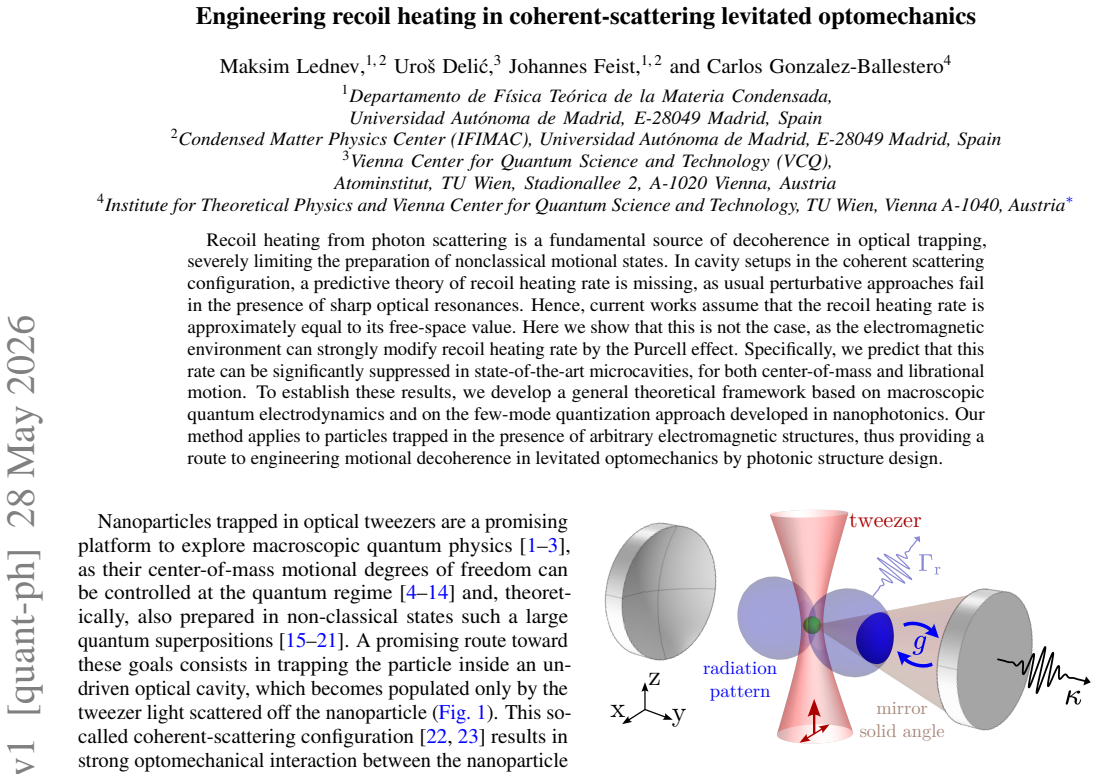
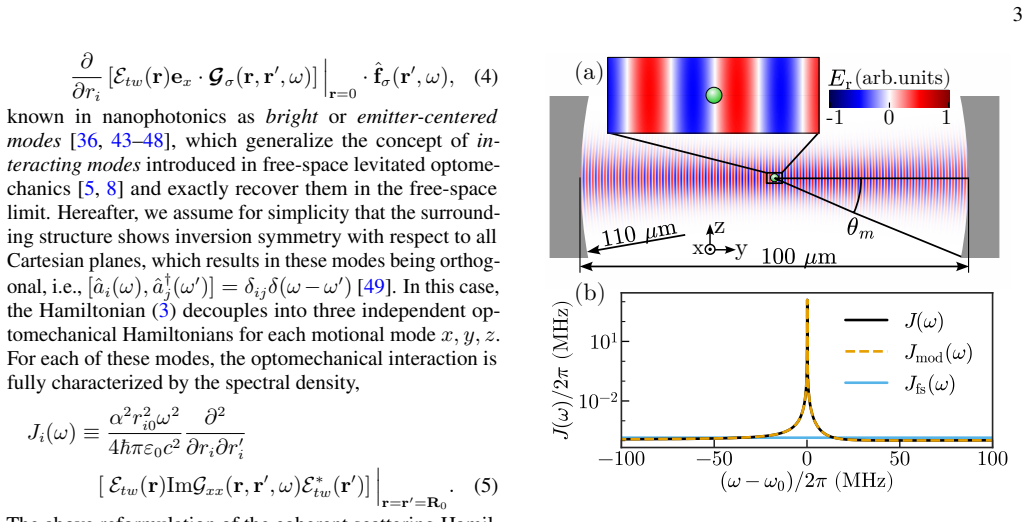
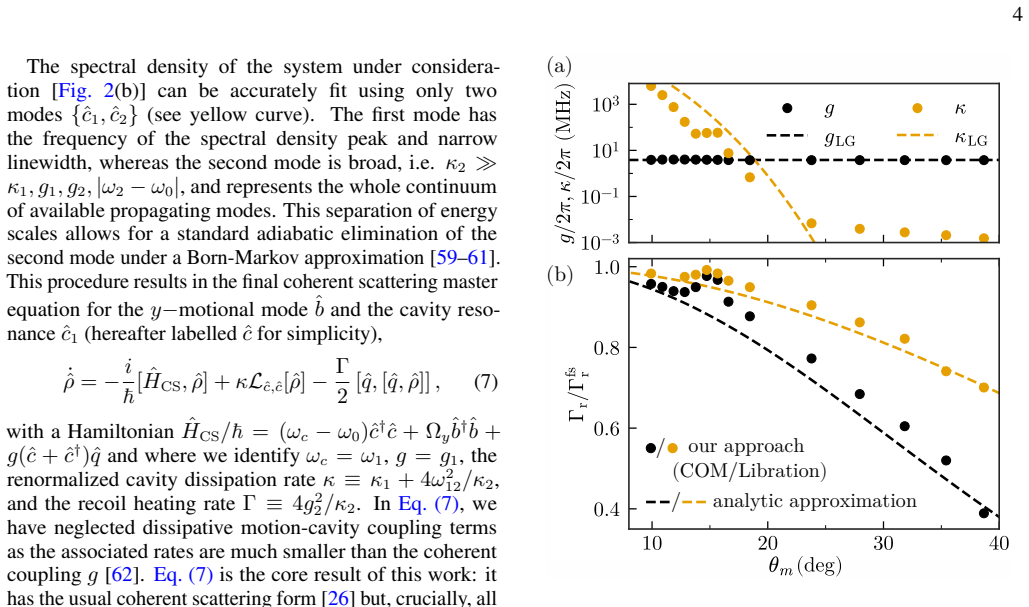
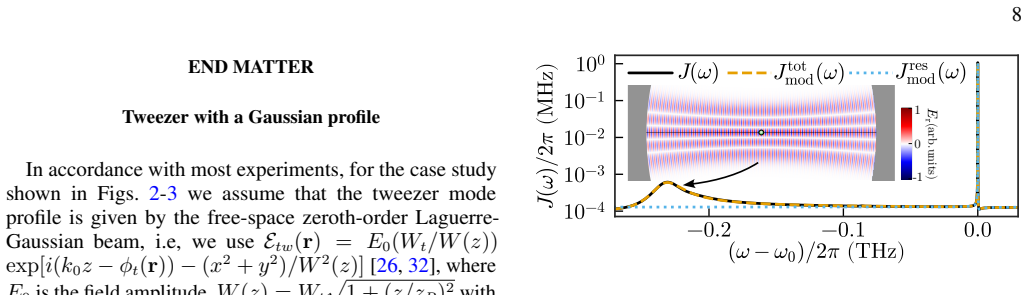
In cavity setups using coherent scattering, the recoil heating rate is not equal to its free-space value; the electromagnetic environment can strongly modify it by the Purcell effect. A general theoretical framework based on macroscopic quantum electrodynamics and few-mode quantization shows that this rate can be significantly suppressed in state-of-the-art microcavities for both center-of-mass and librational motion. The method applies to particles trapped in the presence of arbitrary electromagnetic structures.
What carries the argument
A theoretical framework based on macroscopic quantum electrodynamics combined with the few-mode quantization approach, which captures modifications to recoil heating due to sharp optical resonances where perturbative methods fail.
If this is right
- Recoil heating rate in coherent-scattering cavities differs from the free-space value.
- Significant suppression of heating is possible in microcavities for both center-of-mass and librational degrees of freedom.
- Motional decoherence can be engineered by designing the surrounding photonic structure.
- The framework applies to any particle trapped near arbitrary electromagnetic structures.
Where Pith is reading between the lines
- Cavity designs could be optimized to reach lower decoherence thresholds needed for preparing quantum motional states.
- The same approach might apply to other scattering-induced decoherence channels beyond recoil heating.
- Experiments could test the framework by varying cavity geometry and measuring changes in heating rates.
Load-bearing premise
That usual perturbative approaches cannot accurately predict recoil heating in the presence of sharp optical resonances, so a new framework is required to capture the modification.
What would settle it
A direct experimental comparison of the measured recoil heating rate for a levitated particle inside a state-of-the-art microcavity versus the same particle in free space, checking whether the cavity rate shows the predicted suppression.
Figures
read the original abstract
Recoil heating from photon scattering is a fundamental source of decoherence in optical trapping, severely limiting the preparation of nonclassical motional states. In cavity setups in the coherent scattering configuration, a predictive theory of recoil heating rate is missing, as usual perturbative approaches fail in the presence of sharp optical resonances. Hence, current works assume that the recoil heating rate is approximately equal to its free-space value. Here we show that this is not the case, as the electromagnetic environment can strongly modify recoil heating rate by the Purcell effect. Specifically, we predict that this rate can be significantly suppressed in state-of-the-art microcavities, for both center-of-mass and librational motion. To establish these results, we develop a general theoretical framework based on macroscopic quantum electrodynamics and on the few-mode quantization approach developed in nanophotonics. Our method applies to particles trapped in the presence of arbitrary electromagnetic structures, thus providing a route to engineering motional decoherence in levitated optomechanics by photonic structure design.
Editorial analysis
A structured set of objections, weighed in public.
Referee Report
Summary. The manuscript develops a theoretical framework based on macroscopic quantum electrodynamics combined with the few-mode quantization approach from nanophotonics. It argues that usual perturbative methods fail near sharp optical resonances, so the recoil heating rate in coherent-scattering levitated optomechanics cannot be assumed equal to its free-space value. Instead, the electromagnetic environment modifies the rate via the Purcell effect, and the authors predict significant suppression of this rate (for both center-of-mass and librational motion) in state-of-the-art microcavities. The framework is presented as general for particles in arbitrary electromagnetic structures.
Significance. If the central prediction holds, the work supplies a concrete route to engineering a key decoherence channel in levitated optomechanics through photonic design. This would be relevant for preparing nonclassical motional states. The generality of the macroscopic-QED plus few-mode method is a positive feature, though its quantitative accuracy for total recoil heating remains to be verified.
major comments (1)
- [Framework section (derivation of the modified scattering rate)] The suppression claim is load-bearing on the assertion that the few-mode quantization framework correctly computes the total recoil heating rate (momentum transfer integrated over the full radiation pattern). The skeptic concern is valid here: it is not demonstrated that non-resonant continuum modes, which dominate free-space recoil, are properly included or renormalized rather than left at their unmodified background value. Without an explicit check that the net integrated rate (cavity-modified plus continuum) is reduced, the predicted suppression does not necessarily follow. This issue must be addressed with a concrete calculation or comparison to the free-space limit.
minor comments (2)
- The abstract states that the rate 'can be significantly suppressed' but does not quote the numerical factor or the specific cavity parameters used; these should appear in the main text or a table for reproducibility.
- Notation for the recoil heating rate (free-space versus cavity-modified) should be introduced once and used consistently to avoid ambiguity when comparing to prior literature.
Simulated Author's Rebuttal
We thank the referee for their careful reading and for raising this substantive point about the treatment of continuum modes. We address it directly below and will revise the manuscript accordingly.
read point-by-point responses
-
Referee: [Framework section (derivation of the modified scattering rate)] The suppression claim is load-bearing on the assertion that the few-mode quantization framework correctly computes the total recoil heating rate (momentum transfer integrated over the full radiation pattern). The skeptic concern is valid here: it is not demonstrated that non-resonant continuum modes, which dominate free-space recoil, are properly included or renormalized rather than left at their unmodified background value. Without an explicit check that the net integrated rate (cavity-modified plus continuum) is reduced, the predicted suppression does not necessarily follow. This issue must be addressed with a concrete calculation or comparison to the free-space limit.
Authors: We agree that an explicit verification of the total integrated recoil rate is necessary to substantiate the suppression prediction. Our framework employs macroscopic QED to capture the full electromagnetic environment (including non-resonant contributions via the dyadic Green's function) while using few-mode quantization only for the resonant cavity modes. To directly resolve the concern, the revised manuscript will include a new calculation (or appendix) that decomposes the momentum transfer into resonant and continuum parts, demonstrates recovery of the free-space rate in the limit of vanishing cavity finesse, and confirms that the net integrated rate is reduced relative to free space. This will show that continuum modes are renormalized rather than held at their unmodified background value. revision: yes
Circularity Check
No significant circularity; framework applies established methods to new geometry
full rationale
The paper introduces a framework combining macroscopic QED with few-mode quantization to compute recoil heating rates in structured electromagnetic environments. The central claim—that Purcell modification can suppress the rate relative to free space—follows from applying the scattering calculation to the cavity-modified density of states, without any quoted step that reduces the output to a fitted parameter, a self-citation chain, or a redefinition of the input. No load-bearing uniqueness theorem or ansatz is imported from the authors' prior work in a way that forces the result. The derivation therefore remains self-contained and externally falsifiable via independent nanophotonic calculations.
Axiom & Free-Parameter Ledger
axioms (2)
- domain assumption Macroscopic quantum electrodynamics applies to the particle-cavity system
- domain assumption Few-mode quantization approach from nanophotonics is valid for recoil heating calculation
Forward citations
Cited by 1 Pith paper
-
Scattering theory for cavity-assisted spin-motion-photon interactions
Extends scattering theory to derive a compact operator-based input-output relation for spin-motion-photon interactions in cavity QED applicable across geometries and potentials.
Reference graph
Works this paper leans on
-
[1]
Millen, T
J. Millen, T. S. Monteiro, R. Pettit, and A. N. Vamivakas, Optomechanics with levitated particles, Reports on Progress in Physics83, 026401 (2020)
2020
-
[2]
Gonzalez-Ballestero, M
C. Gonzalez-Ballestero, M. Aspelmeyer, L. Novotny, R. Quidant, and O. Romero-Isart, Levitodynamics: Levi- tation and control of microscopic objects in vacuum, Science 374, eabg3027 (2021)
2021
-
[3]
B. A. Stickler, K. Hornberger, and M. S. Kim, Quantum rotations of nanoparticles, Nature Reviews Physics3, 589 (2021)
2021
-
[4]
Deli ´c, M
U. Deli ´c, M. Reisenbauer, K. Dare, D. Grass, V . Vuleti ´c, N. Kiesel, and M. Aspelmeyer, Cooling of a levitated nanoparticle to the motional quantum ground state, Science 367, 892 (2020)
2020
-
[5]
Magrini, P
L. Magrini, P. Rosenzweig, C. Bach, A. Deutschmann-Olek, S. G. Hofer, S. Hong, N. Kiesel, A. Kugi, and M. Aspelmeyer, Real-time optimal quantum control of mechanical motion at room temperature, Nature595, 373 (2021)
2021
-
[6]
Tebbenjohanns, M
F. Tebbenjohanns, M. L. Mattana, M. Rossi, M. Frimmer, and L. Novotny, Quantum control of a nanoparticle optically levitated in cryogenic free space, Nature595, 378 (2021)
2021
-
[7]
Kamba, R
M. Kamba, R. Shimizu, and K. Aikawa, Optical cold damp- ing of neutral nanoparticles near the ground state in an optical lattice, Opt. Express30, 26716 (2022)
2022
-
[8]
Militaru, M
A. Militaru, M. Rossi, F. Tebbenjohanns, O. Romero-Isart, M. Frimmer, and L. Novotny, Ponderomotive squeezing of light by a levitated nanoparticle in free space, Phys. Rev. Lett. 129, 053602 (2022)
2022
-
[9]
Magrini, V
L. Magrini, V . A. Camarena-Ch´avez, C. Bach, A. Johnson, and M. Aspelmeyer, Squeezed light from a levitated nanopar- ticle at room temperature, Phys. Rev. Lett.129, 053601 (2022)
2022
-
[10]
Piotrowski, D
J. Piotrowski, D. Windey, J. Vijayan, C. Gonzalez-Ballestero, A. de los R´ıos Sommer, N. Meyer, R. Quidant, O. Romero- Isart, R. Reimann, and L. Novotny, Simultaneous ground- state cooling of two mechanical modes of a levitated nanopar- ticle, Nature Physics19, 1009 (2023)
2023
-
[11]
Rossi, A
M. Rossi, A. Militaru, N. Carlon Zambon, A. Riera- Campeny, O. Romero-Isart, M. Frimmer, and L. Novotny, Quantum delocalization of a levitated nanoparticle, Phys. Rev. Lett.135, 083601 (2025)
2025
-
[12]
Troyer, F
S. Troyer, F. Fechtel, L. Hummer, H. Rudolph, B. A. Stickler, U. Deli´c, and M. Arndt, Quantum ground-state cooling of two librational modes of a nanorotor, Nature Physics22, 584 (2026)
2026
-
[13]
Kamba, N
M. Kamba, N. Hara, and K. Aikawa, Quantum squeezing of a levitated nanomechanical oscillator, Science389, 1225 (2025)
2025
-
[14]
M. Skrabulis, M. C. Sosa, N. C. Zambon, A. Militaru, M. Rossi, M. Frimmer, and L. Novotny, Nanomechanical sensor resolving impulsive forces below its zero-point fluctu- ations (2026), arXiv:2601.19392 [quant-ph]
-
[15]
Romero-Isart, M
O. Romero-Isart, M. L. Juan, R. Quidant, and J. I. Cirac, Toward quantum superposition of living organisms, New Journal of Physics12, 033015 (2010)
2010
-
[16]
D. E. Chang, C. A. Regal, S. B. Papp, D. J. Wilson, J. Ye, O. Painter, H. J. Kimble, and P. Zoller, Cavity opto- mechanics using an optically levitated nanosphere, Proceed- ings of the National Academy of Sciences107, 1005 (2010)
2010
-
[17]
Romero-Isart, A
O. Romero-Isart, A. C. Pflanzer, F. Blaser, R. Kaltenbaek, N. Kiesel, M. Aspelmeyer, and J. I. Cirac, Large quantum superpositions and interference of massive nanometer-sized objects, Phys. Rev. Lett.107, 020405 (2011)
2011
-
[18]
Romero-Isart, Quantum superposition of massive objects and collapse models, Phys
O. Romero-Isart, Quantum superposition of massive objects and collapse models, Phys. Rev. A84, 052121 (2011)
2011
-
[19]
Roda-Llordes, A
M. Roda-Llordes, A. Riera-Campeny, D. Candoli, P. T. Gro- chowski, and O. Romero-Isart, Macroscopic quantum super- positions via dynamics in a wide double-well potential, Phys. Rev. Lett.132, 023601 (2024)
2024
-
[20]
Neumeier, M
L. Neumeier, M. A. Ciampini, O. Romero-Isart, M. As- 6 pelmeyer, and N. Kiesel, Fast quantum interference of a nanoparticle via optical potential control, Proceedings of the National Academy of Sciences121, e2306953121 (2024)
2024
-
[21]
Bemani, A
F. Bemani, A. A. Rakhubovsky, and R. Filip, Heralded quan- tum non-gaussian states in pulsed levitating optomechanics, npj Quantum Information11, 160 (2025)
2025
-
[22]
Deli´c, M
U. Deli´c, M. Reisenbauer, D. Grass, N. Kiesel, V . Vuleti´c, and M. Aspelmeyer, Cavity cooling of a levitated nanosphere by coherent scattering, Phys. Rev. Lett.122, 123602 (2019)
2019
-
[23]
Windey, C
D. Windey, C. Gonzalez-Ballestero, P. Maurer, L. Novotny, O. Romero-Isart, and R. Reimann, Cavity-based 3d cooling of a levitated nanoparticle via coherent scattering, Phys. Rev. Lett.122, 123601 (2019)
2019
-
[24]
Dania, O
L. Dania, O. S. Kremer, J. Piotrowski, D. Candoli, J. Vijayan, O. Romero-Isart, C. Gonzalez-Ballestero, L. Novotny, and M. Frimmer, High-purity quantum optomechanics at room temperature, Nature Physics21, 1603 (2025)
2025
-
[25]
V . Jain, J. Gieseler, C. Moritz, C. Dellago, R. Quidant, and L. Novotny, Direct measurement of photon recoil from a levitated nanoparticle, Phys. Rev. Lett.116, 243601 (2016)
2016
-
[26]
Gonzalez-Ballestero, P
C. Gonzalez-Ballestero, P. Maurer, D. Windey, L. Novotny, R. Reimann, and O. Romero-Isart, Theory for cavity cooling of levitated nanoparticles via coherent scattering: Master equation approach, Phys. Rev. A100, 013805 (2019)
2019
-
[27]
Maurer, C
P. Maurer, C. Gonzalez-Ballestero, and O. Romero-Isart, Quantum theory of light interaction with a lorenz-mie par- ticle: Optical detection and three-dimensional ground-state cooling, Phys. Rev. A108, 033714 (2023)
2023
-
[28]
Rudolph, K
H. Rudolph, K. Hornberger, and B. A. Stickler, Entangling levitated nanoparticles by coherent scattering, Phys. Rev. A 101, 011804 (2020)
2020
-
[29]
Rudolph, J
H. Rudolph, J. Sch ¨afer, B. A. Stickler, and K. Hornberger, Theory of nanoparticle cooling by elliptic coherent scattering, Phys. Rev. A103, 043514 (2021)
2021
-
[30]
Sch¨afer, H
J. Sch¨afer, H. Rudolph, K. Hornberger, and B. A. Stickler, Cooling nanorotors by elliptic coherent scattering, Phys. Rev. Lett.126, 163603 (2021)
2021
-
[31]
Vijayan, J
J. Vijayan, J. Piotrowski, C. Gonzalez-Ballestero, K. Weber, O. Romero-Isart, and L. Novotny, Cavity-mediated long- range interactions in levitated optomechanics, Nature Physics 20, 859 (2024)
2024
-
[32]
Novotny and B
L. Novotny and B. Hecht,Principles of Nano-Optics, 2nd ed. (Cambridge University Press, 2012)
2012
-
[33]
Tebbenjohanns, M
F. Tebbenjohanns, M. Frimmer, and L. Novotny, Optimal position detection of a dipolar scatterer in a focused field, Phys. Rev. A100, 043821 (2019)
2019
-
[34]
Scheel and S
S. Scheel and S. Y . Buhmann, Macroscopic quantum electro- dynamics - Concepts and applications, Acta Phys. Slovaca 58(2008)
2008
-
[35]
S. Y . Buhmann,Dispersion Forces I: Macroscopic Quan- tum Electrodynamics and Ground-State Casimir, Casimir- Polder and van der Waals Forces(Springer Berlin Heidel- berg, 2012)
2012
-
[36]
S. Y . Buhmann,Dispersion Forces II: Many-Body Effects, Excited Atoms, Finite Temperature and Quantum Friction (Springer Berlin Heidelberg, 2012)
2012
-
[37]
Medina, F
I. Medina, F. J. Garc´ıa-Vidal, A. I. Fern´andez-Dom´ınguez, and J. Feist, Few-Mode Field Quantization of Arbitrary Elec- tromagnetic Spectral Densities, Phys. Rev. Lett.126, 093601 (2021)
2021
-
[38]
S´anchez-Barquilla, F
M. S´anchez-Barquilla, F. J. Garc´ıa-Vidal, A. I. J. Fern´andez- Dom´ınguez, and J. Feist, Few-mode field quantization for multiple emitters, Nanophotonics11, 4363 (2022)
2022
-
[39]
Lednev, F
M. Lednev, F. J. Garc´ıa-Vidal, and J. Feist, Lindblad master equation capable of describing hybrid quantum systems in the ultrastrong coupling regime, Phys. Rev. Lett.132, 106902 (2024)
2024
-
[40]
Lednev, D
M. Lednev, D. Fern´andez de la Pradilla, F. Lindel, E. Moreno, F. J. Garc´ıa-Vidal, and J. Feist, Spatially resolved photon statistics of general nanophotonic systems, PRX Quantum6, 020361 (2025)
2025
-
[41]
Gonzalez-Ballestero, I
C. Gonzalez-Ballestero, I. Coroli, and U. Deli´c, Optical po- tential shaping and photon recoil suppression through coher- ent scattering, arXiv, In Preparation (2026)
2026
-
[42]
A. C. Pflanzer, O. Romero-Isart, and J. I. Cirac, Master- equation approach to optomechanics with arbitrary di- electrics, Phys. Rev. A86, 013802 (2012)
2012
-
[43]
H ¨ummer, F
T. H ¨ummer, F. J. Garc ´ıa-Vidal, L. Mart ´ın-Moreno, and D. Zueco, Weak and strong coupling regimes in plasmonic qed, Phys. Rev. B87, 115419 (2013)
2013
-
[44]
Rousseaux, D
B. Rousseaux, D. Dzsotjan, G. Colas des Francs, H. R. Jauslin, C. Couteau, and S. Gu´erin, Adiabatic passage medi- ated by plasmons: A route towards a decoherence-free quan- tum plasmonic platform, Phys. Rev. B93, 045422 (2016)
2016
-
[45]
Dzsotjan, B
D. Dzsotjan, B. Rousseaux, H. R. Jauslin, G. C. des Francs, C. Couteau, and S. Gu´erin, Mode-selective quantization and multimodal effective models for spherically layered systems, Phys. Rev. A94, 023818 (2016)
2016
-
[46]
Castellini, H
A. Castellini, H. R. Jauslin, B. Rousseaux, D. Dzsotjan, G. Colas des Francs, A. Messina, and S. Gu´erin, Quantum plasmonics with multi-emitters: application to stimulated raman adiabatic passage, The European Physical Journal D 72, 223 (2018)
2018
-
[47]
Varguet, B
H. Varguet, B. Rousseaux, D. Dzsotjan, H. R. Jauslin, S. Gu ´erin, and G. C. d. Francs, Non-hermitian hamilto- nian description for quantum plasmonics: from dissipative dressed atom picture to fano states, Journal of Physics B: Atomic, Molecular and Optical Physics52, 055404 (2019)
2019
-
[48]
Feist, A
J. Feist, A. I. Fern´andez-Dom´ınguez, and F. J. Garc´ıa-Vidal, Macroscopic QED for quantum nanophotonics: emitter- centered modes as a minimal basis for multiemitter problems, Nanophotonics10, 477 (2021)
2021
-
[49]
(5) but with the substitution r2 i0(∂2/∂ri∂r ′ i)→ ri0rj0 (∂2/∂ri∂r ′ j )
For a non-inversion-symmetric structure, these modes are not orthogonal to each other and commute as [ˆai(ω),ˆa† j (ω′)] = δ(ω−ω ′)Jij (ω)/ p Ji(ω)Jj (ω) [48], with Jij (ω) defined as in Eq. (5) but with the substitution r2 i0(∂2/∂ri∂r ′ i)→ ri0rj0 (∂2/∂ri∂r ′ j )
-
[50]
Inc., Comsol multiphysics® v
C. Inc., Comsol multiphysics® v. 6.4 (2024)
2024
-
[51]
Toroˇs and T
M. Toroˇs and T. S. Monteiro, Quantum sensing and cooling in three-dimensional levitated cavity optomechanics, Phys. Rev. Res.2, 023228 (2020)
2020
-
[52]
Toroˇs, U
M. Toroˇs, U. Deli´c, F. Hales, and T. S. Monteiro, Coherent- scattering two-dimensional cooling in levitated cavity op- tomechanics, Phys. Rev. Res.3, 023071 (2021)
2021
-
[53]
Brand ˜ao, D
I. Brand ˜ao, D. Tandeitnik, and T. Guerreiro, Coher- ent scattering-mediated correlations between levitated nanospheres, Quantum Science and Technology6, 045013 (2021)
2021
-
[54]
H. T. Dung, L. Kn ¨oll, and D.-G. Welsch, Intermolecular energy transfer in the presence of dispersing and absorbing media, Phys. Rev. A65, 043813 (2002). 7
2002
-
[55]
Seberson and F
T. Seberson and F. Robicheaux, Distribution of laser shot- noise energy delivered to a levitated nanoparticle, Phys. Rev. A102, 033505 (2020)
2020
-
[56]
Cerchiari, L
G. Cerchiari, L. Dania, D. S. Bykov, R. Blatt, and T. E. Northup, Position measurement of a dipolar scatterer via self-homodyne detection, Phys. Rev. A104, 053523 (2021)
2021
-
[57]
Jakubec, C
C. Jakubec, C. Jarzynski, and K. Sinha, Decoherence and brownian motion of a polarizable particle near a medium, Phys. Rev. A112, 042225 (2025)
2025
-
[58]
Gajewski and J
R. Gajewski and J. Bateman, Backaction suppression in levi- tated optomechanics using reflective boundaries, Phys. Rev. Res.7, 023041 (2025)
2025
-
[59]
Brion, L
E. Brion, L. H. Pedersen, and K. Mølmer, Adiabatic elimina- tion in a lambda system, Journal of Physics A: Mathematical and Theoretical40, 1033 (2007)
2007
-
[60]
Gonzalez-Ballestero, Tutorial: projector approach to mas- ter equations for open quantum systems, Quantum8, 1454 (2024)
C. Gonzalez-Ballestero, Tutorial: projector approach to mas- ter equations for open quantum systems, Quantum8, 1454 (2024)
2024
-
[61]
Ben-Asher, A
A. Ben-Asher, A. I. Fern ´andez-Dom´ınguez, and J. Feist, Interference-induced cavity resonances and imaginary rabi splitting, Nanophotonics15, e70087 (2026)
2026
-
[62]
Our model fully captures this effect, as opposed to previous models that neglect it by necessity [26]
These terms arise from the finite overlap between the field modes responsible for cavity loss and for Stokes/antiStokes scattering, which in arbitrary structures can be very large. Our model fully captures this effect, as opposed to previous models that neglect it by necessity [26]
-
[63]
Magrini, R
L. Magrini, R. A. Norte, R. Riedinger, I. Marinkovi ´c, D. Grass, U. Deli ´c, S. Gr ¨oblacher, S. Hong, and M. As- pelmeyer, Near-field coupling of a levitated nanoparticle to a photonic crystal cavity, Optica5, 1597 (2018)
2018
-
[64]
Gonzalez-Ballestero, J
C. Gonzalez-Ballestero, J. Zieli´nska, M. Rossi, A. Militaru, M. Frimmer, L. Novotny, P. Maurer, and O. Romero-Isart, Suppressing recoil heating in levitated optomechanics using squeezed light, PRX Quantum4, 030331 (2023)
2023
-
[65]
H ¨upfl, F
J. H ¨upfl, F. Russo, L. M. Rachbauer, D. Bouchet, J. Lu, U. Kuhl, and S. Rotter, Continuity equation for the flow of fisher information in wave scattering, Nature Physics20, 1294 (2024)
2024
-
[66]
Agrenius, J
T. Agrenius, J. Garcia de Abajo, and O. Romero-Isart, In preparation, arXiv (2025)
2025
-
[67]
Neumeier, R
L. Neumeier, R. Quidant, and D. E. Chang, Self-induced back-action optical trapping in nanophotonic systems, New Journal of Physics17, 123008 (2015)
2015
-
[68]
Mestres, J
P. Mestres, J. Berthelot, S. S. A ´cimovi´c, and R. Quidant, Unraveling the optomechanical nature of plasmonic trapping, Light: Science & Applications5, e16092 (2016)
2016
-
[69]
Monterrosas-Romero, S
M. Monterrosas-Romero, S. K. Alavi, E. M. Koistinen, and S. Hong, Optomechanically induced optical trapping system based on photonic crystal cavities, Opt. Express31, 20398 (2023)
2023
-
[70]
S. K. Alavi, Z. Sheng, H. Lee, H. Lee, and S. Hong, En- hanced optomechanical coupling between an optically lev- itated particle and an ultrahigh-q optical microcavity, ACS Photonics12, 34 (2025)
2025
-
[71]
Modifications, however, can easily be included by substi- tuting the Gaussian field profile by the field profile in the presence of the structure, which can be obtained by solving the corresponding classical scattering problem
-
[72]
D. A. Steck,Classical and Modern Optics(University of Oregon, 2021)
2021
-
[73]
C. C. Rusconi, M. Perdriat, G. H´etet, O. Romero-Isart, and B. A. Stickler, Spin-controlled quantum interference of levi- tated nanorotors, Phys. Rev. Lett.129, 093605 (2022). 8 END MATTER Tweezer with a Gaussian profile In accordance with most experiments, for the case study shown in Figs. 2-3 we assume that the tweezer mode profile is given by the free-...
2022
discussion (0)
Sign in with ORCID, Apple, or X to comment. Anyone can read and Pith papers without signing in.