Indistinguishability of photonic qubits emitted from trapped ⁴⁰Ca^+ ions via pulsed excitation
Pith reviewed 2026-06-29 07:16 UTC · model grok-4.3
The pith
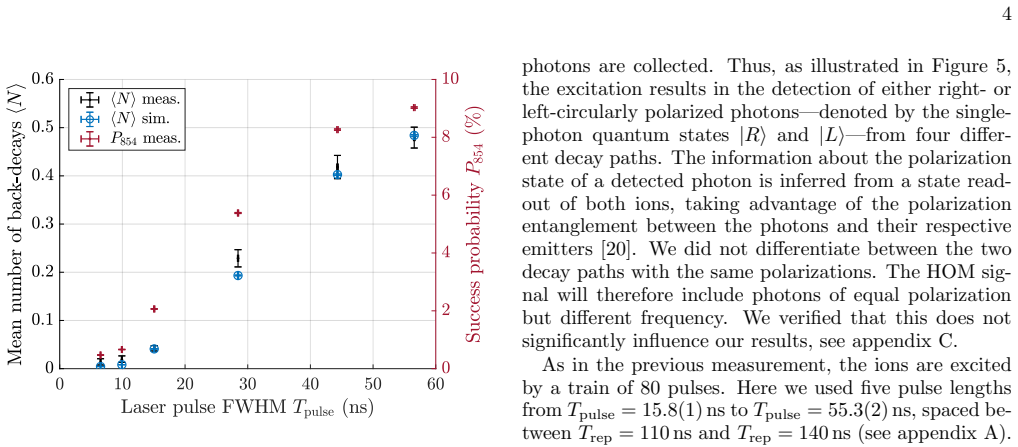
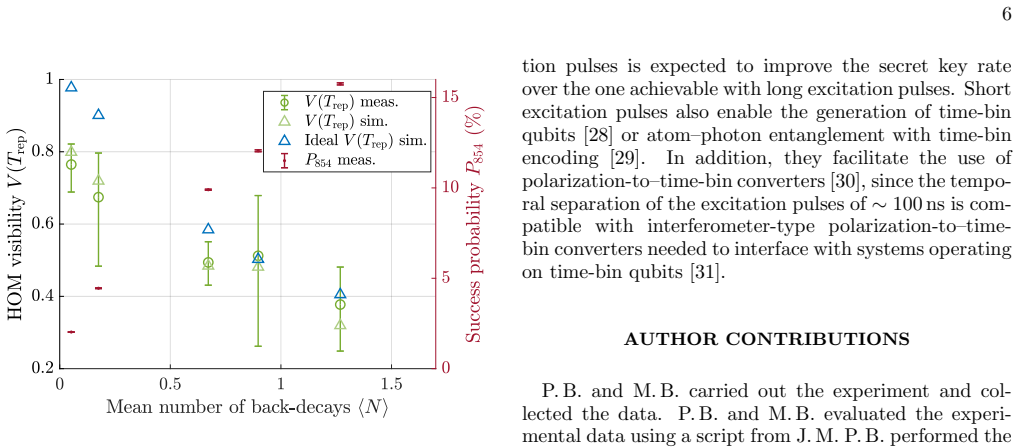
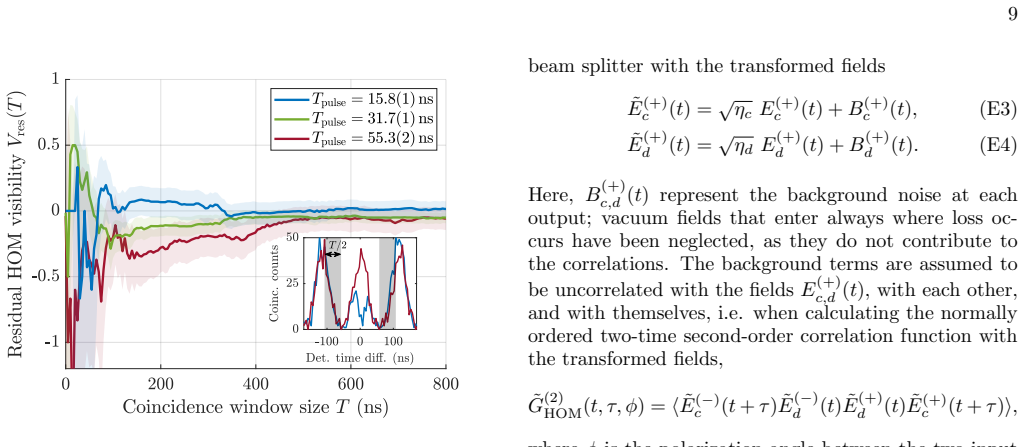
The mean number of back-decays during pulsed excitation directly correlates with the achievable Hong-Ou-Mandel interference visibility between photons from two identical trapped calcium ions.
A machine-rendered reading of the paper's core claim, the machinery that carries it, and where it could break.
Core claim
We identify the mean number of back-decays as a measurable single-emitter quantity that correlates with achievable interference visibility of photons from two identical emitters. The investigation uses few-nanosecond excitation pulses to generate Raman photons from two trapped 40Ca+ ions and elucidates the effect of spontaneous scattering back to the initial state on Hong-Ou-Mandel interference.
What carries the argument
mean number of back-decays, the average count of spontaneous scattering events back to the initial state during the excitation pulse, serving as a predictor of photon indistinguishability
If this is right
- Interference visibility decreases as the mean number of back-decays increases.
- Shorter excitation pulses reduce back-decays and thereby improve photon indistinguishability.
- Single-emitter back-decay counts allow prediction of two-emitter performance without requiring simultaneous operation of both ions.
- The correlation provides a diagnostic for emitter quality in setups aiming for high-visibility quantum interference.
Where Pith is reading between the lines
- Minimizing back-decays could serve as a concrete design target when scaling ion-based sources for quantum networks.
- The same back-decay mechanism is likely to appear in pulsed schemes with other ion species or different pulse lengths.
- Once back-decays are controlled, attention would turn to matching secondary factors such as laser stability or ion position between emitters.
Load-bearing premise
That back-decay is the dominant source of reduced visibility between the two emitters and that all other experimental imperfections are either negligible or perfectly matched.
What would settle it
An experiment that measures mean back-decays on single ions and then finds two-ion interference visibility significantly higher or lower than the value predicted from those counts alone would falsify the claimed direct correlation.
Figures

read the original abstract
We investigate the indistinguishability of Raman photons generated from two trapped $^{40}$Ca$^+$ ions using few-nanosecond excitation pulses. We elucidate how spontaneous scattering back to the initial state affects Hong-Ou-Mandel interference. We identify the mean number of back-decays as a measurable single-emitter quantity that correlates with achievable interference visibility of photons from two identical emitters.
Editorial analysis
A structured set of objections, weighed in public.
Referee Report
Summary. The manuscript reports an experimental investigation of the indistinguishability of Raman photons emitted from two trapped 40Ca+ ions under few-nanosecond pulsed excitation. It examines how spontaneous scattering back to the initial state during the pulse affects Hong-Ou-Mandel interference and identifies the mean number of back-decays as a single-emitter observable that correlates with the achievable two-emitter visibility.
Significance. If the correlation is shown to be robust after isolating back-decays from other experimental variables, the result supplies a practical single-emitter diagnostic for predicting photon indistinguishability in trapped-ion systems. This could streamline characterization of ion-photon interfaces for quantum networks without requiring direct two-emitter HOM measurements each time. The work connects a microscopic scattering process to a key performance metric in a manner that is directly testable with existing ion-trapping apparatus.
major comments (1)
- [Abstract] Abstract and central claim: The assertion that mean back-decays is the quantity setting the HOM visibility limit requires that spontaneous scattering is the dominant or only varying source of which-path information. The manuscript does not report independent measurements confirming that differential laser frequency noise, ion-position jitter, or detection-path mismatch between the two ions remain negligible or constant while the back-decay rate is deliberately varied (e.g., by changing pulse duration or Rabi frequency). Without such isolation, an observed correlation could be driven by a co-varying imperfection.
minor comments (1)
- [Abstract] The abstract would be strengthened by including at least one quantitative example of the reported correlation (e.g., visibility versus mean back-decays) or the range of back-decay numbers explored.
Simulated Author's Rebuttal
We thank the referee for their careful reading of the manuscript and for identifying the need to explicitly demonstrate that spontaneous scattering is the dominant varying source of which-path information. We address the major comment below.
read point-by-point responses
-
Referee: [Abstract] Abstract and central claim: The assertion that mean back-decays is the quantity setting the HOM visibility limit requires that spontaneous scattering is the dominant or only varying source of which-path information. The manuscript does not report independent measurements confirming that differential laser frequency noise, ion-position jitter, or detection-path mismatch between the two ions remain negligible or constant while the back-decay rate is deliberately varied (e.g., by changing pulse duration or Rabi frequency). Without such isolation, an observed correlation could be driven by a co-varying imperfection.
Authors: We agree that the central claim requires evidence that other sources of distinguishability remain constant while the back-decay rate is varied. The manuscript reports data collected with fixed laser frequencies, trap parameters, and detection optics while pulse duration and Rabi frequency are adjusted to change the mean number of back-decays. The observed correlation therefore occurs under these controlled conditions. However, the manuscript does not include separate, independent measurements (e.g., frequency-noise spectra or position jitter histograms) taken at each pulse setting. In the revised manuscript we will add such measurements or a supplementary analysis confirming that differential laser frequency noise, ion-position jitter, and detection-path mismatch remain negligible and do not co-vary with the back-decay rate. This addition will directly address the referee's concern. revision: yes
Circularity Check
No significant circularity; correlation claim is not self-referential
full rationale
The paper's central claim identifies the mean number of back-decays as a single-emitter observable correlating with two-emitter HOM visibility. No derivation chain, equations, or self-citations are shown that reduce this identification to a fitted parameter, self-definition, or prior author result by construction. The abstract presents an empirical/theoretical correlation without evidence of the result being forced by its own inputs. This is the expected non-finding for a paper whose core statement does not collapse under the enumerated circularity patterns.
Axiom & Free-Parameter Ledger
Forward citations
Cited by 1 Pith paper
-
Quantum repeater segment with free-space coupled co-trapped ions using telecom photon interference
Experimental demonstration of a quantum repeater segment with co-trapped 40Ca+ ions using telecom photon interference over 440 m fiber, achieving ≥68(8)% Bell state fidelity.
Reference graph
Works this paper leans on
-
[1]
C. K. Hong, Z. Y. Ou, and L. Mandel, Measurement of subpicosecond time intervals between two photons by in- terference, Phys. Rev. Lett.59, 2044 (1987)
2044
-
[2]
Simon and W
C. Simon and W. T. M. Irvine, Robust long-distance en- tanglement and a loophole-free bell test with ions and photons, Phys. Rev. Lett.91, 110405 (2003)
2003
-
[3]
Dhara, D
P. Dhara, D. Englund, and S. Guha, Entangling quantum memories via heralded photonic bell measurement, Phys. Rev. Res.5, 033149 (2023)
2023
-
[4]
Zippilli, G
S. Zippilli, G. A. Olivares-Renter´ ıa, G. Morigi, C. Schuck, F. Rohde, and J. Eschner, Entanglement of distant atoms by projective measurement: the role of detection effi- ciency, New Journal of Physics10, 103003 (2008)
2008
-
[5]
D. L. Moehring, P. Maunz, S. Olmschenk, K. C. Younge, D. N. Matsukevich, L.-M. Duan, and C. Monroe, En- tanglement of single-atom quantum bits at a distance, Nature449, 68 (2007)
2007
-
[6]
van Leent, M
T. van Leent, M. Bock, F. Fertig, R. Garthoff, S. Eppelt, Y. Zhou, P. Malik, M. Seubert, T. Bauer, W. Rosen- feld, W. Zhang, C. Becher, and H. Weinfurter, Entan- gling single atoms over 33 km telecom fibre, Nature607, 69 (2022)
2022
-
[7]
Krutyanskiy, M
V. Krutyanskiy, M. Galli, V. Krcmarsky, S. Baier, D. A. Fioretto, Y. Pu, A. Mazloom, P. Sekatski, M. Canteri, M. Teller, J. Schupp, J. Bate, M. Meraner, N. San- gouard, B. P. Lanyon, and T. E. Northup, Entanglement of trapped-ion qubits separated by 230 meters, Phys. Rev. Lett.130, 050803 (2023)
2023
-
[8]
Bernien, B
H. Bernien, B. Hensen, W. Pfaff, G. Koolstra, M. S. Blok, L. Robledo, T. H. Taminiau, M. Markham, D. J. Twitchen, L. Childress, and R. Hanson, Heralded entan- glement between solid-state qubits separated by three metres, Nature497, 86 (2013)
2013
-
[9]
M. Bock, P. Eich, S. Kucera, M. Kreis, A. Lenhard, C. Becher, and J. Eschner, High-fidelity entanglement be- tween a trapped ion and a telecom photon via quantum frequency conversion, Nature Communications9(2018)
2018
-
[10]
Briegel, W
H.-J. Briegel, W. D¨ ur, J. I. Cirac, and P. Zoller, Quan- tum repeaters: The role of imperfect local operations in quantum communication, Phys. Rev. Lett.81, 5932 (1998)
1998
-
[11]
H. J. Kimble, The quantum internet, Nature453, 1023 (2008)
2008
-
[12]
van Loock, W
P. van Loock, W. Alt, C. Becher, O. Benson, H. Boche, C. Deppe, J. Eschner, S. H¨ ofling, D. Meschede, P. Mich- ler, F. Schmidt, and H. Weinfurter, Extending Quantum Links: Modules for Fiber- and Memory-Based Quantum Repeaters, Advanced Quantum Technologies3, 1900141 (2020)
2020
-
[13]
O’Reilly, G
J. O’Reilly, G. Toh, I. Goetting, S. Saha, M. Sha- laev, A. L. Carter, A. Risinger, A. Kalakuntla, T. Li, A. Verma, and C. Monroe, Fast photon-mediated entan- glement of continuously cooled trapped ions for quantum networking, Phys. Rev. Lett.133, 090802 (2024)
2024
-
[14]
D. Main, P. Drmota, D. P. Nadlinger, E. M. Ainley, A. Agrawal, B. C. Nichol, R. Srinivas, G. Araneda, and D. M. Lucas, Distributed quantum computing across an optical network link, Nature638, 383 (2025)
2025
-
[15]
M¨ uller, T
P. M¨ uller, T. Tentrup, M. Bienert, G. Morigi, and J. Eschner, Spectral properties of single photons from quantum emitters, Phys. Rev. A96, 023861 (2017)
2017
-
[16]
Maunz, D
P. Maunz, D. L. Moehring, S. Olmschenk, K. C. Younge, D. N. Matsukevich, and C. Monroe, Quantum interfer- ence of photon pairs from two remote trapped atomic ions, Nature Physics3, 538 (2007)
2007
-
[17]
J. Kim, J. Jeong, C. Jung, M. Lee, Y. Park, D. il Dan Cho, and T. Kim, Observation of hong-ou- mandel interference with scalable Yb+-photon interfaces, Opt. Express28, 39727 (2020)
2020
-
[18]
J. Lin, M. Cieszynski, W. Christopherson, D. Khan, L. Li, E. Goldschmidt, and B. DeMarco, 88Sr+ ion trap apparatus for generating 408 nm photons, Review of Sci- entific Instruments97, 013201 (2026)
2026
-
[19]
Arensk¨ otter, S
E. Arensk¨ otter, S. Kucera, O. Elshehy, M. Bergerhoff, M. Kreis, L. Brunel, and J. Eschner, Full Bell-basis mea- surement of an atom-photon 2-qubit state and its appli- cation for quantum networks, Phys. Rev. Res.6, 023061 (2024)
2024
-
[20]
Bergerhoff, O
M. Bergerhoff, O. Elshehy, S. Kucera, M. Kreis, and J. Eschner, Quantum repeater node with free-space cou- 11 pled trapped ions, Phys. Rev. A110, 032603 (2024)
2024
-
[21]
Baumgart, M
P. Baumgart, M. Bergerhoff, and J. Eschner, Indistin- guishability of single Raman photons from single atoms (2026), manuscript in preparation
2026
-
[22]
K. A. Fischer, K. M¨ uller, K. G. Lagoudakis, and J. Vuˇ ckovi´ c, Dynamical modeling of pulsed two-photon interference, New J. Phys.18, 113053 (2016)
2016
-
[23]
M. J. Woolley, C. Lang, C. Eichler, A. Wallraff, and A. Blais, Signatures of Hong–Ou–Mandel interference at microwave frequencies, New Journal of Physics15, 105025 (2013)
2013
-
[24]
Meraner, A
M. Meraner, A. Mazloom, V. Krutyanskiy, V. Krc- marsky, J. Schupp, D. A. Fioretto, P. Sekatski, T. E. Northup, N. Sangouard, and B. P. Lanyon, Indistinguish- able photons from a trapped-ion quantum network node, Phys. Rev. A102, 052614 (2020)
2020
-
[25]
Baumgart, M
P. Baumgart, M. Bergerhoff, J. Meiers, and J. Eschner, Entanglement swapping with two co-trapped 40Ca+ ions for quantum repeater application, inOptica Quantum 2.0 Conference and Exhibition(Optica Publishing Group,
-
[26]
Arensk¨ otter, T
E. Arensk¨ otter, T. Bauer, S. Kucera, M. Bock, J. Eschner, and C. Becher, Telecom quantum photonic interface for a 40Ca+ single-ion quantum memory, npj Quantum Information9, 34 (2023)
2023
-
[27]
Meiers, C
J. Meiers, C. Haen, M. Bergerhoff, S. Kucera, and J. Eschner, Quantum key distribution with atom-photon entanglement for an urban fiber link, inQuantum 2.0 Conference and Exhibition(Optica Publishing Group,
-
[28]
Ward and M
T. Ward and M. Keller, Generation of time-bin-encoded photons in an ion-cavity system, New Journal of Physics 24, 123028 (2022)
2022
-
[29]
S. Saha, M. Shalaev, J. O’Reilly, I. Goetting, G. Toh, A. Kalakuntla, Y. Yu, and C. Monroe, High-fidelity re- mote entanglement of trapped atoms mediated by time- bin photons, Nature Communications16(2025)
2025
-
[30]
Scalcon, C
D. Scalcon, C. Agnesi, M. Avesani, L. Calderaro, G. Fo- letto, A. Stanco, G. Vallone, and P. Villoresi, Cross- encoded quantum key distribution exploiting time-bin and polarization states with qubit-based synchronization, Advanced Quantum Technologies5, 2200051 (2022)
2022
-
[31]
Tchebotareva, S
A. Tchebotareva, S. L. N. Hermans, P. C. Humphreys, D. Voigt, P. J. Harmsma, L. K. Cheng, A. L. Verlaan, N. Dijkhuizen, W. de Jong, A. Dr´ eau, and R. Hanson, Entanglement between a diamond spin qubit and a pho- tonic time-bin qubit at telecom wavelength, Phys. Rev. Lett.123, 063601 (2019)
2019
-
[32]
Legero, T
T. Legero, T. Wilk, M. Hennrich, G. Rempe, and A. Kuhn, Quantum beat of two single photons, Phys. Rev. Lett.93, 070503 (2004)
2004
discussion (0)
Sign in with ORCID, Apple, or X to comment. Anyone can read and Pith papers without signing in.