From Short Histories to Long Futures: Horizon-Aware Graph Neural Networks for Long Horizon Forecasting
Pith reviewed 2026-06-29 08:30 UTC · model grok-4.3
The pith
A multi-horizon graph neural network trained jointly on multiple lead times and state increments produces more stable long-range forecasts for ice sheet dynamics than single-step autoregressive models.
A machine-rendered reading of the paper's core claim, the machinery that carries it, and where it could break.
Core claim
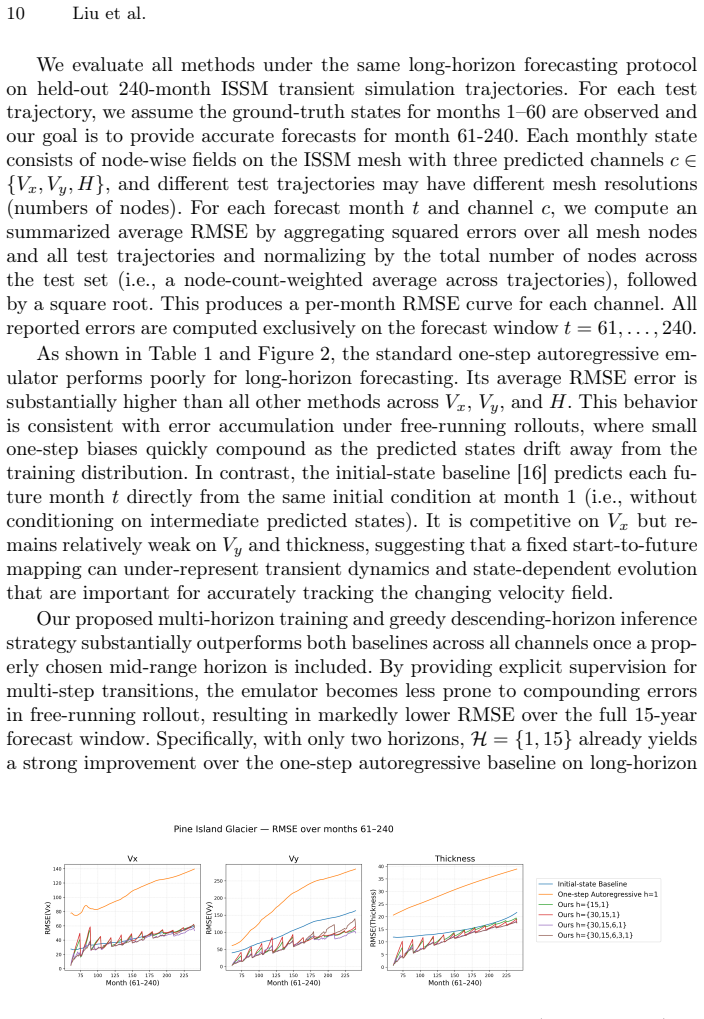
The central claim is that a horizon-aware graph neural network with a shared backbone and per-horizon branches, trained to predict ice thickness and velocity increments at multiple lead times from one current state and rolled out with coarse-to-fine jumps, achieves higher long-range accuracy and improved stability on multi-decadal Pine Island Glacier simulations compared with both an initial-state baseline and a standard single-step autoregressive rollout.
What carries the argument
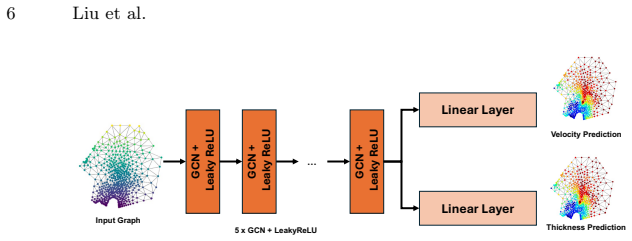
The multi-horizon graph neural network with shared backbone and separate output branches per lead time that predicts state increments rather than absolute states.
If this is right
- Joint training across horizons limits cumulative error growth relative to autoregressive rollout.
- Predicting increments rather than full states improves numerical stability over long sequences.
- Coarse-to-fine inference reduces redundant computation while controlling drift.
- The resulting emulator supplies more reliable inputs for downstream sea-level studies than prior neural baselines.
- The same architecture outperforms both direct-from-initial-state prediction and standard one-step GNN rollouts on the tested multi-decadal runs.
Where Pith is reading between the lines
- The architecture could transfer to other nonlinear systems such as atmospheric or ocean models without major redesign.
- Pairing the emulator with observational data assimilation would test whether real-world noise reduces the observed stability gains.
- Scaling the underlying graph to higher spatial resolution would reveal whether the joint-training benefit persists under increased computational load.
- The method might shorten the reliable forecast horizon needed for ensemble climate projections by lowering per-run cost.
Load-bearing premise
That jointly optimizing across multiple lead times while predicting increments will reduce long-term drift without extra loss terms or physical constraints.
What would settle it
If the multi-horizon model accumulates equal or greater error in ice thickness or velocity than the single-step autoregressive baseline after fifty years on the same Pine Island Glacier test simulations, the stability claim is falsified.
Figures
read the original abstract
Accurate long-range prediction of geophysical systems is difficult due to strongly nonlinear dynamics, the high computational cost of full-physics simulations, and the error accumulation that arise when one-step autoregressive surrogates are rolled out over decades. Deep neural network can serve as efficient emulators, but most are trained only for next-step prediction and often drift or become unstable as the forecast horizon grows. We propose a multi-horizon graph neural network emulator that learns state-to-state transitions from a single current time to multiple future lead times within one unified model. The physical domain is represented as a graph, where nodes correspond to spatial locations with time-varying geophysical attributes and edges encode local spatial interactions. Given the current graph state, the model predicts the future evolution of key fields, ice thickness and ice velocities at all nodes, using a shared graph backbone with separate output branches for each target variable. To improve stability, the network predicts state increments relative to the current state, which are then added back to reconstruct future states. Training jointly optimizes all lead times with a unified regression objective, and inference uses a coarse-to-fine rollout that advances with larger jumps and selectively refines with shorter jumps to reduce drift and avoid redundant computation. Experiments on multi-decadal Pine Island Glacier simulations show that our approach achieves higher long-range accuracy and improved stability than both (i) an initial-state baseline that predicts each future time directly from the starting state and (ii) a standard single-step autoregressive rollout, producing a more reliable emulator for downstream climate and sea-level studies.
Editorial analysis
A structured set of objections, weighed in public.
Referee Report
Summary. The manuscript proposes a multi-horizon graph neural network emulator for long-range forecasting of geophysical systems, applied to multi-decadal Pine Island Glacier ice-flow simulations. The domain is modeled as a graph with nodes holding time-varying attributes and edges encoding spatial interactions; a shared GNN backbone with per-variable output heads predicts state increments (ice thickness and velocities) at multiple lead times. Training jointly optimizes a regression loss across horizons, and inference uses a coarse-to-fine rollout. The central claim is that this yields higher long-range accuracy and stability than an initial-state baseline and a standard single-step autoregressive rollout.
Significance. If the experimental improvements hold under scrutiny, the work could supply more stable and computationally efficient surrogates for downstream climate and sea-level applications, directly addressing error accumulation that limits conventional autoregressive emulators.
major comments (2)
- [Abstract] Abstract: the claim that the approach 'achieves higher long-range accuracy and improved stability' supplies no quantitative metrics, error bars, dataset sizes, ablation results, or statistical tests; this is load-bearing because the entire contribution rests on the experimental comparison to the two baselines.
- [Abstract] Abstract (training and inference paragraphs): joint multi-horizon optimization plus increment prediction is presented as sufficient to 'reduce drift,' yet the text gives no indication of explicit stabilization mechanisms (consistency losses across horizons, physics residuals, or rollout regularization); given that nonlinear ice dynamics are known to amplify discrepancies over decades, this assumption requires explicit verification or counter-evidence.
minor comments (1)
- [Abstract] Abstract: 'Deep neural network can serve' should read 'Deep neural networks can serve'; 'the error accumulation that arise' should read 'the error accumulation that arises'.
Simulated Author's Rebuttal
We thank the referee for the constructive comments on our manuscript. We address each major comment below and have made revisions to strengthen the presentation of our claims and methods.
read point-by-point responses
-
Referee: [Abstract] Abstract: the claim that the approach 'achieves higher long-range accuracy and improved stability' supplies no quantitative metrics, error bars, dataset sizes, ablation results, or statistical tests; this is load-bearing because the entire contribution rests on the experimental comparison to the two baselines.
Authors: We agree that the abstract would be strengthened by including key quantitative support for the central claims. The full paper reports these details in the experiments section, including error metrics across horizons, the size of the Pine Island Glacier simulation dataset, and direct comparisons to the initial-state and autoregressive baselines. We have revised the abstract to incorporate specific accuracy and stability metrics from those comparisons. revision: yes
-
Referee: [Abstract] Abstract (training and inference paragraphs): joint multi-horizon optimization plus increment prediction is presented as sufficient to 'reduce drift,' yet the text gives no indication of explicit stabilization mechanisms (consistency losses across horizons, physics residuals, or rollout regularization); given that nonlinear ice dynamics are known to amplify discrepancies over decades, this assumption requires explicit verification or counter-evidence.
Authors: The design choices of increment prediction and joint multi-horizon training are presented as the core mechanisms for mitigating drift, with the coarse-to-fine rollout providing additional practical stabilization during inference. The multi-decadal experiments on nonlinear ice-flow dynamics serve as the empirical verification, demonstrating reduced error accumulation relative to the baselines. We have clarified the rationale for these choices in an expanded methods discussion and added a brief ablation on the contribution of joint training to long-horizon stability. revision: partial
Circularity Check
No significant circularity; claims rest on empirical validation against baselines
full rationale
The paper presents a multi-horizon GNN architecture with joint training across lead times and increment-based prediction as design choices, validated through direct experimental comparison to an initial-state baseline and single-step autoregressive rollout on Pine Island Glacier data. No equations, fitted parameters, or self-citations are described in the provided text that would reduce the reported accuracy or stability gains to the inputs by construction. The derivation chain consists of architectural decisions whose performance is assessed externally via held-out simulation trajectories, making the central claims self-contained against independent benchmarks rather than tautological.
Axiom & Free-Parameter Ledger
axioms (1)
- domain assumption The physical domain can be represented as a graph where nodes correspond to spatial locations with time-varying geophysical attributes and edges encode local spatial interactions.
Forward citations
Cited by 1 Pith paper
-
COGENT: Continuous Graph Emulators with Neural Ordinary Differential Equations for Long-Term Physical Forecasting
COGENT is a continuous graph emulator using Neural ODEs for stable long-term forecasting on irregular geospatial meshes, evaluated on ice-sheet simulations with improved stability over autoregressive baselines.
Reference graph
Works this paper leans on
-
[1]
Boerner, T.J., Deems, S., Furlani, T.R., Knuth, S.L., Towns, J.: Access: Advancing innovation: Nsf’s advanced cyberinfrastructure coordination ecosystem: Services & 14 Liu et al. support.In:PracticeandExperienceinAdvancedResearchComputing2023:Com- puting for the Common Good. p. 173–176. PEARC ’23, Association for Computing Machinery,NewYork,NY,USA(2023).h...
-
[2]
Computer Meth- ods in Applied Mechanics and Engineering417, 116351 (2023)
Dalton, D., Husmeier, D., Gao, H.: Physics-informed graph neu- ral network emulation of soft-tissue mechanics. Computer Meth- ods in Applied Mechanics and Engineering417, 116351 (2023). https://doi.org/https://doi.org/10.1016/j.cma.2023.116351, https://www. sciencedirect.com/science/article/pii/S0045782523004759
-
[3]
In: Proceedings of the 30th In- ternational Conference on Neural Information Processing Systems
Defferrard, M., Bresson, X., Vandergheynst, P.: Convolutional neural networks on graphs with fast localized spectral filtering. In: Proceedings of the 30th In- ternational Conference on Neural Information Processing Systems. p. 3844–3852. NIPS’16, Curran Associates Inc., Red Hook, NY, USA (2016)
2016
-
[4]
Fillola, E., Santos-Rodriguez, R., Tunnicliffe, R., Clark, J., Keshtmand, N., Gane- san, A., Rigby, M.: Enabling fast greenhouse gas emissions inference from satellites with gates: agraph-neural-network atmospherictransportemulationsystem. EGU- sphere2025, 1–27 (2025). https://doi.org/10.5194/egusphere-2025-2392, https: //egusphere.copernicus.org/preprint...
-
[5]
Forsberg, R., Sorensen, L., Simonsen, S.: Greenland and Antarctica Ice Sheet Mass Changes and Effects on Global Sea Level, pp. 91–106. Springer Inter- national Publishing, Cham (2017). https://doi.org/10.1007/978-3-319-56490-6_5, https://doi.org/10.1007/978-3-319-56490-6_5
-
[6]
Applied and Computational Harmonic Analysis30(2), 129–150 (2011)
Hammond, D.K., Vandergheynst, P., Gribonval, R.: Wavelets on graphs via spec- tral graph theory. Applied and Computational Harmonic Analysis30(2), 129–150 (2011). https://doi.org/https://doi.org/10.1016/j.acha.2010.04.005, https://www. sciencedirect.com/science/article/pii/S1063520310000552
-
[7]
In: Practice and Experience in Advanced Research Computing 2021: Evolution Across All Di- mensions
Hancock, D.Y., Fischer, J., Lowe, J.M., Snapp-Childs, W., Pierce, M., Marru, S., Coulter, J.E., Vaughn, M., Beck, B., Merchant, N., Skidmore, E., Jacobs, G.: Jetstream2: Accelerating cloud computing via jetstream. In: Practice and Experience in Advanced Research Computing 2021: Evolution Across All Di- mensions. PEARC ’21, Association for Computing Machin...
-
[8]
Nature Geoscience4(8), 519–523 (Aug 2011)
Jacobs, S.S., Jenkins, A., Giulivi, C.F., Dutrieux, P.: Stronger ocean circulation and increased melting under pine island glacier ice shelf. Nature Geoscience4(8), 519–523 (Aug 2011). https://doi.org/10.1038/ngeo1188, https://doi.org/10.1038/ ngeo1188
-
[9]
Science Advances7(43), eabi5738 (2021)
Joughin, I., Shapero, D., Dutrieux, P., Smith, B.: Ocean-induced melt vol- ume directly paces ice loss from pine island glacier. Science Advances7(43), eabi5738 (2021). https://doi.org/10.1126/sciadv.abi5738, https://www.science. org/doi/abs/10.1126/sciadv.abi5738
-
[10]
Journal of Glaciology69(273), 13–26 (2023)
Jouvet, G.: Inversion of a stokes glacier flow model emulated by deep learning. Journal of Glaciology69(273), 13–26 (2023). https://doi.org/10.1017/jog.2022.41
-
[11]
Journal of Glaciology69(278), 1941–1955 (2023)
Jouvet, G., Cordonnier, G.: Ice-flow model emulator based on physics- informed deep learning. Journal of Glaciology69(278), 1941–1955 (2023). https://doi.org/10.1017/jog.2023.73
-
[12]
Journal of Glaciology68(270), 651–664 (2022)
Jouvet, G., Cordonnier, G., Kim, B., Lüthi, M., Vieli, A., Aschwanden, A.: Deep learning speeds up ice flow modelling by several orders of magnitude. Journal of Glaciology68(270), 651–664 (2022). https://doi.org/10.1017/jog.2021.120
-
[13]
Kingma, D.P., Ba, J.: Adam: A method for stochastic optimization (2017), https: //arxiv.org/abs/1412.6980 Horizon-Aware Graph Neural Networks for Multi-Step Forecasting 15
work page internal anchor Pith review Pith/arXiv arXiv 2017
-
[14]
In: International Conference on Learning Representations (ICLR) (2017)
Kipf, T.N., Welling, M.: Semi-supervised classification with graph convolutional networks. In: International Conference on Learning Representations (ICLR) (2017)
2017
-
[15]
The Cryosphere19(7), 2583– 2599 (2025)
Koo, Y., Cheng, G., Morlighem, M., Rahnemoonfar, M.: Calibrating calving parameterizations using graph neural network emulators: applica- tion to helheim glacier, east greenland. The Cryosphere19(7), 2583– 2599 (2025). https://doi.org/10.5194/tc-19-2583-2025, https://tc.copernicus.org/ articles/19/2583/2025/
-
[16]
Journal of Glaciology71, e15 (2025)
Koo, Y., Rahnemoonfar, M.: Graph convolutional network as a fast statistical emulator for numerical ice sheet modeling. Journal of Glaciology71, e15 (2025). https://doi.org/10.1017/jog.2024.93
-
[17]
Journal of Geophysical Research: Earth Surface117(F2) (2012)
Larour, E., Schiermeier, J., Rignot, E., Seroussi, H., Morlighem, M., Paden, J.: Sensitivity analysis of pine island glacier ice flow using issm and dakota. Journal of Geophysical Research: Earth Surface117(F2) (2012). https://doi.org/https://doi.org/10.1029/2011JF002146, https://agupubs. onlinelibrary.wiley.com/doi/abs/10.1029/2011JF002146
- [18]
-
[19]
Loshchilov, I., Hutter, F.: Sgdr: Stochastic gradient descent with warm restarts (2017), https://arxiv.org/abs/1608.03983
work page internal anchor Pith review Pith/arXiv arXiv 2017
-
[20]
Earth System Science Data12(2), 1367–1383 (2020)
Mankoff, K.D., Solgaard, A., Colgan, W., Ahlstrøm, A.P., Khan, S.A., Fausto, R.S.: Greenland ice sheet solid ice discharge from 1986 through march 2020. Earth System Science Data12(2), 1367–1383 (2020). https://doi.org/10.5194/essd-12- 1367-2020, https://essd.copernicus.org/articles/12/1367/2020/
-
[21]
In: Van der Veen, C.J., Oerlemans, J
Morland, L.W.: Unconfined ice-shelf flow. In: Van der Veen, C.J., Oerlemans, J. (eds.) Dynamics of the West Antarctic Ice Sheet. pp. 99–116. Springer Netherlands, Dordrecht (1987)
1987
-
[22]
Ngo, D.T., Aouedi, O., Piamrat, K., Hassan, T., Raipin-Parvédy, P.: Empow- ering digital twin for future networks with graph neural networks: Overview, enabling technologies, challenges, and opportunities. Future Internet15(12) (2023). https://doi.org/10.3390/fi15120377, https://www.mdpi.com/1999-5903/ 15/12/377
-
[23]
IET Microwaves, Antennas & Propagation18(7), 505–515 (2024)
Noakoasteen, O., Christodoulou, C., Peng, Z., Goudos, S.K.: Physics-informed surrogates for electromagnetic dynamics using transformers and graph neu- ral networks. IET Microwaves, Antennas & Propagation18(7), 505–515 (2024). https://doi.org/https://doi.org/10.1049/mia2.12463, https://ietresearch. onlinelibrary.wiley.com/doi/abs/10.1049/mia2.12463
-
[24]
Proceedings of the National Academy of Sciences116(4), 1095– 1103 (2019)
Rignot, E., Mouginot, J., Scheuchl, B., van den Broeke, M., van Wessem, M.J., Morlighem, M.: Four decades of antarctic ice sheet mass balance from 1979–2017. Proceedings of the National Academy of Sciences116(4), 1095– 1103 (2019). https://doi.org/10.1073/pnas.1812883116, https://www.pnas.org/ doi/abs/10.1073/pnas.1812883116
-
[25]
The Cryosphere8(5), 1699– 1710 (2014)
Seroussi, H., Morlighem, M., Rignot, E., Mouginot, J., Larour, E., Schodlok, M., Khazendar, A.: Sensitivity of the dynamics of pine island glacier, west antarc- tica, to climate forcing for the next 50 years. The Cryosphere8(5), 1699– 1710 (2014). https://doi.org/10.5194/tc-8-1699-2014, https://tc.copernicus.org/ articles/8/1699/2014/
discussion (0)
Sign in with ORCID, Apple, or X to comment. Anyone can read and Pith papers without signing in.