Elemental cosmic ray spectra reveal two populations of Galactic sources and an immediate transition to an extragalactic component after the knee
Pith reviewed 2026-06-28 12:52 UTC · model grok-4.3
The pith
Elemental cosmic ray spectra are described by two Galactic populations and an immediate extragalactic transition after the knee.
A machine-rendered reading of the paper's core claim, the machinery that carries it, and where it could break.
Core claim
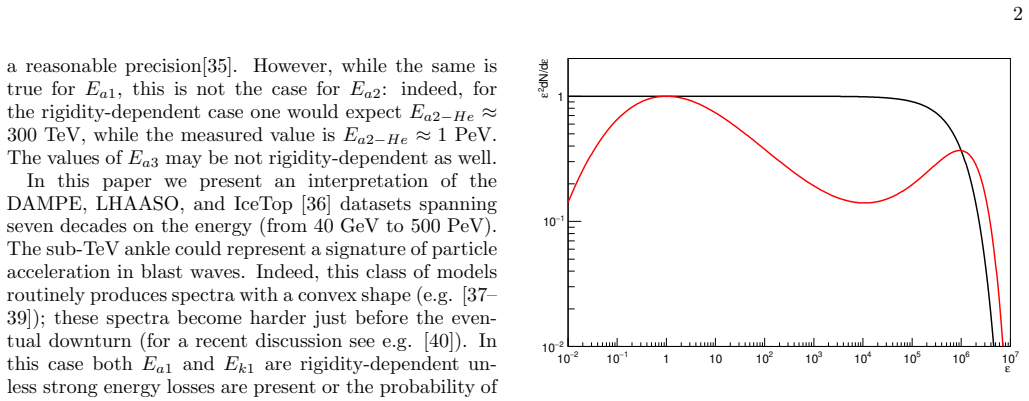
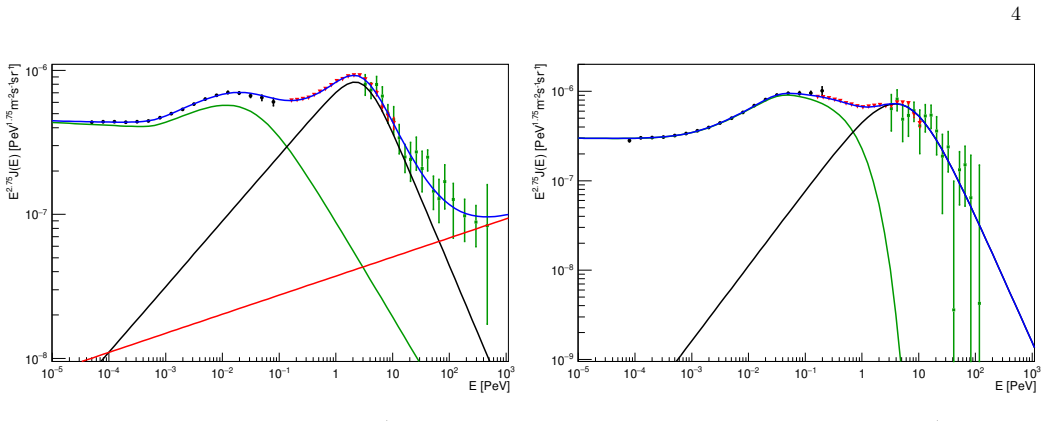
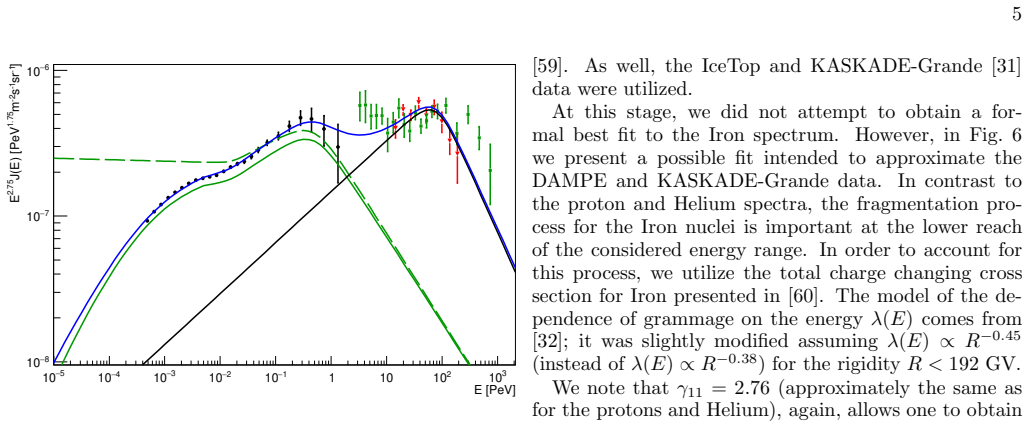
The elemental CR spectra are reasonably well described with a sum of three components: 1) a low-energy Galactic component with a convex spectral shape reflecting the accelerated particle spectrum in the source; this component peters out after the TeV knee, 2) a high-energy Galactic component including the PeV knee, and 3) an extragalactic component. There is no need for any third, additional component of Galactic cosmic rays in the energy range between 10 PeV and 1 EeV.
What carries the argument
The three-component decomposition of elemental cosmic ray spectra into low-energy Galactic, high-energy Galactic, and extragalactic parts that together reproduce all knees and ankles.
If this is right
- The low-energy Galactic component ends after the first knee at roughly 15 Z TeV.
- The high-energy Galactic component produces the second knee near 3 Z PeV.
- The extragalactic component begins right after the PeV knee with no intermediate Galactic population needed.
- Both rigidity-dependent and non-rigidity-dependent ankle features arise from the superposition of the three components.
- Data precision from DAMPE and LHAASO rules out the necessity of extra Galactic sources up to 1 EeV.
Where Pith is reading between the lines
- Distinct acceleration mechanisms or source classes are implied for the two Galactic populations.
- Future higher-energy measurements could confirm the dominance of the extragalactic component by testing the predicted spectral shape.
- The model suggests that propagation effects alone do not generate additional spectral features in the 10 PeV to 1 EeV interval.
- Similar decompositions could be tested on other high-energy particle spectra to check for multiple source populations.
Load-bearing premise
The observed rigidity-dependent knees and ankles plus the non-rigidity-dependent ankles can be fully accounted for by exactly these three components without post-hoc adjustments or additional populations.
What would settle it
A precise measurement of an elemental spectrum between 10 PeV and 1 EeV that shows a clear deviation from the predicted sum of the high-energy Galactic and extragalactic components, requiring a fourth term to fit.
Figures
read the original abstract
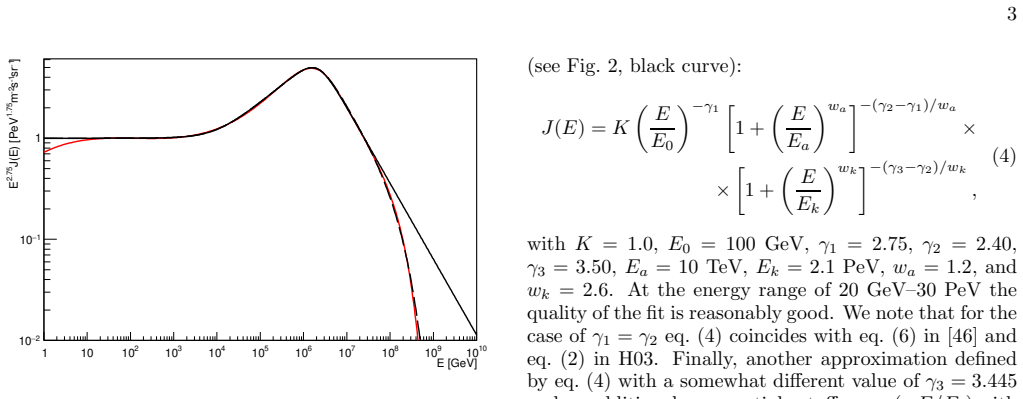
The energy spectra for individual elements and/or for groups of elements in cosmic rays (CR) in the energy range between 100 $\times$ Z GeV and 10$^{3}$ $\times$ Z PeV (where Z is the charge number of the nucleus) have a number of features, including two steepenings ("knees") with the rigidity-dependent energies $E_{k1} \approx$ 15 $\times$ Z TeV and $E_{k2} \approx$ 3 $\times$ Z PeV and three hardenings ("ankles") at $E_{a1} \approx$ 500 $\times$ Z GeV; for protons $E_{a2-p} \approx$ 150 TeV and $E_{ a3-p} \approx$ 100 PeV. While the values of $E_{a1}$ for different nuclei are rigidity-dependent, the values of $E_{a2}$ (and probably of $E_{a3}$) are not: $E_{a2-He} \approx$ 1 PeV for Helium. The recent advances in precision measurements of the elemental CR spectra in the DAMPE and LHAASO experiments, and, to some extent, in IceTop and other experiments, make it possible, for the first time, to clarify the origin of the aforementioned spectral features. We show that the elemental CR spectra are reasonably well described with a sum of three components: 1) a low-energy Galactic component with a convex spectral shape reflecting the accelerated particle spectrum in the source; this component peters out after the TeV knee, 2) a high-energy Galactic component including the PeV knee, and 3) an extragalactic component. There is no need for any third, additional component of Galactic cosmic rays in the energy range between 10 PeV and 1 EeV.
Editorial analysis
A structured set of objections, weighed in public.
Referee Report
Summary. The manuscript claims that elemental cosmic ray spectra between ~100Z GeV and 10^3 Z PeV exhibit rigidity-dependent knees at E_k1 ≈ 15Z TeV and E_k2 ≈ 3Z PeV plus ankles (some rigidity-dependent, others not), and that these features are reasonably well described by the sum of exactly three components: (1) a low-energy Galactic component with convex spectral shape that cuts off after the TeV knee, (2) a high-energy Galactic component that includes the PeV knee, and (3) an extragalactic component, with no requirement for any additional Galactic population in the 10 PeV–1 EeV interval. The model is motivated by recent DAMPE and LHAASO precision data.
Significance. If the three-component description can be shown to hold with quantitative support and without per-species tuning, the result would provide a compact phenomenological framework distinguishing two Galactic source populations and clarifying the Galactic-to-extragalactic transition. The emphasis on rigidity dependence for knees versus element-independent ankles for certain features is a potentially useful organizing principle, but the absence of fit statistics leaves the significance currently difficult to evaluate.
major comments (2)
- [Abstract] Abstract and central claim: the assertion that the spectra are 'reasonably well described' by the three components supplies no chi-squared values, best-fit parameters, uncertainties, or residual analysis, so the central claim rests on an unshown qualitative description rather than demonstrated support.
- [Model description] Component construction: the knees (E_k1, E_k2) and ankles (E_a1, E_a2, E_a3) are defined from the same DAMPE/LHAASO data the model is said to describe; it is therefore unclear whether the functional forms (convex low-energy term plus two additional terms) with the listed free parameters can simultaneously reproduce both the rigidity-dependent knees and the non-rigidity-dependent E_a2 positions (e.g., ~150 TeV for protons vs. ~1 PeV for helium) across nuclei without hidden per-element adjustments to normalization or shape.
minor comments (2)
- A table listing all free parameters, their best-fit values, and the nuclei to which each applies would clarify whether the model is applied uniformly or requires species-specific tuning.
- The manuscript should explicitly state the functional forms (e.g., the precise parametrization of the convex low-energy component) and any assumed propagation or source spectrum assumptions.
Simulated Author's Rebuttal
We thank the referee for the constructive comments. We address the two major points below, agreeing where quantitative support is needed and clarifying the model construction where the functional forms are already specified in the manuscript.
read point-by-point responses
-
Referee: [Abstract] Abstract and central claim: the assertion that the spectra are 'reasonably well described' by the three components supplies no chi-squared values, best-fit parameters, uncertainties, or residual analysis, so the central claim rests on an unshown qualitative description rather than demonstrated support.
Authors: We agree that the abstract and main text would benefit from explicit quantitative measures. The manuscript currently supports the claim via direct overlay of the three-component model on the DAMPE and LHAASO data points in the figures, with parameters listed in Section 3. In revision we will add a table of best-fit parameters (including uncertainties) and report reduced chi-squared values for the elemental spectra shown. revision: yes
-
Referee: [Model description] Component construction: the knees (E_k1, E_k2) and ankles (E_a1, E_a2, E_a3) are defined from the same DAMPE/LHAASO data the model is said to describe; it is therefore unclear whether the functional forms (convex low-energy term plus two additional terms) with the listed free parameters can simultaneously reproduce both the rigidity-dependent knees and the non-rigidity-dependent E_a2 positions (e.g., ~150 TeV for protons vs. ~1 PeV for helium) across nuclei without hidden per-element adjustments to normalization or shape.
Authors: The knee positions are identified from the data as standard for phenomenological modeling, but the functional forms are fixed once and for all: the low-energy Galactic term has a convex shape with rigidity-dependent cutoff at E_k1, the high-energy Galactic term has rigidity-dependent cutoff at E_k2, and the extragalactic term is a power law with a single element-independent ankle at E_a3. The E_a2 feature emerges naturally as the energy where the high-energy Galactic component begins to dominate over the low-energy one; because the two Galactic components have different rigidity scalings, this transition occurs at different total energies for different nuclei while the underlying parameters remain universal. Only normalizations (abundances) are allowed to float per element; all spectral indices and break rigidities are shared. This is shown explicitly for protons, helium, and CNO in the figures without additional per-species shape parameters. revision: partial
Circularity Check
Knee/ankle positions extracted from data define component cutoffs by construction
specific steps
-
self definitional
[Abstract]
"We show that the elemental CR spectra are reasonably well described with a sum of three components: 1) a low-energy Galactic component with a convex spectral shape reflecting the accelerated particle spectrum in the source; this component peters out after the TeV knee, 2) a high-energy Galactic component including the PeV knee, and 3) an extragalactic component. There is no need for any third, additional component of Galactic cosmic rays in the energy range between 10 PeV and 1 EeV."
The low-energy component is defined to end after the observed TeV knee (E_k1 ≈ 15Z TeV) and the high-energy component is defined to include the PeV knee (E_k2 ≈ 3Z PeV); both positions are taken from the same spectra the model is said to describe, so the three-component fit and the 'no additional component' conclusion are achieved by construction.
full rationale
The paper first identifies E_k1, E_k2, E_a1 etc. from DAMPE/LHAASO data, then defines the three components explicitly around those same positions (low-energy component peters out after TeV knee; high-energy includes PeV knee). The claim that these three components suffice with no additional Galactic population therefore reduces to fitting the observed features with parameters chosen to match them, rather than an independent derivation.
Axiom & Free-Parameter Ledger
free parameters (3)
- E_k1 =
15 x Z TeV
- E_k2 =
3 x Z PeV
- convex shape parameters
axioms (2)
- domain assumption Cosmic ray spectra can be decomposed into distinct source populations whose acceleration spectra produce observable knees and ankles.
- domain assumption Rigidity dependence of some features versus lack of it in others reliably distinguishes Galactic from extragalactic contributions.
invented entities (1)
-
Two distinct populations of Galactic sources
no independent evidence
Reference graph
Works this paper leans on
-
[1]
(hereafter Z06); a characteristic signature of a transi- tion between the source populations — a dip at ≈ 60 TeV for protons and at a higher energy for heavier nuclei — is clearly visible in Fig. 1, Fig. 2, and Fig. 4 of this paper. The proton and Helium CR spectra were measured with the DAMPE detector in the energy ranges of 40 GeV – 100 TeV [24] and 70 ...
-
[2]
a hardening (“ankle”)[28] at Ea1 ≈ 500 × Z GeV
-
[3]
a steepening at Ek1 ≈ 15 × Z TeV (the low energy or TeV knee)[29]
-
[4]
a second hardening at Ea2− p ≈ 150 TeV for pro- tons [30], at Ea2− He ≈ 1 PeV for Helium nuclei [27], at Ea2− F e ∼ 2 PeV for Iron nuclei [31], and probably somewhere between 1 and 10 PeV for CNO nuclei
-
[5]
the “main” PeV knee at Ek2 ≈ 3 × Z PeV
-
[6]
another hardening at Ea3− p ∼ 100 PeV for protons
-
[7]
in addition to that, the spectrum of Iron nuclei (and possibly of CNO and of the Silicon group) reveals a sig- nature of fragmentation on the interstellar matter and/or inside the sources below the energy of 50 GeV/nucleon [32, 33]. For the case of CR protons the features in the CR energy spectrum were considered in [34]. The energies of both knees are ri...
work page internal anchor Pith review Pith/arXiv arXiv 2026
-
[8]
Very recently, the second ver- sion of this preprint appeared in arXiv that includes a fit for the Helium CR spectrum as well
for the proton CR spectrum: in this model, the sub- TeV ankle is produced by the intersection of the spectra of the first and second Galactic components, while the TeV knee is due to a cutoff in the spectrum of the first Galactic CR component. Very recently, the second ver- sion of this preprint appeared in arXiv that includes a fit for the Helium CR spectrum...
-
[9]
the hardening of the spectrum before the cutoff
-
[10]
a low-energy downturn in the spectrum
-
[11]
the double log-parabola with an exponential cutoff
the appearance of an additional low-energy component in the spectrum at a relatively late stage of the acceler- ation process when the velocity of the blast wave drops significantly w.r.t. its maximum value. The difference in velocity between the shock wave and the surrounding material may be distributed over some distance; furthermore, the diffusion coefficie...
-
[12]
sharpness
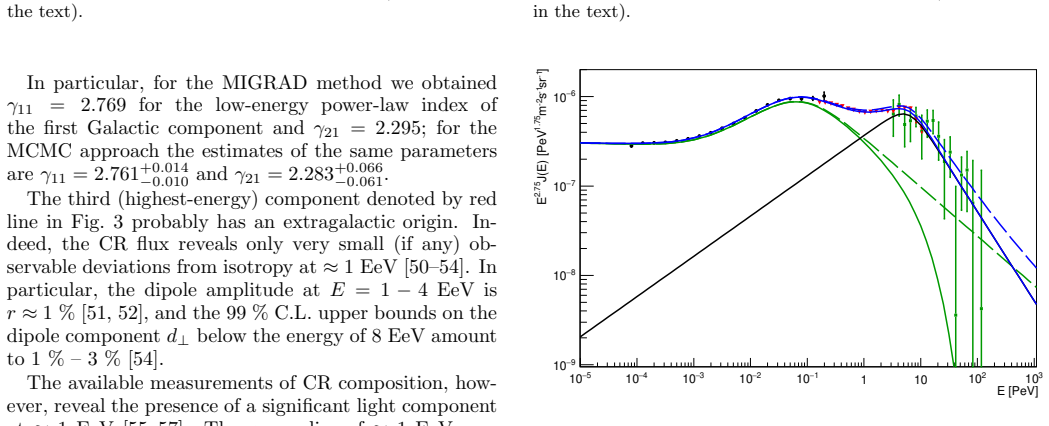
yields a similar overall fitting curve. Uncertainties of the parameters were estimated with the MCMC fitting approach. 4 E [PeV] 5−10 4−10 3−10 2−10 1−10 1 10 210 310 ]-1sr-1s-2m1.75J(E) [PeV2.75E 8−10 7−10 6−10 FIG. 3. Fit to the primary proton spectrum (see details in the text). In particular, for the MIGRAD method we obtained γ11 = 2 . 769 for the low-en...
2024
-
[13]
Kulikov and G
G. Kulikov and G. Khristiansen, Sov. Phys. JETP 8, 441 (1959)
1959
-
[14]
Nagano, T
M. Nagano, T. Hara, Y. Hatano, N. Hayashida, S. Kawaguchi, and et al., J. Phys. G: Nucl. Phys. 10, 1295 (1984)
1984
-
[15]
Aglietta, B
M. Aglietta, B. Alessandro, P. Antonioli, F. Arneodo, L. Bergamasco, and et al., Astroparticle Physics 10, 1 (1999)
1999
-
[16]
Antoni, W
T. Antoni, W. Apel, A. Badea, K. Bekk, A. Bercuci, and et al., Astroparticle Physics 24, 1 (2005)
2005
-
[17]
Amenomori, X
M. Amenomori, X. J. Bi, D. Chen, S. W. Cui, Danzengluobu, and et al., The Astrophysical Journal 678, 1165 (2008)
2008
-
[18]
M. G. Aartsen, R. Abbasi, Y. Abdou, M. Acker- mann, J. Adams, and et al., Physical Review D 88, 10.1103/physrevd.88.042004 (2013)
-
[19]
Peters, Il Nuovo Cimento 22, 800–819 (1961)
B. Peters, Il Nuovo Cimento 22, 800–819 (1961)
1961
-
[20]
Stanev, P
T. Stanev, P. L. Biermann, and T. K. Gaisser, Astronomy & Astrophysics 274, 902 (1993)
1993
-
[21]
Kobayakawa, Y
K. Kobayakawa, Y. S. Honda, and T. Samura, Physical Review D 66, 083004 (2002)
2002
-
[22]
M. C. Bell, J. Kota, and A. W. Wolfendale, J. Phys. A 7, 420 (1974)
1974
-
[23]
V. S. Ptuskin, S. I. Rogovaya, V. N. Zirakashvili, L. G. Chuvilgin, G. B. Khristiansen, E. G. Klepach, and G. V. Kulikov, Astronomy & Astrophysics 268, 726 (1993)
1993
-
[24]
Candia, E
J. Candia, E. Roulet, and L. N. Epele, Journal of High Energy Physics 2002, 033–033 (2002)
2002
-
[25]
Giacinti, M
G. Giacinti, M. Kachelriess, and D. Semikoz, Physical Review D 90, 041302 (2014)
2014
-
[26]
G. Giacinti, M. Kachelriess, and D. Semikoz, Physical Review D 91, 10.1103/physrevd.91.083009 (2015)
-
[27]
Karakula and W
S. Karakula and W. Tkaczyk, Astroparticle Physics 1, 229–237 (1993)
1993
-
[28]
Candia, L
J. Candia, L. N. Epele, and E. Roulet, Astroparticle Physics 17, 23–33 (2002)
2002
-
[29]
H.-B. Hu, Q. Yuan, B. Wang, C. Fan, J.-L. Zhang, and X.-J. Bi, The Astrophysical Journal 700, L170 (2009)
2009
-
[30]
P. L. Biermann, T. K. Gaisser, and T. Stanev, Physical Review D 51, 3450 (1995)
1995
-
[31]
Amenomori, Z
M. Amenomori, Z. Cao, B. Z. Dai, L. K. Ding, Y. X. Feng, and et al., The Astrophysical Journal 461, 408 (1996)
1996
-
[32]
Fowler, L
J. Fowler, L. Fortson, C. Jui, D. Kieda, R. Ong, C. Pryke, and P. Sommers, Astroparticle Physics 15, 49 (2001)
2001
-
[33]
J. R. H¨ orandel, Astroparticle Physics 19, 193 (2003)
2003
-
[34]
J. R. H¨ orandel, Astroparticle Physics 21, 241 (2004)
2004
-
[35]
V. I. Zatsepin and N. V. Sokolskaya, Astronomy & Astrophysics 458, 1 (2006)
2006
-
[36]
Q. An, R. Asfandiyarov, P. Azzarello, P. Bernardini, Bi , and et al., Science Advances 5, 10.1126/sciadv.aax3793 (2019)
-
[37]
Alemanno, Q
F. Alemanno, Q. An, P. Azzarello, F. Barbato, P. Bernardini, and et al., Physical Review Letters 126, 201102 (2021)
2021
-
[38]
Z. Cao, F. Aharonian, Y. Bai, Y. Bao, D. Bastieri, and et al., Science Bulletin 70, 4173 (2025)
2025
-
[39]
Z. Cao, F. Aharonian, Y. Bai, Y. Bao, D. Bastieri, and et al., Physical Review Letters 136, 121001 (2026)
2026
-
[40]
Denoted in analogy with the well-known feature in the CR spectrum at ≈ 4 EeV
-
[41]
the TeV cosmic-ray bump
The spectral structure formed together by the low energ y ankle and the TeV knee is sometimes called “the TeV cosmic-ray bump” (e.g. [70])
-
[42]
F. Varsi, S. Ahmad, M. Chakraborty, A. Chandra, S. Dugad, and et al., Physical Review Letters 132, 10.1103/physrevlett.132.051002 (2024)
-
[43]
W. Apel, J. Arteaga-Vel´ azquez, K. Bekk, M. Bertaina, J. Bl¨ umer, and et al., Astroparticle Physics 47, 54–66 (2013)
2013
-
[44]
M. Aguilar, L. A. Cavasonza, M. Allen, B. Al- pat, and et al., Physical Review Letters 126, 10.1103/physrevlett.126.041104 (2021)
-
[45]
O. Adriani, Y. Akaike, K. Asano, Y. Asaoka, E. Berti, and et al., Physical Review Letters 126, 10.1103/physrevlett.126.241101 (2021)
-
[46]
Lipari and S
P. Lipari and S. Vernetto, Astroparticle Physics 120, 102441 (2020)
2020
-
[47]
Especially of the first one at ≈ 15 × Z TeV, see [59]
-
[48]
M. Aartsen, M. Ackermann, J. Adams, J. Aguilar, M. Ahlers, and et al., Physical Review D 100, 10.1103/physrevd.100.082002 (2019)
-
[49]
E. G. Berezhko, V. K. Elshin, and L. T. Ksenofontov, Soviet Journal of Experimental and Theoretical Physics 82, 1 (1996)
1996
-
[50]
Ptuskin, V
V. Ptuskin, V. Zirakashvili, and E.-S. Seo, The Astrophysical Journal 718, 31 (2010)
2010
-
[51]
Ptuskin, V
V. Ptuskin, V. Zirakashvili, and E.-S. Seo, in International Cosmic Ray Conference , International Cosmic Ray Conference, Vol. 6 (2011) p. 240
2011
-
[52]
Hu, X.-J
H.-X. Hu, X.-J. Lv, X.-J. Bi, T.-L. Chen, K. Fang, and P.-F. Yin, Chinese Physics C 50, 065108 (2026)
2026
-
[53]
F. Aharonian and B. T. Zhang, arXiv e-prints , arXiv:2602.08223 (2026), arXiv:2602.08223 [astro-ph.HE]
work page internal anchor Pith review Pith/arXiv arXiv 2026
-
[54]
Caprioli, JCAP 2012 (07), 038
D. Caprioli, JCAP 2012 (07), 038
2012
-
[55]
Kachelriess and D
M. Kachelriess and D. Semikoz, Physics Letters B 634, 143 (2006)
2006
-
[56]
Aloisio, V
R. Aloisio, V. Berezinsky, P. Blasi, A. Gaz- izov, S. Grigorieva, and B. Hnatyk, Astroparticle Physics 27, 76 (2007)
2007
-
[57]
II is due to propagation effects that typically result in a steepening of the observable spectrum w.r.t
The difference between the values of γ here and in Sect. II is due to propagation effects that typically result in a steepening of the observable spectrum w.r.t. the spec- trum escaping the source
-
[58]
S. V. Ter-Antonyan and L. S. Haroyan, arXiv e-prints , hep-ex/0003006 (2000), arXiv:hep-ex/0003006 [astro-ph]
work page internal anchor Pith review Pith/arXiv arXiv 2000
-
[59]
James and M
F. James and M. Roos, Computer Physics Communications 10, 343 (1975)
1975
-
[60]
Brun and F
R. Brun and F. Rademakers, NIM A 389, 81 (1997)
1997
-
[61]
Foreman-Mackey, D
D. Foreman-Mackey, D. W. Hogg, D. Lang, and J. Good- 8 man, PASP 125, 306 (2013)
2013
-
[62]
Abreu, M
P. Abreu, M. Aglietta, E. Ahn, I. Al- buquerque, D. Allard, and et al., Astroparticle Physics 34, 627–639 (2011)
2011
-
[63]
Abreu, M
P. Abreu, M. Aglietta, M. Ahlers, E. J. Ahn, I. F. M. Albuquerque, and et al., ApJ Suppl. 203, 34 (2012)
2012
-
[64]
Abreu, M
P. Abreu, M. Aglietta, M. Ahlers, E. J. Ahn, I. F. M. Albuquerque, and et al., The Astrophysical Journal 762, L13 (2012)
2012
-
[65]
Abbasi, M
R. Abbasi, M. Abe, T. Abu-Zayyad, M. Allen, R. Azuma, and et al., Astroparticle Physics 86, 21 (2017)
2017
-
[66]
A. Aab, P. Abreu, M. Aglietta, I. F. M. Albuquerque, J. M. Albury, and et al., The Astrophysical Journal 891, 142 (2020)
2020
-
[67]
A. Aab, P. Abreu, M. Aglietta, E. Ahn, I. Al Samarai, and et al., Physical Review D 90, 10.1103/physrevd.90.122006 (2014)
-
[68]
R. U. Abbasi, M. Abe, T. Abu- Zayyad, M. Allen, R. Azuma, and et al., The Astrophysical Journal 858, 76 (2018)
2018
-
[69]
R. U. Abbasi, M. Abe, T. Abu-Zayyad, M. Allen, Y. Arai, and et al., The Astrophysical Journal 909, 178 (2021)
2021
-
[70]
Giacinti, M
G. Giacinti, M. Kachelriess, D. Semikoz, and G. Sigl, JCAP 2012 (07), 031–031
2012
-
[71]
Alemanno, Q
F. Alemanno, Q. An, P. Azzarello, F.-C.-T. Barbato, P. Bernardini, and et al., Nature 653, 52 (2026)
2026
-
[72]
W. R. Webber, J. C. Kish, and D. A. Schrier, Physical Review C 41, 520 (1990)
1990
-
[73]
Szabelski, T
J. Szabelski, T. Wibig, and A. Wolfendale, Astroparticle Physics 17, 125–131 (2002)
2002
-
[74]
Wibig and A
T. Wibig and A. W. Wolfendale, J. Phys. G 31, 255–264 (2005)
2005
-
[75]
Aloisio, V
R. Aloisio, V. Berezinsky, and A. Gazizov, Astroparticle Physics 39-40, 129–143 (2012)
2012
-
[76]
Aloisio, V
R. Aloisio, V. Berezinsky, and A. Gazizov, Astroparticle Physics 34, 620 (2011)
2011
-
[77]
P. Blasi, E. Amato, and P. D. Serpico, Physical Review Letters 109, 10.1103/physrevlett.109.061101 (2012)
-
[78]
A. D. Erlykin and A. W. Wolfendale, J. Phys. G 23, 979–989 (1997)
1997
-
[79]
F. Alemanno, C. Altomare, Q. An, P. Azzarello, F. Barbato, and et al., Physical Review Letters 134, 10.1103/physrevlett.134.191001 (2025)
-
[80]
Zhang, N
M. Zhang, N. V. Pogorelov, Y. Zhang, H. B. Hu, and R. Schlickeiser, The Astrophysical Journal 889, 97 (2020)
2020
discussion (0)
Sign in with ORCID, Apple, or X to comment. Anyone can read and Pith papers without signing in.