Predicting the conditions for observing the Mpemba effect
Pith reviewed 2026-06-28 08:11 UTC · model grok-4.3
The pith
The Mpemba effect in 1D overdamped Langevin dynamics is driven by boundaries rather than the number of potential wells or metastability.
A machine-rendered reading of the paper's core claim, the machinery that carries it, and where it could break.
Core claim
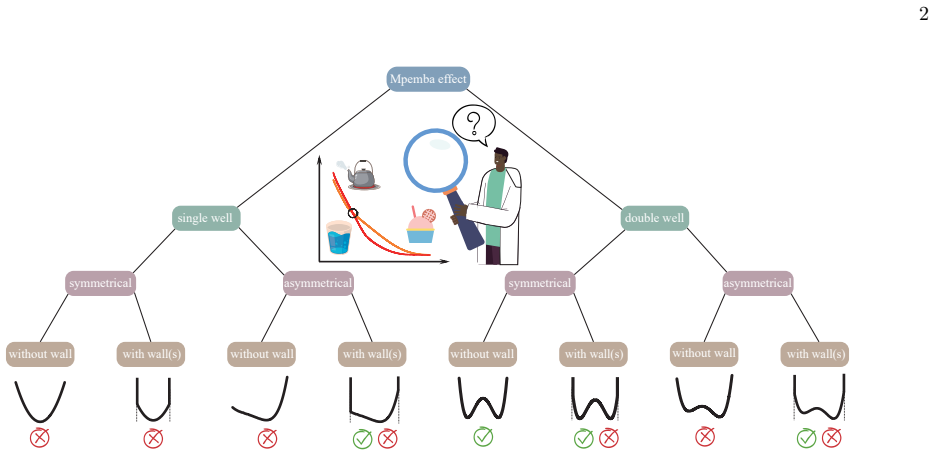
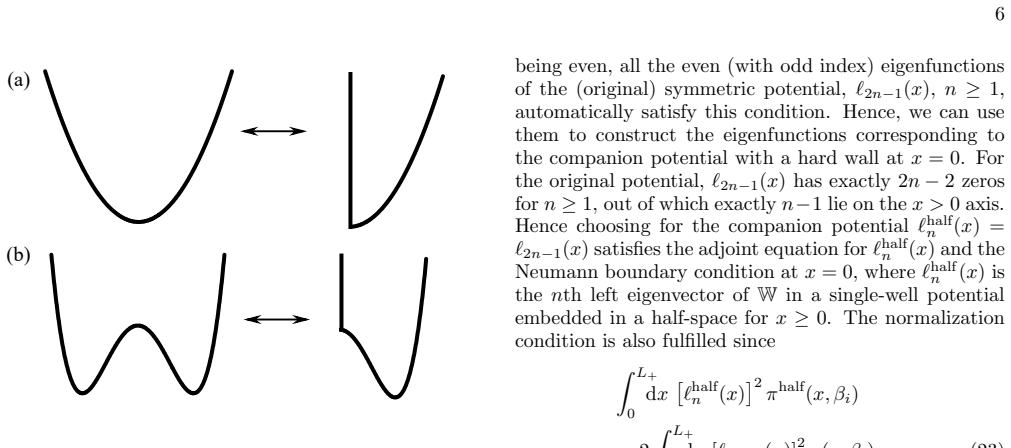
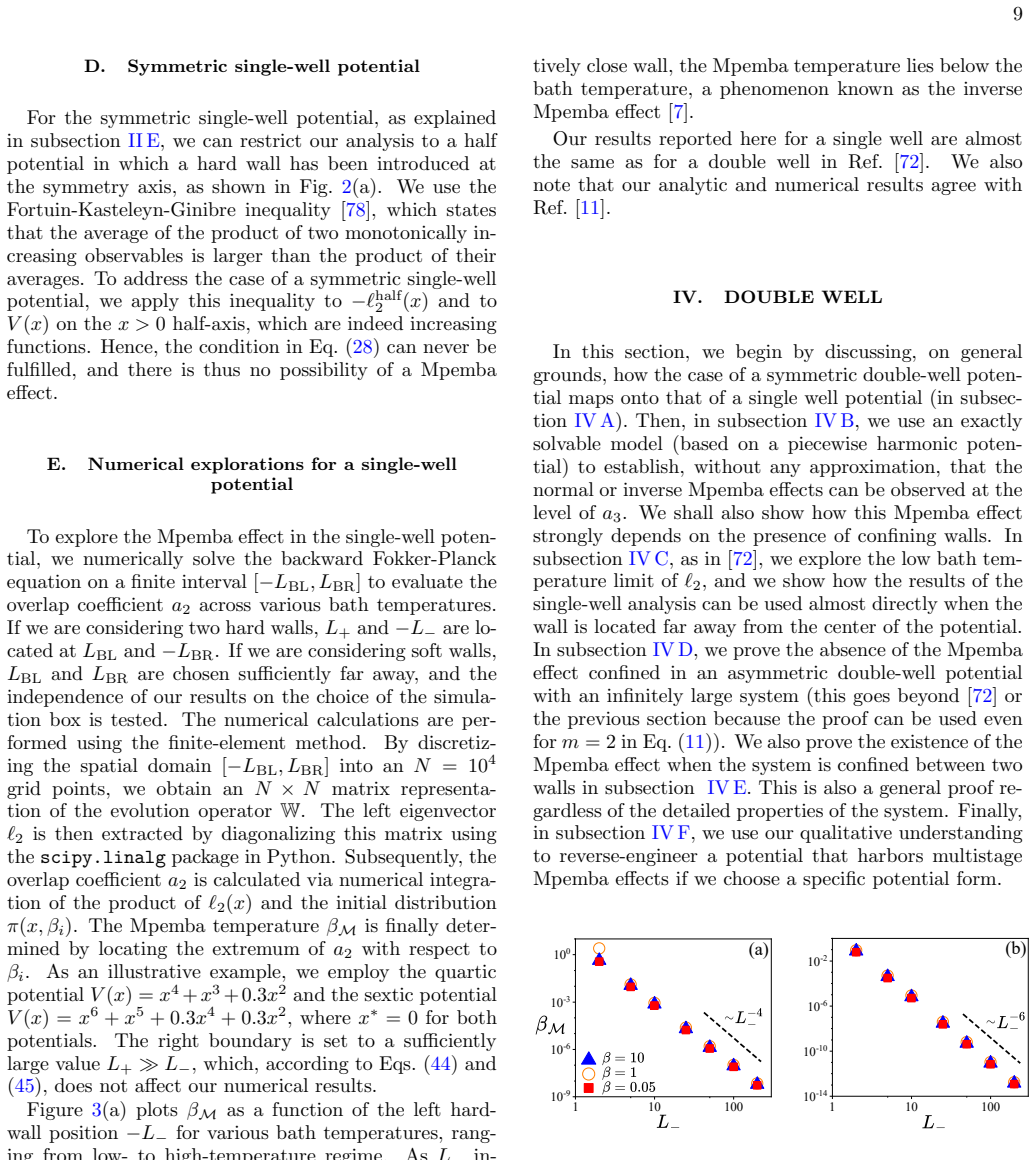
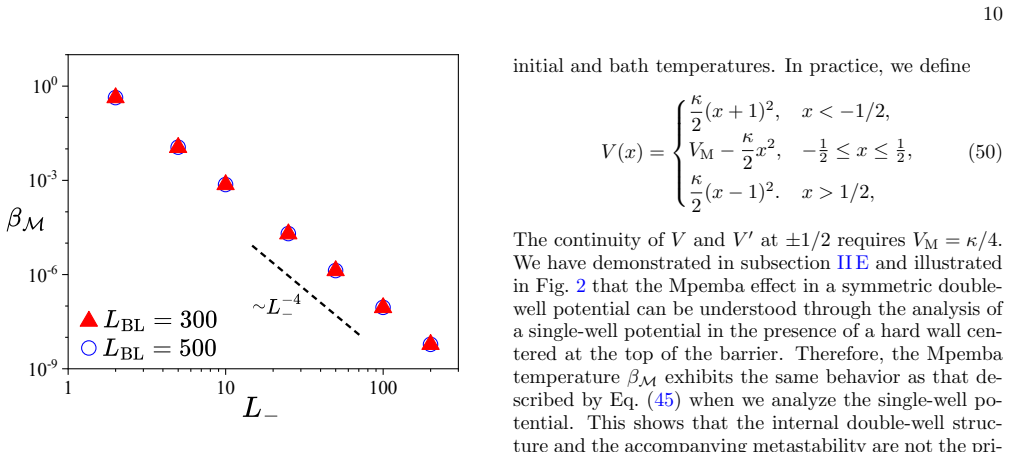
The existence of the Mpemba effect is primarily driven by the presence of boundaries, either hard or soft, rather than the specific internal structure of the potential landscape, such as metastability or the number of minima. Spectral analysis shows that the derivative of the first nontrivial eigenmode of the Fokker-Planck operator behaves as a Dirac delta peak in the low-temperature regime; the Mpemba effect then appears through the interplay of this behavior with the initial population dynamics induced in a nontrivial way by the wall.
What carries the argument
The first nontrivial eigenmode of the Fokker-Planck operator, whose derivative behaves as a Dirac delta peak at low temperature when boundaries are present.
If this is right
- The Mpemba effect occurs for both single-well and double-well potentials once boundaries are present.
- Asymmetry of the potential modifies the conditions and character of the effect.
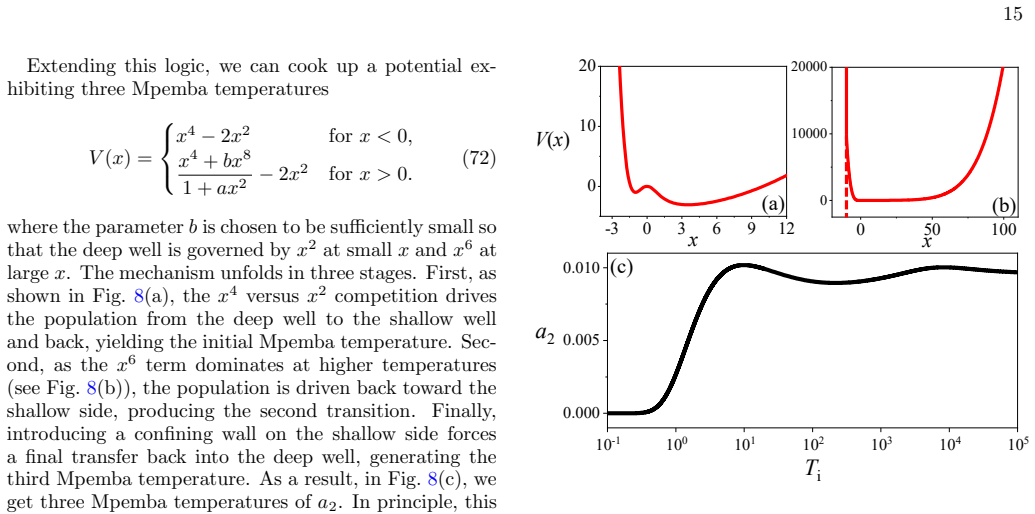
- Potential landscapes can be deliberately shaped to produce multistage Mpemba transitions.
Where Pith is reading between the lines
- The boundary mechanism suggests that effective confining constraints in other geometries could produce analogous Mpemba behavior even without explicit walls.
- Numerical checks in higher-dimensional overdamped systems could test whether the same eigenmode-derivative signature survives when boundaries are present.
- The classification supplies a practical route to design experimental traps that reliably exhibit the effect by tuning only the boundary strength.
Load-bearing premise
The low-temperature regime in which the derivative of the first nontrivial eigenmode behaves as a Dirac delta peak that directly governs the initial population dynamics in the presence of walls.
What would settle it
A simulation or exact calculation that finds the Mpemba effect in an unbounded potential without walls, or that finds the effect absent in every bounded potential at sufficiently low temperature, would falsify the central claim.
Figures
read the original abstract
The Mpemba effect, a counterintuitive phenomenon where a hotter system relaxes faster than a colder one, has been widely observed in various nonequilibrium systems. Despite this progress, the fundamental structural features of the energy landscape required for its emergence remain a subject of debate. In this study, we investigate the conditions for the Mpemba effect within one-dimensional overdamped Langevin dynamics. We classify the potential landscapes based on the presence of single or double wells, their symmetry properties, and the existence of walls. We establish that the existence of the effect is primarily driven by the presence of boundaries, either hard or soft, rather than the specific internal structure of the potential landscape, such as metastability or the number of minima. By employing a spectral decomposition of the Fokker-Planck operator, we analyze the behavior of the first nontrivial eigenmode and demonstrate that its derivative acts as a Dirac delta peak in the low-temperature regime. This helps us elucidate the mechanism underlying the Mpemba effect: it appears as the interplay between this behavior and the initial population dynamics in a non-trivial way induced by the presence of the wall. Our analysis provides a unified classification across single- and double-well potentials, highlighting the crucial role of boundary conditions and asymmetry. Furthermore, we demonstrate that this framework allows for the engineering of potential landscapes capable of producing multistage Mpemba transitions.
Editorial analysis
A structured set of objections, weighed in public.
Referee Report
Summary. The manuscript examines the Mpemba effect in one-dimensional overdamped Langevin dynamics by classifying potentials according to the number of wells (single or double), symmetry, and the presence of hard or soft walls. The central claim is that the effect is driven primarily by the presence of boundaries rather than by metastability or the number of minima in the potential. The authors employ spectral decomposition of the Fokker-Planck operator to show that the derivative of the first nontrivial eigenmode approaches a Dirac delta function in the low-temperature limit. This behavior, combined with wall-induced initial conditions, is argued to produce the Mpemba effect. The framework is used to classify various potentials and to engineer landscapes exhibiting multistage Mpemba transitions.
Significance. If the central claim holds, the work offers a unified classification emphasizing boundary conditions over internal landscape features such as the number of minima. The spectral analysis of the Fokker-Planck operator is a standard tool in the field, and the demonstration that multistage transitions can be engineered would be a useful addition if the underlying approximation is shown to be robust.
major comments (1)
- [Spectral decomposition section (low-T regime of first nontrivial eigenmode)] Spectral decomposition section (low-T regime of first nontrivial eigenmode): the assertion that the derivative of this eigenmode approaches a Dirac delta peak uniformly across single- and double-well potentials (including asymmetric cases) is not accompanied by an explicit derivation, bound, or numerical verification showing that the limit remains insensitive to barrier heights, well depths, or asymmetry parameters once walls are introduced. Without this, the classification of the Mpemba effect by boundary presence alone cannot be considered load-bearing for the central claim.
minor comments (1)
- [Abstract] The abstract states that the framework 'allows for the engineering of potential landscapes' but provides no concrete examples or parameter values; a brief illustration in the main text would improve clarity.
Simulated Author's Rebuttal
We thank the referee for their careful reading and constructive comments. We address the single major comment below and will revise the manuscript to strengthen the supporting analysis.
read point-by-point responses
-
Referee: [Spectral decomposition section (low-T regime of first nontrivial eigenmode)] Spectral decomposition section (low-T regime of first nontrivial eigenmode): the assertion that the derivative of this eigenmode approaches a Dirac delta peak uniformly across single- and double-well potentials (including asymmetric cases) is not accompanied by an explicit derivation, bound, or numerical verification showing that the limit remains insensitive to barrier heights, well depths, or asymmetry parameters once walls are introduced. Without this, the classification of the Mpemba effect by boundary presence alone cannot be considered load-bearing for the central claim.
Authors: We agree that the current presentation would be strengthened by an explicit derivation, bound, or systematic numerical verification establishing that the low-temperature Dirac-delta limit of the eigenmode derivative is insensitive to barrier heights, well depths, and asymmetry once walls are present. While the manuscript illustrates the behavior through spectral decomposition and examples for representative single- and double-well cases, it does not supply the requested uniform proof. In the revised version we will add either an analytical argument based on the Fokker-Planck operator with boundary conditions or comprehensive numerical scans across parameter ranges to confirm the claimed uniformity, thereby supporting the boundary-driven classification. revision: yes
Circularity Check
No circularity; derivation relies on standard Fokker-Planck spectral tools
full rationale
The paper's central claim—that boundaries drive the Mpemba effect independently of internal potential details—follows from applying the standard spectral decomposition of the Fokker-Planck operator to the first nontrivial eigenmode and its low-T Dirac-delta derivative behavior. This is a direct mathematical consequence of the operator's properties under the stated boundary conditions, not a redefinition or fit of the target quantity itself. No step reduces by construction to an input parameter, self-citation chain, or ansatz smuggled from prior work by the same authors. The classification across single- and double-well cases is obtained by explicit comparison of the eigenmode properties, which remains externally falsifiable via the underlying stochastic differential equation.
Axiom & Free-Parameter Ledger
axioms (2)
- standard math Spectral decomposition of the Fokker-Planck operator fully describes the relaxation dynamics
- domain assumption Overdamped Langevin dynamics in 1D with boundaries captures the essential Mpemba mechanism
Forward citations
Cited by 1 Pith paper
-
A closed system setting for quantum thermalisation in free fermions
In a closed tripartite free-fermion setup, the central subsystem relaxes to the bath temperature without the Mpemba effect, with the relaxation fully characterised by generalised hydrodynamics.
Reference graph
Works this paper leans on
-
[1]
(57) is automatically fulfilled
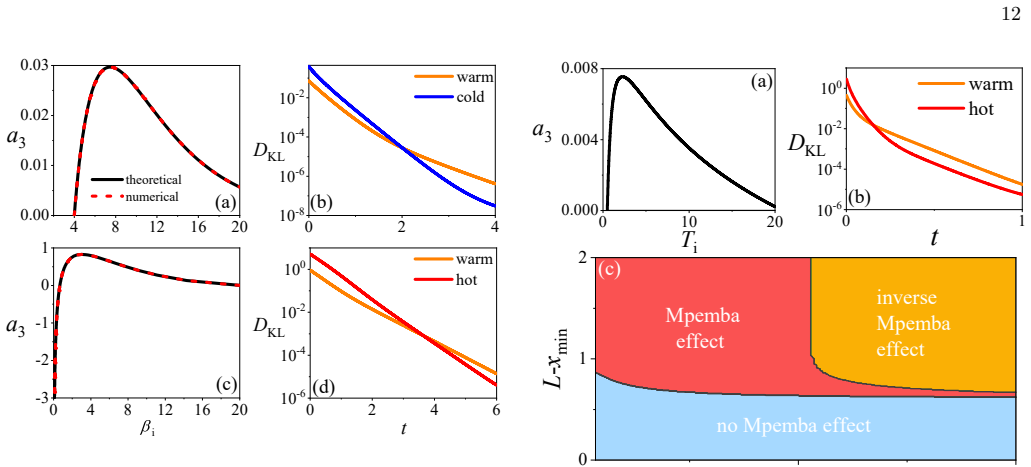
Inverse Mpemba effect To obtain analytical insight, we consider a special choice of parameter for which the eigenvalue can be found exactly, namely, for which the matching condition in Eq. (57) is automatically fulfilled. It turns out that im- posingβκ= 4 leads toν 2 = 1 and thus toλ 2 =κfor the single well potential with a hard wall atx= 0. For this part...
-
[2]
(57) must be solved numerically
Mpemba effect for a quench to a lower temperature If we abandon the conditionβk= 4 and work at an arbitrary bath temperature, no closed-form solution is readily available, and the eigenvalue problem in Eq. (57) must be solved numerically. In that case, we numeri- cally evaluate the overlap coefficienta 3 using the gen- eral expressions derived in subsecti...
-
[3]
Corre- spondingly,φ 1(x) and|φ 2(x)|are exponentially localized nearx=αin the right well, with only exponentially small weight in the left well
Low-temperature localization Asβ→ ∞, the right well, which contains the global minimum, dominates the Boltzmann weight. Corre- spondingly,φ 1(x) and|φ 2(x)|are exponentially localized nearx=αin the right well, with only exponentially small weight in the left well. In contrast, the eigenfunctionφ 2(x) must be orthogo- nal toφ 1(x): Z dxφ1(x)φ2(x) = 0.(B1) ...
-
[4]
Assume, for contradiction, thatx 0 ≤x −
Location of the node We now show that the unique nodex 0 ofφ 2(x) lies in the central region (x −, x+) for sufficiently largeβ. Assume, for contradiction, thatx 0 ≤x −. Thenφ 2(x) has a fixed sign throughout the central region and the right well. Sinceφ 1(x) is exponentially small in those regions, the orthogonality condition (B1) cannot be sat- isfied. S...
-
[5]
The left eigenfunction is ℓ2(x, β) = eβV(x)/2 φ2(x).(B4) Since the exponential factor is positive everywhere,ℓ 2 has the same sign structure asφ 2
Fixed sign bias in the wells Since the node lies strictly in the barrier (central) re- gion, the sign ofφ 2(x) is constant throughout each well: φ2(x) ( >0x < x 0, <0x > x 0, (B3) up to an overall sign choice. The left eigenfunction is ℓ2(x, β) = eβV(x)/2 φ2(x).(B4) Since the exponential factor is positive everywhere,ℓ 2 has the same sign structure asφ 2....
-
[6]
The result relies only on explicit properties of the potential, orthogonality to the ground state, and the Sturm–Liouville nodal theorem, and does not invoke heuristic arguments
Conclusion For connected harmonic–antiharmonic–harmonic double-well potentials with a unique global minimum, 17 the second left eigenfunctionℓ 2(x, β) exhibits a rigorous and robust left-right sign bias in the low-temperature regime. The result relies only on explicit properties of the potential, orthogonality to the ground state, and the Sturm–Liouville ...
-
[7]
V(x) has exactly two local minimax − < x+ and one lo- cal maximumx ∗, 3.V(x −)> V(x +) (asymmetric double well)
Problem setting and statement LetV(x) be a smooth one-dimensional potential sat- isfying: 1.V(x)→+∞as|x| → ∞(normalizability), 2. V(x) has exactly two local minimax − < x+ and one lo- cal maximumx ∗, 3.V(x −)> V(x +) (asymmetric double well). By using the Boltzmann distributionπ(x, β) = e−βiV(x) /Z(βi) and the thermal average ⟨V⟩ βi = Z dxV(x)π(x, β i),(C...
-
[8]
General low-temperature expansion in the initial condition (Model-independent) The unique global minimum is located atx=x +, Ex- pandV(x) nearx +: V(x) =V(x +) + k∗ 2 (x−x +)2 +O (x−x +)3 ,(C2) wherek ∗ >0. By Laplace’s method, the partition func- tion satisfies Z(β i) = e−βiV(x +) r 2π βik∗ 1 +O 1 βi .(C3) Similarly, the thermal average of the potential ...
-
[9]
However, the essential requirement is not the low temperature itself, but the localization property of the probability distributionπ(x, β i)
General condition for sign correlation The previous argument was formulated in the limit of low initial temperatureβ i → ∞, which guarantees strong localization of the initial distribution around the global minimum. However, the essential requirement is not the low temperature itself, but the localization property of the probability distributionπ(x, β i)....
-
[10]
Then pβi(xL)∼e −βi∆V ≪p β(x+).(C8) In a neighborhood ofx R, V(x)−⟨V⟩ βi = ∆V+O (x−x L)2 −O 1 βi >0 (C9) for sufficiently largeβ i
Contribution from the Secondary Well Letx L be the local minimum of the higher-energy well, with ∆V=V(x L)−V(x +)>0. Then pβi(xL)∼e −βi∆V ≪p β(x+).(C8) In a neighborhood ofx R, V(x)−⟨V⟩ βi = ∆V+O (x−x L)2 −O 1 βi >0 (C9) for sufficiently largeβ i. Thus, regions that arenotdominant in probability nec- essarily correspond to positive values ofV(x)− ⟨V⟩ βi. 18
-
[11]
For asymmetric double wells, it holds uniformly in regions that dominate the Boltzmann weight
Summary of applicability The sign correlation holdsgenerallyfor any smooth confining potential with a unique global minimum in the low initial temperature regime. For asymmetric double wells, it holds uniformly in regions that dominate the Boltzmann weight. The argument is therefore not merely physical intuition but a consequence of precise asymp- totic e...
-
[12]
E. B. Mpemba and D. G. Osborne, Cool? Phys. Educ. 4, 172 (1969)
1969
-
[13]
H. C. Burridge and P. F. Linden, Questioning the Mpemba effect: hot water does not cool more quickly than cold, Sci. Rep.6, 37665 (2016)
2016
-
[14]
J. I. Katz, Reply to Burridge & Linden: Hot water may freeze sooner than cold, arXiv preprint arXiv:1701.03219 (2017)
Pith/arXiv arXiv 2017
-
[15]
G. Teza, J. Bechhoefer, A. Lasanta, O. Raz, and M. Vucelja, Speedups in nonequilibrium thermal relaxation: Mpemba and related effects, Phys. Rep.1164, 1 (2026)
2026
-
[16]
F. Ares, P. Calabrese, and S. Murciano, The quantum Mpemba effects, Nat. Rev. Phys.7, 451 (2025)
2025
-
[17]
Bechhoefer, A
J. Bechhoefer, A. Kumar, and R. Ch´ etrite, A fresh un- derstanding of the mpemba effect, Nat Rev Phys3, 534 (2021)
2021
-
[18]
Lu and O
Z. Lu and O. Raz, Nonequilibrium Thermodynamics of the Markovian Mpemba Effect and Its Inverse, Proc. Natl. Acad. Sci. U.S.A.114, 5083 (2017)
2017
-
[19]
Klich, O
I. Klich, O. Raz, O. Hirschberg, and M. Vucelja, Mpemba Index and Anomalous Relaxation, Phys. Rev. X9, 021060 (2019)
2019
-
[20]
D. M. Busiello, D. Gupta, amd A. Maritan, Inducing and optimizing Markovian Mpemba effect with stochastic reset, New J. Phys.23, 103012 (2021)
2021
-
[21]
Kumar and J
A. Kumar and J. Bechhoefer, Exponentially faster cool- ing in a colloidal system, Nature584, 64 (2020)
2020
-
[22]
Kumar, Anomalous relaxation in colloidal systems, PhD thesis, Simon Fraser University, 2021
A. Kumar, Anomalous relaxation in colloidal systems, PhD thesis, Simon Fraser University, 2021
2021
-
[23]
Kumar, R
A. Kumar, R. Che´ etrite and J. Bechhoefer, Anomalous heating in a colloidal system, Proc. Natl. Acad. Sci. U.S.A.119, e2118484119 (2022)
2022
-
[24]
Malhotra and H
I. Malhotra and H. L¨ owen, Double Mpemba effect in the cooling of trapped colloids, J. Chem. Phys.161, 164903 (2024)
2024
-
[25]
Y. Tian, Y. Zheng, L.-H. Liu, L. Wang, G.-C. Guo, and F.-W. Sun, Experimental study of Mpemba effect in anenergy Langevin system, Phys. Rev. Research7, L042020 (2025)
2025
-
[26]
Lasanta, F
A. Lasanta, F. Vega Reyes, A. Prados, and A. Santos, When the Hotter Cools More Quickly: Mpemba Effect in Granular Fluids Phys. Rev. Lett.119, 148001 (2017)
2017
-
[27]
Torrente, M
A. Torrente, M. A. L´ opez-Casta˜ no, A. Lasanta, F. Vega Reyes, A. Prados, and A. Santos, Large Mpemba-like effect in a gas of inelastic rough hard spheres Phys. Rev. E99, 060901(R) (2019)
2019
-
[28]
Biswas, V
A. Biswas, V. V. Prasad, O. Raz, and R. Rajesh, Mpemba effect in driven granular gas, Phys. Rev. E102, 012906 (2020)
2020
-
[29]
Biswas, V
A. Biswas, V. V. Prasad, and R. Rajesh, Mpemba effect in an anisotropically driven granular Maxwell gases, EPL 136, 46001 (2021)
2021
-
[30]
Momp´ o, M
E. Momp´ o, M. A. L´ opez Casta˜ no, A. Torrente, F. Vega Reyes, A. Lasanta, Memory effects in a gas of viscoelastic particles Available to Purchase, Phys. Fluids33, 062005 (2021)
2021
-
[31]
Meg´ ıas and A
A. Meg´ ıas and A. Santos, Mpemba-like effect protocol for granular gases of inelastic and rough hard disks, Front. Phys.10, 971671 (2022)
2022
-
[32]
Patr´ on, B
A. Patr´ on, B. S´ anchez-Rey, C. A. Plata and A. Prados, Non-equilibrium memory effects: Granular fluids and be- yond, EPL143, 61002 (2023). 20
2023
-
[33]
Keller, V
T. Keller, V. Torggler, S. B. J¨ ager, S. Sch¨ utz, H. Ritsch, and G. Morigi, Quenches aintersect the Self-Organization Transition in Multimode Cavities, New J. Phys.20, 025004 (2018)
2018
-
[34]
Santos and A
A. Santos and A. Prados, Mpemba effect in molecu- lar gases under nonlinear drag, Phys. Fluids32, 072010 (2020)
2020
-
[35]
Patr´ on, B
A. Patr´ on, B. S´ anchez-Rey and A. Prados, Strong non- exponential relaxation and memory effects in a fluid with nonlinear drag, Phys. Rev. E104, 064127 (2021)
2021
-
[36]
Takada, H
S. Takada, H. Hayakawa and A. Santos, Mpemba effect in inertial suspensions, Phys. Rev. E103, 032901 (2021)
2021
-
[37]
Santos, Mpemba meets Newton: Exploring the Mpemba and Kovacs effects in the time-delayed cooling law Phys
A. Santos, Mpemba meets Newton: Exploring the Mpemba and Kovacs effects in the time-delayed cooling law Phys. Rev. E109, 044149 (2024)
2024
-
[38]
J. Lin, K. Li, J. He, J. Ren and J. Wang, Power statistics of Otto heat engines with the Mpemba effect, Phys. Rev. E105, 014104 (2022)
2022
-
[39]
Biswas and A
A. Biswas and A. Pal, Mpemba effect on nonequilibrium active Markov chains Phys. Rev. E111, 054136 (2025)
2025
-
[40]
Biswas, R
A. Biswas, R. Rajesh and A. Pal, Mpemba effect in a Langevin system: Population statistics, metastability, and other exact results, J. Chem. Phys.159, 044120 (2023)
2023
-
[41]
Biswas, Mpemba effect in granular and Langevin sys- tems, The thesis of The Institute of Mathematical Sci- ences, Chennai
A. Biswas, Mpemba effect in granular and Langevin sys- tems, The thesis of The Institute of Mathematical Sci- ences, Chennai
-
[42]
Ch´ etrite, A
R. Ch´ etrite, A. Kumar, and J. Bechhoefer, The metastable mpemba effect corresponds to a non- monotonic temperature, dependence of extractable work, Frontiers in Physics9, 654271 (2021)
2021
-
[43]
M. R. Walker and M. Vucelja, Anomalous thermal relax- ation of Langevin particles in a piecewise-constant po- tential, J. Stat. Mech.: Theory and Experiment 2021, 113105 (2021)
2021
-
[44]
Deg¨ unther and U
J. Deg¨ unther and U. Seifert, Anomalous relaxation from a non-equilibrium steady state: An isothermal analog of the Mpemba effect, EPL139, 41002 (2022)
2022
-
[45]
Yang and J.-X
Z.-Y. Yang and J.-X. Hou, Non-Markovian Mpemba ef- fect in mean-field systems, Phys. Rev. E105, 014119 (2022)
2022
-
[46]
D. J. Strachan, A. Purkayastha, and S. R. Clark, Non- Markovian Quantum Mpemba Effect, Phys. Rev. Lett. 134, 220403 (2025)
2025
-
[47]
Yang and J.-X
Z.-Y. Yang and J.-X. Hou, Mpemba effect of a mean- field system: The phase transition time, Phys. Rev. E 105, 014119 (2022)
2022
-
[48]
R. G. Gonz´ alez, N. Khalil and V. Garz´ o, Mpemba-like effect in driven binary mixtures, Phys. Fluids33, 053301 (2021)
2021
-
[49]
Baity-Jesi, E
M. Baity-Jesi, E. Calore, A. Cruz, L. A. Fernandez, J. M. Gil-Narvi´ on, A. Gordillo-Guerrero, D. I˜ niguez, A. Las- anta, A. Maiorano, E. Marinari, V. Martin-Mayor, J. Moreno-Gordo, A. Mu˜ noz Sudupe, D. Navarro, G. Parisi, S. Perez-Gaviro, F. Ricci-Tersenghi, J. J. Ruiz-Lorenzo, S. F. Schifano, B. Seoane, A. Taranc´ on, R. Tripiccione, and D. Yllanes, T...
2010
-
[50]
P. A. Greaney, G. Lani, G. Cicero, and J. C. Grossman, Mpemba-Like Behavior in Carbon Nanotube Resonators, Slow growth of magnetic domains helps fast evolution routes for out-of-equilibrium dynamics, Metall. Mater. Trans. A42, 3907 (2011)
2011
-
[51]
Yang and J.-X
Z.-Y. Yang and J.-X. Hou, Non-Markovian Mpemba ef- fect in mean-field systems, Phys. Rev. E101, 052106 (2020)
2020
-
[52]
Gonz´ alez-Adalid Pemrt´ ın, E
I. Gonz´ alez-Adalid Pemrt´ ın, E. Momp´ o, A. Lasanta, V. Mart´ ın-Mayor and J. Salas, Slow growth of magnetic do- mains helps fast evolution routes for out-of-equilibrium dynamics, Phys. Rev. E104, 044114 (2021)
2021
-
[53]
Holtzman and O
R. Holtzman and O. Raz, Landau theory for the Mpemba effect through phase transitions, Communica- tions Physics5, 280 (2022)
2022
-
[54]
Meg´ ıas, A
A. Meg´ ıas, A. Santos, and A. Prados, Thermal versus entropic Mpemba effect in molecular gases with nonlinear drag, Phys. Rev. E105, 054140 (2022)
2022
-
[55]
Biswas, V
A. Biswas, V. V. Prasad, and R. Rajesh, Mpemba ef- fect in driven granular gases: Role of distance measures, Phys. Rev. E108, 024902 (2023)
2023
-
[56]
I. G. Pemartin, E. Momp´ o, A. Lasanta, V. Martin-Mayor and J. Salas, Shortcuts of Freely Relaxing Systems Using Equilibrium Physical Observables, Phys. Rev. Lett.132, 117102 (2024)
2024
-
[57]
A. P. Antonov and H. L¨ owen, Temperature overshooting in the Mpemba effect of frictional active matter, Phys. Rev. E113, 025407 (2026)
2026
-
[58]
N. Ohga, H. Hayakawa, and S. Ito, Microscopic theory of Mpemba effects and a no-Mpemba theorem for monotone many-body systems, arXiv:2410.06623
-
[59]
Van Vu, and H
T. Van Vu, and H. Hayakawa, Thermomajorization Mpemba Effect, Phys. Rev. Lett.134, 107101 (2025)
2025
-
[60]
Nava and M
A. Nava and M. Fabrizio, Lindblad dissipative dynamics in the presence of phase coexistence, Phys. Rev. B.100, 125102 (2019)
2019
-
[61]
Carollo, A
F. Carollo, A. Lasanta, and I. Lesanovsky, Exponentially Accelerated Approach to Stationarity in Markovian Open Quantum Systems through the Mpemba Effect, Phys. Rev. Lett.127, 060401 (2021)
2021
-
[62]
K.Manikandan, Equidistant quenches in few-level quantum systems, Phys
S. K.Manikandan, Equidistant quenches in few-level quantum systems, Phys. Rev. Res.3, 043108 (2021)
2021
-
[63]
Ivander, N
F. Ivander, N. Anto-Sztrikacs, and D. Segal, Hyperaccel- eration of quantum thermalization dynamics by bypass- ing long-lived coherences: An analytical treatment, Phys. Rev. E108, 014130 (2023)
2023
-
[64]
F. Ares, S. Murciano, and P. Calabrese, Entanglement asymmetry as a probe of symmetry breaking, Nat. Com- mun.14, 2036 (2023)
2036
-
[65]
A. K. Chatterjee, S. Takada and H. Hayakawa, Quantum Mpemba Effect in a Quantum Dot with Reservoirs, Phys. Rev. Lett.131, 080402 (2023)
2023
-
[66]
A. K. Chatterjee, S. Takada and H. Hayakawa, Multiple quantum Mpemba effect: Exceptional points and oscilla- tions, Phys. Rev. A110, 022213 (2024)
2024
-
[67]
L. K. Joshi, J. Franke, A. Rath, F. Ares, S. Murciano, F. Kranzl, R. Blatt, P. Zoller, B. Vermersch, P. Calabrese, C. F. Roos, and M. K. Joshi, Observing the quantum Mpemba effect in quantum simulations Phys. Rev. Lett. 133, 010402 (2024)
2024
-
[68]
S. A. Shapira, Y. Shapira, J. Markov, G. Teza, N. Ak- erman,, O. Raz, and R. Ozeri, Inverse Mpemba Effect Demonstrated on a Single Trapped Ion Qubit, Phys. Rev. Lett.133, 010403 (2024)
2024
-
[69]
Rylands, K
C. Rylands, K. Klobas, F. Ares, P. Calabrese, S. Mur- ciano, and B. Bertini, Microscopic Origin of the Quan- tum Mpemba Effect in Integrable Systems, Phys. Rev. Lett.133, 010401 (2024)
2024
-
[70]
Moroder, O
M. Moroder, O. Culhane, K. Zawadzki, and J. Goold, 21 Thermodynamics of the quantum Mpemba effect, Phys. Rev. Lett.133, 140404 (2024)
2024
-
[71]
Chalas, F
K. Chalas, F. Ares, C. Rylands, and P. Calabrese, Multi- ple crossing during dynamical symmetry restoration and implications for the quantum Mpemba effect, J. Stat. Mech. (2024) 103101
2024
-
[72]
F. Ares, V. Vitale, and Sara Murciano, The quantum Mpemba effect in free-fermionic mixed states, Phys. Rev. B,111, 104312 (2025)
2025
-
[73]
Yamashika, F
S. Yamashika, F. Ares, and P. Calabrese, Entangle- ment asymmetry and quantum Mpemba effect in two- dimensional free-fermion systems, Phys. Rev. B110, 085126 (2024)
2024
-
[74]
Liu, H.-K
S. Liu, H.-K. Zhang, S. Yin, and S.-X. Zhang, Symmetry Restoration and Quantum Mpemba Effect in Symmetric Random Circuits, Phys. Rev. Lett.133, 140405 (2024)
2024
-
[75]
Wang and J
X. Wang and J. Wang, Mpemba effects in nonequilibrium open quantum systems, Phys. Rev. Research,6, 033330 (2024)
2024
-
[76]
Nava and R
A. Nava and R. Egger, Mpemba Effects in Open Nonequi- librium Quantum Systems, Phys. Rev. Lett.133, 136302 (2024)
2024
-
[77]
Longhi, Photonic Mpemba effect, Opt
S. Longhi, Photonic Mpemba effect, Opt. Lett.49, 5188 (2024)
2024
-
[78]
Zhang, G
J. Zhang, G. Xia, C.-W. Wu, T. Chen, Q. Zhang, Y. Xie, W.-B. Su, W. Wu, C.-W. Qiu, P.-X. Chen, W. Li, H. Jing, and Y.-L. Zhou, Observation of quantum strong Mpemba effect, Nat. Commun.16, 301 (2025)
2025
-
[79]
Turkeshi, P
X. Turkeshi, P. Calabrese, and A. De Luca, Quantum Mpemba Effect in Random Circuits, Phys. Rev. Lett. 135, 040403 (2025)
2025
-
[80]
Bao and Z
R. Bao and Z. Hou, Accelerating Quantum Relaxation via Temporary Reset: A Mpemba-Inspired Approach, Phys. Rev. Lett.135, 150403 (2025)
2025
discussion (0)
Sign in with ORCID, Apple, or X to comment. Anyone can read and Pith papers without signing in.