Astrophysical Constraints on Color-Superconducting Gap and N³LO Perturbative-QCD Constant c₀
Pith reviewed 2026-06-28 09:11 UTC · model grok-4.3
The pith
Astrophysical observations limit the color-flavor-locked gap in quark matter to at most 51 MeV.
A machine-rendered reading of the paper's core claim, the machinery that carries it, and where it could break.
Core claim
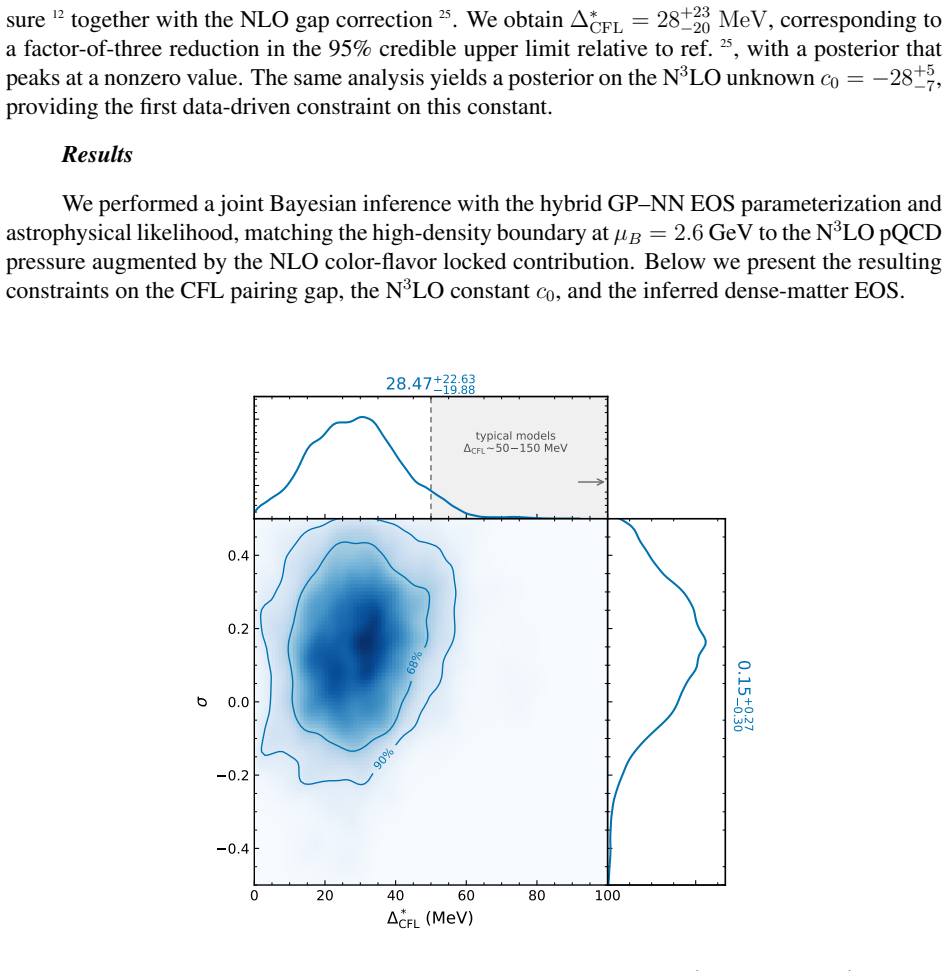
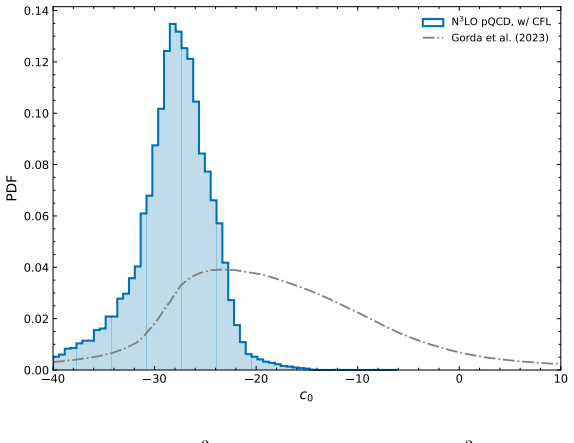
Matching a Gaussian-process-plus-neural-network equation of state to the pQCD plus CFL prediction at μ_B = 2.6 GeV yields Δ_CFL* = 28^{+23}_{-20} MeV at 90 percent credibility, corresponding to a 95 percent credible upper limit of approximately 51 MeV, together with the bound c0 = -28^{+5}_{-7}.
What carries the argument
Bayesian nested sampling of a nonparametric equation of state matched to perturbative QCD with color-flavor locking at fixed chemical potential.
If this is right
- Pairing power corrections contribute at most a few percent to the pressure at μ_B = 2.6 GeV.
- The N3LO constant c0 is bounded to -28^{+5}_{-7}.
- Pairing effects are not a major source of uncertainty for neutron-star matter inference.
- Most microscopic models of the CFL gap are challenged by the tighter bound.
Where Pith is reading between the lines
- Future neutron-star observations could narrow the remaining credible interval on the gap further.
- Microscopic calculations of pairing may need revision to remain consistent with the astrophysical constraint.
- The same matching approach could be extended to other candidate phases of dense matter.
Load-bearing premise
The matching density of 2.6 GeV lies in a regime where both the nonparametric EOS representation and the pQCD plus CFL calculation remain valid without large systematic mismatch.
What would settle it
A microscopic calculation of the CFL gap that consistently yields a value above 51 MeV at μ_B = 2.6 GeV while preserving perturbative convergence would falsify the astrophysical upper limit.
Figures
read the original abstract
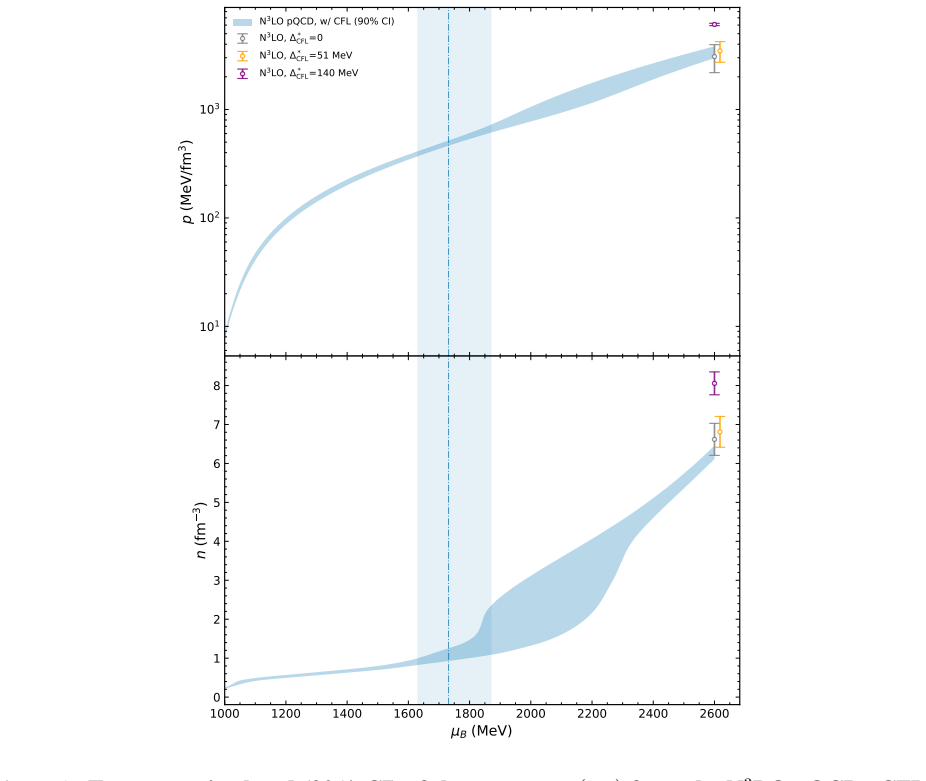
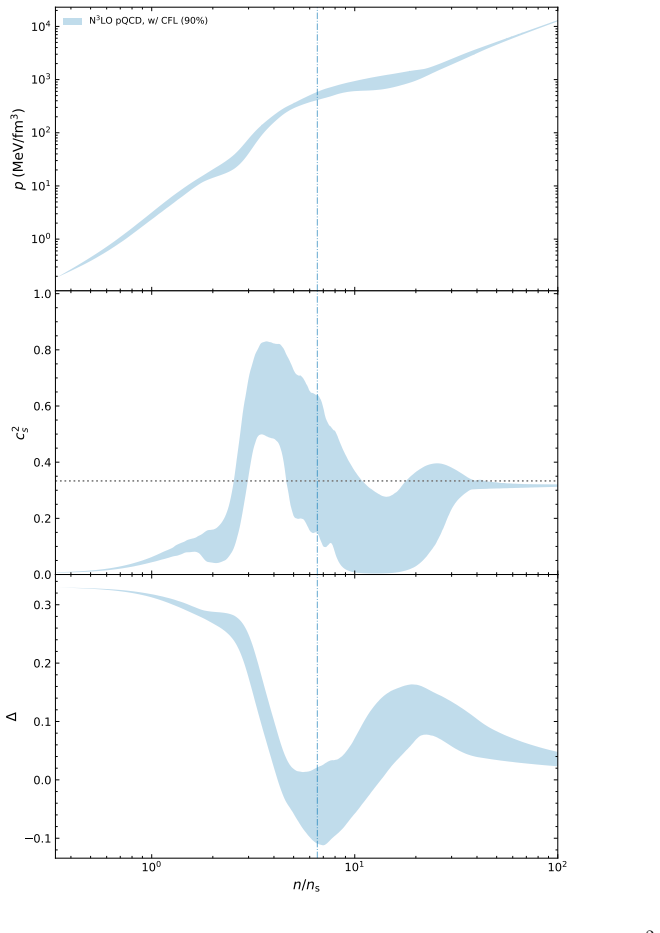
We probe the color-flavor locked (CFL) pairing gap ($\Delta_{\rm CFL}^{*}$) and the unknown N$^3$LO constant $c_0$ in perturbative QCD (pQCD) with Bayesian inference of flexible dense-matter equations of state (EOSs) informed by current astrophysical observations. Our EOS model combines a Gaussian process parameterization with sampled hyperparameters at neutron star densities and a boundary-constrained feed-forward neural network representation extending to pQCD densities, retaining nonparametric flexibility while supporting efficient nested sampling. Matching to the pQCD$+$CFL prediction at $\mu_B=2.6$ GeV, we obtain $\Delta_{\rm CFL}^{*}=28^{+23}_{-20}$ MeV (90% credibility), corresponding to a 95% credible upper limit of $\approx 51$ MeV, which is a factor of $\sim 3$ tighter than previous record and challenges most microscopic models. The pairing power corrections thus contribute at most a few percent at $\mu_B = 2.6~\mathrm{GeV}$, and are not a major source of uncertainty for neutron-star matter inference. We also set a bound on the poorly-known N$^3$LO constant $c_0=-28^{+5}_{-7}$, using a loose prior from convergence analysis of the N$^3$LO pressure.
Editorial analysis
A structured set of objections, weighed in public.
Referee Report
Summary. The paper uses Bayesian inference on a flexible nonparametric EOS model (Gaussian process at neutron-star densities combined with a boundary-constrained neural network at higher densities) informed by astrophysical observations. By matching this EOS to the pQCD+CFL prediction at a fixed μ_B=2.6 GeV, it reports posterior constraints Δ_CFL^*=28^{+23}_{-20} MeV (90% credibility, 95% upper limit ≈51 MeV) and c_0=-28^{+5}_{-7}, claiming a factor-of-∼3 improvement over prior bounds on the gap and that pairing power corrections contribute at most a few percent at the matching density.
Significance. If the matching procedure and model flexibility are free of representation-induced bias, the result would supply substantially tighter empirical limits on the CFL gap than previous work, directly challenging many microscopic pairing calculations, while also bounding the unknown N^3LO coefficient. The nonparametric construction itself is a methodological strength that avoids strong functional assumptions at high density.
major comments (2)
- [Abstract (matching procedure) and associated methods section] The central claim that the reported posteriors on Δ_CFL* and c_0 reflect only physical parameters rests on the assumption that μ_B=2.6 GeV lies in a regime where both the GP+NN representation and the pQCD+CFL calculation are simultaneously valid. Any mismatch at the matching point is absorbed into the inferred gap and c_0; without explicit validation (e.g., recovery tests on mock data generated from known pQCD+CFL EOSs or convergence checks of the NN representation at that density), the posteriors may be systematically biased rather than reflecting the true gap. This is load-bearing for the factor-of-3 tightening claim.
- [Abstract (prior specification) and c_0 inference paragraph] The prior on c_0 is taken from the authors' own convergence analysis of the N^3LO pressure; combined with the use of the same pQCD framework for the CFL matching, this introduces a degree of circularity that is not quantified. The resulting bound on c_0 therefore depends on the internal consistency of the perturbative series rather than being fully independent.
minor comments (1)
- [Abstract] The abstract states the central numerical results but supplies no details on the precise form of the Gaussian-process kernel, the neural-network architecture, the sampling convergence diagnostics, or validation against mock data; these elements should be summarized even in the abstract or immediately referenced.
Simulated Author's Rebuttal
We thank the referee for their careful and constructive review. The comments highlight important aspects of the matching procedure and prior specification that warrant clarification and additional validation. We address each point below and indicate revisions to be incorporated.
read point-by-point responses
-
Referee: [Abstract (matching procedure) and associated methods section] The central claim that the reported posteriors on Δ_CFL* and c_0 reflect only physical parameters rests on the assumption that μ_B=2.6 GeV lies in a regime where both the GP+NN representation and the pQCD+CFL calculation are simultaneously valid. Any mismatch at the matching point is absorbed into the inferred gap and c_0; without explicit validation (e.g., recovery tests on mock data generated from known pQCD+CFL EOSs or convergence checks of the NN representation at that density), the posteriors may be systematically biased rather than reflecting the true gap. This is load-bearing for the factor-of-3 tightening claim.
Authors: We agree that explicit validation is necessary to confirm that the posteriors are not affected by representation mismatch at the matching density. The manuscript emphasizes the nonparametric flexibility of the GP+NN construction and its boundary matching to pQCD, but does not include recovery tests on synthetic data. In the revised version we will add such tests: we will generate mock EOSs from known pQCD+CFL models with fixed input values of Δ_CFL* and c_0, apply the same inference pipeline, and demonstrate recovery of the injected parameters within the reported credible intervals. We will also include additional convergence diagnostics for the NN representation near μ_B=2.6 GeV. These additions will directly support the robustness of the reported constraints. revision: yes
-
Referee: [Abstract (prior specification) and c_0 inference paragraph] The prior on c_0 is taken from the authors' own convergence analysis of the N^3LO pressure; combined with the use of the same pQCD framework for the CFL matching, this introduces a degree of circularity that is not quantified. The resulting bound on c_0 therefore depends on the internal consistency of the perturbative series rather than being fully independent.
Authors: The prior on c_0 is obtained from a separate convergence study of the N^3LO pressure series and is deliberately chosen to be broad. The astrophysical data then constrain the posterior through the requirement that the nonparametric EOS matches the pQCD+CFL prediction at the boundary. While the matching employs the same pQCD framework, the resulting bound on c_0 is informed by the observational likelihood rather than by the prior alone. We acknowledge that full independence from the perturbative framework is not achieved. In the revision we will expand the discussion to quantify the influence of the prior by repeating the inference with a substantially wider prior range and showing that the posterior remains largely unchanged, thereby demonstrating that the constraint is data-driven. revision: partial
Circularity Check
No significant circularity; derivation driven by external astrophysical constraints
full rationale
The paper performs Bayesian inference of nonparametric EOS representations (GP at low density, NN at high density) against astrophysical observations, then matches the resulting EOS to the pQCD+CFL functional form at a fixed μ_B=2.6 GeV to extract posterior constraints on Δ_CFL* and c0. The quoted prior on c0 is described as loose and drawn from a separate convergence analysis of the N³LO pressure series; this is an independent calculation of perturbative behavior and does not reduce the observational inference to a self-referential fit. No step equates a derived quantity to its input by construction, renames a fitted parameter as a prediction, or relies on a load-bearing self-citation whose validity is established only within the present work. The central results therefore remain self-contained against external data.
Axiom & Free-Parameter Ledger
free parameters (1)
- GP and NN hyperparameters
axioms (1)
- domain assumption pQCD+CFL prediction remains valid at μ_B=2.6 GeV
Forward citations
Cited by 1 Pith paper
-
Post-Merger Gravitational-Wave Uncertainties of Binary Neutron Stars under Multi-Messenger EOS Constraints
Multi-messenger constraints shrink the residual uncertainty in post-merger frequency f_{2,mean} to ~100 Hz for fixed mass and compactness, well below the unconstrained range.
Reference graph
Works this paper leans on
-
[1]
& Vuorinen, A
Annala, E., Gorda, T., Kurkela, A., N¨attil¨a, J. & Vuorinen, A. Evidence for quark-matter cores in massive neutron stars.Nature Physics16, 907–910 (2020)
2020
-
[2]
& Rezzolla, L
Altiparmak, S., Ecker, C. & Rezzolla, L. On the Sound Speed in Neutron Stars.Astro- phys. J. Lett.939, L34 (2022)
2022
-
[3]
& Kurkela, A
Gorda, T., Komoltsev, O. & Kurkela, A. Ab-initio QCD Calculations Impact the Inference of the Neutron-star-matter Equation of State.Astrophys. J.950, 107 (2023)
2023
-
[4]
& Fan, Y .-Z
Han, M.-Z., Huang, Y .-J., Tang, S.-P. & Fan, Y .-Z. Plausible presence of new state in neutron stars with masses above 0.98MTOV.Science Bulletin68, 913–919 (2023)
2023
-
[5]
& Rezzolla, L
Jiang, J.-L., Ecker, C. & Rezzolla, L. Bayesian Analysis of Neutron-star Properties with Parameterized Equations of State: The Role of the Likelihood Functions.Astrophys. J.949, 11 (2023)
2023
-
[6]
Annala, E.et al.Strongly interacting matter exhibits deconfined behavior in massive neutron stars.Nature Communications14, 8451 (2023)
2023
-
[7]
& Kaiser, N
Brandes, L., Weise, W. & Kaiser, N. Evidence against a strong first-order phase transition in neutron star cores: Impact of new data.Phys. Rev. D108, 094014 (2023)
2023
-
[8]
& Tang, S.-P
Fan, Y .-Z., Han, M.-Z., Jiang, J.-L., Shao, D.-S. & Tang, S.-P. Maximum gravitational mass MTOV = 2.25 +0.08 −0.07M⊙ inferred at about 3% precision with multimessenger data of neutron stars.Phys. Rev. D109, 043052 (2024)
2024
-
[9]
& Fan, Y .-Z
Tang, S.-P., Huang, Y .-J. & Fan, Y .-Z. Phase transition and nuclear symmetry energy from neutron star observations: Constraints in light of PSR J0614-3329.Phys. Rev. D112, 083009 (2025)
2025
-
[10]
& Sunde, E
Gorda, T., Komoltsev, O., Kurkela, A. & Sunde, E. Constrained Gaussian-process-bridge Prior for Neutron-star Equation-of-state Inference.Astrophys. J.1002, 40 (2026)
2026
-
[11]
Huang, Y .-J., Tang, S.-P. & Fan, Y .-Z. Non-Parametric Equation of State Reveals Non- Conformal Behavior Beyond Neutron Star Densities.arXiv e-printsarXiv:2605.08584 (2026)
Pith/arXiv arXiv 2026
-
[12]
& Sepp¨anen, K
Gorda, T., Paatelainen, R., S ¨appi, S. & Sepp¨anen, K. Equation of State of Cold Quark Matter to O (αs3lnα s).Phys. Rev. Lett.131, 181902 (2023)
2023
-
[13]
& Kurkela, A
Komoltsev, O. & Kurkela, A. How Perturbative QCD Constrains the Equation of State at Neutron-Star Densities.Phys. Rev. Lett.128, 202701 (2022)
2022
-
[14]
& Wilczek, F
Alford, M., Rajagopal, K. & Wilczek, F. QCD at finite baryon density: nucleon droplets and color superconductivity.Physics Letters B422, 247–256 (1998). 13
1998
-
[15]
& Wilczek, F
Alford, M., Rajagopal, K. & Wilczek, F. Color-flavor locking and chiral symmetry breaking in high density QCD.Nuclear Physics B537, 443–458 (1999)
1999
-
[16]
G., Schmitt, A., Rajagopal, K
Alford, M. G., Schmitt, A., Rajagopal, K. & Sch ¨afer, T. Color superconductivity in dense quark matter.Reviews of Modern Physics80, 1455–1515 (2008)
2008
-
[17]
Son, D. T. Superconductivity by long-range color magnetic interaction in high-density quark matter.Phys. Rev. D59, 094019 (1999)
1999
-
[18]
& Velkovsky, M
Rapp, R., Sch ¨afer, T., Shuryak, E. & Velkovsky, M. Diquark Bose Condensates in High Density Matter and Instantons.Phys. Rev. Lett.81, 53–56 (1998)
1998
-
[19]
& Rajagopal, K
Berges, J. & Rajagopal, K. Color superconductivity and chiral symmetry restoration at non- zero baryon density and temperature.Nuclear Physics B538, 215–232 (1999)
1999
-
[20]
Carter, G. W. & Diakonov, D. Light quarks in the instanton vacuum at finite baryon density. Phys. Rev. D60, 016004 (1999)
1999
-
[21]
Baym, G.et al.From hadrons to quarks in neutron stars: a review.Reports on Progress in Physics81, 056902 (2018)
2018
-
[22]
Leonhardt, M.et al.Symmetric Nuclear Matter from the Strong Interaction.Phys. Rev. Lett. 125, 142502 (2020)
2020
-
[23]
& Schallmo, B
Braun, J. & Schallmo, B. From quarks and gluons to color superconductivity at supranuclear densities.Phys. Rev. D105, 036003 (2022)
2022
-
[24]
& Steinhorst, R
Kurkela, A., Rajagopal, K. & Steinhorst, R. Astrophysical Equation-of-State Constraints on the Color-Superconducting Gap.Phys. Rev. Lett.132, 262701 (2024)
2024
-
[25]
& Braun, J
Geißel, A., Gorda, T. & Braun, J. Color Superconductivity under Neutron-Star Conditions at Next-to-Leading Order.Phys. Rev. Lett.135, 211901 (2025)
2025
-
[26]
& Fan, Y .-Z
Han, M.-Z., Jiang, J.-L., Tang, S.-P. & Fan, Y .-Z. Bayesian Nonparametric Inference of the Neutron Star Equation of State via a Neural Network.Astrophys. J.919, 11 (2021)
2021
-
[27]
& Essick, R
Landry, P. & Essick, R. Nonparametric inference of the neutron star equation of state from gravitational wave observations.Phys. Rev. D99, 084049 (2019)
2019
-
[28]
& Holz, D
Essick, R., Landry, P. & Holz, D. E. Nonparametric inference of neutron star composition, equation of state, and maximum mass with GW170817.Phys. Rev. D101, 063007 (2020)
2020
-
[29]
& Chatziioannou, K
Landry, P., Essick, R. & Chatziioannou, K. Nonparametric constraints on neutron star matter with existing and upcoming gravitational wave and pulsar observations.Phys. Rev. D101, 123007 (2020)
2020
-
[30]
Fujimoto, Y ., Fukushima, K., McLerran, L. D. & Praszałowicz, M. Trace Anomaly as Signa- ture of Conformality in Neutron Stars.Phys. Rev. Lett.129, 252702 (2022). 14
2022
-
[31]
Shao, D.-S.et al.Estimating the maximum gravitational mass of nonrotating neutron stars from the GW170817/GRB 170817A/AT2017gfo observation.Phys. Rev. D101, 063029 (2020)
2020
-
[32]
Zhang, S.et al.The enhanced X-ray Timing and Polarimetry mission—eXTP.Science China Physics, Mechanics, and Astronomy62, 29502 (2019)
2019
-
[33]
L.et al.Dense matter with eXTP.Science China Physics, Mechanics, and Astron- omy62, 29503 (2019)
Watts, A. L.et al.Dense matter with eXTP.Science China Physics, Mechanics, and Astron- omy62, 29503 (2019)
2019
-
[34]
Li, A.et al.Dense matter in neutron stars with eXTP.Science China Physics, Mechanics, and Astronomy68, 119503 (2025)
2025
-
[35]
Tolman, R. C. Static Solutions of Einstein’s Field Equations for Spheres of Fluid.Physical Review55, 364–373 (1939)
1939
-
[36]
Oppenheimer, J. R. & V olkoff, G. M. On Massive Neutron Cores.Physical Review55, 374– 381 (1939)
1939
-
[37]
Fritsch, F. N. & Carlson, R. E. Monotone Piecewise Cubic Interpolation.SIAM Journal on Numerical Analysis17, 238–246 (1980)
1980
-
[38]
& Haensel, P
Douchin, F. & Haensel, P. A unified equation of state of dense matter and neutron star struc- ture.A&A380, 151–167 (2001)
2001
-
[39]
& Schwenk, A
Drischler, C., Hebeler, K. & Schwenk, A. Chiral Interactions up to Next-to-Next-to-Next-to- Leading Order and Nuclear Saturation.Phys. Rev. Lett.122, 042501 (2019)
2019
-
[40]
Papaspiliopoulos, O., Roberts, G. O. & Sk ¨old, M. A General Framework for the Parametriza- tion of Hierarchical Models.Statistical Science22, 00014 (2007)
2007
-
[41]
Amsler, C.et al.Review of Particle Physics.Physics Letters B667, 1–6 (2008)
2008
-
[42]
& Lasky, P
Hernandez Vivanco, F., Smith, R., Thrane, E. & Lasky, P. D. A scalable random forest regres- sor for combining neutron-star equation of state measurements: a case study with GW170817 and GW190425.MNRAS499, 5972–5977 (2020)
2020
-
[43]
P.et al.Properties of the Binary Neutron Star Merger GW170817.Physical Review X9, 011001 (2019)
Abbott, B. P.et al.Properties of the Binary Neutron Star Merger GW170817.Physical Review X9, 011001 (2019)
2019
-
[44]
J.961, 62 (2024)
Vinciguerra, S.et al.An Updated Mass-Radius Analysis of the 2017-2018 NICER Data Set of PSR J0030+0451.Astrophys. J.961, 62 (2024)
2017
-
[45]
J.966, 98 (2024)
Luo, C.-N.et al.Bulk Properties of PSR J0030+0451 Inferred with the Compactness Mea- surement of NICER.Astrophys. J.966, 98 (2024)
2024
-
[46]
J.974, 294 (2024)
Salmi, T.et al.The Radius of the High-mass Pulsar PSR J0740+6620 with 3.6 yr of NICER Data.Astrophys. J.974, 294 (2024). 15
2024
-
[47]
Choudhury, D.et al.A NICER View of the Nearest and Brightest Millisecond Pulsar: PSR J0437–4715.Astrophys. J. Lett.971, L20 (2024)
2024
-
[48]
J.995, 60 (2025)
Mauviard, L.et al.A NICER View of the 1.4 M ⊙ Edge-on Pulsar PSR J0614-3329.Astro- phys. J.995, 60 (2025)
2025
-
[49]
Speagle, J. S. DYNESTY: a dynamic nested sampling package for estimating Bayesian poste- riors and evidences.MNRAS493, 3132–3158 (2020). 16 Supplementary Information This Supplementary Information collects the supplemental posterior distributions referenced in the main text for the fiducial N3LO pQCD+CFL inference. Mass-radius posterior.Supplementary Figu...
2020
discussion (0)
Sign in with ORCID, Apple, or X to comment. Anyone can read and Pith papers without signing in.