Minimal superfluid vortices in chiral perturbation theory
Pith reviewed 2026-06-28 05:53 UTC · model grok-4.3
The pith
In the pion condensed phase, rotational vortices nucleate above a critical frequency, carry quantized angular momentum, and self-confine pions.
A machine-rendered reading of the paper's core claim, the machinery that carries it, and where it could break.
Core claim
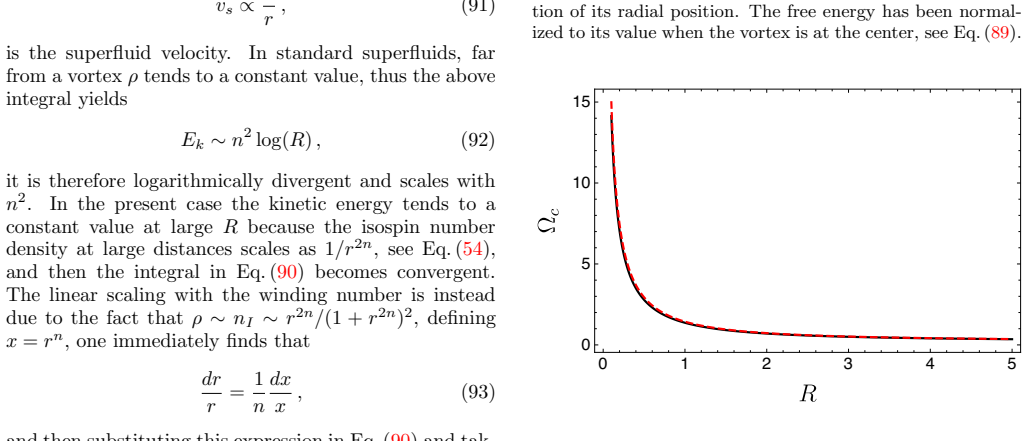
Employing leading order chiral perturbation theory, the minimal energy condition for vortex nucleation in the pion condensed phase is determined. The vortices possess quantized angular momentum along the rotation axis, serving as a hallmark of superfluidity, and they self-confine pions. An estimate is provided for the critical rotation frequency at which these vortices nucleate.
What carries the argument
Minimal-energy vortex solutions obtained from the leading-order chiral Lagrangian in a rotating frame, which enforce quantized circulation and produce pion self-confinement.
If this is right
- Vortices appear only when the system's rotation exceeds the estimated critical frequency.
- Angular momentum along the axis is quantized in discrete units.
- Pions are localized inside the vortex cores rather than distributed uniformly.
- The energy per unit length reaches a minimum at specific radial profiles fixed by the chiral Lagrangian.
Where Pith is reading between the lines
- The result supplies a concrete mechanism by which superfluidity can appear inside a pion condensate described solely by chiral perturbation theory.
- If realized in neutron-star interiors, the vortices would alter the star's rotational dynamics once the critical frequency is reached.
- Analogous vortex nucleation could be sought in laboratory systems that mimic pion condensation, such as certain cold-atom or heavy-ion setups.
Load-bearing premise
Leading order chiral perturbation theory is accurate enough to locate the lowest-energy vortex states and the critical nucleation frequency.
What would settle it
A direct computation or measurement that finds the critical rotation frequency for vortex formation to be substantially different from the value obtained in the leading-order calculation.
Figures
read the original abstract
We derive some properties of rotational vortices in the pion condensed phase. Employing leading order chiral perturbation theory we determine the minimal energy condition for vortex nucleation. Vortices have quantized angular momentum along the rotation axis, an hallmark of superfluidity, and self-confine pions. The critical rotation frequency for vortex nucleation is estimated.
Editorial analysis
A structured set of objections, weighed in public.
Referee Report
Summary. The manuscript derives properties of rotational vortices in the pion-condensed phase of QCD matter. Using leading-order chiral perturbation theory, it determines the minimal-energy condition for vortex nucleation, shows that vortices carry quantized angular momentum along the rotation axis (a hallmark of superfluidity), demonstrates that the vortices self-confine pions, and provides an estimate of the critical rotation frequency required for nucleation.
Significance. If the central results hold, the work supplies a controlled effective-theory prediction for superfluid vortex formation in a pion condensate, which is potentially relevant to the equation of state of rotating neutron-star matter or to rotating QCD matter created in heavy-ion collisions. The manuscript employs a standard low-energy framework and reports a parameter-free derivation of the quantization condition.
major comments (2)
- [Abstract and §2] Abstract and §2: the quantitative estimate of the critical rotation frequency rests on the assumption that leading-order chiral perturbation theory suffices to locate the minimal-energy vortex configuration. No explicit assessment of the chiral expansion parameter (condensate scale relative to the chiral scale) or comparison with next-to-leading-order corrections is provided; an O(1) shift in the energy balance would invalidate the reported threshold.
- [§3, Eq. (minimal-energy condition)] §3, Eq. (minimal-energy condition): the derivation of the minimal-energy vortex state is presented at leading order only; without an accompanying error estimate or demonstration that higher-order terms do not alter the ordering of the rotating superfluid versus vortex energies, the nucleation criterion cannot be regarded as robust.
minor comments (2)
- Notation for the pion condensate and the rotation vector should be introduced once and used consistently; several symbols appear without prior definition in the early sections.
- Figure captions (if present) should explicitly state the values of the pion mass and chemical potential used in the numerical examples.
Simulated Author's Rebuttal
We thank the referee for the careful review and for identifying the need to clarify the robustness of our leading-order results. We address each major comment below and will revise the manuscript to incorporate additional discussion on the chiral expansion.
read point-by-point responses
-
Referee: [Abstract and §2] Abstract and §2: the quantitative estimate of the critical rotation frequency rests on the assumption that leading-order chiral perturbation theory suffices to locate the minimal-energy vortex configuration. No explicit assessment of the chiral expansion parameter (condensate scale relative to the chiral scale) or comparison with next-to-leading-order corrections is provided; an O(1) shift in the energy balance would invalidate the reported threshold.
Authors: We agree that the reported critical frequency is a leading-order estimate and that an explicit assessment of higher-order effects would strengthen the quantitative claim. The work focuses on the minimal configuration and superfluid properties within leading-order chiral perturbation theory. In the revision we will add a paragraph in §2 that discusses the relevant chiral expansion parameter in the pion-condensed phase (set by the ratio of the pion mass to the chiral scale) and provides a power-counting estimate of the expected size of next-to-leading-order corrections to the energy balance. A complete next-to-leading-order calculation lies beyond the present scope. revision: yes
-
Referee: [§3, Eq. (minimal-energy condition)] §3, Eq. (minimal-energy condition): the derivation of the minimal-energy vortex state is presented at leading order only; without an accompanying error estimate or demonstration that higher-order terms do not alter the ordering of the rotating superfluid versus vortex energies, the nucleation criterion cannot be regarded as robust.
Authors: The minimal-energy condition is derived at leading order, consistent with the paper's focus on establishing the leading behavior of the vortex configuration. We will revise §3 to include an explicit caveat stating that higher-order terms could shift the precise energy ordering and therefore the critical frequency, while the quantization of angular momentum and the self-confinement mechanism remain robust features at this order. A full demonstration that next-to-leading-order contributions preserve the ordering would require an explicit next-to-leading-order computation, which we note as future work. revision: partial
Circularity Check
No circularity: derivation applies standard LO ChPT without self-referential reduction
full rationale
The paper states it employs leading-order chiral perturbation theory to determine the minimal energy condition for vortex nucleation and estimate the critical rotation frequency. No equations or steps in the provided abstract reduce a claimed prediction to a fitted parameter by construction, invoke self-citations as load-bearing uniqueness theorems, or rename known results via new coordinates. The framework is presented as an external effective theory applied to the rotating pion-condensed phase, rendering the central claims independent of the target quantities.
Axiom & Free-Parameter Ledger
axioms (1)
- domain assumption Leading order chiral perturbation theory suffices for the vortex energy calculation
Forward citations
Cited by 1 Pith paper
-
Semiclassical decay of de Sitter space into black holes with vortex-deformed horizons
De Sitter space decays into vortex-dressed black holes via a regular Euclidean instanton that generalizes the Nariai solution, with rates organized by topological charge of the vortices.
Reference graph
Works this paper leans on
-
[1]
Shuryak, Strongly coupled quark-gluon plasma in heavy ion collisions, Rev
E. Shuryak, Strongly coupled quark-gluon plasma in heavy ion collisions, Rev. Mod. Phys.89, 035001 (2017), arXiv:1412.8393 [hep-ph]
Pith/arXiv arXiv 2017
-
[2]
R. Pasechnik and M. ˇSumbera, Phenomenological Re- view on Quark–Gluon Plasma: Concepts vs. Observa- tions, Universe3, 7 (2017), arXiv:1611.01533 [hep-ph]
Pith/arXiv arXiv 2017
-
[3]
W. Busza, K. Rajagopal, and W. van der Schee, Heavy Ion Collisions: The Big Picture, and the Big Questions, Ann. Rev. Nucl. Part. Sci.68, 339 (2018), arXiv:1802.04801 [hep-ph]
Pith/arXiv arXiv 2018
- [4]
-
[5]
K. Yagi, T. Hatsuda, and Y. Miake,Quark-Gluon Plasma(Cambridge University Press, 2005)
2005
-
[6]
J. B. Kogut and M. A. Stephanov,The phases of quan- tum chromodynamics: From confinement to extreme en- vironments, Vol. 21 (Cambridge University Press, 2004)
2004
-
[7]
Brambillaet al., QCD and Strongly Coupled Gauge Theories: Challenges and Perspectives, Eur
N. Brambillaet al., QCD and Strongly Coupled Gauge Theories: Challenges and Perspectives, Eur. Phys. J. C 74, 2981 (2014), arXiv:1404.3723 [hep-ph]
Pith/arXiv arXiv 2014
-
[8]
Pisarski, Three Lectures on QCD Phase Transitions, Lect
R. Pisarski, Three Lectures on QCD Phase Transitions, Lect. Notes Phys.999, 89 (2022)
2022
-
[9]
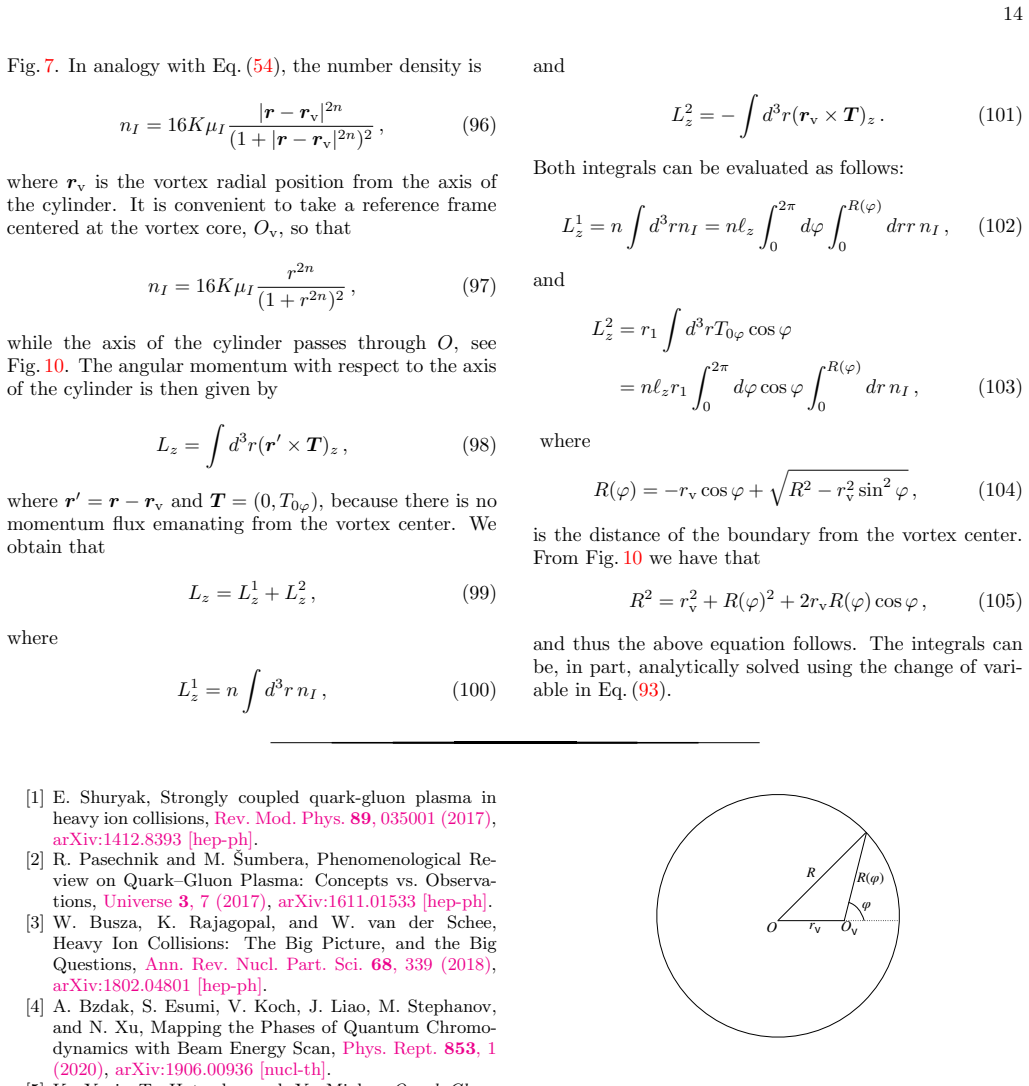
L. McLerran and R. D. Pisarski, Phases of cold, dense quarks at large N(c), Nucl.Phys.A796, 83 (2007), arXiv:0706.2191 [hep-ph]; Y. Hidaka, L. D. McLerran, and R. D. Pisarski, Baryons and the phase diagram for a large number of colors and flavors, Nucl. Phys. A808, OvO φ R(φ)R rv FIG. 10. Two-dimensional projection of the cylindrical sys- tem useful for t...
Pith/arXiv arXiv 2007
-
[10]
M. G. Alford, K. Rajagopal, and F. Wilczek, QCD at finite baryon density: Nucleon droplets and color super- conductivity, Phys.Lett.B422, 247 (1998), arXiv:hep- ph/9711395 [hep-ph]
arXiv 1998
-
[11]
K. Rajagopal and F. Wilczek, The condensed matter physics of qcd, inAt the Frontier of Particle Physics: 15 Handbook of QCD, edited by M. Shifman (World Sci- entific, Singapore, 2001) pp. 2061–2151, arXiv:hep- ph/0011333 [hep-ph]
arXiv 2001
-
[12]
M. G. Alford, A. Schmitt, K. Rajagopal, and T. Schafer, Color superconductivity in dense quark matter, Rev. Mod. Phys.80, 1455 (2008), arXiv:0709.4635 [hep-ph]
Pith/arXiv arXiv 2008
-
[13]
R. Anglani, R. Casalbuoni, M. Ciminale, N. Ippolito, R. Gatto,et al., Crystalline color superconductors, Rev. Mod. Phys.86, 509 (2014), arXiv:1302.4264 [hep-ph]
Pith/arXiv arXiv 2014
-
[14]
Y. Aoki, G. Endrodi, Z. Fodor, S. D. Katz, and K. K. Sz- abo, The Order of the quantum chromodynamics transi- tion predicted by the standard model of particle physics, Nature443, 675 (2006), arXiv:hep-lat/0611014
Pith/arXiv arXiv 2006
-
[15]
Bhattacharyaet al., QCD Phase Transition with Chi- ral Quarks and Physical Quark Masses, Phys
T. Bhattacharyaet al., QCD Phase Transition with Chi- ral Quarks and Physical Quark Masses, Phys. Rev. Lett. 113, 082001 (2014), arXiv:1402.5175 [hep-lat]
Pith/arXiv arXiv 2014
-
[16]
Nagata, Finite-density lattice QCD and sign prob- lem: Current status and open problems, Prog
K. Nagata, Finite-density lattice QCD and sign prob- lem: Current status and open problems, Prog. Part. Nucl. Phys.127, 103991 (2022), arXiv:2108.12423 [hep- lat]
arXiv 2022
-
[17]
N. Y. Astrakhantsev, V. V. Braguta, N. V. Kolomoyets, A. Y. Kotov, D. D. Kuznedelev, A. A. Nikolaev, and A. Roenko, Lattice Study of QCD Properties under Ex- treme Conditions: Temperature, Density, Rotation, and Magnetic Field, Phys. Part. Nucl.52, 536 (2021)
2021
-
[18]
N. Astrakhantsev, V. Braguta, M. Cardinali, M. D’Elia, L. Maio, F. Sanfilippo, A. Trunin, and A. Vasiliev, Elec- tromagnetic conductivity of quark-gluon plasma at non- zero baryon density, PoSLATTICE2021, 119 (2022), arXiv:2110.10727 [hep-lat]
arXiv 2022
-
[19]
B. B. Brandt, F. Cuteri, G. Endr˝ odi, G. Mark´ o, L. Sandbote, and A. D. M. Valois, Thermal QCD in a non-uniform magnetic background, JHEP11(229), arXiv:2305.19029 [hep-lat]
-
[20]
K. Yagi, T. Hatsuda, and Y. Miake,Quark-gluon plasma: From big bang to little bang, Vol. 23 (Cambridge University Press, 2005)
2005
-
[21]
de Forcrand, Simulating QCD at finite density, PoS LAT2009, 010 (2009), arXiv:1005.0539 [hep-lat]
P. de Forcrand, Simulating QCD at finite density, PoS LAT2009, 010 (2009), arXiv:1005.0539 [hep-lat]
Pith/arXiv arXiv 2009
-
[22]
M. G. Alford, A. Kapustin, and F. Wilczek, Imagi- nary chemical potential and finite fermion density on the lattice, Phys. Rev.D 59, 054502 (1999), arXiv:hep- lat/9807039 [hep-lat]
arXiv 1999
-
[23]
A. B. Migdal, Stability of vacuum and limiting fields, Zh. Eksp. Teor. Fiz.61, 2209 (1971)
1971
-
[24]
A. B. Migdal, Vacuum stability and limiting fields, So- viet Physics Uspekhi14, 813 (1972)
1972
-
[25]
R. F. Sawyer, Condensed pi- phase in neutron star mat- ter, Phys. Rev. Lett.29, 382 (1972)
1972
-
[26]
D. J. Scalapino, Pi- condensate in dense nuclear matter, Phys. Rev. Lett.29, 386 (1972)
1972
-
[27]
Kogut and J
J. Kogut and J. T. Manassah,π −condensation and neu- tron star cooling, Phys. Lett.A 41, 129 (1972)
1972
-
[28]
Mannarelli, Meson Condensation, Particles2, 411 (2019), arXiv:1908.02042 [hep-ph]
M. Mannarelli, Meson Condensation, Particles2, 411 (2019), arXiv:1908.02042 [hep-ph]
arXiv 2019
-
[29]
Baym and D
G. Baym and D. K. Campbell, CHIRAL SYMMETRY AND PION CONDENSATION (1978)
1978
-
[30]
D. B. Kaplan and A. E. Nelson, Strange Goings on in Dense Nucleonic Matter, Phys. Lett. B175, 57 (1986)
1986
-
[31]
Dominguez, M
C. Dominguez, M. Loewe, and J. Rojas, Pion and nucleon thermal widths in the linear sigma model, Phys.Lett.B320, 377 (1994)
1994
- [32]
-
[33]
J. Kogut and D. Toublan, QCD at small nonzero quark chemical potentials, Phys. Rev.D 64, 034007 (2001), arXiv:hep-ph/0103271 [hep-ph]
Pith/arXiv arXiv 2001
-
[34]
M. C. Birse, T. D. Cohen, and J. A. McGovern, Phases of QCD with nonvanishing isospin density, Phys. Lett. B516, 27 (2001), arXiv:hep-ph/0104282
Pith/arXiv arXiv 2001
-
[35]
K. Splittorff, D. Toublan, and J. J. M. Verbaarschot, Thermodynamics of chiral symmetry at low densities, Nucl. Phys. B639, 524 (2002), arXiv:hep-ph/0204076
Pith/arXiv arXiv 2002
-
[36]
M. Loewe and C. Villavicencio, Thermal pions at fi- nite isospin chemical potential, Phys.Rev.D67, 074034 (2003), arXiv:hep-ph/0212275 [hep-ph]
Pith/arXiv arXiv 2003
-
[37]
M. Loewe and C. Villavicencio, Thermal pion masses in the second phase:|mu(I)|> m(pi), Phys.Rev.D70, 074005 (2004), arXiv:hep-ph/0404232 [hep-ph]
Pith/arXiv arXiv 2004
-
[38]
M. Loewe and C. Villavicencio, Pion stability in a hot dense media, arXiv e-Print (2011), arXiv:1107.3859 [hep-ph]
Pith/arXiv arXiv 2011
-
[39]
A. Mammarella and M. Mannarelli, Intriguing aspects of meson condensation, Phys. Rev.D 92, 085025 (2015), arXiv:1507.02934 [hep-ph]
Pith/arXiv arXiv 2015
-
[40]
S. Carignano, A. Mammarella, and M. Mannarelli, Equation of state of imbalanced cold matter from chiral perturbation theory, Phys. Rev.D 93, 051503 (2016), arXiv:1602.01317 [hep-ph]
Pith/arXiv arXiv 2016
-
[41]
M. Loewe, A. Raya, and C. Villavicencio, Metastable pions in dense media, Phys. Rev. D95, 096013 (2017), arXiv:1610.05751 [hep-ph]
Pith/arXiv arXiv 2017
-
[42]
S. Carignano, L. Lepori, A. Mammarella, M. Mannarelli, and G. Pagliaroli, Scrutinizing the pion condensed phase, Eur. Phys. J.A 53, 35 (2017), arXiv:1610.06097 [hep-ph]
Pith/arXiv arXiv 2017
-
[43]
L. Lepori and M. Mannarelli, Multicomponent meson superfluids in chiral perturbation theory, Phys. Rev. D 99, 096011 (2019), arXiv:1901.07488 [hep-ph]
Pith/arXiv arXiv 2019
-
[44]
P. Adhikari, J. O. Andersen, and P. Kneschke, Two- flavor chiral perturbation theory at nonzero isospin: Pion condensation at zero temperature, Eur. Phys. J. C79, 874 (2019), arXiv:1904.03887 [hep-ph]
arXiv 2019
-
[45]
A. N. Tawfik, A. M. Diab, M. T. Ghoneim, and H. An- wer, SU(3) Polyakov Linear-Sigma Model With Finite Isospin Asymmetry: QCD Phase Diagram, Int. J. Mod. Phys. A34, 1950199 (2019), arXiv:1904.09890 [hep-ph]
arXiv 2019
-
[46]
I. N. Mishustin, D. V. Anchishkin, L. M. Satarov, O. S. Stashko, and H. Stoecker, Condensation of interacting scalar bosons at finite temperatures, Phys. Rev. C100, 022201 (2019), arXiv:1905.09567 [nucl-th]
arXiv 2019
-
[47]
Barducci, R
A. Barducci, R. Casalbuoni, S. De Curtis, R. Gatto, and G. Pettini, Pion Decay Constant at Finite Temperature and Density, Phys. Rev.D 42, 1757 (1990)
1990
-
[48]
D. Toublan and J. Kogut, Isospin chemical potential and the QCD phase diagram at nonzero temperature and baryon chemical potential, Phys. Lett.B 564, 212 (2003), arXiv:hep-ph/0301183 [hep-ph]
Pith/arXiv arXiv 2003
-
[49]
A. Barducci, R. Casalbuoni, G. Pettini, and L. Ravagli, A Calculation of the QCD phase diagram at finite tem- perature, and baryon and isospin chemical potentials, Phys. Rev.D 69, 096004 (2004), arXiv:hep-ph/0402104 [hep-ph]
Pith/arXiv arXiv 2004
-
[50]
A. Barducci, R. Casalbuoni, G. Pettini, and L. Ravagli, Pion and kaon condensation in a 3-flavor NJL model, Phys. Rev.D 71, 016011 (2005), arXiv:hep-ph/0410250 [hep-ph]. 16
Pith/arXiv arXiv 2005
-
[51]
L.-Y. He, M. Jin, and P.-F. Zhuang, Pion superfluid- ity and meson properties at finite isospin density, Phys. Rev.D 71, 116001 (2005), arXiv:hep-ph/0503272 [hep- ph]
Pith/arXiv arXiv 2005
-
[52]
D. Ebert and K. G. Klimenko, Gapless pion condensa- tion in quark matter with finite baryon density, J. Phys. G 32, 599 (2006), arXiv:hep-ph/0507007 [hep-ph]
Pith/arXiv arXiv 2006
-
[53]
D. Ebert and K. G. Klimenko, Pion condensation in electrically neutral cold matter with finite baryon density, Eur. Phys. J.C 46, 771 (2006), arXiv:hep- ph/0510222 [hep-ph]
arXiv 2006
-
[54]
S. Mukherjee, M. G. Mustafa, and R. Ray, Thermody- namics of the PNJL model with nonzero baryon and isospin chemical potentials, Phys. Rev. D75, 094015 (2007), arXiv:hep-ph/0609249
Pith/arXiv arXiv 2007
-
[55]
L. He and P. Zhuang, Phase structure of Nambu-Jona- Lasinio model at finite isospin density, Phys. Lett. B 615, 93 (2005), arXiv:hep-ph/0501024
Pith/arXiv arXiv 2005
-
[56]
L. He, M. Jin, and P. Zhuang, Pion Condensation in Baryonic Matter: from Sarma Phase to Larkin- Ovchinnikov-Fudde-Ferrell Phase, Phys. Rev. D74, 036005 (2006), arXiv:hep-ph/0604224
Pith/arXiv arXiv 2006
-
[57]
G.-f. Sun, L. He, and P. Zhuang, BEC-BCS crossover in the Nambu-Jona-Lasinio model of QCD, Phys. Rev. D 75, 096004 (2007), arXiv:hep-ph/0703159
Pith/arXiv arXiv 2007
-
[58]
J. O. Andersen and L. Kyllingstad, Pion Condensation in a two-flavor NJL model: the role of charge neutrality, J. Phys. G37, 015003 (2009), arXiv:hep-ph/0701033
Pith/arXiv arXiv 2009
-
[59]
H. Abuki, M. Ciminale, R. Gatto, N. D. Ippolito, G. Nardulli, and M. Ruggieri, Electrical neutrality and pion modes in the two flavor PNJL model, Phys. Rev. D78, 014002 (2008), arXiv:0801.4254 [hep-ph]
Pith/arXiv arXiv 2008
-
[60]
H. Abuki, R. Anglani, R. Gatto, M. Pellicoro, and M. Ruggieri, The Fate of pion condensation in quark matter: From the chiral to the real world, Phys. Rev. D 79, 034032 (2009), arXiv:0809.2658 [hep-ph]
Pith/arXiv arXiv 2009
-
[61]
Mu, L.-y
C.-f. Mu, L.-y. He, and Y.-x. Liu, Evaluating the phase diagram at finite isospin and baryon chemical potentials in the Nambu-Jona-Lasinio model, Phys. Rev. D82, 056006 (2010)
2010
-
[62]
T. Xia, L. He, and P. Zhuang, Three-flavor Nambu–Jona-Lasinio model at finite isospin chem- ical potential, Phys. Rev. D88, 056013 (2013), arXiv:1307.4622 [hep-ph]
Pith/arXiv arXiv 2013
-
[63]
T. Xia and P. Zhuang, Quark-antiquark scattering phase shift and meson spectral function in pion super- fluid, Chinese Physics C (2014), arXiv:1411.6713 [hep- ph]
Pith/arXiv arXiv 2014
-
[64]
J. Chao, M. Huang, and A. Radzhabov, Charged pion condensation in anti-parallel electromagnetic fields and nonzero isospin density, Chin. Phys. C44, 034105 (2020), arXiv:1805.00614 [hep-ph]
Pith/arXiv arXiv 2020
-
[65]
T. G. Khunjua, K. G. Klimenko, and R. N. Zhokhov, Chiral imbalanced hot and dense quark matter: NJL analysis at the physical point and comparison with lattice QCD, Eur. Phys. J. C79, 151 (2019), arXiv:1812.00772 [hep-ph]
Pith/arXiv arXiv 2019
-
[66]
T. G. Khunjua, K. G. Klimenko, and R. N. Zhokhov, Dualities and inhomogeneous phases in dense quark matter with chiral and isospin imbalances in the framework of effective model, JHEP06, 006, arXiv:1901.02855 [hep-ph]
Pith/arXiv arXiv 1901
-
[67]
T. Khunjua, K. Klimenko, and R. Zhokhov, Charged Pion Condensation in Dense Quark Mat- ter: Nambu–Jona-Lasinio Model Study, Symmetry11, 778 (2019), arXiv:1912.08635 [hep-ph]
arXiv 2019
-
[68]
S. S. Avancini, A. Bandyopadhyay, D. C. Duarte, and R. L. S. Farias, Cold QCD at finite isospin density: con- fronting effective models with recent lattice data, Phys. Rev. D100, 116002 (2019), arXiv:1907.09880 [hep-ph]
arXiv 2019
- [69]
-
[70]
J. P. Carlomagno, D. Gomez Dumm, and N. N. Scoc- cola, Cold isospin asymmetric baryonic rich matter in nonlocal NJL-like models, Phys. Rev. D109, 094041 (2024), arXiv:2402.13842 [hep-ph]
arXiv 2024
-
[71]
S. P. Klevansky, The Nambu-Jona-Lasinio model of quantum chromodynamics, Rev. Mod. Phys.64, 649 (1992)
1992
-
[72]
J. O. Andersen, W. R. Naylor, and A. Tranberg, Phase diagram of QCD in a magnetic field: A review, Rev. Mod. Phys.88, 025001 (2016), arXiv:1411.7176 [hep- ph]
Pith/arXiv arXiv 2016
-
[73]
P. Adhikari, J. O. Andersen, and P. Kneschke, On-shell parameter fixing in the quark-meson model, Phys. Rev. D 95, 036017 (2017), arXiv:1612.03668 [hep-ph]
Pith/arXiv arXiv 2017
-
[74]
P. Adhikari, J. O. Andersen, and P. Kneschke, Pion condensation and phase diagram in the Polyakov-loop quark-meson model, Phys. Rev.D 98, 074016 (2018), arXiv:1805.08599 [hep-ph]
Pith/arXiv arXiv 2018
-
[75]
J. O. Andersen and P. Kneschke, Chiral density wave versus pion condensation at finite density and zero temperature, Phys. Rev. D97, 076005 (2018), arXiv:1802.01832 [hep-ph]
Pith/arXiv arXiv 2018
-
[76]
J. O. Andersen, P. Adhikari, and P. Kneschke, Pion condensation and QCD phase diagram at finite isospin density, PoSConfinement2018, 197 (2019), arXiv:1810.00419 [hep-ph]
Pith/arXiv arXiv 2019
-
[77]
B. B. Brandt, V. Chelnokov, G. Endrodi, G. Marko, D. Scheid, and L. von Smekal, Renormalization group invariant mean-field model for QCD at finite isospin density, Phys. Rev. D112, 054038 (2025), arXiv:2502.04025 [hep-ph]
arXiv 2025
- [78]
- [79]
-
[80]
A. Barducci, G. Pettini, L. Ravagli, and R. Casalbuoni, Ladder QCD at finite isospin chemical potential, Phys. Lett. B564, 217 (2003), arXiv:hep-ph/0304019
Pith/arXiv arXiv 2003
discussion (0)
Sign in with ORCID, Apple, or X to comment. Anyone can read and Pith papers without signing in.