Decoded Quantum Interferometry Beyond Hamming: Rank-Metric and Translation Association Schemes
Pith reviewed 2026-06-28 06:00 UTC · model grok-4.3
The pith
Decoded Quantum Interferometry extends to translation association schemes by reducing state biasing to a finite tridiagonal eigenvalue problem.
A machine-rendered reading of the paper's core claim, the machinery that carries it, and where it could break.
Core claim
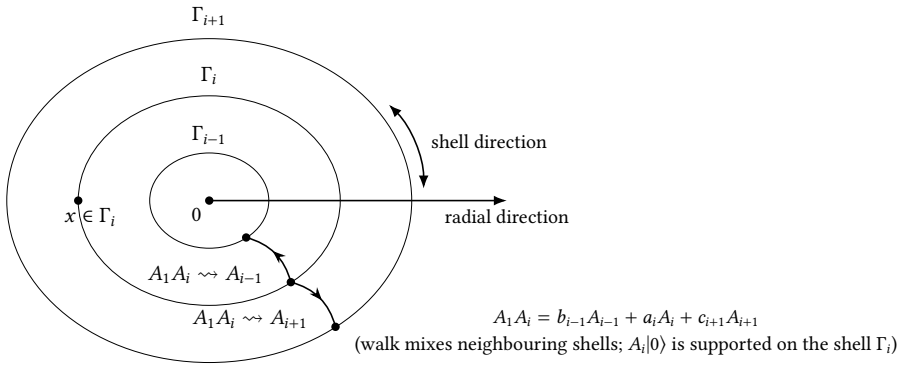
In translation association schemes the DQI state is described by one amplitude per distance shell from a basepoint; biasing toward high-quality solutions therefore becomes the ground state of a finite tridiagonal matrix whose entries are determined by the scheme parameters. For the rank-metric objective the protocol prepares a uniform superposition over fixed-rank matrices and applies Gabidulin-code decoding up to cutoff l, yielding outputs whose effective-rank proxy lies near min(m,n)-l and whose expected score implies a constant-probability upper bound on the residual rank of a single sample.
What carries the argument
Translation association schemes, geometries in which points are partitioned into shells by distance from a fixed basepoint, so that the quantum state is fully described by one complex amplitude per shell.
If this is right
- Solutions are obtained with effective-rank proxy near min(m,n)-l.
- The expected score converts into a constant-probability bound on residual rank of a sampled matrix.
- For Gabidulin nearest-codeword instances the covering-radius obstruction blocks any additive optimality guarantee.
- The protocol supplies the geometric and coding ingredients needed to run DQI on objectives defined by translation association schemes.
Where Pith is reading between the lines
- The same shell-amplitude reduction may let DQI address other optimization problems whose feasible sets carry translation symmetry.
- Because the tridiagonal matrix is small when the number of shells is modest, the biasing step remains classically tractable even for moderately large geometries.
- The rank-metric example suggests that other association schemes with efficient decoders could be turned into DQI instances for combinatorial search tasks.
Load-bearing premise
Gabidulin codes supply efficient low-rank decoding up to cutoff l and the covering-radius obstruction does not invalidate the protocol's utility for identifying the required geometric and coding ingredients.
What would settle it
A concrete numerical check showing that the ground state of the tridiagonal eigenvalue problem for a given translation association scheme fails to produce any matrix whose rank difference to the target is smaller than the classical greedy minimum.
Figures
read the original abstract
Decoded Quantum Interferometry (DQI) uses coherent decoding and a quantum Fourier transform to find high-quality solutions of structured optimisation problems. Existing analyses are closely tied to Hamming space, which underlies the optimisation objective, Dicke state preparation and the decoding step of the algorithm. Here we extend the core DQI mechanism beyond Hamming space to finite geometries with translation symmetry, where points are grouped into shells by their distance from a basepoint. Mathematically, these geometries are translation association schemes. In this setting the algorithm can be analysed by tracking one amplitude per shell, and biasing the prepared state towards high-quality solutions becomes a finite tridiagonal eigenvalue problem. As a non-Hamming example, we develop an efficient DQI protocol for finding an m x n finite-field matrix with smallest rank difference to a target matrix. Initial states are uniform superpositions over fixed-rank matrices, and Gabidulin codes provide candidates for efficient low-rank decoding up to a cutoff l. For this objective, this finds solutions with an effective-rank proxy near min(m,n)-l, and the corresponding expected score can be converted into a constant-probability bound on the residual rank of a sample. For Gabidulin nearest-codeword instances, a covering-radius obstruction shows that this bound does not imply an additive guarantee for the true optimum, and we do not claim a quantum advantage for the rank-metric construction. The results instead identify the geometric and coding ingredients for DQI beyond Hamming space.
Editorial analysis
A structured set of objections, weighed in public.
Referee Report
Summary. The paper extends Decoded Quantum Interferometry (DQI) from Hamming space to translation association schemes with translation symmetry, where the state biasing step reduces to a finite tridiagonal eigenvalue problem. For the rank-metric problem of finding an m×n matrix over a finite field with minimal rank difference to a target, it constructs initial states as uniform superpositions over fixed-rank matrices, invokes Gabidulin codes for efficient low-rank decoding up to cutoff l, obtains solutions whose effective-rank proxy is near min(m,n)−l, and converts the expected score into a constant-probability bound on residual rank; the manuscript explicitly notes that a covering-radius obstruction blocks any additive optimality guarantee and makes no claim of quantum advantage.
Significance. If the eigenvalue reduction and probability conversion hold, the work supplies a systematic route for applying DQI to geometries beyond Hamming space by exploiting shell structure and translation symmetry, while furnishing a concrete rank-metric example together with the requisite coding ingredients (Gabidulin codes). The explicit acknowledgment of the covering-radius limitation keeps the contribution focused on identifying the necessary geometric and algebraic components rather than overstating performance.
minor comments (2)
- The abstract refers to 'the corresponding expected score can be converted into a constant-probability bound' without indicating the section or lemma that performs the conversion; adding an explicit pointer (e.g., §4.3, Lemma 12) would improve traceability.
- Notation for the tridiagonal matrix arising from the association scheme (eigenvalues, off-diagonal entries) is introduced only in the abstract; a short table or equation block early in §3 would clarify the finite-dimensional reduction for readers unfamiliar with association-scheme theory.
Simulated Author's Rebuttal
We thank the referee for the careful reading, accurate summary of the manuscript, and the positive assessment. The recommendation for minor revision is noted; we will incorporate appropriate changes in the revised version.
Circularity Check
No significant circularity; derivation self-contained
full rationale
The manuscript derives the extension of DQI to translation association schemes by tracking amplitudes per shell and reducing the biasing step to a finite tridiagonal eigenvalue problem that follows directly from the translation symmetry and distance partitioning of the scheme. Gabidulin codes are invoked solely as an external efficient classical decoder up to cutoff l, with no fitted parameters renamed as predictions and no self-citation chain required to justify the core reduction or the effective-rank proxy. The paper explicitly notes the covering-radius obstruction and refrains from optimality claims, keeping all steps independent of the target results. No quoted equation or premise reduces by construction to its own inputs.
Axiom & Free-Parameter Ledger
axioms (2)
- domain assumption Translation association schemes permit reduction of the state to one amplitude per shell
- domain assumption Gabidulin codes admit efficient low-rank decoding up to cutoff l
Forward citations
Cited by 1 Pith paper
-
Approximability limits for bounded-degree max-LINSAT and implications for decoded quantum interferometry
Extends NP-hardness of exceeding r/q + O(1/sqrt(D)) for bounded-degree max-Ek-LINSAT(q,r) over F_q and shows quantum decoding is required for DQI to achieve the hardness-optimal 1/sqrt(D) scaling.
Reference graph
Works this paper leans on
-
[1]
S. P. Jordan, N. Shutty, M. Wootters, A. Zalcman, A. Schmidhuber, R. King, S. V. Isakov, T. Khattar, and R. Babbush, Nature646, 831 (2025)
2025
-
[2]
T. Khattar, N. Shutty, C. Gidney, A. Zalcman, N. Yosri, D. Maslov, R. Babbush, and S. P. Jordan, Verifiable Quantum Advantage via Optimized DQI Circuits (2025), arXiv:2510.10967 [quant-ph]
arXiv 2025
-
[3]
Regev, inProceedings of the Thirty-Seventh Annual ACM Symposium on Theory of Computing, STOC ’05 (Association for Computing Machinery, 2005) p
O. Regev, inProceedings of the Thirty-Seventh Annual ACM Symposium on Theory of Computing, STOC ’05 (Association for Computing Machinery, 2005) p. 84–93
2005
- [4]
-
[5]
Debris-Alazard, M
T. Debris-Alazard, M. Remaud, and J.-P. Tillich, IEEE Trans. Inf. Theor.70, 5323 (2024)
2024
-
[6]
A. Blanvillain, A. Chailloux, and J.-P. Tillich, The Quantum Decoding Problem : Tight Achievability Bounds and Application to Regev’s Reduction (2025), arXiv:2509.24796
arXiv 2025
-
[7]
Roth, IEEE Transactions on Information Theory37, 328 (1991)
R. Roth, IEEE Transactions on Information Theory37, 328 (1991)
1991
-
[8]
Koetter and F
R. Koetter and F. R. Kschischang, IEEE Transactions on Information Theory54, 3579 (2008)
2008
- [9]
-
[10]
E. M. Gabidulin, Problems of Information Transmission21, 1 (1985)
1985
-
[11]
Y. Chen, Q. Liu, and M. Zhandry, inAdvances in Cryptology – EUROCRYPT 2022, edited by O. Dunkel- man and S. Dziembowski (Springer International Publishing, Cham, 2022) pp. 372–401
2022
- [12]
-
[13]
Chailloux and J.-P
A. Chailloux and J.-P. Tillich, in19th Conference on the Theory of Quantum Computation, Commu- nication and Cryptography (TQC 2024), Leibniz International Proceedings in Informatics (LIPIcs), Vol. 310, edited by F. Magniez and A. B. Grilo (Schloss Dagstuhl – Leibniz-Zentrum für Informatik, Dagstuhl, Germany, 2024) pp. 6:1–6:14
2024
-
[14]
A. Rosmanis, A nearly linear-time Decoded Quantum Interferometry algorithm for the Optimal Polynomial Intersection problem (2026), arXiv:2601.15171 [quant-ph]
arXiv 2026
-
[15]
C. Piveteau and J. M. Renes, Efficient and optimal quantum state discrimination via quantum belief propagation (2025), arXiv:2509.19441 [quant-ph]
arXiv 2025
- [16]
-
[17]
K. Bu, W. Gu, and X. Li, Multivariate Decoded Quantum Interferometry for Weighted Optimization (2026), arXiv:2605.10666
Pith/arXiv arXiv 2026
-
[18]
Chailloux and J.-P
A. Chailloux and J.-P. Tillich, inProceedings of the 57th Annual ACM Symposium on Theory of Computing, STOC ’25 (Association for Computing Machinery, New York, NY, USA, 2025) p. 738–749
2025
-
[19]
Chailloux, OPI x Soft Decoders (2025), arXiv:2511.22691
A. Chailloux, OPI x Soft Decoders (2025), arXiv:2511.22691 . 21
arXiv 2025
-
[20]
N. Shutty, A. Mandal, S. Ragavan, Q. Buzet, A. Chailloux, N. C. Rubin, A. Khan, S. Boulebnane, R. Shaydulin, J. Azariah, and S. P. Jordan, Optimization Using Locally-Quantum Decoders (2026), arXiv:2604.24633
Pith/arXiv arXiv 2026
-
[21]
A. Schmidhuber, J. Z. Lu, N. Shutty, S. Jordan, A. Poremba, and Y. Quek, Hamiltonian Decoded Quantum Interferometry (2025), arXiv:2510.07913 [quant-ph]
arXiv 2025
-
[22]
K. Bu, W. Gu, and X. Li, Hamiltonian Decoded Quantum Interferometry for General Pauli Hamil- tonians (2026), arXiv:2601.18773 [quant-ph]
arXiv 2026
-
[23]
P. Wocjan, A Factorization Identity for Twisted Multinomial Coefficients with Application to Pilot States in Hamiltonian Decoded Quantum Interferometry (2026), arXiv:2604.01022
Pith/arXiv arXiv 2026
-
[24]
E. R. Anschuetz, D. Gamarnik, and J. Z. Lu, Decoded Quantum Interferometry Requires Structure (2025), arXiv:2509.14509 [quant-ph]
arXiv 2025
-
[25]
O. Parekh, No Quantum Advantage in Decoded Quantum Interferometry for MaxCut (2025), arXiv:2509.19966 [quant-ph]
arXiv 2025
-
[26]
M. J. Kramer, C. Schubert, and J. Eisert, Tight Inapproximability of Max-LINSAT and Implications for Decoded Quantum Interferometry (2026), arXiv:2603.04540
arXiv 2026
-
[27]
Y. Sun and M. Wootters, On Worst-Case Optimal Polynomial Intersection (2026), arXiv:2604.09533
Pith/arXiv arXiv 2026
-
[28]
N. Patamawisut, N. Benchasattabuse, M. Hajdušek, and R. Van Meter, in2025 IEEE International Conference on Quantum Computing and Engineering (QCE)(2025) pp. 291–301, arXiv:2504.18334
arXiv 2025
-
[29]
K. Bu, W. Gu, D. E. Koh, and X. Li, Quantum Science and Technology11, 025010 (2026)
2026
-
[30]
Wang, Kernelized Decoded Quantum Interferometry (2025), arXiv:2511.20016 [quant-ph]
F. Wang, Kernelized Decoded Quantum Interferometry (2025), arXiv:2511.20016 [quant-ph]
arXiv 2025
-
[31]
F. Sabater, O. E. Harzli, G.-J. Besjes, M. Erdmann, J. Klepsch, J. Hiltrop, J.-F. Bobier, Y. Cao, and C. A. Riofrio, Towards solving industrial integer linear programs with Decoded Quantum Interferometry (2025), arXiv:2509.08328 [quant-ph]
Pith/arXiv arXiv 2025
-
[32]
L. Bollmann and M. Hess, Benchmarking Techniques for Decoded Quantum Interferometry (2026), arXiv:2603.24441 [quant-ph]
arXiv 2026
-
[33]
K. Marwaha, B. Fefferman, A. Gheorghiu, and V. Havlicek, On the Complexity of Decoded Quantum Interferometry (2025), arXiv:2509.14443
Pith/arXiv arXiv 2025
-
[34]
Koekoek, P
R. Koekoek, P. A. Lesky, and R. F. Swarttouw,Hypergeometric Orthogonal Polynomials and Their Q-Analogues, Springer Monographs in Mathematics (Springer, Berlin, Heidelberg, 2010)
2010
-
[35]
Richter and S
G. Richter and S. Plass, inITG-Fachbericht(2004) pp. 203–210
2004
- [36]
-
[37]
Martínez-Peñas, Journal of Algebra504, 587 (2018)
U. Martínez-Peñas, Journal of Algebra504, 587 (2018)
2018
-
[38]
Camps-Moreno, E
E. Camps-Moreno, E. Gorla, C. Landolina, E. L. García, U. Martínez-Peñas, and F. Salizzoni, IEEE Transactions on Information Theory68, 3806 (2022)
2022
-
[39]
Delsarte, Journal of Combinatorial Theory, Series A25, 226 (1978)
P. Delsarte, Journal of Combinatorial Theory, Series A25, 226 (1978). 22
1978
-
[40]
(17.9.2), F
NIST Digital Library of Mathematical Functions, Chapter 17:𝑞-hypergeometric and related func- tions, https://dlmf.nist.gov/17.9.E2 (2026), version 1.2.6; Section 17.9, Eq. (17.9.2), F. H. Jack- son’s transformations
2026
-
[41]
Byrne and A
E. Byrne and A. Ravagnani, SIAM Journal on Discrete Mathematics31, 927 (2017)
2017
-
[42]
Zhandry, Journal of Cryptology34, 6 (2021), arXiv:1711.02276
M. Zhandry, Journal of Cryptology34, 6 (2021), arXiv:1711.02276
Pith/arXiv arXiv 2021
-
[43]
N. Silberstein and T. Etzion, IEEE Transactions on Information Theory57, 365 (2011), arXiv:0911.3256
Pith/arXiv arXiv 2011
-
[44]
L. Grover and T. Rudolph, Creating superpositions that correspond to efficiently integrable proba- bility distributions (2002), arXiv:quant-ph/0208112
Pith/arXiv arXiv 2002
-
[45]
C. H. Bennett, SIAM Journal on Computing18, 766 (1989)
1989
-
[46]
S. Beauregard, G. Brassard, and J. M. Fernandez, Quantum arithmetic on galois fields (2003), arXiv:quant-ph/0301163
Pith/arXiv arXiv 2003
-
[47]
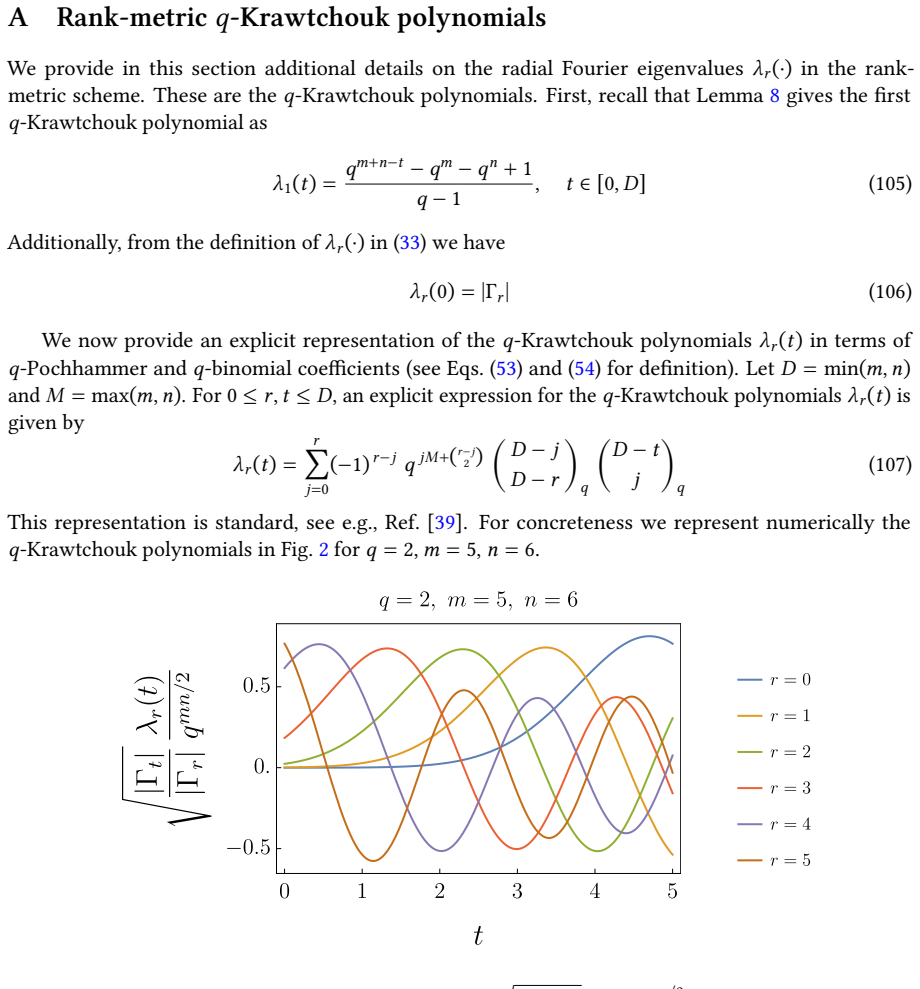
B. Amento, M. Roetteler, and R. Steinwandt, Quantum Information & Computation13, 116 (2013), arXiv:1209.5491 . 23 A Rank-metric𝑞-Krawtchouk polynomials We provide in this section additional details on the radial Fourier eigenvalues 𝜆𝑟(⋅)in the rank- metric scheme. These are the 𝑞-Krawtchouk polynomials. First, recall that Lemma 8 gives the first 𝑞-Krawtch...
Pith/arXiv arXiv 2013
discussion (0)
Sign in with ORCID, Apple, or X to comment. Anyone can read and Pith papers without signing in.