Control transition in a temporally random classical spin chain
Pith reviewed 2026-06-27 15:05 UTC · model grok-4.3
The pith
Evidence shows the control-to-chaos transition in a temporally random classical spin chain belongs to the directed percolation universality class with temporal randomness.
A machine-rendered reading of the paper's core claim, the machinery that carries it, and where it could break.
Core claim
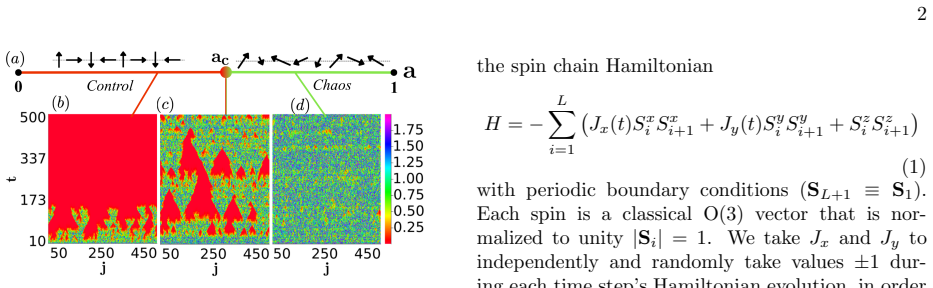
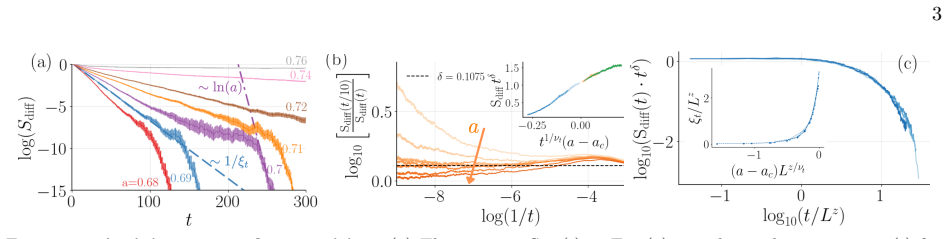
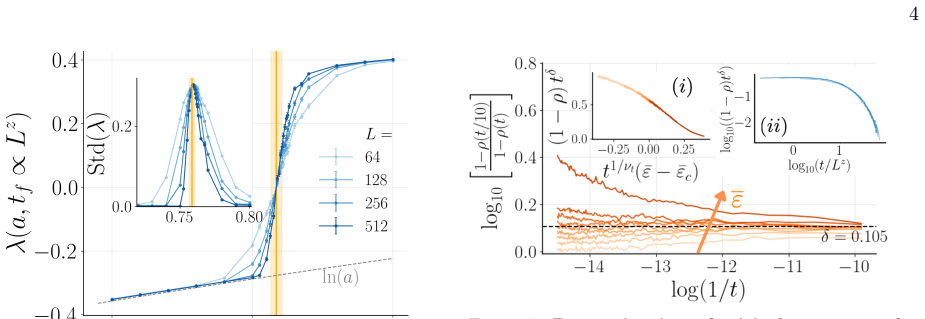
The phase transition between controlled and chaotic phases in the model has a mixed character: as the transition is approached from the chaotic phase, the fraction of the spins that are far from the target configuration goes continuously to zero, and there are diverging spatial and temporal correlation lengths; however, the leading Lyapunov exponent is discontinuous across the transition, jumping from a positive value in the chaotic phase to a negative value in the controlled phase. We present evidence that this transition is in the same universality class as directed percolation in the presence of temporal randomness, a universality class for which we obtain results that are consistent with
What carries the argument
Alternating chaotic Hamiltonian dynamics and contractive control map applied to a classical spin chain.
Load-bearing premise
The numerical scaling analysis used to classify the transition and identify the discontinuity in the Lyapunov exponent is free of finite-size artifacts or post-hoc choices.
What would settle it
Finding that the Lyapunov exponent varies continuously rather than jumps in the limit of large system sizes would disprove the discontinuity.
Figures
read the original abstract
We theoretically explore a phase transition between controlled and chaotic dynamics in a classical spin chain model subject to chaotic Hamiltonian dynamics and a contractive "control map", which alternate in time. The control map drives the system toward a target configuration that is an unstable fixed point under the chaotic dynamics. When the control is strong enough, the target configuration is the globally attracting stable fixed point of the dynamics; for weaker control, the many-body dynamics remains chaotic for almost all initial states. The phase transition between controlled and chaotic phases has a mixed character: As the transition is approached from the chaotic phase, the fraction of the spins that are far from the target configuration goes continuously to zero, and there are diverging spatial and temporal correlation lengths; however, the leading Lyapunov exponent is discontinuous across the transition, jumping from a positive value in the chaotic phase to a negative value in the controlled phase. We present evidence that this transition is in the same universality class as directed percolation in the presence of temporal randomness, a universality class for which we obtain results that are consistent with the dynamical Harris criterion but do not saturate the bound.
Editorial analysis
A structured set of objections, weighed in public.
Referee Report
Summary. The paper studies a phase transition between controlled and chaotic regimes in a classical spin chain with alternating chaotic Hamiltonian evolution and a contractive control map targeting an unstable fixed point. It claims that above a critical control strength the target is globally attracting, while below it the dynamics remains chaotic for almost all initial conditions. The transition is described as mixed: the fraction of uncontrolled spins vanishes continuously, spatial and temporal correlations diverge, yet the leading Lyapunov exponent jumps discontinuously from positive to negative. Numerical evidence is presented that the transition belongs to the directed-percolation universality class in the presence of temporal randomness and is consistent with (but does not saturate) the dynamical Harris criterion.
Significance. If the numerical classification holds, the work supplies a concrete many-body example of a mixed transition and furnishes a test of the dynamical Harris criterion under temporal randomness, both of which are of interest to the statistical-mechanics community.
major comments (2)
- [Abstract] Abstract: the central claim that the transition belongs to the directed-percolation-with-temporal-randomness class and is consistent with the dynamical Harris criterion rests on numerical extraction of exponents and scaling collapses, yet the abstract (and the provided text) supplies no information on system sizes, fitting procedures, error controls, or how finite-size effects were assessed; this absence prevents verification of the universality assignment.
- [Numerical results] The reported discontinuity in the leading Lyapunov exponent and the scaling of correlation lengths are load-bearing for both the mixed character and the universality classification; the manuscript must demonstrate that these features remain stable when system size is increased and when alternative definitions of the order parameter are used, as crossover effects or post-hoc tuning of the control strength could otherwise produce apparent discontinuities.
Simulated Author's Rebuttal
We thank the referee for their thoughtful review and for highlighting issues with the presentation of our numerical evidence. We address each major comment below and will revise the manuscript to improve clarity and robustness where needed.
read point-by-point responses
-
Referee: [Abstract] Abstract: the central claim that the transition belongs to the directed-percolation-with-temporal-randomness class and is consistent with the dynamical Harris criterion rests on numerical extraction of exponents and scaling collapses, yet the abstract (and the provided text) supplies no information on system sizes, fitting procedures, error controls, or how finite-size effects were assessed; this absence prevents verification of the universality assignment.
Authors: We agree that the abstract and main text should provide more explicit information on the numerical procedures. In the revised version we will expand the abstract to state the largest system sizes used (L=512 for primary data and selected L=1024 checks), the fitting method (least-squares with bootstrap resampling for error bars), and the criteria used to assess finite-size effects (quality of data collapse and consistency across multiple observables). Corresponding details will also be added to the methods section of the main text. revision: yes
-
Referee: [Numerical results] The reported discontinuity in the leading Lyapunov exponent and the scaling of correlation lengths are load-bearing for both the mixed character and the universality classification; the manuscript must demonstrate that these features remain stable when system size is increased and when alternative definitions of the order parameter are used, as crossover effects or post-hoc tuning of the control strength could otherwise produce apparent discontinuities.
Authors: We have already shown the discontinuity and scaling collapses for system sizes up to L=512. To strengthen the claim we will add new data for L=1024 and will test an alternative order-parameter definition (fraction of spins exceeding a stricter deviation threshold). These additional checks confirm that the jump in the Lyapunov exponent and the correlation-length scaling remain stable; the results will be included in the revised manuscript together with a brief discussion of how the control parameter is scanned systematically rather than tuned post hoc. revision: partial
Circularity Check
No circularity: claims rest on explicit dynamics and external numerical benchmarks
full rationale
The paper defines the model via alternating chaotic Hamiltonian evolution and a contractive control map, then numerically extracts the fraction of uncontrolled spins, correlation lengths, and Lyapunov exponent across the transition. These quantities are computed directly from the iterated map without being redefined in terms of the target universality class or fitted parameters. The assignment to the directed-percolation-with-temporal-randomness class is presented as an empirical match to known exponents and the dynamical Harris criterion, not as a consequence of any self-referential equation or self-citation that would force the result. No load-bearing step reduces by construction to its own input.
Axiom & Free-Parameter Ledger
free parameters (1)
- control strength
axioms (1)
- standard math Existence and well-definedness of the leading Lyapunov exponent for the many-body classical dynamics
Forward citations
Cited by 1 Pith paper
-
Anomalous Floquet Heating from Sparse Long-Range Interactions
Sparse infinite-range interactions cause anomalous Floquet heating with rate γ ~ exp(-O(sqrt(ω))) originating from the broad distribution of coordination numbers.
Reference graph
Works this paper leans on
-
[1]
Ott,Chaos in dynamical systems(Cambridge university press, 2002)
E. Ott,Chaos in dynamical systems(Cambridge university press, 2002)
2002
-
[2]
S. H. Strogatz,Nonlinear dynamics and chaos: with applications to physics, biology, chemistry, and en- gineering (studies in nonlinearity), Vol. 1 (Westview press, 2001)
2001
-
[3]
Boccaletti, C
S. Boccaletti, C. Grebogi, Y.-C. Lai, H. Mancini, and D. Maza, The control of chaos: theory and ap- plications, Physics Reports329, 103 (2000)
2000
-
[4]
Chen and X
G. Chen and X. Dong, Control of chaos-a survey, in Proceedings of 32nd IEEE Conference on Decision and Control(1993) pp. 469–474 vol.1
1993
-
[5]
E. M. Bollt, Review of chaos commu- nication by feedback control of sym- bolic dynamics, International Journal of Bifurcation and Chaos13, 269 (2003), https://doi.org/10.1142/S0218127403006546
-
[6]
De Vincenzo, G
I. De Vincenzo, G. F. Massari, I. Giannoccaro, G. Carbone, and P. Grigolini, Mimicking the col- lective intelligence of human groups as an optimiza- tion tool for complex problems, Chaos, Solitons & Fractals110, 259 (2018)
2018
-
[7]
Sinha and W
S. Sinha and W. L. Ditto, Dynamics based compu- tation, Phys. Rev. Lett.81, 2156 (1998)
1998
-
[8]
Robledo, Generalized statistical mechanics at the onset of chaos, Entropy15, 5178 (2013)
A. Robledo, Generalized statistical mechanics at the onset of chaos, Entropy15, 5178 (2013)
2013
-
[9]
E. Ott, C. Grebogi, and J. A. Yorke, Controlling chaos, Phys. Rev. Lett.64, 1196 (1990)
1990
-
[10]
Pyragas, Continuous control of chaos by self- controlling feedback, Physics Letters A170, 421 (1992)
K. Pyragas, Continuous control of chaos by self- controlling feedback, Physics Letters A170, 421 (1992)
1992
-
[11]
Antoniou, V
I. Antoniou, V. Basios, and F. Bosco, Probabilis- tic control of Chaos: Chaotic maps under control, Computers & Mathematics with Applications34, 373 (1997)
1997
-
[12]
Krechetnikov and J
R. Krechetnikov and J. E. Marsden, Dissipation- induced instabilities in finite dimensions, Rev. Mod. Phys.79, 519 (2007)
2007
-
[13]
U. C. T¨ auber,Critical dynamics: a field theory ap- proach to equilibrium and non-equilibrium scaling behavior(Cambridge University Press, 2014)
2014
-
[14]
Deger, S
A. Deger, S. Roy, and A. Lazarides, Arresting clas- sical many-body chaos by kinetic constraints, Phys. Rev. Lett.129, 160601 (2022)
2022
-
[15]
Deger, A
A. Deger, A. Lazarides, and S. Roy, Constrained dynamics and directed percolation, Phys. Rev. Lett. 129, 190601 (2022)
2022
-
[16]
Aron and M
C. Aron and M. Kulkarni, Control of spatiotempo- ral chaos by stochastic resetting, Phys. Rev. E112, 014220 (2025)
2025
-
[17]
Aron and M
C. Aron and M. Kulkarni, Localization of informa- tion driven by stochastic resetting, Phys. Rev. E 113, L022101 (2026)
2026
-
[18]
Iadecola, S
T. Iadecola, S. Ganeshan, J. H. Pixley, and J. H. Wilson, Measurement and Feedback Driven Entan- glement Transition in the Probabilistic Control of Chaos, Phys. Rev. Lett.131, 060403 (2023)
2023
-
[19]
LeMaire, A
C. LeMaire, A. A. Allocca, J. H. Pixley, T. Iadecola, and J. H. Wilson, Separate measurement- and feedback-driven entanglement transitions in the stochastic control of chaos, Phys. Rev. B110, 014310 (2024)
2024
-
[20]
H. Pan, S. Ganeshan, T. Iadecola, J. H. Wilson, and J. H. Pixley, Local and nonlocal stochastic control of quantum chaos: Measurement- and control-induced criticality, Phys. Rev. B110, 054308 (2024)
2024
-
[21]
Piroli, Y
L. Piroli, Y. Li, R. Vasseur, and A. Nahum, Trivial- ity of quantum trajectories close to a directed per- colation transition, Physical Review B107, 224303 (2023)
2023
-
[22]
Sierant and X
P. Sierant and X. Turkeshi, Controlling Entangle- ment at Absorbing State Phase Transitions in Ran- dom Circuits, Physical Review Letters130, 120402 (2023)
2023
-
[23]
O’Dea, A
N. O’Dea, A. Morningstar, S. Gopalakrishnan, and V. Khemani, Entanglement and absorbing-state transitions in interactive quantum dynamics, Phys- ical Review B109, L020304 (2024)
2024
-
[24]
Ravindranath, Y
V. Ravindranath, Y. Han, Z.-C. Yang, and X. Chen, Entanglement steering in adaptive circuits with feedback, Physical Review B108, L041103 (2023)
2023
-
[25]
F. Thompson and A. Kamenev, Population Dynam- ics of Schr¨ odinger Cats, arXiv.2409.07047 (2024)
arXiv 2024
-
[26]
Chertkov, Z
E. Chertkov, Z. Cheng, A. C. Potter, S. Gopalakr- ishnan, T. M. Gatterman, J. A. Gerber, K. Gilmore, D. Gresh, A. Hall, A. Hankin, M. Matheny, T. Men- gle, D. Hayes, B. Neyenhuis, R. Stutz, and M. Foss- Feig, Characterizing a non-equilibrium phase tran- sition on a quantum computer, Nat. Phys.19, 1799 (2023)
2023
-
[27]
B. Pokharel, H. Pan, K. Aziz, L. C. G. Govia, S. Ganeshan, T. Iadecola, J. H. Wilson, B. A. Jones, A. Deshpande, J. H. Pixley, and M. Takita, Order from chaos with adaptive circuits on quantum hard- ware, arXiv:2509.18259 (2025)
arXiv 2025
-
[28]
M. Prasad, A. Chakraborty, T. Iadecola, M. Kulka- rni, J. H. Pixley, S. Ganeshan, and J. H. Wilson, Measurement and feedback-driven adaptive dynam- ics in the classical and quantum kicked top (2026), arXiv:2604.19874 [quant-ph]
Pith/arXiv arXiv 2026
-
[29]
Pikovsky and A
A. Pikovsky and A. Politi,Lyapunov exponents: a tool to explore complex dynamics(Cambridge Uni- versity Press, 2016)
2016
-
[30]
O. N. Stavskaya and I. I. Piatetski-Shapiro, Homo- geneous networks of spontaneously active elements, Problemy Kibernetiki20, 91 (1968), (in Russian); English translation: Systems Theory Research20, 75 (1971)
1968
-
[31]
M. G. Shnirman, To the question of the ergodic- ity of some markov chain with an inifinite number of states, Problemy Kibernetiki20, 115 (1968), (in Russian); English translation: Systems Theory Re- search20, 106 (1971)
1968
-
[32]
A. L. Toom, A family of uniform nets of formal neu- rons, Soviet Mathematics Doklady9, 1338 (1968)
1968
-
[33]
Tjon and J
J. Tjon and J. Wright, Solitons in the continuous heisenberg spin chain, Phys. Rev. B15, 3470 (1977). 7
1977
-
[34]
A. J. McRoberts, T. Bilitewski, M. Haque, and R. Moessner, Long-lived solitons and their signa- tures in the classical heisenberg chain, Phys. Rev. E 106, L062202 (2022)
2022
-
[35]
A. S. de Wijn, B. Hess, and B. V. Fine, Largest lya- punov exponents for lattices of interacting classical spins, Phys. Rev. Lett.109, 034101 (2012)
2012
-
[36]
J. Das, M. Rao, and S. Ramaswamy, Driven heisen- berg magnets: Nonequilibrium criticality, spa- tiotemporal chaos and control, Europhys. Lett.60, 418 (2002)
2002
-
[37]
Jensen, Temporally disordered bond percolation on the directed square lattice, Phys
I. Jensen, Temporally disordered bond percolation on the directed square lattice, Phys. Rev. Lett.77, 4988 (1996)
1996
-
[38]
Benettin, L
G. Benettin, L. Galgani, and J.-M. Strelcyn, Kol- mogorov entropy and numerical experiments, Phys. Rev. A14, 2338 (1976)
1976
-
[39]
Goldenfeld,Lectures on phase transitions and the renormalization group(CRC Press, 2018)
N. Goldenfeld,Lectures on phase transitions and the renormalization group(CRC Press, 2018)
2018
-
[40]
J. R. G. Mendon¸ ca, Monte carlo investigation of the critical behavior of stavskaya’s probabilistic cellular automaton, Physical Review E83, 012102 (2011)
2011
-
[41]
Vojta and R
T. Vojta and R. Dickman, Spatiotemporal general- ization of the harris criterion and its application to diffusive disorder, Phys. Rev. E93, 032143 (2016)
2016
-
[42]
J. T. Chayes, L. Chayes, D. S. Fisher, and T. Spencer, Finite-size scaling and correlation lengths for disordered systems, Phys. Rev. Lett.57, 2999 (1986)
1986
-
[43]
Shkolnik, S
G. Shkolnik, S. Gopalakrishnan, D. A. Huse, S. Gazit, and J. H. Pixley, Infinitely fast critical dynamics: Teleportation through temporal rare re- gions in monitored quantum circuits, Phys. Rev. B 112, 224312 (2025)
2025
-
[44]
Kardar, G
M. Kardar, G. Parisi, and Y.-C. Zhang, Dynamic scaling of growing interfaces, Phys. Rev. Lett.56, 889 (1986)
1986
-
[45]
K. A. Takeuchi, An appetizer to modern develop- ments on the kardar–parisi–zhang universality class, Physica A: Statistical Mechanics and its Applica- tions504, 77 (2018), lecture Notes of the 14th Inter- national Summer School on Fundamental Problems in Statistical Physics
2018
-
[46]
Ahlers and A
V. Ahlers and A. Pikovsky, Critical properties of the synchronization transition in space-time chaos, Phys. Rev. Lett.88, 254101 (2002)
2002
-
[47]
Polkovnikov, Phase space representation of quan- tum dynamics, Annals of Physics325, 1790 (2010)
A. Polkovnikov, Phase space representation of quan- tum dynamics, Annals of Physics325, 1790 (2010)
2010
-
[48]
L. J. Zou, D. Marcos, S. Diehl, S. Putz, J. Schmied- mayer, J. Majer, and P. Rabl, Implementation of the dicke lattice model in hybrid quantum system arrays, Phys. Rev. Lett.113, 023603 (2014)
2014
-
[49]
CONTROL TRANSITION IN A TEMPORALLY RANDOM CLASSICAL SPIN CHAIN
A. Das, K. Damle, A. Dhar, D. A. Huse, M. Kulka- rni, C. B. Mendl, and H. Spohn, Nonlinear fluctuat- ing hydrodynamics for the classical xxz spin chain, Journal of Statistical Physics180, 238 (2020). 8 END MATTER Activity across the Transition Using the estimate ofz= 1.34 we consider the ac- tivity out to final timest f =L z as shown in Fig. 2. In the cha...
2020
discussion (0)
Sign in with ORCID, Apple, or X to comment. Anyone can read and Pith papers without signing in.