REVIEW 3 major objections 5 minor 1 cited by
Eccentric mass transfer, not a bug to fix, naturally produces the observed eccentric wide sdB binaries and turns eccentricity into a probe of mass-transfer physics.
Reviewed by Pith at T0; open to challenge. T0 means a machine referee read the full paper against a public rubric. the ladder, T0–T4 →
T0 review · grok-4.5
2026-07-12 14:35 UTC pith:WVQDVVYV
load-bearing objection GeMT applied to wide sdB+MS systems gives the first single-mechanism qualitative match to all three observed orbital correlations; the pure-MT isolation is flagged and real, but does not kill the result. the 3 major comments →
Reframing the Wide Eccentric Binary Problem: Eccentricity as a Probe of Mass-transfer Physics
The pith
A machine-rendered reading of the paper's core claim, the machinery that carries it, and where it could break.
Core claim
The GeMT model of eccentric Roche-lobe overflow naturally reproduces the orbital periods, mass ratios and eccentricities of wide sdB+MS binaries, including their observed correlations, without fine-tuning; nonzero eccentricity is a generic outcome of mass transfer once the mass ratio has reversed.
What carries the argument
The GeMT secular rates for semi-major axis and eccentricity (orbit-averaged equations that depend on mass ratio, accretion efficiency β, angular-momentum-loss parameter γ and the degree of Roche-lobe overflow). These rates alone generate the observed evolutionary tracks once mass transfer proceeds past mass-ratio reversal.
Load-bearing premise
That the pure orbital effects of eccentric mass transfer can be isolated from stellar evolution and tides during the mass-transfer episode itself, so that integrating only the GeMT equations already yields the observed distributions.
What would settle it
Include stellar evolution and tides self-consistently for the same 1–2 solar-mass progenitors; if the resulting post-mass-transfer eccentricities systematically fall below the observed sdB+MS values or destroy the unimodal q–e distribution, the isolation claim fails.
If this is right
- Post-mass-transfer eccentricity becomes a direct constraint on transferred mass, accretion efficiency and angular-momentum loss across binary populations.
- The main and secondary branches of wide sdB+MS systems map to different progenitor masses and initial periods, explaining their relative numbers via the IMF and stability limits.
- The same mechanism accounts for the general rise of maximum eccentricity with orbital period seen in barium stars, post-AGB binaries and white-dwarf–main-sequence systems.
- Eccentricity can be used as a population diagnostic for the progenitors of gravitational-wave sources and Type Ia supernovae.
Where Pith is reading between the lines
- Once tides and stellar evolution are restored, residual eccentricity differences among populations may still isolate the dominant angular-momentum-loss mode.
- The unimodal q–e plane offers a cleaner prior for Bayesian recovery of β and γ than period distributions alone.
- Systems that remain circular after substantial mass transfer would require either very high initial mass ratios or an additional circularizing process not captured by GeMT.
Editorial analysis
A structured set of objections, weighed in public.
Referee Report
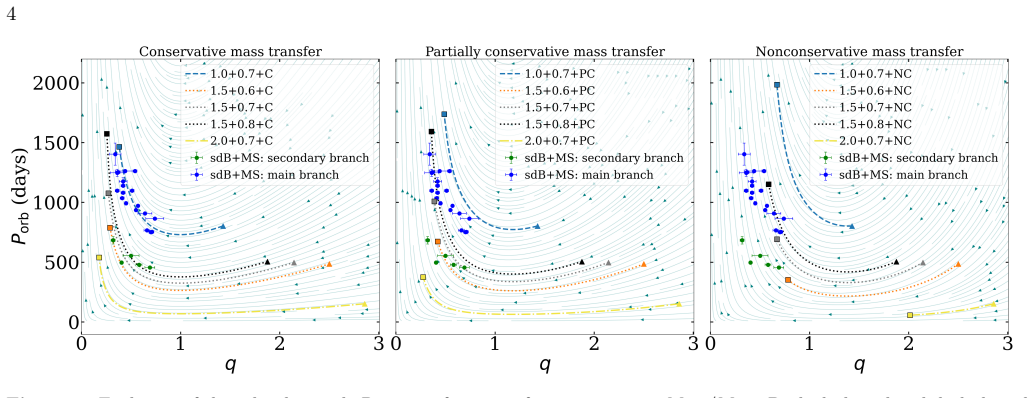
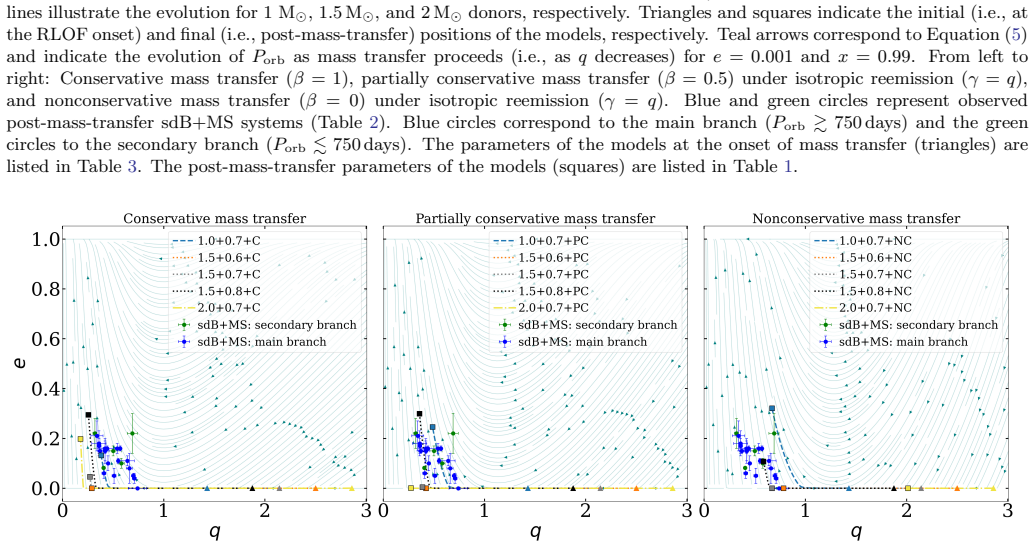
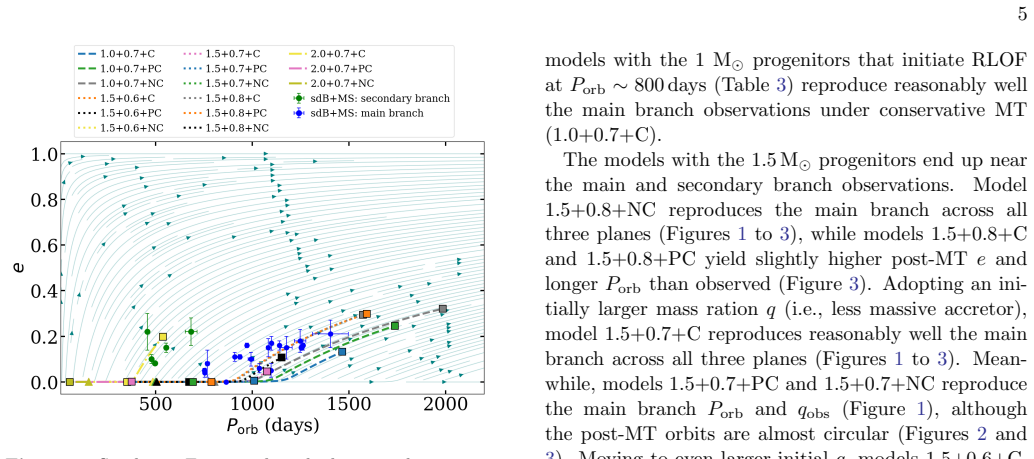
Summary. The paper applies the authors' general mass-transfer (GeMT) framework to the long-standing eccentricity problem in wide post-interaction binaries, focusing on wide sdB+MS systems as well-constrained benchmarks. Integrating the secular GeMT equations for nearly circular RGB donors near the TRGB, the authors show that model endpoints can land near the observed loci in the q–Porb, q–e, and Porb–e planes for selected 1–1.5 M⊙ progenitors under conservative or isotropic-reemission mass transfer. They re-derive orbit-averaged evolutionary tracks (Eqs. 5–7) that are independent of the mass-transfer rate and argue that these tracks recover the signs and qualitative slopes of the three observed correlations, including the unimodal q–e distribution. They further propose that post-MT eccentricity is set primarily by MT parameters (transferred mass, β, γ) rather than orbital period, and should be used as a diagnostic of binary-evolution physics across populations.
Significance. If the qualitative picture holds, this is a meaningful reframing of the eccentricity problem: unlike circumbinary-disk or kick scenarios, GeMT naturally produces higher eccentricities at longer periods and places observed systems in the post-mass-ratio-reversal widening regime. The rate-independent tracks (Eqs. 5–7) and the explanation of the unimodal q–e plane are clean, falsifiable contributions. Using sdB+MS systems as benchmarks with TRGB radius and core-mass constraints is a strong methodological choice. The broader claim that post-MT eccentricity encodes β, AML, and transferred mass across populations is of clear interest if supported by concurrent-tide calculations. The work is an application of the authors' prior GeMT papers rather than a new derivation of the secular equations, but the confrontation with the sdB sample and the interpretive framework are new.
major comments (3)
- [§3.1, Eqs. (1)–(2), Table 1] §3.1 explicitly isolates eccentric RLOF from tides and stellar evolution, integrating pure GeMT (Eqs. 1–2) from e=0.001 to the endpoints in Table 1. For the cool, extended TRGB donors required by the sdB channel (Rdon ~80–180 R⊙, Table 3), tidal circularization timescales are typically short relative to thermal-timescale MT. Concurrent tides would damp e while GeMT pumps it, so the net post-MT eccentricities could be substantially lower than the pure-GeMT values that are compared to the sample. The abstract and §5 flag this for future work, yet the central claim (Conclusions; abstract) that GeMT 'naturally reproduces' the observed eccentricities without fine-tuning rests on this isolation. A quantitative comparison of tidal vs. MT timescales for the Table 3 models, or a consistent softening of the eccentricity-reproduction claim to 'qualitative trend recovery under pure GeMT,' is needed
- [§3.1, Table 1 vs Table 2, Figs. 2–3] The claim that GeMT reproduces 'all orbital parameters' of wide sdB+MS binaries (abstract; Conclusions; §3.1) is not supported for the secondary branch. Models intended for that branch (e.g., 1.5+0.6+C/PC/NC, 2.0+0.7+C/PC in Table 1) yield final e ~ 10^{-5}–0.2 while observed secondary-branch systems have e ~ 0.08–0.22 (Table 2). The paper notes the under-production but still asserts a global match. Either restrict the reproduction claim to the main branch and the correlation signs, or show that concurrent stellar evolution (envelope structure, x evolution) can raise secondary-branch e without spoiling the main-branch match.
- [Abstract; Conclusions; Table 3] The phrase 'without fine-tuning' (abstract; Conclusions) overstates the case. Free parameters include β, γ (isotropic reemission), initial q and Porb, e_init, and x; successful models are those selected from a fifteen-model grid that initiate RLOF at periapsis with chosen companion masses (Table 3). Several combinations fail (mergers, near-zero e, or Porb/q offsets). The qualitative success of Eqs. (5)–(7) does not require fine-tuning, but the quantitative endpoint matches do. Soften the language to reflect that the trends are robust while absolute matches depend on β, γ, and initial conditions.
minor comments (5)
- [Table 3] Table 3 lists Mdon = 1.0 for all 1.5+… and 2.0+… rows, and Macc values for the PC/NC 1.0+0.7 models (0.6, 0.5) that are inconsistent with the labels and with the final masses in Table 1 under the stated β. Correct the initial masses so labels, Table 1, and Table 3 agree.
- [Throughout] Typos and wording: 'speficially' (§2), 'sligtly' (§3.1), 'paterns' (§4.1), 'manifastation' (§4.2), 'horizantal' (Fig. 3 caption), 'mass transfert' (Intro), 'T ransfer' in running title. Also 'and and whether' in Table 3 note.
- [§2, footnote 6] Footnote 6 notes that β is defined opposite to the traditional Soberman et al. convention. State the mapping once in the main text near Eqs. (1)–(2) so readers do not misread accretion efficiency.
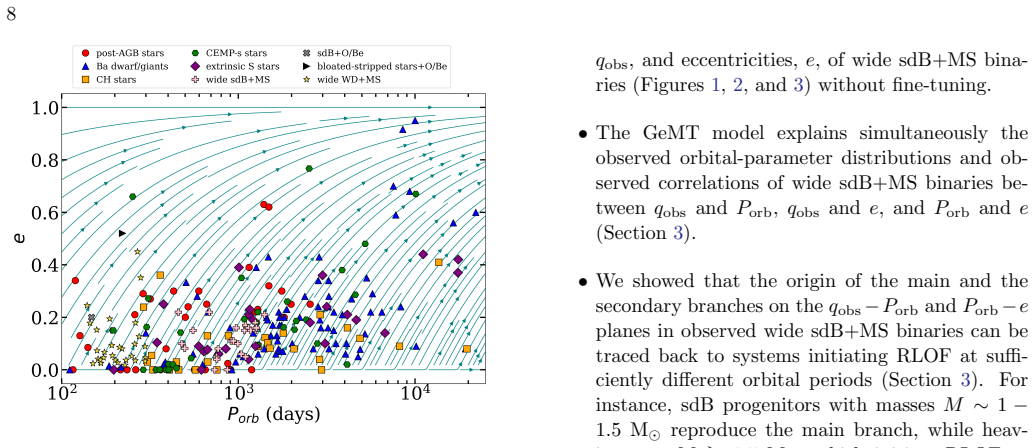
- [Fig. 4, §4.3] Figure 4 is useful for context but is not a quantitative GeMT prediction for those populations. Clarify in the caption or §4.3 that only the sdB+MS sample is modeled here.
- [Abstract] The two abstract versions in the submission materials differ in strength ('naturally reproduces… without fine-tuning' vs. 'qualitatively reproduces… tides should be included'). Align the abstract with the revised claims after addressing the major comments.
Circularity Check
Infrastructural self-citation of GeMT equations; central claim is an independent confrontation with external data, not a by-construction prediction.
specific steps
-
self citation load bearing
[§2, Eqs. (1)–(2) and following paragraph]
"the secular orbital evolution is given by ⟨ȧ⟩/a = …, ⟨ė⟩ = …, where eta is the fraction of the transferred mass that is accreted, γ is a measure of the efficiency of AML …, x ≡ RcL/Rdon …, and f_Ṁdon(e,x), fa(e,x), fe(e,x), are dimensionless functions given explicitly in Appendix E of (A. Parkosidis et al. 2026a)."
The entire orbital-evolution engine used to generate Figs. 1–3 and Table 1 is imported from the authors’ own preceding GeMT papers rather than re-derived or independently verified here. The citation is infrastructural (the functional form of the rates) and does not itself force the numerical match to the sdB sample; the match still requires choosing initial conditions and integrating. Hence only a minor, non-load-bearing circularity step.
full rationale
The secular rates (1)–(2) and the dimensionless functions fa, fe, f_Mdot are taken from the authors’ prior GeMT papers (Parkosidis et al. 2026a,b). That is ordinary self-citation of infrastructure, not a uniqueness theorem or a fitted normalization that forces the result. The evolutionary tracks (5)–(7) are re-derived here from those rates plus Kepler’s law and are independent of the MT rate itself. The paper then integrates the equations for a discrete grid of initial conditions (Table 3) chosen from MESA TRGB radii/cores and confronts the endpoints with an independent observational sample (Table 2, literature sources). No parameter is fitted to the sdB+MS eccentricities or periods and then re-presented as a prediction; the match is qualitative and the abstract/§5 explicitly flag that tides and stellar evolution must still be added. Isolation of pure GeMT from tides is a modelling assumption whose validity can be questioned, but it is not circularity: the derivation does not reduce to its inputs by construction. Score 2 reflects only the non-load-bearing self-citation of the GeMT framework.
Axiom & Free-Parameter Ledger
free parameters (5)
- accretion efficiency β
- AML parameter γ
- initial eccentricity e_init
- RLOF degree x
- initial mass ratios and periods
axioms (5)
- domain assumption Secular orbital evolution under eccentric mass transfer is given by the GeMT orbit-averaged rates (Eqs. 1–2) derived in Parkosidis et al. 2026a,b.
- domain assumption Angular momentum stored in stellar spins is negligible compared with orbital angular momentum (point-mass limit).
- domain assumption Wide sdB+MS systems form via a single episode of stable Roche-lobe overflow that begins near the tip of the red-giant branch, producing cores near 0.47 M⊙ (or 0.41 M⊙ for 2 M⊙ progenitors).
- ad hoc to paper Tides and stellar-structure evolution can be switched off during the mass-transfer phase without changing the qualitative orbital tracks.
- domain assumption For non-conservative mass transfer the ejected material carries the specific angular momentum of the accretor (isotropic re-emission, γ = q).
read the original abstract
Observations of wide post-interaction binaries show an unexpected feature; orbital eccentricity, which is not understood theoretically. A promising resolution to this long-standing puzzle is eccentric mass transfer (MT). Here the first complete framework for MT in orbits with arbitrary eccentricity, the general mass-transfer (GeMT) model, is confronted with the latest observations of hot subdwarfs of spectral type B (sdB) with main-sequence (MS) companions in wide orbits. SdBs are excellent benchmarks for binary evolution models, since their progenitors provide unique constraints on their formation histories. We isolate the effects of eccentric MT from other physical process and we show that it explains the observed orbital-parameter distributions and their correlations seen in wide sdB+MS binaries. To quantitatively constrain their orbital parameters, stellar evolution and tides should be included in future studies, yet it is encouraging that the GeMT model provides the first mechanism that qualitatively reproduces the observed distributions. We further demonstrate that post-MT eccentricities depend directly on key MT parameters, including transferred mass, accretion efficiency, and angular momentum loss. Given the multitude of eccentric post-MT binaries with components ranging from low- to high-mass stars to compact objects, we propose that post-MT eccentricities offer a new window onto binary evolution, presenting a powerful tool to constrain highly uncertain binary-evolution parameters and mass-transfer formation histories across diverse populations. Post-MT eccentricity should therefore be embraced as a key observable, rather than treated as a problem to be corrected.
Figures
Forward citations
Cited by 1 Pith paper
-
Toward 3D orbits of wide sdO/B binaries I. Six composite systems spatially resolved with VLTI/GRAVITY
VLTI/GRAVITY spatially resolved six wide sdO/B+MS binaries, yielding 1-8% precise projected separations of 1-3 au — the first interferometric sample toward 3D orbits and model-independent masses.
Reference graph
Works this paper leans on
-
[1]
2024, MNRAS, 527, 11184, doi: 10.1093/mnras/stad3891
Arancibia-Rojas, E., Zorotovic, M., Vuˇ ckovi´ c, M., et al. 2024, MNRAS, 527, 11184, doi: 10.1093/mnras/stad3891
-
[2]
Barlow, B. N., Liss, S. E., Wade, R. A., & Green, E. M. 2013, ApJ, 771, 23, doi: 10.1088/0004-637X/771/1/23
-
[3]
Barlow, B. N., Wade, R. A., Liss, S. E., Østensen, R. H., & Van Winckel, H. 2012, ApJ, 758, 58, doi: 10.1088/0004-637X/758/1/58
-
[4]
Belczynski, K., Kalogera, V., Rasio, F. A., et al. 2008, ApJS, 174, 223, doi: 10.1086/521026 Bonaˇ ci´ c Marinovi´ c, A. A., Glebbeek, E., & Pols, O. R. 2008, A&A, 480, 797, doi: 10.1051/0004-6361:20078297
doi:10.1086/521026 2008
-
[5]
2025, arXiv e-prints, arXiv:2508.21805, doi: 10.48550/arXiv.2508.21805
Chawla, C., Chatterjee, S., & Breivik, K. 2025, arXiv e-prints, arXiv:2508.21805, doi: 10.48550/arXiv.2508.21805
-
[6]
2013, MNRAS, 434, 186, doi: 10.1093/mnras/stt992
Chen, X., Han, Z., Deca, J., & Podsiadlowski, P. 2013, MNRAS, 434, 186, doi: 10.1093/mnras/stt992
-
[7]
2016, ApJ, 823, 102, doi: 10.3847/0004-637X/823/2/102
Choi, J., Dotter, A., Conroy, C., et al. 2016, ApJ, 823, 102, doi: 10.3847/0004-637X/823/2/102
-
[8]
2018, MNRAS, 474, 433, doi: 10.1093/mnras/stx2755
Deca, J., Vos, J., N´ emeth, P., et al. 2018, MNRAS, 474, 433, doi: 10.1093/mnras/stx2755
-
[9]
Deca, J., Marsh, T. R., Østensen, R. H., et al. 2012, MNRAS, 421, 2798, doi: 10.1111/j.1365-2966.2012.20483.x
-
[10]
G., Jorissen, A., & Van Winckel, H
Dermine, T., Izzard, R. G., Jorissen, A., & Van Winckel, H. 2013, A&A, 551, A50, doi: 10.1051/0004-6361/201219430
-
[11]
S., Irrgang, A., Woolf, V., & Heber, U
Dorsch, M., Jeffery, C. S., Irrgang, A., Woolf, V., & Heber, U. 2021, A&A, 653, A120, doi: 10.1051/0004-6361/202141381
-
[12]
2020, A&A, 639, A24, doi: 10.1051/0004-6361/202037487
Escorza, A., Siess, L., Van Winckel, H., & Jorissen, A. 2020, A&A, 639, A24, doi: 10.1051/0004-6361/202037487
-
[13]
2019, A&A, 626, A128, doi: 10.1051/0004-6361/201935390
Escorza, A., Karinkuzhi, D., Jorissen, A., et al. 2019, A&A, 626, A128, doi: 10.1051/0004-6361/201935390
-
[14]
Fekel, F. C., Joyce, R. R., Hinkle, K. H., & Skrutskie, M. F. 2000, AJ, 119, 1375, doi: 10.1086/301260
doi:10.1086/301260 2000
-
[15]
Ge, H., Hjellming, M. S., Webbink, R. F., Chen, X., & Han, Z. 2010, ApJ, 717, 724, doi: 10.1088/0004-637X/717/2/724
-
[16]
Ge, H., Webbink, R. F., Chen, X., & Han, Z. 2015, ApJ, 812, 40, doi: 10.1088/0004-637X/812/1/40
-
[17]
Ge, H., Webbink, R. F., Chen, X., & Han, Z. 2020, ApJ, 899, 132, doi: 10.3847/1538-4357/aba7b7
-
[18]
Han, Z., Podsiadlowski, P., Maxted, P. F. L., & Marsh, T. R. 2003, MNRAS, 341, 669, doi: 10.1046/j.1365-8711.2003.06451.x
-
[19]
Han, Z., Podsiadlowski, P., Maxted, P. F. L., Marsh, T. R., & Ivanova, N. 2002, MNRAS, 336, 449, doi: 10.1046/j.1365-8711.2002.05752.x
-
[20]
T., Andersen, J., Nordstr¨ om, B., et al
Hansen, T. T., Andersen, J., Nordstr¨ om, B., et al. 2016, A&A, 588, A3, doi: 10.1051/0004-6361/201527409
-
[21]
Harris, C. R., Millman, K. J., van der Walt, S. J., et al. 2020, Nature, 585, 357, doi: 10.1038/s41586-020-2649-2
-
[22]
2009, ARA&A, 47, 211, doi: 10.1146/annurev-astro-082708-101836
Heber, U. 2009, ARA&A, 47, 211, doi: 10.1146/annurev-astro-082708-101836
-
[23]
2016, PASP, 128, 082001, doi: 10.1088/1538-3873/128/966/082001
Heber, U. 2016, PASP, 128, 082001, doi: 10.1088/1538-3873/128/966/082001
-
[24]
2024, arXiv e-prints, arXiv:2410.11663, doi: 10.48550/arXiv.2410.11663
Heber, U. 2024, arXiv e-prints, arXiv:2410.11663, doi: 10.48550/arXiv.2410.11663
-
[25]
Hjellming, M. S., & Webbink, R. F. 1987, ApJ, 318, 794, doi: 10.1086/165412
doi:10.1086/165412 1987
-
[26]
Hunter, J. D. 2007, Computing in Science & Engineering, 9, 90, doi: 10.1109/MCSE.2007.55
-
[27]
Hurley, J. R., Tout, C. A., & Pols, O. R. 2002, MNRAS, 329, 897, doi: 10.1046/j.1365-8711.2002.05038.x
-
[28]
Izzard, R. G., Dermine, T., & Church, R. P. 2010, A&A, 523, A10, doi: 10.1051/0004-6361/201015254
-
[29]
Jorissen, A., Boffin, H. M. J., Karinkuzhi, D., et al. 2019, A&A, 626, A127, doi: 10.1051/0004-6361/201834630
-
[30]
2016, A&A, 586, A158, doi: 10.1051/0004-6361/201526992
Jorissen, A., Van Eck, S., Van Winckel, H., et al. 2016, A&A, 586, A158, doi: 10.1051/0004-6361/201526992
-
[31]
Klement, R., Rivinius, T., Gies, D. R., et al. 2024, ApJ, 962, 70, doi: 10.3847/1538-4357/ad13ec
-
[32]
2001, MNRAS, 322, 231, doi: 10.1046/j.1365-8711.2001.04022.x 10
Kroupa, P. 2001, MNRAS, 322, 231, doi: 10.1046/j.1365-8711.2001.04022.x 10
-
[33]
Mathieu, R. D., & Pols, O. R. 2025, ARA&A, 63, 467, doi: 10.1146/annurev-astro-071221-054402
-
[34]
Meurer, A., Smith, C. P., Paprocki, M., et al. 2017, PeerJ Computer Science, 3, e103, doi: 10.7717/peerj-cs.103
-
[35]
Molina, F., Vos, J., N´ emeth, P., et al. 2022, A&A, 658, A122, doi: 10.1051/0004-6361/202141220 M¨ uller-Horn, J., El-Badry, K., Rix, H.-W., et al. 2025, A&A, 701, A9, doi: 10.1051/0004-6361/202452504
-
[36]
2016, ARA&A, 54, 441, doi: 10.1146/annurev-astro-081915-023315
Naoz, S. 2016, ARA&A, 54, 441, doi: 10.1146/annurev-astro-081915-023315
-
[37]
2020, A&A, 642, A234, doi: 10.1051/0004-6361/202038341
Oomen, G.-M., Pols, O., Van Winckel, H., & Nelemans, G. 2020, A&A, 642, A234, doi: 10.1051/0004-6361/202038341
-
[38]
2018, A&A, 620, A85, doi: 10.1051/0004-6361/201833816
Oomen, G.-M., Van Winckel, H., Pols, O., et al. 2018, A&A, 620, A85, doi: 10.1051/0004-6361/201833816
-
[39]
1976, in IAU Symposium, Vol
Paczynski, B. 1976, in IAU Symposium, Vol. 73, Structure and Evolution of Close Binary Systems, ed. P. Eggleton, S. Mitton, & J. Whelan, 75
1976
-
[40]
2026a, A&A, 706, A79, doi: 10.1051/0004-6361/202555096
Parkosidis, A., Toonen, S., Dosopoulou, F., & Laplace, E. 2026a, A&A, 706, A79, doi: 10.1051/0004-6361/202555096
-
[41]
2026b, A&A, 706, A357, doi: 10.1051/0004-6361/202558055
Parkosidis, A., Toonen, S., Laplace, E., & Dosopoulou, F. 2026b, A&A, 706, A357, doi: 10.1051/0004-6361/202558055
-
[42]
Perets, H. B., & Fabrycky, D. C. 2009, ApJ, 697, 1048, doi: 10.1088/0004-637X/697/2/1048
-
[43]
Petrova, A. V., & Orlov, V. V. 1999, AJ, 117, 587, doi: 10.1086/300671
doi:10.1086/300671 1999
-
[44]
R., Cote, J., Waters, L
Pols, O. R., Cote, J., Waters, L. B. F. M., & Heise, J. 1991, A&A, 241, 419
1991
-
[45]
R., Karakas, A
Pols, O. R., Karakas, A. I., Lattanzio, J. C., & Tout, C. A. 2003, in Astronomical Society of the Pacific Conference
2003
-
[46]
303, Symbiotic Stars Probing Stellar Evolution, ed
Series, Vol. 303, Symbiotic Stars Probing Stellar Evolution, ed. R. L. M. Corradi, J. Mikolajewska, & T. J. Mahoney, 290 Portegies Zwart, S. F., & Verbunt, F. 1996, A&A, 309, 179
1996
-
[47]
Raguzova, N. V., & Popov, S. B. 2005, Astronomical and Astrophysical Transactions, 24, 151, doi: 10.1080/10556790500497311
-
[48]
2022, A&A, 666, A182, doi: 10.1051/0004-6361/202244214
Kupfer, T. 2022, A&A, 666, A182, doi: 10.1051/0004-6361/202244214
-
[49]
Schaffenroth, V., Barlow, B. N., Geier, S., et al. 2019, A&A, 630, A80, doi: 10.1051/0004-6361/201936019
-
[50]
2024, MNRAS, 529, 3729, doi: 10.1093/mnras/stae773
Shahaf, S., Hallakoun, N., Mazeh, T., et al. 2024, MNRAS, 529, 3729, doi: 10.1093/mnras/stae773
-
[51]
Soberman, G. E., Phinney, E. S., & van den Heuvel, E. P. J. 1997, A&A, 327, 620, doi: 10.48550/arXiv.astro-ph/9703016
-
[52]
2000, A&A, 357, 557, doi: 10.48550/arXiv.astro-ph/0002128
Soker, N. 2000, A&A, 357, 557, doi: 10.48550/arXiv.astro-ph/0002128
-
[53]
Sperauskas, J., Zaˇ cs, L., Schuster, W. J., & Deveikis, V. 2016, ApJ, 826, 85, doi: 10.3847/0004-637X/826/1/85
-
[54]
2023, A&A, 669, A45, doi: 10.1051/0004-6361/202244137
Toonen, S. 2023, A&A, 669, A45, doi: 10.1051/0004-6361/202244137
-
[55]
2016, Computational Astrophysics and Cosmology, 3, 6, doi: 10.1186/s40668-016-0019-0
Toonen, S., Hamers, A., & Portegies Zwart, S. 2016, Computational Astrophysics and Cosmology, 3, 6, doi: 10.1186/s40668-016-0019-0
-
[56]
2020, A&A, 640, A16, doi: 10.1051/0004-6361/201936835
Bandopadhyay, D. 2020, A&A, 640, A16, doi: 10.1051/0004-6361/201936835
-
[57]
Virtanen, P., Gommers, R., Oliphant, T. E., et al. 2020, Nature Methods, 17, 261, doi: 10.1038/s41592-019-0686-2
-
[58]
2020, A&A, 641, A163, doi: 10.1051/0004-6361/201937195
Vos, J., Bobrick, A., & Vuˇ ckovi´ c, M. 2020, A&A, 641, A163, doi: 10.1051/0004-6361/201937195
-
[59]
2018, MNRAS, 473, 693, doi: 10.1093/mnras/stx2198
Vos, J., N´ emeth, P., Vuˇ ckovi´ c, M., Østensen, R., & Parsons, S. 2018, MNRAS, 473, 693, doi: 10.1093/mnras/stx2198
-
[60]
H., Marchant, P., & Van Winckel, H
Vos, J., Østensen, R. H., Marchant, P., & Van Winckel, H. 2015, A&A, 579, A49, doi: 10.1051/0004-6361/201526019
-
[61]
Vos, J., Østensen, R. H., N´ emeth, P., et al. 2013, A&A, 559, A54, doi: 10.1051/0004-6361/201322200
-
[62]
H., Vuˇ ckovi´ c, M., & Van Winckel, H
Vos, J., Østensen, R. H., Vuˇ ckovi´ c, M., & Van Winckel, H. 2017, A&A, 605, A109, doi: 10.1051/0004-6361/201730958
-
[63]
2019, MNRAS, 482, 4592, doi: 10.1093/mnras/sty3017
Vos, J., Vuˇ ckovi´ c, M., Chen, X., et al. 2019, MNRAS, 482, 4592, doi: 10.1093/mnras/sty3017
-
[64]
Vos, J., Østensen, R. H., Degroote, P., et al. 2012, A&A, 548, A6, doi: 10.1051/0004-6361/201219723
-
[65]
Yamaguchi, N., El-Badry, K., Fuller, J., et al. 2024, MNRAS, 527, 11719, doi: 10.1093/mnras/stad4005 11 APPENDIX SUPPLEMENTARY TABLES T able 2.Orbital parameters of the wide sdB+MS binary sample. Object BranchP orb e q obs Reference (days) EC22536-5304 secondary 457±1.5 0.22±0.08 0.69±0.05 (1) PG 1514+034 secondary 479±2 0.1±0.02 0.58±0.03 (2) BD−11◦162 s...
discussion (0)
Sign in with ORCID, Apple, or X to comment. Anyone can read and Pith papers without signing in.