REVIEW 3 major objections 1 cited by
Code retrieval for coding agents collapses from snippet search to requirement-driven repository search, and simple PR fine-tuning only partly closes the gap.
Reviewed by Pith at T0; open to challenge. T0 means a machine referee read the full paper against a public rubric. the ladder, T0–T4 →
T0 review · grok-4.5
2026-07-14 18:02 UTC pith:KO75DG7N
load-bearing objection Solid, useful benchmark paper: real L1→L2 gap on repository-state retrieval, careful construction, L3 noisier than advertised but still worth using. the 3 major comments →
CORE-Bench: A Comprehensive Benchmark for Code Retrieval in the Era of Agentic Coding
The pith
A machine-rendered reading of the paper's core claim, the machinery that carries it, and where it could break.
Core claim
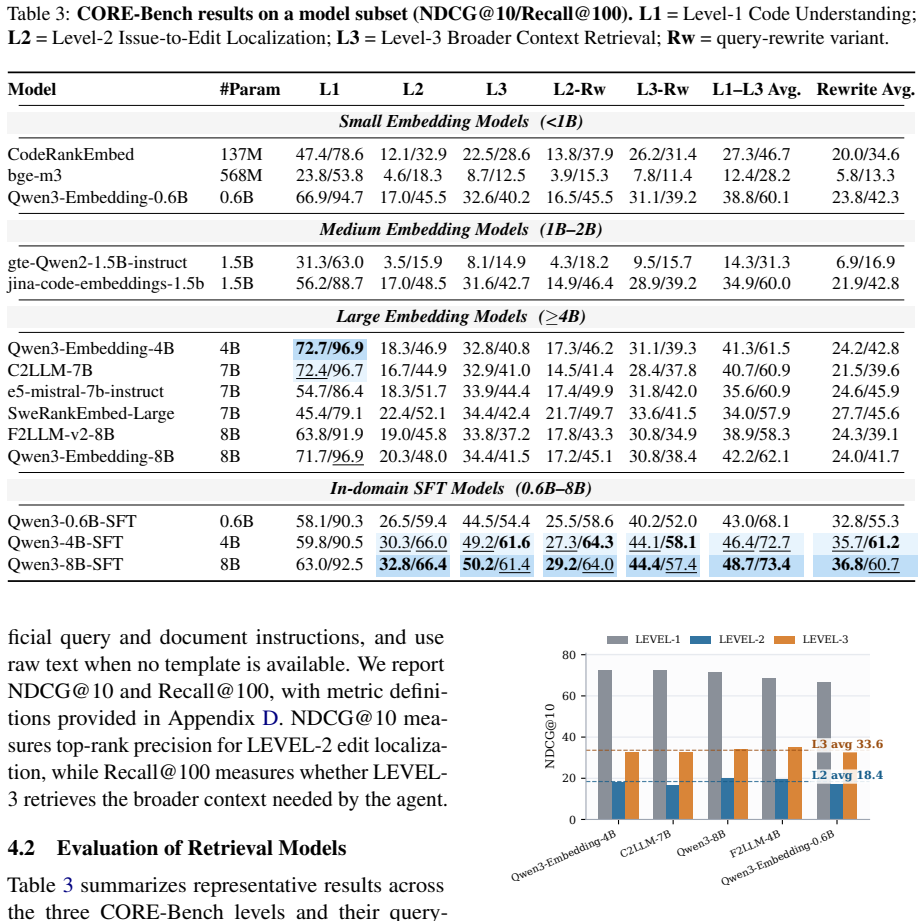
Requirement-driven repository search for agentic coding is much harder than traditional code search: representative embedding models that score well on foundational code understanding drop sharply on issue-to-edit localization and broader context retrieval, while simple in-domain fine-tuning on pull-request supervision improves those agentic levels but still leaves a large remaining gap.
What carries the argument
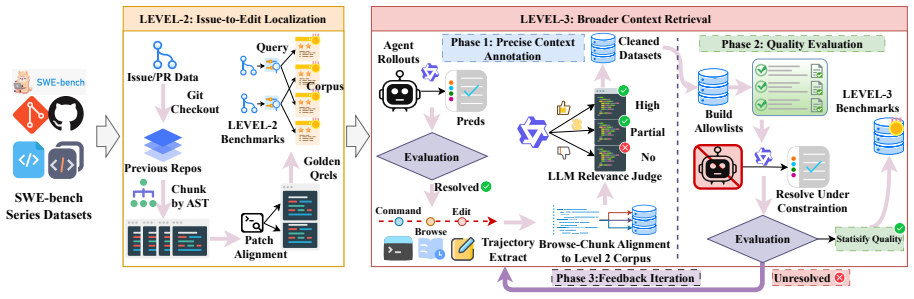
CORE-Bench, a three-level retrieval benchmark: Level-1 code understanding, Level-2 issue-to-edit localization from pre-change repository snapshots and patch-aligned chunks, and Level-3 broader context retrieval labeled via agent browse trajectories, multi-model relevance judging, and allowlist-based usefulness checks.
Load-bearing premise
The paper treats broader-context labels as functionally useful mainly because they come from agent browsing plus LLM votes and because agents resolve more tasks when restricted to those labels than to edit-only labels.
What would settle it
If independent coding agents, given only Level-3 labels versus only Level-2 labels or human-curated context, do not resolve more tasks under the Level-3 set, or if re-judged relevance on held-out trajectories shows high noise, the claim that Level-3 measures agent-useful context would fail.
Editorial analysis
A structured set of objections, weighed in public.
Referee Report
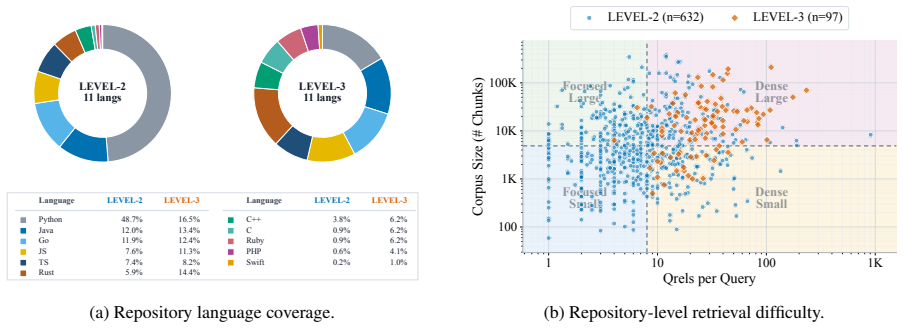
Summary. The paper introduces CORE-Bench, a three-level code-retrieval benchmark aimed at agentic coding rather than isolated snippet matching. Level-1 curates traditional code-understanding retrieval tasks; Level-2 converts SWE-bench-series instances into issue-to-edit localization over pre-PR repository snapshots with patch-aligned chunk labels; Level-3 expands targets to broader supporting context via Mini-SWE-Agent browse traces, multi-LLM relevance voting, and allowlist-based functional checks. Across sparse and dense embedding models, the authors report a large drop from Level-1 to Levels 2/3, and show that simple in-domain SFT on non-SWE-bench pull-request supervision substantially improves Level-2/3 scores while leaving a remaining gap. The resource is large (≈180K queries; 106K Level-3 qrels) and includes rewrite variants, multi-language coverage, and difficulty-regime splits.
Significance. If the construction and evaluation hold, CORE-Bench fills a real and timely gap: existing code-search suites (CodeSearchNet, CoIR, many MTEB code tasks) do not stress requirement-driven search over concrete repository states with local distractors and multi-location targets. Level-2 alone is already a useful, patch-grounded localization benchmark for retrievers used by coding agents. The multi-model comparison, language/difficulty breakdowns, and PR-based SFT results are concrete contributions that can steer embedding work beyond docstring-style matching. Strengths include explicit construction steps (pre-PR checkout, AST/LangChain chunking, patch alignment), repository-level evaluation protocol, and open release of the dataset. The main significance risk is that Level-3’s novelty depends on how faithfully trajectory-derived labels measure agent-useful context rather than agent-browsed text.
major comments (3)
- §3.2.3 and Table 11: Level-3 is the paper’s main extension beyond edit localization, but its functional validation is only relative (higher allowlist resolve rate under L3 vs L2) and confounded by a more restricted agent environment than the full Mini-SWE-Agent run. The manuscript also retains unresolved trajectories after LLM judging and includes partial/adjacent context. As written, Level-3 can measure recovery of annotator-agent browse sets more than independently necessary context. Please either (i) add a human-validated sample of Level-3 qrels with inter-annotator agreement and precision estimates, (ii) report stricter necessity-style ablations (e.g., remove random subsets of L3 labels and re-measure resolve rate), or (iii) substantially narrow the claim language so Level-3 is presented as trajectory-supported context coverage with known proxy limitations.
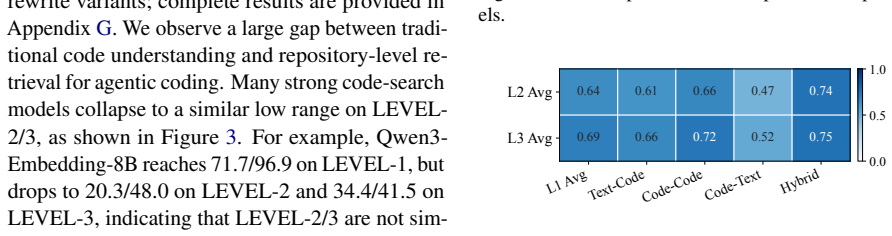
- §4.2 / Table 3 and the abstract’s “sharp drop … substantial room for further progress” claim: the Level-1→Level-2 drop is well supported by patch-aligned labels and is load-bearing. The Level-1→Level-3 drop and SFT gains on Level-3 inherit the label-quality uncertainty above, especially given denser multi-target qrels (41.27 Rels/Q) and emphasis on Recall@100. Separate the main quantitative claims: report Level-2 as the primary agentic result, and Level-3 as secondary with explicit sensitivity analysis (high-only vs high+partial labels; edit-only vs expanded targets). Without that separation, the headline gap can over-read a partially circular proxy.
- §3.4 / Appendix B: in-domain SFT uses PR descriptions with patch-aligned positives and repository-local hard negatives from 628 repos outside the SWE-bench family. This is a good design, but the paper needs a clearer leakage and distribution check: overlap of organizations/projects with evaluation repos, temporal cutoff relative to SWE-bench instances, and whether SFT gains are driven by identifier/path memorization versus requirement-conditioned ranking. A simple control (e.g., path-shuffled or identifier-ablated evaluation, or training with only lexical BM25 hard negatives vs random) would make the “substantial improvement / remaining gap” conclusion more credible.
Circularity Check
No derivation circularity: CORE-Bench is an empirical IR benchmark with patch-aligned Level-2 labels, trajectory-derived Level-3 labels independent of the embedding models under test, and disjoint-repo SFT.
full rationale
CORE-Bench does not claim a first-principles derivation whose conclusion is forced by its inputs. Level-2 qrels are constructed by checking out pre-PR repository states and aligning PR patches to AST/LangChain chunks (Section 3.2.2); those labels are historical edit locations, not quantities fitted from the embedding models being scored. Level-3 qrels come from Mini-SWE-Agent browse traces plus multi-LLM relevance votes and are validated by allowlist resolve-rate comparisons (Section 3.2.3, Table 11); the annotators are generative agents/judges (Qwen3.5-397B-A17B, Claude Sonnet 4.6), not the dual-encoder embedding baselines in Table 3. In-domain SFT uses PR supervision from repositories outside the SWE-bench family (Section 3.4, Appendix B), so train and eval corpora are designed to be disjoint. Reported metrics are standard NDCG@10 and Recall@100. The observed Level-1→Level-2/3 performance drop and SFT gains are empirical comparisons, not predictions that reduce by construction to fitted parameters or self-defined targets. Concerns that Level-3 may over-weight agent-browsed rather than strictly necessary context are measurement-validity issues, not circular reductions of the form 'prediction = input by definition.' No self-definitional loop, fitted-input-as-prediction, load-bearing self-citation uniqueness claim, or renamed known result appears in the load-bearing chain.
Axiom & Free-Parameter Ledger
free parameters (4)
- InfoNCE temperature τ and 1:8 positive-to-negative training ratio
- 64 repository-local hard negatives per query
- Three SFT epochs and chosen Qwen3-Embedding base scales
- LLM relevance vote threshold / ensemble (two Qwen votes + one Claude vote)
axioms (4)
- domain assumption Patch-aligned pre-PR chunks are the correct gold targets for issue-to-edit localization.
- domain assumption Files browsed by a coding agent during resolution attempts, after LLM relevance filtering, constitute useful broader context for completing the change.
- domain assumption NDCG@10 and Recall@100 on embedding retrieval are informative proxies for usefulness inside agentic coding workflows.
- standard math Standard dual-encoder similarity and InfoNCE-style contrastive learning are appropriate training/evaluation formalisms.
invented entities (2)
-
CORE-Bench three-level evaluation hierarchy (L1/L2/L3)
no independent evidence
-
Automated Level-3 broader-context annotation pipeline with allowlist validation
no independent evidence
read the original abstract
Code retrieval is becoming central to coding agents, but agentic coding requires more than matching a natural-language query to an isolated snippet. Given a user request, a coding agent needs to navigate a concrete repository state, locate relevant files and functions, gather supporting context, and filter similar in-repository distractors. Existing code retrieval benchmarks mainly evaluate docstring-to-function or snippet-level matching, thereby missing this requirement-driven repository search problem. To address this gap, we introduce CORE-Bench, a comprehensive benchmark for code retrieval in the era of agentic coding. CORE-Bench evaluates code retrieval ability at three levels: code understanding, issue-to-edit localization, and broader context retrieval. Built from curated code-search tasks and SWE-bench-series instances, CORE-Bench contains over 180K queries and 106K broader-context relevance labels. Experiments with representative embedding models show a sharp drop from traditional code search to code retrieval in agentic coding settings. Simple supervised fine-tuning of existing embedding models significantly improves performance in this setting, suggesting substantial room for further progress.
Figures
Forward citations
Cited by 1 Pith paper
-
Agent Retrieval Bench: Evaluating Repository Context Retrieval for Coding Agents
A 427-sample workflow-grounded benchmark finds complementary strengths across lexical, structural, and embedding retrieval for coding-agent context acquisition, with large residual miss rates and a selective-abstentio...
Reference graph
Works this paper leans on
-
[1]
Junjie Huang, Duyu Tang, Linjun Shou, Ming Gong, Ke Xu, Daxin Jiang, Ming Zhou, and Nan Duan
Measuring coding challenge competence with apps.arXiv preprint arXiv:2105.09938. Junjie Huang, Duyu Tang, Linjun Shou, Ming Gong, Ke Xu, Daxin Jiang, Ming Zhou, and Nan Duan
-
[2]
Cosqa: 20,000+ web queries for code search and question answering. InProceedings of the 59th Annual Meeting of the Association for Computational Linguistics and the 11th International Joint Confer- ence on Natural Language Processing (Volume 1: Long Papers), pages 5690–5700. Hamel Husain, Ho-Hsiang Wu, Tiferet Gazit, Mil- tiadis Allamanis, and Marc Brocks...
Pith/arXiv arXiv 2019
-
[3]
Niklas Muennighoff, Nouamane Tazi, Loïc Magne, and Nils Reimers
Codexglue: A machine learning benchmark dataset for code understanding and generation.arXiv preprint arXiv:2102.04664. Niklas Muennighoff, Nouamane Tazi, Loïc Magne, and Nils Reimers. 2023. Mteb: Massive text embedding benchmark. InProceedings of the 17th Conference of the European Chapter of the Association for Com- putational Linguistics, pages 2014–203...
Pith/arXiv arXiv 2023
-
[4]
Stephen Robertson and Hugo Zaragoza
Swerank: Software issue localization with code ranking.arXiv preprint arXiv:2505.07849. Stephen Robertson and Hugo Zaragoza. 2009. The probabilistic relevance framework: Bm25 and be- yond.Foundations and Trends in Information Re- trieval, 3(4):333–389. Tarun Suresh, Revanth Gangi Reddy, Yifei Xu, Zach Nussbaum, Andriy Mulyar, Brandon Duderstadt, and Heng ...
Pith/arXiv arXiv 2009
-
[5]
InFindings of the Association for Computational Linguistics: ACL 2024, pages 12834–12859
Opencodeinterpreter: Integrating code gener- ation with execution and refinement. InFindings of the Association for Computational Linguistics: ACL 2024, pages 12834–12859. A Detailed Dataset Statistics Table 8 reports the sub-dataset-level statistics for all three CORE-Bench levels behind the aggregate summary in Table 1. LEVEL-1.LEVEL-1 brings together s...
2024
-
[6]
They provide a controlled general-embedding family for testing how model scale affects zero- shot transfer to agentic code retrieval before any in-domain adaptation
are public Qwen3-Embedding models. They provide a controlled general-embedding family for testing how model scale affects zero- shot transfer to agentic code retrieval before any in-domain adaptation. Code-oriented models. • CodeRankEmbed(Suresh et al., 2025) is a 137M bi-encoder trained for code retrieval us- ing contrastive data from CoRNStack. It is a ...
2025
-
[7]
delete()on instances of models without dependencies does not clear PKs
are Jina Code Embeddings checkpoints built from Qwen2.5-Coder backbones. They sup- port multiple code retrieval directions, including natural-language-to-code and code-to-code. • C2LLM-7B(Qin et al., 2025) is a code con- trastive LLM for code retrieval with adaptive cross-attention pooling. • SweRankEmbed-Large(Reddy et al., 2025) is a 7B issue-localizati...
2025
-
[8]
Fix #1234
FILTER_MEANINGLESS: The query is meaningless, underspecified, non-actionable, or has no substantive problem content. Examples: - Only contains an issue/PR number, such as "Fix #1234" or "Closes #567". - Contains only boilerplate template text with no filled content. - Is extremely short with no actionable information, such as "update", "fix", or "bug". - ...
-
[9]
Examples: - Explicitly mentions which file(s) to modify
FILTER_ANSWER_LEAK: The query already reveals the solution, making code retrieval trivial. Examples: - Explicitly mentions which file(s) to modify. - Describes exact code changes or diffs. - Provides the fix implementation in the description. - Names specific functions/methods/classes to change AND describes the exact change. Note: Simply mentioning a mod...
-
[10]
verdict":
KEEP: The query is a valid, meaningful problem description with enough issue-specific signal for retrieval and does not reveal the answer. Respond with ONLY a JSON object in this exact format: {"verdict": "FILTER_MEANINGLESS" | "FILTER_ANSWER_LEAK" | "KEEP", "reason": "<brief reason in English>"} [User prompt template] Query ID: <query_id> Query text: <qu...
discussion (0)
Sign in with ORCID, Apple, or X to comment. Anyone can read and Pith papers without signing in.