From Topological Order to Mixed-State Phases: A Ground-State Probe of Fractionalized Excitations
Pith reviewed 2026-06-27 08:15 UTC · model grok-4.3
The pith
The reduced density matrix of a 2D topologically ordered ground state at an entanglement cut realizes a 1D mixed-state phase whose correlations encode anyon deconfinement.
A machine-rendered reading of the paper's core claim, the machinery that carries it, and where it could break.
Core claim
The RDM of a 2D topologically ordered system expressed at the entanglement cut realizes a 1D mixed-state phase. For the Z2 toric code this is a Z2 strong-to-weak spontaneous symmetry breaking phase in which deconfinement of anyons manifests as short-range correlation of both Z2 charge and Z2 domain-wall operators inside the RDM; the bulk e-m duality translates into Kramers-Wannier self-duality of this SW-SSB phase. In gapped Z2 spin liquids the global spin-rotation symmetry appears as an extra weak symmetry of the RDM, and spin-1/2 spinons produce a cusp in the associated disorder parameter at theta equals pi.
What carries the argument
The reduced density matrix (RDM) obtained across an entanglement cut, which functions as a 1D mixed-state density operator whose symmetry-breaking patterns and correlation lengths detect bulk anyonic deconfinement and symmetry fractionalization.
If this is right
- Anyon deconfinement becomes detectable from ground-state data alone via RDM correlation functions.
- The Kramers-Wannier self-duality of the 1D SW-SSB phase directly reflects the bulk e-m duality.
- Symmetry fractionalization of spin-1/2 spinons appears as a cusp at theta equals pi in the spin-rotation disorder parameter.
- The observable works for any wavefunction that can be prepared or represented, including those from quantum simulators.
Where Pith is reading between the lines
- The same RDM construction may apply to other Abelian topological orders by identifying the appropriate 1D mixed-state phase for each anyon type.
- Tensor-network representations of the ground state could be used to extract the RDM correlations efficiently without full wavefunction storage.
- The approach offers a route to distinguish different gapped spin-liquid phases that share the same topological order but differ in symmetry fractionalization patterns.
Load-bearing premise
The bulk electric-magnetic duality of the two-dimensional topological order continues to act as a Kramers-Wannier self-duality on the one-dimensional mixed-state phase realized by the reduced density matrix.
What would settle it
Compute the RDM correlations for a known deconfined Z2 spin liquid and check whether both the Z2 charge and domain-wall operators exhibit strictly short-range correlations; long-range order in either would falsify the claimed correspondence between anyon deconfinement and RDM behavior.
Figures
read the original abstract
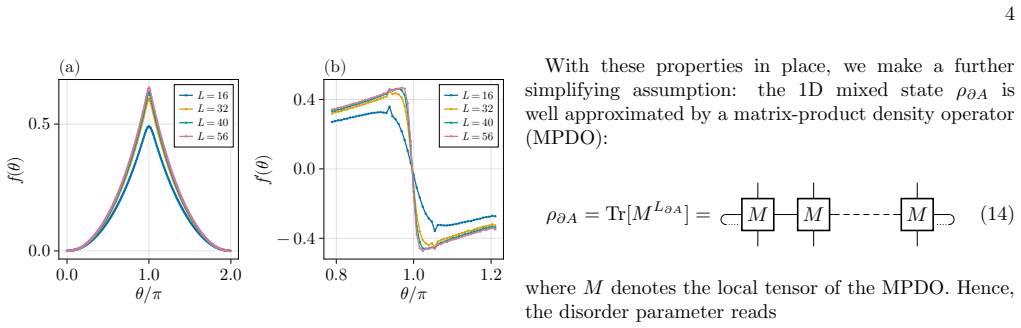
How do we detect topological phases from a single ground state? Entanglement entropy and spectrum have long been the standard tools -- but the reduced density matrix (RDM) itself contains far more information. We show that the RDM of a 2D topologically ordered system, expressed at the entanglement cut, realizes a 1D mixed-state phase. For the $\mathbb{Z}_2$ toric code phase, it is a 1D $\mathbb{Z}_2$ strong-to-weak spontaneous symmetry breaking (SW-SSB) phase, where deconfinement of anyons manifests as the short-range correlation of both $\mathbb{Z}_2$ charge and $\mathbb{Z}_2$ domain-wall in the RDM. The bulk $e$-$m$ duality translates into a Kramers--Wannier self-duality of the SW-SSB phase. Extending the framework to gapped $\mathbb{Z}_2$ spin liquids, the global spin-rotation symmetry manifests as an additional weak symmetry for the 1D RDM. Spin-$\frac{1}{2}$ spinons result in a cusp on the disorder parameter of spin-rotation at $\theta=\pi$, providing a direct, ground-state signature of symmetry fractionalization. We verify this prediction analytically using the matrix product density operator formalism and numerically for the kagome-lattice resonating valence bond state. The proposed observable requires only a single ground-state wavefunction, making it amenable to quantum simulation platforms.
Editorial analysis
A structured set of objections, weighed in public.
Referee Report
Summary. The manuscript claims that the reduced density matrix (RDM) of a 2D topologically ordered ground state, evaluated at an entanglement cut, realizes a 1D mixed-state phase. For the Z2 toric code, this is a Z2 strong-to-weak spontaneous symmetry breaking (SW-SSB) phase in which anyon deconfinement appears as short-range correlations of both Z2 charge and domain-wall operators; the bulk e-m duality maps to Kramers-Wannier self-duality of the 1D phase. For gapped Z2 spin liquids the global spin-rotation symmetry becomes a weak symmetry of the RDM, and spin-1/2 spinons produce a cusp in the spin-rotation disorder parameter at θ=π. These signatures are derived analytically via the matrix-product density operator (MPDO) representation for the toric-code case and confirmed numerically on the kagome RVB state.
Significance. If the central mapping holds, the work supplies a concrete, single-wave-function diagnostic for topological order and symmetry fractionalization that directly links 2D anyon physics to 1D mixed-state order. The explicit analytic construction of the duality and the numerical cross-check on the kagome RVB state constitute reproducible, falsifiable content that strengthens the contribution beyond abstract assertions.
minor comments (3)
- The abstract introduces the acronym MPDO without expansion; the first occurrence in the main text should spell out “matrix-product density operator.”
- [Numerical verification] The numerical section on the kagome RVB state reports a cusp at θ=π but does not state the bond dimension or number of samples used; adding these details would improve reproducibility.
- [Spin-liquid extension] Notation for the disorder parameter (e.g., whether it is normalized by system size or defined via a specific correlator) should be stated explicitly when first introduced.
Simulated Author's Rebuttal
We thank the referee for their positive assessment of our work and for recommending minor revision. We appreciate their recognition that the analytic construction and numerical verification on the kagome RVB state provide reproducible content linking 2D anyon physics to 1D mixed-state order.
Circularity Check
No significant circularity; derivation is self-contained
full rationale
The paper constructs the claimed mapping from 2D topological order to 1D mixed-state SW-SSB phase directly via the reduced density matrix at the entanglement cut, using an explicit analytic derivation in the matrix product density operator formalism for the toric-code case together with a numerical verification on the kagome RVB state that reproduces the predicted cusp in the disorder parameter. Both the duality translation to Kramers-Wannier self-duality and the fractionalization signature are built from the RDM properties and symmetry considerations rather than fitted parameters or self-citation chains. No load-bearing step reduces by construction to the paper's own inputs; the central claim rests on independently verifiable analytic and numerical content.
Axiom & Free-Parameter Ledger
axioms (1)
- domain assumption The reduced density matrix of a 2D topologically ordered system at an entanglement cut realizes a 1D mixed-state phase whose correlations encode bulk anyon properties.
Reference graph
Works this paper leans on
-
[1]
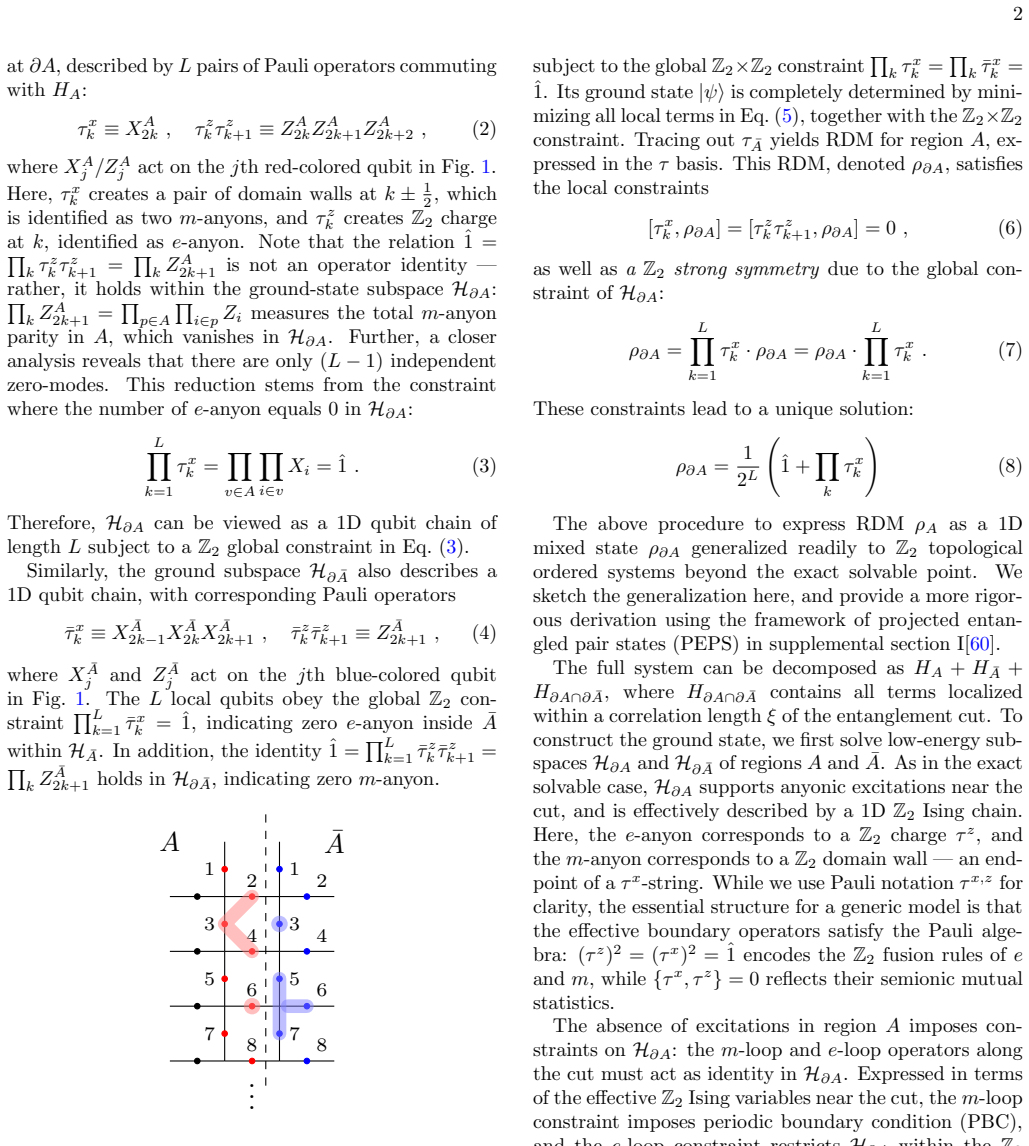
We verify this prediction numerically us- ing the nearest-neighbor resonating valence bond (NN- RVB) state on the kagome lattice. This provides a di- rect, ground-state probe of spinons that requires only a single wavefunction, which is readily implementable on quantum simulation platforms. RDM of the Toric Code Phase.We start by deriv- ing the RDM as a o...
Pith/arXiv arXiv 2026
-
[2]
PBC, signaling zerom
-
[3]
volume-law
Exponential decay of bothZ 2 charge andZ 2 domain-wall correlators (Eq. (10)), signaling anyon deconfinement. Notably, property 3 cannot occur in any pure ground state(s) of aZ 2 symmetric Ising chains[37]. We define the 1D strongZ 2 symmetricρ ∂A whose cor- relation function satisfies Eq. (10) as thestrong-to-weak spontaneous symmetry breaking(SW-SSB) mi...
-
[4]
Wen, Topological orders in rigid states, Interna- tional Journal of Modern Physics B4, 239 (1990)
X.-G. Wen, Topological orders in rigid states, Interna- tional Journal of Modern Physics B4, 239 (1990)
1990
-
[5]
A. Y. Kitaev, Fault-tolerant quantum computation by anyons, Annals of physics303, 2 (2003)
2003
-
[6]
Kitaev, Anyons in an exactly solved model and be- yond, Annals of Physics321, 2 (2006)
A. Kitaev, Anyons in an exactly solved model and be- yond, Annals of Physics321, 2 (2006)
2006
-
[7]
Wen, Colloquium: Zoo of quantum-topological phases of matter, Rev
X.-G. Wen, Colloquium: Zoo of quantum-topological phases of matter, Rev. Mod. Phys.89, 041004 (2017)
2017
-
[8]
X. G. Wen and Q. Niu, Ground-state degeneracy of the fractional quantum hall states in the presence of a ran- dom potential and on high-genus riemann surfaces, Phys. Rev. B41, 9377 (1990)
1990
-
[9]
Kitaev and J
A. Kitaev and J. Preskill, Topological entanglement en- tropy, Phys. Rev. Lett.96, 110404 (2006)
2006
-
[10]
Levin and X.-G
M. Levin and X.-G. Wen, Detecting topological order in a ground state wave function, Phys. Rev. Lett.96, 110405 (2006)
2006
-
[11]
Li and F
H. Li and F. D. M. Haldane, Entanglement spectrum as a generalization of entanglement entropy: Identification of topological order in non-abelian fractional quantum hall effect states, Phys. Rev. Lett.101, 010504 (2008)
2008
-
[12]
J. I. Cirac, D. Poilblanc, N. Schuch, and F. Verstraete, Entanglement spectrum and boundary theories with projected entangled-pair states, Physical Review B83, 10.1103/physrevb.83.245134 (2011)
-
[14]
de Groot, A
C. de Groot, A. Turzillo, and N. Schuch, Symmetry Pro- tected Topological Order in Open Quantum Systems, Quantum6, 856 (2022)
2022
-
[15]
Ma and C
R. Ma and C. Wang, Average symmetry-protected topo- logical phases, Phys. Rev. X13, 031016 (2023)
2023
-
[16]
J. Y. Lee, C.-M. Jian, and C. Xu, Quantum criticality under decoherence or weak measurement, PRX quantum 4, 030317 (2023)
2023
-
[17]
Chen and T
Y.-H. Chen and T. Grover, Symmetry-enforced many- body separability transitions, PRX Quantum5, 030310 (2024)
2024
-
[18]
S. Sang, Y. Zou, and T. H. Hsieh, Mixed-state quantum phases: Renormalization and quantum error correction, Physical Review X14, 031044 (2024)
2024
-
[19]
Ma and A
R. Ma and A. Turzillo, Symmetry-protected topological phases of mixed states in the doubled space, PRX Quan- tum6, 010348 (2025)
2025
-
[20]
Ma, J.-H
R. Ma, J.-H. Zhang, Z. Bi, M. Cheng, and C. Wang, Topological phases with average symmetries: The deco- hered, the disordered, and the intrinsic, Phys. Rev. X15, 021062 (2025)
2025
-
[21]
L. A. Lessa, R. Ma, J.-H. Zhang, Z. Bi, M. Cheng, and C. Wang, Strong-to-weak spontaneous symmetry break- ing in mixed quantum states, PRX Quantum6, 010344 (2025)
2025
-
[22]
S. Sang, L. A. Lessa, R. S. K. Mong, T. Grover, C. Wang, and T. H. Hsieh, Mixed-state phases from local reversibil- ity (2025), arXiv:2507.02292 [quant-ph]
arXiv 2025
- [23]
-
[24]
S. Schafer-Nameki, A. Tiwari, A. Warman, and C. Zhang, SymTFT approach for mixed states with non-invertible symmetries, arXiv:2507.05350 (2025), 2507.05350
arXiv 2025
-
[25]
M. Qi, R. Sohal, X. Chen, D. T. Stephen, and A. Prem, The symmetry taco: Equivalences between gapped, gap- less, and mixed-state SPTs, arXiv:2507.05335 (2025), 2507.05335
arXiv 2025
- [26]
-
[27]
C. Xu, Y. Zang, Y. Ma, Y. Gu, and S. Jiang, Diagnosing 2d symmetry protected topological states via mixed state anomaly, arXiv preprint arXiv:2506.13096 (2025)
arXiv 2025
-
[28]
Y. Ma, C. Xu, and S. Jiang, Measurement protocol for detecting correlated topological insulators in synthetic quantum systems, arXiv preprint arXiv:2511.10163 (2025)
arXiv 2025
-
[29]
P. Sala, S. Gopalakrishnan, M. Oshikawa, and Y. You, Spontaneous strong symmetry breaking in open sys- tems: Purification perspective, Phys. Rev. B110, 155150 (2024)
2024
-
[30]
S. Lu, P. Zhu, and Y.-M. Lu, Bilayer construction for mixed state phenomena with strong, weak symmetries and symmetry breakings (2024), arXiv:2411.07174 [cond- mat.str-el]
arXiv 2024
-
[31]
Z. Liu, L. Chen, Y. Zhang, S. Zhou, and P. Zhang, Diag- nosing strong-to-weak symmetry breaking via wightman correlators, Communications Physics8, 274 (2025)
2025
-
[32]
Weinstein, Efficient detection of strong-to-weak spon- taneous symmetry breaking via the r´ enyi-1 correlator, Phys
Z. Weinstein, Efficient detection of strong-to-weak spon- taneous symmetry breaking via the r´ enyi-1 correlator, Phys. Rev. Lett.134, 150405 (2025)
2025
-
[33]
F. Divi, L. A. Lessa, and C. Wang, Local strong- to-weak spontaneous symmetry breaking (2026), arXiv:2605.28967 [quant-ph]
Pith/arXiv arXiv 2026
-
[34]
C. Zhang, Local diagnostics for strong-to-weak spon- taneous symmetry breaking and non-equilibrium phase transitions (2026), arXiv:2605.29113 [quant-ph]
Pith/arXiv arXiv 2026
-
[35]
R. Liu, J. Yi, and D. V. Else, A local description of strong 7 symmetries and strong-to-weak symmetry breaking in quantum many-body systems (2026), arXiv:2605.28925 [quant-ph]
Pith/arXiv arXiv 2026
-
[36]
V. V. Albert and L. Jiang, Symmetries and conserved quantities in lindblad master equations, Phys. Rev. A 89, 022118 (2014)
2014
-
[37]
Gaiotto, A
D. Gaiotto, A. Kapustin, N. Seiberg, and B. Willett, Generalized global symmetries, Journal of High Energy Physics2015, 172 (2015)
2015
-
[38]
Ji and X.-G
W. Ji and X.-G. Wen, Categorical symmetry and nonin- vertible anomaly in symmetry-breaking and topological phase transitions, Phys. Rev. Res.2, 033417 (2020)
2020
-
[39]
L. P. Kadanoff and H. Ceva, Determination of an oper- ator algebra for the two-dimensional ising model, Phys. Rev. B3, 3918 (1971)
1971
-
[40]
Levin, Constraints on order and disorder parameters in quantum spin chains: M
M. Levin, Constraints on order and disorder parameters in quantum spin chains: M. levin, Communications in Mathematical Physics378, 1081 (2020)
2020
-
[41]
H. A. Kramers and G. H. Wannier, Statistics of the two-dimensional ferromagnet. part i, Phys. Rev.60, 252 (1941)
1941
-
[42]
L. Li, Z. Bi, and W. Cao, Generalized symmetry- protected topological phases in mixed states from gaug- ing dualities, arXiv:2603.17282 (2026), 2603.17282
arXiv 2026
-
[43]
Anderson, Resonating valence bonds: A new kind of insulator?, Materials Research Bulletin8, 153 (1973)
P. Anderson, Resonating valence bonds: A new kind of insulator?, Materials Research Bulletin8, 153 (1973)
1973
-
[44]
S. Sachdev, Kagom´ e-and triangular-lattice heisenberg antiferromagnets: Ordering from quantum fluctuations and quantum-disordered ground states with unconfined bosonic spinons, Physical Review B45, 12377 (1992)
1992
-
[45]
Wen, Quantum orders and symmetric spin liquids, Physical Review B65, 165113 (2002)
X.-G. Wen, Quantum orders and symmetric spin liquids, Physical Review B65, 165113 (2002)
2002
-
[46]
L. Savary and L. Balents, Quantum spin liquids: a re- view, Rep. Prog. Phys.80, 016502 (2017), 1601.03742
Pith/arXiv arXiv 2017
-
[47]
Barkeshli, P
M. Barkeshli, P. Bonderson, M. Cheng, and Z. Wang, Symmetry fractionalization, defects, and gauging of topological phases, Phys. Rev. B100, 115147 (2019)
2019
-
[48]
Chen, Symmetry fractionalization in two dimensional topological phases, Reviews in Physics2, 3–18 (2017)
X. Chen, Symmetry fractionalization in two dimensional topological phases, Reviews in Physics2, 3–18 (2017)
2017
-
[49]
Wang, T.-G
C.-Y. Wang, T.-G. Zhou, Y.-N. Zhou, and P. Zhang, Distinguishing quantum phases through cusps in full counting statistics, Physical Review Letters133, 083402 (2024)
2024
-
[50]
Chen, H.-H
B.-B. Chen, H.-H. Tu, Z. Y. Meng, and M. Cheng, Topo- logical disorder parameter: A many-body invariant to characterize gapped quantum phases, Phys. Rev. B106, 094415 (2022)
2022
-
[51]
Huang, X.-Q
Z.-M. Huang, X.-Q. Sun, and S. Diehl, Topological gauge theory for mixed dirac stationary states in all dimensions, Physical Review B106, 245204 (2022)
2022
-
[52]
Cai and M
K.-L. Cai and M. Cheng, Universal contributions to charge fluctuations in spin chains at finite temperature, Phys. Rev. B111, 205104 (2025)
2025
-
[53]
Liu, Z.-C
Z.-X. Liu, Z.-C. Gu, and X.-G. Wen, Microscopic real- ization of 2-dimensional bosonic topological insulators, Phys. Rev. Lett.113, 267206 (2014)
2014
-
[54]
Jiang, B.-B
W. Jiang, B.-B. Chen, Z. H. Liu, J. Rong, and F. F. Assaad, Many versus one: The disorder operator and entanglement entropy in fermionic quantum matter, Sci- Post Phys.15, 082 (2023)
2023
-
[55]
Cai and M
K.-L. Cai and M. Cheng, Disorder operators in two- dimensional fermi and non-fermi liquids through mul- tidimensional bosonization, Phys. Rev. B112, 155123 (2025)
2025
-
[56]
L. Mao, H. Zhai, and F. Yang, Probing the topology of fermionic gaussian mixed states with u (1) symmetry by full counting statistics, Chinese Physics Letters42, 067401 (2025)
2025
-
[57]
Huang and S
Z.-M. Huang and S. Diehl, Mixed-state topological or- der parameters for symmetry-protected fermion matter, Physical Review Research7, 033028 (2025)
2025
-
[58]
Huang and S
Z.-M. Huang and S. Diehl, Interaction-induced topolog- ical phase transition at finite temperature, Physical Re- view Letters134, 053002 (2025)
2025
-
[59]
W. W. Ho, L. Cincio, H. Moradi, D. Gaiotto, and G. Vi- dal, Edge-entanglement spectrum correspondence in a nonchiral topological phase and kramers-wannier dual- ity, Phys. Rev. B91, 125119 (2015)
2015
-
[60]
See Supplemental Materials for details
-
[61]
Fradkin and S
E. Fradkin and S. H. Shenker, Phase diagrams of lattice gauge theories with higgs fields, Phys. Rev. D19, 3682 (1979)
1979
-
[62]
Haegeman, V
J. Haegeman, V. Zauner, N. Schuch, and F. Verstraete, Shadows of anyons and the entanglement structure of topological phases, Nature communications6, 8284 (2015)
2015
-
[63]
T.-H. Han, J. S. Helton, S. Chu, D. G. Nocera, J. A. Rodriguez-Rivera, C. Broholm, and Y. S. Lee, Fraction- alized excitations in the spin-liquid state of a kagome- lattice antiferromagnet, Nature492, 406 (2012)
2012
-
[64]
Lu and Y.-M
S. Lu and Y.-M. Lu, Detecting symmetry fractionaliza- tion in gapped quantum spin liquids by magnetic impu- rities, Phys. Rev. B110, L100401 (2024)
2024
-
[65]
Zhang, Y
C. Zhang, Y. Xu, J.-H. Zhang, C. Xu, Z. Bi, and Z.-X. Luo, Strong-to-weak spontaneous breaking of 1- form symmetry and intrinsically mixed topological order, Physical Review B111, 115137 (2025)
2025
-
[66]
L. Kong, T. Lan, X.-G. Wen, Z.-H. Zhang, and H. Zheng, Algebraic higher symmetry and categorical symmetry: A holographic and entanglement view of symmetry, Physi- cal Review Research2, 043086 (2020)
2020
-
[67]
J. I. Cirac, D. Poilblanc, N. Schuch, and F. Verstraete, Entanglement spectrum and boundary theories with pro- jected entangled-pair states, Phys. Rev. B83, 245134 (2011)
2011
-
[68]
Schuch, I
N. Schuch, I. Cirac, and D. P´ erez-Garc´ ıa, PEPS as ground states: Degeneracy and topology, Annals of Physics325, 2153 (2010)
2010
-
[69]
Duivenvoorden, M
K. Duivenvoorden, M. Iqbal, J. Haegeman, F. Verstraete, and N. Schuch, Entanglement phases as holographic du- als of anyon condensates, Phys. Rev. B95, 235119 (2017)
2017
-
[70]
Huxford, D
J. Huxford, D. X. Nguyen, and Y. B. Kim, Gaining insights on anyon condensation and 1-form symmetry breaking across a topological phase transition in a de- formed toric code model, SciPost Phys.15, 253 (2023)
2023
- [71]
-
[72]
V. Zauner-Stauber, L. Vanderstraeten, M. T. Fishman, F. Verstraete, and J. Haegeman, Variational optimization algorithms for uniform matrix product states, Physical Review B97, 10.1103/physrevb.97.045145 (2018)
-
[73]
Schuch, D
N. Schuch, D. Poilblanc, J. I. Cirac, and D. P´ erez-Garc´ ıa, Resonating valence bond states in the peps formalism, Phys. Rev. B86, 115108 (2012)
2012
-
[74]
Z.-C. Gu, M. Levin, and X.-G. Wen, Tensor- entanglement renormalization group approach as a uni- 8 fied method for symmetry breaking and topological phase transitions, Physical Review B78, 10.1103/phys- revb.78.205116 (2008)
-
[75]
Heinrich, F
C. Heinrich, F. Burnell, L. Fidkowski, and M. Levin, Symmetry-enriched string nets: Exactly solvable models for set phases, Phys. Rev. B94, 235136 (2016)
2016
-
[76]
Cheng, Z.-C
M. Cheng, Z.-C. Gu, S. Jiang, and Y. Qi, Exactly solvable models for symmetry-enriched topological phases, Phys. Rev. B96, 115107 (2017)
2017
-
[77]
M. Iqbal, K. Duivenvoorden, and N. Schuch, Study of anyon condensation and topological phase transitions from a𭟋 4 topological phase using the projected en- tangled pair states approach, Phys. Rev. B97, 195124 (2018), 1712.04021. Supplemental Materials: From Topological Order to Mixed-State Phases: A Ground-State Probe of Fractionalized Excitations Yunlon...
Pith/arXiv arXiv 2018
-
[78]
RDM in the entanglement space 11
-
[79]
Fixed-point PEPS representation 12
-
[80]
Discussion on corner entanglement cut 14 II
General relation with SW-SSB 14 C. Discussion on corner entanglement cut 14 II. Comparing different definitions of SW-SSB phases 15 III. Kramers-Wannier transformation in the mixed-state phases and the bulke-mduality 17 IV. Details of Numerical Studies 18 A. Numerical verification of SW-SSB in the RDM of deformed toric code model 18 B. Disorder parameter ...
-
[81]
For a 2D gapped state described by a PEPS,H ∂A comprises the virtual legs along the entanglement cut, where dimH ∂A ∼χ L∂A, withχthe virtual bond dimension
RDM in the entanglement space We start by considering a generic bipartite tensor wavefunction, represented diagrammatically as |ψ⟩= Tr H∂A TA ⊗T ¯A = TA T ¯A ,(S9) where the trace is performed over the entanglement spaceH ∂A. For a 2D gapped state described by a PEPS,H ∂A comprises the virtual legs along the entanglement cut, where dimH ∂A ∼χ L∂A, withχth...
discussion (0)
Sign in with ORCID, Apple, or X to comment. Anyone can read and Pith papers without signing in.