New results on gauge field decomposition in SU(3) gluodynamics
Pith reviewed 2026-06-27 04:51 UTC · model grok-4.3
The pith
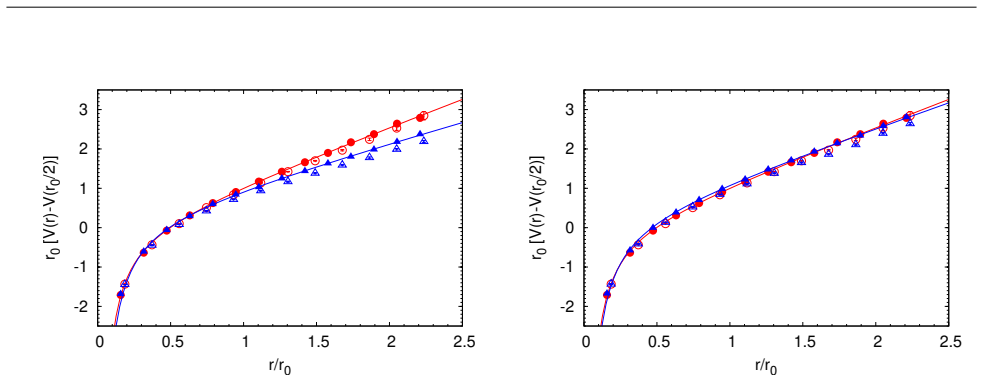
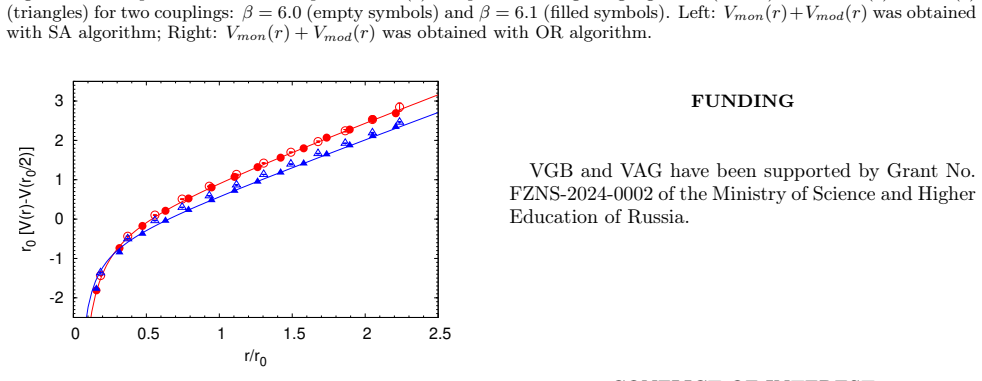
An alternative set of Gribov copies makes the monopole plus modified nonabelian decomposition of the static potential hold at all distances in SU(3) gluodynamics.
A machine-rendered reading of the paper's core claim, the machinery that carries it, and where it could break.
Core claim
The decomposition of the static potential V(r) into the sum of the monopole contribution V_mon and the modified nonabelian contribution V_mod is satisfied with good precision at all distances when an alternative set of Gribov copies is used in the Maximal Abelian gauge fixing.
What carries the argument
An alternative set of Gribov copies selected during Maximal Abelian gauge fixing, which restores the additive relation between the monopole and modified nonabelian static potentials.
If this is right
- The decomposition holds at both short and long distances rather than only asymptotically.
- The result is stable across two different lattice spacings.
- Standard optimal gauge fixing does not guarantee the additive decomposition.
- The choice among Gribov copies controls whether the monopole and modified components add to the full potential.
Where Pith is reading between the lines
- Different Gribov copies may correspond to distinct ways of isolating monopole effects that are relevant for confinement.
- One could test whether the same copy choice restores additivity for other observables such as the string tension or Polyakov loop correlators.
- The finding raises the question of which Gribov copy set should be regarded as the physically preferred one for studies of Abelian dominance.
Load-bearing premise
The alternative set of Gribov copies yields a physically meaningful decomposition rather than an artifact of the gauge-fixing procedure.
What would settle it
Recompute the three potentials using a third, independent ensemble of Gribov copies and check whether their sum still equals the full potential or deviates again.
Figures
read the original abstract
We study decomposition of the nonabelian gauge field into the Abelian component created by Abelian monopoles and the modified nonabelian components with monopoles removed after fixing the Maximal Abelian gauge in SU(3) lattice gluodynamics. We compute the static potential V (r) for the original gauge field and for its components V_mon and V_mod at two values of the lattice spacing. We confirm that with optimal gauge fixing the sum V_mon + V_mod deviates substantially from V(r). We show that this decomposition of the static potential is satisfied with good precision at all distances when we use another set of Gribov copies.
Editorial analysis
A structured set of objections, weighed in public.
Referee Report
Summary. The paper studies the decomposition of the non-Abelian gauge field into Abelian monopole and modified non-Abelian components in SU(3) lattice gluodynamics after Maximal Abelian gauge (MAG) fixing. Static potentials V(r), V_mon(r) and V_mod(r) are computed at two lattice spacings; the authors confirm that V_mon + V_mod deviates substantially from V(r) for optimal Gribov copies but agrees to good precision at all distances for another set of Gribov copies.
Significance. If the Gribov-copy selection is shown to be unbiased and independent of the potential observable, the result would indicate that the monopole decomposition of the static potential is sensitive to the choice among Gribov copies and could affect interpretations of Abelian dominance in confinement. The multi-spacing numerical test is a positive feature.
major comments (2)
- [abstract and gauge-fixing section] The selection rule for the 'another set of Gribov copies' (abstract and § on gauge fixing) is not stated explicitly as a procedure fixed in advance and independent of the static-potential observable. Without this, the reported agreement risks being an artifact of post-selection rather than evidence for a physically meaningful decomposition.
- [results section] No quantitative measure (e.g., integrated deviation, χ² per degree of freedom, or percentage deviation as function of r) is provided to substantiate 'good precision at all distances' for the second ensemble versus the optimal one (results section).
minor comments (2)
- [simulation details] Lattice parameters (β values, volumes, number of configurations, number of Gribov copies per configuration) should be tabulated for both ensembles.
- [throughout] Notation for the two ensembles ('optimal' versus 'another') should be defined once and used consistently.
Simulated Author's Rebuttal
We thank the referee for the careful reading of our manuscript and the constructive comments. We address each major comment below. We agree that additional clarity and quantitative support are needed and will revise the manuscript accordingly.
read point-by-point responses
-
Referee: [abstract and gauge-fixing section] The selection rule for the 'another set of Gribov copies' (abstract and § on gauge fixing) is not stated explicitly as a procedure fixed in advance and independent of the static-potential observable. Without this, the reported agreement risks being an artifact of post-selection rather than evidence for a physically meaningful decomposition.
Authors: We agree that the manuscript does not explicitly describe the selection rule for the alternative Gribov copies as a procedure fixed in advance and independent of the observable. The alternative copies were obtained using a distinct but related gauge-fixing criterion (lower value of the gauge-fixing functional compared to the optimal copies). To eliminate any ambiguity regarding post-selection, we will revise the gauge-fixing section to state the exact selection procedure explicitly, including that the criterion was chosen prior to the potential measurements and is independent of the static-potential observable. This will make the methodology transparent and strengthen the physical interpretation. revision: yes
-
Referee: [results section] No quantitative measure (e.g., integrated deviation, χ² per degree of freedom, or percentage deviation as function of r) is provided to substantiate 'good precision at all distances' for the second ensemble versus the optimal one (results section).
Authors: We agree that the results section would benefit from quantitative measures to support the statement of 'good precision at all distances'. In the revised version we will add the relative deviation |(V_mon(r) + V_mod(r) − V(r))/V(r)| plotted versus r for both ensembles, together with an integrated deviation measure over the available distance range. This will allow a direct, quantitative comparison between the optimal and alternative Gribov-copy results. revision: yes
Circularity Check
Direct numerical lattice computation with no load-bearing reductions
full rationale
The paper reports explicit lattice computations of the static potentials V(r), V_mon(r) and V_mod(r) after MAG fixing in SU(3) gluodynamics, comparing results across two lattice spacings and two classes of Gribov copies. The central observation—that V_mon + V_mod approximates V(r) for one copy ensemble but not the other—is presented as an empirical numerical outcome. No equations, fitted parameters, or self-citations are invoked that would make the reported agreement tautological by construction; the derivation chain consists of standard Monte-Carlo measurements and does not reduce the claimed result to its own inputs.
Axiom & Free-Parameter Ledger
Reference graph
Works this paper leans on
-
[1]
MAGwasintroducedin[1]withinthescopeof the dual superconductor scenario of confinement pro posed by G
INTRODUCTION We study properties of the maximal Abelian gauge (MAG) in 𝑆𝑈 (3) gluodynamics using lattice regular ization. MAGwasintroducedin[1]withinthescopeof the dual superconductor scenario of confinement pro posed by G. t’Hooft [2] and S. Mandelstam [3], see Refs. [4–6] for reviews. For𝑆𝑈 (3) gauge group the gauge is defined by minimization of the f...
-
[2]
DEFINITION OF THE GAUGE FIELD DECOMPOSITION We first make an Abelian projection of the gauge field configurations fixed to MAG. This means decom posing the non-Abelian gauge field 𝑈𝜇(𝑥) ∈ 𝑆𝑈 (3) into the product of the non-diagonal component 𝑈 𝑜𝑓 𝑓 𝑑 𝜇 (𝑥) ∈ 𝑆𝑈 (3)/𝑈 (1) × 𝑈 (1) and the diagonal com ponent 𝑈 𝐴𝑏𝑒𝑙 𝜇 (𝑥) ∈ 𝑈 (1) × 𝑈 (1) [13]: 𝑈𝜇(𝑥) = 𝑈 𝑜𝑓...
Pith/arXiv arXiv 2026
-
[3]
This algorithm was first used to fix MAG in the𝑆𝑈 (2) case [15] and then was extended to the𝑆𝑈 (3) group in [16]
NUMERICAL RESUL TS FOR THE ST A TIC POTENTIAL DECOMPOSITION We fixed MAG using the simulated annealing (SA) algorithm which is the optimal choice for MAG, as well as for other gauges that require minimization of the gauge fixing functional. This algorithm was first used to fix MAG in the𝑆𝑈 (2) case [15] and then was extended to the𝑆𝑈 (3) group in [16]. A ...
-
[4]
Here we presented results for two lattice spacings and for two sets of Gri bov copies for each lattice spacing
CONCLUSIONS We continued our study of the gauge field decompo sition into the monopole and the modified (monopole less) components after fixing MAG. Here we presented results for two lattice spacings and for two sets of Gri bov copies for each lattice spacing. With effective SA algorithm we obtained Gribov copies which do not sup port the decompositio...
2024
-
[5]
’t Hooft, Nucl
G. ’t Hooft, Nucl. Phys. B190 (1981) 455
1981
-
[6]
’t Hooft, inHigh Energy Physics, ed
G. ’t Hooft, inHigh Energy Physics, ed. A. Zichichi, EPS International Conference, Palermo (1975)
1975
-
[7]
Mandelstam, Phys
S. Mandelstam, Phys. Rept.23, 245 (1976)
1976
-
[8]
Greensite, Prog
J. Greensite, Prog. Part. Nucl. Phys.51 (2003), 1
2003
-
[9]
Suganuma, Handbook of Nuclear Physics, (Springer, Singapore, 2023) pp
H. Suganuma, Handbook of Nuclear Physics, (Springer, Singapore, 2023) pp. 1–48
2023
-
[10]
Chernodub, Handbook of Nuclear Physics, (Springer, Singapore, 2023) pp
M. Chernodub, Handbook of Nuclear Physics, (Springer, Singapore, 2023) pp. 1-42
2023
-
[11]
V. N. Gribov, Nucl. Phys. B139 (1978), 1
1978
-
[12]
Shiba and T
H. Shiba and T. Suzuki, Phys. Lett. B 333, 461 (1994)
1994
-
[13]
J. D. Stack, S. D. Neiman and R. J. Wensley, Phys. Rev. D 50, 3399 (1994)
1994
-
[14]
V. G. Bornyakov, M. I. Polikarpov, G. Schierholz, et al, Nucl. Phys. B Proc. Suppl.153, 25-32 (2006)
2006
-
[15]
V.G.Bornyakov, I.KudrovandR.N.Rogalyov, Phys. Rev. D 105 (2022) no.5, 054519
2022
-
[16]
G Bornyakov and I
V. G Bornyakov and I. E. Kudrov, JETP Lett.117 (2023) no.5, 328-331. [13]
2023
-
[17]
Brandstater, U
F. Brandstater, U. J. Wiese and G. Schierholz, Phys. Lett. B 272 (1991), 319-325
1991
-
[18]
Smit and A
J. Smit and A. van der Sijs, Nucl. Phys. B355 (1991), 603-648
1991
-
[19]
G. S. Bali, V. Bornyakov, M. Muller-Preussker and F. Pahl, Nucl. Phys. B Proc. Suppl. 42 (1995), 852-854
1995
-
[20]
Bornyakov, G
V. Bornyakov, G. Schierholz and T. Streuer, Nucl. Phys. B Proc. Suppl.106 (2002), 676-678
2002
-
[21]
I. E. Kudrov and V. G. Bornyakov, Phys. Part. Nucl. 56 (2025) no.2, 242-246
2025
-
[22]
Kudrov and V
I. Kudrov and V. Bornyakov, Phys. Part. Nucl. Lett. 22 (2025) no.1, 112-116
2025
-
[23]
Schr¨ ock and H
M. Schr¨ ock and H. Vogt, Comput. Phys. Commun. 184 (2013), 1907-1919
2013
-
[24]
Albaneseet al
M. Albaneseet al. [APE], Phys. Lett. B192 (1987), 163-169
1987
-
[25]
Hasenfratz and F
A. Hasenfratz and F. Knechtli, Phys. Rev. D 64 (2001), 034504
2001
-
[26]
Sakumichi and H
N. Sakumichi and H. Suganuma, Phys. Rev. D 90 (2014) no.11, 111501. x–3
2014
discussion (0)
Sign in with ORCID, Apple, or X to comment. Anyone can read and Pith papers without signing in.