REVIEW 2 major objections 1 minor 1 cited by
6G ISAC must advance from isolated target snapshots to continuous event-level sensing to interpret behavioral intent.
Reviewed by Pith at T0; open to challenge. T0 means a machine referee read the full paper against a public rubric. the ladder, T0–T4 →
T0 review · grok-4.3
2026-06-27 05:07 UTC pith:G2IZUIDY
load-bearing objection This is a survey that names event-level sensing as the next step for 6G ISAC but supplies no formal separation from existing continuous tracking methods. the 2 major comments →
Toward Deeper Environmental Understanding: Event-Level Sensing for Intelligent 6G ISAC
The pith
A machine-rendered reading of the paper's core claim, the machinery that carries it, and where it could break.
Core claim
To bridge the gap between raw physical measurements and meaningful environmental understanding, ISAC in 6G must advance toward event-level sensing, which models continuous-time states to enable persistent recognition and prediction of target intent and behavioral semantics, overcoming the limitations of target-level sensing that supplies only fragmented snapshots.
What carries the argument
Event-level sensing, which models continuous-time states to support recognition of behavioral semantics and intent.
Load-bearing premise
Target-level sensing inherently lacks the ability to interpret behavioral intent, and event-level modeling can supply that capability in practical networks.
What would settle it
A demonstration that post-processed target-level data already achieves comparable accuracy in predicting target intent and behavior in IoV or LAE scenarios would undermine the need for the proposed shift.
If this is right
- Waveform design, target state estimation, and event recognition techniques become central to realizing continuous sensing.
- Applications in Internet of vehicles and low-altitude economy gain the ability to enhance downstream operational functions with semantic event information.
- 6G networks can evolve toward proactive, intent-aware services instead of reactive parameter estimation.
- Future research must address integration across sensing types and scenarios to support intelligent evolution.
Where Pith is reading between the lines
- Event-level sensing could require new data models that combine physical measurements with learned behavioral patterns over time.
- Success would imply tighter coupling between sensing outputs and network decision layers for real-time adaptation.
- Testing in controlled IoV or drone environments could quantify the accuracy gain in intent prediction compared with snapshot methods.
Editorial analysis
A structured set of objections, weighed in public.
Referee Report
Summary. The manuscript claims that existing ISAC studies are limited to target-level sensing, which supplies only fragmented physical snapshots lacking behavioral semantics for intent interpretation, and that 6G ISAC must advance to event-level sensing via continuous-time state modeling to enable persistent recognition and prediction of target intent. It offers an overview of fundamental concepts, sensing types, scenarios, enabling techniques (waveform design, state estimation/tracking, event recognition), IoV/LAE applications, and future research directions.
Significance. If the distinction can be formalized, the overview could help steer ISAC research toward semantically richer, intent-aware sensing for intelligent networks. The paper's value is in its synthesis of representative scenarios, applications, and cross-domain techniques rather than new derivations or experiments.
major comments (2)
- [Introduction and fundamental concepts] Introduction and fundamental concepts section: the claim that target-level sensing inherently lacks behavioral semantic capability while event-level sensing enables intent prediction rests on a narrative contrast, without a formal state-space definition, objective function, or explicit algorithmic separation from standard continuous-trajectory methods (e.g., extended Kalman or particle filters) already used in ISAC tracking.
- [Key enabling techniques] Key enabling techniques section (target state estimation and tracking; event recognition): no concrete example, reference, or derivation is supplied showing how event recognition produces semantic outputs that cannot be obtained by augmenting existing ISAC trackers with semantic post-processing, leaving the asserted necessity of the new paradigm ungrounded.
minor comments (1)
- [Introduction] The term 'intelligent service engine' is used without a precise definition or citation to prior literature.
Simulated Author's Rebuttal
We thank the referee for the constructive feedback on our overview paper. We address the major comments point by point below, noting that the manuscript synthesizes concepts and scenarios rather than deriving new formalisms.
read point-by-point responses
-
Referee: [Introduction and fundamental concepts] Introduction and fundamental concepts section: the claim that target-level sensing inherently lacks behavioral semantic capability while event-level sensing enables intent prediction rests on a narrative contrast, without a formal state-space definition, objective function, or explicit algorithmic separation from standard continuous-trajectory methods (e.g., extended Kalman or particle filters) already used in ISAC tracking.
Authors: We agree that the distinction is presented through conceptual narrative and scenarios rather than a formal state-space definition or objective function. As an overview, the section motivates the paradigm by highlighting limitations of fragmented physical snapshots versus persistent behavioral semantics. Standard trackers provide physical states but do not inherently yield intent prediction without additional semantic layers. We will revise the introduction to include a high-level state-space representation distinguishing physical estimation from event-level semantic modeling. revision: yes
-
Referee: [Key enabling techniques] Key enabling techniques section (target state estimation and tracking; event recognition): no concrete example, reference, or derivation is supplied showing how event recognition produces semantic outputs that cannot be obtained by augmenting existing ISAC trackers with semantic post-processing, leaving the asserted necessity of the new paradigm ungrounded.
Authors: The section provides an overview of techniques with citations but does not include a specific derivation or example of necessity, consistent with the paper's role as a synthesis rather than a technical proposal. We acknowledge that a concrete illustration of how event recognition integrates into continuous-time modeling (versus post-processing) would better ground the distinction. We will add a brief conceptual example and reference in the revision. revision: yes
Circularity Check
No circularity: conceptual overview with no derivations or self-referential reductions
full rationale
The paper is a survey-style overview that contrasts target-level and event-level sensing through narrative description of limitations and capabilities. It supplies no equations, no fitted parameters, no state-space models, no uniqueness theorems, and no derivations that could reduce to inputs by construction. All load-bearing claims remain at the level of stated conceptual distinctions without any self-citation chain or ansatz that is internally verified only by the present work. The argument is therefore self-contained as a high-level positioning piece.
Axiom & Free-Parameter Ledger
read the original abstract
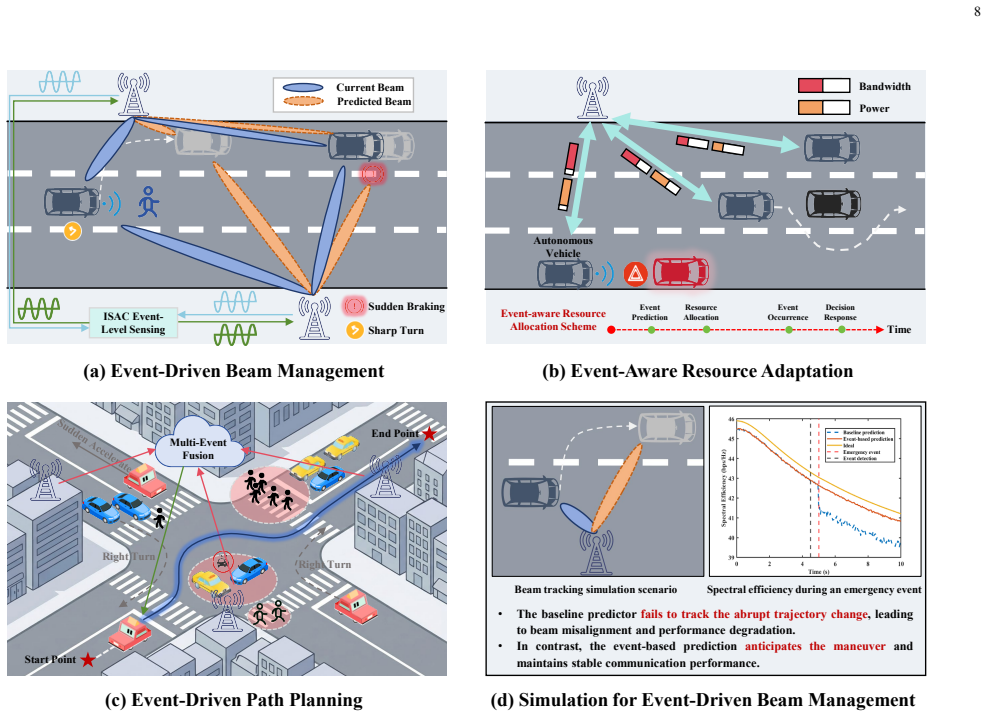
The intelligent evolution of mission-critical networks, such as the Internet of vehicles (IoV) and the low-altitude economy (LAE), requires sixth-generation (6G) networks to move beyond discrete physical parameter estimation toward deeper environmental understanding. However, existing integrated sensing and communications (ISAC) studies mainly focus on target-level sensing, which provides fragmented snapshots of the physical world and lacks the behavioral semantic capability to interpret intent. This limitation hinders the intelligent evolution of such networks and prevents 6G from acquiring the essential sensing foundation to evolve into an "intelligent service engine". To bridge this gap, ISAC must advance toward event-level sensing, which models continuous-time states to enable persistent recognition and prediction of target intent and behavioral semantics. This article presents a comprehensive overview of event-level sensing in 6G ISAC networks. We first introduce its fundamental concepts, sensing types, and representative scenarios. We then review key enabling techniques across waveform design, target state estimation and tracking, and event recognition. Furthermore, focusing on IoV and LAE scenarios, we discuss representative applications of ISAC event-level sensing and the intelligent enhancement of downstream operational functions enabled by event-level information. Finally, we highlight future research trends and potential directions to further advance ISAC event-level sensing toward intelligent and proactive 6G networks.
Figures


Forward citations
Cited by 1 Pith paper
-
GDPR-Aware Trajectory Sharing for ISAC-Assisted Robot Navigation: A Case Study on FID-Constrained Collision Prediction
FID-controlled trajectory perturbation yields lower reconstruction leakage and shorter continuous exposure than fixed-error noise at matched missed-conflict rates on real pedestrian traces.
Reference graph
Works this paper leans on
-
[1]
Tensor decom- positions for integrated sensing and communications,
J. Du, M. Han, Y . Chen, L. Jin, H. Wu, and F. Gao, “Tensor decom- positions for integrated sensing and communications,” IEEE Commun. Mag., vol. 62, no. 9, pp. 128–134, Sep. 2024
2024
-
[2]
Integrated sensing and communications framework for 6G networks,
H. Luo, T. Zhang, C. Zhao, Y . Wang, B. Lin, Y . Jiang, D. Luo, and F. Gao, “Integrated sensing and communications framework for 6G networks,” IEEE Wireless Commun., vol. 32, no. 6, pp. 102–109, Dec. 2025
2025
-
[3]
Beyond target-level: ISAC-enabled event-level sensing for behavioral intention prediction,
H. Liu, Z. Wei, Y . Du, J. Wei, X. Li, and Z. Feng, “Beyond target-level: ISAC-enabled event-level sensing for behavioral intention prediction,” IEEE Wireless Commun. Lett., vol. 15, pp. 1971–1975, Jan. 2026
1971
-
[4]
6G networks integrated with AI: Endogenous intelligence, capability exposure, digital twin,
DT Mobile, CICT Mobile, ZGC-XNET and State Key Laboratory of Wireless Mobile Communications, “6G networks integrated with AI: Endogenous intelligence, capability exposure, digital twin,” CICT Mobile Communication Technology Co., Ltd., Tech. Rep., Mar. 2026. [Online]. Available: https://www.cictmobile.com/data/download/7097. html
2026
-
[5]
Sensing with communication signals: From information theory to signal processing,
F. Liu, Y .-F. Liu, Y . Cui, C. Masouros, J. Xu, T. Xiao Han, S. Buzzi, Y . C. Eldar, and S. Jin, “Sensing with communication signals: From information theory to signal processing,” IEEE J. Sel. Areas Commun., vol. 44, pp. 1–30, Feb. 2026
2026
-
[6]
Optimizing 6G integrated sensing and communications via expert networks,
J. Wang, H. Du, G. Sun, J. Kang, H. Zhou, D. Niyato, and J. Chen, “Optimizing 6G integrated sensing and communications via expert networks,” IEEE Wireless Commun., vol. 32, no. 5, pp. 142–150, Oct. 2025
2025
-
[7]
Joint beamforming optimization for active STAR-RIS-assisted ISAC systems,
S. Zhang, W. Hao, G. Sun, C. Huang, Z. Zhu, X. Li, and C. Yuen, “Joint beamforming optimization for active STAR-RIS-assisted ISAC systems,” IEEE Trans. Wireless Commun., vol. 23, no. 11, pp. 15 888– 15 902, Nov. 2024
2024
-
[8]
AirGuard: UA V and bird recognition scheme for integrated sensing and communications system,
H. Luo, Z. Chu, T. Zhang, C. Zhao, B. Lin, and F. Gao, “AirGuard: UA V and bird recognition scheme for integrated sensing and communications system,” IEEE J. Sel. Areas Commun., vol. 44, pp. 835–848, Feb. 2026
2026
-
[9]
Behavioral intention prediction in driving scenes: A survey,
J. Fang, F. Wang, J. Xue, and T.-S. Chua, “Behavioral intention prediction in driving scenes: A survey,”IEEE Trans. Intell. Transp. Syst., vol. 25, no. 8, pp. 8334–8355, Aug. 2024
2024
-
[10]
Deep cooperation in ISAC system: Resource, node and infrastructure perspectives,
Z. Wei, H. Liu, Z. Feng, H. Wu, F. Liu, Q. Zhang, and Y . Du, “Deep cooperation in ISAC system: Resource, node and infrastructure perspectives,” IEEE Internet Things Mag., vol. 7, no. 6, pp. 118–125, Nov. 2024
2024
-
[11]
ISAC- empowered LEO constellation networked sensing: Challenges and opportunities,
Z. Wei, H. Liu, Y . Geng, Z. Feng, G. Gui, and K. Zheng, “ISAC- empowered LEO constellation networked sensing: Challenges and opportunities,” IEEE Wireless Commun., 2026, early Access, doi: 10.1109/MWC.2026.3654488
-
[12]
Low-altitude wireless networks: A comprehensive survey,
J. Wu, Y . Yang, W. Yuan et al., “Low-altitude wireless networks: A comprehensive survey,” arXiv preprint, 2025
2025
-
[13]
Low complexity waveform PAPR reduction in uplink ISAC system,
Y . Niu, Z. Wei, Y . Long, L. Sun, and Z. Feng, “Low complexity waveform PAPR reduction in uplink ISAC system,” IEEE Wireless Commun. Lett., vol. 15, pp. 1010–1014, Dec. 2025
2025
-
[14]
Physical channels and modulation,
3GPP, “Physical channels and modulation,” 3rd Generation Partnership Project (3GPP), Technical Report 3GPP TR 38.211 V18.7.0, Jul. 2025. [Online]. Available: https://www.3gpp.org/ftp/Specs/archive/38 series/ 38.211/38211-i70.zip
2025
-
[15]
Integrated sensing, communication and control enabled agile UA V swarm,
Z. Wei, Y . Du, Z. Feng, H. Liu, Y . Cui, T. Zhang, Y . Zhou, and H. Wu, “Integrated sensing, communication and control enabled agile UA V swarm,” IEEE Internet Things Mag., 2026, early Access, doi: 10.1109/MIOT.2025.3647932
discussion (0)
Sign in with ORCID, Apple, or X to comment. Anyone can read and Pith papers without signing in.