REVIEW 3 major objections 5 minor 3 cited by
GWTC-5.0 chirp-mass peaks form a hierarchical ladder with a new 19 solar-mass rung, unifying two spin transitions under one generation-scaling rule.
Reviewed by Pith at T0; open to challenge. T0 means a machine referee read the full paper against a public rubric. the ladder, T0–T4 →
T0 review · grok-4.5
2026-07-14 17:46 UTC pith:VDAW23OE
load-bearing objection New 19 M☉ peak and a clean unification of two spin-transition claims, but the ladder scale is still tuned to the same peaks it is said to predict. the 3 major comments →
The Chirp-Mass Ladder: A New Rung Emerges
The pith
A machine-rendered reading of the paper's core claim, the machinery that carries it, and where it could break.
Core claim
The chirp-mass distribution of binary black holes exhibits regularly spaced peaks whose locations match the expected chirp masses of successive intra- and intergenerational hierarchical mergers; an intermediate peak near 19 solar masses, anticipated earlier as the 2G+3G rung, has now emerged, and the same fixed generation ladder unifies two previously separate 1G+2G spin-transition groups as the 1G+2G and 3G+4G rungs.
What carries the argument
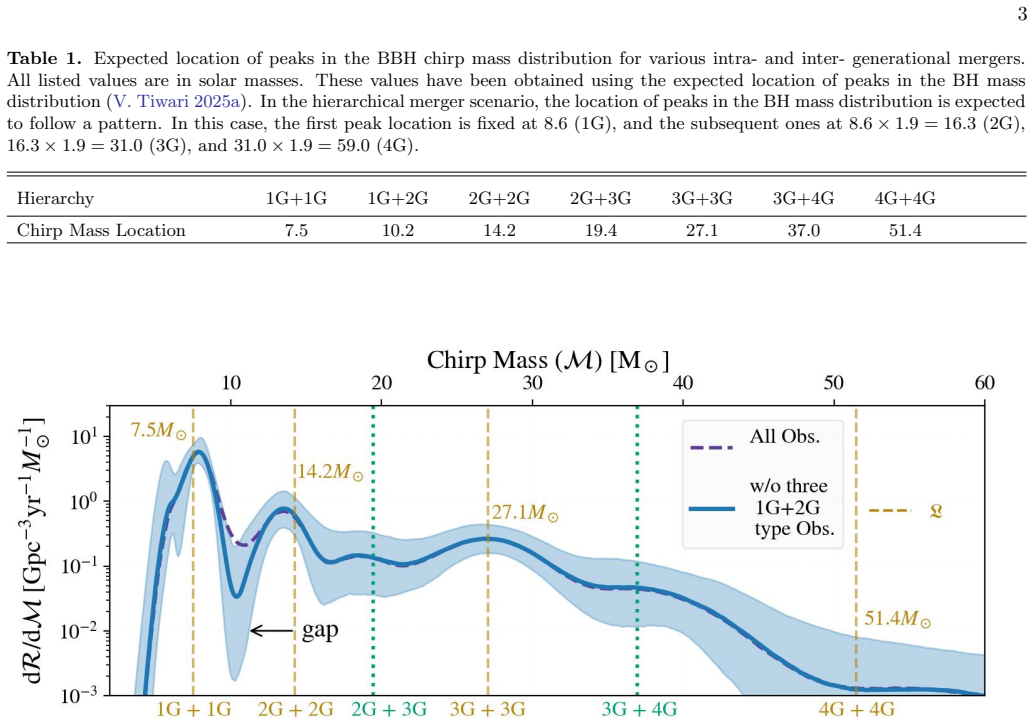
The hierarchical chirp-mass ladder: a fixed first-generation mass scale of 8.6 solar masses scaled by successive factors of 1.9 (accounting for gravitational-wave mass loss), which predicts both the intra-generational peaks (7.5, 14.2, 27.1, 51.4 solar masses) and the intergenerational peaks (10.2, 19.4, 37.0 solar masses) listed in Table 1.
Load-bearing premise
The entire ladder rests on fixing the first-generation black-hole mass at 8.6 solar masses (and the exact scale factor 1.9) so that the predicted peak locations best overlap the observed chirp-mass features; if that starting scale is not astrophysically preferred, the alignment collapses.
What would settle it
A larger future catalogue in which the intermediate 19 solar-mass feature disappears or the higher peaks deviate systematically from the predicted 1.9 scaling, or high-spin systems that no longer cluster at the component-mass locations corresponding to the ladder rungs.
If this is right
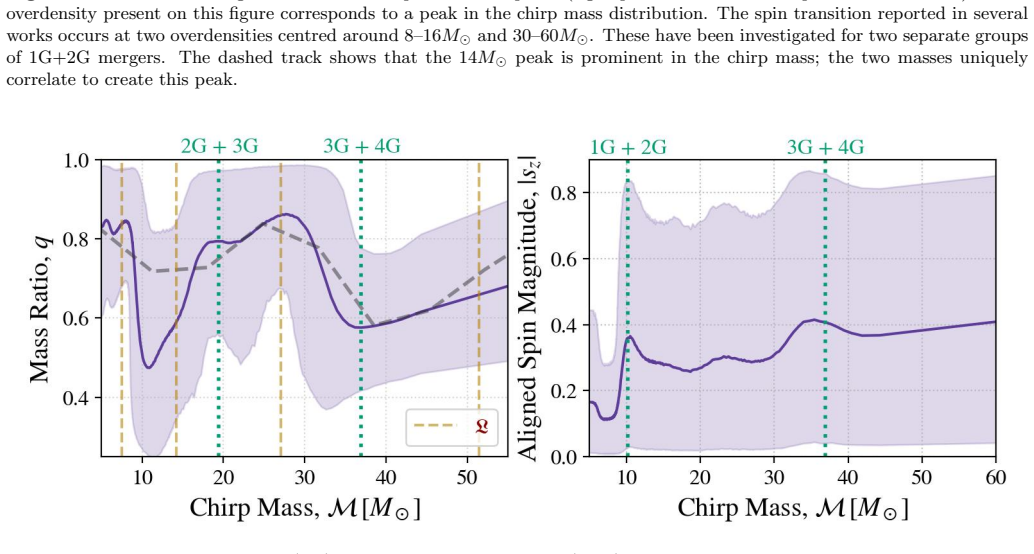
- Both reported spin transitions (near 10 and 37 solar masses) are described by one generation-spacing rule rather than two independent 1G+2G subpopulations.
- The same ladder predicts further intermediate and higher-mass rungs that can be tested as catalogues grow.
- Astrometric black-hole masses from forthcoming Gaia data can provide an independent, selection-free check of the first-generation scale.
- If hierarchical mergers dominate the mass structure, the chirp-mass peaks remain a more robust tracer of the underlying population than mass ratios or spins, which are more susceptible to measurement systematics.
Where Pith is reading between the lines
- The persistence of the ladder after three successive catalogue releases suggests the structure is unlikely to be a transient statistical fluctuation, raising the stakes for dynamical-assembly models that must reproduce the same fixed spacing.
- If mass-ratio and spin signatures remain washed out while chirp-mass peaks stay sharp, population inference may need to treat chirp mass as the primary observable and component masses as secondary, correlated quantities.
- The ladder supplies a ready-made mass scale that could be used as a standard-siren rung in cosmological applications once redshift evolution of the peaks is measured.
Editorial analysis
A structured set of objections, weighed in public.
Referee Report
Summary. The paper analyses the BBH chirp-mass distribution from GWTC-5.0 (~250 events) with the Vamana mixture model and reports robust peaks near 7.5, 14 and 27 M⊙ plus a weaker intermediate feature near 19 M⊙. These locations are compared with the chirp masses expected from successive intra- and inter-generational hierarchical mergers (Table 1), obtained by fixing a first-generation black-hole mass scale at 8.6 M⊙ and scaling subsequent generations by a factor 1.9. The same ladder is used to re-interpret two previously reported spin-transition groups (near primary masses ~10–20 M⊙ and ≥45 M⊙) as the 1G+2G and 3G+4G rungs of a single sequence. High-spin systems are shown to cluster near the same component-mass values, while the broader absence of the expected mass-ratio and spin signatures is attributed to limited measurability of those parameters relative to chirp mass.
Significance. If the regularly spaced peaks are astrophysical and the generational scale is independently preferred, the hierarchical-merger ladder would supply a single, predictive mechanism that unifies the mass spectrum and the two reported spin transitions, with clear falsifiable locations for future rungs and potential applications to stellar dynamics and cosmology. The work is grounded in a standard public catalogue and a documented mixture-model pipeline (Vamana), and it correctly emphasises that the intermediate 19 M⊙ feature was anticipated in earlier papers once the scale had been fixed. These are genuine strengths of presentation and continuity. The central claim, however, remains a post-hoc geometric re-description until the free scale is shown to be preferred by data independent of the peaks themselves.
major comments (3)
- Footnote 2 and Section 2 state that the sole free parameter (1G mass = 8.6 M⊙) “is chosen to maximise the overlap” between the locations listed in Table 1 and the peaks visible in Figures 1 and 3. Once that scale and the factor 1.9 are fixed, every subsequent rung (14.2, 19.4, 27.1, 37.0, 51.4 M⊙) is algebraically determined. The reported alignment is therefore largely by construction; the intermediate 19 M⊙ feature, described as weak and supported by only 13 events, cannot break the circularity. An independent determination of the 1G scale (or a formal model comparison against a non-hierarchical mixture free to place peaks anywhere) is required before the ladder can be presented as predictive rather than descriptive.
- Section 3 and Figure 1 present the 19 M⊙ feature as an “emerging peak” that “demonstrates the predictive value” of the scenario, yet the text itself characterises the confidence as weak. No Bayes factor, posterior odds, or even a simple significance estimate relative to a smooth or free-peak model is supplied. Without such a quantification the claim that a new rung has emerged remains visual and under-powered for a load-bearing prediction.
- Section 5 and Figure 5 invoke “limited measurability” of mass ratio and spins to explain why most events lack the hierarchical signatures expected from the same ladder that is claimed to shape the chirp-mass distribution. The argument is plausible but remains qualitative; no injection-recovery or systematic-bias study is shown that demonstrates how large a shift in q or χ is needed to erase the expected features while leaving the chirp-mass peaks intact. Until that demonstration is provided, the absence of mass-ratio/spin signatures continues to weaken the hierarchical interpretation.
minor comments (5)
- Table 1 caption and the surrounding text should state explicitly that the factor 1.9 already incorporates an approximate 5 % mass loss; the numerical origin of 1.9 is otherwise opaque.
- Figure 1: the blue curve (after exclusion of three high-spin events) is useful, but the caption should quantify how much the 10–12 M⊙ gap deepens or the 19 M⊙ feature changes after the cut.
- Section 4: the claim that the heavier spin transition is “naturally accommodated as a 3G+4G rung” would be clearer if the expected secondary-mass edge (~31 M⊙) and the observed decay near 45 M⊙ were over-plotted on Figure 2.
- Appendix A / Table 2: the modified proportionality of Gaussian scales with location is mentioned but not written as an equation; a short formula would aid reproducibility.
- A few typographical inconsistencies remain (e.g., “V aibhav”, spacing around M⊙ symbols, “inter– and intra-generation”).
Circularity Check
Ladder scale (1G mass 8.6 M⊙, factor 1.9) is chosen to maximise overlap with the same chirp-mass peaks later presented as matching the hierarchical predictions; intermediate 19 M⊙ rung is then arithmetic.
specific steps
-
fitted input called prediction
[Section 2 + Footnote 2 + Table 1]
"The only free parameter is the starting value. This is chosen to maximise the overlap between the location of inter– and intra-generation mergers in Table 1 and the location of peaks in Figure 3. … After fixing the location of the first generation, these values increase by a factor of 1.9 … Hierarchy 1G+1G 1G+2G 2G+2G 2G+3G 3G+3G 3G+4G 4G+4G Chirp Mass Location 7.5 10.2 14.2 19.4 27.1 37.0 51.4"
The single free parameter (1G mass = 8.6 M⊙) is explicitly tuned so that the arithmetic sequence of Table 1 coincides with the observed peaks. Once fixed, the remaining locations (including the 'predicted' 19.4 and 37.0) are forced by multiplication by 1.9 and the chirp-mass formula. Calling the subsequent alignment a match or prediction therefore recycles the fitted scale rather than testing an independent astrophysical quantity.
-
self citation load bearing
[Abstract + Section 1 + Section 3]
"Notably, with the addition of new observations, an intermediate peak near 19M⊙ emerges. This feature had been anticipated in earlier work as a consequence of intergenerational mergers involving second- and third-generation (G) black holes, thereby highlighting the predictive power of the hierarchical-merger interpretation. … (Section 4 in V. Tiwari (2022))"
The claim of predictive power for the 19 M⊙ feature rests on the author's own prior papers that already adopted the same hierarchical ladder and the same fitted 1G scale. Those citations are not independent external corroboration; they re-use the identical construction that is being re-applied to GWTC-5.0.
-
fitted input called prediction
[Section 4 + Figure 3]
"The first transition happens around a chirp mass of 10M⊙ and is consistent with 1G+2G mergers. … The second transition occurs around a chirp mass of 37M⊙. Within the hierarchical merger scenario … this group is naturally accommodated as a 3G+4G rung … the ladder describes both spin transitions with a single mechanism"
The two spin-transition locations (≈10 M⊙ and ≈37 M⊙) are exactly the 1G+2G and 3G+4G entries already fixed by the fitted scale in Table 1. Relabeling previously reported 1G+2G groups as successive rungs of that same ladder does not constitute an independent prediction; it is a re-description forced by the earlier fit.
full rationale
The paper's central claim is that observed chirp-mass peaks align with the hierarchical-merger locations of Table 1, and that an intermediate ~19 M⊙ feature (plus unification of two spin-transition groups) demonstrates predictive power. Footnote 2 and Section 2 state that the sole free parameter—the 1G mass scale—is fixed by maximising overlap between those Table 1 locations and the peaks visible in the data (Figures 1/3). Once that scale is set, every subsequent intra- and inter-generational chirp-mass value (14.2, 19.4, 27.1, 37.0, …) follows by multiplication by 1.9 and the chirp-mass formula; the reported alignment of the main peaks is therefore largely by construction. The only element that could break the circularity is the intermediate 19 M⊙ peak, which the paper itself describes as weak (13 events) and which was already anticipated in the author's prior work once the same scale had been fixed on earlier catalogs. Self-citations to Tiwari & Fairhurst (2021), Tiwari (2022, 2025a) supply the ladder framework and the anticipation claim; they are load-bearing for the 'predictive power' narrative. The result is partial circularity (score 6): the main rungs recycle a fitted scale, while the intermediate feature and spin-transition unification retain some independent content but do not fully escape the fit.
Axiom & Free-Parameter Ledger
free parameters (2)
- 1G black-hole mass scale =
8.6 M⊙
- generational mass-multiplication factor =
1.9
axioms (3)
- domain assumption Successive hierarchical mergers produce black-hole mass peaks that scale by a nearly constant factor ~1.9, generating both intra- and inter-generational chirp-mass peaks at the locations listed in Table 1.
- domain assumption The first peak at ~7.5 M⊙ is produced exclusively by first-generation stellar-remnant black holes.
- ad hoc to paper Limited measurability of mass ratio and spins (relative to chirp mass) can systematically shift component-mass and spin posteriors while leaving the chirp-mass distribution intact.
invented entities (1)
-
chirp-mass ladder (with discrete G-generation rungs)
no independent evidence
read the original abstract
The population of binary black holes (BBHs) observed through gravitational waves (GWs) now includes around 250 events with the release of GWTC-5.0, enabling more detailed studies. The inferred chirp-mass distribution shows prominent peaks at approximately $7.5M_{\odot}$, $14M_{\odot}$, and $27M_{\odot}$, with subsequent peaks spaced by approximately a factor of two. A parsimonious explanation for this structured distribution is a hierarchical merger scenario, in which the first peak arises from mergers of black holes of stellar origin, and higher-mass peaks arise from repeated mergers. Notably, with the addition of new observations, an intermediate peak near $19M_{\odot}$ emerges. This feature had been anticipated in earlier work as a consequence of intergenerational mergers involving second- and third-generation (G) black holes, thereby highlighting the predictive power of the hierarchical-merger interpretation. Furthermore, two groups of $1G+2G$ mergers recently reported in separate studies can be understood as distinct rungs -- $1G+2G$ and $3G+4G$ -- within this hierarchical chirp-mass ladder, a unification that describes both spin transitions with a single mechanism. Although expected correlations between mass ratios and spins are observed in multiple events across the mass range, the lack of clear signatures across all rungs invites investigation into the role of hierarchical mergers in shaping the BBH population.
Figures
Forward citations
Cited by 3 Pith papers
-
A Four-dimensional Model-agnostic Probe into the Astrophysical Origins of Binary Black Hole Subpopulations
A GPU-accelerated binned Gaussian process yields the first model-agnostic 4D BBH population in (m1, q, χeff, χp), revealing four mass-based subpopulations and new spin-mass-ratio correlations.
-
Uncovering Hierarchical Sub-Population of Binary Black Holes
A flexible six-component fit to 259 LIGO/Virgo/KAGRA black-hole mergers finds a roughly geometric sequence of mass peaks but no aligned-spin signal except in the lowest-mass component.
-
Joint population and strong-lensing inference for resolved gravitational-wave events probes the black-hole merger rate beyond the peak of star formation
Joint strong-lensing and population inference on resolved gravitational-wave events finds no lensed events and tightens constraints on the black-hole merger rate peak redshift and high-redshift tail.
Reference graph
Works this paper leans on
-
[1]
, " * write output.state after.block = add.period write newline
ENTRY address archivePrefix author booktitle chapter doi edition editor eprint howpublished institution journal key month number organization pages publisher school series title misctitle type volume year version url label extra.label sort.label short.list INTEGERS output.state before.all mid.sentence after.sentence after.block FUNCTION init.state.consts ...
-
[2]
write newline
" write newline "" before.all 'output.state := FUNCTION format.url url empty "" new.block "" url * "" * if FUNCTION format.eprint eprint empty "" archivePrefix empty "" archivePrefix "arXiv" = new.block " " eprint * " " * new.block " " eprint * " " * if if if FUNCTION format.doi doi empty "" " " doi * " " * if FUNCTION format.pid doi empty eprint empty ur...
-
[3]
,# (7),01444 '9=82<.342C 2! !22222222222222222222222222222222222222222222222222 w ?
thebibliography [1] 20pt to REFERENCES 6pt =0pt \@twocolumntrue 12pt -12pt 10pt plus 3pt =0pt =0pt =1pt plus 1pt =0pt =0pt -12pt =13pt plus 1pt =20pt =13pt plus 1pt \@M =10000 =-1.0em =0pt =0pt 0pt =0pt =1.0em @enumiv\@empty 10000 10000 `\.\@m \@noitemerr \@latex@warning Empty `thebibliography' environment \@ifnextchar \@reference \@latexerr Missing key o...
discussion (0)
Sign in with ORCID, Apple, or X to comment. Anyone can read and Pith papers without signing in.